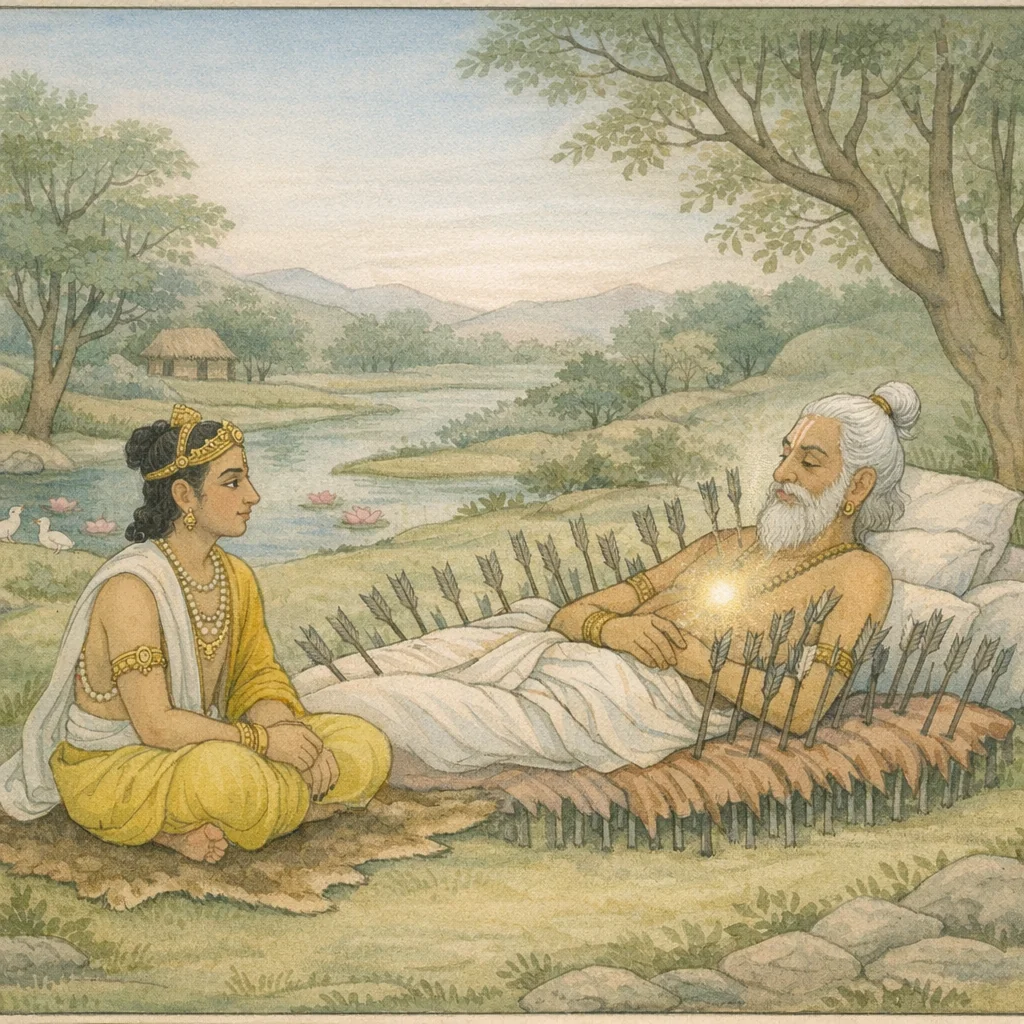
Adhyaya 302
Adhyāya 302: Guṇa-vicāra, Gati-bheda, and the Imperishable State (Yājñavalkya–Janaka)
Upa-parva: Mokṣa-dharma (Liberation Teachings) – Yājñavalkya–Janaka Dialogue Segment
Yājñavalkya outlines the three guṇas as persistent constituents of primordial nature (pradhāna) and describes their permutations and mixtures as explanatory tools for differentiated embodied experience. He classifies destinations (gati) correlated with guṇa-compositions: a predominance of sattva is associated with higher states, rajas with intermediate human conditions, and tamas with lower conditions; mixed configurations yield specific rebirth outcomes. He then introduces a distinct, stable locus described as beyond puṇya and pāpa—imperishable, unchanging, and fear-free—linked with the standpoint of knowledge. The discourse further characterizes an unmanifest (avyakta) principle and its relation to prakṛti, including claims about non-sentience and cosmic functions of creation and dissolution under governance. Janaka responds by problematizing how two beginningless, formless, and graspless realities can be differentiated as sentient vs. non-sentient, and requests a comprehensive account of mokṣa-dharma: existence and non-existence categories, the departing embodied being’s ‘exit locus,’ the post-mortem attainment over time, and a clarified distinction between Sāṃkhya knowledge and Yoga practice, along with associated signs (ariṣṭa).
Chapter Arc: युधिष्ठिर (धर्मराज) पितामह से ‘अक्षर’ उस परम तत्त्व का स्वरूप पूछते हैं जिसे पाकर जीव लौटकर संसार में नहीं आता, और ‘क्षर’ उस परिवर्तनशील पदार्थ का भेद भी जानना चाहते हैं। → प्रश्न गहराता है—क्षर-अक्षर का स्पष्ट विवेचन, इन्द्रियों-मन की उत्पत्ति, और यह कि जीव गुणों के अनुसार किन-किन लोकों/योनियों में गिरता-उठता है; ज्ञान की कसौटी पर ‘मैं कौन’ और ‘यह जगत क्या’ का द्वंद्व तीव्र होता जाता है। → अक्षर का निर्णायक संकेत दिया जाता है—वही एक आत्मवान् हृदय में सर्व मूर्तियों में स्थित, अद्वितीय, चेतन, नित्य, सर्वस्वरूप होते हुए भी अमूर्त; सृष्टि-प्रलय प्रकृति के धर्म हैं, पुरुष उनसे असंग रहते हुए भी ‘गोचर’ में गुण-संज्ञा से जाना जाता है। → क्षर को प्रकृति-जन्य, अव्यक्त-विषय (प्रकृति के क्षेत्र में आने वाला) कहा जाता है; गुण-त्रय के अनुसार गति बताई जाती है—तामस नरक, राजस मनुष्यलोक, सात्त्विक देवलोक; कर्म-समुच्चय से तिर्यग, मनुष्य, देवत्व की प्राप्ति का क्रम स्पष्ट होता है। → क्षर-अक्षर के भेद को जानकर साधक किस उपाय से ‘अक्षर’ में प्रतिष्ठित हो—यह प्रश्न अगले विवेचन की ओर संकेत करता है।
Shlokas
Verse 1
युधिष्ठिरने पूछा--पितामह! वह अक्षर तत्त्व कया है, जिसे प्राप्त कर लेनेपर जीव फिर इस संसारमें नहीं लौटता तथा वह क्षर पदार्थ क्या है, जिसको जानने या पा लेनेपर भी पुनः इस संसारमें लौटना पड़ता है?
Yudhishthira said: “Grandfather, what is that imperishable Reality which, once attained, a living being does not return again to this world? And what is that perishable principle which, even when known or attained, still leads one to return again to worldly existence?”
Verse 2
अक्षरक्षरयोर्व्यक्ति पृच्छाम्यरिनिषूदन । उपलब्धं महाबाहो तत्त्वेन कुरुनन्दन,शत्रुसूदन! महाबाहु! कुरुनन्दन! क्षर और अक्षरके स्वरूपको स्पष्टरूपसे समझनेके लिये ही मैंने आपसे यह प्रश्न किया है
Yudhishthira said: “O slayer of foes, I ask you to make clear the distinction between the imperishable and the perishable. O mighty-armed delight of the Kurus, I have asked this so that the truth may be grasped as it really is.”
Verse 3
त्वं हि ज्ञाननिधिरवविप्रैरुच्यसे वेदपारगै: । ऋषिभिश्न महाभागैर्यतिभिश्न महात्मभि:,वेदोंके पारंगत विद्वान् ब्राह्मण, महाभाग महर्षि तथा महात्मा यति भी आपको ज्ञाननिधि कहते हैं
Yudhishthira said: “Indeed, you are called a very treasury of knowledge by learned brāhmaṇas who have crossed to the far shore of the Vedas, and likewise by fortunate sages and great-souled ascetics. Your wisdom is acknowledged by those most qualified to judge it.”
Verse 4
शेषमल्पं दिनानां ते दक्षिणायनभास्करे । आवूृते भगवत्यके गन्तासि परमां गतिम्,अब सूर्यके दक्षिणायनमें रहनेके थोड़े ही दिन शेष हैं। भगवान् सूर्यके उत्तरायणमें पदार्पण करते ही आप परमधामको पधारेंगे
Yudhiṣṭhira said: “Only a few days remain for you while the Sun is in its southern course. When the revered Sun turns to the northern course, you will depart to the highest state.”
Verse 5
त्वयि प्रतिगते श्रेय: कुत: श्रोष्यामहे वयम् । कुरुवंशप्रदीपस्त्व॑ ज्ञानदीपेन दीप्यसे,आपके चले जानेपर हमलोग अपने कल्याणकी बातें किससे सुनेंगे? आप कुरुवंशको प्रकाशित करनेवाले प्रदीप हैं और ज्ञानदीपसे उद्भासित हो रहे हैं
Yudhiṣṭhira said: “When you have departed, from whom shall we hear what leads to our highest good? You are the lamp that illumines the Kuru lineage, and you shine with the lamp of true knowledge.”
Verse 6
तदेतच्छोतुमिच्छामि त्वत्त: कुरुकुलोद्वह | न तृप्यामीह राजेन्द्र शृण्वन्नमृतमीदृूशम्,अतः कुरुकुलधुरन्धर! राजेन्द्र! मैं आपहीके मुँहसे यह सब सुनना चाहता हूँ। आपके इन अमृतमय वचनोंको सुनकर मुझे तृप्ति नहीं होती है (अतएव आप मुझे यह क्षर- अक्षरका विषय बताइये।)
Therefore, O upholder of the Kuru house, O king of kings, I wish to hear all this from your own lips. Listening to your nectar-like words, I am never satisfied.
Verse 7
भीष्म उवाच अन्न ते वर्तयिष्यामि इतिहासं पुरातनम् । वसिष्ठस्थ च संवादं करालजनकस्य च,भीष्मजीने कहा--युधिष्ठिर!! इस विषयमें कराल नामक जनक और वसिष्ठका जो संवाद हुआ था, वही प्राचीन इतिहास मैं तुम्हें बतलाऊँगा
Bhishma said: “Yudhiṣṭhira, I shall recount to you an ancient tradition—the dialogue between Vasiṣṭha and Janaka known as Karāla. This old account I will narrate to illuminate the matter at hand.”
Verse 8
वसिष्ठ श्रेष्ठमासीनमृषीणां भास्करद्युतिम् । पप्रच्छ जनको राजा ज्ञानं नैःश्रेयसं परम्,एक समयकी बात है, ऋषियोंमें सूर्यके समान तेजस्वी मुनिश्रेष्ठ वसिष्ठ अपने आश्रमपर विराजमान थे। वहाँ राजा जनकने पहुँचकर उनसे परम कल्याणकारी ज्ञानके विषयमें पूछा
Once, Vasiṣṭha—the foremost of sages, radiant among the ṛṣis like the Sun—was seated in his hermitage. There King Janaka came and questioned him about the supreme knowledge that brings the highest good.
Verse 9
परमध्यात्मकुशलम ध्यात्मगतिनिश्चयम् । मैत्रावरुणिमासीनमभिवाद्य कृताउ्जलि:,मित्रावरुणके पुत्र वसिष्ठजी अध्यात्मविषयक प्रवचनमें अत्यन्त कुशल थे और उन्हें अध्यात्मज्ञानका निश्चय हो गया था। वे एक आसनपर विराजमान थे। पूर्वकालमें कराल नामक राजा जनकने उन मुनिवरके पास जा हाथ जोड़कर प्रणाम किया और सुन्दर अक्षरोंसे युक्त विनयपूर्ण तथा कुतर्करहित मधुर वाणीमें इस प्रकार पूछा--
Bhishma said: Vasiṣṭha, the son of Mitra and Varuṇa, was supremely skilled in the knowledge of the Self and firmly established in certainty about the soul’s highest course. Seated upon his seat, he was approached in former times by King Janaka (called Karāla), who bowed with joined palms and, in a gentle, respectful voice—free from captious argument—asked him as follows.
Verse 10
स्वक्षरं प्रश्मितं वाक््यं मधुरं चाप्यनुल्बणम् | पप्रच्छर्षिवरं राजा करालजनक: पुरा,मित्रावरुणके पुत्र वसिष्ठजी अध्यात्मविषयक प्रवचनमें अत्यन्त कुशल थे और उन्हें अध्यात्मज्ञानका निश्चय हो गया था। वे एक आसनपर विराजमान थे। पूर्वकालमें कराल नामक राजा जनकने उन मुनिवरके पास जा हाथ जोड़कर प्रणाम किया और सुन्दर अक्षरोंसे युक्त विनयपूर्ण तथा कुतर्करहित मधुर वाणीमें इस प्रकार पूछा--
Bhishma said: Long ago, King Janaka—known as Karāla—approached an excellent sage and, with folded hands, asked his question in words that were well-formed, gently smiling in tone, sweet, humble, and free from harshness or contentious reasoning. The scene frames an ethical ideal: spiritual inquiry should be conducted with courtesy, clarity, and restraint, honoring the teacher and the subject of self-knowledge.
Verse 11
भगवन् श्रोतुमिच्छामि परं ब्रह्म सनातनम् । यस्मान्न पुनरावृत्तिमाप्रुवन्ति मनीषिण:,“भगवन्! जहाँसे मनीषी पुरुष पुनः इस संसारमें लौटकर नहीं आते हैं, उस सनातन परब्रह्मके स्वरूपका मैं वर्णन सुनना चाहता हूँ
Bhishma said: “O venerable one, I wish to hear about the supreme, eternal Brahman—That from which the wise do not return again to worldly existence.”
Verse 12
यच्च तत् क्षरमित्युक्तं यत्रेदं क्षरते जगत् | यच्चाक्षरमिति प्रोक्तं शिवं क्षेम्यममनामयम्,“तथा जिसे क्षर कहा गया है, उसे भी जानना चाहता हूँ। जिसमें इस जगत्का क्षरण (लय) होता है और जिसे अक्षर कहा गया है, उस निर्विकार कल्याणमय शिवस्वरूप अधिष्ठानका भी ज्ञान प्राप्त करना चाहता हूँ
Bhīṣma said: “I wish to understand that which is called the perishable—wherein this entire world undergoes decay and dissolution. And I also seek knowledge of that which is declared imperishable: the unchanging, auspicious foundation, the source of welfare, free from all affliction.”
Verse 13
वसिष्ठ उवाच श्रूयतां पृथिवीपाल क्षरतीदं यथा जगत् | यन्न क्षरति पूर्वेण यावत्कालेन वाप्यथ,वसिष्ठदजीने कहा--भूपाल! जिस प्रकार इस जगतका क्षय (परिवर्तन) होता है, उसको तथा जो किसी भी कालमें क्षरित (नष्ट) नहीं होता, उस अक्षरको भी बता रहा हूँ, सुनो
Vasiṣṭha said: “Listen, O protector of the earth. I shall explain how this world undergoes decay and change. And I shall also speak of that which does not perish—unchanged by what came before, and unconsumed by time itself.”
Verse 14
युगं द्वादशसाहस्र॑ कल्पं विद्धि चतुर्युगम् दशकल्पशतावृत्तमहस्तद् ब्राह्ममुच्यते,देवताओंके बारह हजार वर्षोका एक चतुर्युग होता है। इसीको कल्प अर्थात् महायुग समझो। ऐसे एक हजार महायुगोंका ब्रह्माजीका एक दिन बताया जाता है
Vasiṣṭha said: “Know that a cycle of twelve thousand (divine) years constitutes the fourfold yuga-cycle; this is to be understood as a kalpa, a great age. And a day of Brahmā is declared to be the completion of a thousand such great ages.”
Verse 15
रात्रिश्वनैतावती राजन् यस्यान्ते प्रतिबुद्धयते । सृजत्यनन्तकर्माणं महान्तं भूतमग्रजम्,राजन! उनकी रात्रि भी इतनी ही बड़ी होती है; जिसके अन्तमें वे जागते हैं। अनन्तकर्मा ब्रह्माजी सबके अग्रज और महान् भूत हैं। यह सम्पूर्ण विश्व उन्हींका स्वरूप है। जो अणिमा, लघिमा और प्राप्ति आदि सिद्धियोंपर शासन करनेवाले हैं, वे कल्याणस्वरूप निराकार परमेश्वर ही उन मूर्तिमान् ब्रह्माकी सृष्टि करते हैं। परमात्मा ज्योतिःस्वरूप स्वयं प्रकट और अविनाशी हैं। उनके हाथ, पैर, नेत्र, मस्तक और मुख सब ओर हैं। कान भी सब ओर हैं। वे संसारमें सबको व्याप्त करके स्थित हैं
Vasiṣṭha said: “O King, his ‘night’ too is of just this vast measure; at its end he awakens. Then that great First-born Being—Brahmā, of endless activity—sets creation in motion.”
Verse 16
मूर्तिमन्तममूर्तात्मा विश्व शम्भु: स्वयम्भुव: । अणिमा लघिमा प्राप्तिरीशानं ज्योतिरव्ययम्,राजन! उनकी रात्रि भी इतनी ही बड़ी होती है; जिसके अन्तमें वे जागते हैं। अनन्तकर्मा ब्रह्माजी सबके अग्रज और महान् भूत हैं। यह सम्पूर्ण विश्व उन्हींका स्वरूप है। जो अणिमा, लघिमा और प्राप्ति आदि सिद्धियोंपर शासन करनेवाले हैं, वे कल्याणस्वरूप निराकार परमेश्वर ही उन मूर्तिमान् ब्रह्माकी सृष्टि करते हैं। परमात्मा ज्योतिःस्वरूप स्वयं प्रकट और अविनाशी हैं। उनके हाथ, पैर, नेत्र, मस्तक और मुख सब ओर हैं। कान भी सब ओर हैं। वे संसारमें सबको व्याप्त करके स्थित हैं
Vasiṣṭha said: “The Self that is itself formless brings forth the One who is endowed with form—the all-pervading Śambhu, the Self-born. He is the Lord who governs the powers such as minuteness (aṇimā), lightness (laghimā), and unobstructed reach (prāpti); he is imperishable Light.”
Verse 17
सर्वतः पाणिपादं तत् सर्वतो$क्षिशिरोमुखम् । सर्वतःश्रुतिमल्लोके सर्वमावृत्य तिष्ठतति,राजन! उनकी रात्रि भी इतनी ही बड़ी होती है; जिसके अन्तमें वे जागते हैं। अनन्तकर्मा ब्रह्माजी सबके अग्रज और महान् भूत हैं। यह सम्पूर्ण विश्व उन्हींका स्वरूप है। जो अणिमा, लघिमा और प्राप्ति आदि सिद्धियोंपर शासन करनेवाले हैं, वे कल्याणस्वरूप निराकार परमेश्वर ही उन मूर्तिमान् ब्रह्माकी सृष्टि करते हैं। परमात्मा ज्योतिःस्वरूप स्वयं प्रकट और अविनाशी हैं। उनके हाथ, पैर, नेत्र, मस्तक और मुख सब ओर हैं। कान भी सब ओर हैं। वे संसारमें सबको व्याप्त करके स्थित हैं
Vasiṣṭha said: “That Supreme Reality has hands and feet on every side; eyes, heads, and faces on every side; and hearing on every side in the world. Enveloping all, it abides—pervading everything.”
Verse 18
हिरण्यगर्भो भगवानेष बुद्धिरिति स्मृत: । महानिति च योगेषु विरिज्चिरिति चाप्यज:,परमेश्वरसे उत्पन्न जो सबके अग्रज भगवान् हिरण्यगर्भ हैं, ये ही बुद्धि कहे गये हैं। योगशास्त्रमें ये ही महान् कहे गये हैं। इन्हींको विरिज्चि तथा अज भी कहते हैं
Vasiṣṭha said: “The Blessed Lord who is the first-born of all—Hiraṇyagarbha—is remembered as ‘Buddhi’ (cosmic intelligence). In the disciplines of Yoga he is also called ‘Mahān’ (the Great Principle). He is likewise known as ‘Viriñci’ and also as ‘Aja’ (the Unborn).”
Verse 19
सांख्ये च पल्यते शास्त्रे नामभिरबहुधात्मक: । विचित्ररूपो विश्वात्मा एकाक्षर इति स्मृत:,अनेक नाम और रुपोंसे युक्त इन हिरण्यगर्भ ब्रह्माका सांख्यशास्त्रमें भी वर्णन आता है। ये विचित्र रूपधारी, विश्वात्मा और एकाक्षर कहे गये हैं। इस अनेक रूपोंवाली त्रिलोकीकी रचना उन्होंने ही की है और स्वयं ही इसे व्याप्त कर रक्खा है। इस प्रकार बहुत-से रूप धारण करनेके कारण वे विश्वरूप माने गये हैं
Vasiṣṭha said: “In the Sāṅkhya teaching as well, that Reality is described as having many aspects and being known by many names. It is remembered as the One of wondrous forms, the Soul of the universe, and the ‘Single Imperishable Syllable.’ Though appearing in countless names and forms, it is the single all-pervading principle that both brings forth the threefold world and pervades it; therefore it is understood as the cosmic, all-formed Being.”
Verse 20
वृतं नैकात्मकं येन कृतं त्रैलोक्यमात्मना । तथैव बहुरूपत्वाद् विश्वरूप इति स्मृत:,अनेक नाम और रुपोंसे युक्त इन हिरण्यगर्भ ब्रह्माका सांख्यशास्त्रमें भी वर्णन आता है। ये विचित्र रूपधारी, विश्वात्मा और एकाक्षर कहे गये हैं। इस अनेक रूपोंवाली त्रिलोकीकी रचना उन्होंने ही की है और स्वयं ही इसे व्याप्त कर रक्खा है। इस प्रकार बहुत-से रूप धारण करनेके कारण वे विश्वरूप माने गये हैं
Vasiṣṭha said: He by whom the three worlds were fashioned through his own Self is not confined to a single form. Because he manifests in many forms, he is remembered as “Viśvarūpa,” the All-Form. Thus the cosmos is both created and pervaded by that one reality, who appears as manifold without losing his inner unity.
Verse 21
एष वै विक्रियापन्न: सृजत्यात्मानमात्मना । अहड्कारं महातेजा: प्रजापतिमहंकृतम्,ये महातेजस्वी भगवान् हिरण्यगर्भ विकारको प्राप्त हो स्वयं ही अहंकारकी और उसके अभिमानी प्रजापति विराट्की सृष्टि करते हैं
Vasiṣṭha said: “When the Supreme enters into manifestation, He brings forth the cosmos from Himself by His own power. That great, radiant One first projects ‘I’-sense (ahaṅkāra), and along with it the presiding creator (Prajāpati), who is characterized by that self-assertion—thus the manifested order begins.”
Verse 22
अव्यक्ताद् व्यक्तमापन्नं विद्यासर्ग वदन्ति तम् । महान्तं चाप्यहड़कारमविद्यासर्गमेव च,इनमें निराकारसे साकार रूपमें प्रकट होनेवाली मूल प्रकृतिको तो विद्यासर्ग कहते हैं और महत्तत्त्व एवं अहंकारको अविद्यासर्ग कहते हैं
Vasiṣṭha said: “That manifestation which proceeds from the Unmanifest into the manifest is called the ‘creation of knowledge’ (vidyā-sarga). But the emergence of Mahat (the great principle) and of Ahaṅkāra (the ego-principle) is indeed called the ‘creation of ignorance’ (avidyā-sarga).”
Verse 23
अविधिश्व विधिश्वैव समुत्पन्नौ तथैकतः । विद्याविद्येति विख्याते श्रूतिशास्त्रार्थचिन्तकै:,अविधि (ज्ञान) और विधि (कर्म) की उत्पत्ति भी उस परमात्मासे ही हुई है। श्रुति तथा शास्त्रके अर्थका विचार करनेवाले विद्वानोंने उन्हें विद्या और अविद्या बतलाया है
Vasiṣṭha said: Both non-prescribed action (or mere knowing without right application) and prescribed action alike arise from the same single source. Those learned persons who reflect on the meanings of the Veda and the śāstras describe these two as ‘knowledge’ (vidyā) and ‘ignorance’ (avidyā).
Verse 24
भूतसर्गमहड्कारात् तृतीयं विद्धि पार्थिव । अहड्कारेषु सर्वेषु चतुर्थ विद्धि वैकृतम्,पृथ्वीनाथ! अहंकारसे जो सूक्ष्म भूतोंकी सृष्टि होती है उसे तीसरा सर्ग समझो। सात्विक, राजस और तामस भेदसे तीन प्रकारके अहंकारोंसे जो चौथी सृष्टि उत्पन्न होती है, उसे वैकृत-सर्ग समझो
Vasiṣṭha said: “O king, know that the third stage of creation arises from ahaṅkāra (the principle of ‘I’-ness): from it proceeds the emanation of the subtle elements. And know that the fourth creation is called the ‘vaikṛta’ creation: it is the differentiated production that emerges from all forms of ahaṅkāra—sāttvika, rājasa, and tāmasa.”
Verse 25
महर्षि वसिष्ठका राजा कराल जनकको उपदेश वायुज्योतिरथाकाशमापो5थ पृथिवी तथा । शब्द: स्पर्शक्षु रूपं च रसो गन्धस्तथैव च,आकाश, वायु, तेज, जल और पृथ्वी--ये पाँच महाभूत तथा शब्द, स्पर्श, रूप, रस और गन्ध--ये पाँच विषय वैकृत-सर्गके अन्तर्गत हैं
Vasiṣṭha said: “Air, fire, and space, then water and likewise earth—these are the five great elements. Sound, touch, form, taste, and smell—these five sense-objects arise within the created order (the evolved creation).” In this instruction, the sage frames the world of experience as a structured manifestation, guiding the listener toward discernment: ethical steadiness and inner freedom begin by understanding that sensory objects and elemental constituents are products of nature and not the Self.
Verse 26
एवं युगपदुत्पन्न॑ं दशवर्गमसंशयम् । पज्चमं विद्धि राजेन्द्र भौतिकं सर्गमर्थवत्,इन दसोंकी उत्पत्ति एक ही साथ होती है, इसमें संशय नहीं है। राजेन्द्र! पाँचवाँ भौतिक सर्ग समझो। जो प्राणियोंके लिये विशेष प्रयोजनीय होनेके कारण सार्थक है
Vasiṣṭha said: “These ten classes arise simultaneously—of this there is no doubt. O best of kings, understand the fifth to be the ‘material’ creation, meaningful and practically significant, because it is especially useful for embodied beings.”
Verse 27
श्रोत्रं त्वक् चक्षुषी जिह्ला प्राणमेव च पठचमम् | वाक् च हस्तौ च पादौ च पायुर्मेढ्रंतथैव च,इस भौतिक सर्गके अन्तर्गत आँख, कान, नाक, त्वचा और जिह्ला--ये पाँच ज्ञानेन्द्रियाँ तथा वाणी, हाथ, पैर, गुदा और लिंग--ये पाँच कर्मन्द्रियाँ हैं। पृथ्वीनाथ! मनसहित इन सबकी उत्पत्ति भी एक ही साथ होती है
Vasiṣṭha said: “Hearing, touch, sight, taste, and the vital breath as the fifth—these are the five faculties of knowledge. Speech, the hands, the feet, the anus, and the generative organ—these are the five faculties of action. O lord of the earth, the arising of all these, together with the mind, occurs simultaneously within this material creation.”
Verse 28
बुद्धीन्द्रियाणि चैतानि तथा कर्मेन्द्रियाणि च । सम्भूतानीह युगपन्मनसा सह पार्थिव,इस भौतिक सर्गके अन्तर्गत आँख, कान, नाक, त्वचा और जिह्ला--ये पाँच ज्ञानेन्द्रियाँ तथा वाणी, हाथ, पैर, गुदा और लिंग--ये पाँच कर्मन्द्रियाँ हैं। पृथ्वीनाथ! मनसहित इन सबकी उत्पत्ति भी एक ही साथ होती है
Vasiṣṭha said: “O lord of the earth, within this embodied, material creation, these faculties arise together: the organs of knowledge and likewise the organs of action. They come into being here simultaneously, along with the mind.”
Verse 29
एषा तत्त्वचतुर्विशा सर्वाकृतिषु वर्तते । यां ज्ञात्वा नाभिशोचन्ति ब्राह्मणास्तत्त्वदर्शिन:,ये चौबीस तत्त्व सम्पूर्ण प्राणियोंके शरीरोंमें मौजूद रहते हैं। तत्त्वदर्शी ब्राह्मण इनके यथार्थ स्वरूपको जानकर कभी शोक नहीं करते हैं
This set of twenty-four principles pervades all embodied forms. Knowing it as it truly is, the truth-seeing brahmins do not fall into grief—because they recognize the body and its changes as products of principles, while the knower is not diminished by what is merely formed and dissolved.
Verse 30
एतद् देहं समाख्यातं॑ त्रैलोक्ये सर्वदेहिषु । वेदितव्यं नरश्रेष्ठ सदेवनरदानवे,नरश्रेष्ठ! तीनों लोकोंमें जितने देहधारी हैं, उन सबमें इन्हीं तत्त्वोंके समुदायको देह समझना चाहिये। देवता, मनुष्य, दानव, यक्ष, भूत, गन्धर्व किन्नर, महासर्प, चारण, पिशाच, देवर्षि, निशाचर, दंश (डंक मारनेवाली मक्खी), कीट, मच्छर, दुर्गन्धित कीड़े, चूहे, कुत्ते, चाण्डाल, हिरन, श्वपाक (कुत्ताका मांस खानेवाला), पुल्कस (म्लेच्छ), हाथी, घोड़े, गधे, सिंह, वृक्ष और गौ आदिके रूपमें जो कुछ मूर्तिमान् पदार्थ है, सर्वत्र इन्हीं तत्त्वोंका दर्शन होता है
Vasiṣṭha said: “Thus the body has been explained as it is found among all embodied beings in the three worlds. O best of men, you should understand that, whether among gods, humans, or demons, what is called ‘body’ is everywhere this very assemblage of fundamental constituents.”
Verse 31
सयक्षभूतगन्धर्वे सकिन्नरमहोरगे । सचारणपिशाचे वै सदेवर्षिनिशाचरे,नरश्रेष्ठ! तीनों लोकोंमें जितने देहधारी हैं, उन सबमें इन्हीं तत्त्वोंके समुदायको देह समझना चाहिये। देवता, मनुष्य, दानव, यक्ष, भूत, गन्धर्व किन्नर, महासर्प, चारण, पिशाच, देवर्षि, निशाचर, दंश (डंक मारनेवाली मक्खी), कीट, मच्छर, दुर्गन्धित कीड़े, चूहे, कुत्ते, चाण्डाल, हिरन, श्वपाक (कुत्ताका मांस खानेवाला), पुल्कस (म्लेच्छ), हाथी, घोड़े, गधे, सिंह, वृक्ष और गौ आदिके रूपमें जो कुछ मूर्तिमान् पदार्थ है, सर्वत्र इन्हीं तत्त्वोंका दर्शन होता है
Vasiṣṭha said: O best of men, whether among yakṣas, bhūtas, gandharvas, kinnaras, great serpents, cāraṇas, piśācas, divine seers, or night-roamers—indeed, among all embodied beings in the three worlds—the body should be understood as nothing but a composite of these very fundamental constituents. Whatever form appears as a tangible, embodied entity—be it god, human, demon, or any other creature—everywhere one sees only these same constituents at work. The ethical thrust is to loosen pride and aversion by recognizing a single material basis underlying all embodied life.
Verse 32
सदंशकीटमशके सपूतिकृमिमूषिके । शुनि श्वपाके चैणेये सचाण्डाले सपुल्कसे,नरश्रेष्ठ! तीनों लोकोंमें जितने देहधारी हैं, उन सबमें इन्हीं तत्त्वोंके समुदायको देह समझना चाहिये। देवता, मनुष्य, दानव, यक्ष, भूत, गन्धर्व किन्नर, महासर्प, चारण, पिशाच, देवर्षि, निशाचर, दंश (डंक मारनेवाली मक्खी), कीट, मच्छर, दुर्गन्धित कीड़े, चूहे, कुत्ते, चाण्डाल, हिरन, श्वपाक (कुत्ताका मांस खानेवाला), पुल्कस (म्लेच्छ), हाथी, घोड़े, गधे, सिंह, वृक्ष और गौ आदिके रूपमें जो कुछ मूर्तिमान् पदार्थ है, सर्वत्र इन्हीं तत्त्वोंका दर्शन होता है
Vasiṣṭha said: “O best of men! Whether it be a stinging fly, an insect, a mosquito, a foul worm, or a mouse; whether a dog, a dog-eater, a deer, a Caṇḍāla, or a Pulkaśa—indeed, among all embodied beings in the three worlds, the ‘body’ should be understood as nothing but this same aggregate of fundamental constituents. In gods, humans, and every other class of living creature, the same elements are seen everywhere.”
Verse 33
हस्त्यश्वखरशार्दूले सवृक्षे गवि चैव ह । यच्च मूर्तिमयं किंचित् सर्वत्रैतन्निदर्शनम्,नरश्रेष्ठ! तीनों लोकोंमें जितने देहधारी हैं, उन सबमें इन्हीं तत्त्वोंके समुदायको देह समझना चाहिये। देवता, मनुष्य, दानव, यक्ष, भूत, गन्धर्व किन्नर, महासर्प, चारण, पिशाच, देवर्षि, निशाचर, दंश (डंक मारनेवाली मक्खी), कीट, मच्छर, दुर्गन्धित कीड़े, चूहे, कुत्ते, चाण्डाल, हिरन, श्वपाक (कुत्ताका मांस खानेवाला), पुल्कस (म्लेच्छ), हाथी, घोड़े, गधे, सिंह, वृक्ष और गौ आदिके रूपमें जो कुछ मूर्तिमान् पदार्थ है, सर्वत्र इन्हीं तत्त्वोंका दर्शन होता है
Vasiṣṭha said: “In the elephant, the horse, the donkey, and the tiger; in trees; and in the cow as well—indeed, in whatever has a formed, embodied shape—this same principle is seen everywhere, O best of men. Therefore, among all embodied beings in the three worlds, one should understand the ‘body’ as nothing but a composite of these fundamental elements, appearing in countless forms.”
Verse 34
जले भुवि तथा55काशे नान्यत्रेति विनिश्चय: । स्थान देहवतामासीदित्येवमनुशुश्रुम,पृथ्वी, जल और आकाशमें ही देहधारियोंका निवास है, और कहीं नहीं; यह विद्वानोंका निश्चय है। ऐसा मैंने सुन रक्खा है
Vasiṣṭha said: “It is the settled conclusion of the learned that embodied beings have their dwelling only in water, on earth, and in the sky—nowhere else. Thus have I heard and preserved in tradition.”
Verse 35
कृत्स्नमेतावतस्तात क्षरते व्यक्तसंज्ञितम् । अहन्यहनि भूतात्मा तत: क्षर इति स्मृत:,हे तात! यह सम्पूर्ण पांचभौतिक जगत् व्यक्त कहलाता है और प्रतिदिन इसका क्षरण होता है, इसलिये इसको क्षर कहते हैं
Vasiṣṭha said: “Dear child, all this entire manifest world—so called because it is evident and perceptible—undergoes wasting away. Day after day, the embodied principle within beings is subject to decay; therefore it is remembered as ‘kṣara’, the perishable.”
Verse 36
एतदक्षरमित्युक्तं क्षरतीदं यथा जगत् | जगन्मोहात्मकं प्राहुरव्यक्ताद् व्यक्तसंज्ञकम्,इससे भिन्न जो तत्त्व है, उसे अक्षर कहा गया है। इस प्रकार उस अव्यक्त अक्षरसे उत्पन्न हुआ यह व्यक्तसंज्ञक मोहात्मक जगत् क्षरित होनेके कारण क्षर नाम धारण करता है
Vasiṣṭha said: “That reality is called the Imperishable (Akṣara). But this world, as we see it, perishes and passes away. Therefore the sages describe this universe—born from the Unmanifest and known as the Manifest—as ‘delusive in nature’; and because it decays, it is termed the Perishable (Kṣara).”
Verse 37
महांश्वैवाग्रजो नित्यमेतत् क्षरनिदर्शनम् | कथितं ते महाराज यन्मां त्वं परिपृच्छसि,क्षर-तत्त्वोंमें सबसे पहले महत्तत्त्वकी ही सृष्टि हुई है। यह बात सदा ध्यानमें रखनेयज्ञेय है। यही क्षरका परिचय है। महाराज! तुमने जो मुझसे पूछा था, उसके अनुसार यह मैंने तुम्हारे समक्ष क्षर-अक्षरके विषयका वर्णन किया है
Vasiṣṭha said: “Know this always as the defining mark of the perishable (kṣara): among the evolutes, Mahat (the Great Principle) is indeed the first-born. O great king, in accordance with what you asked me, I have thus explained to you the matter of the perishable and the imperishable.”
Verse 38
पञ्चविंशतिमो विष्णुरनिस्तत्त्वस्तत्त्वसंज्ञित: । तत्त्वसंश्रयणादेतत् तत्त्वमाहुर्मनीषिण:,इन चौबीस तत्त्वोंसे परे जो भगवान् विष्णु (सर्वव्यापी परमात्मा) हैं, उन्हें पचीसवाँ तत्त्व कहा गया है। तत्त्वोंको आश्रय देनेके कारण ही मनीषी पुरुष उन्हें तत्त्व कहते हैं
Vasiṣṭha said: “Beyond these twenty-four tattvas stands Lord Viṣṇu—the all-pervading Supreme Self—who is called the twenty-fifth tattva. Because he is the support and ground of the tattvas, the wise therefore speak of him as ‘tattva’.”
Verse 39
यन्मर्त्यमसृजद् व्यक्त तत्तन्मूर्त्यधितिष्ठति । चतुर्विशतिमो<व्यक्तो हामूर्त: पडचविंशक:,महत्तत्त्व आदि व्यक्त पदार्थ जिन मरणशील (नश्वर) पदार्थोंकी सृष्टि करते हैं, वे किसी- न-किसी आकार या मूर्तिका आश्रय लेकर स्थित होते हैं। गणना करनेपर चौबीसवाँ तत्त्व है अव्यक्त प्रकृति और पचीसवाँ है निराकार परमात्मा
Vasiṣṭha said: Whatever perishable world is produced from the manifest principles, each such product abides by taking support in some form—a body or configuration. In the reckoning of principles, the twenty-fourth is the Unmanifest (Prakṛti), and the twenty-fifth is the Formless Supreme Self.
Verse 40
स एव ह्ृदि सर्वासु मूर्तिष्वातिष्ठते55त्मवान् । केवलश्वैतनो नित्य: सर्वमूर्तिरमूर्तिमान्,जो अद्वितीय, चेतन, नित्य, सर्वस्वरूप, निराकार एवं सबके आत्मा हैं, वे परम पुरुष परमात्मा ही समस्त शरीरोंके हृदयदेशमें निवास करते हैं
Vasiṣṭha said: That very Supreme Self abides in the heart within all embodied forms. Ever pure consciousness and eternal, He is present as all forms, yet Himself formless—the one, non-dual Inner Self dwelling in every being.
Verse 41
सर्गप्रलयधर्मिण्या असर्गप्रलयात्मक: । गोचरे वर्तते नित्यं निर्गुणं गुणसंज्ञितम्,यद्यपि सृष्टि और प्रलय प्रकृतिके ही धर्म हैं। पुरुष तो उनसे सर्वथा सम्बन्धरहित है तथापि उस प्रकृतिके संसर्गवश पुरुष भी उस सृष्टि और प्रलयरूप धर्मसे सम्बद्ध-सा जान पड़ता है। इन्द्रियोंका विषय न होनेपर भी इन्द्रियगोचर-सा हो जाता है तथा निर्गुण होनेपर भी गुणवान्-सा जान पड़ता है
Vasiṣṭha said: Though creation and dissolution are natural properties of Prakṛti, the Puruṣa is, in truth, of a nature untouched by creation and dissolution. Yet, through association with Prakṛti, he appears as if bound up with those very processes. Though not an object of the senses, he seems to fall within their range; and though beyond qualities, he is spoken of as if qualified—an appearance born of contact and misapprehension rather than of his real nature.
Verse 42
एवमेष महानात्मा सर्गप्रलयकोविद: । विकुर्वाण: प्रकृतिमानभिमन्यत्यबुद्धिमान्,इस प्रकार सृष्टि और प्रलयके तत्त्वको जाननेवाला यह महान् आत्मा अविकारी होकर भी प्रकृतिके संसर्गसे युक्त हो विकारवान्-सा हो जाता है एवं प्राकृत-बुद्धिसे रहित होनेपर भी शरीरमें आत्माभिमान कर लेता है
Vasiṣṭha said: Thus this great Self, though truly versed in the principles of creation and dissolution, remains in itself unmodified; yet, through association with Prakṛti, it appears as if it undergoes change. And though it is in fact free from material (prakṛta) intelligence, it nevertheless comes to imagine an ‘I’ in relation to the body—mistaking the non-self for the Self.
Verse 43
तम:सत्त्वरजोयुक्तस्तासु तास्विह योनिषु । नियते प्रतिबुद्धित्वादबुद्धजनसेवनात्,प्रकृतिके संसर्गवश ही वह सत्त्वमुण, रजोगुण और तमोगुणसे युक्त हो जाता है तथा अज्ञानी मनुष्योंका संग करनेसे उन्हींकी भाँति अपनेको शरीरस्थ समझनेके कारण वह उन- उन सात््विक, राजस, तामस योनियोंमें जन्म ग्रहण करता है
Vasiṣṭha said: Under the compulsion of contact with Prakṛti, the embodied self becomes associated with the three guṇas—sattva, rajas, and tamas. By keeping company with the unwise, and by the fixed habit of imagining itself to be lodged in the body, it comes to take birth again and again in corresponding wombs—sāttvika, rājasa, or tāmasa—according to that association.
Verse 44
सहवास विनाशित्वान्नान्योडहमिति मन्यते । यो<5हं सो5हमिति हुक्त्वा गुणानेवानुवर्तते,प्रकृतिके सहवाससे अपने स्वरूपका बोध लुप्त हो जानेके कारण पुरुष यह समझने लगता है कि मैं शरीरसे भिन्न नहीं हूँ। “मैं यह हूँ, वह हूँ, अमुकका पुत्र हूँ, अमुक जातिका हूँ", इस प्रकार कहता हुआ वह सात्त्विक आदि गुणोंका ही अनुसरण करता है
Vasiṣṭha said: Because prolonged association with Prakṛti and the body obscures one’s true nature, a person comes to think, “I am not other than this.” Declaring, “I am this; I am that”—as someone’s son, as belonging to a certain lineage or caste—he merely follows the play of the guṇas such as sattva and the rest, instead of knowing the Self as distinct from them.
Verse 45
तमसा तामसान् भावान् विविधानू् प्रतिपद्यते । रजसा राजसांश्वैव सात्त्विकान् सत्त्वसंश्रयात्,वह तमोगुणसे मोह आदि नाना प्रकारके तामस भावोंको, रजोगुणसे प्रकृत्ति आदि राजस भावोंको तथा सत्त्वगुणका आश्रय लेकर प्रकाश आदि सात््विक भावोंको प्राप्त होता है
Through tamas he falls into many tamasic states—delusion and the like. Through rajas he takes on rajasic states—restlessness and worldly striving. And, resting on sattva, he attains sattvic states—light and clarity.
Verse 46
शुक्ललोहितकृष्णानि रूपाण्येतानि त्रीणि तु । सर्वाण्येतानि रूपाणि यानीह प्राकृतानि वै,सत्त्वगगुण, रजोगुण और तमोगुणसे क्रमश: शुक्ल, रक्त और कृष्ण--ये तीन वर्ण प्रकट होते हैं। प्रकृतिसे जो-जो रूप प्रकट हुए हैं, वे सब इन्हीं तीनों वर्णोंके अन्तर्गत हैं
White, red, and black—these are the three forms (or colors). Indeed, whatever forms arise here from Prakṛti are all contained within these three.
Verse 47
तामसा निरयं यान्ति राजसा मानुषानथ । सात्त्विका देवलोकाय गच्छन्ति सुखभागिन:,तमोगुणी प्राणी नरकमें पड़ते हैं, राजस स्वभावके जीव मनुष्यलोकमें जाते हैं तथा सुखके भागी सात्त्विक पुरुष देवलोकको प्रस्थान करते हैं
Those dominated by tamas descend to hell; those ruled by rajas take birth among humans; and those established in sattva—sharers in happiness—go onward to the world of the gods.
Verse 48
निष्कैवल्येन पापेन तिर्यग्योनिमवाप्नुयात् । पुण्यपापेन मानुष्यं पुण्येनेकेन देवता:,अत्यन्त केवल पापकर्मोंके फलस्वरूप जीव पशु-पक्षी आदि तिर्यग्योनिको प्राप्त होता है। पुण्य और पाप दोनोंके सम्मिश्रणसे मनुष्यलोक मिलता है तथा केवल पुण्यसे प्राणी देवयोनिको प्राप्त होता है
By exclusively sinful action one falls into an animal birth. By a mixture of merit and sin one attains human birth; and by merit alone one reaches the state of the gods.
Verse 49
एवमव्यक्तविषयं क्षरमाहुर्मनीषिण: । पज्चविंशतिमो यो<यं ज्ञानादेव प्रवर्तते,इस प्रकार ज्ञानी पुरुष प्रकृतिसे उत्पन्न हुए पदार्थोंको क्षर कहते हैं। उपर्युका चौबीस तत्त्वोंसे भिन्न जो पचीसवाँ तत्त्व--परमपुरुष परमात्मा बताया गया है, वही अक्षर है। उसकी प्राप्ति ज्ञानसे ही होती है
Vasiṣṭha said: “Thus, the wise declare as ‘perishable’ (kṣara) all that has the Unmanifest (prakṛti) as its field and basis. But that which is the twenty-fifth principle—distinct from the twenty-four evolutes—namely the Supreme Person, the highest Self, is ‘imperishable’ (akṣara). One reaches Him only through true knowledge.”
Verse 302
इति श्रीमहाभारते शान्तिपर्वणि मोक्षधर्मपर्वणि वसिष्ठकरालजनकसंवादे दयधिकत्रिशततमो<ध्याय:
Thus, in the Śrī Mahābhārata, within the Śānti Parva—specifically the Mokṣa-dharma section—ends the dialogue of Vasiṣṭha with Karāla and Janaka: the three-hundred-and-second chapter, emphasizing compassion (dayā) as paramount.
Frequently Asked Questions
He questions how two beginningless, formless, and graspless realities can be distinguished such that one is labeled non-sentient (prakṛti) while the other is sentient (kṣetrajña/puruṣa), and how their relation explains cosmic activity.
The chapter frames ethical-psychological cultivation as consequential: guṇa predominance and mixtures correlate with higher, intermediate, or lower trajectories, while knowledge is associated with orientation toward a stable state beyond merit–demerit accounting.
No explicit phalaśruti appears in the provided passage; instead, the chapter ends with Janaka’s structured requests for further instruction (mokṣa-dharma completeness, Sāṃkhya vs. Yoga, and signs/ariṣṭa), functioning as a discourse-transition marker.