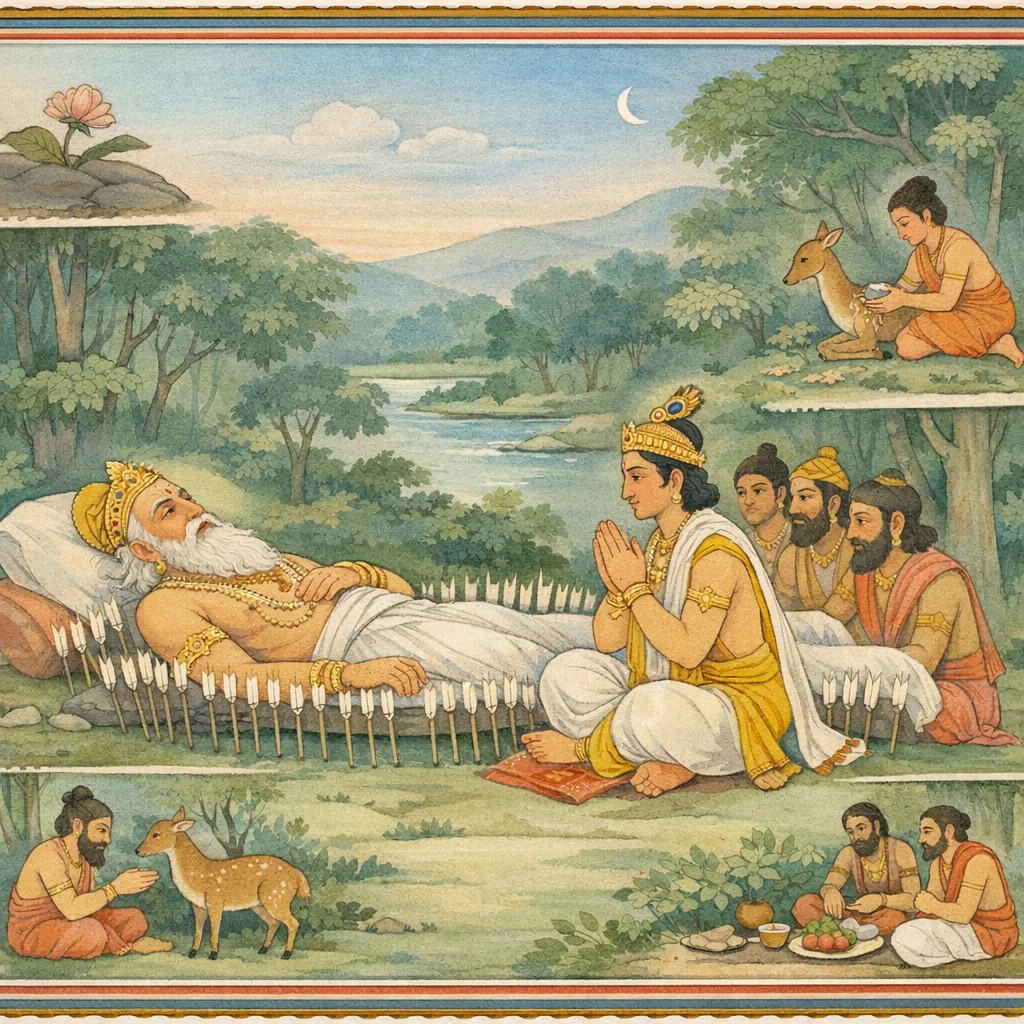
Adhyaya 273
इन्द्रेण वृत्रवधः, ब्रह्महत्याया अनुगमनम्, तथा च विभाजन-निवासविधानम् (Indra’s defeat of Vṛtra; pursuit by Brahmahatyā; allocation of her abodes)
Upa-parva: Rājadharmānushāsana Upa-Parva (राजधर्मानुशासन उपपर्व) — Indra–Vṛtra Episode on Brahmahatyā
Bhīṣma recounts to Yudhiṣṭhira the omens and bodily signs of Vṛtra afflicted by fever (jvara): terrifying discoloration, tremors, harsh breathing, and ominous phenomena around him. Indra (Śakra), raising the vajra empowered with Viṣṇu’s association, engages and quickly brings down Vṛtra. From Vṛtra’s body emerges Brahmahatyā—depicted as a fear-inducing, monstrous female figure—who pursues Indra and seizes him, leading to Indra’s immobilization and distress. Indra approaches Brahmā (Pitāmaha), who pacifies Brahmahatyā and proposes dividing her into four parts to release Indra. Fire (Agni) accepts a quarter with a condition: those who approach fire but do not properly offer with seeds/herbs incur her. Vegetation (trees, herbs, grasses) accept a quarter with the rule that improper cutting/splitting at specified times draws her. Apsarases accept a quarter tied to prohibited intercourse with menstruating women. Waters accept a quarter tied to those who, thinking waters ‘small/insignificant,’ discharge impurities into them. Brahmahatyā releases Indra accordingly; Indra later undertakes Aśvamedha to attain purification. The chapter closes with an implicit didactic aim: strategic action must be coupled with expiatory governance, and recitation of this Indra narrative is presented as protective against moral demerit (a phalaśruti-style assurance).
Chapter Arc: युधिष्ठिर मोक्ष के विषय में पितामह भीष्म से पूछते हैं—क्या मोक्ष केवल उपदेश से मिलता है या किसी निश्चित ‘उपाय’ (साधन-पथ) से? वे उस यथान्याय उपाय को सुनना चाहते हैं। → भीष्म उत्तर देते हैं कि तुम्हारी दृष्टि स्वयं उपाय-मार्ग में निपुण है, फिर भी वे साधना की सूक्ष्मता स्पष्ट करते हैं: जैसे घट बनने के बाद वही निर्माण-बुद्धि ‘उत्पत्ति’ नहीं कहलाती, वैसे ही धर्म के उपायों में कारण-कार्य का विवेक आवश्यक है—भ्रम, मोह, आवर्त (मानसिक चक्र) को अभ्यास से लौटाना पड़ता है। → भीष्म मोक्ष-मार्ग को एक निर्मल अनुशासन के रूप में उद्घाटित करते हैं: शास्त्र-अभ्यास से भ्रम-निद्रा-प्रमाद का क्षय; अनित्य-चिन्तन से आसक्ति का शमन; योग से क्षुधा-वेग का संयम; करुणा से अहं का क्षय; परितोष से तृष्णा का निरोध—और इन सबके साथ काम-क्रोध-त्याग, असंगता, अमूढता, अव्यग्रता, स्थैर्य। यही ‘प्रसन्न, विमल, शुचि’ मोक्ष-मार्ग है तथा वाक्-काय-मन का नियम उसका द्वार। → अध्याय का निष्कर्ष यह है कि तेज (आत्मिक प्रकाश) इन गुणों से बढ़ता है, पाप का उपहन्ता होता है, संकल्प सिद्ध होते हैं और विज्ञान (विवेक-ज्ञान) प्रवर्तित होता है; शान्त चित्त और शुचि कर्म वाला साधक बुद्धि द्वारा इन्द्रियों सहित मन-वाणी को वश में कर, विवेक-नेत्र से शमन कर, मोक्ष-मार्ग को जानता है।
Shlokas
Verse 1
है ० बक। ] अडिफशशाए: चतुःसप्तरत्याधिकद्विशततमो<ध्याय: मोक्षके साधनका वर्णन युधिछिर उवाच मोक्ष: पितामहेनोक्त उपायान्नानुपायतः । तमुपायं यथान्यायं श्रोतुमिच्छामि भारत,युधिष्ठिरने पूछा--पितामह! आपने योग्य उपायसे मोक्षकी प्राप्ति बतायी, अयोग्य उपायसे नहीं। भरतनन्दन! वह यथायोग्य उपाय क्या है? इसे मैं सुनना चाहता हूँ
Yudhiṣṭhira said: “Grandfather, you have taught that liberation is attained through proper means, not through improper ones. O descendant of Bharata, I wish to hear that rightful method in accordance with dharma.”
Verse 2
भीष्म उवाच त्वय्येवैतन्महाप्राज्ञ युक्त निपुणदर्शनम् । येनोपायेन सर्वार्थ नित्यं मृगयसेडनघ,भीष्मजीने कहा--महाप्राज्ञ निष्पाप नरेश! तुम उचित उपायसे ही सदा सम्पूर्ण धर्म आदि पुरुषार्थोकी खोज किया करते हो। इसलिये तुममें सुने हुए विषयोंकी परीक्षा करनेकी निपुण दृष्टिका होना उचित ही है
Bhishma said: “O greatly wise and sinless king, it is indeed fitting that you possess a keen and discerning insight. For by proper means you continually seek out all the aims of life—dharma and the rest—therefore a refined capacity to test and examine what you have heard rightly belongs in you.”
Verse 3
करणे घटस्य या बुद्धिर्घटोत्पत्ती न सा मता । एवं धर्मभ्युपायेषु नान्यधर्मेषु कारणम्,घटके निर्माणकालमें जिस बुद्धिका उपयोग है, वह घटकी उत्पत्ति हो जानेपर आवश्यक नहीं रहती, इसी प्रकार चित्त-शुद्धिके उपायभूत यज्ञादि धर्मोंका लक्ष्य पूरा हो जानेपर मोक्षसाधनरूप शम-दमादि अन्य धर्मोंके लिये वे आवश्यक नहीं रहते
Bhishma said: The practical know-how employed in making a pot is not regarded as still necessary once the pot has come into being. In the same way, ritual and other disciplines that serve as means toward dharma—such as sacrifices undertaken for purification—are not, after their purpose is fulfilled, the direct cause for other, higher disciplines; for the pursuit of liberation, one must rely on the distinct virtues like self-control and inner calm that are themselves the means to moksha.
Verse 4
पूर्वे समुद्रे यः पन््था: स न गच्छति पश्चिमम् एक: पन्था हि मोक्षस्य तन्मे विस्तरत: शृणु,देखो, जो मार्ग पूर्व समुद्रकी ओर जाता है, वह पश्चिम समुद्रकी ओर नहीं जा सकता। इसी प्रकार मोक्षका भी एक ही मार्ग है, उसे मैं विस्तारपूर्वक बता रहा हूँ, सुनो
Bhīṣma said: “A path that leads to the eastern ocean cannot, as the same path, reach the western ocean. In the same way, liberation has a single true path. Hear from me, in detail, what that path is.”
Verse 5
क्षमया क्रोधमुच्छिन्द्यात् कामं संकल्पवर्जनात् | सत्त्वसंसेवनादू धीरो निद्रां च च्छेत्तुमहिति,मुमुक्षु पुरुषको चाहिये कि क्षमासे क्रोधका और संकल्पोंके त्यागसे कामनाओंका उच्छेद कर डाले। धीर पुरुष ज्ञानध्यानादि सात्त्विक गुणोंके सेवनसे निद्राका क्षय करे
Bhīṣma said: One should cut off anger through forbearance, and uproot desire by abandoning the habit of forming craving-driven intentions. A steadfast person, by cultivating sāttvika qualities and disciplines, should also diminish sleep—so that wakeful clarity supports liberation.
Verse 6
अप्रमादाद् भयं रक्षेत् ध्वासं क्षेत्रज्ञणीलनात् इच्छां द्वेषं च काम॑ च धैर्येण विनिवर्तयेत्,अप्रमादसे भयको दूर करे, आत्माके चिन्तनसे श्वासकी रक्षा करे अर्थात् प्राणायाम करे और थीैर्यके द्वारा इच्छा, द्वेष एवं कामका निवारण करे
Bhīṣma said: One should ward off fear through vigilance (freedom from negligence). One should steady and protect the breath by inward contemplation of the knower of the field (the Self), that is, by disciplined regulation of the life-breath. And by steadfast patience one should turn back desire, aversion, and lust—so that the mind becomes fit for dharma and inner peace.
Verse 7
भ्रम॑ं सम्मोहमावर्तम भ्यासाद् विनिवर्तयेत् । निद्रां च प्रतिभां चैव ज्ञानाभ्यासेन तत्त्ववित्,तत्त्ववेत्ता पुरुष शास्त्रके अभ्याससे भ्रम, मोह और संशयका तथा आलस्य और प्रतिभा (नानाविषयिणी बुद्धि)--इन दोनों दोषोंका ज्ञानके अभ्याससे निराकरण करे
Bhishma said: A knower of reality should, through steady practice, turn back confusion, delusion, and the whirlpool of mental disturbance. Likewise, by the disciplined practice of true knowledge, the wise person should remove both sleepiness (sloth) and ‘pratibhā’—the mind’s scattering brilliance that runs after many objects—since these too become obstacles to clear understanding and right conduct.
Verse 8
उपद्रवांस्तथा रोगान् हितजीर्णमिताशनात् । लोभ मोहं च संतोषाद् विषयांस्तत्त्वदर्शनात्,शारीरिक उपद्रवों तथा रोगोंका हितकर, सुपाच्य और परिमित आहारसे, लोभ और मोहका संतोषसे तथा विषयोंका तात्त्विक दृष्टिसे निवारण करे
Bhishma said: One should ward off bodily disturbances and diseases by taking food that is wholesome, easy to digest, and measured. One should overcome greed and delusion through contentment, and restrain attachment to sense-objects through insight into their true nature. Thus, self-mastery is established by disciplined living, inner satisfaction, and clear discernment.
Verse 9
अनुक्रोशादधर्म च जयेद् धर्ममवेक्षया । आयत्या च जयेदाशामर्थ संगविवर्जनात्,अधर्मको दयासे और धर्मको विचारपूर्वक पालन करनेसे जीते। भविष्यका विचार करके आशापर और आसत्तिके त्यागसे अर्थपर विजय प्राप्त करे
Bhīṣma said: “By compassion one should overcome even the impulse toward unrighteousness, and by keeping dharma in view one should prevail in righteousness. And with an eye on the future, one should conquer hope and craving; by abandoning attachment and clinging to wealth, one gains mastery over material aims.”
Verse 10
अनित्यत्वेन च स्नेहं क्षुधां योगेन पण्डित: । कारुण्येनात्मनो मान तृष्णां च परितोषत:,विद्वान् पुरुष वस्तुओंकी अनित्यताका चिन्तन करके स्नेहको, योगाभ्यासके द्वारा क्षुधाको, करुणाके द्वारा अपने अभिमानको और संतोषसे तृष्णाको जीते
Bhīṣma said: A wise person conquers attachment by reflecting on the impermanence of all things; overcomes hunger through disciplined yogic practice; subdues self-conceit through compassion; and masters craving through contentment. Thus, by cultivating these inner disciplines, one becomes fit for steady conduct in dharma.
Verse 11
उत्थानेन जयेत् तन्द्रीं वितर्क निश्चयाज्जयेत् । मौनेन बहुभाष्यं च शौर्येण च भयं त्यजेत्,आलस्यको उद्योगसे और विपरीत तर्कको शास्त्रके प्रति दृढ़ विश्वाससे जीते, मौनावलम्बनद्वारा बहुत बोलनेकी आदतको और शूरवीरताके द्वारा भयको त्याग दे
Bhīṣma said: “By rising up and exerting oneself, one should conquer lethargy; by firm discernment and settled conviction, one should overcome contrary reasoning and doubt. By observing silence, one should restrain the habit of excessive speech; and by courage, one should cast off fear.”
Verse 12
यच्छेद् वाड्मनसी बुद्धया तां यच्छेज्ज्ञानचक्षुषा । ज्ञानमात्मावबोधेन यच्छेदात्मानमात्मना
Bhīṣma said: One should restrain speech and mind by means of the intellect; that intellect, in turn, should be governed by the eye of true knowledge. Knowledge itself should be steadied through direct self-awakening, and finally the self should be mastered by the Self—so that inner discipline culminates in inward freedom rather than mere outward control.
Verse 13
योगदोषान् समुच्छिद्य पठच यान् कवयो विदु:,काम, क्रोध, लोभ, भय और निद्रा--ये ही योगसम्बन्धी वे पाँच दोष हैं, जिनको विद्वान् पुरुष जानते हैं। इनका मूलोच्छेद कर देना चाहिये तथा इनका परित्याग करके वाणीको संयममें रखते हुए योगसाधनोंका सेवन करना चाहिये
Bhishma said: “Cut off the defects that obstruct yoga—five that the wise recognize: desire, anger, greed, fear, and sleep. One should uproot them at their source; abandoning them, restraining one’s speech, one should devote oneself to the disciplines of yoga.”
Verse 14
काम॑ क्रोधं च लोभं च भयं स्वप्रं च पजचमम् । परित्यज्य निषेवेत यतवाग् योगसाधनान्,काम, क्रोध, लोभ, भय और निद्रा--ये ही योगसम्बन्धी वे पाँच दोष हैं, जिनको विद्वान् पुरुष जानते हैं। इनका मूलोच्छेद कर देना चाहिये तथा इनका परित्याग करके वाणीको संयममें रखते हुए योगसाधनोंका सेवन करना चाहिये
Bhīṣma said: Desire, anger, greed, fear, and sleep as the fifth—these are known by the wise as the five faults that obstruct yoga. One should uproot them at the root; abandoning them, and restraining one’s speech, one should diligently practice the disciplines that lead to yoga.
Verse 15
ध्यानमध्ययन दान सत्य द्वीरार्जवं क्षमा | शौचमाहारत: शुद्धिरिन्द्रियाणां च संयम:,ध्यान, अध्ययन, दान, सत्य, लज्जा, सरलता, क्षमा, बाहर-भीतरकी पवित्रता, आहारशुद्धि और इन्द्रियोंका संयम--ये ही योगके साधन हैं। इन सबके द्वारा साधकका तेज बढ़ता है। वह अपने पापोंका नाश कर डालता है। उसके संकल्प सिद्ध होने लगते हैं और हृदयमें विज्ञानका आविर्भाव हो जाता है
Bhishma said: Meditation, study, charity, truthfulness, modesty, straightforwardness, forgiveness, purity (both outward and inward), purity of diet, and restraint of the senses—these are the disciplines of yoga. By cultivating them, a seeker’s inner radiance grows; sins are destroyed, intentions begin to bear fruit, and true discernment awakens in the heart.
Verse 16
एतैरविंवर्धते तेज: पाप्मानमुपहन्ति च । सिध्यन्ति चास्य संकल्पा विज्ञानं च प्रवर्तते,ध्यान, अध्ययन, दान, सत्य, लज्जा, सरलता, क्षमा, बाहर-भीतरकी पवित्रता, आहारशुद्धि और इन्द्रियोंका संयम--ये ही योगके साधन हैं। इन सबके द्वारा साधकका तेज बढ़ता है। वह अपने पापोंका नाश कर डालता है। उसके संकल्प सिद्ध होने लगते हैं और हृदयमें विज्ञानका आविर्भाव हो जाता है
Bhīṣma said: “By these disciplines one’s inner radiance and spiritual strength increase, and one’s sins are struck down. A seeker’s resolves begin to bear fruit, and true discernment (vijñāna) arises and moves forward within the heart.”
Verse 17
धूतपाप: स तेजस्वी लघ्वाहारो जितेन्द्रिय: । कामक्रोधौ वशे कृत्वा निनीषेद् ब्रह्मण: पदम्,इस प्रकार जब पाप धुल जायँ और साधक तेजस्वी, मिताहारी और जितेन्द्रिय हो जाय, तब वह काम और क्रोधको अपने अधीन करके अपने-आपको ब्रह्मपदमें प्रतिष्ठित करनेकी इच्छा करे
Bhishma said: When a seeker has washed away sin, becomes radiant in conduct, eats lightly, and has mastered the senses, then—having brought desire and anger under control—he should aspire to establish himself in the state of Brahman, the highest spiritual station.
Verse 18
अमूढत्वमसंगित्वं कामक्रोधविवर्जनम् । अदैन्यमनुदीर्णत्वमनुद्वेगो व्यवस्थिति:,मूढता और आसक्तिका अभाव, काम और क्रोधका त्याग एवं दीनता, उद्ण्डता तथा उद्वेगसे रहित होना और चित्तकी स्थिरता एवं निष्कामभावसे मन, वाणी और इन्द्रियोंका संयम--यह मोक्षका स्वच्छ, निर्मल एवं पवित्र मार्ग है
Bhīṣma said: “Clarity free from delusion, non-attachment, and the abandonment of lust and anger; freedom from dejection, absence of arrogance or overbearing agitation, and an unshaken steadiness—these qualities together form the pure, stainless, and sacred path that leads to liberation.”
Verse 19
एष मार्गों हि मोक्षस्य प्रसन्नो विमल: शुचि: । तथा वाक्कायमनसां नियम: कामतो<न्यथा,मूढता और आसक्तिका अभाव, काम और क्रोधका त्याग एवं दीनता, उद्ण्डता तथा उद्वेगसे रहित होना और चित्तकी स्थिरता एवं निष्कामभावसे मन, वाणी और इन्द्रियोंका संयम--यह मोक्षका स्वच्छ, निर्मल एवं पवित्र मार्ग है
Bhishma said: “This indeed is the clear path to liberation—serene, spotless, and pure: the disciplined restraint of speech, body, and mind, not driven by desire or its contrary impulses. Freedom from delusion and attachment; the abandonment of lust and anger; the absence of wretchedness, arrogance, and agitation; steadiness of mind; and the selfless (desireless) regulation of mind, speech, and the senses—this is the clean, immaculate, and holy road to moksha.”
Verse 126
तदेतदुपशान्तेन बोद्धव्यं शुचिकर्मणा । मन और वाणीको अर्थात् मनसहित समस्त इन्द्रियोंको बुद्धिद्वारा वशमें करे, बुद्धिका विवेकरूप नेत्रद्वारा शमन करे, फिर आत्मज्ञानद्वारा विवेकज्ञानका शमन करे और आत्माको परमात्मामें विलीन कर दे। इस प्रकार पवित्र आचार-विचारसे युक्त साधकको सब ओरसे उपरत होकर शान्तभावसे परमात्माका साक्षात्कार करना चाहिये
Bhishma said: “This truth is to be realized by one who is inwardly pacified and whose conduct is pure. Having brought the mind and speech—indeed, all the senses together with the mind—under the governance of discernment, one should quiet them through the clear ‘eye’ of discriminative intelligence; then, by the knowledge of the Self, one should still even that discriminative knowing, and finally merge the individual self in the Supreme Self. Thus, a seeker endowed with purified conduct and thought, withdrawing from all sides and abiding in calm, should attain direct realization of the Supreme.”
Verse 274
इति श्रीमहाभारते शान्तिपर्वणि मोक्षधर्मपर्वणि योगाचारानुवर्णनं नाम चतु:सप्तत्यधिकद्विशततमो<5ध्याय:
Thus, in the Śrī Mahābhārata, within the Śānti Parva and specifically the Mokṣa-dharma section, concludes the chapter entitled “The Description of the Disciplines of Yoga,” being the 274th chapter.
Frequently Asked Questions
Indra’s necessary strategic engagement against Vṛtra is followed by Brahmahatyā as moral consequence, creating tension between justified action and residual culpability that requires formal remediation.
Even when an act is strategically effective, a ruler must address downstream moral and social effects through adjudication, distribution of burdens, and expiatory or restorative procedures to stabilize legitimacy.
Yes: it states that those who recite this ‘divine Śakra narrative’ in learned settings do not incur kīlbiṣa (demerit), marking the episode as both didactic history and protective recitational material.