Adhyaya 241
Adhyāya 241: Guṇa-sṛṣṭi, Kṣetrajña-sākṣitva, and Śama through Ātma-jñāna (गुणसृष्टिः, क्षेत्रज्ञसाक्षित्वं, शमः)
Upa-parva: Mokṣa-dharma (Liberation-Oriented Instruction), Śānti-parva
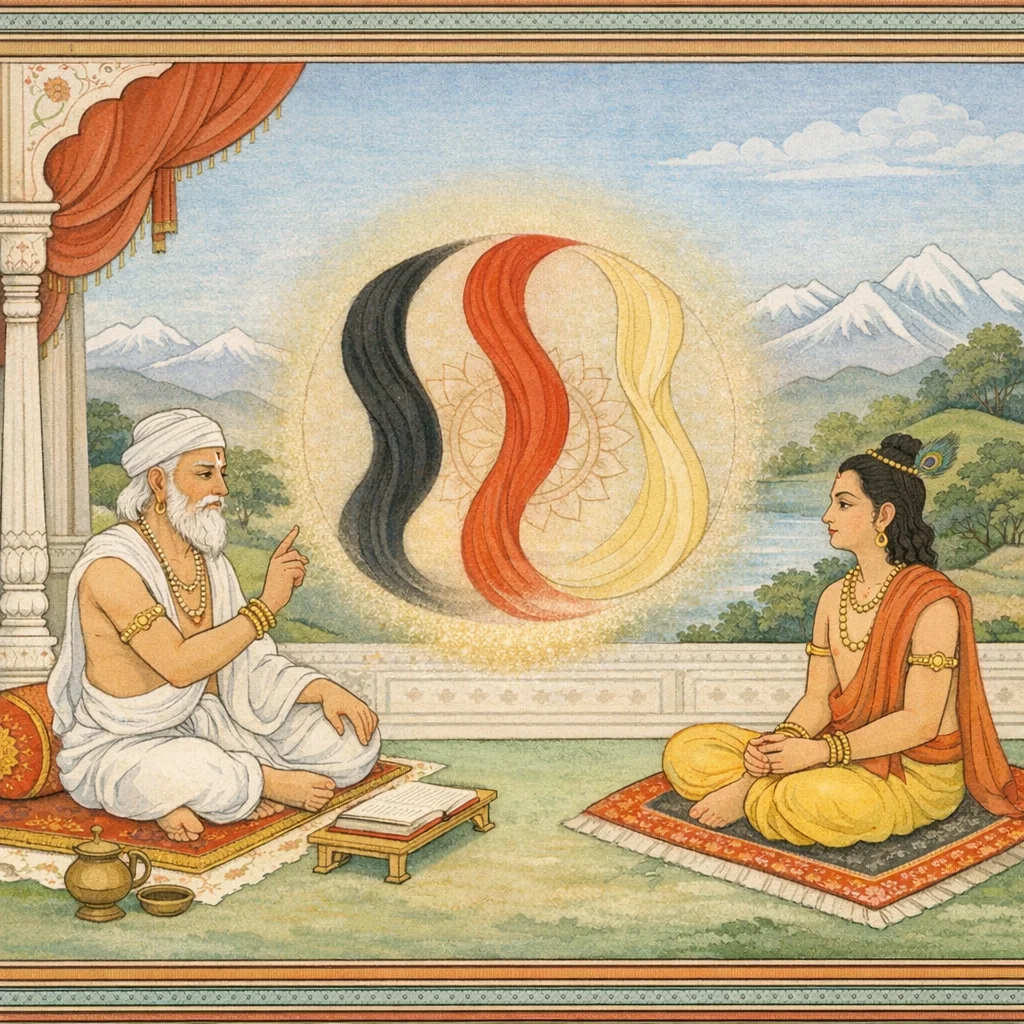
Vyāsa articulates a metaphysical-ethical account in which the guṇas are generated and transformed within nature, while the kṣetrajña (the inner knower) abides as an apparently detached witness. An analogy compares the production of guṇas to a spider emitting thread, emphasizing spontaneous, svabhāva-driven manifestation. The discourse notes divergent interpretations—some affirm irrevocable cessation after dissolution, others emphasize withdrawal (nivṛtti)—and recommends reflective adjudication rather than dogmatic fixation. Practical instruction follows: one who ‘approaches’ the beginningless and endless (anādinidhana) should move through life without anger, without excessive exhilaration, and free from envy, thereby cutting the “heart-knot” of rigid, thought-made conviction. A contrast is drawn between the unlearned, who suffer like people swept into a full river, and the learned, who remain untroubled on firm ground through tattva-knowledge. By understanding the coming and going of beings, one gradually attains superior tranquility (uttama-śama). The chapter culminates by defining true wisdom as liberation through knowledge, portraying the learned as less susceptible to fear and grief, and describing action done without ulterior intention as karmically neutralizing prior residues.
Chapter Arc: शुकदेव जिज्ञासा रखते हैं: शास्त्र एक ओर ‘कुरु कर्म’ कहता है और दूसरी ओर ‘त्यज कर्म’—ये परस्पर-विरोधी वचन साधक को किस मार्ग पर ले जाएँ? → भीष्म धर्म-विवाद की पीड़ा को छूते हैं—‘धर्म है’ और ‘धर्म नहीं’ जैसे प्रतिपक्षों की तरह ही कर्म-त्याग का द्वंद्व भी मन को व्यथित करता है। फिर वे बंधन का सूत्र रखते हैं: सकाम कर्म जीव को बाँधता है, ज्ञान मुक्त करता है; इसलिए पारदर्शी यति कर्म-आसक्ति से हटते हैं। → निर्णायक प्रतिपादन: कर्म को ‘अंत’ नहीं, ‘बंधन’ या ‘शुद्धि’ के संदर्भ में समझो—अधूरे ज्ञान वाले कर्म की प्रशंसा कर देह-जाल में रमते हैं, पर ज्ञान का लक्ष्य उस अवस्था की ओर है ‘जहाँ जाकर न मृत्यु है, न जन्म, न पुनरावृत्ति’। इसी के साथ त्रिगुण (तम-रज-सत्त्व), जीव-गुण और आत्मा-परमात्मा के भेद/सम्बन्ध का संकेत देकर मोक्ष-मार्ग का दार्शनिक आधार रखा जाता है। → भीष्म कर्म और ज्ञान के अन्तर को समन्वित करते हैं: सकाम कर्म बंधनकारी है, विवेक-ज्ञान विमोचक है; त्रिगुण-आधारित जीव-प्रकृति को जानकर साधक क्षेत्र-क्षेत्रज्ञ (देह-जड़ बनाम चेतन) का विवेक करता है और ब्रह्म-प्राप्ति के उपाय की दिशा पकड़ता है। → त्रिगुण, जीव-गुण और परमात्मा के सम्बन्ध का जो सूत्र यहाँ रखा गया है, उसका विस्तृत विवेचन आगे के अध्यायों में साधना-क्रम और ज्ञान-निष्ठा के रूप में खुलने को छोड़ दिया जाता है।
Shlokas
Verse 1
अपन बक। है २ >> एकचत्वारिशर्दाधिकद्विशततमो< ध्याय: कर्म और ज्ञानका अन्तर तथा ब्रह्माप्राप्तिके उपायका वर्णन शुक उवाच यदिदं वेदवचनं कुरु कर्म त्यजेति च । कां दिशं विद्यया यान्ति कां च गच्छन्ति कर्मणा,शुकदेवने पूछा--पिताजी! वेदमें “कर्म करो” और “कर्म छोड़ो'--ये जो दो प्रकारके वचन मिलते हैं, उनके सम्बन्धमें मैं यह जानना चाहता हूँ कि विद्या (ज्ञान) के द्वारा कर्मको त्याग देनेपर मनुष्य किस दिशामें जाते हैं? और कर्म करनेसे उन्हें किस गतिकी प्राप्ति होती है?
Śuka said: “Father, in the Veda one encounters two kinds of injunctions—‘perform action’ and ‘renounce action.’ I wish to understand this: when a person gives up action through knowledge (vidyā), to what ‘direction’ or state do they go? And by performing action, what destination do they attain?”
Verse 2
एतद् वै श्रोतुमिच्छामि तद् भवान् प्रब्रवीतु मे । एतच्चान्योन्यवैरूप्ये वर्तेते प्रतिकूलत:
Śuka said: “This indeed I wish to hear; therefore, please explain it to me. And how is it that, through mutual distortion and opposition, these matters proceed in a contrary way?”
Verse 3
मैं इस विषयको सुनना चाहता हूँ, आप कृपापूर्वक मुझे यह बतावें। ये दोनों वचन एक दूसरेके विपरीत हैं, अतः प्रतिकूल परिणाम ही उत्पन्न कर सकते हैं ।। भीष्म उवाच इत्युक्त: प्रत्युवाचेदं पराशरसुत: सुतम् । कर्मविद्यामयावेतौ व्याख्यास्यामि क्षराक्षरी,भीष्मजी कहते हैं--राजन्! शुकदेवजीके इस प्रकार पूछनेपर पराशरनन्दन भगवान् व्यासने यों उत्तर दिया-'बेटा! ये कर्ममय और ज्ञानमय मार्ग क्रमशः: विनाशशील और अविनाशी हैं, मैं इनकी व्याख्या आरम्भ करता हूँ
Bhishma said: When this was spoken, Vyasa, Parashara’s son, replied to his own son: “My child, these two paths—one grounded in action (karma) and the other in knowledge (jñāna)—are respectively perishable and imperishable. I shall now begin to explain them.”
Verse 4
यां दिशं विद्यया यान्ति यां च गच्छन्ति कर्मणा । शृणुष्वैकमना वत्स गद्दरं होतदन्तरम्,“वत्स! ज्ञानसे मनुष्य जिस दिशाको जाते हैं और कर्मद्वारा उन्हें जिस गतिकी प्राप्ति होती है, वह सब बताता हूँ, एकचित्त होकर सुनो। इन दोनोंका अन्तर अत्यन्त गहन है
Bhishma said: “Dear child, listen with a single, steady mind. I will tell you what direction people reach through true knowledge, and what course they attain through action. The difference between these two paths is exceedingly profound.”
Verse 5
अस्ति धर्म इति प्रोक्त नास्तीत्यत्रैव यो वदेत् । तस्य पक्षस्य सदृशमिदं मम भवेद् व्यथा,“धर्म है, ऐसा शास्त्रका उपदेश है, इसके विपरीत यदि कोई कहे कि धर्म नहीं है तो उसे सुनकर एक आस्तिकको जितना कष्ट होता है, उसके पक्षके ही समान यह कर्म और विद्याका तारतम्यविषयक प्रश्न मेरे लिये क्लेशदायक है
Bhishma said: “The scriptures declare, ‘Dharma exists.’ But if someone were to assert right here, ‘Dharma does not exist,’ the anguish that would arise in a believer on hearing that—an anguish aligned with the believer’s side—so too does this question about the relative ranking of action and knowledge become a source of distress for me.”
Verse 6
द्वाविमावथ पन्थानौ यत्र वेदा: प्रतिष्ठिता: । प्रवृत्तिलक्षणो धर्मो निवृत्ती च सुभाषित:,'प्रवृत्तिलक्षण धर्म और निवृत्तिके उद्देश्यसे प्रतिपादित धर्म, ये दो मार्ग हैं जहाँ वेद प्रतिष्ठित हैं
Bhishma said: There are two paths on which the Vedas are firmly grounded. One is the dharma marked by engagement in action and worldly duties (pravṛtti); the other is the well-taught dharma of withdrawal and renunciation (nivṛtti).
Verse 7
कर्मणा बध्यते जन्तुर्विद्यया तु प्रमुच्यते । तस्मात् कर्म न कुर्वन्ति यतय: पारदर्शिन:,“सकामकर्मसे मनुष्य बन्धनमें पड़ता है और ज्ञानसे मुक्त हो जाता है, अतः दूरदर्शी यति कर्म नहीं करते हैं
Bhishma said: A living being is bound by action, but is released through true knowledge. Therefore, the far-seeing ascetics do not engage in action—understanding that deeds driven by desire fasten the soul to bondage, while insight leads toward liberation.
Verse 8
कर्मणा जायते प्रेत्य मूर्तिमान्ू षोडशात्मक: । विद्यया जायते नित्यमव्यक्त हाव्ययात्मकम्,“कर्म करनेसे मनुष्य मृत्युके पश्चात् सोलह- तत्त्वोंके बने हुए मूर्तिमान शरीरको धारण करके जन्म लेता है; किन्तु ज्ञानके प्रभावसे जीव नित्य, अव्यक्त, अविनाशी परमात्माको प्राप्त होता है
Bhishma said: By action, after death, a being is born again, taking on a tangible body constituted of the sixteen principles; but by knowledge, one ever attains That whose essence is unmanifest and imperishable.
Verse 9
कर्म त्वेके प्रशंसन्ति स्वल्पबुद्धिरता नरा: । तेन ते देहजालानि रमयन्त उपासते,“अधूरे ज्ञानमें आसक्त अर्थात् इन्द्रियज्ञानको ही ज्ञान माननेवाले कुछ मनुष्य सकामकर्मकी प्रशंसा करते हैं, इसलिये वे भोगासक्त होकर बारंबार विभिन्न शरीरोंमें आनन्द मानकर उनका सेवन करते हैं
Bhishma said: Some men, whose understanding is small and incomplete, praise action (karma) alone. Therefore, delighting in the web of embodied existences, they cling to and pursue those bodies again and again—taking sense-based knowledge to be the whole of knowledge and remaining attached to enjoyment and its results.
Verse 10
ये सम बुद्धि परां प्राप्ता धर्मनैपुण्यदर्शिन: । नते कर्म प्रशंसन्ति कूपं नद्यां पिबन्निव,'परंतु जो धर्मके तत्त्वको भलीभाँति समझकर सर्वोत्तम ज्ञान प्राप्त कर चुके हैं, वे कर्मकी उसी तरह प्रशंसा नहीं करते हैं, जैसे प्रतिदिन नदीका पानी पीनेवाले मनुष्य कुएँका आदर नहीं करते हैं
Bhishma said: Those who have attained the highest even-minded understanding and who clearly discern the subtle skill of dharma do not extol ritual action as supreme—just as a person who drinks daily from a flowing river does not prize a well.
Verse 11
कर्मण: फलमाप्रोति सुखदु:खे भवाभवौ | विद्यया तदवाप्रोति यत्र गत्वा न शोचति,“कर्मके फल हैं सुख-दुःख और जन्म-मृत्यु। कर्मद्वारा मनुष्य इन्हींको पाते हैं, परंतु ज्ञानके द्वारा उन्हें उस परमपदकी प्राप्ति होती है, जहाँ जानेसे सदाके लिये शोकसे मुक्त हो जाता है
Bhishma teaches that action yields its natural fruits—pleasure and pain, and the cycle of coming-to-be and ceasing-to-be (birth and death). By action a person attains only these conditioned results; but through true knowledge one reaches that highest state, having gone to which one no longer grieves.
Verse 12
यत्र गत्वा न ग्रियते यत्र गत्वा न जायते । न पुनर्जायते यत्र यत्र गत्वा न वर्तते,“जहाँ जाकर फिर मृत्युका कष्ट नहीं उठाना पड़ता, जहाँ जानेसे फिर जन्म नहीं होता, जहाँ पुनर्जन्मका भय नहीं रहता तथा जहाँ जाकर मनुष्य फिर इस संसारमें नहीं लौटता
Bhishma said: “That is the state which, once reached, one does not die; once reached, one is not born again. There, rebirth does not recur; having gone there, one does not return to worldly existence.”
Verse 13
यत्र तद् ब्रह्म परममव्यक्तमचलं ध्रुवम् । अव्याकृतमनायासमव्यक्तं चावियोगि च,“जहाँ बिना क्लेशके प्राप्त होनेवाले और मिलकर कभी विलग न होनेवाले, अव्यक्त, अचल, नित्य, अनिर्वचनीय तथा विकारशून्य उस परब्रह्म परमात्माका साक्षात्कार हो जाता है
Bhishma said: “There, one realizes the Supreme Brahman—unmanifest, immovable, and everlasting; beyond modification and beyond full articulation—attained without strain, and never subject to separation once attained.”
Verse 14
द्न्द्ै्न यत्र बाध्यन्ते मानसेन च कर्मणा । समा: सर्वत्र मैत्राश्व॒ सर्वभूतहिते रता:,“उस स्थितिको प्राप्त हुए मनुष्योंको सुख-दुःखादि द्वन्द्ध, मानसिक संकल्प और कर्म- संस्कार बाधा नहीं पहुँचाते। वहाँ पहुँचे हुए मानव सर्वत्र समानभाव रखते हैं, सबको मित्र मानते हैं और समस्त प्राणियोंके हितमें तत्पर रहते हैं
Bhishma said: “In that attained state, people are no longer afflicted by the pairs of opposites—pleasure and pain and the like—nor by mental constructions and the momentum of past actions. Established there, they remain even-minded everywhere, regard all as friends, and are devoted to the welfare of all living beings.”
Verse 15
विद्यामयो<न्य: पुरुषस्तात कर्ममयो5पर: । विद्धि चन्द्रमसं दर्शे सूक्ष्म्पा कलया स्थितम्,“तात! ज्ञानी मनुष्य कुछ और ही होता है, कर्मासक्त मनुष्य उससे सर्वथा भिन्न है। जैसे चन्द्रमा घटते-घटते अमावास्याको एक सूक्ष्म कलाके रूपमें ही शेष रह जाता है, यही अवस्था तुम कर्मासक्त मनुष्योंकी भी समझो--उसे क्षय और वृद्धिके ही चक््करमें पड़े रहना पड़ता है
Bhishma said: “Dear one, the person formed by knowledge is of one kind, and the person formed by action—bound to action and its fruits—is of another. Understand this by the example of the moon: on the new-moon night it remains only as a subtle sliver. So too is the condition of those attached to action—they are compelled to revolve within the cycle of diminution and increase (loss and gain), rather than resting in the steadiness born of true knowledge.”
Verse 16
तदेतदृषिणा प्रोक्तं विस्तरेणानुमीयते । नवजं शशिन दृष्टवा वक्रतन्तुमिवाम्बरे,“इस बातको एक मन्त्रद्र्ठ ऋषिने विस्तारके साथ बताया है। अमावास्याके बाद आकाशमें एक टेढ़े और पतले सूतके समान प्रतीत होनेवाले नवोदित चन्द्रमाको देखकर ऐसा ही अनुमान किया जाता है
“This has been spoken in detail by a mantra-seeing rishi; and it is inferred in the same way when one beholds, after the new-moon night, the newly risen moon in the sky, like a thin, curved thread.”
Verse 17
एकादशविकारात्मा कलासम्भारसम्भृत: । मूर्तिमानिति तं विद्धि तात कर्मगुणात्मकम्,“कर्मजन्य कलाओंके भारको धारण करनेवाला कर्मासक्त मनुष्य मन और इन्द्रियरूप ग्यारह विकारोंसे युक्त होकर जन्म धारण किया करता है। इस प्रकार वह मूर्तिमान् (देहधारी) व्यक्ति होता है। तुम उसे कर्मफलसम्भूत त्रिगुणात्मक शरीरसे युक्त तथा चन्द्रमाके समान वृद्धि और हासका भागी होनेवाला समझो
Bhishma said: “Know, dear one, that the embodied person is ‘form-bearing’ (mūrtimān): he is constituted by the eleven modifications—mind and the senses—and he carries the accumulated load of the ‘parts’ (kalā) produced by action. Thus the living being takes on birth as a doer, shaped by karma and the guṇas, and becomes subject to embodied increase and decline.”
Verse 18
देवो यः संश्रितस्तस्मिन्नब्बिन्दुरिव पुष्करे । क्षेत्रज्ञ तं विजानीयान्नित्यं योगजितात्मकम्,'प्राणियोंके अन्तःकरण (हृदयाकाश) में जो स्वयम्प्रकाश चिन्मय देवता कमलके पत्तेपर पड़ी हुई पानीकी बूँदके समान निर्लेपभावसे विराजमान है तथा जिसने योगके द्वारा चित्तको वशमें किया है, उस आत्मतत्त्वको तुम सदैव क्षेत्रज्ष समझो
Bhishma said: The self-luminous divine principle that abides within the hearts of beings remains untouched—like a drop of water resting on a lotus leaf. Know that reality, ever, as the Kṣetrajña (the Knower of the Field): the inner Self whose nature is mastery won through yoga, having brought the mind under control.
Verse 19
तमो रजश्न सत्वं च विद्धि जीवगुणात्मकम् | जीवमात्मगुणं विद्यादात्मानं परमात्मन:,“तमोगुण, रजोगुण और सत्वगुण-इन तीनोंको बुद्धिका गुण समझो, इनके सम्बन्धसे जीव गुणस्वरूप और गुण जीवस्वरूप प्रतीत होने लगते हैं। अतः वास्तवमें जीवात्मा परमात्माका ही अंश है, ऐसा समझो
Know that tamas, rajas, and sattva are the three guṇas that constitute the living being. Through their association, the jīva appears as though it were the guṇas, and the guṇas appear as though they were the jīva. Therefore understand truly: the individual self is a portion of the Supreme Self.
Verse 20
सचेतनं जीवगुणं वदन्ति स चेष्टते जीवयते च सर्वम् | ततः पर क्षेत्रविदो वदन्ति प्राकल्पयद् यो भुवनानि सप्त,“शरीर स्वयं तो अचेतन (जड) है, परंतु चेतनसे युक्त होनेसे उसे जीवात्माके गुण चैतन्यसे युक्त कहा जाता है। जीवात्मा ही शरीरके द्वारा चेष्टा करता है और वही समस्त शरीरको जीवन (चेतना) प्रदान करता है, परंतु जिस परमात्माने सातों भुवनोंकी सृष्टि की है, उसे क्षेत्रवेत्ता विद्वान् उस जीवात्मासे भी श्रेष्ठ बताते हैं
Bhishma said: They describe the body as ‘endowed with consciousness’ because it is associated with the qualities of the living self. It is the individual self that acts through the body and imparts life and awareness to the whole organism. Yet the knowers of the field declare as higher than that individual self the Supreme Self—He who, in the beginning, fashioned the seven worlds.
Verse 241
इति श्रीमहा भारते शान्तिपर्वणि शुकानुप्रश्ने एकचत्वारिंशदधिकद्विशततमो ध्याय:,इस प्रकार श्रीमह्याभारत शान्तिपर्वके अन्तर्गत मोक्षधर्मपर्वमें शुकदेवका अनुप्रश्नविषयक दी सौ इकतालीसवाँ अध्याय पूरा हुआ
Thus ends, in the Śrī Mahābhārata, within the Śānti Parvan, the two-hundred-and-forty-first chapter, concerning Śuka’s follow-up inquiry. In this way, the chapter on the topic of Śukadeva’s further questioning—situated in the Mokṣadharma section of the Śānti Parvan—has been completed.
Frequently Asked Questions
It prescribes steady conduct grounded in self-knowledge: remaining without anger (akrodha), without excessive exhilaration (aprahṛṣa), and without envy (vigata-matsara), thereby loosening the “heart-knot” of compulsive, rigid cognition.
The chapter presents the guṇas as the changing operations of nature, while the kṣetrajña is depicted as the stable knower that ‘witnesses’ these transformations with detachment; discernment of this difference supports tranquility and reduces sorrow.
Yes: it states that understanding the arising and passing of beings and recognizing the self as pure knowledge leads gradually to superior śama; the learned are portrayed as less vulnerable to fear and grief, and as attaining release (vimukti) through correct discernment.