Adhyaya 206
Śānti-parva 206: Guṇa-hetu Moha, Kāma-krodha Chain, Indriya-utpatti, and Nirodha
Upa-parva: Mokṣa-dharma (Liberation Teachings) — Guṇa–Indriya–Saṃsāra Analysis Unit
A teacher (guru) explains a causal map of bondage: rajas and tamas are linked with delusion; from cognitive confusion arise desire (kāma), then anger (krodha), greed (lobha), fear (bhaya), pride (darpa), and ego-sense (ahaṃkāra), culminating in action (kriyā). Action generates relational attachment (sneha), then sorrow (śoka), and repeated cycles of pleasure–pain that condition rebirth. The discourse includes an intentionally unsentimental account of gestation and bodily formation to counteract craving. It then shifts to a Sāṃkhya-like account of prakṛti/field (kṣetra) and knower (kṣetrajña), describing how sensory faculties and vital functions arise in relation to specific cravings (e.g., sound-craving with hearing). Suffering is said to expand through appropriation (upādāna) and conceit/identification (abhimāna), while cessation is attainable through relinquishment (tyāga) and nirodha; one who knows cessation is described as freed from renewed embodiment. The chapter closes by urging examination of the senses’ arising and dissolution with “śāstra-vision,” so that knowledge of causes prevents return to bodily re-entry.
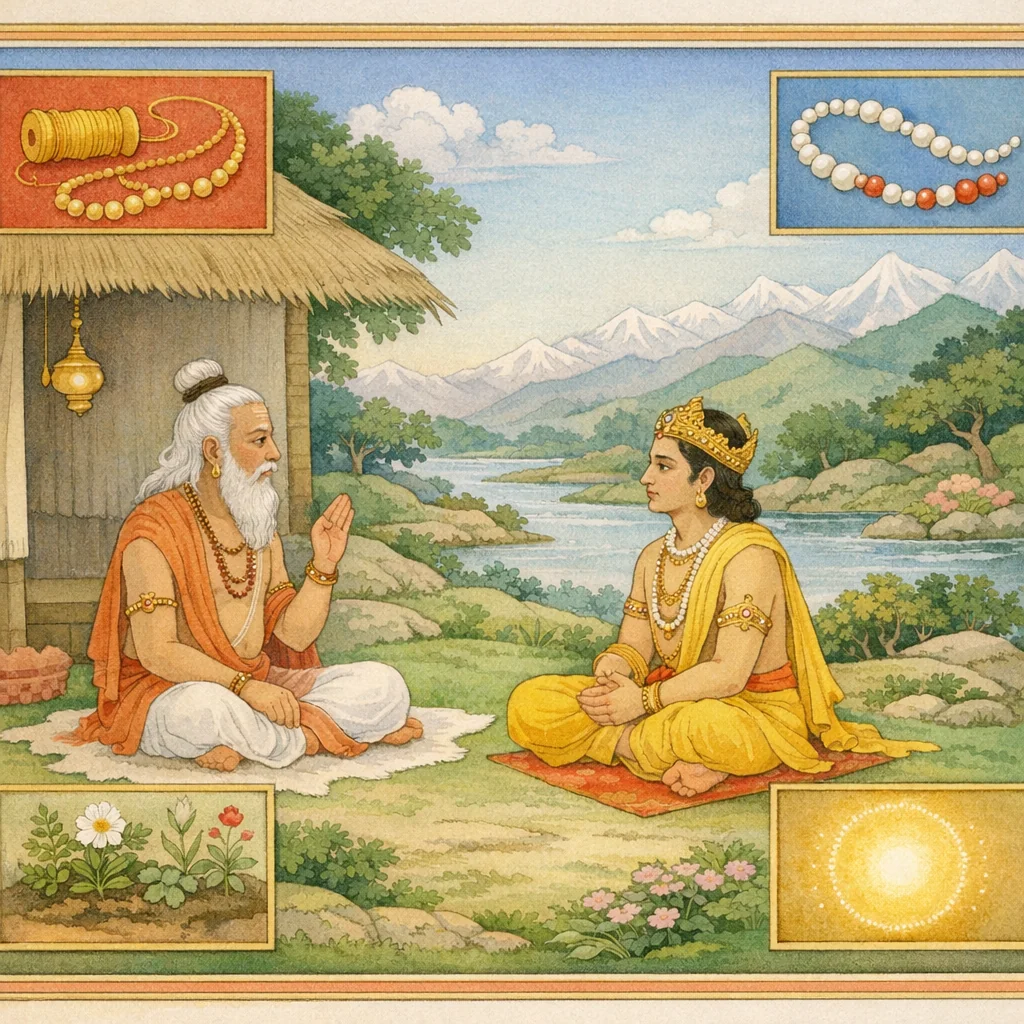
Chapter Arc: मनु, पंचभूतों और मन-बुद्धि-इन्द्रियों के संयोग से जीव की अनुभूति-यात्रा का सूत्र पकड़ाते हैं—एक ही परम तत्त्व कैसे अनेक देहों में अनेक रूपों से चमकता है? → उपमाओं की शृंखला से जिज्ञासा तीव्र होती है: जैसे स्वर्ण में सूत्र, मोतियों-प्रवालों में वही तत्त्व, वैसे ही आत्मा घोड़े-मनुष्य-हाथी-मृग-कीट-पतंग तक में कर्मानुसार आसक्त होकर भिन्न-भिन्न देह-धर्म धारण करती है; भूमि में एक रस होते हुए भी बीज के अनुसार औषधि-स्वभाव बदलता है, वैसे ही बुद्धि कर्मानुगा होकर अंतरात्मा का दर्शन ढक देती है। → ज्ञान से बुद्धि को निर्मल कर, मन को साधकर, और इन्द्रिय-ग्राम को मन के अधीन कर साधक ‘अक्षर’ पद को प्राप्त करता है—वही अनागत, सनातन, अव्यय, ध्रुव, स्वयम्भू परमगति; इसी निश्चय में अमृतत्व का द्वार खुलता है। → वेद (ऋक्-यजुः-साम) भी अध्ययन-काल में शरीराश्रित, यत्नसाध्य और विनाशिन बताए जाते हैं; और यह भी कि दुर्भाग्य, साधनहीनता तथा कर्मफलासक्ति के कारण मर्त्य उस मार्ग को नहीं देख पाते जिससे परम पद की प्राप्ति होती है—अतः निष्काम, शुद्ध-बुद्धि ज्ञान ही उपाय है।
Shlokas
Verse 1
ऑपन--माज बछ। अकाल षर्डाधिकद्विशततमो< ध्याय: परमात्मतत्त्वका निरूपण--मनु-बृहस्पति-संवादकी समाप्ति मनुर्वाच यदा तै: पञ्चभि: पज्च युक्तानि मनसा सह । अथ तद् रक्ष्यते ब्रह्म मणौ सूत्रमिवापितम्,मनुजी कहते हैं--बृहस्पते! जिस समय मनुष्य शब्द आदि पाँच विषयोंसहित पाँचों ज्ञानेन्द्रियों और मनको काबूमें कर लेता है, उस समय वह मणियोंमें ओतप्रोत तागेके समान सर्वत्र व्याप्त परब्रह्मका साक्षात्कार कर लेता है
Manu said: When a person, together with the mind, brings the five senses under control along with their five objects—sound, touch, form, taste, and smell—then the all-pervading Supreme Brahman is realized, like a thread that runs through and holds together a string of gems.
Verse 2
तदेव च यथा सूत्र सुवर्णे वर्तते पुनः । मुक्तास्वथ प्रवालेषु मृन्मये राजते तथा
Bhīṣma said: “Just as the very same thread is again found running through gold, so too it shines when set among pearls and corals, and likewise even in an earthen setting. In the same way, the one underlying principle remains the same while appearing in different forms and conditions; its worth is not diminished by the outward medium.”
Verse 3
तद्धद् गोडश्वमनुष्येषु तद्धद्धस्तिमृगादिषु । तद्धत् कीटपतड्लेषु प्रसक्तात्मा स्वकर्मभि:
Bhīṣma said: The same ensouling principle is found among cattle, horses, and human beings; the same is found among elephants, deer, and other creatures; the same is found among worms and insects as well. Yet each embodied being, bound by its own actions, remains attached—its mind engrossed in the particular work and mode of life that karma has assigned.
Verse 4
जैसे वही तागा सोनेकी लड़ियोंमें, मोतियोंमें, मूँगोंमें और मिट्टीकी मालाके दानोंमें ओतप्रोत होकर सुशोभित होता है, उसी प्रकार एक ही परमात्मा गौ, अश्व, मनुष्य, हाथी, मृग और कीट-पतंग आदि समस्त शरीरोंमें व्याप्त है! विषयासक्त जीवात्मा अपने-अपने कर्मके अनुसार भिन्न-भिन्न शरीर धारण करता है ।। येन येन शरीरेण यद्यत्कर्म करोत्ययम् । तेन तेन शरीरेण तत् तत् फलमुपाश्ुते,यह मनुष्य जिस-जिस शरीरसे जो-जो कर्म करता है, उस-उस शरीरसे उसी-उसी कर्मका फल भोगता है
Bhīṣma said: Just as a single thread, passing through strings of gold, pearls, coral, and even beads of clay, holds them together and lends them beauty, so too the one Supreme Self pervades every body—cow, horse, human, elephant, deer, and even insects and flying creatures. Yet the individual self, attached to sense-objects, takes on diverse bodies according to its own deeds. Whatever action a person performs through whatever body, through that very body it experiences the corresponding fruit.
Verse 5
यथा होकरसा भूमिरोषध्यर्थानुसारिणी । तथा कर्मनुगा बुद्धिरन्तरात्मानुदर्शिनी,जैसे भूमिमें एक ही रस होता है तो भी उसमें जैसा बीज बोया जाता है, उसीके अनुसार वह उसमें रस उत्पन्न करती है, उसी तरह अन्तरात्मासे ही प्रकाशित बुद्धि पूर्वजन्मके कर्मोके अनुसार ही एक शरीरसे दूसरे शरीरको प्राप्त होती है
Bhīṣma said: “Just as the earth is of one and the same essence, yet brings forth the particular sap and yield according to the kind of seed that is sown, so too the intellect—illumined by the inner Self—moves in accordance with one’s past actions, carrying the being onward from one embodiment to another.”
Verse 6
ज्ञानपूर्वा भवेल्लिप्सा लिप्सापूर्वाभिसंधिता । अभिसंधिपूर्वकं कर्म कर्ममूलं ततः फलम्,मनुष्यको पहले तो विषयका ज्ञान होता है; फिर उसके मनमें उसे पानेकी इच्छा उत्पन्न होती है। उसके बाद “इस कार्यको सिद्ध करूँ” यह निश्चय और प्रयत्न आरम्भ होता है। फिर कर्म सम्पन्न होता और उसका फल मिलता है
Bhishma said: First there arises knowledge of an object; from that knowledge springs the desire to obtain it. From desire comes deliberate resolve—‘I will accomplish this’—and the effort that follows. Then action is performed, and from action its result is obtained. Thus, human experience moves in a moral chain from cognition to craving, from intention to deed, and from deed to consequence.
Verse 7
फल कर्मात्मकं विद्यात् कर्म ज्ञेयात्मकं तथा । ज्ञेयं ज्ञानात्मकं विद्याज्ज्ञानं सदसदात्मकम्,इस प्रकार फलको कर्मस्वरूप समझे। कर्मको जाननेमें आनेवाले पदार्थोंका रूप समझे और ज्ञेयको ज्ञानरूप समझे तथा ज्ञानका स्वरूप कार्य और कारण जाने
Bhishma said: One should understand that the ‘result’ is of the nature of action; that action, in turn, is of the nature of what is to be known (the knowable field of objects); and that the knowable is of the nature of knowledge. Knowledge itself has a twofold character—being connected with both the existent and the non-existent (cause and effect, manifestation and its prior condition). Thus, by tracing result back through action to knowledge, one sees how ethical responsibility and right understanding are bound together.
Verse 8
ज्ञानानां च फलानां च ज्ञेयानां कर्मणां तथा । क्षयान्ते यत् फल विद्याउज्ञानं ज्ञेयप्रतिष्ठितम्,ज्ञान, फल, ज्ञेय और कर्म--इन सबका अन्त होनेपर जो प्राप्तव्य फलरूपसे शेष रहता है, उसको ही तुम ज्ञेयमात्रमें व्याप्त होकर स्थित हुआ ज्ञानस्वरूप परमात्मा समझो
Bhīṣma said: “When knowledge, results, the knowable, and actions—all these—reach their end, that which remains as the final fruit to be attained, know that to be the Supreme Self (Paramātman): of the very nature of knowledge, abiding as all-pervading within the knowable alone.”
Verse 9
महद्धि परमं भूतं यत् प्रपश्यन्ति योगिन: । अबुधास्तं न पश्यन्ति हा[ात्मस्थं गुणबुद्धय:,उस परम महान् तत्त्वको योगिजन ही देख पाते हैं। विषयोंमें आसक्त अज्ञानी मनुष्य अपने भीतर ही विराजमान उस परब्रह्म परमात्माको नहीं देख सकते हैं
Bhishma said: That supreme, vast Reality is indeed what the yogins directly behold. But the unwise—whose understanding is shaped by the play of the qualities and who remain attached to sense-objects—do not perceive that Supreme Self, though It abides within their own being.
Verse 10
पृथिवीरूपतो रूपमपामिह महत्तरम् । अद्धों महत्तरं तेजस्तेजस: पवनो महान्
Bhīṣma said: “Here, the form of water is greater than the form of earth. Greater still than water is fire; and greater than fire is the mighty wind.”
Verse 11
पवनाच्च महद् व्योम तस्मात् परतरं मन: । मनसो महती बुद्धिर्बुद्धे: कालो महान् स्मृत:
Bhīṣma said: “From wind arises the vast expanse of space; beyond that is the mind. Greater than the mind is the mighty intellect, and greater than the intellect is Time, remembered as the great power.”
Verse 12
कालात् स भगवान् विष्णुर्यस्य सर्वमिदं जगत् । नादिरन मध्यं नैवान्तस्तस्य देवस्य विद्यते
Bhīṣma said: “From Time itself arises that Blessed Lord Viṣṇu, to whom this entire universe belongs. For that divine Being, no beginning, no middle, and no end can be known—He is beyond all limits and measures.”
Verse 13
इस जगतमें पृथ्वीके रूपसे जलका ही रूप महान् है। जलसे तेज अति महान है, तेजसे पवन महान् है, पवनसे आकाश महान् है, आकाशसे मन परतर है अर्थात् सूक्ष्म, श्रेष्ठ और महान् है। मनसे बुद्धि महान् है, बुद्धिसे काल अर्थात् प्रकृति महान् है और कालसे भगवान् विष्णु अनन्त, सूक्ष्म, श्रेष्ठ और महान् हैं। यह सारा जगत् उन्हींकी सृष्टि है। उन भगवान् विष्णुका न कोई आदि है, न मध्य है और न अन्त ही है ।। अनादित्वादमध्यत्वादनन्तत्वाच्च सोडव्यय: । अत्येति सर्वदुःखानि दुःखं हुन्तवदुच्यते,वे आदि, मध्य और अन्तसे रहित होनेके कारण ही अविनाशी हैं; अतएव सम्पूर्ण दुःखोंसे परे हैं, क्योंकि विनाशशील वस्तु ही दुःखरूप हुआ करती है
Bhishma said: “In this world, the form called ‘earth’ is, in truth, a great manifestation of water. Greater than water is fire; greater than fire is wind; greater than wind is space. Beyond space is mind—subtler, higher, and greater. Greater than mind is intellect; greater than intellect is Time, that is, Prakriti. Beyond Time stands the Blessed Lord Vishnu—endless, subtle, supreme, and great. This entire universe is His creation. Of that Lord Vishnu there is no beginning, no middle, and no end. Because He is without beginning, middle, and end, He is imperishable; therefore He transcends all sorrows, for sorrow is said to belong to what is subject to decay.”
Verse 14
तद् ब्रह्म परम॑ प्रोक्त तद्धाम परमं पदम् । तद् गत्वा कालविषयाद् विमुक्ता मोक्षमाश्रिता:
Bhīṣma said: “That is declared to be the supreme Brahman—its own highest abode, the ultimate state. Having reached it, beings are freed from the domain of Time and take refuge in liberation (mokṣa).”
Verse 15
अविनाशी विष्णु ही परबत्रह्म कहे जाते हैं। वे ही परमधाम और परमपद हैं। उन्हें प्राप्त कर लेनेपर जीव कालके राज्यसे मुक्त हो मोक्षधाममें स्थित हो जाते हैं ।। गुणेष्वेते प्रकाशन्ते निर्गुणत्वात् तत: परम् | निवृत्तिलक्षणो धर्मस्तथा535नन्त्याय कल्पते,ये वध्य जीव गुणोंमें अर्थात् गुणोंके कार्यरूप शरीर आदिके सम्बन्धसे व्यक्त हो रहे हैं; परंतु परमात्मा निर्मुण होनेके कारण उनसे अत्यन्त परे हैं। जो निवृत्तिरूप धर्म (निष्काम कर्म) है, वह अक्षय पद (मोक्ष) की प्राप्ति करानेमें समर्थ है
Bhishma said: The imperishable Vishnu is spoken of as the Supreme Brahman. He alone is the highest abode and the supreme state. Having attained Him, a being is freed from the dominion of Time and becomes established in the realm of liberation. Beings appear as manifest within the guṇas—through their connection with the guṇas’ effects such as body and mind—yet the Supreme Self, being beyond attributes, stands utterly beyond them. The dharma characterized by withdrawal (nivṛtti)—action performed without craving and with renunciation of possessiveness—has the power to lead one to the imperishable state of mokṣa.
Verse 16
ऋचो यजूंषि सामानि शरीराणि व्यपश्रिता: । जिद्लााग्रेषु प्रवर्तन्ते यत्नसाध्या विनाशिन:,ऋग्वेद, यजुर्वेद और सामवेद--ये अध्ययनकालमें शरीरके आश्रित रहते हैं और जिह्वाके अग्रभागपर प्रकट होते हैं; इसीलिये वे यत्नसाध्य और विनाशशील हैं अर्थात् इनका लुप्त होना स्वाभाविक है
The Ṛc, the Yajus, and the Sāman—the three Vedas—during study depend upon the body and appear upon the tip of the tongue; therefore they are things accomplished by effort and are perishable, that is, their fading away is natural.
Verse 17
न चैवमिष्यते ब्रह्म शरीराश्रयसम्भवम् । न यत्नसाध्यं तद् ब्रह्म नादिमध्यं न चान्तवत्
Bhīṣma said: Brahman is not to be conceived as something produced from a bodily basis or dependent on the body. That Brahman is not something attained by mere exertion as a manufactured result; it is without beginning and middle, and it is not something that comes to an end.
Verse 18
किंतु परब्रह्म परमात्मा इस प्रकार शरीरका आश्रय लेकर प्रकट होनेपर भी वेदाध्ययनकी भाँति यत्नसाध्य नहीं है; क्योंकि उनका आदि, मध्य और अन्त नहीं है ।। ऋचामादिस्तथा साम्नां यजुषामादिरुच्यते । अन्तश्वादिमतां दृष्टो न त्वादिर््रह्यण: स्मृत:
Bhishma said: Yet the Supreme Brahman, the Paramatman, even when He becomes manifest by taking support of a body, is not something attained by effort in the way Vedic study is; for He has no beginning, no middle, and no end. The beginnings of the Ṛk, the Sāman, and the Yajus are spoken of, and the end of things that have a beginning is seen; but of Brahman no beginning is remembered.
Verse 19
वही ऋग्वेद, यजुर्वेद और सामवेदका आदि कहलाता है। जिनका कोई आदि होता है, उन पदार्थोंका अन्त होता देखा गया है। ब्रह्मका कोई भी आदि नहीं बताया गया है ।। अनादित्वादनन्तत्वातृतदनन्तमथाव्ययम् | अव्ययत्वाच्च निर्दु:खं द्वन्द्धाभावस्तत: परम्,वह अनादि और अनन्त होनेके कारण अक्षय और अविनाशी है। अविनाशी होनेसे ही दुःखरहित है। उसमें हर्ष और शोक आदि द्वल्धोंका अभाव है; अतएव वह सबसे परे है
Bhishma said: Because Brahman is without beginning and without end, it is boundless and also imperishable. And precisely because it is imperishable, it is free from suffering. In it there is no presence of opposites such as joy and grief; therefore it stands beyond all conditioned states.
Verse 20
अदृष्टतो<नुपायाच्च प्रतिसंधेश्व॒ कर्मण: । न तेन मर्त्या: पश्यन्ति येन गच्छन्ति तत् पदम्,परंतु दुर्भाग्य, साधनहीनता और कर्मफलविषयक आसक्तिके कारण जिससे परमात्माकी प्राप्ति होती है, मनुष्य उस मार्गका दर्शन नहीं कर पाते हैं
Bhīṣma said: Because it is not directly seen, because the means are not understood, and because actions are entangled in conflicting considerations, mortals do not perceive that path by which one reaches the supreme state. Through ill-fortune, lack of spiritual resources, and attachment to the fruits of action, people fail to recognize the way that leads to the Highest.
Verse 21
विषयेषु च संसर्गाच्छा श्वतस्य च दर्शनात् । मनसा चान्यदाकांक्षन् परं न प्रतिपद्यते
Bhīṣma said: By continued association with sense-objects, and by beholding what is transient, a person—though inwardly longing for something else—fails to attain the Highest. The mind, pulled outward by contact and appearances, cannot settle into the supreme goal it dimly seeks.
Verse 22
मनुष्योंकी विषयोंमें आसक्ति है; क्योंकि विषय-सुख सदा रहनेवाले हैं; ऐसी उनकी भावना है तथा वे अपने मनसे सांसारिक पदार्थोंको पानेकी इच्छा रखते हैं; इसीलिये उन्हें परब्रह्म परमात्माकी प्राप्ति नहीं होती है ।। गुणान् यदिह पश्यन्ति तदिच्छन्त्यपरे जना: । परं नैवाभिकांक्षन्ति निर्गुणत्वाद् गुणार्थिन:,संसारी मनुष्य इस संसारमें जिन-जिन विषयोंको देखते हैं, उन्हींको पाना चाहते हैं। सर्वश्रेष्ठ परब्रह्म परमात्मा हैं, उन्हें पानेके लिये उनके मनमें इच्छा नहीं होती है; क्योंकि वे गुणार्थी (विषयाभिलाषी) होते हैं और परमात्मा निर्गुण (गुणातीत) हैं
Bhishma said: In this world, some people desire only those sense-objects and qualities that they can see and experience. They do not truly long for the Supreme Brahman, because they are seekers of qualities and pleasures, while the Supreme is beyond all qualities (nirguṇa). Therefore, attachment to worldly enjoyments obstructs the attainment of the Highest Self.
Verse 23
गुणैर्यस्त्ववरैर्युक्त: कथं विद्यात् परान् गुणान् । अनुमानाद्धि गन्तव्यं गुणैरवयवै: परम्,भला, जो इन तुच्छ विषयोंमें फँसा हुआ है, वह परमदिव्य गुणोंको कैसे जान सकता है? जैसे धूमसे अग्निका अनुमान होता है, उसी प्रकार नित्यत्व आदि स्वरूपभूत दिव्य गुणोंद्वारा परब्रह्म परमात्माके स्वरूपका दिग्दर्शन हो सकता है
Bhīṣma said: “How can one who is bound up with inferior qualities come to know the higher qualities? The Supreme is to be approached by inference: just as fire is inferred from smoke, so too the nature of the Supreme Brahman is glimpsed through its manifest attributes and indications.”
Verse 24
सूक्ष्मेण मनसा विद्यो वाचा वक्तुंन शकक््नुम: । मनो हि मनसा ग्राहां दर्शनेन च दर्शनम्,हम ध्यानद्वारा शुद्ध और सूक्ष्म हुए मनसे परमात्माके स्वरूपका अनुभव तो कर सकते हैं, किंतु वाणीद्वारा उसका वर्णन नहीं कर सकते; क्योंकि मनके द्वारा ही मानसिक विषयका ग्रहण हो सकता है और ज्ञानके द्वारा ही ज्ञेयको जाना जा सकता है
Bhishma said: With a mind refined into subtle purity, we may directly apprehend the Supreme Reality; yet we are not able to express That through speech. For the objects of the mind are grasped only by the mind, and vision (direct seeing) is known only through vision itself.
Verse 25
ज्ञानेन निर्मलीकृत्य बुद्धि बुद्धथा मनस्तथा । मनसा चेन्द्रियग्राममक्षरं प्रतिपद्यते
Bhishma said: By purifying the intellect (buddhi) through true knowledge (jñāna), and then steadying the mind (manas) by that clarified intellect, one brings the whole host of senses under the mind’s governance; thus disciplined, one attains the Imperishable (Akṣara), the unchanging Brahman.
Verse 26
इसलिये ज्ञानके द्वारा बुद्धिको, बुद्धिके द्वारा मनको तथा मनके द्वारा इन्द्रिय- समुदायको निर्मल एवं शुद्ध करके अविनाशी परमात्माको प्राप्त किया जा सकता है ।। बुद्धिप्रवीणो मनसा समृद्धो निराशिषं निर्गुणमभ्युपैति । परं त्यजन्तीह विलोड्यमाना हुताशनं वायुरिवेन्धनस्थम्
Bhishma said: When one refines the intellect through true knowledge, steadies the mind through that clarified intellect, and then purifies the whole range of the senses through the disciplined mind, one becomes fit to attain the imperishable Supreme Self. A person skilled in discernment and enriched with a well-governed mind approaches the attributeless Reality (nirguṇa) without craving. Just as wind, by churning and fanning, makes the fire hidden in fuel blaze forth, so does inner discipline bring forth the Supreme by abandoning lower attachments here in this very life.
Verse 27
बुद्धिमें प्रवीण अर्थात् विशुद्ध और सूक्ष्म बुद्धिसे सम्पन्न एवं मानसिक बलसे युक्त हुआ पुरुष, समस्त इच्छासे अतीत निर्गुण ब्रह्मको प्राप्त होता है। जैसे वायु काठमें रहनेवाले अदृश्य अग्निको बिना प्रज्वलित किये ही छोड़ देता है, वैसे ही कामनाओंसे विकल हुए पुरुष भी अपने शरीरके भीतर स्थित परमात्माका त्याग कर देते हैं अर्थात् उसे जानने और पानेकी चेष्टा नहीं करते ।। गुणादाने विप्रयोगे च तेषां मन: सदा बुद्धिपरावराभ्याम् | अनेनैव विधिना सम्प्रवृत्तो गुणापाये ब्रह्म शरीरमेति,जब साधक साधनरूप गुणोंको धारण कर लेता है और उन सांसारिक पदार्थोंसे मनको हटा लेता है, तब उसका मन बुद्धिजन्य अच्छे-बुरे भावोंसे रहित होकर निरन्तर निर्मल रहता है। इस प्रकार साधनमें लगा हुआ साधक जब गुणोंसे अतीत हो जाता है, तब ब्रह्मके स्वरूपका साक्षात् कर लेता है
Bhishma said: A man who is skilled in discernment—his intellect purified, subtle, and steady, and strengthened by inner resolve—attains the attributeless Brahman (nirguṇa) that lies beyond all craving. Just as the wind leaves behind the unseen fire that dwells in wood without kindling it, so too men shaken by desires abandon the Supreme Self residing within their own body: they do not strive to know Him or to reach Him. But when a seeker takes up the disciplines that serve as means (the ‘qualities’ of practice) and withdraws the mind from worldly objects, his mind remains continually clear, free from the intellect’s notions of ‘higher’ and ‘lower’, ‘good’ and ‘bad’. Proceeding in this very way, when he transcends even those supporting qualities, he directly realizes Brahman—the true reality embodied within.
Verse 28
अव्यक्तात्मा पुरुषो व्यक्तकर्मा सोव्यक्तत्वं गच्छति हुन्तकाले । तैरेवायं चेन्द्रियैर्वर्थमानै- ग्लयद्िवा5वर्ततेडकामरूप:,पुरुषका आत्मा (वास्तविक स्वरूप) अव्यक्त है और उसके कर्म शरीररूपमें व्यक्त हैं। अतः वह अन्तकालमें अव्यक्तभावको प्राप्त हो जाता है। परंतु कामनाओंसे तद्गरूप हुआ वह जीव उन बढ़ी हुई विषयप्रबल इन्द्रियोंसे युक्त होकर पुनः संसारमें आ जाता है अर्थात् पुनः शरीरको धारण कर लेता है
Bhishma said: The person’s true self is unmanifest (avyakta), while his actions are manifest through the body. Therefore, at the time of death he passes into the unmanifest state. Yet, shaped by desire, the embodied being—carrying those very senses that have grown powerful through their objects—returns again to worldly existence, taking up another body.
Verse 29
सर्वैरय॑ चेन्द्रियै: सम्प्रयुक्तो देहं प्राप्त: पठडचभूताश्रय: स्यात् । नासामर्थ्याद् गच्छति कर्मणेह हीनस्तेन परमेणाव्ययेन,सम्पूर्ण इन्द्रियोंसे संयुक्त होकर यह देहधारी जीव पंचभूतस्वरूप शरीरके आश्रित हो जाता है। ज्ञान और उपासना आदिकी शक्तिके बिना वह केवल कर्मोद्वारा परमात्माको नहीं पाता। अतः वह उस अविनाशी परमेश्वरसे वंचित रह जाता है
Bhishma said: When the embodied being is fully furnished with all the senses, it comes to inhabit a body that rests upon the five great elements. Yet, lacking the requisite inner capacity—such as the power born of true knowledge and disciplined worship—it does not reach the Supreme merely through ritual action here. Therefore, it remains deprived of that imperishable Highest Reality.
Verse 30
पृथ्व्यां नर: पश्यति नान्तमस्या ह्ान्तश्नास्या भविता चेति विद्धि | पर॑ं नयन्तीह विलोड्यमानं यथा प्लवं वायुरिवार्णवस्थम्
Bhīṣma said: On this earth a man does not perceive her end; know also that her inner limit cannot be reached. Here, when one is churned about by circumstances, one is carried onward—just as the wind drives a boat afloat upon the ocean. The teaching is that human life, bound to the world’s vastness and instability, is easily swept along unless steadied by discernment and dharma.
Verse 31
इस भूतलपर रहनेवाला मनुष्य यद्यपि इस पृथ्वीका अन्त नहीं देखता है तो भी कहीं- न-कहीं इसका अन्त अवश्य है, ऐसा समझो। जैसे समुद्रमें लहरोंद्वारा ऊपर-नीचे होते हुए जहाजको प्रवाहके अनुकूल बहती हुई हवा तटपर लगा देती है, उसी प्रकार संसारसमुद्रमें गोता लगाते हुए मनुष्यको अनुकूल वातावरण संसारसागरसे पार कर देता है ।। दिवाकरो गुणमुपलभ्य निर्गुणो यथा भवेदपगतरश्मिमण्डल: । तथा हासौ मुनिरिह निर्विशेषवान् स निर्गुणं प्रविशति ब्रह्म चाव्ययम्,सम्पूर्ण जगत्का प्रकाशक सूर्य प्रकाशरूपी गुणको पाकर भी अस्ताचलको जाते समय अपने किरणसमूहको समेटकर जैसे निर्गुण हो जाता है, उसी प्रकार भेदभावसे रहित हुआ मुनि यहाँ अविनाशी निर्गुण ब्रह्ममें प्रवेश कर जाता है
Bhīṣma said: Even if a man living on this earth does not see the end of the earth, understand that somewhere its end surely exists. Just as a ship in the ocean, rising and falling with the waves, is nevertheless carried by a favorable wind in harmony with the current and brought to the shore, so too a person who plunges into the ocean of worldly existence is carried across the sea of saṁsāra by a conducive spiritual atmosphere. As the sun, though it possesses the quality of light, becomes as it were ‘quality-less’ when it sets—drawing in its circle of rays—so the sage here, having become free of distinctions, enters the imperishable, attributeless Brahman.
Verse 32
अनागतं सुकृतवतां परां गतिं स्वयम्भुवं प्रभवनिधानमव्ययम् । सनातन यदमृतमव्ययं ध्रुवं निचाय्य तत् परममृतत्वमश्षुते,जो कहींसे आया हुआ नहीं है, नित्य विद्यमान है, पुण्यवानोंकी परमगति है, स्वयम्भू (अजन्मा) है, सबकी उत्पत्ति और प्रलयका स्थान है, अविनाशी एवं सनातन है, अमृत, अविकारी एवं अचल है, उस परमात्माका ज्ञान प्राप्त करके मनुष्य परममोक्षको प्राप्त कर लेता है
Bhīṣma said: That Supreme Reality is not something newly arrived or produced; it ever exists. It is the highest goal of the meritorious, self-born (uncreated), the source and final resting-place of all beings, imperishable and eternal—deathless, unchanging, and steadfast. By discerning and realizing That, a person attains the highest liberation, the state beyond death.
Verse 205
इस प्रकार श्रीमह्याभारत शान्तिपर्वके अन्तर्गत मोक्षधर्मपर्वमें मनु और बृहस्पतिका संवादविषयक दो सौ पाँचवाँ अध्याय पूरा हुआ
Thus ends the two-hundred-and-fifth chapter of the Mokṣadharma section within the Śānti Parva of the sacred Mahābhārata, presenting the dialogue between Manu and Bṛhaspati.
Verse 206
इति श्रीमहाभारते शान्तिपर्वणि मोक्षधर्मपर्वणि मनुबृहस्पतिसंवादे षडधिकद्विशततमो<ध्याय:
Thus, in the Śrī Mahābhārata, within the Śānti Parvan—specifically the Mokṣa-dharma section—ends the two-hundred-and-sixth chapter, the dialogue between Manu and Bṛhaspati.
Frequently Asked Questions
The chapter analyzes how a person becomes behaviorally compelled by desire-driven cognition—progressing from kāma to krodha, lobha, pride, and ahaṃkāra—until action and attachment produce sorrow and repeated suffering.
Understand the causes (kāraṇas) of sense-impulses and identification, then apply tyāga and nirodha: suffering grows through appropriation and self-referential conceit, and diminishes through relinquishment and disciplined restraint grounded in discernment.
Yes: the chapter states that one who knows cessation (nirodhajña) is freed, and that when the causal bases are known the embodied being “does not again deserve/require a body,” indicating release from renewed embodiment.