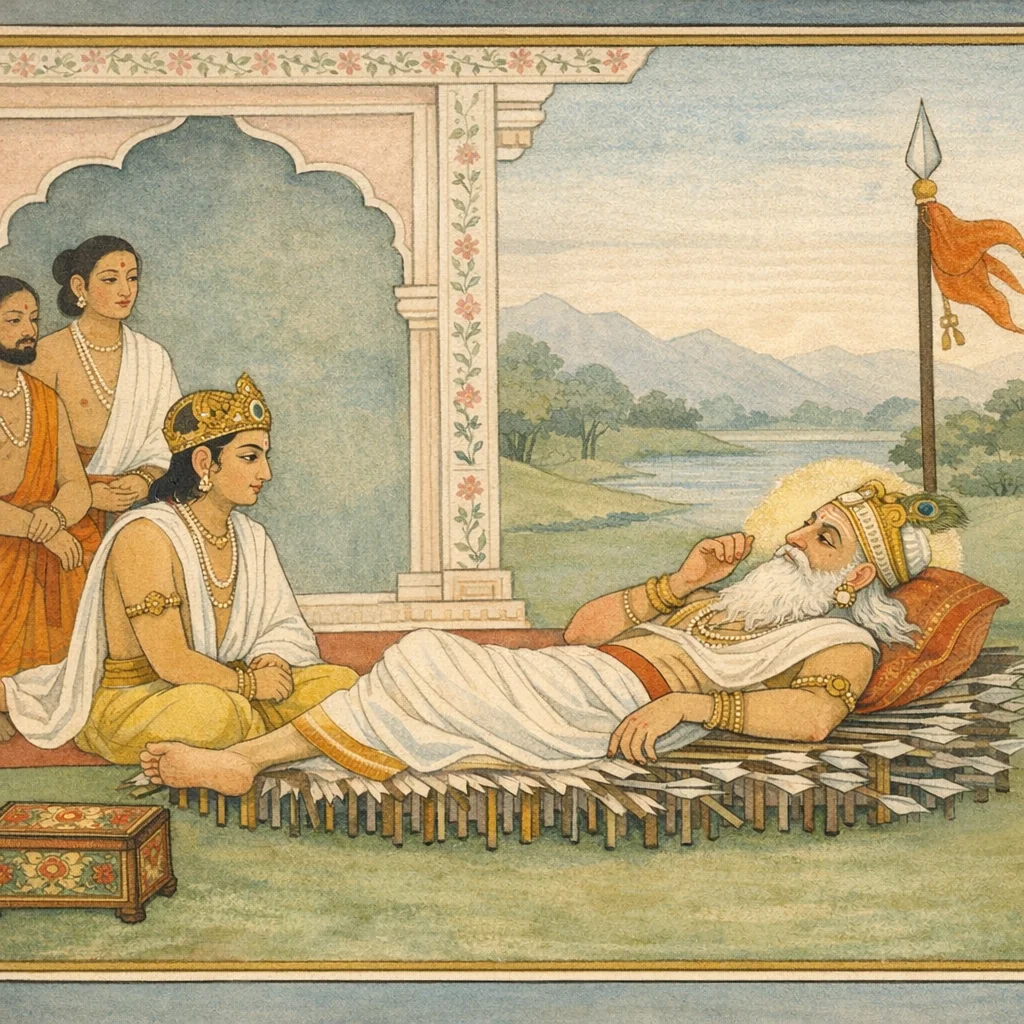
Adhyaya 134
Kośa-saṃjanana and Subtle Dharma (Treasury Formation and Fine-Grained Ethics)
Upa-parva: Rājadharmānuśāsana (Instruction on Royal Duty) — Treasury, Taxation, and Legitimate Exaction
Bhīṣma cites older brahma-gāthās on the pathways by which kings ‘generate the treasury’ (kośa-saṃjanana). He marks a boundary around wealth linked to yajña and devasva (sacred/sacrificial property), indicating it is not a legitimate target of royal seizure. By contrast, he permits a dhārmika king, under kṣātra authority, to take wealth from disruptive or non-contributing groups, provided the act serves public order and does not erode social trust. The discourse frames the king’s true ‘wealth’ as the people themselves—subjects are to be protected and supported; absent that relationship, royal wealth has no stable second foundation. Revenue is justified for two ends: state strength (balārtha) and ritual/public obligation (yajñārtha), aligning fiscal policy with security and normative continuity. Bhīṣma praises the ruler who removes resources from the ‘asādhu’ and reallocates to the ‘sādhu,’ treating redistribution as a dharma-informed corrective. The chapter closes by stressing dharma’s subtlety through natural analogies: just as small creatures and minute growths arise and persist, so too dharma operates in fine gradations; hence governance must apply discriminating judgment rather than uniform force.
Chapter Arc: युधिष्ठिर के मन में राज्य-धर्म का एक कठोर प्रश्न उठता है—राजा का ‘शासन’ कब आवश्यक हो जाता है, विशेषतः तब जब अहंकार से अंधा व्यक्ति कर्तव्य-अकर्तव्य भूलकर उत्पथ पर चल पड़े। → भीष्म राजधर्म की व्यावहारिक रीढ़ खोलते हैं: ‘कोश’ (राजकोष) का संग्रह और संरक्षण ही राज्य-बल का आधार है। परंतु यह संग्रह न तो केवल शुद्ध-सौच से स्वतः हो जाता है, न ही नृशंसता से टिकता है—राजा को मध्यम मार्ग साधना पड़ता है। → भीष्म का निर्णायक सूत्र: ‘अबलस्य कुतः कोशः, अकोशस्य कुतो बलम्’—बलहीन राजा का कोष नहीं टिकता, कोषहीन राजा की सेना नहीं, और बिना बल-कोष के राज्य-श्री भी नहीं। इसी के साथ वे चेताते हैं कि निरंकुश/निर्दय आचरण से समाज में भय और दस्यु-वृत्ति सहज उभरती है। → निष्कर्ष यह कि राजा को कोष का सत्कारपूर्वक संग्रह, सावधानी से पालन, और संरक्षण के बाद उचित उपयोग—तीनों करने चाहिए; साथ ही शासन का प्रयोग अहंकार-निवारण और लोक-रक्षा हेतु हो, न कि क्रूरता के लिए। दस्यु तक के लिए भी नीति है: ‘बलस्थोऽहम्’ के मद में नृशंस कर्म न करें, क्योंकि भय-आधारित व्यवस्था अंततः सबको असुरक्षित करती है। → राजा यदि मध्यम मार्ग छोड़ दे—अत्यधिक शौच-आदर्शवाद या अत्यधिक नृशंसता—तो आपत्ति-काल में कौन-सा उपाय धर्मसम्मत रह जाता है?
Shlokas
Verse 1
#द5>2/5-> (9) शीला - यथा--ुरोरप्यवलिप्तस्य कार्याकार्यमजानतः । उत्पथं प्रतिपन्नस्य कार्य भवति शासनम् || अर्थात् घमंडमें आकर कर्तव्य और अकर्तव्यका विचार न करते हुए कुमार्गपर चलनेवाले गुरुको भी दण्ड देना आवश्यक है। त्रयस्त्रिशर्दाधिकशततमोब& ध्याय: राजाके लिये कोशसंग्रहकी आवश्यकता, मर्यादाकी स्थापना और अमर्यादित दस्युवृत्तिकी निन््दा भीष्म उवाच स्वराष्ट्रात् परराष्ट्राच्च कोशं संजनयेन्नूप: । कोशाद्ि धर्म: कौन्तेय राज्यमूलं च वर्धते,भीष्मजी कहते हैं--युधिष्ठि! राजाको चाहिये कि वह अपने तथा शत्रुके राज्यसे धन लेकर खजानेको भरे। कोशसे ही धर्मकी वृद्धि होती है और राज्यकी जड़ें बढ़ती अर्थात् सुदृढ़ होती हैं
Bhishma said: “O son of Kunti, a king should build up his treasury by revenues drawn from his own realm and also from the enemy’s realm. For it is from the treasury that dharma is sustained and expanded, and the very foundations of the kingdom grow firm and strong.”
Verse 2
तस्मात् संजनयेत् कोशं सत्कृत्य परिपालयेत् । परिपाल्यानुतनुयादेष धर्म: सनातन:,इसलिये राजा कोशका संग्रह करे, संग्रह करके सादर उसकी रक्षा करे और रक्षा करके निरन्तर उसको बढ़ाता रहे; यही राजाका सदासे चला आनेवाला धर्म है
Therefore a king should build up the treasury, and having amassed it, he should guard it with due respect and careful administration. Having protected it, he should steadily augment it again and again. This is the ancient, time-honoured duty of kingship.
Verse 3
न कोश: शुद्धशौचेन न नृशंसेन जातुचित् । मध्यमं पदमास्थाय कोशसंग्रहणं चरेत्,जो विशुद्ध आचार-विचारसे रहनेवाला है, उसके द्वारा कभी कोशका संग्रह नहीं हो सकता। जो अत्यन्त क्रूर है, वह भी कदापि इसमें सफल नहीं हो सकता; अतः मध्यम मार्गका आश्रय लेकर कोश-संग्रह करना चाहिये
Bhishma said: A treasury is never amassed by one who clings only to spotless purity and scrupulous restraint; nor is it ever secured by one who is brutally cruel. Therefore, taking the middle course, one should pursue the gathering of revenue—so that prosperity is obtained without abandoning ethical conduct.
Verse 4
अबलस्य कुतः कोशो हाकोशस्य कुतो बलम् । अबलस्य कुतो राज्यमराज्ञ: श्रीर्भवेत् कुत:,यदि राजा बलहीन हो तो उसके पास कोश कैसे रह सकता है? कोशहीनके पास सेना कैसे रह सकती है? जिसके पास सेना ही नहीं है, उसका राज्य कैसे टिक सकता है और राज्यहीनके पास लक्ष्मी कैसे रह सकती है?
If a king is without strength, how can he have a treasury? If he has no treasury, how can he maintain an army? If he has no army, how can his kingdom endure? And if he is without a kingdom, how can prosperity (Lakshmi) abide with him?
Verse 5
उच्चैव॒त्ति: श्रियो हानिर्यथैव मरणं तथा । तस्मात् कोशं बलं मित्रमथ राजा विवर्धयेत्,जो धनके कारण ऊँचे तथा महत्त्वपूर्ण पदपर पहुँचा हुआ है, उसके धनकी हानि हो जाय तो उसे मृत्युके तुल्य कष्ट होता है, अतः राजाको कोश, सेना तथा मित्रकी संख्या बढ़ानी चाहिये
Bhishma said: For one who has risen to a high station through wealth and prosperity, the loss of that wealth brings anguish comparable to death itself. Therefore a king should steadily strengthen his treasury, his armed force, and his circle of allies.
Verse 6
हीनकोशं॑ हि राजानमवजानन्ति मानवा: । न चास्याल्पेन तुष्यन्ति कार्यमप्युत्सहन्ति च,जिस राजाके पास धनका भण्डार नहीं है, उसकी साधारण मनुष्य भी अवहेलना करते हैं। उससे थोड़ा लेकर लोग संतुष्ट नहीं होते हैं और न उसका कार्य करनेमें ही उत्साह दिखाते हैं
Bhishma said: People hold a king in contempt when his treasury is depleted. They are not satisfied with receiving only a little from him, and they also lack enthusiasm to carry out his tasks.
Verse 7
श्रियो हि कारणाद् राजा सत्क्रियां लभते पराम् | सास्य गूहति पापानि वासो गुह्यूमिव स्त्रिया:,लक्ष्मीके कारण ही राजा सर्वत्र बड़ा भारी आदर-सत्कार पाता है। जैसे कपड़ा नारीके गुप्त अंगोंको छिपाये रखता है, उसी प्रकार लक्ष्मी राजाके सारे दोषोंको ढक लेती है
Bhishma said: It is on account of prosperity (Lakshmi) that a king receives the highest honor and reverent service. That very prosperity conceals his faults and sins—just as a garment covers a woman’s private parts.
Verse 8
ऋद्धिमस्यानु तप्यन्ते पुरा विप्रकृता नरा: । शालावृका इवाजसंं जिघांसुमेव विन्दति,पहलेके तिरस्कृत हुए मनुष्य इस राजाकी बढ़ती हुई समृद्धिको देखकर जलते रहते हैं और अपने वधकी इच्छा रखनेवाले उस राजाका ही कपटपूर्वक आश्रय ले उसी तरह उसकी सेवा करते हैं, जैसे कुत्ते अपने घातक चाण्डालकी सेवामें रहते हैं
Bhishma said: Men who were formerly slighted and wronged burn with envy when they see this king’s prosperity steadily increasing. Yet, with deceitful intent, they still seek the very king’s shelter and serve him—much as dogs remain in attendance upon a murderous outcaste, even though he is bent on killing them.
Verse 9
ईदृशस्य कुतो राज्ञ: सुखं भवति भारत । उद्यच्छेदेव न नमेदुद्यमो होव पौरुषम्
Bhīṣma said: “O Bhārata, how could such a king ever find happiness? For true manly effort does not bend; like something held aloft, it does not bow down.”
Verse 10
अप्यरण्यं समाश्रित्य चरेन्मृगगणै: सह
Bhīṣma said: “Even taking refuge in the forest, one may live and move about in the company of herds of deer.”
Verse 11
भारत! डाकुओंको लूट-पाट या हिंसा आदि भयानक कर्मोके लिये अनायास ही सेना सुलभ हो जाती है। सर्वथा मर्यादाशून्य मनुष्यसे सब लोग उद्विग्न हो उठते हैं। केवल निर्दयतापूर्ण कर्म करनेवाले पुरुषकी ओरसे डाकू भी शंकित रहते हैं
O Bhārata, for robbers, a band of followers is obtained with little effort for dreadful deeds such as plunder and violence. Everyone becomes alarmed at a man who is utterly without restraint. Even robbers themselves remain suspicious and fearful of one who acts only with ruthless cruelty.
Verse 12
एकान्ततो हाामर्यादात् सर्वोडप्युद्धिजते जन: । दस्यवो<प्यभिशड्कन्ते निरनुक्रोशकारिण:,भारत! डाकुओंको लूट-पाट या हिंसा आदि भयानक कर्मोके लिये अनायास ही सेना सुलभ हो जाती है। सर्वथा मर्यादाशून्य मनुष्यसे सब लोग उद्विग्न हो उठते हैं। केवल निर्दयतापूर्ण कर्म करनेवाले पुरुषकी ओरसे डाकू भी शंकित रहते हैं
Bhishma said: From a person who is utterly without restraint and boundary, everyone becomes anxious and disturbed. Even robbers themselves feel suspicion and fear toward a man who acts with sheer mercilessness, O Bharata—because such unbounded cruelty makes society unsafe for all, including the wicked.
Verse 13
स्थापयेदेव मर्यादां जनचित्तप्रसादिनीम् । अल्पे>प्यर्थे च मर्यादा लोके भवति पूजिता,राजाको ऐसी ही मर्यादा स्थापित करनी चाहिये, जो सब लोगोंके चित्तको प्रसन्न करनेवाली हो। लोकमें छोटे-से काममें भी मर्यादाका ही मान होता है
Bhīṣma said: “A king should establish maryādā—proper boundaries and standards of conduct—that bring calm and satisfaction to the minds of the people. In the world, even in the smallest matters, it is propriety and due order (maryādā) that is honored.”
Verse 14
नायं लोको<$स्ति न पर इति व्यवसितो जन: । नालं गन्तुं हि विश्वासं नास्तिके भयशड्किते,संसारमें ऐसे भी मनुष्य हैं, जो यह निश्चय किये बैठे हैं कि 'यह लोक और परलोक हैं ही नहीं।' ऐसा नास्तिक मानव भयकी शंकाका स्थान है, उसपर कभी विश्वास नहीं करना चाहिये
Bhīṣma said: “There are people in this world who have settled into the conviction, ‘This world and the next do not exist.’ Such a nihilistic unbeliever becomes a source of fear and suspicion; one should never place trust in him.”
Verse 15
यथा सद्धिः परादानमहिंसा दस्युभि: कृता । अनुरज्यन्ति भूतानि समयदिषु दस्युषु,दस्युओंमें भी मर्यादा होती है, जैसे अच्छे डाकू दूसरोंका धन तो लूटते हैं, परंतु हिंसा नहीं करते (किसीकी इज्जत नहीं लेते)। जो मर्यादाका ध्यान रखते हैं, उन लुटेरोंमें बहुत-से प्राणी स्नेह भी करते हैं, (क्योंकि उनके द्वारा बहुतोंकी रक्षा भी होती है)
Bhīṣma said: “Just as even among bandits there can be a code of conduct—when ‘good’ robbers take others’ wealth yet refrain from violence—so living beings may even grow attached to bandits who observe agreed limits and conventions. For those who keep to a boundary of restraint can, in their own way, become acceptable and even protective to many.”
Verse 16
अयुद्धयमानस्य वधो दारामर्ष: कृतघ्नता | ब्रह्मवित्तस्य चादानं नि:शेषकरणं तथा,युद्ध न करनेवालेको मारना, परायी स्त्रीपर बलात्कार करना, कृतघ्नता, ब्राह्मणके धनका अपहरण, किसीका सर्वस्व छीन लेना, कुमारी कन््याका अपहरण करना तथा किसी ग्राम आदिपर आक्रमण करके स्वयं उसका स्वामी बन बैठना--ये सब बातें डाकुओंमें भी निन्दित मानी गयी हैं। इस्युको भी परस्त्रीका स्पर्श और उपर्युक्त सभी पाप त्याग देने चाहिये
Bhīṣma said: “To kill one who is not fighting, to violate another man’s wife, to be ungrateful, to seize the wealth of a knower of Brahman (a venerable brāhmaṇa), and likewise to strip someone of everything—these are acts condemned even among robbers.”
Verse 17
स्त्रिया मोष: पतिस्थान दस्युष्वेतद् विगर्हितम् । संश्लेषं च परस्त्रीभिवर्दस्युरेतानि वर्जयेत्,युद्ध न करनेवालेको मारना, परायी स्त्रीपर बलात्कार करना, कृतघ्नता, ब्राह्मणके धनका अपहरण, किसीका सर्वस्व छीन लेना, कुमारी कन््याका अपहरण करना तथा किसी ग्राम आदिपर आक्रमण करके स्वयं उसका स्वामी बन बैठना--ये सब बातें डाकुओंमें भी निन्दित मानी गयी हैं। इस्युको भी परस्त्रीका स्पर्श और उपर्युक्त सभी पाप त्याग देने चाहिये
Bhīṣma said: “Even among thieves, it is condemned to violate a woman, to steal what belongs to her husband’s household, and to consort with another man’s wife. Therefore, a robber too should abstain from these acts.”
Verse 18
अभिसंदधते ये च विश्वासायास्य मानवा: । अशेषमेवोपलभ्य कुर्वन्तीति विनिश्चय:,जिनका सर्वस्व लूट लिया जाता है, वे मनुष्य उन डाकुओंके साथ मेल-जोल और विश्वास बढ़ानेकी चेष्टा करते हैं और उनके स्थान आदिका पता लगाकर फिर उनका सर्वस्व नष्ट कर देते हैं, यह निश्चित बात है
Men whose all has been plundered still strive to associate with those robbers and to increase their trust; and once they learn their whereabouts and dwelling-places, they surely bring about the utter destruction of the robbers’ wealth—this is a settled certainty.
Verse 19
तस्मात् सशेषं कर्तव्यं स्वाधीनमपि दस्युभि: । न बलस्थो5हमस्मीति नृशंसानि समाचरेत्,इसलिये दस्युओंको उचित है कि वे दूसरोंके धनको अपने अधिकारमें पाकर भी कुछ शेष छोड़ दें, सारा-का-सारा न लूट लें। “मैं बलवान् हूँ” ऐसा समझकर क्रूरतापूर्ण बर्ताव न करें
Therefore, even robbers, though they may have brought another’s wealth under their control, should leave something behind and not plunder everything. Let no one, thinking “I stand on strength; I am powerful,” commit acts of cruelty.
Verse 20
स शेषकारिणतस्तत्र शेषं पश्यन्ति सर्वश: | नि:शेषकारिणो नित्यं नि:शेषकरणाद् भयम्,जो डाकू दूसरोंके धनको शेष छोड़ देते हैं, वे सब ओर अपने धनका भी अवशेष देख पाते हैं; तथा जो दूसरोंके धनमेंसे कुछ भी शेष नहीं छोड़ते, उन्हें सदा अपने धनके भी नि:शेष हो जानेका भय बना रहता है
Bhīṣma said: “Those who, in taking another’s wealth, leave something as a remainder, come to see remainders preserved for themselves on every side as well. But those who leave no remainder—who strip others completely—live constantly in fear that their own wealth too will be utterly exhausted.”
Verse 96
अप्यपर्वणि भज्येत न नमेतेह कस्यचित् | भारत! ऐसे नरेशको कैसे सुख मिलेगा? अतः राजाको सदा उद्यम ही करना चाहिये, किसीके सामने झुकना नहीं चाहिये; क्योंकि उद्यम ही पुरुषत्व है। जैसे सूखी लकड़ी बिना गाँठके ही टूट जाती है, परंतु झुकती नहीं है, उसी प्रकार राजा नष्ट भले ही हो जाय, परंतु उसे कभी दबना नहीं चाहिये
Bhīṣma said: “Even if he should break at an unseasonable point, let him not bow here before anyone. O Bhārata, how could such a king ever obtain happiness? Therefore a king should always exert himself and never stoop before another; for steadfast effort itself is manliness. As dry wood snaps without even forming a knot, yet does not bend, so too a king may perish, but he should never submit.”
Verse 103
न त्वेवोज्झितमयदिर्दस्युभि: सहितश्चरेत् । वह वनकी शरण लेकर मृगोंके साथ भले ही विचरे; किंतु मर्यादा भंग करनेवाले डाकुओंके साथ कदापि न रहे
Bhīṣma said: “One should never keep company with bandits who have cast off all restraint and violate the boundaries of dharma. It is better to take refuge in the forest and wander even among wild animals than to live, even for a moment, with lawless men who break the limits of dharma.”
Verse 131
दस्यूनां सुलभा सेना रौद्रकर्मसु भारत
Bhīṣma said: “O Bhārata, among men of a bandit-like nature, a fighting force is easily gathered—especially for harsh and violent undertakings.”
Verse 132
इस प्रकार श्रीमहाभारत शान्तिपर्वके अन्तर्गत आपद्धर्मपर्वमें राजर्षियोंका चरित्र नामक एक सौ बत्तीसवाँ अध्याय पूरा हुआ
Thus concludes the one hundred and thirty-second chapter, entitled “The Conduct of Royal Sages,” within the Āpaddharma section of the Śānti Parva of the Śrī Mahābhārata. This closing colophon signals the completion of a unit of instruction on dharma in times of crisis, framed through exemplary narratives of king-sages.
Verse 133
इति श्रीमहा भारते शान्तिपर्वणि आपद्धार्मपर्वणि त्रयस्त्रिंशयदधिकशततमो< ध्याय: ।। १२३३ ।। इस प्रकार श्रीमह्याभारत शान्तिपर्वके अन्तर्गत आपद्धर्मपर्वमें एक सौ तैंतीसवाँ अध्याय पूरा हुआ
Thus, in the Śrī Mahābhārata, within the Śānti Parvan—specifically in the section on Dharma in times of distress (Āpaddharma Parvan)—the one-hundred-and-thirty-third chapter concludes. This closing colophon marks the completion of the chapter in which Bhīṣma’s instruction to Yudhiṣṭhira continues to frame ethical conduct under crisis and constraint.
Frequently Asked Questions
How a ruler can lawfully build and use the treasury without violating sacred/ritual property or exploiting productive households, while still maintaining order by acting against disruptive or non-contributing actors.
Legitimate power is protection-based: the king’s fiscal claims are subordinate to welfare and order, and dharma must be applied with context-sensitive discernment because it operates in subtle gradations.
No explicit phalaśruti is stated in the provided passage; the meta-teaching appears implicitly through the closing analogies, emphasizing that understanding dharma requires attention to fine distinctions rather than relying on rigid general rules.