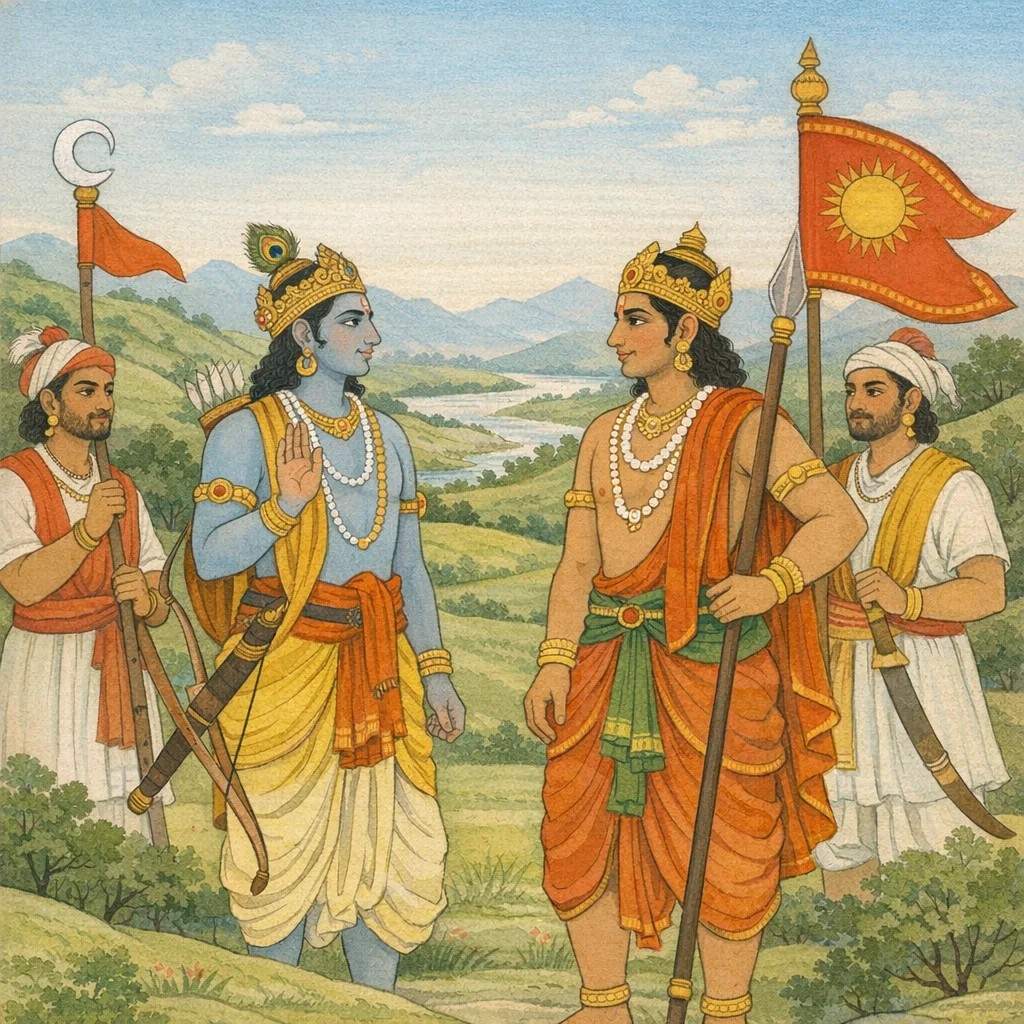
Adhyaya 26
Bhīmasena’s Eastern Digvijaya and the Cedi Reception (Sabhā-parva 26)
Upa-parva: Digvijaya (Bhīmasena’s Eastern Campaign) — Sabhā-parva Context Unit
Vaiśaṃpāyana narrates Bhīma’s eastward expedition undertaken with Yudhiṣṭhira’s consent. Bhīma advances with a substantial force, first stabilizing relations with the Pāñcālas through varied conciliatory measures. He then rapidly subdues Gandakī and Videha and proceeds to Daśārṇa, where King Sudharmā performs a striking act of resistance described as a major, non-weapon encounter; Bhīma, assessing capability and utility, appoints Sudharmā as a senior military leader (adhisenāpati), converting opposition into administrative support. Continuing his campaign, Bhīma defeats an ‘Aśvamedheśvara’ ruler and extends control over eastern territories, then turns south to Pulinda regions, bringing local rulers (Sukumāra; Sumitra) under authority. Acting under Yudhiṣṭhira’s directive, Bhīma approaches the powerful Cedi king Śiśupāla, who comes out to receive him; they exchange formal inquiries about their lineages, clarify Yudhiṣṭhira’s purpose, and regularize cooperation. Bhīma stays for thirty nights, honored by Śiśupāla, and departs with forces intact—an episode emphasizing institutional expansion through recognition, negotiation, and selective coercion.
Chapter Arc: Janamejaya’s hunger for ancestral glory flares again—he urges the sage to narrate the digvijaya in full, for his satisfaction is not yet quenched. → Vaishampayana turns the lens to Dhananjaya (Arjuna): with measured force he brings regions like Kulinda under sway, then meets a sterner test in the eastern king Bhagadatta, whose resistance stretches into an eight-day contest. → After eight days of battle, Bhagadatta—still unwearied—addresses Arjuna with admiration, naming him Indra’s son and acknowledging that such prowess befits him; the duel’s heat turns into a moment of recognition and choice. → Arjuna declares his purpose: not personal enmity, but Yudhishthira’s rajasuya—he asks Bhagadatta to give tribute and accept the dharmic overlordship of the truthful, sacrificial king. Bhagadatta consents, equating Arjuna and Yudhishthira in his regard and promising to do what is asked. → The digvijaya continues beyond Bhagadatta’s submission—new lands and kings await Arjuna’s approach.
Shlokas
Verse 1
जनमेजय बोले--ब्रह्मन्! दिग्विजयका विस्तार-पूर्वक वर्णन कीजिये। अपने पूर्वजोंके इस महान् चरित्रको सुनते-सुनते मेरी तृप्ति नहीं हो रही है
Janamejaya said: “O Brahmin, describe in full detail the conquest of the quarters. As I keep hearing of this great deed of my forefathers, my satisfaction is still not fulfilled.”
Verse 2
वैशम्पायन उवाच धनंजयस्य वक्ष्यामि विजयं पूर्वमेव ते । यौगपटद्येन पार्थहि निर्जितेयं वसुन्धरा,वैशम्पायनजी कहते हैं--राजन्! यद्यपि कुन्तीके चारों पुत्रोंने एक ही समय इन चारों दिशाओंकी पृथ्वीपर विजय प्राप्त की थी, तो भी पहले तुम्हें अर्जुनका दिग्विजयवृत्तान्त सुनाऊँगा
Vaiśampāyana said: “O King, I shall first recount to you the conquest of Dhanañjaya (Arjuna). Though the four sons of Pṛthā (Kuntī) subdued this earth simultaneously in the four directions, I will begin with Arjuna’s campaign.”
Verse 3
पूर्व कुलिन्दविषये वशे चक्रे महीपतीन् । धनंजयो महाबाहुर्नातितीव्रेण कर्मणा,महाबाहु धनंजयने अत्यन्त दुःसह पराक्रम प्रकट किये बिना ही पहले कुलिन्द देशके भूमिपालोंकोी अपने वशमें किया
Vaiśampāyana said: “In the land of the Kulindas, mighty-armed Dhanañjaya (Arjuna) brought the local kings under his control, without resorting to excessively harsh measures.”
Verse 4
आनर्तान् कालकूटांश्व कुलिन्दांश्न विजित्य सः । सुमण्डलं च विजितं कृतवान् सहसैनिकम्,कुलिन्दोंके साथ-साथ कालकूट और आनर्त देशके राजाओंको जीतकर सेनासहित राजा सुमण्डलको भी जीत लिया
Vaiśampāyana said: “Having subdued the kings of Ānarta, Kālakūṭa, and Kulinda, he also conquered King Sumaṇḍala together with his army.”
Verse 5
स तेन सहितो राजन् सव्यसाची परंतप: । विजिग्ये शाकल द्वीपं प्रतिविन्ध्यं च पार्थिवम्,राजन! तदनन्तर शत्रुओंको संताप देनेवाले सव्यसाची अर्जुनने सुमण्डलको साथी बना लिया और उनके साथ जाकर शाकलद्दीप तथा राजा प्रतिविन्ध्य-पर विजय प्राप्त की
Vaiśampāyana said: “O King, then Arjuna, the Savyasācī—scorcher of foes—took him as an ally and, with him, subdued Śākala-dvīpa; he also conquered King Prativindhya.”
Verse 6
शाकलद्दीपवासाश्च सप्तद्वीपेषु ये नृपा: । अर्जुनस्य च सैन्यैस्तैर्विग्रहस्तुमुलो5भवत्,शाकलद्दीप तथा अन्य सातों द्वीपोंमें जो राजा रहते थे, उनके साथ अर्जुनके सैनिकोंका घमासान युद्ध हुआ
Vaiśampāyana said: The kings who dwelt in Śākaladvīpa and in the other island-continents clashed fiercely with Arjuna’s forces; a tumultuous battle arose.
Verse 7
स तानपि महेष्वासान् विजिग्ये भरतर्षभ । तैरेव सहित: सर्व: प्राग्ज्योतिषमुपाद्रवत्,भरतकुलभूषण जनमेजय! अर्जुनने उन महान् धनुर्धरोंको भी जीत लिया और उन सबको साथ लेकर प्राग्ज्योतिषपुरपर धावा किया
Vaiśampāyana said: O bull among the Bharatas, Arjuna overcame even those mighty bowmen. Then, with all of them accompanying him, he advanced to assault Prāgjyotiṣa.
Verse 8
तत्र राजा महानासीद् भगदत्तो विशाम्पते । तेनासीत् सुमहद् युद्ध पाण्डवस्य महात्मन:,महाराज! प्राग्ज्योतिषपुरके प्रधान राजा भगदत्त थे। उनके साथ महात्मा अर्जुनका बड़ा भारी युद्ध हुआ
Vaiśampāyana said: “There, O lord of the people, was the mighty king Bhagadatta. With him the noble Pāṇḍava (Arjuna) fought a very great battle.”
Verse 9
स किरातैश्न चीनैश्व वृतः प्राग्ज्योतिषो5भवत् | अन्यैश्न बहुभियोंधे: सागरानूपवासिभि:,प्राग्ज्योतिषपुरके नरेश किरात, चीन तथा समुद्रके टापुओंमें रहनेवाले अन्य बहुतेरे योद्धाओंसे घिरे हुए थे
Vaiśampāyana said: The king of Prāgjyotiṣa was surrounded by Kirātas and Cīnas, and also by many other warriors who dwelt along the seacoasts and in the marshy littoral regions.
Verse 10
ततः स दिवसानष्टौ योधयित्वा धनंजयम् | प्रहसन्नब्रवीद् राजा संग्रामविगतक्लमम्,राजा भगदत्तने अर्जुनके साथ आठ दिनोंतक युद्ध किया, तो भी उन्हें युद्धसे थकते न देख वे हँसते हुए बोले--
Then that king, having fought with Dhanañjaya for eight days and seeing him unwearied in battle, spoke with a smile—
Verse 11
“महाबाहु कौरवनन्दन! तुम इन्द्रके पुत्र और संग्राममें शोभा पानेवाले शूरवीर हो। तुममें ऐसा बल और पराक्रम उचित ही है
Vaiśampāyana said: “O mighty-armed scion of the Kuru line! You are the son of Indra, a heroic warrior who shines in battle. Such strength and valor in you are only fitting.”
Verse 12
अहं सखा महेन्द्रस्य शक्रादनवरो रणे । न शक्ष्यामि च ते तात स्थातुं प्रमुखतो युधि,“मैं देवराज इन्द्रका मित्र हूँ और युद्धमें उनसे तनिक भी कम नहीं हूँ, बेटा! तो भी मैं संग्राममें तुम्हारे सामने खड़ा नहीं हो सकूँगा
Vaiśaṃpāyana said: “I am a friend of Mahendra (Indra), and in battle I am not inferior even to Śakra. Yet, dear child, I will not be able to stand facing you in the forefront of war.”
Verse 13
उपपन्नं महाबाहो त्वयि कौरवनन्दन । पाकशासनदायादे वीर्यमाहवशोभिनि,त्वमीप्सितं पाण्डवेय ब्रूहि किं करवाणि ते । यद् वक्ष्यसि महाबाहो तत् करिष्यामि पुत्रक 'पाण्डुनन्दन! तुम्हारी इच्छा क्या है, बताओ? मैं तुम्हारा कौन-सा प्रिय कार्य करूँ? वत्स! महाबाहो! तुम जो कहोगे, वही करूँगा”
Vaiśaṃpāyana said: “O mighty-armed son of the Kurus, heir of Pākaśāsana (Indra), your valor—splendid in battle—befits you fully. O son of Pāṇḍu, tell me what you desire: what dear service shall I do for you? Whatever you command, O mighty-armed one, my child, that I will surely do.”
Verse 14
अजुन उवाच कुरूणामृषभो राजा धर्मपुत्रो युधिष्ठिर: । धर्मज्ञ: सत्यसंधश्न यज्वा विपुलदक्षिण:,अर्जुन बोले--महाराज! धर्मज्ञ सत्यप्रतिज्ञ कुरु-कुलरत्न धर्मपुत्र राजा युधिष्ठिर बहुत दक्षिणा देकर राजसूययज्ञ करनेवाले हैं। मैं चाहता हूँ वे चक्रवर्ती सम्राट् हों। आप उन्हें कर दीजिये। आप मेरे पिताके मित्र हैं और मुझसे भी प्रेम रखते हैं; अतः मैं आपको आज्ञा नहीं दे सकता। आप प्रेमभावसे ही उन्हें भेंट दीजिये
Arjuna said: “Yudhiṣṭhira, the son of Dharma, is the king—the foremost among the Kurus. He is a knower of dharma, steadfast in truth, and a sacrificer who gives abundant gifts.”
Verse 15
तस्य पार्थिवतामीप्से करस्तस्मै प्रदीयताम् । भवान् पितृसखा चैव प्रीयमाणो मयापि च । ततो नाज्ञापयामि त्वां प्रीतिपूर्व प्रदीयताम्,अर्जुन बोले--महाराज! धर्मज्ञ सत्यप्रतिज्ञ कुरु-कुलरत्न धर्मपुत्र राजा युधिष्ठिर बहुत दक्षिणा देकर राजसूययज्ञ करनेवाले हैं। मैं चाहता हूँ वे चक्रवर्ती सम्राट् हों। आप उन्हें कर दीजिये। आप मेरे पिताके मित्र हैं और मुझसे भी प्रेम रखते हैं; अतः मैं आपको आज्ञा नहीं दे सकता। आप प्रेमभावसे ही उन्हें भेंट दीजिये
Arjuna said: “I desire that he attain sovereign kingship; therefore let the tribute be given to him. You are my father’s friend, and you are also dear to me; for that reason I do not command you. Give it willingly, out of affection.”
Verse 16
भगदत्त उवाच कुन्तीमातर्य था मे त्वं तथा राजा युधिष्ठिर: । सर्वमेतत् करिष्यामि कि चान्यत् करवाणि ते,भगदत्तने कहा--कुन्तीकुमार! मेरे लिये जैसे तुम हो वैसे राजा युधिष्ठिर हैं, मैं यह सब कुछ करूँगा। बोलो, तुम्हारे लिये और क्या करूँ?
Bhagadatta said: “O son of Kuntī, to me you are as dear and as worthy as King Yudhiṣṭhira. I will do all this. Tell me—what else shall I do for you?”
Verse 26
इति श्रीमहाभारते सभापर्वणि दिग्विजयपर्वणि अर्जुनदिग्विजये भगदत्तपराजये षड्विंशो5ध्याय:
Thus, in the Śrī Mahābhārata, within the Sabhā Parva, in the Digvijaya section—telling of Arjuna’s digvijaya and the defeat of Bhagadatta—ends the twenty-sixth chapter.
Frequently Asked Questions
The chapter presents the tension between coercive conquest and ethical consolidation: Bhīma must secure submission for Yudhiṣṭhira’s imperial project while minimizing destabilization, choosing incorporation (e.g., appointing Sudharmā) over punitive annihilation.
Effective governance is shown as authorization-driven, protocol-sensitive expansion: legitimacy is strengthened when power is exercised with restraint, when capable opponents are integrated, and when political aims are communicated transparently to regional rulers.
No explicit phalaśruti appears in this excerpt; its meta-function is structural—documenting how digvijaya supports the rājasūya framework by converting regional encounters into recognized overlordship and stable alliances.