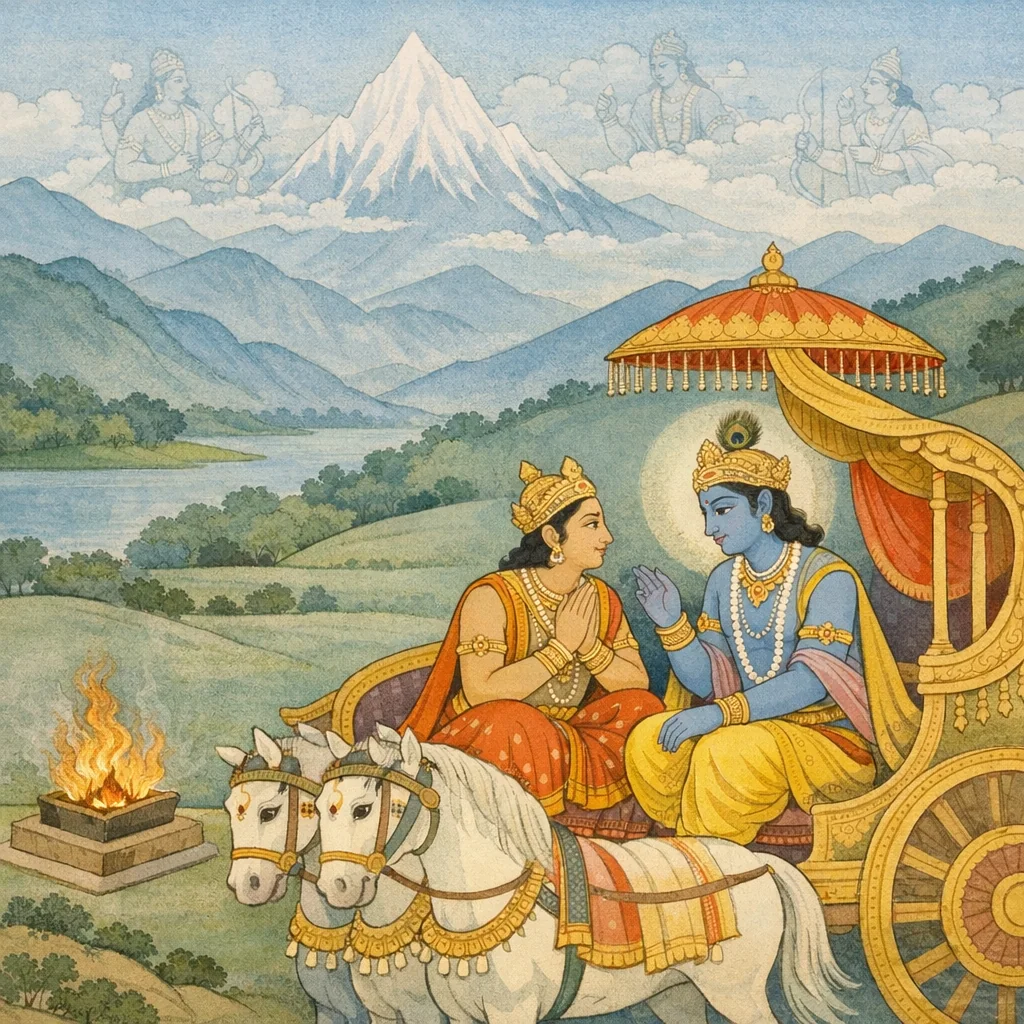
Adhyaya 35
Kṣetra–Kṣetrajña-Jñāna–Jñeya-Viveka (Field, Knower, Knowledge, and the Knowable)
Upa-parva: Bhagavad Gītā Parva (Kṣetra–Kṣetrajña-Vijñāna Context)
Śrī Kṛṣṇa defines the body as kṣetra (field) and the one who knows it as kṣetrajña, identifying himself as the universal kṣetrajña present in all fields. He outlines what constitutes the ‘field’ by listing ontic and psychological components (mahābhūtas, ahaṃkāra, buddhi, avyakta; senses and their objects; desire, aversion, pleasure, pain, aggregation, consciousness, and resolve). He then enumerates the marks of jñāna as cultivated dispositions (e.g., humility, non-violence, patience, purity, steadiness, self-control, detachment, equanimity, unwavering devotion, solitude, and commitment to adhyātma-jñāna). Next, he characterizes the jñeya (the knowable) as beginningless Brahman/Paramātman, described via paradoxical attributes: all-pervading yet subtle, unmoving yet moving, without guṇas yet experiencing guṇas, sustaining and transcending beings. The chapter further distinguishes prakṛti and puruṣa as beginningless, explains agency and enjoyment through their conjunction, and presents multiple approaches to realization (meditation, sāṃkhya-yoga, karma-yoga, and receptive learning). It culminates in the liberative discernment that sees the same Lord equally present in all beings, recognizes actions as proceeding from prakṛti, and understands the difference between kṣetra and kṣetrajña with the ‘eye of knowledge’—a discernment linked to release from bhūta-prakṛti entanglement.
Chapter Arc: Arjuna, overwhelmed by what he has heard, proclaims Krishna as the Supreme Brahman—parama dhāma, parama pavitra—citing the testimony of seers and the inner certainty of his own heart. → Having accepted Krishna’s words as wholly true—beyond the grasp of gods and demons—Arjuna’s hunger to know intensifies; he begs again for an expansive telling of Krishna’s yoga-power and vibhūtis, for the nectar of that hearing never satiates him. → Krishna’s vibhūti-declarations crest in sweeping identifications—among Rudras, Śaṅkara; among Yakṣas and Rākṣasas, Kubera; among Vasus, Fire; among mountains, Meru—each a thunderclap of presence that turns the world into a litany of the Divine. → Krishna closes the catalogue with a boundary-statement: there is no end to His divine manifestations; what has been spoken is only an indication, a brief pointing toward the infinite. → “What need is there of knowing all this in detail?”—Krishna hints at a greater revelation: with a single fragment of Himself He pervades and sustains the entire universe, preparing the mind for the vision that must follow.
Shlokas
Verse 10
इति श्रीमहाभारते भीष्मपर्वणि श्रीमद्धगवदगीतापर्वणि श्रीमद्भगवद्गीतासूपनिषत्तसु ब्रह्मुविद्यायां योगशास्त्रे श्रीकृष्णार्जुनसंवादे विभूतियोगो नाम दशमो<थध्याय:
Thus, within the Mahābhārata, in the Bhīṣma Parva, in the section known as the Śrīmad Bhagavad Gītā, among its Upaniṣadic teachings—on the knowledge of Brahman and the discipline of Yoga—within the dialogue between Śrī Kṛṣṇa and Arjuna, ends the tenth chapter, called “Vibhūti Yoga” (The Yoga of Divine Manifestations).
Verse 12
अर्जुन बोले--आप परम ब्रह्म, परम धाम और परम पवित्र हैं;* क्योंकि आपको सब ऋषिगणः सनातन, दिव्य पुरुष एवं देवोंका भी आदिदेव, अजन्मा और सर्वव्यापी कहते हैं। वैसे ही देवर्षिः नारद तथा असित और देवल ऋषि तथा महर्षि व्यास भी कहते हैं? और स्वयं आप भी मेरे प्रति कहते हैं;
Arjuna said: “You are the Supreme Brahman, the highest abode, and the utmost purity; for all the seers proclaim You as the eternal, divine Person—the primal God even of the gods—unborn and all-pervading. Thus speak the divine sage Nārada, and Asita, Devala, and the great sage Vyāsa; and You Yourself also declare this to me.”
Verse 13
आहुस्त्वामृषय:” सर्वे देवर्षिनारिदस्तथा । असितो देवलो व्यास: स्वयं चैव ब्रवीषि मे,अर्जुन बोले--आप परम ब्रह्म, परम धाम और परम पवित्र हैं;* क्योंकि आपको सब ऋषिगणः सनातन, दिव्य पुरुष एवं देवोंका भी आदिदेव, अजन्मा और सर्वव्यापी कहते हैं। वैसे ही देवर्षिः नारद तथा असित और देवल ऋषि तथा महर्षि व्यास भी कहते हैं? और स्वयं आप भी मेरे प्रति कहते हैं;
Arjuna said: “All the seers declare You to be thus; and so does the divine sage Nārada. Likewise Asita, Devala, and Vyāsa affirm it. And You Yourself also tell me the same.”
Verse 14
सर्वमेतदृतं मनन््ये यनन््मां वदसि केशव । नहि ते भगवन् व्यक्ति विदुर्देवा न दानवा:,हे केशव!* जो कुछ भी मेरे प्रति आप कहते हैं, इस सबको मैं सत्य मानता हूँ। हे भगवन्!" आपके लीलामय स्वरूपको न तो दानव जानते हैं न देवता ही?
Arjuna said: “O Keśava, I accept as true all that You say to me. For, O Blessed Lord, neither the gods nor the demons truly know the full reality of Your manifested being.”
Verse 15
स्वयमेवात्मना55त्मान वेत्थ त्वं पुरुषोत्तम । भूतभावन भूतेश देवदेव जगत्पते,हे भूतोंको उत्पन्न करनेवाले! हे भूतोंके ईश्वर! हे देवोंके देव! हे जगत्के स्वामी! हे पुरुषोत्तम! आप स्वयं ही अपनेसे अपनेको जानते हैं*
Arjuna said: “O Supreme Person, You alone know Yourself by Your own Self. O originator of all beings, Lord of beings, God of gods, and Master of the universe—Your true nature is self-revealed and cannot be fully grasped by others.”
Verse 16
वक्तुमर्हस्यशेषेण दिव्या ह्यात्मविभूतय: । याभिविंभूतिभिलोंकानिमांस्त्वं व्याप्प तिष्ठसि,इसलिये आप ही उन अपनी दिव्य विभूतियोंको सम्पूर्णतासे कहनेमें समर्थ हैं, जिन विभूतियोंके द्वारा आप इन सब लोकोंको व्याप्त करके स्थित हैं
Arjuna said: “You alone are fully able to describe, without omission, Your divine manifestations—those very powers by which You pervade and sustain all these worlds.”
Verse 17
कथं विद्यामहं योगिंस्त्वां सदा परिचिन्तयन् । केषु केषु च भावेषु चिन्त्योडसि भगवन् मया,हे योगेश्वर! मैं किस प्रकार निरन्तर चिन्तन करता हुआ आपको जानूँ और हे भगवन्! आप किन-किन भावोंमें मेरे द्वारा चिन्तन करनेयोग्य हैं?
Arjuna said: “How am I to truly know You, O supreme Yogi, by constantly meditating upon You? And, O Blessed Lord, in what particular states, aspects, or manifestations should You be contemplated by me?”
Verse 18
विस्तरेणात्मनो योगं विभूतिं च जनार्दन | भूय: कथय तृप्तिहिं शृण्वतो नास्ति मेडमृतम्,हे जनार्दन!* अपनी योगशक्तिको और विभूतिको फिर भी विस्तारपूर्वक कहिये; क्योंकि आपके अमृतमय वचनोंको सुनते हुए मेरी तृप्ति नहीं होतीर अर्थात् सुननेकी उत्कण्ठा बनी ही रहती है
Arjuna said: “O Janārdana, describe again—at length—Your own divine yoga and Your manifestations. For as I listen to Your nectar-like words, I do not feel satisfied; my longing to hear more never ceases.”
Verse 19
सम्बन्ध-- अजुनिके द्वार योग और विथूतियोंका विस्तार-पूर्वक पूर्णरूपसे वर्णन करनेके लिये प्रार्थना की जानेपर भगवान् पहले अपने विस्तारकी अनन्तता बतलाकर प्रधानतासे अपनी विभूतियोंका वर्णन करनेकी प्रतिज्ञा करते हैं-- श्रीभगवानुवाच हन्त ते कथयिष्यामि दिव्या ह्यात्मविभूतय: । प्राधान्यत: कुरुश्रेष्ठ नास्त्यन्तो विस्तरस्य मे,श्रीभगवान् बोले--हे कुरुश्रेष्ठ] अब मैं जो मेरी दिव्य विभूतियाँ हैं, उनको तेरे लिये प्रधानतासे कहूँगा; क्योंकि मेरे विस्तारका अन्त नहीं है*
The Blessed Lord said: “Very well—listen. I shall tell you of My own divine manifestations, O best of the Kurus, but only in their principal forms; for there is no end to the vastness of My expanse.”
Verse 20
सम्बन्ध-- अब अपनी प्रतिज्ञाके अनुसार भगवान् बीसवेंसे उनतालीसवें #लोकतक पहले अपनी विशभ्ूूतियों-का वर्णन करते हैं-- अहमात्मा गुडाकेश” सर्वभूताशयस्थित: । अहमादिदश्नव मध्यं च भूतानामन्त एव च,हे अर्जुन! मैं सब भूतोंके हृदयमें स्थित सबका आत्मा हूँ तथा सम्पूर्ण भूतोंका आदि, मध्य और अन्त भी मैं ही हूँ
O Gudakesha (Arjuna), I am the Self abiding in the heart of all beings; and I am also the beginning, the middle, and the end of all beings.
Verse 21
आदित्यानामहं विष्णुज्योतिषां रविरंशुमान् | मरीचिर्मरुतामस्मि नक्षत्राणामहं शशी,मैं अदितिके बारह पुत्रोंमें विष्णु और ज्योतियोंमें किरणोंवाला सूर्य हूँ: तथा मैं उनचास वायु-देवताओंका तेज” और नक्षत्रोंका अधिपति चन्द्रमा हूँ
Among the Ādityas I am Viṣṇu; among luminous bodies I am the radiant Sun; among the Maruts I am Marīci; and among the stars I am the Moon.
Verse 22
वेदानां सामवेदो5स्मि देवानामस्मि वासव: । इन्द्रियाणां मनश्लास्मि भूतानामस्मि चेतना,मैं वेदोंमें सामवेद हूँ, देवोंमें इन्द्र हूँ, इन्द्रियोंमें मन हूँ और भूतप्राणियोंकी चेतना अर्थात् जीवनी शक्ति हूँ
Among the Vedas I am the Sāma Veda; among the gods I am Vāsava (Indra). Among the senses I am the mind; and among living beings I am consciousness—the inner life-force.
Verse 23
रुद्राणां शंकरश्नास्मि वित्तेशो यक्षरक्षसाम् | वसूनां पावकश्नास्मि मेर: शिखरिणामहम्
Among the Rudras I am Śaṅkara; among Yakṣas and Rākṣasas I am the Lord of Wealth. Among the Vasus I am Fire, and among mountains I am Meru.
Verse 24
मैं एकादश रुद्रोंमें शंकर हूँ और यक्ष तथा राक्षसोंमें धनका स्वामी कुबेर हूँ। मैं आठ वसुओंमें अग्नि हूँः और शिखरवाले पर्वतोंमें सुमेरु पर्वत हूँ ।। पुरोधसां च मुख्य॑ मां विद्धि पार्थ बृहस्पतिम् । सेनानीनामहं स्कन्द: सरसामस्मि सागर:
Among the eleven Rudras, I am Śaṅkara (Śiva); and among the Yakṣas and Rākṣasas, I am Kubera, lord of wealth. Among the eight Vasus, I am Agni (Fire); and among the peak-crowned mountains, I am Mount Sumeru.
Verse 25
पुरोहितोंमें मुखिया बृहस्पति मुझको जानःं। हे पार्थ! मैं सेनापतियोंमें स्कन्द" और जलाशयोंमें समुद्र हूँ ।। महर्षीणां भगुरहं गिरामस्म्येकमक्षरम् । यज्ञानां जपयज्ञोडस्मि स्थावराणां हिमालय:,मैं महर्षियोंमें भगुः और शब्दोंमें एक अक्षर अर्थात् ओंकार हूँ। सब प्रकारके यज्ञोंमें जपयज्ञः और स्थिर रहनेवालोंमें हिमालय पहाड़ हूँ:
Know Me, O Pārtha, as Bṛhaspati, foremost among priests; among commanders I am Skanda; among bodies of water I am the ocean. Among the great seers I am Bhṛgu; among uttered sounds I am the single imperishable syllable, Oṁ. Among sacrifices I am the sacrifice of repetition (japa); and among the immovable, I am the Himālaya.
Verse 26
अश्र॒त्थ: सर्ववृक्षाणां देवर्षीणां च नारद: । गन्धर्वाणां चित्ररथ: सिद्धानां कपिलो मुनि:
Among all trees I am the aśvattha (the sacred fig); among the divine seers I am Nārada; among the Gandharvas I am Citraratha; and among the Siddhas I am the sage Kapila.
Verse 27
मैं सब वृक्षोंमें पीपलका वृक्ष, देवर्षियोंमें नारद मुनि5, गन्धर्वोमें चित्ररथरः और सिद्धोंमें कपिल मुनि हूँ? ।। उच्चै:श्रवसमश्चानां विद्धि माममृतोद्धवम् | ऐरावतं गजेन्द्राणां नराणां च नराधिपम्,घोड़ोंमें अमृतके साथ उत्पन्न होनेवाला उच्चै:श्रवा नामक घोड़ा, श्रेष्ठ हाथियोंमें ऐरावत नामक हाथी और मनुष्योंमें राजा5 मुझको जान
Among all trees I am the aśvattha (the sacred fig); among the divine seers I am Nārada; among the Gandharvas I am Citraratha; and among the Siddhas I am the sage Kapila. Among horses know Me as Uccaiḥśravas, born along with the nectar of immortality; among the foremost elephants I am Airāvata; and among human beings I am the sovereign king.
Verse 28
आयुधानामहं वज्ं धेनूनामस्मि कामधुक् । प्रजनश्वास्मि कन्दर्प: सर्पाणामस्मि वासुकि:,मैं शास्त्रोंमें वज्ञः और गौओंमें कामधेनुउ हूँ। शास्त्रोक्त रीतिसे संतानकी उत्पत्तिका हेतु कामदेव हूँ और सर्पोर्में सर्पराज वासुकि5 हूँ
Among weapons I am the vajra, the thunderbolt; among cows I am Kāmadhenu, the wish-fulfilling cow. I am also Kandarpa (Kāmadeva), the cause of procreation according to sacred ordinance; and among serpents I am Vāsuki, the king of snakes.
Verse 29
अनन्तश्नास्मि नागानां वरुणो यादसामहम् | पितृणामर्यमा चास्मि यम: संयमतामहम्,मैं नागोंमें शेषनागल और जलचरोंका अधिपति वरुणदेवता* हूँ और पितरोंमें अर्यमा* नामक पितर तथा शासन करनेवालोंमें यमराज- मैं हूँ
Among the Nāgas I am Ananta (Śeṣa); among the beings of the waters I am Varuṇa, their sovereign. Among the Pitṛs I am Aryaman; and among those who restrain and administer justice, I am Yama.
Verse 30
प्रह्नादश्षास्मि दैत्यानां काल:*? कलयतामहम् । मृगाणां च मृगेन्द्रो5हं वैनतेयश्व॒ पक्षिणाम्,मैं दैत्योंमें प्रह्माद-* और गणना करनेवालोंका समय हूँ तथा पशुओंमें मृगराज-5 सिंह और पक्षियोंमें मैं गरुड़४ हूँ
Among the Daityas I am Prahlāda; among those who reckon and measure, I am Time itself. Among beasts I am the lord of beasts, the lion; and among birds I am Vainateya (Garuḍa).
Verse 31
पवन: पवतामस्मि राम: शस्त्रभृतामहम् । झषाणां मकरक्चास्मि स्रोतसामस्मि जाह्नवी,मैं पवित्र करनेवालोंमें वायु और शस्त्रधारियोंमें श्रीरामः हूँ तथा मछलियोंमें मगरः हूँ और नदियोंमें श्रीभागीरथी गंगाजी हूँ:
Among purifiers I am the wind; among those who bear weapons I am Rāma. Among fishes I am the makara, and among flowing rivers I am the Jāhnavī (the Gaṅgā).
Verse 32
सर्गाणामादिरन्तश्न मध्यं चैवाहमर्जुन । अध्यात्मविद्या विद्यानां वाद: प्रवदतामहम्,हे अर्जुन! सृष्टियोंका आदि और अन्त तथा मध्य भी मैं ही हूँ। मैं विद्याओंमें अध्यात्मविद्यारं अर्थात् ब्रह्मविद्या और परस्पर विवाद करने-वालोंका तत्त्व- निर्णयके लिये किया जानेवाला वाद” हूँ
O Arjuna, of all creations I am their beginning, their end, and their very middle. Among branches of knowledge I am the knowledge of the Self (brahma-vidyā); and among those who speak and debate, I am the disciplined inquiry (vāda) that seeks truth and right conclusion.
Verse 33
अक्षराणामकारो<स्मि द्वन्दः सामासिकस्य च | अहमेवाक्षय: कालो धाताहं विश्वतोमुख:,मैं अक्षरोंमें अकार* हूँ और समासोंमें द्वन्द्ध/ नामक समास हूँ। अक्षय काल* अर्थात् कालका भी महाकाल तथा सब ओर मुखवाला विराट्स्वरूप, सबका धारण-पोषण करनेवाला भी मैं ही हूँ
Among letters I am “a,” the primal sound; among compound formations I am the dvandva, the pairing that holds equals together. I am also imperishable Time—Mahākāla. And I am the universal sustainer, with faces turned in every direction, bearing and nourishing the whole world.
Verse 34
मृत्यु: सर्वहरश्चाहमुद्धवश्व भविष्यताम् । कीर्ति: श्रीर्वाक् च नारीणां स्मृतिर्मेधा धृति: क्षमा,मैं सबका नाश करनेवाला मृत्यु और उत्पन्न होनेवालोंका उत्पत्तिहेतुई हूँ तथा स्त्रियोंमें कीर्ति, श्री, वाकू, स्मृति, मेधा, धृति और क्षमाः हूँ
The Blessed Lord declares: “I am Death, the all-seizing end that takes everything away; and I am also the source from which all beings yet to arise come forth. Among women, I am fame and auspicious fortune; I am speech, memory, intelligence, steadfastness, and forgiveness.”
Verse 35
बृहत्साम तथा साम्नां गायत्री छन््दसामहम् । मासानां मार्गशीर्षो5हमृतूनां कुसुमाकर:,तथा गायन करनेयोग्य श्रुतियोंमें मैं बृहत्सामः और हन्दोंमें गायत्री छन्द हूँ तथा महीनोंमें मार्गशीर्षण और ऋतुओंमें वसन्तः मैं हूँ
The Blessed Lord declares: “Among the Sāman chants I am the majestic Bṛhatsāman; among metres I am the Gāyatrī; among months I am Mārgaśīrṣa; and among seasons I am spring, the maker of blossoms.”
Verse 36
द्यूतं छलयतामस्मि तेजस्तेजस्विनामहम् । जयो<स्मि व्यवसायो<स्मि सत्त्वं सत्ववतामहम्,मैं छल करनेवालोंमें जूआः और प्रभावशाली पुरुषोंका प्रभाव हूँ। मैं जीतनेवालोंका विजय हूँ। निश्चय करनेवालोंका निश्चय और सात््विक पुरुषोंका सात््विकभावः हूँ
The Blessed Lord declares: “I am gambling among those who deceive; I am the splendor of the splendid. I am victory among the victorious; I am firm resolve among the resolute; and I am the pure inner strength of those who are steadfast in goodness.”
Verse 37
वृष्णीनां वासुदेवो5स्मि पाण्डवानां धनंजय: । मुनीनामप्यहं व्यास: कवीनामुशना कवि:,वृष्णिवंशियोंमें वासुदेवः अर्थात् मैं स्वयं तेरा सखा, पाण्डवोंमें धनंजयडें अर्थात् तू, मुनियोंमें वेदव्यास* और कवियोंमें शुक्राचार्य कवि* भी मैं ही हूँ [
The Lord declares: “Among the Vṛṣṇis I am Vāsudeva (Kṛṣṇa); among the Pāṇḍavas I am Dhanañjaya (Arjuna); among sages I am Vyāsa; and among poets I am Uśanā (Śukrācārya).”
Verse 38
दण्डो दमयतामस्मि नीतिरस्मि जिगीषताम् । मौनं चैवास्मि गुह्मानां ज्ञानं ज्ञानवतामहम्?,मैं दमन करनेवालोंका दण्ड* अर्थात् दमन करनेकी शक्ति हूँ, जीतनेकी इच्छावालोंकी नीतिः* हूँ, गुप्त रखनेयोग्य भावोंका रक्षक मौनः हूँ और ज्ञानवानोंका तत्त्वज्ञान मैं ही हूँ
The Blessed Lord declares: “Among those who restrain, I am the rod of discipline—the power to subdue; among those who seek victory, I am right policy and statecraft; among what must be kept secret, I am the guarding silence; and among the wise, I am true knowledge.”
Verse 39
यच्चापि सर्वभूतानां बीजं तदहमर्जुन । न तदस्ति विना यत् स्यान्मया भूतं चराचरम्,और हे अर्जुन! जो सब भूतोंकी उत्पत्तिका कारण है, वह भी मैं ही हूँ;+ क्योंकि ऐसा चर और अचर कोई भी भूत नहीं है, जो मुझसे रहित हों
O Arjuna, whatever is the seed—the originating cause—of all beings, that too am I. For there exists no being, moving or unmoving, that could be without Me.
Verse 40
नान्तो$स्ति मम दिव्यानां विभूतीनां परंतप । एष तूद्देशतः प्रोक्तो विभूतेर्विस्तरो मया,है परंतप! मेरी दिव्य विभूतियोंका अन्त नहीं है, मैंने अपनी विभूतियोंका यह विस्तार तो तेरे लिये एकदेशसे अर्थात् संक्षेपसे कहा है
Arjuna, scorcher of foes, there is no end to My divine manifestations. What I have stated to you is only a brief indication—an illustrative outline—of the vast expanse of My vibhūtis.
Verse 41
सम्बन्ध-- अठारहवें श्लोकमें अर्जुनने भगवान्सें उनकी विश्रूति और योगशक्तिका वर्णन करनेकी प्रार्थना की थी; उसके अनुसार भगवान् अपनी दिव्य विभूतियोंका वर्णन समाप्त करके अब संक्षेप्में अपनी योगशक्तिका वर्णन करते हैं-- यद् यद् विभूतिमत् सत्त्वं श्रीमदूर्जितमेव वा ।। तत् तदेवावगच्छ त्वं मम तेजों5शसम्भवम्,जो-जो भी विभूतियुक्त अर्थात् ऐश्वर्ययुक्त, कान्तियुक्त और शक्तियुक्त वस्तु है, उस-उसको तू मेरे तेजके अंशकी ही अभिव्यक्ति* जान
Whatever being or thing you encounter that is marked by excellence—endowed with majesty, beauty, prosperity, or extraordinary power—know each such manifestation to arise from a portion of My radiance.
Verse 42
अथवा बहुनैतेन किं ज्ञानेत तवार्जुन । विष्ट भ्याहमिदं कृत्स्नकांशेन स्थितो जगत्,अथवा हे अर्जुन! इस बहुत जाननेसे तेरा क्या प्रयोजन है? मैं इस सम्पूर्ण जगत्को अपनी योगशक्तिकेः एक अंशमात्रसे धारण करके स्थित हूँ
Or else, what is the use to you, Arjuna, of knowing all this in such detail? I sustain and uphold this entire universe, remaining established while pervading it with but a single fraction of My power.
Frequently Asked Questions
The dilemma of acting amid conflict without ethical disintegration is addressed by separating embodied reactions (kṣetra) from the witnessing knower (kṣetrajña), enabling duty-bound action without egoic appropriation or despair-driven avoidance.
The takeaway is disciplined knowledge: recognize the constituents and changes of the ‘field,’ cultivate the enumerated virtues as jñāna, and realize the all-pervading Paramātman so that agency is understood correctly and liberation becomes intelligible within lived action.
Yes. The chapter links correct discernment to a transformative outcome: the devotee who understands kṣetra, jñāna, and jñeya ‘attains’ the divine state (madbhāva), and those who know the distinction between kṣetra and kṣetrajña, along with release from prakṛti, ‘go to the highest.’