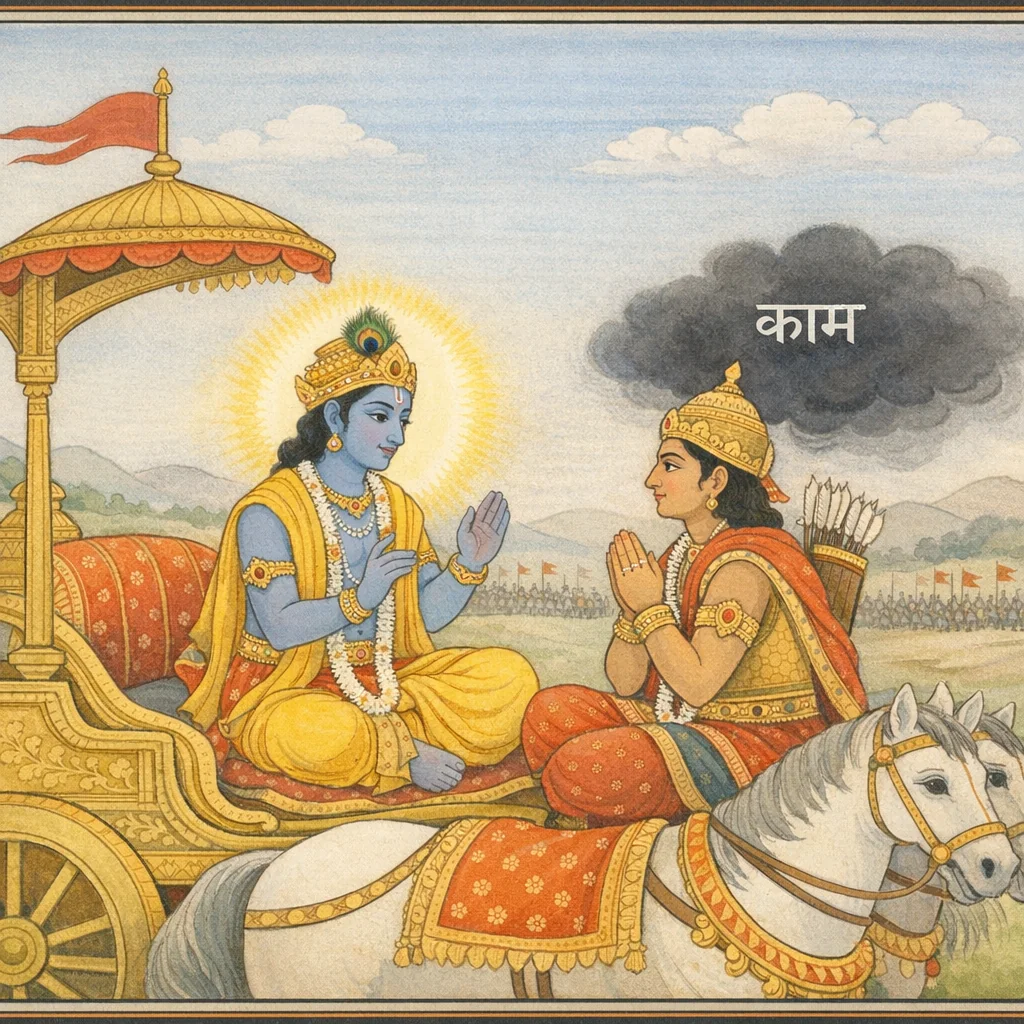
Adhyaya 27
Karma-Saṃnyāsa–Karma-Yoga Saṃvāda (Renunciation and the Discipline of Action)
Upa-parva: Bhagavadgītā Parva (Gītā-upākhyāna within Bhīṣma-parva)
This chapter opens with Arjuna’s request for a definitive adjudication between saṃnyāsa (renunciation of actions) and punar-yoga (the disciplined path of action). Kṛṣṇa responds by affirming both as conducive to the highest good, while prioritizing karma-yoga over mere action-renunciation when inner discipline is absent. The discourse defines the ‘constant renunciant’ as one free from hatred and craving, and argues that sāṃkhya (discriminative knowledge) and yoga (disciplined practice) are not ultimately separate when properly understood. It details the phenomenology of non-doership: the wise person recognizes sensory operations as occurring within the field of prakṛti while maintaining inward detachment. Actions offered to Brahman, performed without attachment, do not ethically stain the agent, illustrated by the lotus leaf unaffected by water. The chapter further explains how ignorance veils knowledge, how knowledge dispels impurity, and how equanimity yields impartial vision toward all beings. It culminates in a practical profile of the liberated practitioner—restrained senses, moderated affect, and recognition of the divine as the beneficiary of disciplined acts and the well-wisher of all—resulting in stable peace (śānti).
Chapter Arc: अर्जुन के भीतर कर्म-त्याग की आकांक्षा और ‘बंधन’ का भय उठता है—यदि शुभ कर्म भी बाँधते हैं, तो फिर युद्धभूमि में कर्म का आग्रह क्यों? → श्रीकृष्ण कर्म-त्याग की निष्फलता दिखाते हैं: मन से इन्द्रियों को रोककर भी जो भीतर-भीतर विषयों का चिन्तन करता है, वह मिथ्याचारी है; इसके विपरीत जो मन से इन्द्रियों को संयमित कर कर्मेन्द्रियों से अनासक्त होकर कर्मयोग करता है, वही श्रेष्ठ है। फिर शंका उभरती है—यज्ञ, दान, तप जैसे शास्त्रविहित कर्म भी बंधन के हेतु कहे गए हैं, तो कर्म कैसे मुक्तिदायक बने? → भगवान् अपने दिव्य ‘लोक-संग्रह’ के रहस्य को उद्घाटित करते हैं: ‘यदि मैं कर्म न करूँ तो लोक नष्ट-भ्रष्ट हो जाएँ; मैं संकर का कर्ता बनूँ और प्रजा का उपघात करूँ’—अर्थात् श्रेष्ठ पुरुष का आचरण ही समाज की धुरी है, इसलिए आसक्ति-रहित कर्म ही धर्म का रक्षक है। → कर्म का विधान स्पष्ट होता है: श्रद्धावान, दोषदृष्टि-रहित मनुष्य जो इस मत का नित्य अनुष्ठान करते हैं, वे कर्मों से भी मुक्त होते हैं। साथ ही भीतर के शत्रु ‘काम’ का निदान बताया जाता है—काम इन्द्रिय, मन, बुद्धि में आश्रय लेकर ज्ञान को ढँकता है; अतः इन्द्रियों को वश में कर, मन-बुद्धि को स्थिर कर, बुद्धि से भी पर आत्मतत्त्व में स्थित होकर इस शत्रु का वध करना चाहिए। → अर्जुन के सामने अब निर्णायक प्रश्न खड़ा है—क्या वह ‘आत्मा से पर’ उस आधार में टिककर, काम-रूप आवरण को चीरते हुए, युद्ध-कर्म को योग बना पाएगा?
Shlokas
Verse 1
भीष्मपर्वमें छब्बीसवाँ अध्याय पूरा हुआ ॥/ २६ ॥। नक्शा + (0) आज अनन- $. तत्त्वको जाननेवाले महापुरुषोंद्वारा 'असत्” और “सत्' का विवेचन करके जो यह निश्चय कर लेना है कि जिस वस्तुका परिवर्तन और नाश होता है
Arjuna said: “O Janārdana, if in your view understanding (buddhi, the path of knowledge) is superior to action, then why, O Keśava, do you urge me into this dreadful deed of battle?”
Verse 2
इस प्रकार श्रीमह्ाभारत भीष्मपर्वके श्रीमद्भगवद्गीतापरवके अन्तर्गत ब्रह्मविद्या एवं योगशासत्ररूप श्रीमद्भगवद्गीतोपनिषद्
Arjuna said: “With words that seem mixed and ambiguous, you appear to bewilder my understanding. Therefore, tell me one course clearly and decisively—by which I may attain what is truly good.”
Verse 3
सम्बन्ध-- इस प्रकार अजुनके पूछनेपर भगवान् उनका निश्चित कर्तव्य भक्तिप्रधान कर्मयोग बतलानेके उद्देश्यसे पहले उनके प्रश्नका उत्तर देते हुए यह दिखलाते हैं कि मेरे वचन व्यामिश्र' अर्थात् 'मिले हुए" नहीं हैं वरं सर्वधा स्पष्ट और अलग-अलग हैं-- श्रीभगवानुवाच लोकेडस्मिन् द्विविधा निष्ठा पुरा प्रोक्ता मयानघ । ज्ञानयोगेन सांख्यानां कर्मयोगेन योगिनाम्
The Blessed Lord said: “O sinless one, in this world I formerly taught a twofold steadfast path. For those devoted to discernment (the Sāṅkhyas), it is the path of knowledge; for those committed to disciplined action (the Yogins), it is the path of action. Thus my teaching is not confused, but distinct disciplines suited to different temperaments.”
Verse 4
न कर्मणामनारम्भान्ेष्कर्म्य पुरुषो श्षुते । न च संन्यसनादेव सिद्धि समधिगच्छति
A person does not attain freedom from action merely by not undertaking actions; nor does one reach perfection simply by renouncing actions outwardly.
Verse 5
मनुष्य न तो कर्मोंका आरम्भ किये बिना निष्कर्मताको यानी योगनिष्ठाको प्राप्त होता है और न कर्मोके केवल त्यागमात्रसे सिद्धि यानी सांख्यनिष्ठाको ही प्राप्त होता है ।।
For no one ever remains, even for a single moment, without performing action. Every person is inevitably driven to act, compelled by the qualities born of material nature.
Verse 6
सम्बन्ध-- पूर्वश्लीकर्में यह बात कही गयी कि कोई भी मनुष्य क्षणमात्र भी कर्म किये बिना नहीं रहता: इसपर यह शंका होती है कि इन्द्रियोंकी क्रियाओंकोी हठसे रोककर भी तो मनुष्य कमोंका त्याग कर सकता है। इसपर कहते हैं-- कर्मेन्द्रियाणिः संयम्य य आस्ते मनसा स्मरन् | इन्द्रियार्थान् विमूढात्मा मिथ्याचार: स उच्यते
One who forcibly restrains the organs of action, yet sits dwelling in the mind upon the objects of the senses—such a person, deluded in understanding, is called a hypocrite, for the outer show of renunciation is contradicted by inner craving.
Verse 7
यस्त्विन्द्रियाणि मनसा नियम्यारभतेअर्जुन । कर्मेन्द्रिये: कर्मयोगमसक्त: स विशिष्यतेएं
But the one who, having restrained the senses by the mind, sets to work and practices the Yoga of action through the organs of action without attachment—he, O Arjuna, is the superior person.
Verse 8
सम्बन्ध-- अजुनने जो यह पूछा था कि आप मुझे घोर कर्ममें क्यों लगाते हैं; उसके उत्तरमें ऊपरये कर्मोका त्याग करनेवाले मिथ्याचारीकी निन््दा और कर्मयोगीकी प्रशंसा करके अब उन्हें कर्म करनेके लिये आज्ञा देते हैं-- नियतं कुरु कर्म त्वं कर्म ज्यायो हाकर्मण: । शरीरयात्रापि च ते न प्रसिद्धयेदकर्मण:
Perform the duty that is prescribed for you; action is superior to inaction. If you refrain from action, even the maintenance of your body and the continuance of life would not be possible.
Verse 9
सम्बन्ध-- यहाँ यह जिज्ञासा होती है कि शास्त्रविह्ित यज्ञ
Actions performed for the sake of sacrifice (yajña) do not bind; but actions done for any other motive entangle people in the bondage of karma. Therefore, O son of Kuntī, perform your rightful work for that sacrificial purpose, free from attachment, and carry it out well.
Verse 10
सम्बन्ध-- पूर्वश्लीकर्में भगवान्ने यह बात कही कि यज्ञके निमित्त कर्म करनेवाला मनुष्य कर्मोसे नहीं बाँधता: इसलिये यहाँ यह जिज्ञासा होती है कि यज्ञ किसको कहते हैं; उसे क्यों करना चाहिये और उसके लिये कर्म करनेवाला मनुष्य कैसे नहीं बँधता। अतएव इन बातोंकोी समझानेके लिये भगवान् ब्रह्माजीके वचनोंका प्रमाण देकर कहते हैं-- सहयज्ञा: प्रजा: सृष्टवा पुरोवाच प्रजापति: । अनेन प्रसविष्यध्वमेष वो<स्त्विष्टककामधुक्
At the beginning of creation, Prajāpati (Brahmā), having brought forth beings together with sacrifice, addressed them: “By this you shall prosper and multiply. Let this yajña be for you a wish-fulfilling giver of desired enjoyments.”
Verse 11
देवान् भावयतानेन ते देवा भावयन्तु वः । परस्परं भावयन्त: श्रेय: परमवाप्स्यथ
By this sacrificial offering, nurture and uphold the gods, and may the gods in turn nurture and uphold you. Thus, sustaining one another in a spirit of mutual support, you will attain the highest good.
Verse 12
इष्टान् भोगान् हि वो देवा दास्यन्ते यज्ञभाविता: । तैर्दत्तानप्रदायै भ्यो यो भुड्क्ते स्तेन एव सः
The gods, nourished and strengthened by your sacrificial offerings, will surely grant you the desired enjoyments even without your asking. But whoever consumes the gifts bestowed by the gods without first offering back what is due—he is, in truth, a thief.
Verse 13
यज्ञशिष्टाशिन: सनन््तो मुच्यन्ते सर्वकिल्बिषै: । भुज्जते ते त्वघं पापा ये पचन्त्यात्मकारणात्
The righteous who eat what remains after sacrifice (yajña-śiṣṭa) are freed from all sin. But the wicked who cook only for the sake of feeding themselves—those eat sin itself.
Verse 14
सम्बन्ध-- यहाँ यह जिज्ञासा होती है कि यज्ञ न करनेसे क्या हानि है; इसपर युष्टिचक्रको युरक्षित रखनेके लिये यज्ञकी आवश्यकताका प्रतिपादन करते हैं-- अन्नाद् भवन्ति भूतानि पर्जन्यादन्नसम्भव: । यज्ञाद् भवति पर्जन्यो यज्ञ: कर्मसमुद्भव:
All living beings arise and are sustained by food; food comes into being from rain; rain is produced through sacrifice (yajña); and sacrifice is born of prescribed action. Thus the moral order is shown as a chain of mutual support: when people perform their rightful duties in a spirit of offering, nature is nourished, society is fed, and life is upheld.
Verse 15
कर्म ब्रह्मोद्धवं विद्धि ब्रद्माक्षरसमुद्धवम् । तस्मात् सर्वगतं ब्रह्म नित्यं यज्ञे प्रतेष्ठितम्
Know that prescribed action (karma) arises from Brahman (the Veda), and that Brahman (the Veda) arises from the Imperishable (Akṣara). Therefore the all-pervading Imperishable Reality is eternally grounded in sacrifice (yajña).
Verse 16
एवं प्रवर्तितं चक्र नानुवर्तयतीह य: । अघायुरिन्द्रियारामो मोघं पार्थ स जीवति
O Pārtha, the person who does not follow here the wheel of cosmic order thus set in motion—who refuses to live in harmony with the inherited rhythm of duty and sacrifice—lives in vain. Delighting only in the senses, such a one lives a sinful, wasted life, severed from the sustaining reciprocity that upholds the world.
Verse 17
यस्त्वात्मरतिरेव स्यादात्मतृप्तश्न॒ मानव: । आत्मन्येव च संतुष्टस्तस्य कार्य न विद्यते
But the one who delights only in the Self, is satisfied by the Self, and is content in the Self alone—for him there is no duty to be done.
Verse 18
नैव तस्य कृतेनार्थों नाकृतेनेह कश्नन । न चास्य सर्वभूतेषु कश्चिदर्थव्यपाश्रय:
For that great-souled person, in this world there is no personal end to be gained by performing action, nor is there any end to be gained by refraining from action. Nor does he depend upon any being whatsoever for the sake of self-interest.
Verse 19
सम्बन्ध-- यहॉँतक भगवान्ने बहुत-से हेतु बतलाकर यह बात सिद्ध की कि जबतक मनुष्यको परम श्रेयरूप परमात्माकी प्राप्ति न हो जाय
Therefore, remain continually unattached and steadily perform the work that ought to be done. For a person who acts without attachment attains the Supreme.
Verse 20
कर्मणैव हि संसिद्धिमास्थिता जनकादय: । लोकसंग्रहमेवापि सम्पश्यन् कर्तुमहसि
For it was through action alone that Janaka and other exemplars attained perfection. Therefore, even with a view to sustaining the order of the world and guiding people by your example, you ought to perform your duty.
Verse 21
सम्बन्ध-- पूर्वश्लोकर्ें भगवान्ने अर्जुनकों लोक-संग्रहकी ओर देखते हुए कर्मोका करना उचित बतलाया: इसपर यह जिज्ञासा होती है कि कर्म करनेसे किस प्रकार लोकसंग्रह होता है; अतः यही बात समझानेके लिये कहते हैं-- यद् यदाचरति श्रेष्ठस्तत् तदेवेतरो जन: । स यत् प्रमाणं कुरुते लोकस्तदनुवर्तते
Whatever conduct an eminent person adopts, that very conduct other people follow. Whatever standard he establishes as authoritative, the world conforms to it.
Verse 22
न मे पार्थास्ति कर्तव्यं त्रिषु लोकेषु किंचन । नानवाप्तमवाप्तव्यं वर्त एव च कर्मणि
Kṛṣṇa says: “O Pārtha, in the three worlds there is nothing whatsoever that I must do. There is nothing unattained that I need to attain; yet I continue to engage in action.”
Verse 23
यदि हाहं न वर्तेयं जातु कर्मण्यतन्द्रित: । मम वर्त्मनिवर्तन्ते मनुष्या: पार्थ सर्वश:
“If I were ever to cease acting with vigilance in the performance of my duties, O Pārtha, it would bring great harm; for in every way people follow the path that I set, taking my conduct as their model.”
Verse 24
उत्सीदेयुरिमे लोका न कुर्या कर्म चेदहम् । संकरस्य च कर्ता स्यामुपहन्यामिमा: प्रजा:
“If I were not to perform action, these worlds would fall into ruin. I would become the cause of social and moral confusion, and I would thereby harm—indeed, help destroy—these people.”
Verse 25
सक्ता: कर्मण्यविद्वांसो यथा कुर्वन्ति भारत । कुर्याद् विद्वांस्तथासक्तश्निकीर्षुलोंकसंग्रहम्
“O Bhārata, just as the unlearned act while clinging to action, so too should the wise act without attachment—seeking to uphold the order of the world (loka-saṅgraha).”
Verse 26
भीष्मपर्वणि तु षड्विंशो5ध्याय:
“A wise person, firmly established in inner discipline, should not unsettle the understanding of the ignorant who are attached to action. Rather, while performing all prescribed duties with proper integration, he should encourage them to engage in those same duties.”
Verse 27
प्रकृते: क्रियमाणानि गुणै: कर्माणि सर्वश: । अहंकारविमूढात्मा कर्ताहमिति मन्यते
Arjuna said: All actions, in every way, are carried out by the qualities (guṇas) of Nature (prakṛti). Yet the ignorant person, whose inner self is deluded by egoism, imagines, ‘I am the doer.’
Verse 28
तत्त्ववित् तु महाबाहो गुणकर्मविभागयो: । गुणा गुणेषु वर्तन्त इति मत्वा न सज्जते
O mighty-armed one, the knower of truth regarding the distinctions of the guṇas and of actions understands that it is only the guṇas operating among the guṇas; therefore, he does not cling—neither to action nor to its fruits—remaining ethically free from possessiveness and attachment even while deeds continue.
Verse 29
प्रकृतेर्गुणसम्मूढा: सज्जन्ते गुणकर्मसु । तानकृत्स्नविदो मन्दान् कृत्स्नविन्न विचालयेत्
Those whose understanding is bewildered by the guṇas of material nature become attached to the guṇas and to the actions that arise from them. A knower of the whole should not unsettle the dull-minded who grasp only a part; rather, he should guide without provoking confusion or contempt—especially in a time of grave duty and impending war.
Verse 30
१४-अनायक्तभावसे कर्म करनेसे परमात्माकी प्राप्ति होती है (गीता ३/१९)। १५-पूर्वकालमें जनकादिने भी कमोद्वारा ही सिद्धि प्राप्त की थी (गीता ३/२०/। १६-दूसरे मनुष्य श्रेष्ठ महापुरुषका अनुकरण करते हैं; इसलिये श्रेष्ठ महापुरुषको कर्म करना चाहिये (गीता ३॥२१)। १७-भगवान्को कुछ भी कर्तव्य नहीं है; तो भी वे लोकसंग्रहके लिये कर्म करते हैं (गीता ३/२२)। १८-ज्ञानीके लिये कोई कर्तव्य नहीं है
Fixing your mind on Me, the indwelling Self, surrender all actions into Me. Free from craving and the sense of ‘mine,’ and released from feverish agitation, engage in battle.
Verse 31
ये मे मतमिदं नित्यमनुतिष्ठन्ति मानवा: । श्रद्धावन्तो5नसूयन्तो मुच्यन्ते तेडपि कर्मभि:
Those people who, free from fault-finding and endowed with faith, consistently live in accordance with this teaching of mine—even they are released from the binding consequences of actions.
Verse 32
ये त्वेतदभ्यसूयन्तो नानुतिष्ठन्ति मे मतम् । सर्वज्ञानविमूढांस्तान् विद्धि नष्टानचेतस:
But those who, finding fault with this teaching, do not live by my guidance—know them to be deluded in all understanding, their discernment ruined and their inner awareness lost.
Verse 33
सम्बन्ध-- पूर्वश्लोकम्ें यह बात कही गयी कि भगवान्के मतके अनुसार न चलनेवाला नष्ट हो जाता है। इसपर यह जिज्ञासा होती है कि यदि कोई भगवान्के मतके अनुसार कर्म न करके हठपूर्वक कर्मोका सर्वथा त्याग कर दे तो क्या हानि है? इसपर कहते हैं-- सदृशं चेष्टते स्वस्या: प्रकृतेज्ञानवानपि । प्रकृतिं यान्ति भूतानि निग्रह: कि करिष्यति
Arjuna said: Even a person of knowledge acts in accordance with his own nature. All beings follow their inborn disposition; what, then, can restraint accomplish?
Verse 34
सम्बन्ध--इस प्रकार सबको प्रकृतिके अनुसार कर्म करने पड़ते हैं तो फिर कर्मबन्धनसे छूटनेके लिये मनुष्यको क्या करना चाहिये? इस जिज्ञासापर कहते हैं-- इन्द्रियस्येन्द्रियस्यार्थे रागद्वेषौ व्यवस्थितौ । तयोर्न वशमागच्छेत् तौ हास्य परिपन्थिनौ
Arjuna said: In the sphere of each sense and its objects, attachment and aversion lie entrenched. One should not fall under the sway of these two, for they stand as obstructers on the path of one’s true good—inner welfare and right action.
Verse 35
सम्बन्ध-- यहाँ अर्जुनिके मनमें यह बात आ सकती है कि मैं यह युद्धरूप घोर कर्म न करके यदि भिक्षावृत्तिसे अपना निर्वाह करता हुआ शान्तिमय क्मोें लगा रहूँ तो सहज ही राग-द्वेषसे छूट सकता हूँ: फिर आप मुझे युद्ध करनेके लिये आज्ञा क्यों दे रहे हैं; इसपर भगवान् कहते हैं-- श्रेयान् स्वधर्मो विगुण: परधर्मात् स्वनुछितात् । स्वधर्मे निधनं श्रेय: परधर्मो भयावह:
The Blessed Lord teaches that one’s own duty, even if imperfectly carried out, is ethically superior to another person’s duty performed with excellence. Even death while standing within one’s rightful duty is said to be spiritually beneficial, whereas taking up another’s dharma brings fear and peril.
Verse 36
सम्बन्ध--गनुष्यका स्वधर्मपालन करनेगें ही कल्याण है
Arjuna said: O Krishna, by what force is a person driven to commit sin—acting as though compelled—even when he does not wish to do so?
Verse 37
श्रीभगवानुवाच काम एष क्रोध एष रजोगुणसमुद्धव: । महाशनो महापाप्मा विद्धयेनमिह वैरिणम्
The Blessed Lord said: This is desire; this is anger—born of the quality of passion (rajas). It is insatiable, ever hungry for enjoyment, and deeply sinful. Know this, here and now, as the enemy in this matter.
Verse 38
सम्बन्ध-- यहाँ जिज्ञासा होती है कि यह काम मनुष्यको किस प्रकार पापोंगें प्रवृत्त करता है। अत: तीन श्लोकोद्वार इयका समाधान करते हैं-- धूमेनाव्रियते वल्निर्यथादर्शो मलेन च | यथोल्बेनावृतो गर्भस्तथा तेनेदमावृतम्
Just as fire is veiled by smoke, a mirror is obscured by grime, and an embryo is enclosed by the womb, so too this knowledge is covered over by that desire (kāma).
Verse 39
आवृतं ज्ञानमेतेन ज्ञानिनो नित्यवैरिणा । कामरूपेण कौन्तेय दुष्पूरेणानलेन च,और हे अर्जुन! इस अग्निके समान कभी न पूर्ण होनेवाले कामरूप ज्ञानियोंके नित्य वैरीकेः द्वारा मनुष्यका ज्ञान ढका हुआ है
O son of Kuntī, the discernment of even the wise is veiled by this constant enemy—desire—appearing in the form of craving and burning like a fire that is never satisfied.
Verse 40
इन्द्रियाणि मनो बुद्धिरस्याधिष्ठानमुच्यते । एतैर्विमोहयत्येष ज्ञानमावृत्य देहिनम्
The senses, the mind, and the intellect are said to be its seat. Using these, it bewilders the embodied being by veiling true knowledge.
Verse 41
इन्द्रियाँ, मन और बुद्धि--ये सब इसके वासस्थान कहे जाते हैं। यह काम इन मन, बुद्धि और इन्द्रियोंके द्वारा ही ज्ञाकको आच्छादित करके जीवात्माको मोहित करता हैः ।।
Therefore, O best of the Bharatas, first bring the senses under discipline; then strike down this sinful force—desire—which destroys both true knowledge and lived discernment.
Verse 42
सम्बन्ध-- पूर्वश्लोकमें इन्द्रियॉको वशर्में करके कामरूप शत्रुकों मारनेके लिये कहा गया। इसपर यह शंका होती है कि जब इन्द्रिय
Arjuna said: “They say the senses are superior to the body; higher than the senses is the mind; higher than the mind is the intellect; and higher than the intellect is the Self. Therefore, to confront desire—which works through these inner instruments—one must discern this inner hierarchy and take refuge in the Self beyond intellect, rather than be driven by the senses and mind.”
Verse 43
इन्द्रियोंको स्थूल शरीरसे पर यानी श्रेष्ठ, बलवान् और सूक्ष्म कहते हैं; इन इन्द्रियोंसे पर मन है, मनसे भी पर बुद्धि है और जो बुद्धिसे भी अत्यन्त पर है वह आत्मा है ।।
Arjuna said: “The senses are said to be superior to the gross body—finer, stronger, and more capable. Beyond the senses is the mind; beyond the mind is the intellect; and beyond even the intellect stands the Self. Knowing thus the Self as higher than the intellect, and steadying the mind by the disciplined power of the inner self, O mighty-armed one, strike down this hard-to-conquer enemy that takes the form of desire.”
Frequently Asked Questions
Arjuna seeks a single, certain prescription between renouncing action (saṃnyāsa) and performing action through disciplined practice (karma-yoga), reflecting a dilemma about whether ethical purity is better preserved by withdrawal or by regulated engagement.
Kṛṣṇa teaches that mature renunciation is primarily internal—freedom from aversion and craving—and that disciplined action offered without attachment leads efficiently to purification, knowledge, equanimity, and stable peace.
Rather than a formal phalaśruti, the chapter embeds outcome-statements: non-attached action does not bind; knowledge removes impurity and leads to non-return (apunarāvṛtti) and brahma-nirvāṇa; recognizing the divine as the beneficiary and well-wisher yields śānti.
Read Mahabharata in the Vedapath app
Scan the QR code to open this directly in the app, with audio, word-by-word meanings, and more.