Adhyaya 7
अग्निशाप-प्रसंगः (Agni’s Curse and the Restoration of Ritual Order)
Upa-parva: Agniśāpa-Itihāsa (Episode of Agni’s Curse) — Ādi Parva
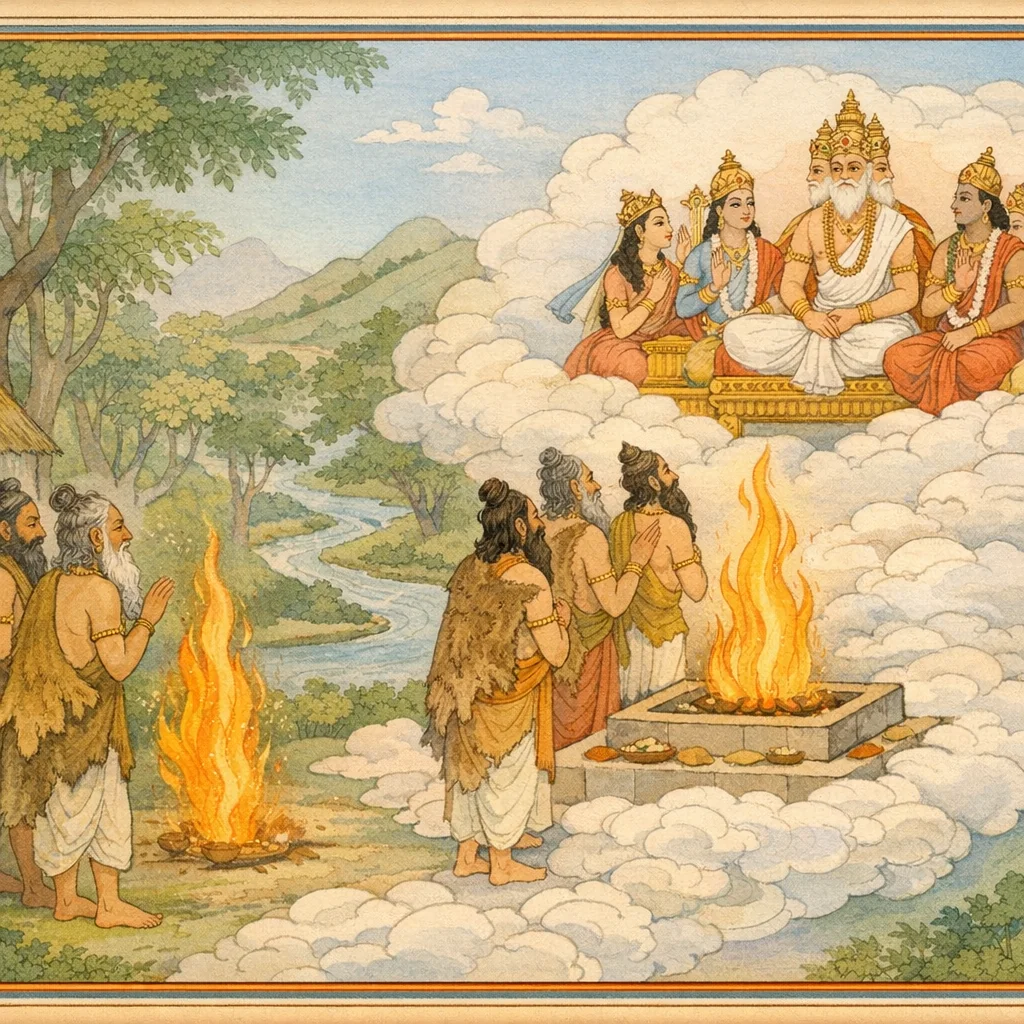
Sauti narrates how Agni (Vahni), cursed by Bhṛgu, defends his truth-speaking as a witness: to speak otherwise would harm lineages, and to remain silent despite knowledge is likewise blameworthy. Agni asserts his pervasive presence through yogic multiplicity in sacrificial forms and explains that offerings made according to Vedic injunctions satisfy devas and pitṛs. Yet he questions how he can remain the ‘mouth’ of devas and ancestors if labeled sarvabhakṣa. After deliberation, Agni withdraws from agnihotra and sacrificial actions, resulting in rites lacking oṃkāra, vaṣaṭ, svadhā, and svāhā, and causing distress across the three worlds. Ṛṣis and devas approach Brahmā, reporting the curse and the collapse of ritual. Brahmā summons Agni and delivers a conciliatory doctrine: Agni sustains the worlds and initiates rites; he will not become impure through universal consumption because his flames purify what they touch, analogous to the sun’s rays. Brahmā instructs Agni to uphold the curse’s truth through his own tejas while continuing to receive offerings as the divine ‘mouth.’ Agni assents, rites resume, and the narrative is identified as an ancient itihāsa connected to Pulomā’s destruction and Cyavana’s birth.
Chapter Arc: नैमिषारण्य में शौनकादि ऋषियों के समक्ष सौति उग्रश्रवा एक प्राचीन वृत्तांत उठाते हैं—भृगुवंश के प्रसंग में अग्निदेव पर पड़ा शाप, और उसके कारण यज्ञ-क्रियाओं का संकट। → भृगु के सत्यवचन और साक्षी-धर्म की कठोर मर्यादा का उद्घोष होता है—जो साक्षी जानते हुए भी असत्य बोले, वह अपने और पराए कुलों का नाश करता है। इसी पृष्ठभूमि में अग्निदेव शाप से कुपित होकर अदृश्य हो जाते हैं और यज्ञ, अग्निहोत्र, तथा वैदिक क्रियाएँ ठप पड़ जाती हैं; प्रजा दुखी, ऋषि व्याकुल, देवता चिंतित हो उठते हैं। → ऋषि और देवता ब्रह्मा के पास जाकर अग्नि के शाप और ‘क्रिया-संहार’ की सूचना देते हैं; अग्नि की व्यथा उभरती है—‘देवों के मुख’ होकर भी ‘सर्वभक्ष’ (क्रव्याद सहित) कहलाना कैसे सहूँ? यही क्षण धर्म और लोक-व्यवस्था के बीच टकराव का शिखर बनता है। → ब्रह्मा शाप को ‘सत्य’ रखते हुए उसका संकुचन/मर्यादन करते हैं—अग्नि देवताओं के मुख बने रहें, यज्ञ-भाग ग्रहण करें, और ‘सर्वभक्षत्व’ का अर्थ लोक-व्यवस्था के लिए आवश्यक रूप में सीमित/व्यवस्थित हो। अग्निदेव प्रसन्न होकर पुनः प्रकट होते हैं और यज्ञ-क्रियाएँ पुनर्जीवित होती हैं। → यह ‘अग्निशाप’ का इतिहास आगे पुलोमा-प्रसंग, उसके विनाश, और च्यवन के जन्म की ओर कथा-धारा को मोड़ देता है।
Shlokas
Verse 1
ऑपन- मा बछ। अर सप्तमो<्ध्याय: शापसे कुपित हुए अग्निदेवका अदृश्य होना और ब्रद्माजीका उनके शापको संकुचित करके उन्हें प्रसन्न करना सौतिरुवाच शप्तस्तु भुगुणा वद्िः क्ुद्धो वाक्यमथाब्रवीत् । किमिदं साहसं ब्रह्मन् कृतवानसि मां प्रति,उग्रश्रवाजी कहते हैं--महर्षि भूगुके शाप देनेपर अग्निदेवने कुपित होकर यह बात कही--“ब्रह्मन! तुमने मुझे शाप देनेका यह दुस्साहसपूर्ण कार्य क्यों किया हे?”
Sauti said: When Bhṛgu had pronounced the curse, Agni grew enraged and spoke: “O Brahman, why have you committed this rash, audacious act against me—why did you dare to curse me?”
Verse 2
धर्मे प्रयतमानस्य सत्यं च वदत: समम् | पृष्टो यदब्रवं सत्यं व्यभिचारो5त्र को मम,“मैं सदा धर्मके लिये प्रयत्मनशील रहता और सत्य एवं पक्षपातशून्य वचन बोलता हूँ; अतः उस राक्षसके पूछनेपर यदि मैंने सच्ची बात कह दी तो इसमें मेरा क्या अपराध है?
“I am ever striving to uphold dharma, and I speak the truth impartially. Therefore, when that rākṣasa questioned me, if I stated what was true, what fault or deviation can there be in me for that?”
Verse 3
पृष्टो हि साक्षी यः साक्ष्यं जानानो5प्यन्यथा वदेत् । स पूर्वानात्मन: सप्त कुले हन्यात् तथा परान्,“जो साक्षी किसी बातको ठीक-ठीक जानते हुए भी पूछनेपर कुछ-का-कुछ कह देता --झूठ बोलता है, वह अपने कुलमें पहले और पीछेकी सात-सात पीढ़ियोंका नाश करता -5उन्हें नरकमें ढकेलता है
“For a witness who, knowing the testimony truly, yet when questioned speaks otherwise—who lies—destroys seven generations before him and seven after him in his lineage, and brings ruin upon others as well, casting them down into hell.”
Verse 4
यश्न कार्यार्थतत्त्वज्ञो जानानोडपि न भाषते । सो<पि तेनैव पापेन लिप्यते नात्र संशय:,“इसी प्रकार जो किसी कार्यके वास्तविक रहस्यका ज्ञाता है, वह उसके पूछनेपर यदि जानते हुए भी नहीं बतलाता--मौन रह जाता है तो वह भी उसी पापसे लिप्त होता है; इसमें संशय नहीं है
Śaunaka said: Even one who truly knows the real purport and inner principle of a matter—if, when questioned, he remains silent and does not speak despite knowing—he too is stained by that very same sin; of this there is no doubt.
Verse 5
शक्तो5हमपि शप्तुं त्वां मान्यास्तु ब्राह्मणा मम । जानतो<पि च ते ब्रह्मन् कथयिष्ये निबोध तत्,“मैं भी तुम्हें शाप देनेकी शक्ति रखता हूँ तो भी नहीं देता हूँ; क्योंकि ब्राह्मण मेरे मान्य हैं। ब्रह्मन! यद्यपि तुम सब कुछ जानते हो, तथापि मैं तुम्हें जो बता रहा हूँ, उसे ध्यान देकर सुनो--
I am able even to curse you, yet I do not—for Brahmins are worthy of honor to me. O Brahmin, though you already know all this, still I shall state it; listen attentively to what I say.
Verse 6
इस प्रकार श्रीमहा भारत आदिपव॑के अन्तर्गत पौलोगपर्वमें अग्निशापविषयक छठा अध्याय पूरा हुआ,योगेन बहुधात्मानं कृत्वा तिष्ठामि मूर्तिषु अन्निहात्रेषु सत्रेषु क्रियासु च मखेषु च 'मैं योगसिद्धिके बलसे अपने-आपको अनेक रूपोंमें प्रकट करके गार्हपत्य और दक्षिणाग्नि आदि मूर्तियोंमें, नित्य किये जानेवाले अन्निहोत्रोंमें, अनेक व्यक्तियोंद्वारा संचालित सत्रोंमें, गर्भाधान आदि क्रियाओंमें तथा ज्योतिष्टोम आदि मखों (यज्ञों)-में सदा निवास करता हूँ
“By the power of yoga, I manifest myself in many forms and abide continually: in the sacred embodiments of fire such as the Gārhapatya and Dakṣiṇāgni, in the daily Agnihotra offerings, in extended sacrificial sessions (satra) conducted by many officiants, in life‑cycle rites such as conception ceremonies (garbhādhāna), and in great Vedic sacrifices like the Jyotiṣṭoma.”
Verse 7
वेदोक्तेन विधानेन मयि यद् हूयते हवि: । देवता: पितरश्वैव तेन तृप्ता भवन्ति वै,“मुझमें वेदोक्त विधिसे जिस हविष्यकी आहुति दी जाती है, उसके द्वारा निश्चय ही देवता तथा पितृगण तृप्त होते हैं इति श्रीमहाभारते आदिपर्वणि पौलोमपर्वणि अग्निशापमोचने सप्तमो<5ध्याय: ।। ७ || इस प्रकार श्रीमह्योा भारत आदिपव॑ीके अन्तर्गत पौलोगपर्वमें अग्निशापमोचनसम्बन्धी यातवाँ अध्याय पूरा हुआ
Whatever oblation (havis) is offered into me according to the procedure enjoined by the Vedas—by that, indeed, both the gods and the Pitṛs (ancestral spirits) become satisfied.
Verse 8
आपो देवगणा: सर्वे आप: पितृगणास्तथा । दर्शश्व॒ पौर्णमासश्न देवानां पितृभि: सह,“जल ही देवता हैं तथा जल ही पितृगण हैं। दर्श और पौर्णमास याग पितरों तथा देवताओंके लिये किये जाते हैं
Śaunaka says: “Water itself is the host of the gods, and water itself is likewise the host of the ancestors. The Darśa and Paurṇamāsa rites are performed for the gods together with the Pitṛs.”
Verse 9
देवता: पितरस्तस्मात् पितरश्नापि देवता: । एकीभूताश्न पूज्यन्ते पृथक्त्वेन च पर्वसु,“अत: देवता पितर हैं और पितर ही देवता हैं। विभिन्न पर्वोपर ये दोनों एक रूपमें भी पूजे जाते हैं और पृथक्-पृथक् भी
Śaunaka said: “Therefore the gods are, in essence, the Fathers (Pitṛs), and the Pitṛs too are gods. In the observances and sacred occasions (parvans), they are worshipped sometimes as one unified reality and sometimes as distinct—each in its own form.”
Verse 10
देवता: पितरश्वैव भुज्जते मयि यद् हुतम् । देवतानां पितृणां च मुखमेतदहं स्मृतम्,“मुझमें जो आहुति दी जाती है, उसे देवता और पितर दोनों भक्षण करते हैं। इसीलिये मैं देवताओं और पितरोंका मुख माना जाता हूँ
“Whatever oblation is offered into me is partaken of by both the gods and the ancestral Fathers. Therefore I am remembered as the very ‘mouth’—the receiving channel—of the gods and the Pitṛs, through which offerings reach them in due order.”
Verse 11
अमावास्यां हि पितर: पौर्णमास्यां हि देवता: । मन्मुखेनैव हूयन्ते भुड्जते च हुतं हवि:
Śaunaka said: “On the new-moon day the Pitṛs are to be honored, and on the full-moon day the Devas. When offerings are made through my mouth—i.e., through the proper sacred channel—they accept the oblation and partake of the havis duly offered.”
Verse 12
सौतिर्वाच चिन्तयित्वा ततो वल्रिश्वक्रे संहारमात्मन:,उग्रश्रवाजी कहते हैं--महर्षियो! तदनन्तर अग्निदेवने कुछ सोच-विचारकर द्विजोंके अन्निहोत्र, यज्ञ, सत्र तथा संस्कारसम्बन्धी क्रियाओंमेंसे अपने-आपको समेट लिया। फिर तो अग्निके बिना समस्त प्रजा ३>कार, वषट्कार, स्वथा और स्वाहा आदिसे वंचित होकर अत्यन्त दुःखी हो गयी। तब महर्षिगण अत्यन्त उद्विग्न हो देवताओंके पास जाकर बोले --
Sauti said: After reflecting, O great seers, Agni withdrew himself from the rites. The Fire-god, having considered the matter, drew himself back from the ritual acts of the twice-born—daily agnihotra offerings, sacrifices, long sacrificial sessions (satra), and the consecratory rites (saṃskāra). Deprived of Agni, all beings were cut off from the sacred utterances and offerings—oṁ, vaṣaṭ, svadhā, svāhā, and the rest—and fell into deep distress. Then the sages, greatly alarmed, approached the gods and spoke—
Verse 13
द्विजानामन्निहोत्रेषु यज्ञसत्रक्रियासु च । निरोंकारवषट्कारा: स्वधास्वाहाविवर्जिता:,उग्रश्रवाजी कहते हैं--महर्षियो! तदनन्तर अग्निदेवने कुछ सोच-विचारकर द्विजोंके अन्निहोत्र, यज्ञ, सत्र तथा संस्कारसम्बन्धी क्रियाओंमेंसे अपने-आपको समेट लिया। फिर तो अग्निके बिना समस्त प्रजा ३>कार, वषट्कार, स्वथा और स्वाहा आदिसे वंचित होकर अत्यन्त दुःखी हो गयी। तब महर्षिगण अत्यन्त उद्विग्न हो देवताओंके पास जाकर बोले --
Śaunaka said: “In the daily agnihotra offerings of the twice-born and in the rites of sacrifices and sacrificial sessions, the sacred utterances ceased—there were no longer the syllable oṁ, nor the vaṣaṭ-call, and the invocations ‘svadhā’ and ‘svāhā’ were absent. Deprived of Agni’s presence in ritual, the people became deeply distressed.”
Verse 14
विनाग्निना प्रजा: सर्वास्तत आसन सुदु:खिता: । अथर्षय: समुद्विग्ना देवान् गत्वाब्रुवन् वच:,उग्रश्रवाजी कहते हैं--महर्षियो! तदनन्तर अग्निदेवने कुछ सोच-विचारकर द्विजोंके अन्निहोत्र, यज्ञ, सत्र तथा संस्कारसम्बन्धी क्रियाओंमेंसे अपने-आपको समेट लिया। फिर तो अग्निके बिना समस्त प्रजा ३>कार, वषट्कार, स्वथा और स्वाहा आदिसे वंचित होकर अत्यन्त दुःखी हो गयी। तब महर्षिगण अत्यन्त उद्विग्न हो देवताओंके पास जाकर बोले --
Śaunaka said: “Thereafter, with Agni absent, all creatures fell into extreme distress. Then the sages, deeply agitated, went to the gods and spoke these words.”
Verse 15
अग्निनाशात् क्रियाभ्रंशाद् भ्रान्ता लोकास्त्रयो5नघा: । विदध्वमत्र यत् कार्य न स्यात् कालात्ययो यथा,“पापरहित देवगण! अग्निके अदृश्य हो जानेसे अग्निहोत्र आदि सम्पूर्ण क्रियाओंका लोप हो गया है। इससे तीनों लोकोंके प्राणी किंकर्तव्यविमूढ़ हो गये हैं; अतः इस विषयमें जो आवश्यक कर्तव्य हो, उसे आपलोग करें। इसमें अधिक विलम्ब नहीं होना चाहिये”
Śaunaka said: “O sinless divine ones! With the disappearance of Agni, the sacrificial rites—Agnihotra and the rest—have fallen into ruin. Because of this, beings in the three worlds have become bewildered about what ought to be done. Therefore, do here whatever action is necessary, so that there may be no delay and no loss of the proper time.”
Verse 16
अथर्षयकश्न देवाश्व॒ ब्रह्माणमुपगम्य तु । अग्नेरावेदयछ्छापं क्रियासंहारमेव च,तत्पश्चात् ऋषि और देवता ब्रह्माजीके पास गये और अग्निको जो शाप मिला था एवं अग्निने सम्पूर्ण क्रियाओंसे जो अपने-आपको समेटकर अदृश्य कर लिया था, वह सब समाचार निवेदन करते हुए बोले--
Then the sages and the gods approached Brahmā and reported to him the curse that had fallen upon Agni, and also how Agni, withdrawing from all sacrificial functions, had drawn his activity back into himself and become unseen.
Verse 17
भगुणा वै महाभाग शप्तो<ग्नि: कारणान्तरे | कथं देवमुखो भूत्वा यज्ञभागाग्रभुक् तथा
Śaunaka said: “O highly fortunate one, Agni was indeed cursed by Bhṛgu on another occasion. How did that Fire-god, becoming the ‘mouth of the gods’, also come to be the foremost consumer of the sacrificial portions?”
Verse 18
श्रुत्वा तु तद् वचस्तेषामग्निमाहूय विश्वकृत्,देवताओं तथा ऋषियोंकी बात सुनकर विश्वविधाता ब्रह्माजीने प्राणियोंको उत्पन्न करनेवाले अविनाशी अग्निको बुलाकर मधुर वाणीमें कहा--'हुताशन! यहाँ समस्त लोकोंके स्रष्टा और संहारक तुम्हीं हो, तुम्हीं तीनों लोकोंको धारण करनेवाले हो, सम्पूर्ण क्रियाओंके प्रवर्तक भी तुम्हीं हो। अतः लोकेश्वर! तुम ऐसा करो जिससे अग्निहोत्र आदि क्रियाओंका लोप न हो। तुम सबके स्वामी होकर भी इस प्रकार मूढ़ (मोहग्रस्त) कैसे हो गये? तुम संसारमें सदा पवित्र हो, समस्त प्राणियोंकी गति भी तुम्हीं हो
Having heard the words of the gods and the seers, the Creator of the universe summoned Agni, the imperishable producer of creatures, and spoke to him in gentle speech: “O Hutaśana, here you alone are the maker and destroyer of all the worlds; you uphold the three worlds and set all rites and actions in motion. Therefore, O Lord of the world, act in such a way that the sacrificial rites—beginning with the Agnihotra—do not fall into ruin. Though you are the master of all, how have you become thus deluded? In the world you are ever pure, and you are the very refuge and final course of all living beings.”
Verse 19
उवाच वचन श्लक्ष्णं भूताभावनमव्ययम् । लोकानामिह सर्वेषां त्वं कर्ता चान्त एव च,देवताओं तथा ऋषियोंकी बात सुनकर विश्वविधाता ब्रह्माजीने प्राणियोंको उत्पन्न करनेवाले अविनाशी अग्निको बुलाकर मधुर वाणीमें कहा--'हुताशन! यहाँ समस्त लोकोंके स्रष्टा और संहारक तुम्हीं हो, तुम्हीं तीनों लोकोंको धारण करनेवाले हो, सम्पूर्ण क्रियाओंके प्रवर्तक भी तुम्हीं हो। अतः लोकेश्वर! तुम ऐसा करो जिससे अग्निहोत्र आदि क्रियाओंका लोप न हो। तुम सबके स्वामी होकर भी इस प्रकार मूढ़ (मोहग्रस्त) कैसे हो गये? तुम संसारमें सदा पवित्र हो, समस्त प्राणियोंकी गति भी तुम्हीं हो
Śaunaka said: With gentle, well-chosen words he addressed the imperishable one who brings beings into existence: “Here, for all the worlds, you are both the maker and the very end—their dissolution as well.” Thus cosmic responsibility is laid down as a moral charge: the sustainer of sacrificial order must not lapse into delusion, for the continuity of rites such as the Agnihotra safeguards dharma and the welfare of beings.
Verse 20
त्वं धारयसि लोकांस्त्रीन् क्रियाणां च प्रवर्तक: । स तथा कुरु लोकेश नोच्छिद्येरन् यथा क्रिया:,देवताओं तथा ऋषियोंकी बात सुनकर विश्वविधाता ब्रह्माजीने प्राणियोंको उत्पन्न करनेवाले अविनाशी अग्निको बुलाकर मधुर वाणीमें कहा--'हुताशन! यहाँ समस्त लोकोंके स्रष्टा और संहारक तुम्हीं हो, तुम्हीं तीनों लोकोंको धारण करनेवाले हो, सम्पूर्ण क्रियाओंके प्रवर्तक भी तुम्हीं हो। अतः लोकेश्वर! तुम ऐसा करो जिससे अग्निहोत्र आदि क्रियाओंका लोप न हो। तुम सबके स्वामी होकर भी इस प्रकार मूढ़ (मोहग्रस्त) कैसे हो गये? तुम संसारमें सदा पवित्र हो, समस्त प्राणियोंकी गति भी तुम्हीं हो
You uphold the three worlds and set all sacred actions in motion. Therefore, O Lord of the worlds, act so that ritual duties—like the Agnihotra—do not fall into decline. The ethical thrust is clear: cosmic order depends on the continuity of prescribed acts, and the one who sustains the worlds must also safeguard the practices that sustain dharma.
Verse 21
कस्मादेवं विमूढस्त्वमी श्वर: सन् हुताशन | त्वं पवित्र॑ं सदा लोके सर्वभूतगतिश्न ह,देवताओं तथा ऋषियोंकी बात सुनकर विश्वविधाता ब्रह्माजीने प्राणियोंको उत्पन्न करनेवाले अविनाशी अग्निको बुलाकर मधुर वाणीमें कहा--'हुताशन! यहाँ समस्त लोकोंके स्रष्टा और संहारक तुम्हीं हो, तुम्हीं तीनों लोकोंको धारण करनेवाले हो, सम्पूर्ण क्रियाओंके प्रवर्तक भी तुम्हीं हो। अतः लोकेश्वर! तुम ऐसा करो जिससे अग्निहोत्र आदि क्रियाओंका लोप न हो। तुम सबके स्वामी होकर भी इस प्रकार मूढ़ (मोहग्रस्त) कैसे हो गये? तुम संसारमें सदा पवित्र हो, समस्त प्राणियोंकी गति भी तुम्हीं हो
Śaunaka said: “Why have you become so deluded, O Hutāśana, though you are a lord? You are ever pure in the world, and indeed you are the very course and refuge of all beings.” The question underscores a moral concern: when one entrusted with sustaining sacred rites and cosmic order falls into confusion, the stability of dharma itself is threatened.
Verse 22
न त्वं सर्वशरीरेण सर्वभक्षत्वमेष्यसि । अपाने हार्चिषो यास्ते सर्व भक्ष्यन्ति ता: शिखिन्,“तुम सारे शरीरसे सर्वभक्षी नहीं होओगे। अग्निदेव! तुम्हारे अपानदेशमें जो ज्वालाएँ होंगी, वे ही सब कुछ भक्षण करेंगी
Śaunaka said: “You will not become an all-devouring fire with your entire body. Rather, O Flame-crested one (Agni), only those tongues of fire that abide in your lower region (apāna) will consume everything.”
Verse 23
क्रव्यादा च तनुर्या ते सा सर्व भक्षयिष्यति । यथा सूर्याशुभि: स्मृष्टं सर्व शुचि विभाव्यते,“इसके सिवा जो तुम्हारी क्रव्याद मूर्ति है (कच्चा मांस या मुर्दा जलानेवाली जो चिताकी आग है) वही सब कुछ भक्षण करेगी। जैसे सूर्यकी किरणोंसे स्पर्श होनेपर सब वस्तुएँ शुद्ध मानी जाती हैं, उसी प्रकार तुम्हारी ज्वालाओंसे दग्ध होनेपर सब कुछ शुद्ध हो जायगा। अग्निदेव! तुम अपने प्रभावसे ही प्रकट हुए उत्कृष्ट तेज हो; अतः विभो! अपने तेजसे ही महर्षिके उस शापको सत्य कर दिखाओ और अपने मुखमें आहुतिके रूपमें पड़े हुए देवताओंके तथा अपने भागको भी ग्रहण करो”
Śaunaka said: “That form of yours which is the flesh-devouring fire will consume everything. Just as all things are regarded as purified when touched by the rays of the sun, so too whatever is burned by your flames will be considered purified. Therefore, O Agni—manifest as supreme radiance by your own power—make the seer’s curse come true through your own splendor, and accept into your mouth, as oblations, both the gods who have fallen there and your own rightful share.”
Verse 24
तथा त्वदर्चिनिर्दिग्धं सर्व शुचि भविष्यति । त्वमग्ने परमं तेज: स्वप्रभावाद् विनिर्गतम्,“इसके सिवा जो तुम्हारी क्रव्याद मूर्ति है (कच्चा मांस या मुर्दा जलानेवाली जो चिताकी आग है) वही सब कुछ भक्षण करेगी। जैसे सूर्यकी किरणोंसे स्पर्श होनेपर सब वस्तुएँ शुद्ध मानी जाती हैं, उसी प्रकार तुम्हारी ज्वालाओंसे दग्ध होनेपर सब कुछ शुद्ध हो जायगा। अग्निदेव! तुम अपने प्रभावसे ही प्रकट हुए उत्कृष्ट तेज हो; अतः विभो! अपने तेजसे ही महर्षिके उस शापको सत्य कर दिखाओ और अपने मुखमें आहुतिके रूपमें पड़े हुए देवताओंके तथा अपने भागको भी ग्रहण करो”
Śaunaka said: “So too, whatever is scorched by your flames will become wholly pure. O Agni, you are the supreme radiance that has manifested by your own inherent power. Therefore, O mighty one, by your own splendor make the sage’s curse come true, and accept into your mouth—as oblations—both the gods who have fallen there and your own rightful share as well.”
Verse 25
स्वतेजसैव तं शापं कुरु सत्यमृषेर्विभो । देवानां चात्मनो भागं गृहाण त्वं मुखे हुतम्,“इसके सिवा जो तुम्हारी क्रव्याद मूर्ति है (कच्चा मांस या मुर्दा जलानेवाली जो चिताकी आग है) वही सब कुछ भक्षण करेगी। जैसे सूर्यकी किरणोंसे स्पर्श होनेपर सब वस्तुएँ शुद्ध मानी जाती हैं, उसी प्रकार तुम्हारी ज्वालाओंसे दग्ध होनेपर सब कुछ शुद्ध हो जायगा। अग्निदेव! तुम अपने प्रभावसे ही प्रकट हुए उत्कृष्ट तेज हो; अतः विभो! अपने तेजसे ही महर्षिके उस शापको सत्य कर दिखाओ और अपने मुखमें आहुतिके रूपमें पड़े हुए देवताओंके तथा अपने भागको भी ग्रहण करो”
Śaunaka said: “O mighty one, by your own innate radiance make the sage’s curse come true. And do you accept—into your mouth as the offered oblation—the share due to the gods and the share due to yourself.”
Verse 26
सौतिर्वाच एवमस्त्विति तं वह्रि: प्रत्युवाच पितामहम् । जगाम शासन कर्तु देवस्य परमेछ्ठिन:,उग्रश्रवाजी कहते हैं--यह सुनकर अग्निदेवने पितामह ब्रह्माजीसे कहा--“एवमस्तु (ऐसा ही हो)।” यों कहकर वे भगवान् ब्रह्माजीके आदेशका पालन करनेके लिये चल दिये
Ugraśravas (Sauti) said: Hearing this, Agni replied to the Grandsire Brahmā, “So be it.” Having thus assented, he departed to carry out the command of the god Parameṣṭhin (Brahmā).
Verse 27
देवर्षयश्न मुदितास्ततो जम्मुर्यथागतम् । ऋषयश्च यथापूर्व क्रिया: सर्वाः प्रचक्रिरे,इसके बाद देवर्षिगण अत्यन्त प्रसन्न हो जैसे आये थे वैसे ही चले गये। फिर ऋषि- महर्षि भी अग्निहोत्र आदि सम्पूर्ण कर्मोंका पूर्ववत् पालन करने लगे
Śaunaka said: Then the divine seers, delighted, departed just as they had come. Thereafter the sages and great sages resumed, as before, the full round of prescribed observances—such as the agnihotra—thereby restoring the steady rhythm of dharma through disciplined ritual life.
Verse 28
दिवि देवा मुमुदिरे भूतसड्घाश्व॒ लौकिका: । अन्निश्च परमां प्रीतिमवाप हतकल्मष:,देवतालोग स्वर्गलोकमें आनन्दित हो गये और इस लोकके समस्त प्राणी भी बड़े प्रसन्न हुए। साथ ही शापजनित पाप कट जानेसे अग्निदेवको भी बड़ी प्रसन्नता हुई
Śaunaka said: In heaven the gods rejoiced, and the hosts of beings in this world also became glad. And Agni, his defilement caused by the curse now removed, attained supreme delight.
Verse 29
एवं स भगवाउ्छापं लेभेडग्निर्भुगुत: पुरा । एवमेष पुरावृत्त इतिहासोडग्निशापज: । पुलोम्नश्न विनाशो5यं च्यवनस्य च सम्भव:,इस प्रकार पूर्वकालमें भगवान् अग्निदेवको महर्षि भृगुसे शाप प्राप्त हुआ था। यही अग्निशापसम्बन्धी प्राचीन इतिहास है। पुलोमा राक्षसके विनाश और च्यवन मुनिके जन्मका वृत्तान्त भी यही है
Śaunaka said: “Thus, in ancient times, the blessed Fire-god Agni incurred a curse from the sage Bhṛgu. This is that old, well-known account arising from Agni’s curse. It also contains the episode of the destruction of the rākṣasa Puloman and the birth of the sage Cyavana.”
Verse 113
सर्वभक्ष: कथं त्वेषां भविष्यामि मुखं त्वहम् “अमावास्याको पितरोंके लिये और पूर्णिमाको देवताओंके लिये मेरे मुखसे ही आहुति दी जाती है और उस आहुतिके रूपमें प्राप्त हुए हविष्यका वे देवता और पितर उपभोग करते हैं, सर्वभक्षी होनेपर मैं इन सबका मुँह कैसे हो सकता हूँ?”
“If I am to become a devourer of all things, how can I be their very mouth? On the new-moon day (amāvāsyā) oblations are offered for the Pitṛs, and on the full-moon day (pūrṇimā) for the gods—through my mouth alone those offerings are poured, and gods and ancestors partake of the havis received as oblation. If I am a devourer of all, how can I be the mouth of them all?”
Verse 173
हुतभुक् सर्वलोकेषु सर्वभक्षत्वमेष्यति “महाभाग! किसी कारणवश महर्षि भृगुने अग्निदेवको सर्वभक्षी होनेका शाप दे दिया है, किंतु वे सम्पूर्ण देवताओंके मुख, यज्ञभागके अग्रभोक्ता तथा सम्पूर्ण लोकोंमें दी हुई आहुतियोंका उपभोग करनेवाले होकर भी सर्वभक्षी कैसे हो सकेंगे?”
“O great one! For some reason the sage Bhṛgu has cursed the Fire-god Agni to become a devourer of all things. Yet Agni is the mouth of all the gods, the foremost recipient of the sacrificial portion, and the enjoyer of oblations offered throughout all the worlds—how then could he be a devourer of all?”
Frequently Asked Questions
The dilemma concerns speech-duty under dharma: when questioned as a witness, speaking untruth is condemned, but withholding known truth is also treated as ethically blameworthy—raising the problem of how truthful speech can still trigger harmful consequences.
The chapter presents a reconciliation between ritual function and moral purity: Agni’s consuming power does not imply defilement, because tejas (radiant energy) is framed as intrinsically purifying, preserving the legitimacy of sacrificial mediation.
Rather than a phalaśruti promising merit, the chapter ends with an explicit meta-label: it is an ancient itihāsa (purāvṛtta) tied to subsequent genealogical consequences—Pulomā’s destruction and Cyavana’s birth—signaling its function as an etiological bridge within Ādi Parva.