Adhyaya 28
Garuḍa’s Assault on the Devas and the Fire-Barrier (अमृत-रक्षा-युद्धम्)
Upa-parva: Astīka Parva (Garuḍa’s Amṛta-Haraṇa Episode Context)
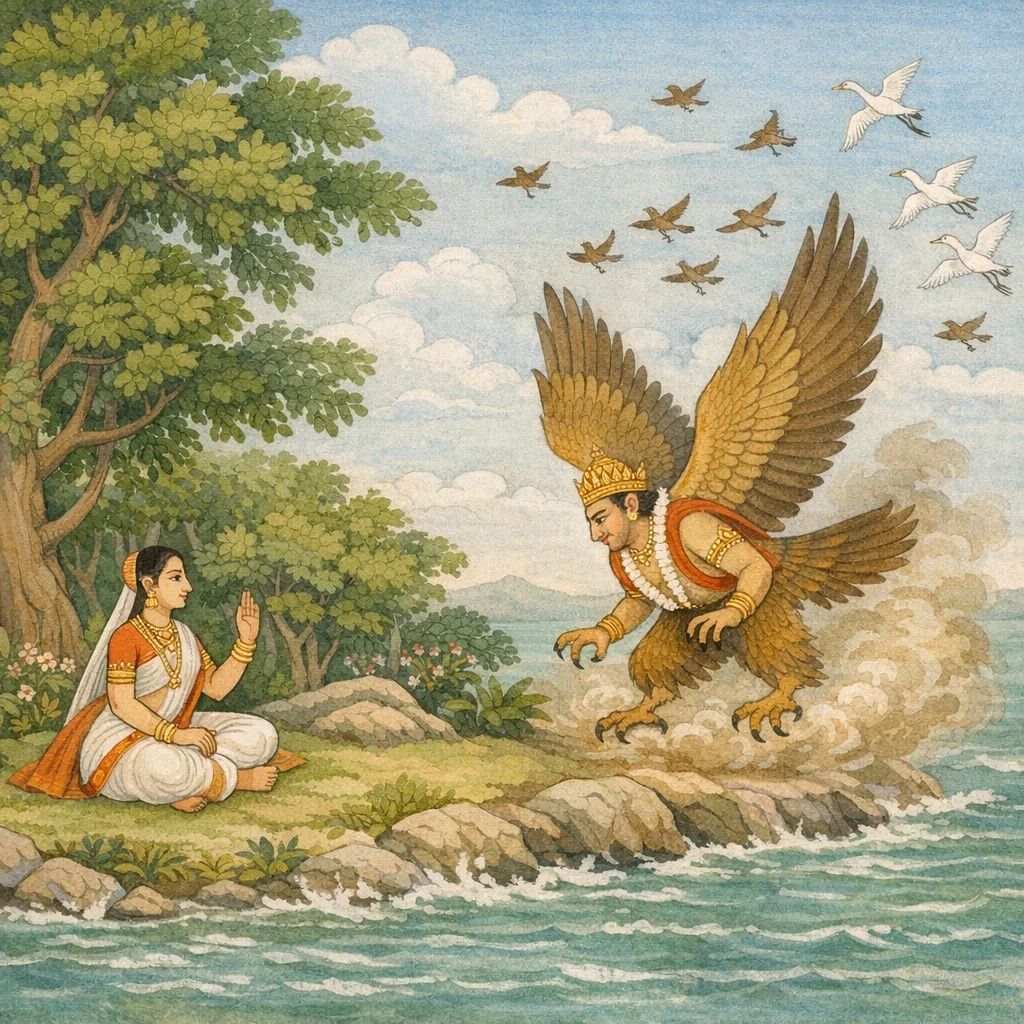
Sauti narrates a high-intensity confrontation in which Garuḍa (Vainateya), arriving swiftly before the devas, engages the celestial guardians of amṛta. The devas respond with coordinated weaponry and defensive formations, yet Garuḍa’s strength and mobility prevent destabilization. He raises a massive dust-storm with wing-beats, temporarily obscuring visibility and inducing disorientation among the guardians; Indra (Sahasrākṣa) instructs Vāyu to disperse the dust, restoring clarity. Combat resumes with volleys of weapons (including blazing, wheel-like discs) and close-quarters impacts as Garuḍa scatters devas in multiple directions, leaving many wounded. Advancing toward the nectar, Garuḍa then confronts a surrounding ring of fierce fire. He multiplies mouths, rapidly draws up river waters, and uses them to suppress and cover the flames, then contracts his body to pass through the diminished opening—an operational transition from battlefield dominance to problem-solving against a layered environmental defense.
Chapter Arc: सौतिरुवाच—गरुड, माता विनता की दासता छुड़ाने हेतु अमृत लाने को उद्यत है; पर मार्ग में माता की आज्ञा आती है—पहले निषादों का भक्षण कर शक्ति-संचय करो। → विनता समुद्र-मध्य के एकान्त द्वीप में बसे निषाद-समूह का संकेत देती है, पर साथ ही कठोर चेतावनी देती है—किसी भी दशा में ब्राह्मण का वध न हो; ब्राह्मण अग्नि-सदृश, अवध्य और सर्वभूतों का गुरु है। गरुड व्याकुल होकर पूछता है—ब्राह्मण का रूप, शील, पराक्रम और पहचान क्या है, ताकि अनजाने में अपराध न हो। → गरुड निषादों पर टूट पड़ता है; आकाश में पक्षियों का उन्मत्त कोलाहल उठता है और धूल-पवन से वन-सा दृश्य बनता है। उसी उग्र भक्षण-वेग के बीच ब्राह्मण-भक्षण का भय चरम पर पहुँचता है—विनता का वचन गूँजता है कि जो कण्ठ में अंगार-सा दहे, या जठर में न पचे, वही द्विजोत्तम समझो और उसे कदापि न मारो। → विनता पुत्र-स्नेह से बार-बार धर्म-सीमा रेखांकित करती है—ब्राह्मणों से द्रोह न हो; क्रुद्ध होने पर भी विप्र अवध्य है। गरुड को ‘पहचान’ का उपाय देकर वह उसे हिंसा के उन्माद से धर्म-नियंत्रण में बाँधती है, ताकि अमृत-यात्रा का उद्देश्य अधर्म से कलुषित न हो। → निषाद-भक्षण के बाद गरुड का अगला चरण—अमृत की ओर प्रस्थान और नागों से निर्णायक टकराव—निकट आता है; क्या वह धर्म-सीमा निभाते हुए अमृत तक पहुँचेगा?
Shlokas
Verse 1
अपर अष्टाविशोश् ध्याय: गरुडका अमृतके लिये (2 और अपनी माताकी आज्ञाके अनुसार निषादोंका भक्षण करना सौतिरुवाच इत्युक्तो गरुड: सर्पैस्ततो मातरमब्रवीत् । गच्छाम्यमृतमाहर्तु भक्ष्यमिच्छामि वेदितुम्,उग्रश्रवाजी कहते हैं--सर्पोंकी यह बात सुनकर गरुड अपनी मातासे बोले--“माँ! मैं अमृत लानेके लिये जा रहा हूँ, किंतु मेरे लिये भोजन-सामग्री क्या होगी? यह मैं जानना चाहता हूँ"
Sauti said: Thus addressed by the serpents, Garuḍa then spoke to his mother: “I am going to bring the nectar of immortality; but I wish to know what food is to be provided for me.” The verse frames Garuḍa’s resolve as obedience to his mother’s command while also raising an ethical question about the means—what he may consume on the way to fulfill a duty.
Verse 2
विनतोवाच समुद्रकुक्षावेकान्ते निषादालयमुत्तमम् | निषादानां सहस्राणि तान् भुक्त्वामृतमानय,विनताने कहा--समुद्रके बीचमें एक टापू है, जिसके एकान्त प्रदेशमें निषादों (जीवहिंसकों)-का निवास है। वहाँ सहस्रों निषाद रहते हैं। उन््हींको मारकर खा लो और अमृत ले आओ
Verse 3
नचते ब्राह्मणं हन्तुं कार्या बुद्धि: कथंचन । अवध्य: सर्वभूतानां ब्राह्म॒णो हनलोपम:,किंतु तुम्हें किसी प्रकार ब्राह्मणको मारनेका विचार नहीं करना चाहिये; क्योंकि ब्राह्मण समस्त प्राणियोंके लिये अवध्य है। वह अग्निके समान दाहक होता है
You must not, under any circumstance, entertain the thought of killing a brāhmaṇa. A brāhmaṇa is to be regarded as inviolable by all living beings; he is like fire—capable of burning those who violate this moral boundary.
Verse 4
अग्निरकोरों विषं शस्त्र विप्रो भवति कोपित: । गुरुहिं सर्वभूतानां ब्राह्मण: परिकीर्तित:,कुपित किया हुआ ब्राह्मण अग्नि, सूर्य, विष एवं शस्त्रके समान भयंकर होता है। ब्राह्मणको समस्त प्राणियोंका गुरु कहा गया है
The Grandsire said: “When provoked, a brāhmaṇa becomes as fearsome as fire, the sun, poison, and a weapon. For the brāhmaṇa is proclaimed to be the teacher and guide of all living beings.” The statement underscores the ethical warning that disrespecting or enraging a spiritual authority can bring consequences as destructive as the most dangerous forces, and it affirms the brāhmaṇa’s normative role as moral instructor within dharma.
Verse 5
एवमादिस्वरूपैस्तु सतां वै ब्राह्मणो मत: । स ते तात न हन्तव्य: संक्रुद्धेनापि सर्वथा,इन्हीं रूपोंमें सत्पुरुषोंके लिये ब्राह्मण आदरणीय माना गया है। तात! तुम्हें क्रोध आ जाय तो भी ब्राह्मणकी हत्यासे सर्वथा दूर रहना चाहिये
Thus, by such qualities and forms of conduct, a brāhmaṇa is regarded by the virtuous as worthy of honor. Therefore, dear child, you must never kill a brāhmaṇa—under any circumstances, not even when inflamed with anger.
Verse 6
ब्राह्मणानामभिद्रोहो न कर्तव्य: कथंचन । न होवममग्निर्नादित्यो भस्म कुर्यात् तथानघ,भूतानामग्रभूविंप्रो वर्णश्रेष्ठ: पिता गुरु: । ब्राह्मणोंके साथ किसी प्रकार द्रोह नहीं करना चाहिये। अनघ! कठोर व्रतका पालन करनेवाला ब्राह्मण क्रोधमें आनेपर अपराधीको जिस प्रकार जलाकर भस्म कर देता है, उस तरह अग्नि और सूर्य भी नहीं जला सकते। इस प्रकार विविध चिह्लोंके द्वारा तुम्हें ब्राह्मणको पहचान लेना चाहिये। ब्राह्मण समस्त प्राणियोंका अग्रज, सब वर्णोमें श्रेष्ठ पिता और गुरु है
The Grandsire said: “One must never, under any circumstance, commit hostility against Brahmins. O blameless one, when a Brahmin who observes severe vows is provoked to anger, he can burn an offender to ashes—something even fire and the sun cannot do in that same way. Therefore, by such distinguishing marks you should recognize a Brahmin. A Brahmin is the foremost among beings, the best among the varṇas, and is to be regarded as father and teacher.”
Verse 7
यथा कुयदिभिक्रुद्धो ब्राह्मण: संशितव्रत: । तदेतैरविविषधैरलिज्लिस्त्व॑ं विद्यास्तं द्विजोत्तमम्
Pitāmaha said: “Just as a Brahmin of firm, disciplined vows becomes enraged by vile and improper acts, so too—by these harmless (inoffensive) means—you should recognize that excellent Brahmin.”
Verse 8
गरुड उवाच किंरूपो ब्राह्म॒णो मात: किंशील: किंपराक्रम:,गरुडने पूछा--माँ! ब्राह्मगका रूप कैसा होता है? उसका शील-स्वभाव कैसा है? तथा उसमें कौन-सा पराक्रम है
Garuḍa said: “Mother, what is a brāhmaṇa like in appearance? What is his character and conduct? And what kind of prowess does he possess?”
Verse 9
किंस्विदग्निनिभो भाति किंस्वित् सौम्यप्रदर्शन: । यथाहमभिजानीयां ब्राह्मणं लक्षणै: शुभै:
Garuḍa said: “What is it that shines like fire, and what is it that bears a gentle, auspicious appearance? Tell me the noble marks by which I may rightly recognize a true brāhmaṇa.”
Verse 10
विनतोवाच यस्ते कण्ठमनुप्राप्तो निगीर्ण बडिशं यथा,विनता बोली--बेटा! जो तुम्हारे कण्ठमें पड़नेपर अंगारकी तरह जलाने लगे और मानो बंसीका काँटा निगल लिया गया हो, इस प्रकार कष्ट देने लगे, उसे वर्णोमें श्रेष्ठ ब्राह्मण समझना। क्रोधमें भरे होनेपर भी तुम्हें ब्रह्महत्या नहीं करनी चाहिये
Vinata said: “My son, if someone reaches your throat and burns you like a live ember, causing torment as though you had swallowed a fishhook, know him to be a Brahmin—the best among the orders. Even if you are seized by anger, you must not commit the sin of killing a Brahmin.”
Verse 11
दहेदज्भारवत् पुत्र त॑ विद्या ब्राह्मणर्षभम् विप्रस्त्वया न हन्तव्य: संक्रुद्धेनापि सर्वदा,विनता बोली--बेटा! जो तुम्हारे कण्ठमें पड़नेपर अंगारकी तरह जलाने लगे और मानो बंसीका काँटा निगल लिया गया हो, इस प्रकार कष्ट देने लगे, उसे वर्णोमें श्रेष्ठ ब्राह्मण समझना। क्रोधमें भरे होनेपर भी तुम्हें ब्रह्महत्या नहीं करनी चाहिये
Garuḍa said: “My son, know that being—who, when lodged in your throat, burns like a live coal and torments you as though a fishhook had been swallowed—to be a foremost Brāhmaṇa. Even when you are inflamed with anger, you must never kill a Brāhmaṇa.”
Verse 12
प्रोवाच चैनं विनता पुत्रहार्दादिदं वच: । जठरे न च जीरयेंद् यस्तं जानीहि द्विजोत्तमम्,विनताने पुत्रके प्रति स्नेह होनेके कारण पुन: इस प्रकार कहा--'बेटा! जो तुम्हारे पेटमें पच न सके, उसे ब्राह्मण जानना”
Moved by a mother’s deep affection for her son, Vinatā spoke to him again: “My child, recognize as the foremost of the twice-born (a brahmin) that being whom you would be unable to digest in your belly.”
Verse 13
पुन: प्रोवाच विनता पुत्रहार्दादिदं वच: । जानन्त्यप्यतुलं वीर्यमाशीर्वादपरायणा
Then Vinatā spoke again, driven by a mother’s deep affection for her son. Though she knew his incomparable might, she remained intent on offering blessings—speaking words meant to protect and guide him through what lay ahead.
Verse 14
विनतोवाच पक्षौ ते मारुत: पातु चन्द्रसूर्यों च पृष्ठत:,विनताने कहा--बेटा! वायु तुम्हारे दोनों पंखोंकी रक्षा करें, चन्द्रमा और सूर्य पृष्ठभागका संरक्षण करें
Vinata said: “May the Wind-god protect your two wings, and may the Moon and the Sun guard you from behind.”
Verse 15
शिरश्न पातु वह्निस्ते वसव: सर्वतस्तनुम् । अहं च ते सदा पुत्र शान्तिस्वस्तिपरायणा,अग्निदेव तुम्हारे सिरकी और वसुगण तुम्हारे सम्पूर्ण शरीरकी सब ओरसे रक्षा करें। पुत्र! मैं भी तुम्हारे लिये शान्ति एवं कल्याणसाधक कर्ममें संलग्न हो यहाँ निरन्तर कुशल मनाती रहूँगी। वत्स! तुम्हारा मार्ग विध्नरहित हो, तुम अभीष्ट कार्यकी सिद्धिके लिये यात्रा करो
Garuḍa said: “May Agni protect your head, and may the Vasus guard your whole body on every side. And I too, my son, ever devoted to peace and well-being, shall continually wish you safety. Dear child, may your path be free of obstacles; go forth on your journey to accomplish your desired aim.”
Verse 16
इहासीना भविष्यामि स्वस्तिकारे रता सदा । अरिएं व्रज पन्थान पुत्र कार्यार्थसिद्धये,अग्निदेव तुम्हारे सिरकी और वसुगण तुम्हारे सम्पूर्ण शरीरकी सब ओरसे रक्षा करें। पुत्र! मैं भी तुम्हारे लिये शान्ति एवं कल्याणसाधक कर्ममें संलग्न हो यहाँ निरन्तर कुशल मनाती रहूँगी। वत्स! तुम्हारा मार्ग विध्नरहित हो, तुम अभीष्ट कार्यकी सिद्धिके लिये यात्रा करो
Garuḍa said: “I shall remain seated here, ever devoted to rites that bring peace and well-being. O noble one, proceed on your path, my child, so that your intended purpose may be fulfilled.”
Verse 17
सौतिरुवाच ततः स मातुर्वचनं निशम्य वितत्य पक्षौ नभ उत्पपात । ततो निषादान् बलवानुपागतो बुभुक्षित: काल इवान्तको5पर:,उग्रश्रवाजी कहते हैं--शौनकादि महर्षियो! माताकी बात सुनकर महाबली गरुड पंख पसारकर आकाशमें उड़ गये तथा क्षुधातुर काल या दूसरे यमराजकी भाँति उन निषादोंके पास जा पहुँचे
Sauti said: Hearing his mother’s words, Garuḍa spread his wings and rose into the sky. Then, driven by hunger, the mighty one went toward the Niṣādas—like Time itself, or like another Yama, the bringer of death.
Verse 18
स तान् निषादानुपसंहरंस्तदा रज: समुद्धूय नभ:स्पृशं महत् | समुद्रकुक्षोी च विशोषयन् पय: समीपजान् भूधरजान् विचालयन्,उन निषादोंका संहार करनेके लिये उन्होंने उस समय इतनी अधिक धूल उड़ायी, जो पृथ्वीसे आकाशतक छा गयी। वहाँ समुद्रकी कुक्षिमें जो जल था, उसका शोषण करके उन्होंने समीपवर्ती पर्वतीय वृक्षोंको भी विकम्पित कर दिया
Then, intent on destroying those Niṣādas, he whipped up a vast cloud of dust that rose from the earth and reached the sky. He even drew out the waters held in the ocean’s depths, and by the force of his movement he shook the trees growing on the nearby mountains.
Verse 19
तत:ः स चक्रे महदाननं तदा निषादमार्ग प्रतिरुध्य पक्षिराट् । ततो निषादास्त्वरिता: प्रवव्रजुः यतो मुखं तस्य भुजड्रभोजिन:,इसके बाद पक्षिराजने अपना मुख बहुत बड़ा कर लिया और निषादोंका मार्ग रोककर खड़े हो गये। तदनन्तर वे निषाद उतावलीमें पड़कर उसी ओर भागे, जिधर सर्पभोजी गरुडका मुख था
Then the king of birds suddenly made his mouth vast and, blocking the path of the Niṣādas, stood in their way. Alarmed and in haste, the Niṣādas ran straight toward the very direction of his gaping mouth—toward Garuḍa, the eater of serpents.
Verse 20
तदाननं विवृतमतिप्रमाणवत् समभ्ययुर्गगनमिवार्दिता: खगा: । सहस्रश: पवनरजोविमोहिता यथानिलप्रचलितपादपे वने,जैसे आँधीसे कम्पित वृक्षवाले वनमें पवन और धूलसे विमोहित एवं पीड़ित सहस्तरों पक्षी उन्मुक्त आकाशमें उड़ने लगते हैं, उसी प्रकार हवा और धूलकी वर्षासे बेसुध हुए हजारों निषाद गरुडके खुले हुए अत्यन्त विशाल मुखमें समा गये
Garuda said: “Then, as distressed birds rush into the open sky, so too thousands, bewildered by the wind and dust, were swept in and disappeared into my gaping, immensely vast mouth—like creatures in a forest of wind-shaken trees thrown into confusion by the gusts and the whirling dust.”
Verse 21
ततः खगो वदनममित्रतापन: समाहरत् परिचपलो महाबल: । निषूदयन् बहुविधमत्स्यजीविनो बुभुक्षितो गगनचरेश्वरस्तदा,तत्पश्चात् शत्रुओंको संताप देनेवाले, अत्यन्त चपल, महाबली और क्षुधातुर पक्षिराज गरुडने मछली मारकर जीविका चलानेवाले उन अनेकानेक निषादोंका विनाश करनेके लिये अपने मुखको संकुचित कर लिया
Then Garuḍa—the bird-king, mighty, exceedingly swift, and a tormentor of foes—drew in and tightened his beak. Hungry, he set about destroying the many Niṣādas who lived by catching fish, asserting his dominance in the sky and clearing his way by force.
Verse 27
इस प्रकार श्रीमहाभारत आदिपव॑के अन्तर्गत आस्तीकपवरें गरुडचरित्रविषयक सत्ताईसवाँ अध्याय पूरा हुआ
Thus ends the twenty-seventh chapter of the Garuḍa narrative within the Āstīka section of the Ādi Parva of the Śrī Mahābhārata. This closing colophon marks the completion of a unit of narration, signaling a transition to the next portion of the epic’s moral and genealogical frame.
Verse 28
इति श्रीमहाभारते आदिपर्वणि आस्तीकपर्वणि सौपर्णे अष्टाविंशो5ध्याय:
Thus ends the twenty-eighth chapter of the Sauparṇa section within the Āstīka sub-parvan of the Ādi Parvan of the revered Mahābhārata.
Verse 73
भूतानामग्रभूविंप्रो वर्णश्रेष्ठ: पिता गुरु: । ब्राह्मणोंके साथ किसी प्रकार द्रोह नहीं करना चाहिये। अनघ! कठोर व्रतका पालन करनेवाला ब्राह्मण क्रोधमें आनेपर अपराधीको जिस प्रकार जलाकर भस्म कर देता है, उस तरह अग्नि और सूर्य भी नहीं जला सकते। इस प्रकार विविध चिह्लोंके द्वारा तुम्हें ब्राह्मणको पहचान लेना चाहिये। ब्राह्मण समस्त प्राणियोंका अग्रज, सब वर्णोमें श्रेष्ठ पिता और गुरु है
Pitāmaha said: “The Brāhmaṇa stands foremost among beings—best among the varṇas, a father and a teacher. Therefore one should never, in any manner, commit hostility against a Brāhmaṇa. O sinless one, when a Brāhmaṇa who observes severe vows is provoked to anger, he can burn an offender to ashes—something even fire and the sun cannot accomplish in that way. By such distinguishing marks you should recognize the Brāhmaṇa. He is the elder of all creatures, the best among all classes, and a father and guru.”
Verse 96
तन्मे कारणतो मात: पृच्छतो वक्तुमहसि । वह देखनेमें अग्नि-जैसा जान पड़ता है? अथवा सौम्य दिखायी देता है? माँ! जिस प्रकार शुभ लक्षणोंद्वारा मैं ब्राह्मणको पहचान सकूँ, वह सब उपाय मुझे बताओ
Garuḍa said: “Mother, you should explain this to me clearly, since I am asking for the reason. How does a brāhmaṇa appear—does he look like fire in his radiance, or does he seem gentle and calm? Mother, tell me every means by which, through auspicious signs, I may recognize a true brāhmaṇa.”
Verse 136
प्रीता परमदु:खार्ता नागैर्विप्रकृता सती । पुत्रके प्रति स्नेह होनेके कारण विनताने पुनः इस प्रकार कहा--वह पुत्रके अनुपम बलको जानती थी तो भी नागोंद्वारा ठगी जानेके कारण बड़े भारी दुःखसे आतुर हो गयी थी। अत: अपने पुत्रको प्रेमपूर्वक आशीर्वाद देने लगी
Vinatā—though devoted and fully aware of her son’s incomparable strength—was overwhelmed by the bitterest sorrow, for the Nāgas had deceived and mistreated her. Stirred by a mother’s affection, she spoke again in this manner and began to bless her son with love.
Frequently Asked Questions
The chapter stages an ethical tension between a guarded cosmic good (amṛta, protected by devas for order) and Garuḍa’s compelling objective under prior constraints; it raises the question of whether extraordinary ends justify confrontational means when divine custodianship is at stake.
Effective agency combines resolve with adaptability: when direct opposition meets structured defenses, success often depends on shifting methods—using environment, timing, and proportional escalation—while keeping the objective clearly prioritized.
No explicit phalaśruti appears in this passage; its meta-function is illustrative—positioning Garuḍa’s feat as an exemplar within the epic’s causal web, clarifying how exceptional actions interact with guarded cosmic order and set conditions for subsequent events.