Adhyaya 15
Dakṣa’s Progeny, Nṛsiṃha–Varāha Avatāras, and Andhaka’s Defeat (Hari–Hara–Śakti Synthesis)
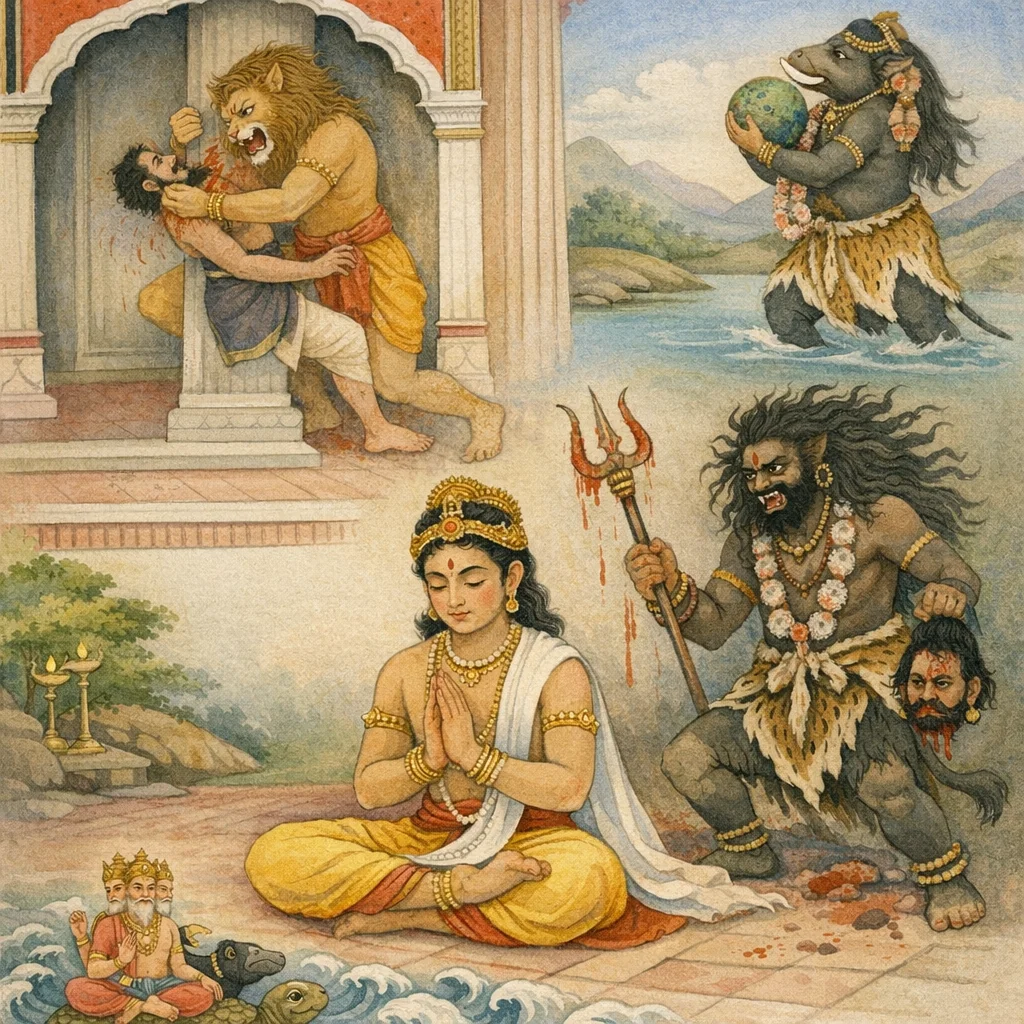
Continuing the cosmogonic account, Sūta describes Dakṣa’s mandated creation: when mental creation does not multiply, procreation through union begins. The chapter lists Dakṣa’s daughters and their marriages (to Dharma, Kaśyapa, Soma, etc.), then Dharma’s wives and the birth of divine classes—the Viśvedevas, Sādhyas, Maruts, and the eight Vasus—with notable descendants. It turns to Kaśyapa’s line: from Diti are born Hiraṇyakaśipu and Hiraṇyākṣa. Oppressed by Hiraṇyakaśipu’s boon-backed tyranny, the gods seek help; Brahmā approaches Hari in the Milk Ocean and praises Viṣṇu as the all-god and inner Self. Viṣṇu manifests as Nṛsiṃha to slay Hiraṇyakaśipu, and later as Varāha to rescue Earth from Rasātala after Hiraṇyākṣa’s oppression. A moral-psychological episode follows: Prahlāda’s bhakti is disturbed by a brāhmaṇa’s curse after disrespect, leading to conflict and then restored discernment and refuge in Hari—showing saṃskāra, delusion, and bhakti’s recovery. The narrative then enters the Andhaka cycle: Andhaka’s desire for Umā brings Śiva forth as Kālabhairava; battles spread with gaṇas, mātṛkās, and supportive manifestations of Viṣṇu. The doctrinal center is the Lord’s explicit teaching that He is Nārāyaṇa and also Gaurī, affirming non-duality and warning against sectarian division. Impaled on the trident, Andhaka is purified, offers a Vedāntic hymn identifying Rudra with Nārāyaṇa and Brahman, and is granted gaṇa-status. The chapter closes by extolling Bhairava’s sacred greatness and reiterating the cosmic roles of Time (Kāla), māyā, and sustaining Nārāyaṇa, preparing for later systematizations of dharma, worship, and yogic theology.
Shlokas
Verse 1
इति श्रीकूर्मपुराणे षट्साहस्त्र्यां संहितायां पूर्वविभागे चतुर्दशो ऽध्यायः सूत उवाच प्रजाः सृजेति व्यादिष्टः पूर्वं दक्षः स्वयंभुवा / ससर्ज देवान् गन्धर्वान् ऋषींश्चैवासुरोरगान्
Thus, in the Śrī Kūrma Purāṇa, in the Ṣaṭ-sāhasrī Saṃhitā, within the Pūrvabhāga, the fourteenth chapter comes to its close. Sūta said: Formerly, Dakṣa—commanded by Svayambhū (Brahmā) with the injunction, “Create the creatures!”—brought forth the gods, the Gandharvas, and the Ṛṣis, as well as the Asuras and the Nāgas, the serpent-beings.
Verse 2
यदास्य सृजमानस्य न व्यवर्धन्त ताः प्रजाः / तदा ससर्ज भूतानि मैथुनेनैव धर्मतः
When, even as he was creating, those beings did not multiply, then—according to Dharma—he brought forth creatures through sexual union itself (maithuna).
Verse 3
असिक्न्यां जनयामास वीरणस्य प्रजापतेः / सुतायां धर्मयुक्तायां पुत्राणां तु सहस्त्रकम्
In Asiknī—who was the dharma-abiding daughter of the Prajāpati Vīraṇa—(Dakṣa) begot a thousand sons.
Verse 4
तेषु पुत्रेषु नष्टेषु मायया नारदस्य सः / षष्टिं दक्षो ऽसृजत् कन्या वैरण्यां वै प्रजापतिः
When those sons had been lost through Nārada’s power of māyā, that Prajāpati Dakṣa, indeed, begot sixty daughters from Vairaṇyā.
Verse 5
ददौ स दश धर्माय कश्यपाय त्रयोदश / विंशत् सप्त च सोमाय चतस्त्रो ऽरिष्टनेमिने
He gave ten (daughters) to Dharma, thirteen to Kaśyapa, twenty-seven to Soma (the Moon), and four to Ariṣṭanemi.
Verse 6
द्वे चैव बहुपुत्राय द्वे कृशाश्वाय धीमते / द्वे चैवाङ्गिरसे तद्वत् तासां वक्ष्ये ऽथ निस्तरम्
Two (daughters) were given to Bahuputra, two to the wise Kṛśāśva, and likewise two to Aṅgiras. Now I shall set forth, in due order, the lines of their descent.
Verse 7
अरुन्धती वसुर्जामी लम्बा भानुर्मरुत्वती / संकल्पा च मुहूर्ता च साध्या विश्वा च भामिनी
Arundhatī; Vasū; Jāmī; Lambā; Bhānū; Marutvatī; Saṃkalpā; Muhūrtā; Sādhyā; Viśvā; and Bhāminī—these are her sacred names.
Verse 8
धर्मपत्न्यो दश त्वेतास्तासां पुत्रान् निबोधत / विश्वाया विश्वदेवास्तु साध्या साध्यानजीजनत्
These are indeed the ten wives of Dharma; now learn of their sons. From Viśvā were born the Viśvedevas, and from Sādhyā were born the Sādhyas.
Verse 9
मरुत्वन्तो मरुत्वत्यां वसवो ऽष्टौ वसोः सुताः / भानोस्तु भानवश्चैव मुहूर्ता वै मुहूर्तजाः
From Marutvatī were born the Marutvants; and from Vasu were born the eight Vasus, her sons. From Bhānū were born the Bhānavas; and the Muhūrtas, indeed, were born from Muhūrtā.
Verse 10
लम्बायाश्चाथ घोषो वै नागवीथी तु जामिजा / पृथिवीविषयं सर्वमरुन्दत्यामजायत / संकल्पायास्तु संकल्पो धर्मपुत्रा दश स्मृताः
From Lambā was born Ghoṣa indeed, and from Jāmi-jā was born Nāgavīthī. From Arundhatī arose the entire sphere of the earth’s domain, and from Saṃkalpā was born Saṃkalpa. These are remembered as the ten sons of Dharma.
Verse 11
आपो ध्रुवश्च सोमश्च धरश्चैवानिलो ऽनलः / प्रत्यूषश्च प्रभासश्च वसवो ऽष्टौ प्रकीर्तिताः
Āpa, Dhruva, Soma, Dhara, Anila, Anala, Pratyūṣa, and Prabhāsa—these are proclaimed as the eight Vasus, elemental deities who uphold the cosmos.
Verse 12
आपस्य पुत्रो वैतण्ड्यः श्रमः श्रान्तो धुनिस्तथा / ध्रुवस्य पुत्रो भगवान् कालो लोकप्रकालनः
From Āpa was born Vaitaṇḍya, and also Śrama, Śrānta, and Dhuni. From Dhruva was born the venerable Kāla—Time itself—who regulates and measures the worlds.
Verse 13
सोमस्य भगवान् वर्चा धरस्य द्रविणः सुतः / पुरोजवो ऽनिलस्य स्यादविज्ञातगतिस्तथा
Of Soma, the divine epithet is “Varchas” (Radiance). Of Dhara, it is “Draviṇa-suta” (Son of Wealth). Of Anila, the Wind, it is said to be “Purojava” (Swift in Front), and likewise “Avijñāta-gati” (He whose course is unknown).
Verse 14
कुमारो ह्यनलस्यासीत् सेनापतिरिति स्मृतः / देवलो भगवान् योगी प्रत्यूषस्याभवत् सुतः / विश्वकर्मा प्रभासस्य शिल्पकर्ता प्रजापतिः
Kumāra was indeed the son of Anala and is remembered as the commander of the celestial hosts. Devala, the venerable yogin, was born as the son of Pratyūṣa. And Viśvakarmā—son of Prabhāsa—was the Prajāpati, the divine artisan who fashions sacred forms and works.
Verse 15
अदितिर्दितिर्दनुस्तद्वदरिष्टा सुरसा तथा / सुरभिर्विनता चैव ताम्र क्रोधवशा इरा / कद्रुर्मुनिश्च धर्मज्ञा तत्पुत्रान् वै निबोधत
Aditi, Diti, Danu, and likewise Ariṣṭā and Surasā; Surabhi and Vinatā as well; Tāmra, Krodhavaśā, Irā, and Kadrū—O dharma-knowing sage, now understand their sons indeed.
Verse 16
अंशो धाता भगस्त्वष्टा मित्रो ऽथ वरुणोर्ऽयमा / विवस्वान् सविता पूषा ह्यंशुमान् विष्णुरेव च
Aṃśa, Dhātṛ, Bhaga, Tvaṣṭṛ, Mitra, Varuṇa, and Aryaman; Vivasvān, Savitṛ, Pūṣan, and Aṃśumān—these indeed are the Ādityas, and among them is Viṣṇu as well.
Verse 17
तुषिता नाम ते पूर्वं चाक्षुषस्यान्तरे मनोः / वैवस्वते ऽन्तरे प्रोक्ता आदित्याश्चादितेः सुताः
Formerly, in the Manvantara of Cākṣuṣa Manu, those deities were known as the Tuṣitas. In the present Manvantara of Vaivasvata Manu, they are declared to be the Ādityas—the sons of Aditi.
Verse 18
दितिः पुत्रद्वयं लेभे कश्यपाद् बलसंयुतम् / हिरण्यकशिपुं ज्येष्ठं हिरण्याक्षं तथापरम्
Diti bore two mighty sons by Kaśyapa: the elder was Hiraṇyakaśipu, and the other was Hiraṇyākṣa.
Verse 19
हिरण्यकशिपुर्दैत्यो महाबलपराक्रमः / आराध्य तपसा देवं ब्रह्माणं परमेष्ठिनम् / दृष्ट्वालेभेवरान् दिव्यान् स्तुत्वासौ विविधैः स्तवै
Hiraṇyakaśipu, the Daitya of immense strength and prowess, having propitiated the god Brahmā—the supreme Lord of creatures—through austerity, beheld him; and after praising him with many kinds of hymns, he obtained divine boons.
Verse 20
अथ तस्य बलाद् देवाः सर्व एव सुरर्षयः / बाधितास्ताडिता जग्मुर्देवदेवं पितामहम्
Then, overpowered by his might, all the gods—together with the divine seers—harassed and struck, went to Pitāmaha Brahmā, the God of gods, seeking refuge.
Verse 21
शरण्यं शरणं देवं शंभुं सर्वजगन्मयम् / ब्रह्माणं लोककर्तारं त्रातारं पुरुषं परम् / कूटस्थं जगतामेकं पुराणं पुरुषोत्तमम्
I take refuge in that God who is the refuge of all—Śambhu—who pervades the entire universe; who is Brahmā, the maker of the worlds; the Protector, the Supreme Person; the immutable One, Kūṭastha, abiding as the inner support; the One of all beings; the Ancient, the Highest Person, Purushottama.
Verse 22
स याचितो देववरैर्मुनिभिश्च मुनीश्वराः / सर्वदेवहितार्थाय जगाम कमलासनः
Thus entreated by the foremost of the gods and by the sages, the Lotus-seated Brahmā set forth, intent on securing the welfare of all the deities.
Verse 23
संस्तूयमानः प्रणतैर्मुनीन्द्रैरमरैरपि / क्षीरोदस्योत्तरं कूलं यत्रास्ते हरिरीश्वरः
There, on the northern shore of the Ocean of Milk, Hari—the Supreme Lord, Īśvara—abides, being continually praised by the foremost sages and even by the devas, who bow down in reverence.
Verse 24
दृष्ट्वा देवं जगद्योनिं विष्णुं विश्वगुरुं शिवम् / ववन्दे चरणौ मूर्ध्ना कृताञ्जलिरभाषत
Having beheld the Divine Lord—the womb of the universe—Vishnu, the Teacher of the world, who is also Shiva, he bowed at His feet with his head; then, with hands joined in reverence, he spoke.
Verse 25
ब्रह्मोवाच त्वं गतिः सर्वभूतानामनन्तो ऽस्यखिलात्मकः / व्यापी सर्वामरवपुर्महायोगी सनातनः
Brahmā said: You are the refuge and final goal of all beings—endless, the inner Self of this entire universe. All-pervading, bearing the form of all the gods, you are the eternal Great Yogin, Sanātana.
Verse 26
त्वमात्मा सर्वभूतानां प्रधानं प्रकृतिः परा / वैराग्यैश्वर्यनिरतो रागातीतो निरञ्जनः
You are the Self of all beings; You are the Pradhāna, the Supreme Prakṛti. Abiding in dispassion and sovereign power, You are beyond attachment and utterly stainless.
Verse 27
त्वं कर्ता चैव भर्ता च निहन्ता सुरविद्विषाम् / त्रातुमर्हस्यनन्तेश त्राता हि परमेश्वरः
You alone are the doer and the sustainer, and the slayer of the enemies of the gods. O Ananteśa, you ought to protect us, for the Supreme Lord is indeed the Protector.
Verse 28
इत्थं स विष्णुर्भगवान् ब्रह्मणा संप्रबोधितः / प्रोवाचोन्निद्रपद्माक्षः पीतवासासुरद्विषः
Thus the Blessed Lord Viṣṇu, awakened by Brahmā, spoke forth—He of lotus-eyes now fully opened from slumber, clad in yellow raiment, the foe of the Asuras.
Verse 29
किमर्थं सुमहावीर्याः सप्रजापतिकाः सुराः / इमं देशमनुप्राप्ताः किं वा कार्यं करोमि वः
For what purpose have you mighty, heroic gods—together with the Prajāpatis—arrived in this land? And what task shall I accomplish for you?
Verse 30
देवा ऊचुः हिरण्यकशिपुर्नाम ब्रह्मणो वरदर्पितः / बाधते भगवन् दैत्यो देवान् सर्वान् सहर्षिभिः
The gods said: “O Blessed Lord, the Daitya named Hiraṇyakaśipu—made arrogant by the boon of Brahmā—harasses all the gods, together with the sages.”
Verse 31
अवध्यः सर्वभूतानां त्वामृते पुरुषोत्तम / हन्तुमर्हसि सर्वेषां त्वं त्रातासि जगन्मय
O Puruṣottama, apart from You none among all beings is truly slayable. Yet You alone are fit to strike down the wicked for the good of all; for You, pervading the universe, are the Protector.
Verse 32
श्रुत्वा तद्दैवतैरुक्तं स विष्णुर्लोकभावनः / वधाय दैत्यमुख्यस्य सो ऽसृजत् पुरुषं स्वयम्
Having heard what the gods had spoken, Viṣṇu—the nourisher and sustainer of the worlds—himself brought forth a divine being, to slay the foremost of the Daityas.
Verse 33
मेरुपर्वतवर्ष्माणं घोररूपं भयानकम् / शङ्खचक्रगदापाणिं तं प्राह गरुडध्वजः
Then Garuḍadhvaja (Lord Viṣṇu), bearing the conch, discus, and mace, addressed that being whose body was like Mount Meru—dreadful in form and terrifying to behold.
Verse 34
हत्वा तं दैत्यराजं त्वं हिरण्यकशिपुं पुनः / इमं देशं समागन्तुं क्षिप्रमर्हसि पौरुषात्
Having slain once again that king of the Daityas—Hiraṇyakaśipu—you should, by your heroic might, hasten to return and come to this land.
Verse 35
निशम्य वैष्णवं वाक्यं प्रणम्य पुरुषोत्तमम् / महापुरुषमव्यक्तं ययौ दैत्यमहापुरम्
Having heard the Vaiṣṇava message, he bowed to Puruṣottama—the Great Person, the Unmanifest—and then went to the great city of the Daityas.
Verse 36
विमुञ्चन् भैरवं नादं शङ्खचक्रगदाधरः / आरुह्य गरुडं देवो महामेरुरिवापरः
The Lord, bearing conch, discus, and mace, released a fearsome, thunderous roar and mounted Garuḍa, appearing like another mighty Mount Mahāmeru.
Verse 37
आकर्ण्य दैत्यप्रवरा महामेघरवोपमम् / समाचचक्षिरे नादं तदा दैत्यपतेर्भयात्
Hearing that roar—like the rumbling of a vast thundercloud—the foremost Daityas at once took heed of the sound, seized by fear for their lord, the chief of the Daityas.
Verse 38
असुरा ऊचुः कश्चिदागच्छति महान् पुरुषो देवचोदितः / विमुञ्चन् भैरवं नादं तं जानीमो ऽमरार्दन
The Asuras said: “A great Person approaches, urged on by the gods, releasing a terrifying roar. We know him—he is the slayer of the Amaras (the gods).”
Verse 39
ततः सहासुरवरैर्हिरण्यकशिपुः स्वयम् / संनद्धैः सायुधैः पुत्रैः प्रह्रादाद्यैस्तदा ययौ
Then Hiraṇyakaśipu himself set forth, accompanied by the foremost Asuras and by his sons such as Prahlāda, all fully armed and arrayed for battle.
Verse 40
दृष्ट्वा तं गरुडासीनं सूर्यकोटिसमप्रभम् / पुरुषं पर्वताकारं नारायणमिवापरम्
Beholding Him seated upon Garuḍa, radiant like ten million suns, they saw the Supreme Person, vast as a mountain—appearing as Nārāyaṇa Himself once more.
Verse 41
दुद्रुवुः केचिदन्योन्ममूचुः संभ्रान्तलोचनाः / अयं स देवो देवानां गोप्ता नारायणो रिपुः
Some fled, while others cried out in panic, their eyes darting in confusion: “This is that divine One—Nārāyaṇa—protector of the gods, the foe of their enemies.”
Verse 42
अस्माकमव्ययो नूनं तत्सुतो वा समागतः / इत्युक्त्वा शस्त्रवर्षाणि ससृजुः पुरुषाय ते / तानि चाशेषतो देवो नाशयामास लीलया
“Surely our Avyaya (the Undecaying One)—or else his son—has arrived!” Saying this, they hurled a rain of weapons at that Supreme Person; but the Lord, with effortless play, destroyed them all without remainder.
Verse 43
तदा हिरण्यकशिपोश्चत्वारः प्रथितौजसः / पुत्रा नारायणोद्भूतं युयुधुर्मेघनिः स्वनाः / प्रह्रादश्चाप्यनुह्रादः संह्रादो ह्राद एव च
Then the four sons of Hiraṇyakaśipu—renowned for their might—roared like thunderclouds and fought against that manifestation born of Nārāyaṇa: Prahlāda, Anuhrāda, Saṃhrāda, and Hrāda.
Verse 44
प्रह्रादः प्राहिणोद् ब्राह्ममनुह्रादो ऽथ वैष्णवम् / संह्रादश्चापि कौमारमाग्नेयं ह्राद एव च
Prahlāda transmitted the Brāhma (Brahmā-related) teaching; then Anuhrāda transmitted the Vaiṣṇava (Viṣṇu-related) one. Saṃhrāda likewise transmitted the Kaumāra (Kumāra/Skanda-related) teaching, and Hrāda transmitted the Āgneya (Agni-related) one.
Verse 45
तानि तं पुरुषं प्राप्य चत्वार्यस्त्राणि वैष्णवम् / न शेकुर्बाधितुं विष्णुं वासुदेवं यथा तथा
Having reached that Supreme Person, those four Vaiṣṇava missiles were unable, in any manner whatsoever, to afflict Viṣṇu—Vāsudeva.
Verse 46
अथासौ चतुरः पुत्रान् महाबाहुर्महाबलः / प्रगृह्य पादेषु करैः संचिक्षेप ननाद च
Then that mighty-armed one, of immense power, seized his four sons by their feet with his hands, hurled them away, and roared aloud.
Verse 47
विमुक्तेष्वथ पुत्रेषु हिरण्यकशिपुः स्वयम् / पादेन ताडयामास वेगेनोरसि तं बली
Then, when his sons had been released, Hiraṇyakaśipu himself—mighty as he was—struck him on the chest with his foot, with great force.
Verse 48
स तेन पीडितो ऽत्यर्थं गरुडेन तथाऽशुगः / अदृश्यः प्रययौ तूर्णं यत्र नारायणः प्रभुः / गत्वा विज्ञापयामास प्रवृत्तमखिलं तथा
Tormented exceedingly by Garuḍa, that swift one became invisible and hurried at once to where Lord Nārāyaṇa was. Having gone there, he duly informed him of everything that had occurred.
Verse 49
संचिन्त्य मनसा देवः सर्वज्ञानमयो ऽमलः / नरस्यार्धतनुं कृत्वा सिंहस्यार्धतनुं तथा
Having contemplated within his mind, the stainless Deity—whose very nature is omniscience—fashioned one half of his body as a man, and likewise the other half as a lion.
Verse 50
नृसिंहवपुरव्यक्तो हिरण्यकशिपोः पुरे / आविर्बभूव सहसा मोहयन् दैत्यपुङ्गवान्
In the city of Hiraṇyakaśipu, the Lord—previously unmanifest in His man-lion form—suddenly became manifest, bewildering the foremost of the Daityas.
Verse 51
दंष्ट्राकरालो योगात्मा युगान्तदहनोपमः / समारुह्यात्मनः शक्तिं सर्वसंहारकारिकाम् / भाति नारायणो ऽनन्तो यथा मध्यन्दिने रविः
Terrible with protruding fangs, established in Yoga as the very Self, and blazing like the fire at the end of an age, the infinite Narayana shines forth like the sun at midday.
Verse 52
दृष्ट्वा नृसिंहवपुषं प्रह्रादं ज्येष्ठपुत्रकम् / वधाय प्रेरयामास नरसिहस्य सो ऽसुरः
Seeing Prahlada—his own eldest son—endowed with the spirit and bearing of Narasimha, that asura urged that Prahlada be put to death, out of enmity toward Narasimha.
Verse 53
इमं नृसिंहवपुषं पूर्वस्माद् बहुशक्तिकम् / सहैव त्वनुजैः सर्वैर्नाशयाशु मयेरितः
“Destroy at once this Narasimha-bodied one—now even more power-endowed than before—together with all his younger allies. I command it.”
Verse 54
तत्संनियोगादसुरः प्रह्रादो विष्णुमव्ययम् / युयुधे सर्वयत्नेन नरसिंहेन निर्जितः
By that fated conjunction of circumstances, the asura Prahlada fought with all his might against Vishnu, the imperishable Lord; yet he was overcome by Narasimha.
Verse 55
ततः संचोदितो दैत्यो हिरण्याक्षस्तदानुजः / ध्यात्वा पशुपतेरस्त्रं ससर्ज च ननाद च
Then the Daitya Hiranyaksha, stirred into action along with his younger brother, meditated upon the weapon of Pashupati (Shiva), released that missile, and roared aloud.
Verse 56
तस्य देवादिदेवस्य विष्णोरमिततेजसः / न हानिमकरोदस्त्रं यथा देवस्य शूलिनः
Against Viṣṇu—the God of gods, of immeasurable splendor—the missile wrought no harm, just as it could not harm the trident-bearing Lord (Śiva).
Verse 57
दृष्ट्वा पराहतं त्वस्त्रं प्रह्रादो भाग्यगौरवात् / मेने सर्वात्मकं देवं वासुदेवं सनातनम्
Seeing Tvaṣṭṛ’s weapon rendered powerless, Prahlāda—by the weight of his blessed fortune—recognized the eternal Lord Vāsudeva as the indwelling Self of all beings.
Verse 58
संत्यज्य सर्वशस्त्राणि सत्त्वयुक्तेन चेतसा / ननाम शिरसा देवं योगिनां हृदयेशयम्
Laying aside all weapons, with a mind established in sattva (clarity and harmony), he bowed his head to the Divine—He who dwells in the hearts of yogins.
Verse 59
स्तुत्वा नारायणैः स्तोत्रैः ऋग्यजुः सामसंभवैः / निवार्य पितरं भ्रातृन् हिरण्याक्षं तदाब्रवीत्
Having praised Nārāyaṇa with hymns born of the Ṛg, Yajus, and Sāman, and having restrained his father and his brothers, he then addressed Hiraṇyākṣa.
Verse 60
अयं नारायणो ऽनन्तः शाश्वतो भगवानजः / पुराणपुरुषो देवो महायोगी जगन्मयः
He is Nārāyaṇa—the Infinite; the Eternal Bhagavān, unborn. He is the Primeval Person, the radiant Deity, the Great Yogi, pervading and embodying the entire universe.
Verse 61
अयं धाता विधाता च स्वयञ्ज्योतिर्निरञ्जनः / प्रधानपुरुषस्तत्त्वं मूलप्रकृतिरव्ययः
He is the Sustainer and the Ordainer—self-luminous and stainless. He is the very Reality as Pradhāna and Puruṣa, the imperishable Root-Nature (mūla-prakṛti) itself.
Verse 62
ईश्वरः सर्वभूतानामन्तर्यामी गुणातिगः / गच्छध्वमेनं शरणं विष्णुमव्यक्तमव्ययम्
He is the Lord (Īśvara) of all beings—the Inner Ruler (Antaryāmin), beyond the guṇas. Go to Him for refuge: to Viṣṇu, the Unmanifest (Avyakta) and the Imperishable.
Verse 63
एवमुक्ते सुदुर्बुद्धिर्हिरण्यकशिपुः स्वयम् / प्रोवाच पुत्रमत्यर्थं मोहितो विष्णुमायया
When this was spoken, the evil-minded Hiraṇyakaśipu himself—bewildered by Viṣṇu’s māyā—spoke at length to his son.
Verse 64
अयं सर्वात्मना वध्यो नृसिंहो ऽल्पपराक्रमः / समागतो ऽस्मद्भवनमिदानीं कालचोदितः
“This Narasiṃha must be slain without hesitation; his prowess is small. Urged on by Kāla (Time), he has now come to our very dwelling.”
Verse 65
विहस्य पितरं पुत्रो वचः प्राह महामतिः / मा निन्दस्वैनमीशानं भूतानामेकमव्ययम्
Smiling at his father, the wise son spoke: “Do not disparage Him—Īśāna, the one imperishable Lord of all beings.”
Verse 66
कथं देवो महादेवः शाश्वतः कालवर्जितः / कालेन हन्यते विष्णुः कालात्मा कालरूपधृक्
How is Mahādeva, the Great Lord, eternal and beyond Time—yet Viṣṇu, whose very essence is Time and who bears the form of Time, is said to be struck down by Time?
Verse 67
ततः सुवर्णकशिपुर्दुरात्मा विधिचोदितः / निवारितो ऽपि पुत्रेण युयोध हरिमव्ययम्
Then Suvarṇakaśipu—evil-minded and driven on by destiny—though restrained by his own son, still fought against Hari, the imperishable Lord.
Verse 68
संरक्तनयनो ऽन्तो हिरण्यनयनाग्रजम् / नखैर्विदारयामास प्रह्रादस्यैव पश्यतः
With eyes reddened in righteous fury, the One within (the pillar) tore apart Hiraṇyanayana’s elder brother with His nails—while Prahlāda himself looked on.
Verse 69
हते हिरण्यकशिपौ हिरण्याक्षो महाबलः / विसृज्य पुत्रं प्रह्रादं दुद्रुवे भयविह्वलः
When Hiraṇyakaśipu had been slain, the mighty Hiraṇyākṣa—overwhelmed by fear—abandoned his son Prahrāda and fled.
Verse 70
अनुह्रादादयः पुत्रा अन्ये च शतशो ऽसुराः / नृसिंहदेहसंभूतैः सिंहैर्नोता यमालयम्
Anuhrāda and the other sons, along with hundreds of other Asuras, were driven by the lions that sprang from Narasiṁha’s own body, and were forced toward Yama’s abode, the realm of death.
Verse 71
ततः संहृत्य तद्रूपं हरिर्नारायणः प्रभुः / स्वमेव परमं रूपं ययौ नारायणाह्वयम्
Then Lord Hari—Nārāyaṇa, the Sovereign—having withdrawn that assumed form, returned to His own supreme form, truly known as Nārāyaṇa.
Verse 72
गते नारायणे दैत्यः प्रह्रादो ऽसुरसत्तमः / अभिषेकेण युक्तेन हिरण्याक्षमयोजयत्
When Nārāyaṇa had departed, Prahlāda—the Daitya, foremost among the Asuras—invested Hiraṇyākṣa with sovereignty, duly performing the consecratory abhiṣeka.
Verse 73
स बाधयामास सुरान् रणे जित्वा मुनीनपि / लब्ध्वान्धकं महापुत्रं तपसाराध्य शङ्करम्
Having conquered the gods in battle, he went on to harass even the sages; and by worshipping Śaṅkara through austerity, he obtained Andhaka as a great son.
Verse 74
देवाञ्जित्वा सदेवेन्द्रान् बध्वाच धरणीमिमाम् / नीत्वा रसातलं चक्रे वन्दीमिन्दीवरप्रभाम्
Having conquered the gods along with Indra, he bound this Earth and, carrying her down to Rasātala, made the lotus-hued Earth as though a captive.
Verse 75
ततः सब्रह्मका देवाः परिम्लानमुखश्रियः / गत्वा विज्ञापयामासुर्विष्णवे हरिमन्दिरम्
Then the gods—together with Brahmā—their faces dulled and their splendor faded, went to Hari’s temple and submitted their petition to Viṣṇu.
Verse 76
स चिन्तयित्वा विश्वात्मा तद्वधोपायमव्ययः / सर्वेदेवमयं शुभ्रं वाराहं वपुरादधे
Having reflected, the Imperishable World-Self devised the means to slay him; then the Lord assumed a radiant Varāha (Boar) form, constituted of all the gods.
Verse 77
गत्वा हिरण्यनयनं हत्वा तं पुरुषोत्तमः / दंष्ट्रयोद्धारयामास कल्पादौ धरणीमिमाम्
Having approached and slain Hiraṇyanayana, the Supreme Person then, at the beginning of the aeon, lifted up this very Earth with His tusks.
Verse 78
त्यक्त्वा वराहसंस्थानं संस्थाप्य च सुरद्विजान् स्वामेव प्रकृतिं दिव्यां ययौ विष्णुः परं पदम्
Casting aside the embodied state of Varāha, and re-establishing the gods and the twice-born in their proper order, Viṣṇu returned to His own divine Prakṛti and attained the supreme abode.
Verse 79
तस्मिन् हते ऽमररिपौ प्रह्रादौ विष्णुतत्परः / अपालयत् स्वकंराज्यं भावं त्यक्त्वा तदाऽसुरम्
When that enemy of the gods had been slain, Prahlāda—wholly devoted to Viṣṇu—then protected his own kingdom, casting off the asuric disposition.
Verse 80
इयाज विधिवद् देवान् विष्णोराराधने रतः / निः सपत्नं तदा राज्यं तस्यासीद् विष्णुवैभवात्
He duly worshipped the gods according to prescribed rites, ever devoted to the adoration of Lord Viṣṇu. By the majesty of Viṣṇu, his kingdom then became free from rivals and opposition.
Verse 81
ततः कदाचिदसुरो ब्राह्मणं गृहमागतम् / तापसं नार्चयामास देवानां चैव मायया
Then, on one occasion, an asura failed to honor the brahmin ascetic who had come to his house; deluded by māyā, he thus showed disregard even for the gods.
Verse 82
स तेन तापसो ऽत्यर्थं मोहितेनावमानितः / शशापासुरराजानं क्रोधसंरक्तलोचनः
Deeply insulted by that deluded one, the ascetic—his eyes reddened with anger—pronounced a curse upon the king of the Asuras.
Verse 83
यत्तद्वलं समाश्रित्य ब्राह्मणानवमन्यसे / सा भक्तिर्वैष्णवी दिव्या विनाशं ते गमिष्यति
Relying on that mere strength, you disparage the Brahmanas; therefore that divine Vaiṣṇava devotion to Viṣṇu will lead you to destruction.
Verse 84
इत्युक्त्वा प्रययौ तूर्णं प्रह्रादस्य गृहाद् द्विजः / मुमोह राज्यसंसक्तः सो ऽपि शापबलात् ततः
Having spoken thus, the Brahmin swiftly departed from Prahlāda’s house. Thereafter, Prahlāda too—attached to kingship—fell into delusion through the force of that curse.
Verse 85
बाधयामास विप्रेन्द्रान् न विवेद जनार्दनम् / पितुर्वधमनुस्मृत्य क्रोधं चक्रे हरिं प्रति
He began to harass the foremost brāhmaṇa-sages, not recognizing Janārdana (the Lord) as present; remembering the slaying of his father, he stirred up wrath against Hari (Viṣṇu).
Verse 86
तयोः समभवद् युद्धं सुघोरं रोमहर्षणम् / नारायणस्य देवस्य प्रह्रादस्यामरद्विषः
Between those two there arose a battle—most dreadful and hair-raising—between Nārāyaṇa, the divine Lord, and Prahlāda, the asura who was an enemy of the immortal Devas.
Verse 87
कृत्वा तु सुमहद् युद्धं विष्णुना तेन निर्जितः / पुर्वसंस्कारमाहात्म्यात् परस्मिन् पुरुषे हरौ / संजातं तस्य विज्ञानं शरण्यं शरणं ययौ
After waging a very great battle, he was defeated by that Viṣṇu. Yet, by the power of his former impressions (pūrvasaṃskāras), true discernment arose in him regarding Hari, the Supreme Person; and he went for refuge to that Refuge of all, the One worthy of shelter.
Verse 88
ततः प्रभृति दैत्येन्द्रो ह्यनन्यां भक्तिमुद्वहन् / नारायणे महायोगमवाप पुरुषोत्तमे
From that time onward, the lord of the Daityas—bearing unwavering, single-minded devotion—attained the Great Yoga in Nārāyaṇa, the Supreme Person (Puruṣottama).
Verse 89
हिरण्यकशिपोः पुत्रे योगसंसक्तचेतसि / अवाप तन्महद् राज्यमन्धको ऽसुरपुङ्गवः
When Hiraṇyakaśipu’s son had his mind absorbed in yoga, Andhaka—the foremost of the Asuras—obtained that vast kingdom.
Verse 90
हिरण्यनेत्रतनयः शंभोर्देहसमुद्भवः / मन्दरस्थामुमां देवीं चकमे पर्वतात्मजाम्
The son of Hiraṇyanetra—born from Śambhu’s own body—desired Umā, the Goddess, the mountain-born daughter who dwelt upon Mount Mandara.
Verse 91
पुरा दारुवने पुण्ये मुनयो गृहमेधिनः / ईश्वराराधनार्थाय तपश्चेरुः सहस्त्रशः
Long ago, in the holy forest of Dāruvana, householding sages—numbering in the thousands—performed austerities to worship the Lord Īśvara.
Verse 92
ततः कदाचिन्महति कालयोगेन दुस्तरा / अनावृष्टिरतीवोग्रा ह्यासीद् भूतविनाशिनी
Then, at a certain time, by the formidable conjunction of Time (kāla), an insurmountable and exceedingly fierce drought arose, bringing destruction upon living beings.
Verse 93
समेत्य सर्वे मुनयो गौतमं तपसां निधिम् / अयाचन्त क्षुधाविष्टा आहारं प्राणधारणम्
Gathering together, all the sages approached Gautama, a very treasury of austerity, and—overcome by hunger—begged him for food to sustain their lives.
Verse 94
स तेभ्यः प्रददावन्नं मृष्टं बहुतरं बुधः / सर्वे बुबुजिरे विप्रा निर्विशङ्केन चेतसा
Then that wise man offered them abundant, well-prepared food; and all the Brahmin sages ate with minds free from doubt and suspicion.
Verse 95
गते तु द्वादशे वर्षे कल्पान्त इव शङ्करी / बभूव वृष्टिर्महती यथापूर्वमभूज्जगत्
When the twelve years had passed, Śaṅkarī—like the power that ends an aeon—brought forth a mighty rainfall, and the world became as it had been before.
Verse 96
ततः सर्वे मुनिवराः समामन्त्र्य परस्परम् / महर्षि गौतमं प्रोचुर्गच्छाम इति वेगतः
Then all those eminent sages, having consulted among themselves, addressed the great seer Gautama: “Let us go,” and they set out swiftly.
Verse 97
निवारयामास च तान् कञ्चित् कालं यथासुखम् / उषित्वा मद्गृहे ऽवश्यं गच्छध्वमिति पण्डिताः
And he courteously detained them for some time, letting them remain at ease. “Having surely stayed in my house, you should then depart,” thus spoke the wise.
Verse 98
ततो मायामयीं सृष्ट्वा कृशां गां सर्व एव ते / समीपं प्रापयामासुगौतमस्य महात्मनः
Then all of them, having conjured through māyā an illusory, emaciated cow, caused it to be brought near the great-souled sage Gautama.
Verse 99
सो ऽनुवीक्ष्य कृपाविष्टस्तस्याः संरक्षणोत्सुकः / गोष्ठे तां बन्धयामास स्पृष्टमात्रा ममार सा
Seeing her again, he was filled with compassion and, eager to protect her, tied her in the cowshed; yet the moment she was touched, she died.
Verse 100
स शोकेनाभिसंतप्तः कार्याकार्यं महामुनिः / न पश्यति स्म सहसा तादृशं मुनयो ऽब्रुवन्
Scorched by grief, the great sage could not at once discern what ought to be done and what ought not to be done; seeing him in such a condition, the sages spoke to him.
Verse 101
गोवध्येयं द्विजश्रेष्ठ यावत् तव शरीरगा / तावत् ते ऽन्नं न भोक्तव्यं गच्छामो वयमेव हि
O best of the twice-born, so long as the sin of cow-slaughter remains lodged within your body, you must not partake of food. Truly, we ourselves shall depart from you.
Verse 102
तेन ते मुदिताः सन्तो देवदारुवनं शुभम् / जग्मुः पापवशं नीतास्तपश्चर्तुं यथा पुरा
Delighted by this, those holy ones went to the auspicious Devadāru forest—driven under the sway of sin—so as to undertake austerity again, just as before.
Verse 103
स तेषां मायया जातां गोवध्यां गौतमो मुनिः / केनापि हेतुना ज्ञात्वा शशापातीवकोपनः
Knowing, for some reason, that the cow-slaughter had arisen through their deceit, the sage Gautama—overwhelmed with fierce anger—pronounced a curse upon them.
Verse 104
भविष्यन्ति त्रयीबाह्या महापातकिभिः समाः / बभूवुस्ते तथा शापाज्जायमानाः पुनः पुनः
“They shall become outsiders to the threefold Veda, equal to great sinners.” Thus, by that curse, they indeed came to be born again and again.
Verse 105
सर्वे संप्राप्य देवेशं शङ्करं विष्णुमव्ययम् / अस्तुवन् लौकिकैः स्तोत्रैरुच्छिष्टा इव सर्वगौ
All of them, having approached the Lord of the gods—Śaṅkara, who is Viṣṇu, the imperishable—praised Him with worldly hymns, like cattle of every kind offering what is left over.
Verse 106
देवदेवौ महादेवौ भक्तानामार्तिनाशनौ / कामवृत्त्या महायोगौ पापान्नस्त्रातुमर्हथः
O God of gods, O two Great Lords—destroyers of the anguish of devotees—O great Yogins who, in gracious intent, turn Your will toward granting boons: be pleased to rescue us from sin.
Verse 107
तदा पार्श्वस्थितं विष्णुं संप्रेक्ष्य वृषभध्वजः / किमेतेषां भवेत् कार्यं प्राह पुण्यैषिणामिति
Then Vṛṣabhadhvaja (Śiva), looking toward Viṣṇu who stood at his side, asked: “What should be done for these seekers of merit?”
Verse 108
ततः स भगवान् विष्णुः शरण्यो भक्तवत्सलः / गोपतिं प्राह विप्रेन्द्रानालोक्य प्रणतान् हरिः
Then that Blessed Lord Viṣṇu—an unfailing refuge and tender to His devotees—looked upon the foremost of brāhmaṇa sages who had bowed down, and Hari Himself, leader of the gopas, spoke.
Verse 109
न वेदबाह्ये पुरुषे पुण्यलेशो ऽपि शङ्कर / संगच्छते महादेव धर्मो वेदाद् विनिर्बभौ
O Śaṅkara, in a person who stands outside the Veda, not even the slightest trace of merit can truly abide. O Mahādeva, for Dharma itself has arisen from the Veda.
Verse 110
तथापि भक्तवात्सल्याद् रक्षितव्या महेश्वर / अस्माभिः सर्व एवेमे गन्तारो नरकानपि
Even so, O Maheśvara, out of affection for devotees, they must be protected; for all of us here would otherwise be destined to go even to the hells.
Verse 111
तस्माद् वै वेदबाह्यानां रक्षणार्थाय पापिनाम् / विमोहनाय शास्त्राणि करिष्यामो वृषध्वज
Therefore, to protect those who stand outside the Veda—though sinful—and to bewilder them away from the Vedic path, we shall compose treatises, O Bull-bannered Lord (Śiva).
Verse 112
एवं संबोधितो रुद्रो माधवेन मुरारिणा / चकार मोहशास्त्राणि केशवो ऽपि शिवेरितः
Thus addressed by Mādhava, the slayer of Mura, Rudra composed the delusive treatises (moha-śāstras); and Keśava too, prompted by Śiva, set them in motion as part of the divine design.
Verse 113
कापालं नाकुलं वामं भैरवं पूर्वपश्चिमम् / पञ्चरात्रं पाशुपतं तथान्यानि सहस्त्रशः
The Kāpāla, the Nākula, the Vāma, the Bhairava, the Eastern and the Western traditions; the Pāñcarātra and the Pāśupata—along with thousands of other doctrinal systems as well.
Verse 114
सृष्ट्वा तानूचतुर्देवौ कुर्वाणाः शास्त्रचोदितम् / पतन्तो निरये घोरे बहून् कल्पान् पुनः पुनः
Having created them, the four divine ones spoke: “Even while acting under the impulse of what the scriptures enjoin, those who misapply it and act wrongly fall into a dreadful hell—again and again—for many aeons.”
Verse 115
जायन्तो मानुषे लोके क्षीणपापचयास्ततः / ईश्वराराधनबलाद् गच्छध्वं सुकृतां गतिम् / वर्तध्वं मत्प्रसादेन नान्यथा निष्कृतिर्हि वः
Being born again in the human world, and with your accumulated heaps of sin thereby exhausted, by the power of worshipping the Lord (Īśvara) you shall proceed to the auspicious path attained through merit. Abide by My grace—there is no other true expiation and deliverance for you.
Verse 116
एवमीश्वरविष्णुभ्यां चोदितास्ते महर्षयः / आदेशं प्रत्यपद्यन्त शिरसासुरविद्विषोः
Thus urged by Īśvara (Śiva) and Viṣṇu, those great seers bowed their heads in obedience and accepted the command of the foe of the Asuras.
Verse 117
चक्रुस्ते ऽन्यानि शास्त्राणि तत्र तत्र रताः पुनः / शिष्यानध्यापयामासुर्दर्शयित्वा फलानि तु
Engrossed again and again in diverse disciplines, they composed other treatises in many places; and, after demonstrating their practical and spiritual fruits, they trained and instructed their disciples.
Verse 118
मोहयन्त इमं लोकमवतीर्य महीतले / चकार शङ्करो भिक्षां हितायैषां द्विजैः सह
Descending upon the earth and bewildering this world, Śaṅkara adopted the practice of sacred mendicancy—together with these Brahmins—for their ultimate welfare.
Verse 119
कपालमालाभरणः प्रेतभस्मावगुण्ठितः / विमोहयंल्लोकमिमं जटामण्डलमण्डितः
Wearing a garland of skulls, veiled in the ash of the dead, and adorned with a great circle of matted locks, he bewilders this entire world.
Verse 120
निक्षिप्य पार्वतीं देवीं विष्णावमिततेजसि / नियोज्याङ्गभवं रुद्रं भैरवं दुष्टनिग्रहे
Entrusting the Goddess Pārvatī to Viṣṇu of immeasurable splendor, (Śiva) then appointed the Rudra born from his own body—Bhairava—for the suppression of the wicked.
Verse 121
दत्त्वा नारायणे देवीं नन्दिनं कुलनन्दिनम् / संस्थाप्य तत्र गणपान् देवानिन्द्रपुरोगमान्
Having offered the Goddess to Nārāyaṇa, and also Nandin—the delight of the lineage—he then established there the leaders of Śiva’s gaṇas, as well as the gods headed by Indra.
Verse 122
प्रस्थिते ऽथ महादेवे विष्णुर्विश्वतनुः स्वयम् / स्त्रीरूपधारी नियतं सेवते स्म महेश्वरीम्
Then, when Mahādeva had departed, Viṣṇu—whose very body is the universe—himself, assuming a woman’s form, steadfastly continued to attend upon Mahēśvarī, the great Goddess.
Verse 123
ब्रह्मा हुताशनः शक्रो यमो ऽन्ये सुरपुङ्गवाः / सिषेविरे महादेवीं स्त्रीवेशं शोभनं गताः
Brahmā, Agni, Indra, Yama, and other foremost gods attended upon Mahādevī, having assumed a beautiful feminine guise.
Verse 124
नन्दीश्वरश्च भगवान् शंभोरत्यन्तवल्लभः / द्वारदेशे गणाध्यक्षो यथापूर्वमतिष्ठत
And Nandīśvara—the revered lord, exceedingly dear to Śaṃbhu—stood as before at the gateway, the chief of the Gaṇas stationed at the entrance.
Verse 125
एतस्मिन्नन्तरे दैत्यो ह्यन्धको नाम दुर्मतिः / आहर्तुकामो गिरिजामाजगामाथ मन्दरम्
Meanwhile, the ill-willed Daitya named Andhaka—desiring to carry off Girijā (Pārvatī)—came to Mount Mandara.
Verse 126
संप्राप्तमन्धकं दृष्ट्वा शङ्करः कालभैरवः / न्यषेधयदमेयात्मा कालरूपधरो हरः
Seeing Andhaka draw near, Śaṅkara—Kālabhairava—Hara of immeasurable essence, bearing the very form of Time, restrained and checked him.
Verse 127
तयोः समभवद् युद्धं सुघोरं रोमहर्षणम् / शूलेनोरसि तं दैत्यमाजघान वृषध्वजः
Between the two of them a most dreadful, hair-raising battle arose. Then Vṛṣadhvaja (Śiva), with his trident, struck that Daitya upon the chest.
Verse 128
ततः सहस्त्रशो दैत्यः ससर्जान्धकसंज्ञितान् / नन्दिषेणादयो दैत्यैरन्धकैरभिनिर्जिताः
Then that Daitya produced, by the thousand, beings known as the Andhakas; and Nandiṣeṇa and the others were completely overpowered by those Daitya-Andhakas.
Verse 129
घण्टाकर्णो मेघनादश्चण्डेशश्चण्डतापनः / विनायको मेघवाहः सोमनन्दी च वैद्युतः
‘Ghaṇṭākarṇa, Meghanāda, Caṇḍeśa, Caṇḍatāpana, Vināyaka, Meghavāha, Somanandī, and Vaidyuta’—these are (named among) the fierce attendants of Rudra.
Verse 130
सर्वे ऽन्धकं दैत्यवरं संप्राप्यातिबलान्विताः / युयुधुः शूलशक्त्यृष्टिगिरिकूटपरश्वधैः
All of them, endowed with tremendous strength, closed in upon Andhaka, the foremost of the Daityas, and fought him using tridents, spears, javelins, mountain-peaks (as missiles), and axes.
Verse 131
भ्रामयित्वाथ हस्ताभ्यां गृहीतचरणद्वयाः / दैत्येन्द्रेणातिबलिना क्षिप्तास्ते शतयोजनम्
Then, seizing their two feet with both hands and whirling them about, the exceedingly mighty lord of the Daityas hurled them a full hundred yojanas away.
Verse 132
ततो ऽन्धकनिसृष्टास्ते शतशो ऽथ सहस्त्रशः / कालसूर्यप्रतीकाशा भैरवं त्वभिदुद्रुवुः
Then those beings unleashed by Andhaka—by the hundreds and then by the thousands—shining like the sun at the end of Time, rushed straight at Bhairava.
Verse 133
हा हेति शब्दः सुमहान् बभूवातिभयङ्करः / युयोध भैरवो रुद्रः शूलमादाय भीषणम्
A mighty cry of “Hā! Hā!” arose—exceedingly dreadful. Then Bhairava-Rudra joined battle, taking up his fearsome trident.
Verse 134
दृष्ट्वान्धकानां सुबलं दुर्जयं तर्जितो हरः / जगाम शरणं देवं वासुदेवमजं विभुम्
Seeing the Andhakas as exceedingly strong and unconquerable, Hara (Śiva), being challenged, went for refuge to the Divine Lord Vāsudeva—the unborn, all-pervading Sovereign.
Verse 135
सो ऽसृजद् भगवान् विष्णुर्देवीनां शतमुत्तमम् / देवीपार्श्वस्थितो देवो विनाशायामरद्विषाम्
Then the Blessed Lord Viṣṇu brought forth a most excellent hundred goddesses; and the Deity, standing beside the Goddess, acted for the destruction of the foes of the immortals—the asuras.
Verse 136
तथान्धकसहस्त्रं तु देवीभिर्यमसादनम् / नीतं केशवमाहात्म्याल्लीलयैव रणाजिरे
So too, on the battlefield, the Devīs—by the sheer majesty of Keśava—through divine līlā playfully sent a thousand of Andhaka’s warriors to Yama’s abode.
Verse 137
दृष्ट्वा पराहतं सैन्यमन्धको ऽपि महासुरः / पराङ्मुखोरणात् तस्मात् पलायत महाजवः
Seeing his army utterly crushed, Andhaka too—the mighty Asura—turned away from the fight and fled that battlefield with great speed.
Verse 138
ततः क्रीडां महादेवः कृत्वा द्वादशवार्षिकीम् / हिताय लोके भक्तानामाजगामाथ मन्दरम्
Then Mahādeva, having enacted His divine līlā for twelve years, came to Mandara—bringing welfare to the world and grace to His devotees.
Verse 139
संप्राप्तमीश्वरं ज्ञात्वा सर्व एव गणेश्वराः / समागम्योपतस्थुस्तं भानुमन्तमिव द्विजाः
Knowing that Īśvara had arrived, all the chiefs of the gaṇas assembled and stood in reverent attendance upon Him—like twice-born sages gathering around the radiant Sun.
Verse 140
प्रविश्य भवनं पुण्यमयुक्तानां दुरासदम् / ददर्श नन्दिनं देवं भैरवं केशवं शिवः
Entering that sacred mansion—hard to approach for the undisciplined—Śiva beheld the divine Nandin, Bhairava, and Keśava.
Verse 141
प्रणामप्रवणं देवं सो ऽनुगृह्याथ नन्दिनम् / आघ्राय मूर्धनीशानः केशवं परिषस्वजे
Then Īśāna (Śiva), having shown grace to Nandin, embraced Keśava (Viṣṇu)—that god ever inclined to offer salutations—after kissing and breathing in the fragrance upon the crown of his head.
Verse 142
दृष्ट्वा देवी महादेवं प्रीतिविस्फारितेक्षणा / ननाम शिरसा तस्य पादयोरीश्वरस्य सा
Seeing Mahādeva, the Goddess—her eyes widened with joy—bowed her head and prostrated at the feet of that Lord, Īśvara.
Verse 143
निवेद्य विजयं तस्मै शङ्करायाथ शङ्करी / भैरवो विष्णुमाहात्म्यं प्रणतः पार्श्वगो ऽवदत्
Having reported the victory to Lord Śaṅkara, Śaṅkarī (Pārvatī) also spoke; and Bhairava, bowing and standing at his side, proclaimed the greatness of Viṣṇu.
Verse 144
श्रुत्वा तद्विजयं शंभुर्विक्रमं केशवस्य च / समास्ते भगवानीशो देव्या सह वरासने
Hearing of that victory, and of Keśava’s mighty valor, Śambhu—the Blessed Lord Īśa—remained seated with the Goddess upon the excellent throne.
Verse 145
ततो देवगणाः सर्वे मरीचिप्रमुखा द्विजाः / आजग्मुर्मन्दरं द्रुष्टं देवदेवं त्रिलोचनम्
Then all the hosts of gods, together with the twice-born sages headed by Marīci, went to Mount Mandara to behold Trilocana, the Lord of the gods (Śiva).
Verse 146
येन तद् विजितं पूर्वं देवीनां शतमुत्तमम् / समागतं दैत्यसैन्यमीश्दर्शनवाञ्छया
By him, in former times, the finest company of a hundred goddesses was subdued; now the host of the Daityas has assembled, yearning for the darśana—the vision—of the Lord (Īśa).
Verse 147
दृष्ट्वा वरासनासीनं देव्या चन्द्रविभूषणम् / प्रणेमुरादराद् देव्यो गायन्ति स्मातिलालसाः
Seeing the Goddess seated upon an excellent throne, adorned with the moon as her ornament, the divine ladies bowed in reverence and, eager with bhakti, began to sing her praises.
Verse 148
प्रणेमुर्गिरिजां देवीं वामपार्श्वे पिनाकिनः / देवासनगतं देवं नारायणमनामयम्
They bowed in reverence to Goddess Girijā, who stands on the left side of Pinākin (Śiva, bearer of the bow), and also to Nārāyaṇa, seated upon the divine throne, free from all affliction.
Verse 149
दृष्ट्वा सिंहासनासीनं देव्या नारायणेन च / प्रणम्य देवमीशानं पृष्टवत्यो वराङ्गनाः
Seeing Lord Īśāna seated upon a throne together with the Goddess and with Nārāyaṇa, the noble ladies bowed to that divine Lord and then put their questions to him.
Verse 150
कन्या ऊचुः कस्त्वं विभ्राजसे कान्त्या केयं बालरविप्रभा / को ऽन्वयं भ्ति वपुषा पङ्कजायतलोचनः
The maidens said: “Who are you, shining with such splendor? Who is this woman whose radiance is like the newly risen sun? And who is this lotus-eyed one, glowing with such a form—of what lineage are you?”
Verse 151
निशम्य तासां वचनं वृषेन्द्रवरवाहनः / व्याजहार महायोगी भूताधिपतिरव्ययः
Hearing their words, the Lord—mounted upon the excellent bull, the supreme Yogin, the imperishable Sovereign of beings—spoke in reply.
Verse 152
अहं नारायणो गौरी जगन्माता सनातनी / विभज्य संस्थितो देवः स्वात्मानं बहुधेश्वरः
I am Nārāyaṇa; I am also Gaurī, the eternal Mother of the universe. The one Lord, dividing His own Self, abides in manifold forms as the single Sovereign.
Verse 153
न मे विदुः परं तत्त्वं देवाद्या न महर्षयः / एको ऽयं वेद विश्वात्मा भवानी विष्णुरेव च
Neither the gods and other celestial beings, nor even the great seers truly know My supreme Reality. Only the one all-pervading Self of the universe knows itself as Bhavānī—and as Viṣṇu as well.
Verse 154
अहं हि निष्क्रियः शान्तः केवलो निष्परिग्रहः / मामेव केशवं देवमाहुर्देवीमथाम्बिकाम्
I am truly actionless, tranquil, solitary (non-dual), and free from all possession. It is Me alone whom they call Keśava, the Divine Lord—and likewise they call Me the Goddess, Ambikā.
Verse 155
एष धाता विधाता च कारणं कार्यमेव च / कर्ता कारयिता विष्णुर्भुक्तिमुक्तिफलप्रदः
He is the Sustainer and the Ordainer; He is both the cause and the effect. Viṣṇu is the agent and the one who causes action, and He bestows the fruits of both worldly enjoyment and liberation.
Verse 156
भोक्ता पुमानप्रमेयः संहर्ता कालरूपधृक् / स्त्रष्टा पाता वासुदेवो विश्वात्मा विश्वतोमुखः
He is the Enjoyer (bhoktā), the immeasurable Person; the dissolver who bears the form of Time. He is the creator and protector—Vāsudeva, the Soul of the universe, whose faces turn to every direction.
Verse 157
कृटस्थो ह्यक्षरो व्यापी योगी नारायणः स्वयम् / तारकः पुरुषो ह्यात्मा केवलं परमं पदम्
He is established in the unshakable Reality—imperishable, all-pervading; the supreme Yogin is Nārāyaṇa Himself. He is the tāraka, the liberating Saviour; the Supreme Person, the very Ātman—the One without a second, the highest abode.
Verse 158
सैषा माहेश्वरी गौरी मम शक्तिर्निरञ्जना / सान्ता सत्या सदानन्दा परं पदमिति श्रुतिः
She indeed is Maheshvarī—Gaurī—my stainless Śakti. She is tranquil, true, ever-blissful; the Śruti declares her to be the Supreme Abode.
Verse 159
अस्याः सर्वमिदं जातमत्रैव लयमेष्यति / एषैव सर्वभूतानां गतीनामुत्तमा गतिः
From Her this entire universe is born, and into Her alone it dissolves. She alone is the highest destination among all the destinies of all beings.
Verse 160
तयाहं संगतो देव्या केवलो निष्कलः परः / पश्याम्यशेषमेवेदं यस्तद् वेद स मुच्यते
United with that Devī, I abide as the solitary, partless, transcendent Supreme; I behold this entire universe without remainder. Whoever truly knows That is liberated.
Verse 161
तस्मादनादिमद्वैतं विष्णुमात्मानमीश्वरम् / एकमेव विजानीध्वं ततो यास्यथ निर्वृतिम्
Therefore know Viṣṇu—beginningless, non-dual, the Supreme Self and Lord—as the One alone; by that knowledge you will attain final peace and liberation.
Verse 162
मन्यन्ते विष्णुमव्यक्तमात्मानं श्रद्धयान्विताः / ये भिन्नदृष्ट्यापीशानं पूजयन्तो न मे प्रियाः
Those who, endowed with faith, regard Viṣṇu as the unmanifest Supreme Self; yet, even while worshipping Īśāna (Śiva), do so with a divided outlook—such worshippers are not dear to Me.
Verse 163
द्विषन्ति ये जगत्सूतिं मोहिता रौरवादिषु / पच्यमाना न मुच्यन्ते कल्पकोटिशतैरपि
Those who, deluded, hate the Mother/Source of the universe—while being cooked in hells such as Raurava—are not released even after hundreds of crores of kalpas.
Verse 164
तसमादशेषभूतानां रक्षको विष्णुरव्ययः / यथावदिह विज्ञाय ध्येयः सर्वापदि प्रभुः
Therefore, the imperishable Lord Viṣṇu is the protector of all beings without exception. Knowing this rightly here in the world, one should meditate upon that Sovereign in every time of distress.
Verse 165
श्रुत्वा भगवतो वाक्यं देव्यः सर्वगणेश्वराः / नेमुर्नारायणं देवं देवीं च हिमशैलजाम्
Having heard the Blessed Lord’s words, the goddesses and all the chiefs of the divine hosts bowed down—to Lord Nārāyaṇa and also to the Goddess born of the snowy mountain (Himālaya).
Verse 166
प्रार्थयामासुरीशाने भक्तिं भक्तजनप्रिये / भवानीपादयुगले नारायणपदाम्बुजे
She prayed to the Supreme Lord for bhakti—O beloved of devotees—seeking loving devotion at the twin feet of Bhavānī and at the lotus-feet of Nārāyaṇa.
Verse 167
ततो नारायणं देवं गणेशा मातरो ऽपि च / न पश्यन्ति जगत्सूतिं तद्भुतमिवाभवत्
Then even the divine Nārāyaṇa, the Gaṇeśas (hosts of gaṇas), and the Mothers (Mātṛkās) could not behold Jagatsūti, the begetter of the worlds; it seemed a marvel beyond measure.
Verse 168
तदन्तरे महादैत्यो ह्यन्धको मन्मथार्दितः / मोहितो गिरिजां देवीमाहर्तुं गिरिमाययौ
Meanwhile, the great Daitya Andhaka—tormented by Kāma’s stirring—fell into delusion; and, intent on carrying off the goddess Girijā (Pārvatī), he went to the mountain.
Verse 169
अथानन्तवपुः श्रीमान् योगी नारायणो ऽमलः / तत्रैवाविरभूद् दैत्यैर्युद्धाय पुरुषोत्तमः
Then the blessed, stainless Nārāyaṇa—the yogin of infinite form—manifested right there as Puruṣottama, to do battle with the Daityas.
Verse 170
कृत्वाथ पार्श्वे भगवन्तमीशो युद्धाय विष्णुं गणदेवमुख्यैः / शिलादपुत्रेण च मातृकाभिः स कालरुद्रो ऽभिजगाम देवः
Then Īśa, having stationed the Blessed Viṣṇu at his side for battle, approached as the divine Kālarudra, accompanied by the foremost of the Gaṇa-deities, by Śilāda’s son, and by the Mātṛkās.
Verse 171
त्रिशूलमादाय कृशानुकल्पं स देवदेवः प्रययौ पुरस्तात् / तमन्वयुस्ते गणराजवर्या जगाम देवो ऽपि सहस्त्रबाहुः
Taking up his trident, blazing like fire, the God of gods advanced at the front. The foremost leaders of his gaṇas followed after him, and the god Sahasrabāhu also went along.
Verse 172
रराज मध्ये भगवान् सुराणां विवाहनो वारिदवर्णवर्णः / तदा सुमेरोः शिखराधिरूढ- स्त्रिलोकदृष्टिर्भगवानिवार्कः
In the midst of the gods, the Blessed Lord—whose mount is Garuḍa and whose hue is like a rain-cloud—shone resplendently. Then, having ascended the summit-crest of Mount Sumeru and casting His gaze across the three worlds, He blazed forth like the Sun Himself.
Verse 173
जगत्यनादिर्भगवानमेयो हरः सहस्त्राकृतिराविरासीत् / त्रिशूलपाणिर्गगने सुघोषः पपात देवोपरि पुष्पवृष्टिः
Then Hara (Shiva)—the beginningless Lord of the universe, immeasurable and divine—manifested, appearing in a thousand forms. Holding the trident, resounding with auspicious thunder in the sky, he appeared; and upon the gods there fell a shower of flowers.
Verse 174
समागतं वीक्ष्य गणेशराजं समावृतं देवरिपुर्गणेशैः / युयोध शक्रेण समातृकाभि- र् गणैरशेषैरमपप्रधानैः
Seeing the king of the Gaṇas arrive, surrounded by the Gaṇeśas belonging to the enemies of the gods, Indra (Śakra) fought him—together with the Mothers (Mātṛkās) and with all the Gaṇas, led by the immortals (the Devas).
Verse 175
विजित्य सर्वानपि बाहुवीर्यात् स संयुगे शंभुमनन्तधाम / समाययौ यत्र स कालरुद्रो विमानमारुह्य विहीनसत्त्वः
Having conquered all of them in battle by the might of his arms, he approached Śambhu—Śiva of endless splendour—at that place where Kālarudra, bereft of courage, had mounted his aerial car.
Verse 176
दृष्ट्वान्धकं समयान्तं भगवान् गरुडध्वजः / व्याजहार महादेवं भैरवं भूतिभूषणम्
Seeing Andhaka’s appointed time of destruction draw near, the Blessed Lord—whose banner bears Garuḍa—addressed Mahādeva: “Bhairava, You who are adorned with sacred ash.”
Verse 177
हन्तुमर्हसि दैत्येशमन्धकं लोककण्टकम् / त्वामृते भगवान् शक्तो हन्ता नान्यो ऽस्य विद्यते
You alone are worthy to slay Andhaka, lord of the Daityas, a thorn to the worlds. Apart from You, O Blessed Lord, there is no other who can kill him.
Verse 178
त्वं हर्ता सर्वलोकानां कालात्मा ह्यैश्वरी तनुः / स्तूयते विविधैर्मन्त्रर्वेदविद्भिर्विचक्षणैः
You are the withdrawer of all worlds; indeed, You are Time itself (Kāla), embodied as the sovereign divine form. You are praised with manifold mantras by discerning knowers of the Veda.
Verse 179
स वासुदेवस्य वचो निशम्य भगवान् हरः / निरीक्ष्य विष्णुं हनने दैत्यन्द्रस्य मतिं दधौ
Hearing Vāsudeva’s words, the Blessed Lord Hara (Śiva) looked upon Viṣṇu and fixed his resolve to slay the lord of the Daityas.
Verse 180
जगाम देवतानीकं गणानां हर्षमुत्तमम् / स्तुवन्ति भैरवं देवमन्तरिक्षचरा जनाः
The host of the gods advanced, while the Gaṇas were filled with the highest joy. In the mid-sky, beings who moved through the atmosphere praised Bhairava, the divine Lord.
Verse 181
जयानन्त महादेव कालमूर्ते सनातन / त्वमग्निः सर्वभूतानामन्तश्चरसि नित्यशः
Victory to You, O endless Mahādeva—O Eternal One whose very form is Time. You are the fire within all beings, ever moving and abiding as their inner presence.
Verse 182
त्वं यत्रज्ञस्त्वं वषट्कारस्त्वं धाता हरिरव्ययः / त्वं ब्रह्मा त्वं महादेवस्त्वं धाम परमं पदम्
You are the knower of the sacrificial field; you are the vashaṭ-call itself. You are the Sustainer—Hari, the imperishable. You are Brahmā; you are Mahādeva; you are the supreme abode, the highest state.
Verse 183
ओङ्कारमूर्तिर्योगात्मा त्रयीनेत्रस्त्रिलोचनः / महाविभूतिर्देवेशो जयाशेषजगत्पते
Victory to You—the Lord whose very form is Oṁ, whose essence is Yoga; who bears the Three Vedas as His eyes, the Three-eyed One; the possessor of great divine majesty, the Lord of the gods, the sovereign of the entire universe without remainder.
Verse 184
ततः कालाग्निरुद्रो ऽसौ गृहीत्वान्धकमीश्वरः / त्रिशूलाग्रेषु विन्यस्य प्रननर्त सतां गतिः
Then Kālāgnirudra—Lord Śiva himself—seized Andhaka, set him upon the points of his trident, and danced in triumph, he who is the refuge and final course of the righteous.
Verse 185
दृष्ट्वान्धकं देवगणाः शूलप्रोतं पितामहः / प्रणेमुरीश्वरं देवं भैरवं भवमोचकम्
Seeing Andhaka transfixed upon the trident, the hosts of gods—together with Pitāmaha (Brahmā)—bowed down to the Lord, the divine Bhairava, the liberator from worldly becoming (saṃsāra).
Verse 186
अस्तुवन् मुनयः सिद्धा जगुर्गन्धर्विकिंनराः / अन्तरिक्षे ऽप्सरः सङ्घा नृत्यन्तिस्म मनोरमाः
The perfected sages, the Siddhas, chanted hymns of praise; the Gandharvas and Kinnaras sang; and in the mid-sky, delightful hosts of Apsarases danced in beauty.
Verse 187
संस्थापितो ऽथशूलाग्रे सो ऽन्धको दग्धकिल्बिषः / उत्पन्नाखिलविज्ञानस्तुष्टाव परमेश्वरम्
Then Andhaka, set upon the tip of the trident, had his sins burned away; and as complete knowledge arose within him, he praised Parameśvara, the Supreme Lord.
Verse 188
अन्धक उवाच नमामि मूर्ध्ना भगवन्तमेकं समाहिता यं विदुरीशतत्त्वम् / पुरातनं पुण्यमनन्तरूपं कालं कविं योगवियोगहेतुम्
Andhaka said: “With my head bowed, I worship the one Bhagavān, whom the collected-minded know as the very principle of Īśvara: the Ancient One, the Holy, of infinite forms; Time itself, the seer-poet, and the cause of union and separation in yoga.”
Verse 189
दंष्ट्राकरालं दिवि नृत्यमानं हुताशवक्त्रं ज्वलनार्करूपम् / सहस्त्रपादाक्षिशिरोभियुक्तं भवन्तमेकं प्रणमामि रुद्रम्
I bow to you, Rudra—terrible with fangs, dancing in the heavens; whose mouth is fire, whose form blazes like the sun; endowed with a thousand feet, eyes, and heads—yet the One Lord.
Verse 190
जयादिदेवामरपूजिताङ्घ्रे विभागहीनामलतत्त्वरूप / त्वमग्निरेको बहुधाभिपूज्यसे वाय्वादिभेदैरखिलात्मरूप
O Primordial Lord, whose feet are worshipped by the gods and the immortals—though you are beyond all division, the stainless reality itself—You are the one Fire, yet you are revered in many ways, appearing through distinctions such as Wind and the other elements, as the inner Self of all.
Verse 191
त्वामेकमाहुः पुरुषं पुराणम् आदित्यवर्णं तमसः परस्तात् / त्वं पश्यसीदं परिपास्यजस्त्रं त्वमन्तको योगिगणाभिजुष्टः
They proclaim You alone as the ancient Supreme Person—sun-hued, beyond all darkness. You behold this whole universe and, protecting it without cease, You are also Antaka, the Ender of time and death, revered and sought as refuge by hosts of yogins.
Verse 192
एको ऽन्तरात्मा बहुधा निविष्टो देहेषु देहादिविशेषहीनः / त्वमात्मशब्दं परमात्मतत्त्वं भवन्तमाहुः शिवमेव केचित्
The one Inner Self abides in many ways within bodies, yet is free of all distinctions such as body and the like. You are the Reality denoted by the word ‘Self’—the truth of the Supreme Self (Paramātman); therefore some indeed declare You to be Śiva.
Verse 193
त्वमक्षरं ब्रह्म परं पवित्र- मानन्दरूपं प्रणवाभिधानम् / त्वमीश्वरो वेदपदेषु सिद्धः स्वयं प्रभो ऽशेषविशेषहीनः
You are the imperishable Supreme Brahman, the highest Purity—of the very nature of bliss—designated by the sacred Pranava syllable, Oṁ. You are the Lord (Īśvara) established in the utterances of the Veda; self-luminous Master, devoid of all limiting distinctions whatsoever.
Verse 194
त्वमिन्द्ररूपो वरुणाग्निरूपो हंसः प्राणो मृत्युरन्तासि यज्ञः / प्रजापतिर्भगवानेकरुद्रो नीलग्रीवः स्तूयसे वेदविद्भिः
You are manifest as Indra; You are manifest as Varuṇa and as Agni. You are the Haṁsa, the very life-breath (prāṇa), and also Death and the end; You are the Sacrifice (yajña) itself. You are Prajāpati; You are the Blessed Lord, the one Rudra—Nīlagrīva—praised by the knowers of the Veda.
Verse 195
नारायणस्त्वं जगतामथादिः पितामहस्त्वं प्रपितामहश्च / वेदान्तगुह्योपनिषत्सु गीतः सदाशिवस्त्वं परमेश्वरो ऽसि
You are Nārāyaṇa, the primordial origin of all worlds. You are the Grandfather (Brahmā) and the Great-Grandfather as well. You are the One sung of in the secret Upaniṣads—the hidden heart of Vedānta. You are Sadāśiva; You are the Supreme Lord (Parameśvara).
Verse 196
नमः परस्तात् तमसः परस्मै परात्मने पञ्चपदान्तराय / त्रिशक्त्यतीताय निरञ्जनाय सहस्त्रशक्त्यासनसंस्थिताय
Homage to the Supreme Self, beyond the darkness of tamas, higher than the highest; transcending the fivefold states/steps; beyond the three powers (guṇas), stainless and untouched; abiding enthroned upon the seat of a thousand śaktis.
Verse 197
त्रिमूर्तये ऽनन्दपदात्ममूर्ते जगन्निवासाय जगन्मयाय / नमो ललाटार्पितलोचनाय नमो जनानां हृदि संस्थिताय
Salutations to the Three-formed Lord (Trimūrti), whose very embodiment is the Self abiding in the state of bliss; to Him who is the dwelling-place of the universe and who pervades the universe as its very substance. Salutations to Him whose eye is set upon the forehead, and salutations to Him who is established within the hearts of all beings.
Verse 198
फणीन्द्रहाराय नमो ऽस्तु तुभ्यं मुनीन्द्रसिद्धार्चितपादयुग्म / ऐश्वर्यधर्मासनसंस्थिताय नमः परान्ताय भवोद्भवाय
Salutations to You, O Lord who wears the serpent-king as a garland—whose pair of feet is worshipped by great sages and perfected beings. Salutations to the Supreme Beyond, established upon the throne of sovereignty (aiśvarya) and dharma—O Bhavodbhava, the source from whom even Bhava arises.
Verse 199
सहस्त्रचन्द्रार्कविलोचनाय नमो ऽस्तु ते सोम सुमध्यमाय / नमो ऽस्तु ते देव हिरण्यबाहो नमो ऽम्बिकायाः पतये मृडाय
Salutations to You, O Soma—whose vision is as countless moons and suns, and whose form is exquisitely proportioned. Salutations to You, O God with golden arms; salutations to Rudra, the auspicious one, the Lord of Ambikā.
Verse 200
नमो ऽतिगुह्याय गुहान्तराय वेदान्तविज्ञानसुनिश्चिताय / त्रिकालहीनामलधामधाम्ने नमो महेशाय नमः शिवाय
Salutations to the Supremely Hidden One, the Inner Indweller within the secret cave of the heart, firmly ascertained through the wisdom of Vedānta. Salutations to the stainless Abode of light, beyond the three times. Salutations to Maheśa; salutations to Śiva.
Frequently Asked Questions
It presents them as mutually inclusive forms of the one Lord: Viṣṇu is praised as bearing the form of all gods (including Śiva), and later the Lord declares identity with both Nārāyaṇa and Gaurī; Andhaka’s hymn further equates Rudra with Nārāyaṇa, Brahman, sacrifice, and the Vedāntic Absolute—an explicit Hari-Hara synthesis.
Kāla is introduced genealogically (born from Dhruva) as world-measurer and regulator, and later doctrinally as the devouring dissolution-principle that assumes Rudra-nature at pralaya, while Nārāyaṇa (sattva-abounding) sustains the cosmos—linking cosmology, avatāra intervention, and eschatology.
They are framed as a divine strategy: Rudra (with Keśava’s prompting/participation) produces teachings that bewilder those ‘outside the Veda’ while still protecting them, exhausting sin through rebirth and redirecting them—ultimately—toward auspicious paths; the passage functions as a Purāṇic explanation of doctrinal plurality and deviation.