Adhyaya 14
Dakṣa-yajña-bhaṅgaḥ — Dadhīci’s Teaching and the Destruction of Dakṣa’s Sacrifice
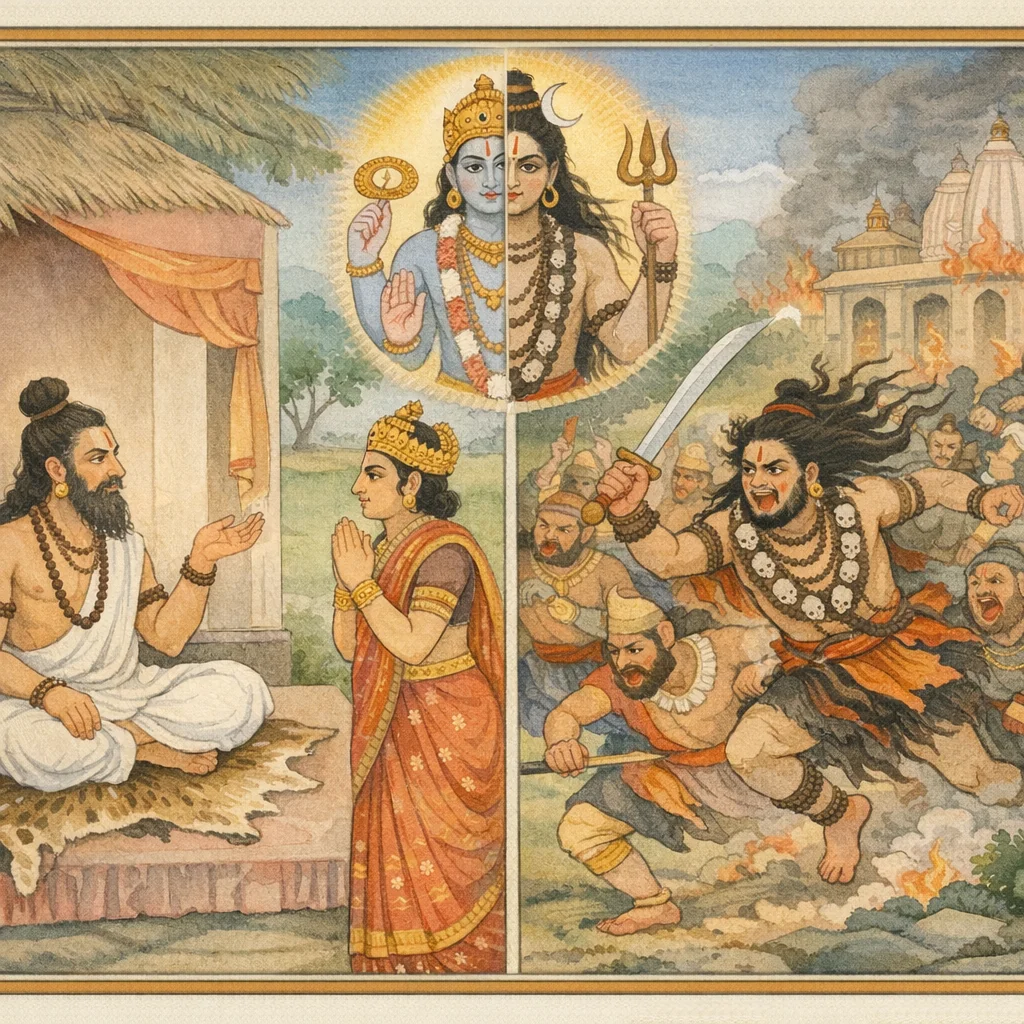
Continuing from the previous chapter’s close, the sages of Naimiṣa ask Sūta about the origin of the Vaivasvata-Manvantara and what became of Dakṣa after Śiva’s curse. Sūta recounts Dakṣa’s renewed sacrifice at Gaṅgādvāra: the gods arrive without Śiva, and Dadhīci challenges Dakṣa for excluding Śaṅkara from the sacrificial shares. The dispute rises into doctrine— the Supreme Lord cannot be reduced to crude outward images, and Nārāyaṇa and Rudra are revealed as one, the Time-essence and inner witness of yajña. Yet Dakṣa’s party, veiled by tamas and māyā, persists; Dadhīci curses the hostile brahmins to drift toward “outside-Vedic” ways in Kali. The Goddess recalls the former insult and seeks the rite’s ruin; Śiva emanates Vīrabhadra (with Bhadrakālī and hosts of Rudras), who devastates the arena, humiliates many deities, and even checks Viṣṇu’s advance. Brahmā intervenes; Śiva appears, receives praise, commands that he be worshipped in all sacrifices, counsels Dakṣa toward devotion, and grants him a future destiny as Gaṇeśa at the end of the aeon. Brahmā then reaffirms the non-duality of Viṣṇu and Rudra and warns against slander, before the narrative turns toward Dakṣa’s progeny and his daughters’ genealogies in the next chapter.
Shlokas
Verse 1
इति श्रीकूर्मपुराणे षट्माहस्त्र्यां संहितायां पूर्वविभागे त्रयोदशो ऽध्यायः नैमिषीया ऊचुः देवानां दानवानां च गन्धर्वोरगरक्षसाम् / उत्पत्तिं विस्तरात् सूत ब्रूहि वैवस्वते ऽन्तरे
Thus ends the thirteenth chapter in the First Part of the Śrī Kūrma Purāṇa, in the Ṣaṭmāhastrī Saṃhitā. The sages of Naimiṣa said: “O Sūta, describe to us in detail the origins of the gods, the Dānavas, the Gandharvas, the Nāgas, and the Rākṣasas—within the Vaivasvata Manvantara.”
Verse 2
स शप्तः शंभुना पूर्वं दक्षः प्राचेतसो नृपः / किमकार्षोन्महाबुद्धे श्रोतुमिच्छाम सांप्रतम्
O King, Dakṣa, the son of Pracetas, was formerly cursed by Śaṃbhu (Śiva). O great-minded one, what did he do thereafter? We wish to hear it now.
Verse 3
सूत उवाच वक्ष्ये नारायणेनोक्तं पूर्वकल्पानुषङ्गिकम् / त्रिकालबद्धं पापघ्नं प्रजासर्गस्य विस्तरम्
Sūta said: I shall recount the teaching spoken by Nārāyaṇa—linked with the tales of former kalpas—bound to the threefold time, sin-destroying, and setting forth in detail the unfolding expansion of the creation of beings.
Verse 4
स शप्तः शंभुना पूर्वं दक्षः प्राचेतसो नृपः / विनिन्द्य पूर्ववैरेण गङ्गाद्वरे ऽयजद् भवम्
That king Dakṣa, son of Prācetas, once cursed by Śambhu (Śiva), later—still driven by an old enmity and speaking with contempt—performed worship of Bhava (Śiva) at Gaṅgādvāra, the gateway of the Gaṅgā.
Verse 5
देवाश्च सर्वे भागार्थमाहूता विष्णुना सह / सहैव मुनिभिः सर्वैरागता मुनिपुङ्गवाः
All the gods, summoned by Viṣṇu for the sake of their allotted share, arrived; and along with all the sages, the foremost among seers also came there.
Verse 6
दृष्ट्वा देवकुलं कृत्स्नं शङ्करेण विनागतम् / दधीचो नाम विप्रर्षिः प्राचेतसमथाब्रवीत्
Seeing the entire host of gods arrive without Śaṅkara (Śiva), the brahmin-sage named Dadhīci then spoke to Prācetasa (Dakṣa).
Verse 7
दधीच उवाच ब्रह्मादयः पिशाचान्ता यस्याज्ञानुविधायिनः / स देवः सांप्रतं रुद्रो विधिना किं न पूज्यते
Dadhīci said: “From Brahmā and the other gods down to the piśācas, all follow whose command. That very God is now manifest as Rudra—so why should he not be worshipped according to the prescribed rule (vidhi)?”
Verse 8
दक्ष उवाच सर्वेष्वेव हि यज्ञेषु न भागः परिकल्पितः / न मन्त्रा भार्यया सार्धं शङ्करस्येति नेज्यते
Dakṣa said: “Truly, in all sacrifices no share has been assigned to Śaṅkara; nor is he to be worshipped with mantras together with his wife.”
Verse 9
विहस्य दक्षं कुपितो वचः प्राह महामुनिः / शृण्वतां सर्वदेवानां सर्वज्ञानमयः स्वयम्
Then the great sage—smiling yet angered—addressed Dakṣa with words as all the gods listened; he himself, the very embodiment of omniscience, spoke.
Verse 10
दधीच उवाच यतः प्रवृत्तिर्विश्वेषां यश्चास्य परमेश्वरः / संपूज्यते सर्वयज्ञैर्विदित्वा किल शङ्करः
Dadhīci said: “He from whom the activity and unfolding of all worlds proceeds, and who is their Supreme Lord—having known Him thus, people indeed worship Śaṅkara through all sacrifices.”
Verse 11
न ह्यं शङ्करो रुद्रः संहर्ता तामसो हरः / नग्नः कपाली विकृतो विश्वात्मा नोपपद्यते
For I am not (merely) Śaṅkara as Rudra—the destroyer, the tamasic ‘Hara’. The Universal Self cannot properly be conceived as naked, skull-bearing, or grotesque in form.
Verse 12
ईश्वरो हि जगत्स्त्रष्टा प्रभुर्नारायणः स्वराट् / सत्त्वात्मको ऽसौ भगवानिज्यते सर्वकर्मसु
For Nārāyaṇa is indeed the Lord—the Creator of the universe, the sovereign Self-ruler. That Blessed One, whose essence is sattva (purity and luminous balance), is worshipped in all rites and actions.
Verse 13
दधीच उवाच किं त्वया भगवानेष सहस्त्रांशुर्न दृश्यते / सर्वलोकैकसंहर्ता कालात्मा परमेश्वरः
Dadhīca said: “Why do you not behold this Blessed One, the thousand-rayed Sun? He is the Supreme Lord, whose very essence is Time; He alone is the single withdrawer and destroyer of all the worlds.”
Verse 14
यं गृणन्तीह विद्वांसो धार्मिका ब्रह्मवादिनः / सो ऽयं साक्षी तीव्ररोचिः कालात्मा शाङ्करीतनुः
He whom the learned here—righteous men and expounders of Brahman—unceasingly hymn: He indeed is the Witness, of fierce radiance, the Self as Time, embodied as Śaṅkara (Śiva).
Verse 15
एष रुद्रो महादेवः कपर्दे च घृणी हरः / आदित्यो भगवान् सूर्यो नीलग्रीवो विलोहितः
He indeed is Rudra, the Mahādeva—Kapardī (the matted-haired Lord), Ghṛṇī (the Radiant One), and Hara (the Remover). He is also Āditya, the Blessed Sun, Sūrya himself—Nīlagrīva (Blue-throated) and Vilohita (the intensely red-hued One).
Verse 16
संस्तूयते सहस्त्रांशुः सामगाध्वर्युहोतृभिः / पश्यैनं विश्वकर्माणं रुद्रमूर्ति त्रयीमयम्
The thousand-rayed Sun is praised by the Sāman-chanters, the Adhvaryu priests, and the Hotṛ reciters. Behold Him—Viśvakarman, the all-fashioning One—whose very form is Rudra, and who is constituted of the Vedic Triad.
Verse 17
दक्ष उवाच य एते द्वादशादित्या आगता यज्ञभागिनः / सर्वे सूर्या इति ज्ञेया न ह्यान्यो विद्यते रविः
Dakṣa said: “These twelve Ādityas who have come as entitled sharers in the sacrificial offerings should all be understood as ‘Sūrya’ (the Sun). For truly there is no other Ravi apart from Him.”
Verse 18
एवमुक्ते तु मुनयः समायाता दिदृक्षवः / बाढमित्यब्रुवन् वाक्यं तस्य साहाय्यकारिणः
When this was spoken, the sages, longing to behold it for themselves, gathered together; and replying, “So be it,” they consented to his request and became his helpers.
Verse 19
तमसाविष्टमनसो न पश्यन्ति वृषध्वजम् / सहस्त्रशो ऽथ शतशो भूय एव विनिन्द्यते
Those whose minds are seized by darkness (tamas) do not behold Vṛṣadhvaja—Śiva, the Bull-bannered Lord; instead, again and again, by the hundred and by the thousand, he is reviled.
Verse 20
निन्दन्तो वैदिकान् मन्त्रान् सर्वभूतपतिं हरम् / अपूजयन् दक्षवाक्यं मोहिता विष्णुमायया
Deluded by Viṣṇu’s māyā, they reviled the Vedic mantras and did not honor Hara, the Lord of all beings; instead they followed Dakṣa’s words and withheld worship.
Verse 21
देवाश्च सर्वे भागार्थमागता वासवादयः / नापश्यन् देवमीशानमृते नारायणं हरिम्
All the gods—Indra and the rest—came seeking their allotted share; yet they saw no other Supreme Lord, except Nārāyaṇa, Hari alone.
Verse 22
हिरण्यगर्भो भगवान् ब्रह्मा ब्रह्मविदां वरः / पश्यतामेव सर्वेषां क्षणादन्तरधीयत
Hiraṇyagarbha—Brahmā, the Blessed Lord, foremost among the knowers of Brahman—while all were watching, vanished from sight in a single instant.
Verse 23
अन्तर्हिते भगवति दक्षो नारायणं हरिम् / रक्षकं जगतां देवं जगाम शरणं स्वयम्
When the Blessed Lord withdrew from sight, Dakṣa himself sought refuge in Nārāyaṇa—Hari, the divine Protector of the worlds.
Verse 24
प्रवर्तयामास च तं यज्ञं दक्षो ऽथ निर्भयः / रक्षते भगवान् विष्णुः शरणागतरक्षकः
Then Dakṣa, free from fear, set that sacrifice in motion; for the Blessed Lord Viṣṇu—protector of those who seek refuge—indeed safeguards all.
Verse 25
पुनः प्राह च तं दक्षं दधीचो भगवानृषिः / संप्रेक्ष्यर्षिगणान् देवान् सर्वान् वै ब्रह्मविद्विषः
Then the blessed sage Dadhīci spoke again to Dakṣa; and, looking upon all the hosts of sages and the gods, he addressed those who are hostile to Brahman, the Vedic truth.
Verse 26
अपूज्यपूजने चैव पूज्यानां चाप्यपूजने / नरः पापमवाप्नोति महद् वै नात्र संशयः
By honoring what is unworthy of honor, and by failing to honor those truly worthy of honor, a person incurs great sin—of this there is no doubt.
Verse 27
असतां प्रग्रहो यत्र सतां चैव विमानना / दण्डो देवकृतस्तत्र सद्यः पतति दारुणः
Where the wicked are favored and the virtuous are dishonored, there a dreadful punishment, ordained by the gods, falls immediately.
Verse 28
एवमुक्त्वा तु विप्रर्षिः शशापेश्वरविद्विषः / समागतान् ब्राह्मणांस्तान् दक्षसाहाय्यकारिणः
Having spoken thus, the brahmin-sage cursed those who hated the Lord—the assembled brahmins who had come as helpers of Daksha.
Verse 29
यस्माद् बहिष्कृता वेदा भवद्भिः परमेश्वरः / विनिन्दितो महादेवः शङ्करो लोकवन्दितः
Because you have cast aside the Vedas, you have reviled the Supreme Lord—Mahādeva Śaṅkara, the great God worshipped by the worlds.
Verse 30
भविष्यध्वं त्रयीबाह्याः सर्वे ऽपीश्वरविद्विषः / निन्दन्तो ह्यैश्वरं मार्गं कुशास्त्रासक्तमानसाः
“You shall all become ‘outside the Vedic triad’—indeed, all of you will be haters of the Lord—reviling the Lord’s own path, with minds attached to perverse and misleading treatises.”
Verse 31
मिथ्याधीतसमाचारा मिथ्याज्ञानप्रलापिनः / प्राप्य घोरं कलियुगं कलिजैः किल पीडिताः
Their conduct will be shaped by false learning, and they will prattle about counterfeit ‘knowledge’. Having entered the dreadful age of Kali, they will indeed be afflicted by those born of Kali—its corrupting forces and people.
Verse 32
त्यक्त्वा तपोबलं कृत्स्नं गच्छध्वं नरकान् पुनः / भविष्यति हृषीकेशः स्वाश्रितो ऽपि पराङ्मुखः
“Abandoning the entire strength gained through austerity, you will again go to the hell-realms. Even Hṛṣīkeśa, the Lord of the senses, though you claim Him as your refuge, will turn His face away from you.”
Verse 33
एवमुक्त्वा तु विप्रर्षिर्विरराम तपोनिधिः / जगाम मनसा रुद्रमशेषाघविनाशनम्
Having spoken thus, the Brahmin-sage—treasure of austerity—fell silent; and with his mind he approached Rudra, the destroyer of all sins without remainder.
Verse 34
एतस्मिन्नन्तरे देवी महादेवं महेश्वरम् / पतिं पशुपतिं देवं ज्ञात्वैतत् प्राह सर्वदृक्
Meanwhile, the Goddess—who sees all—recognized him as Mahādeva, Maheśvara, the Lord, Paśupati, the God; and, knowing this, she spoke these words.
Verse 35
देव्युवाच दक्षो यज्ञेन यजते पिता मे पूर्वजन्मनि / विनिन्द्य भवतो भावमात्मानं चापि शङ्कर
The Goddess said: “In my former birth, my father Dakṣa performed a sacrifice; and, O Śaṅkara, he reviled your sacred nature and even himself.”
Verse 36
देवाः सहर्षिभिश्चासंस्तत्र साहाय्यकारिणः / विनाशयाशु तं यज्ञं वरमेकं वृणोम्यहम्
The gods, together with the sages, were present there as helpers. “Destroy that sacrifice at once; I choose this single boon.”
Verse 37
एवं विज्ञापितो देव्या देवो देववरः प्रभुः / ससर्ज सहसा रुद्रं दक्षयज्ञजिघांसया
Thus petitioned by the Goddess, the Lord—supreme among the gods—at once brought forth Rudra, with the intent of destroying Dakṣa’s sacrifice.
Verse 38
सहस्त्रशीर्षपादं च सहस्त्राक्षं महाभुजम् / सहस्त्रपाणिं दुर्धर्षं युगान्तानलसन्निभम्
He is beheld as having a thousand heads and feet, a thousand eyes, and mighty arms; a thousand hands—invincible, blazing like the fire at the end of an age.
Verse 39
दंष्ट्राकरालं दुष्प्रेक्ष्यं शङ्खचक्रगदाधरम् / दण्डहस्तं महानादं शार्ङ्गिणं भूतिभूषणम्
He appeared with fearsome fangs, difficult to behold; bearing the conch, discus, and mace—holding a staff in His hand—thundering with a mighty roar, wielding the Śārṅga bow, and adorned with sacred ash as His ornament.
Verse 40
वीरभद्र इति ख्यातं देवदेवसमन्वितम् / स जातमात्रो देवेशमुपतस्थे कृताञ्जलिः
He became renowned as Vīrabhadra, endowed with the presence and power of the God of gods; and, the very moment he was born, he reverently approached the Lord of the devas, standing before Him with folded hands.
Verse 41
तमाह दक्षस्य मखं विनाशय शिवोस्त्विति / विनिन्द्य मां स यजते गङ्गाद्वारे गणेश्वर
He said to me, ‘Be for Śiva—go and destroy Dakṣa’s sacrifice.’ Yet, after reviling me, that very one performs worship at Gaṅgādvāra, O Lord of the Gaṇas.
Verse 42
ततो बन्धुप्रयुक्तेन सिंहेनैकेन लीलया / वीरभद्रेण दक्षस्य विनाशमगमत् क्रतुः
Then, by a single lion—sent forth at the prompting of his kinsmen—Vīrabhadra, as if in sport, brought Dakṣa’s sacrificial rite to ruin.
Verse 43
मन्युना चोमया सृष्टा भद्रकाली महेश्वरी / तया च सार्धं वृषभं समारुह्य ययौ गणः
From wrath and from Umā arose Bhadrakālī, the great Goddess. With her, the host of Gaṇas mounted the bull and set forth.
Verse 44
अन्ये सहस्त्रशो रुद्रा निसृष्टास्तेन धीमता / रोमजा इति विख्यातास्तस्य साहाय्यकारिणः
By that wise One, other Rudras too were emanated in their thousands; they are famed as the ‘Romaja’ (hair-born) Rudras, serving as his helpers in the cosmic work.
Verse 45
शूलशक्तिगदाहस्ताष्टङ्कोपलकरास्तथा / कालाग्निरुद्रसंकाशा नादयन्तो दिशो दश
Bearing tridents, spears, and maces in their hands, and likewise grasping clubs and stones, they appeared like Rudra as the fire of Time, roaring so that the ten directions resounded.
Verse 46
सर्वे वृषासनारूढाः सभार्याश्चातिभीषणाः / समावृत्य गणश्रेष्ठं ययुर्दक्षमखं प्रति
All of them, mounted upon bulls, exceedingly fearsome and accompanied by their wives, surrounded the foremost of the Gaṇas and set out toward Dakṣa’s sacrificial rite.
Verse 47
सर्वे शंप्राप्य तं देशं गङ्गाद्वारमिति श्रुतम् / ददृशुर्यज्ञदेशं तं दक्षस्यामिततेजसः
Having all reached that region—heard of as Gaṅgādvāra—they beheld there the sacrificial ground of Dakṣa, whose splendor was immeasurable.
Verse 48
देवाङ्गनासहस्त्राढ्यमप्सरोगीतनादितम् / वीणावेणुनिनादाढ्यं वेदवादाभिनादितम्
It was filled with thousands of celestial maidens, resonant with the songs of the Apsarases; rich with the sounds of vīṇā and flute, and reverberating with the solemn recitation of Vedic utterances.
Verse 49
दृष्ट्वा सहर्षिभिर्देवैः समासीनं प्रजापतिम् / उवाच भद्रया रुद्रैर्वोरभद्रः स्मयन्निव
Seeing Prajāpati seated in the assembly together with the sages and the gods, Vīrabhadra—accompanied by the Rudras—spoke, as though smiling, with a gracious yet firm composure.
Verse 50
वयं ह्यनुचराः सर्वे शर्वस्यामिततेजसः / भागाभिलप्सया प्राप्ता भागान् यच्छध्वमीप्सितान्
“We are all attendants of Śarva (Śiva) of immeasurable splendor. Desiring our due shares, we have come—grant us the portions we seek.”
Verse 51
अथ चेत् कस्यचिदियमाज्ञा मुनिसुरोत्तमाः / भागो भवद्भ्यो देयस्तु नास्मभ्यमिति कथ्यताम् / तं ब्रूताज्ञापयति यो वेत्स्यामो हि वयं ततः
“Now, O best of sages and gods, if this is indeed someone’s command—namely, ‘the share must be given to you, not to us’—then tell us who it is that issues this order. Once we know that authority, we shall act accordingly.”
Verse 52
एवमुक्ता गणेशेन प्रजापतिपुरः सराः / देवा ऊचुर्यज्ञभागे न च मन्त्रा इति प्रभुम्
Thus addressed by Gaṇeśa before Prajāpati’s assembly, the gods said to the Lord: “In the matter of the sacrificial share, the mantras do not sanction it in that way.”
Verse 53
मन्त्रा ऊचुः सुरान् यूयं तमोपहतचेतसः / ये नाध्वरस्य राजानं पूजयध्वं महेश्वरम्
The Mantras said to the gods: “Your minds are struck down by darkness, for you do not worship Mahēśvara, the sovereign Lord of the sacrifice (adhvara).”
Verse 54
ईश्वरः सर्वभूतानां सर्वभूततनुर्हरः / पूज्यते सर्वयज्ञेषु सर्वाभ्युदसिद्धिदः
Īśvara, Lord of all beings—Hari who has taken the very bodies of all beings as his form—is worshipped in every sacrifice, for he bestows all prosperity and every spiritual accomplishment (siddhi).
Verse 55
एवमुक्ता अपीशानं मायया नष्टचेतसः / न मेनिरे ययुर्मन्त्रा देवान् मुक्त्वा स्वमालयम्
Though thus addressed, their minds were ruined by Māyā; they did not recognize Īśāna. Abandoning the gods, those mantra-bearing ones departed to their own abode.
Verse 56
ततः स रुद्रो भगवान् सभार्यः सगणेश्वरः / स्पृशन् कराभ्यां ब्रह्मर्षि दधीचं प्राह देवताः
Then the Blessed Lord Rudra—together with his consort and attended by the lords of his gaṇas—touched the Brahmarṣi Dadhīci with both hands and addressed the gods.
Verse 57
मन्त्राः प्रमाणं न कृता युष्माभिर्बलगर्वितैः / यस्मात् प्रसह्य तस्माद् वो नाशयाम्यद्य गर्वितम्
“You, intoxicated with the pride of strength, did not accept the mantras as authoritative proof. Therefore, having subdued you by force, I shall destroy your arrogance today.”
Verse 58
इत्युक्त्वा यज्ञशालां तां ददाह गणपुङ्गवः / गणेश्वराश्च संक्रुद्धा यूपानुत्पाट्य चिक्षिपुः
Thus having spoken, the foremost of Śiva’s gaṇas set that sacrificial hall ablaze; and the gaṇa-lords, enraged, tore up the yūpa-posts and hurled them away.
Verse 59
प्रस्तोत्रा सह होत्रा च अश्वं चैव गणेश्वराः / गृहीत्वा भीषणाः सर्वे गङ्गास्त्रोतसि चिक्षिपुः
Then the Gaṇeśvaras—terrifying in form—seized the sacrificial horse, along with the prastotṛ and the hotṛ priests, and hurled them into the current of the Gaṅgā.
Verse 60
वीरभद्रो ऽपि दीप्तात्मा शक्रस्योद्यच्छतः करम् / व्यष्टम्भयददीनात्मा तथान्येषां दिवौकसाम्
Then Vīrabhadra, radiant in spirit, checked the upraised hand of Śakra (Indra); and with an undaunted heart he likewise restrained the hands of the other dwellers in heaven.
Verse 61
भगस्य नेत्रे चोत्पाट्य करजाग्रेण लीलया / निहत्य मुष्टिना दन्तान् पूष्णश्चैवमपातयत्
Playfully, he tore out Bhaga’s eyes with the tips of his fingernails; and then, striking Pūṣan’s teeth with his fist, he knocked him down in that very way.
Verse 62
तथा चन्द्रमसं देवं पादाङ्गुष्ठेन लीलया / धर्षयामास बलवान् स्मयमानो गणेश्वरः
In the same way, the mighty Lord of the Gaṇas (Gaṇeśvara), smiling, playfully pressed down and humiliated the god Candra (the Moon) with the great toe of his foot.
Verse 63
वह्नेर्हस्तद्वयं छित्त्वा जिह्वामुत्पाट्य लीलया / जघान मूर्ध्नि पादेन मुनीनपि मुनीश्वराः
Having severed Agni’s two hands and, as if in sport, torn out his tongue, the lord among sages struck even the sages upon the crown of the head with his foot.
Verse 64
तथा विष्णुं सहरुडं समायान्तं महाबलः / विव्याध निशेतैर्बाणैः स्तम्भयित्वा सुदर्शनम्
Then, as Viṣṇu advanced together with Garuḍa, that mighty warrior—having checked Sudarśana—pierced him with razor‑sharp arrows.
Verse 65
समालोक्य महाबाहुरागत्य गरुडो गणम् / जघान पक्षैः सहसा ननादाम्बुनिधिर्यथा
Seeing the host, the mighty‑armed Garuḍa swooped in and in an instant struck the troop with his wings, roaring like the ocean.
Verse 66
ततः सहस्त्रशो भद्रः ससर्ज गरुडान् स्वयम् / वैनतेयादभ्यधिकान् गरुडं ते प्रदुद्रुवुः
Thereupon the Auspicious One himself brought forth Garuḍas by the thousand—Garuḍas surpassing even Vainateya—and those Garuḍas rushed toward Garuḍa (Vainateya).
Verse 67
तान् दृष्ट्वा गरुडो धीमान् पलायत महाजवः / विसृज्य माधवं वेगात् तदद्भुतमिवाभवत्
Seeing them, the wise Garuḍa—swift as a mighty tempest—fled. In his sudden speed he let go of Mādhava, and the whole event appeared truly wondrous.
Verse 68
अन्तर्हिते वैनतेये भगवान् पद्मसंभवः / आगत्य वारयामास वीरभद्रं च केशवम्
When Vainateya (Garuḍa) vanished from sight, the Blessed Lord Padmasaṃbhava (Brahmā) arrived and restrained both Vīrabhadra and Keśava (Viṣṇu).
Verse 69
प्रसादयामास च तं गौरवात् परमेष्ठिनः / संस्तूय भगवानीशः साम्बस्तत्रागमत् स्वयम्
And out of reverence for the Supreme Lord (Parameṣṭhin), he sought to propitiate him; then, having offered praise, the Blessed Lord—Sāmba—came there in person.
Verse 70
वीक्ष्य देवाधिदेवं तं साम्बं सर्वगणैर्वृतम् / तुष्टाव भगवान् ब्रह्मा दक्षः सर्वे दिवौकसः
Beholding that Lord of the gods—Sāmba (Śiva)—surrounded by all his gaṇas, the venerable Brahmā, along with Dakṣa and all the celestial beings, praised him.
Verse 71
विशेषात् पार्वतीं देवीमीश्वरार्धशरीरिणीम् / स्तोत्रैर्नानाविधैर्दक्षः प्रणम्य च कृताञ्जलिः
In particular, Dakṣa—having bowed with folded hands—offered many kinds of hymns in praise of Goddess Pārvatī, who abides as the very half-body of Īśvara (Ardhanārīśvara).
Verse 72
ततो भगवती देवी प्रहसन्ती महेश्वरम् / प्रसन्नमानसा रुद्रं वचः प्राह घृणानिधिः
Then the Blessed Goddess, smiling, addressed Maheśvara. With a serene and pleased mind, she spoke words to Rudra—she who is a very treasury of compassion.
Verse 73
त्वमेव जगतः स्त्रष्टा शासिता चैव रक्षकः / अनुग्राह्यो भगवता दक्षश्चापि दिवौकसः
You alone are the Creator of the universe—its Governor and its Protector. Even Dakṣa, the skilled lord among the dwellers of heaven, must receive grace from the Blessed Lord (You).
Verse 74
ततः प्रहस्य भगवान् कपर्दे नीललोहितः / उवाच प्रणतान् देवान् प्राचेतसमथो हरः
Then, smiling, the Blessed Lord—Kapardin, Nīlalohita, Hara—together with Prācetasa, addressed the gods who had bowed down in reverence.
Verse 75
गच्छध्वं देवताः सर्वाः प्रसन्नो भवतामहम् / संपूज्यः सर्वयज्ञेषु न निन्द्यो ऽहं विशेषतः
Depart now, all you deities; may I be graciously pleased with you. In every sacrifice I am to be duly worshipped, and I am certainly not to be censured—especially so.
Verse 76
त्वं चापि शृणु मे दक्ष वचनं सर्वरक्षणम् / त्यक्त्वा लोकैषणामेतां मद्भक्तो भव यत्नतः
And you too, O Dakṣa, listen to my counsel that safeguards in every way: abandoning this craving for worldly recognition, become devoted to me with sustained effort.
Verse 77
भविष्यसि गणेशानः कल्पान्ते ऽनुग्रहान्मम / तावत् तिष्ठ ममादेशात् स्वाधिकारेषु निर्वृतः
By my grace, at the end of the aeon you shall become the Lord of the Gaṇas (Gaṇeśa). Until then, by my command, remain serene and content within your own appointed sphere of authority.
Verse 78
एवमुक्त्वा स भगवान् सपत्नीकः सहानुगः / अदर्शनमनुप्राप्तो दक्षस्यामिततेजसः
Having spoken thus, the Blessed Lord—together with His consort and attendants—vanished from the sight of radiant Dakṣa, whose splendor was boundless.
Verse 79
अन्तर्हिते महादेवे शङ्करे पद्मसंभवः / व्याजहार स्वयं दक्षमशेषजगतो हितम्
When Mahādeva Śaṅkara had withdrawn from sight, Padmasaṃbhava (Brahmā) himself addressed Dakṣa—speaking for the welfare of the entire world.
Verse 80
ब्रह्मोवाच किं तवापगतो मोहः प्रसन्ने वृषभध्वजे / यदाचष्ट स्वयं देवः पालयैतदतन्द्रितः
Brahmā said: “Has your delusion now departed, O Lord of the Bull-banner, since you are appeased? As the God Himself has declared, let him protect this—unceasingly and without negligence.”
Verse 81
सर्वेषामेव भूतानां हृद्येष वसतीश्वरः / पश्यन्त्येनं ब्रह्मभूता विद्वांसो वेदवादिनः
In the heart of all beings indeed dwells the Lord. Those who have become Brahman—wise knowers and expounders of the Veda—behold Him directly.
Verse 82
स आत्मा सर्वभूतानां स बीजं परमा गतिः / स्तूयते वैदिकैर्मन्त्रैर्देवदेवो महेश्वरः
He is the Self of all beings; He is the seed (cause) and the supreme goal. That Mahādeva—Maheśvara, the God of gods—is praised by the mantras of the Veda.
Verse 83
तमर्चयति यो रुद्रं स्वात्मन्येकं सनातनम् / चेतसा भावयुक्तेन स याति परमं पदम्
Whoever worships Rudra—the one, eternal Lord—within one’s own Self, with a mind filled with true devotion and inner contemplation, attains the supreme abode.
Verse 84
तस्मादनादिमध्यान्तं विज्ञाय परमेश्वरम् / कर्मणा मनसा वाचा समाराधय यत्नतः
Therefore, having understood the Supreme Lord—without beginning, middle, or end—worship Him earnestly through your actions, your mind, and your speech.
Verse 85
यत्नात् परिहरेशस्य निन्दामात्मविनाशनीम् / भवन्ति सर्वदोषाय निन्दकस्य क्रिया यतः
One should carefully avoid censuring Īśa, for such blame destroys one’s own self; whatever deeds a slanderer performs ultimately become causes of every fault.
Verse 86
यस्तवैष महायोगी रक्षको विष्णुरव्ययः / स देवदेवो भगवान् महादेवो न संशयः
He who is your protector—Viṣṇu, the imperishable Great Yogi—he indeed is Bhagavān Mahādeva, the God of gods; of this there is no doubt.
Verse 87
मन्यन्ते ये जगद्योनिं विभिन्नं विष्णुमीश्वरात् / मोहादवेदनिष्ठत्वात् ते यान्ति नरकं नराः
Those who, through delusion and steadfastness in non-knowledge, imagine Viṣṇu—the source-womb of the universe—to be different from Īśvara, go to hell.
Verse 88
वेदानुवर्तिनो रुद्रं देवं नारायणं तथा / एकीभावेन पश्यन्ति मुक्तिभाजो भवन्ति ते
Those who follow the Vedas behold Rudra and Lord Nārāyaṇa as one single Reality; they become sharers in liberation (mokṣa).
Verse 89
यो विष्णुः स स्वयं रुद्रो यो रुद्रः स जनार्दनः / इति मत्वा यजेद् देवं स याति परमां गतिम्
He who is Viṣṇu is verily Rudra Himself; and he who is Rudra is Janārdana. Knowing thus, one should worship the Divine—such a worshipper attains the supreme destination.
Verse 90
सृजत्येतज्जगत् सर्वं विष्णुस्तत् पश्यतीश्वरः / इत्थं जगत् सर्वमिदं रुद्रनारायणोद्भवम्
Viṣṇu brings forth this entire universe, and Īśvara (Rudra) beholds and oversees it. Thus, all this universe arises from Rudra and Nārāyaṇa together.
Verse 91
तस्मात् त्यक्त्वा हरेर्निन्दां विष्णावपि समाहितः / समाश्रयेन्महादेवं शरण्यं ब्रह्मवादिनाम्
Therefore, abandoning all slander of Hari, and remaining steady in devotion even to Viṣṇu, one should take refuge in Mahādeva—the sure refuge of the knowers and teachers of Brahman.
Verse 92
उपश्रुत्याथ वचनं विरिञ्चस्य प्रजापतिः / जगाम शरणं देवं गोपतिं कृत्तिवाससम्
Having heard the words of Viriñci (Brahmā), Prajāpati then went for refuge to the God—Gopati, Lord of beings—Śiva, the wearer of the hide (Kṛttivāsa).
Verse 93
ये ऽन्ये शापाग्निनिर्दग्धा दधीचस्य महर्षयः / द्विषन्तो मोहिता देवं संबभूवुः कलिष्वथ
And those other great sages connected with Dadhīci—scorched by the fire of a curse—became deluded; hating the Lord, they then came to embody the temper of the Kali age.
Verse 94
त्यक्त्वा तपोबलं कृत्स्नं विप्राणां कुलसंभवाः / पूर्वसंस्कारमहात्म्याद् ब्रह्मणो वचनादिह
Born in the lineages of Brahmin sages, they here set aside the entirety of their ascetic power—moved by the greatness of former samskāras and in obedience to the command of Brahmā.
Verse 95
मुक्तशापास्ततः सर्वे कल्पान्ते रौरवादिषु / निपात्यमानाः कालेन संप्राप्यादित्यवर्चसम् / ब्रह्माणं जगतामीशमनुज्ञाताः स्वयंभुवा
Then all of them, freed from the curse, at the end of the aeon—though being cast down by Time into hells such as Raurava—attained the radiant splendor of the Sun and, by the permission of the Self-born (Svayambhū), reached Brahmā, the Lord of the worlds.
Verse 96
समाराध्य तपोयोगादीशानं त्रिदशाधिपम् / भविष्यन्ति यथा पूर्वं शङ्करस्य प्रसादतः
Having duly propitiated Īśāna—Śiva, the lord of asceticism and yoga, the ruler of the gods—they shall become as they once were before, through Śaṅkara’s grace.
Verse 97
एतद् वः कथितं सर्वं दक्षयज्ञनिषूदनम् / शृणुध्वं दक्षपुत्रीणां सर्वासां चैव संततिम्
Thus I have told you in full about the destruction of Dakṣa’s sacrifice. Now listen to the progeny—the lineal descents—of all the daughters of Dakṣa as well.
Frequently Asked Questions
Because the chapter frames Śiva/Īśvara as the presiding Self and witness of yajña; excluding him contradicts Vedic understanding and results from tamas and māyā rather than mantra-guided discernment.
It explicitly states that Viṣṇu is Rudra and Rudra is Janārdana; those who see difference fall into ruin, while Veda-followers recognize their essential unity and attain liberation.
Beyond narrative drama, it functions as a theological correction: ritual without reverence to Īśvara becomes spiritually void, and sectarian contempt is shown to generate karmic downfall and Kali-like dispositions.