Adhyaya 16
Virocana–Bali, Aditi’s Tapas, and the Vāmana–Trivikrama Episode
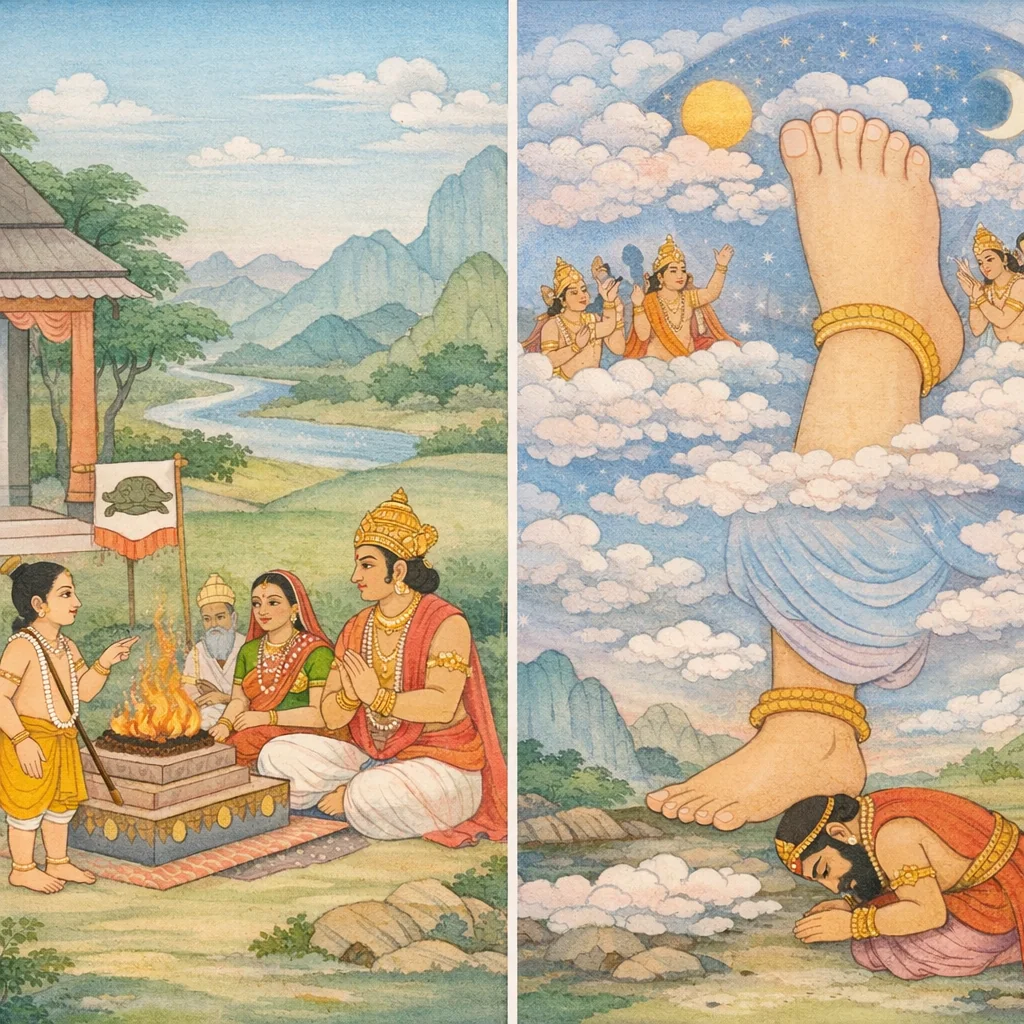
Continuing the purāṇic account of the Asura lineages after Andhaka’s subduing, Lord Kūrma tells how Prahlāda’s son Virocana rules the three worlds with a rare, dharma-centered policy. Prompted by Viṣṇu, Sanatkumāra visits, praises this Daitya righteousness, and imparts the most secret dharma as ātma-jñāna; Virocana renounces and entrusts the kingdom to Bali. Bali conquers Indra, driving the Devas to seek Viṣṇu’s refuge, while Aditi performs intense tapas and heart-lotus meditation on Vāsudeva. Viṣṇu appears, accepts her hymns that unite divine names and functions (as Time, Narasiṃha, Śeṣa, Kāla-Rudra, and also addressed as Śambhu/Śiva), and grants the boon of being born as her son. As omens arise in Bali’s city, Prahlāda reveals Viṣṇu’s descent for Deva-protection and counsels surrender; Bali seeks refuge yet continues dharmic guardianship. Viṣṇu is born as Upendra, exemplifies Vedic study and right conduct, then comes as Vāmana to Bali’s sacrifice and asks for three steps of land. As Trivikrama he spans earth, mid-region, and heaven, pierces the cosmic enclosure, and the Gaṅgā descends—named by Brahmā. Bali offers himself; Viṣṇu sends him to Pātāla with the promise of final union at pralaya, restores Indra’s sovereignty, and the world hymns the “Great Yoga” of bhakti, leading into Bali’s continued devotion and ritual order under Prahlāda’s guidance.
Shlokas
Verse 1
इति श्रीकूर्मपुराणे षट्साहस्त्र्यां संहितायां पूर्वविभागे पञ्चदशो ऽध्यायः श्रीकूर्म उवाच अन्दके निगृहीते वै प्रह्लादस्य महात्मनः / विरोचनो नाम सुतो बभूव नृपतिः पुरा
Thus, in the Śrī Kūrma Purāṇa, in the six-thousand-verse Saṃhitā, in the Pūrva-bhāga, the fifteenth chapter ends. Lord Kūrma said: “When Andhaka had been subdued, there was formerly born to the great-souled Prahlāda a son named Virocana, who became a king.”
Verse 2
देवाञ्जित्वा सदेवेन्द्रान बहून् वर्षान् महासुरः / पालयामास धर्मेण त्रैलोक्यं सचराचरम्
Having conquered the gods along with Indra, the great Asura ruled for many years the three worlds—both the moving and the unmoving—according to dharma.
Verse 3
तस्यैवं वर्तमानस्य कदाचिद् विष्णुचोदितः / सनत्कुमारो भगवान् पुरं प्राप महामुनिः
While he was thus engaged, at a certain time the great sage Sanatkumāra—moved by the prompting of Viṣṇu—arrived at the city.
Verse 4
दृष्ट्वा सिहासनगतो ब्रह्मपुत्रं महासुरः / ननामोत्थाय शिरसा प्राञ्जलिर्वाक्यमब्रवीत्
Seeing Brahmā’s son seated upon the throne, the mighty Asura rose, bowed his head in reverence, and with hands joined in salutation spoke these words.
Verse 5
धन्यो ऽस्म्यनुगृहीतो ऽस्मि संप्राप्तो मे पुरातनः / योगीश्वरो ऽद्य भगवान् यतो ऽसौ ब्रह्मवित् स्वयम्
Blessed am I; I have been shown grace. Today the ancient Lord—the master of yogins—has come to me, for he indeed is a knower of Brahman in his very own being.
Verse 6
किमर्थमागतो ब्रह्मन् स्वयं देवः पितामहः / ब्रूहि मे ब्रह्मणः पुत्र किं कार्यं करवाण्यहम्
“For what purpose have you come, O Brahman—indeed you yourself are the divine Grandfather (Brahmā). Tell me, O son of Brahmā: what task am I to accomplish?”
Verse 7
सो ऽब्रवीद् भगवान् देवो धर्मयुक्तं महासुरम् / द्रष्टुमभ्यागतो ऽहं वै भवन्तं भाग्यवानसि
Then the Blessed Lord, the divine One, spoke to that great Asura who was established in dharma: “I have indeed come here to see you; you are truly fortunate.”
Verse 8
सुदुर्लभा नीतिरेषा दैत्यानां दैत्यसत्तम / त्रिलोके धार्मिको नूनं त्वादृशो ऽन्यो न विद्यते
This kind of righteous policy is exceedingly rare among the Daityas, O best of Daityas. Truly, in all the three worlds there is no other dharmic one like you.
Verse 9
इत्युक्तो ऽसुरराजस्तं पुनः प्राह महामुनिम् / धर्माणां परमं धर्मं ब्रूहि मे ब्रह्मवित्तम
Thus addressed, the king of the Asuras again spoke to the great sage: “O knower of Brahman, tell me the highest Dharma—the supreme principle among all dharmas.”
Verse 10
सो ऽब्रवीद् भगवान् योगी दैत्येन्द्राय महात्मने / सर्वगुह्यतमं धर्ममात्मज्ञानमनुत्तमम्
Then the Blessed Lord—the Yogin—spoke to the great-souled lord of the Daityas, imparting the most secret Dharma: the unsurpassed knowledge of the Self (Ātman).
Verse 11
स लब्ध्वा परमं ज्ञानं दत्त्वा च गुरुदक्षिणाम् / निधाय पुत्रे तद्राज्यं योगाभ्यासरतो ऽभवत्
Having attained the highest knowledge, and having offered the teacher’s due honorarium, he entrusted that kingdom to his son and became devoted to the disciplined practice of Yoga.
Verse 12
स तस्य पुत्रो मतिमान् बलिर्नाम महासुरः / ब्रह्मण्यो धार्मिको ऽत्यर्थं विजिग्ये ऽथ पुरन्दरम्
His son was the wise great Asura named Bali—devoted to the Brāhmaṇas and exceedingly righteous; and then he conquered Purandara (Indra).
Verse 13
कृत्वा तेन महद् युद्धं शक्रः सर्वामरैर्वृतः / जगाम निर्जितो विष्णुं देवं शरणमच्युतम्
Having waged a great battle with him, Śakra (Indra), surrounded by all the gods, went—defeated—to Viṣṇu, the divine Acyuta, seeking refuge.
Verse 14
तदन्तरे ऽदितिर्देवी देवमाता सुदुः खिता / दैत्येन्द्राणां वधार्थाय पुत्रो मे स्यादिति स्वयम्
Meanwhile, the goddess Aditi—the Mother of the Devas—was plunged in deep sorrow. She herself resolved: “May a son be born to me, for the slaying of the lords of the Daityas.”
Verse 15
तताप सुमहद् घोरं तपोराशिस्तपः परम् / प्रपन्ना विष्णुमव्यक्तं शरण्यं शरणं हरिम्
She undertook exceedingly great and fearsome austerity—the supreme treasury of tapas—having surrendered to the unmanifest Vishnu, Hari, the true Refuge, the shelter of all who seek shelter.
Verse 16
कृत्वा हृत्पद्मकिञ्जल्के निष्कलं परमं पदम् / वासुदेवमनाद्यन्तमानन्दं व्योम केवलम्
Having established within the filaments of the lotus of the heart the partless Supreme State, one should contemplate Vāsudeva—without beginning or end—pure bliss itself, the sole all-pervading expanse of consciousness.
Verse 17
प्रसन्नो भगवान् विष्णुः शङ्खचक्रगदाधरः / आविर्बभूव योगात्मा देवमातुः पुरो हरिः
Pleased, the Blessed Lord Viṣṇu—bearing conch, discus, and mace—manifested Himself: Hari, whose very essence is Yoga, appeared before the Mother of the Devas.
Verse 18
दृष्ट्वा समागतं विष्णुमदितिर्भक्तिसंयुता / मेने कृतार्थमात्मानं तोषयामास केशवम्
Seeing Vishnu arrive before her, Aditi—filled with devotion—felt her life’s purpose fulfilled, and she sought to please Keshava.
Verse 19
अदितिरुवाच जयाशेषदुः खौघनाशैकहेतो जयानन्तमाहात्म्ययोगाभियुक्त / जयानादिमध्यान्तविज्ञानमूर्ते जयाशेषकल्पामलानन्दरूप
Aditi said: Victory to You—the sole cause that destroys the entire flood of sorrow; victory to You, endowed with Yoga and infinite greatness. Victory to You, whose very form is all-knowing consciousness spanning beginning, middle, and end; victory to You, whose nature is stainless bliss through all the aeons.
Verse 20
नमो विष्णवे कालरूपाय तुभ्यं नमो नारसिंहाय शेषाय तुभ्यम् / नमः कालरुद्राय संहारकर्त्रे नमो वासुदेवाय तुभ्यं नमस्ते
Salutations to You, Vishnu, whose very form is Time. Salutations to You as Narasiṃha, and to You as Śeṣa. Salutations to You as Kāla-Rudra, the agent of dissolution. Salutations to You as Vāsudeva—obeisance to You.
Verse 21
नमो विश्वमायाविधानाय तुभ्यं नमो योगगम्याय सत्याय तुभ्यम् / नमो धर्मविज्ञाननिष्ठाय तुभ्यं नमस्ते वराहाय भूयो नमस्ते
Salutations to You, the Ordainer of the universe’s māyā; salutations to You, the Truth attainable through Yoga. Salutations to You, steadfast in dharma and in spiritual discernment. O Varāha, salutations to You—again and again, salutations.
Verse 22
नमस्ते सहस्त्रार्कचन्द्राभमूर्ते नमो वेदविज्ञानधर्माभिगम्य / नमो देवदेवादिदेवादिदेव प्रभो विश्वयोने ऽथ भूयो नमस्ते
Salutations to You whose form shines like a thousand suns and moons. Salutations to You who are attainable through the Vedas, through true knowledge, and through Dharma. Salutations to You—the God of gods, the primal God among gods. O Lord, womb and source of the universe—once again, salutations to You.
Verse 23
नमः शंभवे सत्यनिष्ठाय तुभ्यं नमो हेतवे विश्वरूपाय तुभ्यम् / नमो योगपीठान्तरस्थाय तुभ्यं शिवायैकरूपाय भूयो नमस्ते
Salutations to You, Śambhu, steadfast in Truth. Salutations to You, the causal Source, whose form is the entire universe. Salutations to You who abide within the inner seat of Yoga. Again and again, salutations to You, Śiva, the One of single, undivided nature.
Verse 24
एवं स भगवान् कृष्णो देवमात्रा जगन्मयः / तोषितश्छन्दयामास वरेण प्रहसन्निव
Thus the Blessed Lord Kṛṣṇa—whose very measure is the gods and who pervades the whole universe—being pleased, granted a boon, as though smiling gently.
Verse 25
प्रणम्य शिरसा भूमौ सा वब्रे वरमुत्तमम् / त्वामेव पुत्रं देवानां हिताय वरये वरम्
Bowing down, with her head to the ground, she chose the highest boon: “You alone I choose as my son—this boon I ask for the welfare of the gods.”
Verse 26
तथास्त्वित्याह भगवान् प्रपन्नजनवत्सलः / दत्त्वा वरानप्रमेयस्तत्रैवान्तरधीयत
“So be it,” said the Blessed Lord—tender to those who take refuge in Him. Having bestowed immeasurable boons, the Infinite One vanished from that very place.
Verse 27
ततो बहुतिथे काले भगवन्तं जनार्दनम् / दधार गर्भं देवानां माता नारायणं स्वयम्
Then, after a long lapse of time, the Mother of the gods herself conceived in her womb the Blessed Lord Janārdana—Nārāyaṇa in his own person.
Verse 28
समाविष्टे हृषीकेशे देवमातुरथोदरम् / उत्पाता जज्ञिरे घोरा बलेर्वैरोचनेः पुरे
When Hṛṣīkeśa had entered the womb of the Mother of the Gods, then in the city of Bali Vairocana dreadful portents arose.
Verse 29
निरीक्ष्य सर्वानुत्पातान् दैत्येन्द्रो भयविह्वलः / प्रह्लादमसुरं वृद्धं प्रणम्याह पितामहम्
Seeing all the ominous portents, the lord of the Daityas, shaken with fear, bowed to the aged Asura Prahlāda and addressed him as his grandsire.
Verse 30
बलिरुवाच पितामह महाप्राज्ञ जायन्ते ऽस्मत्पुरे ऽधुना / किमुत्पाता भवेत् कार्यमस्माकं किंनिमित्तकाः
Bali said: “O Grandfather, O great sage, omens are now arising in our city. What kind of portents are these? What action should we take, and what is their cause?”
Verse 31
निशम्य तस्य वचनं चिरं ध्यात्वा महासुरः / नमस्कृत्य हृषीकेशमिदं वचनमब्रवीत्
Having heard his words, the great Asura reflected for a long time; then, bowing to Hṛṣīkeśa, the Lord of the senses, he spoke these words.
Verse 32
प्रह्लाद उवाच यो यज्ञैरिज्यते विष्णुर्यस्य सर्वमिदं जगत् / दधारासुरनाशार्थं माता तं त्रिदिवौकसाम्
Prahlāda said: That Viṣṇu who is worshipped through sacrifices, and to whom this entire universe belongs—his Mother bore him for the destruction of the Asuras and for the protection of the dwellers of the three heavens, the Devas.
Verse 33
यस्मादभिन्नं सकलं भिद्यते यो ऽखिलादपि / स वासुदेवो देवानां मातुर्देहं समाविशत्
From whom the entire undivided cosmos appears as differentiated—and who, though beyond all, pervades all—He, Vāsudeva, entered the body of the Mother of the gods.
Verse 34
न यस्य देवा जानन्ति स्वरूपं परमार्थतः / स विष्णुरदितेर्देहं स्वेच्छयाद्य समाविशत्
He whose true nature the gods do not know in the ultimate Reality—that very Viṣṇu, by His own free will, has now entered the body of Aditi.
Verse 35
यस्माद् भवन्ति भूतानि यत्र संयान्ति संक्षयम् / सो ऽवतीर्णो महायोगी पुराणपुरुषो हरिः
He from whom all beings arise, and into whom they return at dissolution—He has descended among beings as the great Yogin, Hari, the Primordial Person.
Verse 36
न यत्र विद्यते नामजात्यादिपरिकल्पना / सत्तामात्रात्मरूपो ऽसौ विष्णुरंशेन जायते
Where there is no mental construction of name, species, and the like, there the Lord—whose very nature is the Self as pure Being alone—manifests as an aṃśa (portion/power) of Viṣṇu.
Verse 37
यस्य सा जगतां माता शक्तिस्तद्धर्मधारिणी / माया भगवती लक्ष्मीः सो ऽवतीर्णो जनार्दनः
He whose Power (Śakti) is the Mother of the worlds, upholding His very dharma—she is the divine Māyā, Goddess Lakṣmī; that very Janārdana has descended as an avatāra.
Verse 38
यस्य सा तामसी मूर्तिः शङ्करो राजसी तनुः / ब्रह्मा संजायते विष्णुरंशेनैकेन सत्त्वभृत्
Of Him, the form embodying tamas is Śaṅkara; the rājasic body becomes Brahmā; and Viṣṇu, sustainer of sattva, arises from a single portion of that Supreme.
Verse 39
इत्थं विचिन्त्य गोविन्दं भक्तिनम्रेण चेतसा / तमेव गच्छ शरणं ततो यास्यसि निर्वृतिम्
Thus, having reflected upon Govinda with a mind humbled by devotion, go to Him alone for refuge; then you shall attain peace and final contentment.
Verse 40
ततः प्रह्लादवचनाद् बलिर्वैरोचनिर्हरिम् / जगाम शरणं विश्वं पालयामास धर्मतः
Then, at Prahlāda’s counsel, Bali—son of Virocana—went to Hari for refuge; and, upholding Dharma, he protected the whole world.
Verse 41
काले प्राप्ते महाविष्णुं देवानां हर्षवर्धनम् / असूत कश्यपाच्चैनं देवमातादितिः स्वयम्
When the destined time had arrived, Aditi—the mother of the gods—herself gave birth, through Kaśyapa, to Mahāviṣṇu, the one who increases the joy of the devas.
Verse 42
चतुर्भुजं विशालाक्षं श्रीवत्साङ्कितवक्षसम् / नीलमेघप्रतीकाशं भ्राजमानं श्रियावृतम्
Meditate upon Him as four-armed, wide-eyed, bearing the Śrīvatsa mark upon His chest—radiant like a dark rain-cloud, resplendent, and encompassed by Śrī (Lakṣmī).
Verse 43
उपतस्थुः सुराः सर्वे सिद्धाः साध्याश्च चारणाः / उपेन्द्रमिन्द्रप्रमुखा ब्रह्मा चर्षिगमैर्वृतः
All the gods came forward to attend upon Upendra (Vishnu). The Siddhas, the Sādhyas, and the Cāraṇas also stood in service; and Indra with the other chiefs, along with Brahmā surrounded by hosts of sages, approached him.
Verse 44
कृतोपनयनो वेदानध्यैष्ट भगवान् हरिः / समाचारं भरद्वाजात् त्रिलोकाय प्रदर्शयन्
Having undergone the upanayana rite, the Blessed Lord Hari studied the Vedas; and, learning right conduct from Bharadvāja, He revealed that discipline to the three worlds.
Verse 45
एवं हि लौकिकं मार्गं प्रदर्शयति स प्रभुः / स यत् प्रमाणं कुरुते लोकस्तदनुवर्तते
Thus indeed, that Sovereign Lord demonstrates the proper path of worldly life; whatever standard He establishes as authoritative, the people follow in its wake.
Verse 46
ततः कालेन मतिमान् बलिर्वैरोचनिः स्वयम् / यज्ञैर्यज्ञेश्वरं विष्णुमर्चयामास सर्वगम्
Then, in due course, the wise Bali—son of Virocana—personally worshipped all-pervading Viṣṇu, the Lord of sacrifice, by means of sacrificial rites.
Verse 47
ब्राह्मणान् पूजयामास दत्त्वा बहुतरं धनम् / ब्रह्मर्षयः समाजग्मुर्यज्ञवाटं महात्मनः
He honored the Brāhmaṇas, bestowing abundant wealth; and the Brahmarṣis assembled at the great-souled one’s sacrificial enclosure.
Verse 48
विज्ञाय विष्णुर्भगवान् भरद्वाजप्रचोदितः / आस्थाय वामनं रूपं यज्ञदेशमथागमत्
Understanding the situation, the Blessed Lord Viṣṇu—urged on by Bharadvāja—assumed the form of Vāmana and then arrived at the place of the sacrifice.
Verse 49
कृष्णाजिनोपवीताङ्ग आषाढेन विराजितः / ब्राह्मणो जटिलो वेदानुद्गिरन् भस्ममण्डितः
A Brāhmaṇa appeared in the splendor of ascetic discipline—wearing the sacred thread, clad in black antelope-skin, radiant with his staff, matted-haired in jata, adorned with sacred ash, and ceaselessly uttering the Vedas.
Verse 50
संप्राप्यासुरराजस्य समीपं भिक्षुको हरिः / स्वपादैर्विमितं देशमयाचत बलिं त्रिभिः
Approaching the king of the Asuras, Hari—appearing as a mendicant—asked Bali for a tract of land to be measured by His own feet in three steps.
Verse 51
प्रक्षाल्य चरणौ विष्णोर्बलिर्भासमन्वितः / आचामयित्वा भृङ्गारमादाय स्वर्णनिर्मितम्
After washing Lord Viṣṇu’s feet, Bali—radiant with devotion—performed ācāmana and, taking up a golden bhṛṅgāra (water-vessel), proceeded with the rite.
Verse 52
दास्ये तवेदं भवते पदत्रयं प्रीणातु देवो हरिरव्ययाकृतिः / विचिन्त्य देवस्य कराग्रपल्लवे निपातयामास जलं सुशीतलम्
“In service I offer these three steps at Your feet; may Lord Hari, whose form is imperishable, be pleased.” Thus reflecting, he gently poured very cool water upon the tender tips of the Lord’s fingers.
Verse 53
विचक्रमे पृथिवीमेष एता- मथान्तरिक्षं दिवमादिदेवः / व्यपेतरागं दितिजेश्वरं तं प्रकर्तुकामः शरणं प्रपन्नम्
That Primeval God (Vāmana-Viṣṇu) strode across this earth, then the mid-region (atmosphere), and then the heavens—intending to bring to an end that lord of the Dānavas, Bali, who, free from passion and having sought refuge, had surrendered to Him.
Verse 54
आक्रम्य लोकत्रयमीशपादः प्राजापत्याद् ब्रह्मलोकं जगाम / प्रणेमुरादित्यसहस्त्रकल्पं ये तत्र लोके निवसन्ति सिद्धाः
Having traversed the three worlds, the Lord—whose feet are sovereign—went from the realm of Prajāpati to Brahmā’s world. There the Siddhas dwelling in that realm bowed to Him, the Eternal One, radiant as a thousand suns and measured in age by cosmic kalpas.
Verse 55
अथोपतस्थे भगवाननादिः पितामहास्तोषयामास विष्णुम् / भित्त्वा तदण्डस्य कपालमूर्ध्वं जगाम दिव्यावरणानि भूयः
Then the beginningless Bhagavān was duly worshipped, and Pitāmaha (Brahmā) pleased Lord Viṣṇu with his hymns. Splitting open the upper, skull-like dome of the cosmic egg, He proceeded onward again through the divine enclosing layers of the universe.
Verse 56
अथाण्डभेदान्निपपात शीतलं महाजलं तत् पुण्यकृद्भिश्चजुष्टम् / प्रवर्तते चापि सरिद्वरा तदा गङ्गेत्युक्ता ब्रह्मणा व्योमसंस्था
Then, when the cosmic egg split open, vast cool oceanic waters fell down—cherished and sought by those who perform merit. At that time the foremost of rivers began to flow; established in the sky, she was named “Gaṅgā” by Brahmā.
Verse 57
गत्वा महान्तं प्रकृतिं प्रधानं ब्रह्माणमेकं पुरुषं स्वबीजम् / अतिष्ठदीशस्य पदं तदव्ययं दृष्ट्वा देवास्तत्र तत्र स्तुवन्ति
Having gone beyond Mahat, Prakṛti, and Pradhāna, and realizing the one Brahman—the single Puruṣa who is self-caused, whose seed abides in Himself—He became established in the Lord’s imperishable station. Beholding that supreme state, the gods there and everywhere sing hymns of praise.
Verse 58
आलोक्य तं पुरुषं विश्वकायं महान् बलिर्भक्तियोगेन विष्णुम् / ननाम नारायणमेकमव्ययं स्वचेतसा यं प्रणमन्ति देवाः
Beholding that all-pervading Puruṣa whose body is the universe—Viṣṇu—the great Bali bowed through the yoga of devotion. With inward resolve he worshipped the one, imperishable Nārāyaṇa, whom even the gods revere in prostration.
Verse 59
तमब्रवीद् भगवानादिकर्ता भूत्वा पुनर्वामनो वासुदेवः / ममैव दैत्याधिपते ऽधुनेदं लोकत्रयं भवता भावदत्तम्
Then the Blessed Lord, the primordial Creator—Vāsudeva, having again become Vāmana—said: “O lord of the Daityas, now this threefold world has indeed been granted to Me by you, with full intent and devotion.”
Verse 60
प्रणम्य मूर्ध्ना पुनरेव दैत्यो निपातयामास जलं कराग्रे / दास्ये तवात्मानमनन्तधाम्ने त्रिविक्रमायामितविक्रमाय
Bowing again with his head, the Daitya poured water from the tip of his hand (in the rite of donation) and declared: “I give myself into your service—unto you, Trivikrama, whose abode is infinite, whose stride is immeasurable.”
Verse 61
प्रगृह्य सूनोरपि संप्रदत्तं प्रह्लादसूनोरथ शङ्खपाणिः / जगाद दैत्यं जगदन्तरात्मा पातालमूलं प्रविशेति भूयः
Then Śaṅkhapāṇi (Viṣṇu), the Inner Self of the universe, taking up even what had been offered by the son, spoke to the Daitya—the son of Prahlāda: “Enter once more to the very root of Pātāla (the netherworld).”
Verse 62
समास्यतां भवता तत्र नित्यं भुक्त्वा भोगान् देवतानामलभ्यान् / ध्यायस्व मां सततं भक्तियोगात् प्रवेक्ष्यसे कल्पदाहे पुनर्माम्
“Dwell there continually, and enjoy delights unattainable even to the gods. Yet, through the yoga of devotion, meditate on Me at all times; and when the aeon is consumed in the cosmic conflagration, you shall enter into Me again.”
Verse 63
उक्त्वैवं दैत्यसिंहं तं विष्णुः सत्यपराक्रमः / पुरन्दराय त्रैलोक्यं ददौ विष्णुरुरुक्रमः
Having thus addressed that lion among the Daityas, Vishnu—whose valor is unfailing and true—restored the sovereignty of the three worlds to Purandara (Indra), the wide-striding Lord granting back cosmic rule.
Verse 64
संस्तुवन्ति महायोगं सिद्धा देवर्षिकिन्नराः / ब्रह्मा शक्रो ऽथ भगवान् रुद्रादित्यमरुद्गणाः
The Siddhas, the divine seers, and the Kinnaras hymn that Great Yoga; and so too do Brahmā, Śakra (Indra), the Blessed Lord, and the hosts of the Rudras, Ādityas, and Maruts.
Verse 65
कृत्वैतदद्भुतं कर्म विष्णुर्वामनरूपधृक् / पश्यतामेव सर्वेषां तत्रैवान्तरधीयत
Having performed this marvelous deed, Viṣṇu—who had assumed the form of Vāmana—vanished on the very spot, even as everyone was watching.
Verse 66
सो ऽपि दैत्यवरः श्रीमान् पातालं प्राप चोदितः / प्रह्लादेनासुरवरैर्विष्णुना विष्णुतत्परः
That illustrious best of the Daityas too, being urged on, went down to Pātāla—prompted by Prahlāda, by the foremost among the Asuras, and by Viṣṇu—his mind wholly devoted to Viṣṇu.
Verse 67
अपृच्छद् विष्णुमाहात्मयं भक्तियोगमनुत्तमम् / पूजाविधानं प्रह्लादं तदाहासौ चकार सः
He inquired about the greatness of Lord Viṣṇu, about the unsurpassed Yoga of devotion, and about the proper procedure of worship; and then that very Prahlāda spoke of it—so he did, as instructed.
Verse 68
अथ रथचरणासिशङ्खपाणिं सरसिजोलचनमीशमप्रमेयम् / शरणमुपपयौ स भावयोगात् प्रणतगतिं प्रणिधाय कर्मयोगम्
Then, through bhāva-yoga (devotional contemplation), he went for refuge to the immeasurable Lord—lotus-eyed, bearing the conch and sword, whose feet are upon the chariot—having fixed his course in humble prostration and firmly established himself in karma-yoga, the discipline of consecrated action.
Verse 69
एष वः कथितो विप्रा वामनस्य पराक्रमः / स देवकार्याणि सदा करोति पुरुषोत्तमः
Thus, O brāhmaṇas, has the prowess of Vāmana been told to you. That Supreme Person, Puruṣottama, ever accomplishes the works of the gods.
Frequently Asked Questions
It is presented as the most secret dharma—ātma-jñāna—given by Sanatkumāra, culminating in renunciation of kingship and disciplined yoga practice, indicating liberation-oriented dharma beyond mere political righteousness.
Prahlāda emphasizes Viṣṇu as the all-pervading source from whom beings arise and into whom they return, while also pointing to a supramental reality beyond name-and-form constructions; devotion and surrender become the practical means by which the finite aligns with the Supreme Puruṣa.
Aditi’s hymn addresses the appearing Lord as Viṣṇu and also as Śambhu/Śiva and Kāla-Rudra, while affirming one supreme consciousness behind multiple cosmic functions—maintenance, dissolution, and time—thus modeling the Purāṇa’s integrative devotional grammar.
Bali exemplifies karma-yoga through yajña, dāna, and righteous rule, yet the climax is śaraṇāgati—self-offering to Trivikrama—showing karma purified and completed by bhakti-yoga (bhāva-yoga) rather than opposed to it.