Adhyaya 25
Akalamṛtyu-kāraṇa and Bāla Antyeṣṭi: Age-graded Funeral Rites, Śrāddha Types, and Sonship Duties
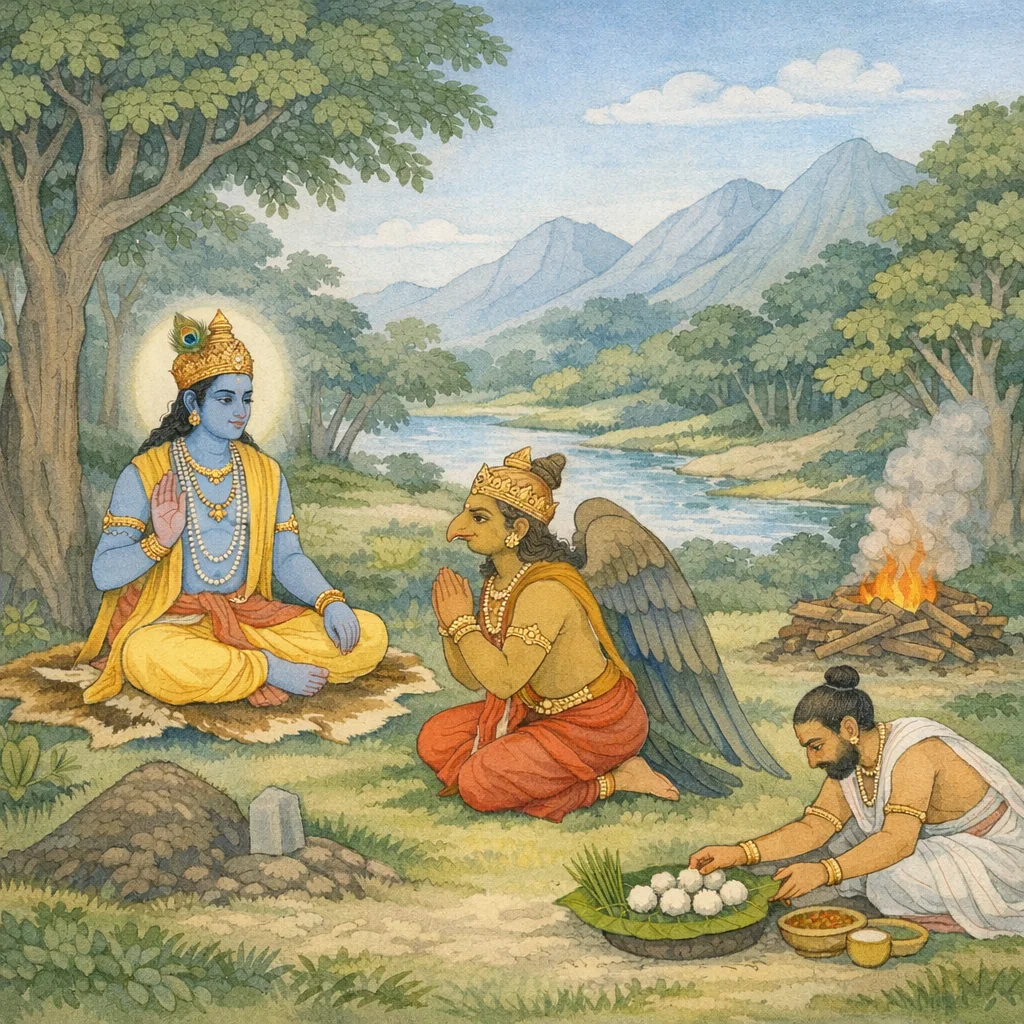
Continuing the Preta Kalpa’s practical guidance on post-death transitions, this chapter focuses on untimely death—especially of children—and clarifies when and how rites apply. Viṣṇu distinguishes miscarriage (no funerary rite) from infant death (offerings of milk and pāyasa), then sets age thresholds for burial versus cremation. He defines life-stages (śiśu, bāla, kumāra/kaumāra, paugaṇḍa, kiśora, yauvana) and provides alternative age reckoning for communities without upanayana, stressing that core preta-support—especially the ten piṇḍas—must not be neglected once death occurs beyond five years. The chapter then broadens to the śrāddha system: when to omit sapiṇḍīkaraṇa, how ekoddiṣṭa differs from pārvaṇa, the need for proper officiants and suitable food, and the primacy of anna-dāna. A philosophical bridge explains rebirth and familial recurrence through the “space in pots” analogy, preparing for deeper discussion of lineage, eligibility, and the consequences of correct or incorrect śrāddha.
Shlokas
Verse 1
ऽल्पायुर्मरणहे तुबालान्त्येष्ट्योर्निरूपणं नाम चतुर्विशो ऽध्यायः श्रीविष्णुरुवाच / अतः परं प्रवक्ष्यामि पुरुषस्त्री विनिर्णयम् / जीवन्वापि मृतो वापि पञ्चवर्षाधिको ऽपि वा
This is the twenty-fourth chapter, called “The explanation of the causes of untimely (short-lived) death and the last rites (antyeṣṭi) for a child.” Lord Śrī Viṣṇu said: “Now, hereafter, I shall explain the proper determination regarding a male and a female—whether the child is still living or has died, and even when the age is above five years.”
Verse 2
पूर्णे तु पञ्चमे वर्षे पुमांश्चैव प्रतिष्ठितः / सर्वैन्द्रियाणि जानाति रूपारूपविपर्ययौ
When the fifth year is completed, the male child becomes firmly established in growth; he comes to know the functions of all the senses (indriyas), and can distinguish between form and formlessness—without confusion or reversal.
Verse 3
पूर्वकर्मविपाकेन प्राणिनां वधबन्धनम् / विप्रादीनन्त्यजान्सर्वान्पापं मारयति ध्रुवम्
By the ripening of past actions (karma), living beings meet with killing and bondage. Sin surely destroys everyone—from brāhmaṇas and the rest down to the lowest-born.
Verse 4
गर्भे नष्टे क्रिया नास्ति दुग्धं देयं मृते शिशौ / परं च पायसं क्षीरं दद्याद्वलविपत्तितः
If the fetus is lost (miscarried), no funerary rite is to be performed. If an infant dies, milk should be offered; and, in addition, rice cooked in milk (pāyasa) and milk are to be given as offerings, according to one’s capacity and circumstances.
Verse 5
एकादशाहं द्वादशाहं वृषं वृषविधिं विना / महादानविहीनं च कुमारे कृत्यमादिशेत्
For a boy who has died young, one should prescribe the required post-death rites—such as the eleventh-day and twelfth-day observances—without performing the bull-rite (vṛṣa-vidhi) and its procedure, and without the great gifts (mahādāna).
Verse 6
कुमाराणां चैव बालानां भोजनं वस्त्रवेष्टनम् / बाले वा तरुणे वृद्धे घटो भवति वै मृते
For boys and small children there is feeding and the wrapping with cloth. Likewise, whether one dies as a child, a youth, or an old person, upon death one certainly becomes a ‘ghaṭa’—a dependent recipient requiring ritual support.
Verse 7
भूमौ विनिः क्षिपेद्बालं द्विमासोनं द्विवार्षिकम् / ततः परं खगश्रेष्ठ देहदाहो विधोयते
A child younger than two months, and also one up to two years of age, should be consigned to the earth (buried). After that age, O best of birds (Garuda), the burning of the body (cremation) is prescribed.
Verse 8
शिशुरा दन्तजननाद्बालः स्याद्यावदाशिखम् / कथ्यते सर्वशास्त्रेषु कुमारो मौञ्जिबन्धनात्
From the time the teeth begin to appear, one is called a ‘śiśu’ (child). From then until the first shaving of the head (the beginning of the topknot), one is termed a ‘bāla’ (boy). In all the śāstras, from the tying on of the muñja-girdle at upanayana, he is called a ‘kumāra’ (youth).
Verse 9
शूद्रादीनां कथं कुर्यात्संशयो मौञ्जिवर्जनात् / गर्भाच्च नवमं हित्वा शिशुरामासषोडशम्
For Śūdras and others, how is the rite to be done? Doubt arises because they do not receive the sacred girdle (mauñjī). One should omit the ninth month from conception; for the child, the reckoning extends up to sixteen months.
Verse 10
बालश्चाथ परञ्ज्ञेय आमाससप्तविंशति / आ पञ्च वर्षात्कौमारः पौगण्डो नवहांयनः
Know further that the stage called bāla (infant) lasts for twenty-seven months. Up to five years is termed kaumāra (early childhood), and up to nine years is termed paugaṇḍa (boyhood).
Verse 11
किशोरः षोडशाब्दः स्यात्ततो यौवनमादिशेत् / मृतो ऽपि पञ्चमे वर्षे अवृतः सवृतो ऽपि वा
A boy is regarded as kiśora up to sixteen years of age; thereafter he should be designated as yauvana (youth). Even if one dies in the fifth year, whether the sacred rite has not yet been performed or has been performed, the rule is to be applied accordingly.
Verse 12
पूर्वोक्तमेव कर्तव्यमीहते दशपिण्डकम् / स्वल्पकर्मप्रसङ्गाच्च स्वल्पाद्विषयबन्धनात्
Even here, one should do exactly as stated earlier—namely, the rite of offering the ten piṇḍas—because entanglement arises even from slight involvement in actions and from even a small bondage to sense-objects.
Verse 13
स्वल्षाद्वपुषि वस्त्राच्च क्रियां स्वल्पामपीच्छति / यावदुपचयो जन्तुर्यावद्विषयवेष्टितः
With a meagre body and scant clothing, the embodied being asks for even a small rite (done on his behalf), so long as his subtle growth continues and so long as he remains bound up in sense-objects.
Verse 14
यद्यद्यस्योपजीव्यं स्यात्तत्तद्देयमिहेच्छति / ब्रह्मबीजोद्भवाः पुत्रा देवर्षोणां च वल्लभाः
Whatever a being lived upon and was sustained by, that very thing it longs to have offered here after death. The sons born of Brahmā’s seed, beloved of the divine ṛṣis, teach that offerings should be made accordingly.
Verse 15
यमेन यमदूतैश्च शास्यन्ते निश्चितं खग / बालो वृद्धो युबा वापि घटमिच्छन्ति देहिनः
O bird (Garuda), it is certain that beings are punished by Yama and by Yama’s messengers. Whether a child, an old man, or a youth, embodied souls still cling to the body, yet they are taken away.
Verse 16
सुखं दुः खं सदा वेत्ति देही वै सर्वगस्त्विह / परित्यज्य तदात्मानं जीर्णां त्वचमिवोरगः
The embodied soul continually experiences pleasure and pain here, moving everywhere. Abandoning that body-bound self, it departs—like a serpent casting off its worn-out skin.
Verse 17
अङ्गुष्ठमात्रः पुरुषो वायुभृतः क्षुधान्वितः / तस्माद्देयानि दानानि मृते बाले सुनिश्चितम्
The departed becomes thumb-sized, sustained only by vital breath and afflicted by hunger; therefore it is firmly taught that charitable gifts should certainly be given even when a child has died.
Verse 18
जन्मतः पञ्च वर्षाणि भुङ्क्ते दत्तमसंस्कृतम् / पञ्चवर्षाधिके बाले विपत्तिर्यदि जायते
From birth up to five years, a child partakes of what is offered without being bound by full ritual consecration. But if misfortune (such as death) befalls a child older than five years, then the consequences and the required rites arise accordingly.
Verse 19
वृषोत्सर्गादिकं कर्म सपिण्डीकरणं विना / द्वादशे हनि सम्प्राप्ते कुर्याच्छ्राद्धानि षोडश
Even without performing the rite of sapiṇḍīkaraṇa, one should carry out acts such as vṛṣotsarga and the like; and when the twelfth day has arrived, one should perform sixteen śrāddha offerings.
Verse 20
पायसेन गुडेनापि पिण्डान्दद्याद्यथाक्रमम् / उदकुम्भप्रदानं च पद (उप) दानानि यानि च
One should offer the piṇḍas in their proper sequence—using pāyasa (rice-pudding) or even guḍa (jaggery)—and also perform the gifting of a water-pot (udakumbha-pradāna), along with whatever subsidiary donations are prescribed.
Verse 21
भोजनानि द्विजे दद्यान्महादानादि शक्तितः / दीपदानादि यत्किञ्चित्पञ्चवर्षाधिके सदा
One should offer meals to a dvija (brāhmaṇa), and—according to one’s capacity—perform mahādāna and other great gifts. Whatever offering is possible, such as dīpa-dāna (the gift of a lamp), should be done regularly, especially after five years have passed.
Verse 22
कर्तव्यं च खगश्रेष्ठ व्रतात्प्राक् प्रेततृप्तये / यदा नक्रियते सर्वं मुद्गलत्वं स गच्छति
O best of birds (khaga-śreṣṭha), before undertaking a vrata, one should do what is required for the satisfaction of the preta, the departed spirit. When all this is not done, one falls into the state called mudgalatva, a degraded and obstructed condition.
Verse 23
व्रतात्प्राङ्गेव देयं तु ततः पितृगणस्य च / स्वाहाकारेण वै कुर्यादेकोद्दिष्टानि षोडश
Just before completing the vow (vrata), one should make the offering that is to be given; thereafter one should also offer to the host of Pitṛs (pitṛ-gaṇa). With the utterance “svāhā,” one should perform the sixteen ekoddiṣṭa offerings meant for a single departed ancestor.
Verse 24
ऋजुदर्भैस्तिलैः शुक्लैः प्राचीनावीति निश्चितम् / अपसव्यं च कर्तव्यं कृते यान्ति परां गतिम्
It is firmly ordained that the rite be performed in the prācīnāvīti manner, using straight darbha grass and white sesame. The sacred thread should also be worn in the apasavya position; when this is duly done, the departed attains the highest state.
Verse 25
पुनश्चिरायुषो भूत्वा जायन्ते स्वकुले ध्रुवम् / सर्वसौख्यप्रदः पुत्रः पित्रोः प्रीतिविवर्धनः
Then, becoming long-lived once again, they are surely born within their own lineage. A son is born who bestows every happiness and increases the joy of father and mother.
Verse 26
आकाशमेकं हि यथा चन्द्रादित्यौ यथैकतः / घटादिषु पृथक् सर्वं पश्य रूपं च तत्समम्
Just as space is truly one, and just as the moon and the sun are each a single orb, so too—though it appears divided among pots and other containers—see that it is all one, and that its form is the same everywhere.
Verse 27
आत्मा तथैव सर्वेषु पुत्त्रेषु विचरेत्सदा / या यस्य प्रकृतिः पूर्वं शुक्रशोणितसङ्गमे
In the same way, the Ātman continually moves among all one’s sons; and the nature that belonged to each being previously—at the union of semen and blood—manifests again accordingly.
Verse 28
सा (स) तेन भावयोगेन पुत्त्रास्तत्कर्मकारिणः / पितृरूपं समादाय कस्यचिज्जायते सुतः
By that very power of bhāva-yoga—the subtle linkage of intention—sons are born to carry out those deeds in accordance with karma; and, taking on the father’s form, a son is born to someone.
Verse 29
पितृतः को ऽपि रूपाढ्यो गुणज्ञो दानतत्परः / सदृशः को ऽपि लोके ऽस्मिन्न भूतो न भविष्यति
From the paternal line there may arise one who is fair of form, discerning of virtues, and devoted to charity; yet in this world none is truly comparable—none has been, and none will be.
Verse 30
अन्धादन्धो न भवति मूकान्मूको न जायते / बधिराद्बधिरो नैव विद्यावान्विदुषो न हि / अनुरूपा न दृश्यन्ते मदीयं वचनं शृणु
From a blind person a blind one does not necessarily arise; from one who is mute, a mute child is not necessarily born. Nor does a deaf person invariably beget a deaf one; and from a scholar a learned one is not always born. Truly compatible counterparts are not easily found—listen to my words.
Verse 31
गरुड उवाच / औरसक्षेत्रजाद्याश्च पुत्त्रा दशविधाः स्मृताः / संगृहीतः सुतो यस्तु दासीपुत्त्रश्च तेन किम्
Garuḍa said: “The sons—beginning with the natural-born (aurasa) and the kṣetrajā—are remembered as ten kinds. But what of the ‘accepted/adopted’ son, and what of the son born of a female servant—how are they to be regarded?”
Verse 32
काङ्कां गतिमवाप्नोति जायो मृत्युवशं गतः / भवेन्न दुहिता यस्य न दौहित्रो न वा सुतः
A man who has come under the sway of death attains a pitiable state—especially if he has neither a daughter, nor a daughter’s son (dauhitra), nor a son.
Verse 33
श्राद्धं तस्य कथं कार्यं विधिना केन तद्भवेत् / श्रीभगवानुवाच / मुखं दृष्ट्वा तु पुत्रस्य मुच्यते पैतृकादृणात्
“How should his śrāddha be performed, and by what proper procedure is it accomplished?” The Blessed Lord said: “By merely beholding the face of one’s son, a man is freed from the ancestral debt (paitṛka ṛṇa).”
Verse 34
पौत्त्रस्य दर्शनाज्जन्तुर्मुच्यते चः ऋणत्रयात् / लोकानन्त्यं दिवः प्राप्तिः पुत्त्रपौत्त्र प्रपौत्त्रकैः
By merely beholding one’s grandson, a person is freed from the threefold debt. Through sons, grandsons, and great-grandsons one gains enduring prosperity in the worlds and attains heaven.
Verse 35
अन्यक्षेत्रोद्भवाद्या ये भुक्तिमात्रप्रदाः सुताः / कुर्वीत पार्वणं श्राद्धमारैसो विधिवत्सुतः
Even sons born from another lineage or “field” (and similar cases), who offer only enjoyment and do not fulfill true filial duty—such a son should still perform the pārvana śrāddha properly, according to rule, without negligence.
Verse 36
कुर्वन्त्यन्ये सुताः श्राद्धमे कोद्दिष्टं न पार्वणम् / ब्राह्मोढाजस्तून्नयति संगृहीतस्त्वधो नयेत् / श्राद्धं सांवत्सरं कुर्वञ्जायते नरकाय वै
Some sons perform only the ekoddiṣṭa śrāddha and not the pārvaṇa śrāddha. If a Brahmin is wrongly chosen, the rite is borne upward; but if the one chosen is ‘seized’ (impure/unfit), he drags it downward. And one who performs śrāddha only once a year is indeed destined for hell.
Verse 37
सर्वदानानि देयानि ह्यन्न दानादृते खग / संगृहीतः सुतः कुर्यादेकोद्दिष्टं न पार्वणम्
O Khaga (Garuda), all kinds of gifts should indeed be given, yet none is equal to the gift of food. A son who has been adopted should perform the ekoddiṣṭa, but not the pārvaṇa.
Verse 38
प्रत्यब्दं पितृमातृभ्यां श्राद्धं दत्त्वा न लिप्यते / एकोद्दिष्टं परित्यज्य पार्वणं कुरुते यदि
By offering the annual śrāddha to one’s father and mother, a person is not tainted by fault. And if, setting aside the ekoddiṣṭa, one performs the pārvaṇa, there is no blame in that either.
Verse 39
आत्मानं च पितॄंश्चैव स नयेद्यममन्दिरम् / संगृहीतस्तु यः केचिद्दासीपुत्त्रादयश्च ये
He is led to Yama’s abode—together with his own self and even his forefathers, the Pitṛs; and likewise, those whom he had taken into his care—such as the sons of maidservants and other dependents—are also drawn into that consequence.
Verse 40
तीर्थे कुर्युः पितृश्राद्धं दानं (मासं) दद्युर्द्विजन्मने / संगृहीतसुतो भूत्वा पाकं वा यः प्रयच्छति
At a tīrtha one should perform the ancestral śrāddha, and one should give charity—even monthly—to a twice-born Brāhmaṇa. And whoever, acting as an accepted son, offers a cooked meal as service and oblation also gains merit.
Verse 41
वृथा श्राद्धं विजानीयाच्छूद्रान्नेन यथा द्विजः / न प्रीणयति तच्छ्राद्धं पितामहमुखान्पितॄन् / एवं ज्ञात्वा स्वगश्रेष्ठ हीनजातीन्सुतांस्त्यजेत्
Know that a śrāddha becomes futile—like a twice-born offering it with food deemed improper for him. Such a śrāddha does not gladden the Pitṛs, who receive through the ancestral line of grandfathers. Therefore, understanding this, O best among birds, one should renounce sons of degraded birth-status.
Verse 42
(ब्राह्मण्यां ब्राह्मणाज्जातश्चाण्डालादधमः स्मृतः ) / यस्तु प्रव्रजिताज्जातो ब्राह्मण्यां शूद्रतश्च यः
One born from a Brāhmaṇa father in a Brāhmaṇa woman is declared even lower than a Cāṇḍāla; and so too is one born from a renunciant (pravrajita), as well as one born in a Brāhmaṇa woman from a Śūdra.
Verse 43
द्वावेतौ विद्धि चाण्डालौ सगोत्राद्यस्तु जायते / स्वर्यातिविहितान्पुत्रः समुत्पाद्य खगेश्वर
Know, O Lord of Birds, that these two are to be regarded as Cāṇḍālas: first, one born from a forbidden union within the same lineage (sagotra); and second, a son who, after begetting offspring in a prohibited manner, departs from this world for heaven.
Verse 44
तैः सुवृत्तैः सुखं प्राप्यं कुवृत्तैर्नरकं व्रजेत् / हीनजातिसमुद्भूतैः सुवृत्तैः सुखमेधते
Through good conduct one attains happiness; through bad conduct one goes to hell. Even those born in a low condition, if endowed with good conduct, flourish in happiness.
Verse 45
कलिकलुषविमुक्तः पूजितः सिद्धसङ्घैरमरचमरमालावीज्यमानो ऽप्सरोभिः / पितृशतमपि बन्धून्पुत्त्रपौत्त्रप्रपौत्त्रानपि नरकनिमग्नानुद्धरेदेक एव
Freed from the taint of the Kali age, honored by hosts of Siddhas, and fanned by Apsarās with heavenly chāmaras and garlands—such a one, even alone, can raise up a hundred forefathers, and also relatives, sons, grandsons, and great-grandsons, though they be sunk in hell.
Frequently Asked Questions
The chapter states that if the fetus is lost, no funerary rite (antyeṣṭi/śrāddha) is to be performed.
Milk is offered, and additionally rice cooked in milk (pāyasa) and milk are given as offerings according to one’s capacity.
It prescribes consigning very young children (specified as under two months and up to two years) to the earth (burial), and after that age, cremation is prescribed.
Because even slight entanglement with actions and sense-objects can bind the subtle being; therefore the ten piṇḍas and related preta-satisfaction rites are taught as necessary once the relevant age/eligibility is reached.
It is described as a degraded/obstructed condition that results when required rites for the preta’s satisfaction are not performed before undertaking (and completing) other sacred observances (vratas).
Ekoddiṣṭa is a single-departed-focused offering, while pārvaṇa is the collective ancestral rite for the lineage; the chapter notes adopted sons should do ekoddiṣṭa but not pārvaṇa, and warns against negligence or improper procedure.
The gift of food (anna-dāna) is stated to be unequaled among gifts.