Adhyaya 72
Indranīla (Blue Sapphire): Source-Myth, Grades, Tests, Substitutes, and Price
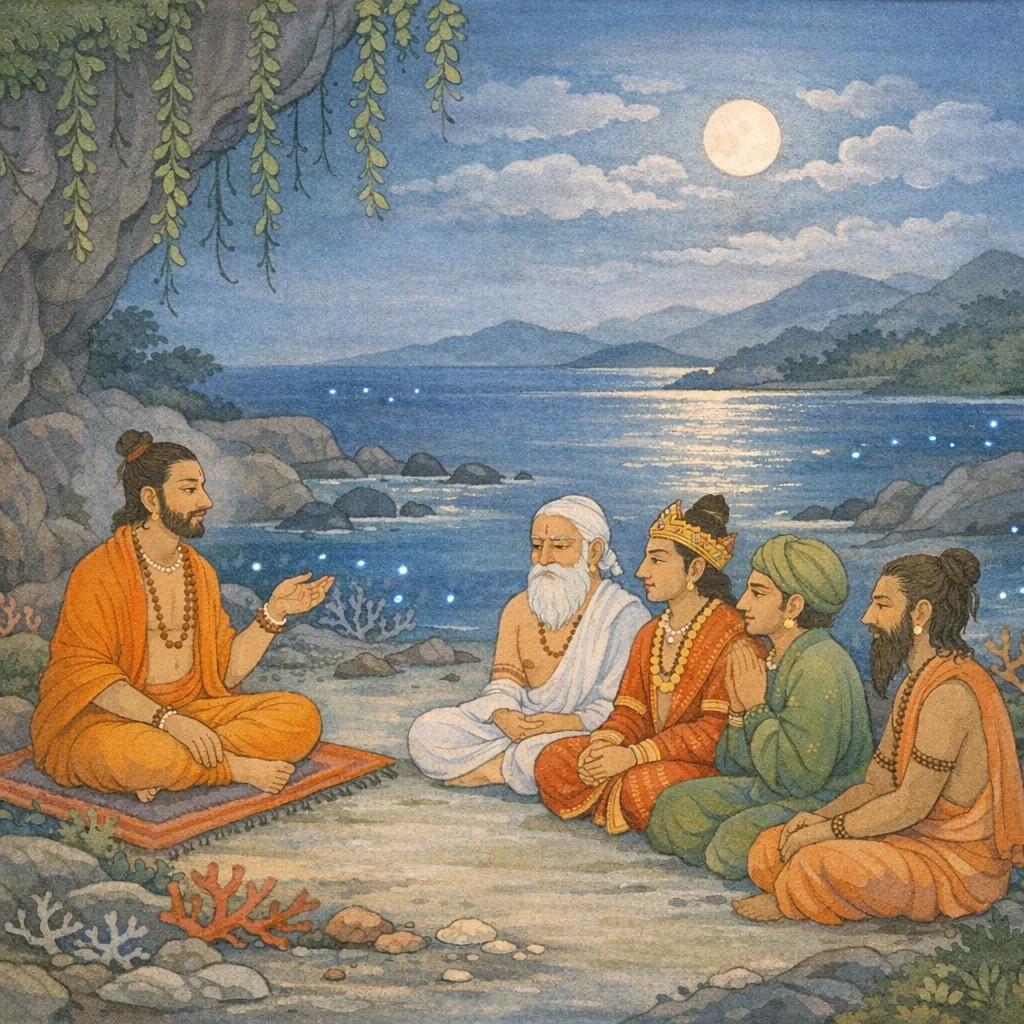
Continuing the Ratna-Śāstra stream, Sūta first grounds the rise of indranīla (blue sapphire) in a sanctified coastal landscape strewn with coral and lavalī stones, where the fallen eyes of a Daitya shine like blue lotuses and make the shore gleam as if set with sapphires. From this mythic cause, the chapter turns to practical gem-lore: it lists color-forms and radiances, notes that sapphires arise mixed with earth and rock, and may bear cloud-shadow defects. Sapphire appraisal is then aligned with ruby standards—sharing the same threefold grading and criteria—yet the text warns that fire-testing is perilous when agni is mishandled, bringing ritual fault and misfortune. For market discernment it names pseudo–vaidūrya look-alikes (glass, utpala/blue-lotus stone, karavīra-stone, crystal) and marks true signs: indranīla with a vajra-like central brilliance, and mahā-nīla with an overpowering bluing potency. The chapter ends with a valuation rule: ruby priced by māṣa corresponds to sapphire priced by suvarṇa, preparing for further systematic ratna classification.
Shlokas
Verse 1
नामैकसप्ततितमो ऽध्यायः सूत उवाच / तत्रैव सिंहलवधूकरपल्लवाग्रव्यालूनबाललवलीकुसुमप्रवाले / देशे पपात दितिजस्य नितान्तकान्तं प्रोत्फुल्लनीरजसमद्युति नेत्रयुग्मम्
Sūta said: There itself, in a region strewn with tender coral-like shoots and the blossoms of young lavalī plants, there fell to the ground the exceedingly beautiful pair of eyes of the Daitya, shining with a radiance like fully-bloomed blue lotuses.
Verse 2
तत्प्रत्ययादुभयशोभनवीचिभासा विस्तारिणी जलनिधेरुपकच्छभूमिः / प्रोद्भिन्नकेतकवनप्रतिबद्धलेखासान्द्रेन्द्रनीलमणिरत्नवती विभाति
Because of that radiance, the ocean’s broad coastal stretch shines with the lustre of waves beautiful in two ways; traced with lines of blossoming ketaka groves, it gleams as though studded with dense sapphire-blue indranīla gems and jewels.
Verse 3
तत्रासिताब्जहलभृद्वसनासिभृङ्गशार्ङ्गायुधाङ्गहरकण्ठकषायपुष्पैः / शुष्केतरैश्च कुसुमैर्गिरिकर्णिकायास्तस्माद्भवन्ति मणयः सदृशावभासः
There, from the Girikarṇikā plant—by flowers of many hues, such as dark lotus, the plough-bearing sign, yellow-robed, sword, bee, the Śārṅga-weapon, limb-like radiance, Śiva’s throat-color, and tawny blossoms, whether fresh or dried—gems are formed, shining with a radiance matching each hue.
Verse 4
अन्ये प्रसन्नपयसः पयसां निधातुरम्बुत्विषः शिखिगणप्रतिमास्तथान्ये / नीलीरसप्रभवबुद्वुदभाश्च केचित्केचित्तथा समदकोकिलकण्ठभासः
Some are lucid and milk-white, like pure milk; others gleam with a watery sheen, like a peacock’s plumage. Some appear as bubbles born of indigo-blue essence, and some shine like the throat of the kokila (cuckoo) intoxicated with delight.
Verse 5
एकप्रकारा विस्पष्टवर्णशोभावभासिनः / जायन्ते मणयस्तस्मिन्निन्द्रनीला महागुणाः
There, gems of a single kind arise, radiant with clearly manifest color and splendor; indranīla (sapphires) are produced there, endowed with great qualities.
Verse 6
मृत्पाषाणशिलारन्ध्रकर्करात्राससंयुताः / अभ्रिकापटलच्छायावर्णदोषैश्च दूषिताः
They are mingled with earth, stone, and rocky crevices, marked by roughness and dread; and they are further tainted by the shadow of cloud-like layers and by defects of color and appearance.
Verse 7
तत एव हि जायन्ते मणयस्तत्र भूरयः / सास्त्रसम्बोधितधियस्तान्प्रशंसन्ति सूरयः
From that very source indeed, many gems are produced there; and the wise—whose understanding is awakened by the śāstras—praise those gems.
Verse 8
धार्यमाणस्य ये दृष्टा पद्मरागमणेर्गुणाः / धारणादिन्द्रनीलस्य तानेवाप्नोति मानवः
One who wears the Padmarāga gem (ruby) attains exactly the qualities seen in that jewel; and by wearing Indranīla (blue sapphire), a human being likewise gains those very qualities.
Verse 9
यथा च पद्मरागाणां जातकत्रितयं भवेत् / इन्द्र नीलेष्वपि तथा द्रष्टव्यमविशेषतः
Just as, in the case of Padmarāga rubies, a threefold classification is recognized, so too for Indranīla sapphires it should be understood in the same way, without any distinction.
Verse 10
परीक्षाप्रत्ययैर्यैश्च पद्मरागः परीक्ष्यते / त एव प्रत्यया दृष्टा इन्द्रनीलमणेरपि
By whatever tests and criteria a Padmarāga ruby is examined, those very same criteria are likewise applicable for examining an Indranīla sapphire.
Verse 11
यावन्तं च क्रमेदग्निं पद्मरागोपयोगतः / इन्द्रनीलमणिस्तस्मात्क्रमेत सुमहत्तरम्
As far as fire can be made to advance by employing a Padmarāga ruby, the Indranīla (blue sapphire) makes it advance even much farther than that.
Verse 12
तथापि न परीक्षार्थं गुणानामभि (ति) वृद्धये / मणिरग्नौ समाधेयः कथञ्चिदपि कश्चन
Even so, neither for the sake of testing nor for increasing its qualities should anyone ever place any jewel into fire.
Verse 13
अग्निमात्रापरिज्ञाने दाहदोषैश्च दूपितः / सो ऽनर्थाय भवेद्भर्तुः कर्तुः कारयितुस्तथा
If the proper measure and right handling of the sacred fire (Agni) are not understood, and the rite is tainted by faults of burning, it brings misfortune—upon the patron for whom it is done, the performer, and even the one who causes it to be performed.
Verse 14
काचोत्पलकरवीरस्फटिकाद्या इह बुधैः सवैदूर्याः / कथिता विजातय इमे सदृशा मणिनेन्द्रनीलेन
Here the learned describe glass, blue-lotus stone, karavīra-stone, crystal and the like as “pseudo–vaidūrya (cat’s-eye)”—inferior substitutes that merely resemble the supreme gem nīla (sapphire).
Verse 15
गुरुभावकठिनभावावेतेषां नित्यमेव विज्ञेयौ / काचाद्यथावदुत्तरविवर्धमानौ विशेषेण
Their heaviness and hardness should always be understood; like glass and the like, they increase further and further in a distinct, progressive manner.
Verse 16
इन्द्रनीलो यथा कश्चिद्विभर्त्याताम्रवर्णताम् / रक्षणयौ तथा ताम्रौ करवीरोत्पलावुभौ
Just as a sapphire (indranīla) can, as it were, take on a coppery hue, in the same way both karavīra and utpala—when copper-colored—are regarded as protective (rakṣā) agents.
Verse 17
यस्य मध्यगता भाति नीलस्येन्द्रायुधप्रभा / तमिन्द्रनीलमित्याहुर्महार्हं भुवि दुर्लभम्
That blue gem in whose center shines a radiance like Indra’s weapon (indra-yudha) is called Indranīla (sapphire); it is exceedingly precious and rare upon the earth.
Verse 18
यस्य वर्णस्य भूयस्त्वात्क्षीरे शतगुणे स्थितः / नीलतां तन्नयेत्सर्वं महानीलः स उच्यते
That which, by the dominance of its own hue, even when diluted a hundredfold in milk, turns the whole mixture blue—this is called “mahā-nīla” (deep blue).
Verse 19
यत्पद्मरागस्य महागुणस्य मूल्यं भवेन्माषसमुन्मितस्य / तदिन्द्रनीलस्य महागुणस्य सुवर्ण संख्यातु लितस्य मूल्यम्
Whatever price is set for an excellent padmarāga (ruby) when its weight is measured in māṣas—at that very measure, the price of an excellent indranīla (blue sapphire) is reckoned in suvarṇas (gold units).
Frequently Asked Questions
A true indranīla is described as the blue gem whose center displays a radiance like Indra’s vajra (thunderbolt), marking it as rare and exceedingly valuable.
It names common look-alikes as pseudo–vaidūrya (glass, blue-lotus stone, karavīra-stone, crystal) and directs attention to measurable traits such as heaviness and hardness, along with stable, clearly manifest color and characteristic luster.
It states that sapphire follows the same threefold classification as ruby and that the same tests and criteria applied to rubies are applicable to indranīla as well, indicating a shared evaluative framework in this ratna-śāstra passage.