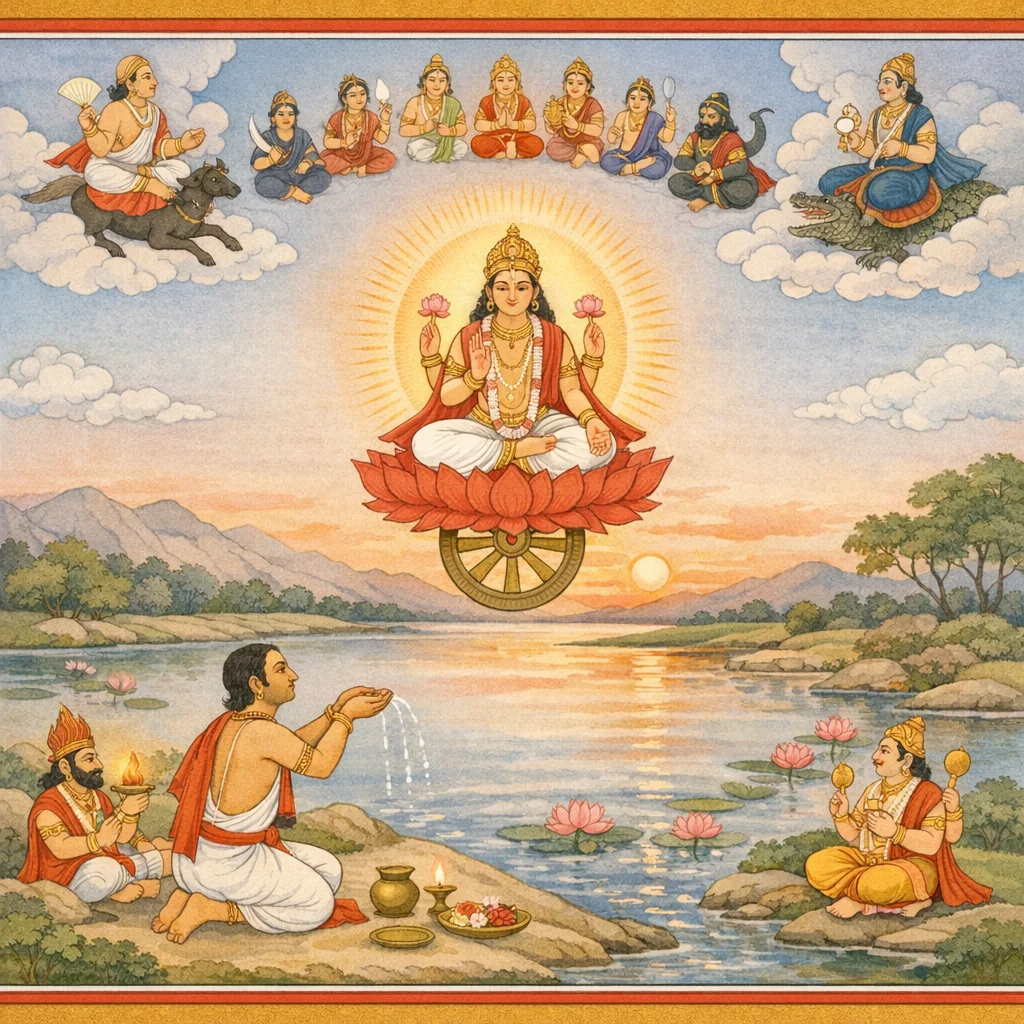
Adhyaya 39
Sūrya-pūjā-vidhi: Gateway Deities, Lotus-Mandala, Nyāsa, Navagrahas, and Arghya
Continuing the ācāra-based teachings, Rudra asks Janārdana to restate, briefly yet clearly, the Deva-worship method, stressing Sūrya as Viṣṇu’s form and the giver of bhukti and mukti. Vāsudeva lays out a stepwise rite: mantra-salutations to the gateway beings (Uccaiḥśravas, Aruṇa, Daṇḍin, Piṅgala), then central worship of Prabhūta/Amala and the corner-direction deities (Vimala, Sārā, Ādhāra, Paramamukha). The practice proceeds through lotus-mandala symbolism and śaktis such as Dīptā, culminating in Sarvatomukhī, followed by heart-mantras and bīja-based installation (āhvāna, sthāpanā, sannirophaṇa/sakalīkaraṇa). An iconic meditation on Sūrya is given—red radiance, white lotus, one-wheeled chariot—along with root mantra, mudrās, and nyāsa. Directional placements extend to Rudra forms and the Navagrahas with specific salutations. The sequence culminates in 8,000 japa, worship of Caṇḍa-tejas, preparation and offering of arghya with prescribed posture, and closes by honoring Gaṇapati and the gurus, promising attainment of Viṣṇuloka and setting a template for later chapters.
Shlokas
Verse 1
नामाष्टत्रिंशो ऽध्यायः रुद्र उवाच / पुनर्देवार्चनं ब्रूहि संक्षेपेण जनार्दन / सूर्यस्य विष्णुरूपस्य भुक्तिमुक्तिप्रदायकम्
Chapter Thirty-Nine. Rudra said: “O Janārdana, tell again—briefly—the method of worship of the Devas, especially of Sūrya who is the form of Viṣṇu, the giver of both worldly enjoyment and liberation.”
Verse 2
वासुदेव उवाच / शृणु सूर्यस्य रुद्र त्वं पुनर्वक्ष्यामि पूजनम् / ॐ उच्चैः श्रवसे नमः ॐ अरुणाय नमः / ॐ दण्डिने नमः / ॐ पिङ्गलाय नमः / एते द्वारे प्रपूज्या वै एपिर्मन्त्रैर्वृषध्वज
Vāsudeva said: “O Rudra, listen. I shall again describe the method of worship of the Sun. (Offer salutations:) ‘Om, obeisance to Uccaiḥśravas; Om, obeisance to Aruṇa; Om, obeisance to Daṇḍin; Om, obeisance to Piṅgala.’ These are to be worshipped at the gateway with these mantras, O bearer of the bull-banner.”
Verse 3
ॐ अं प्रभूताय नमः / इमं तु पूजयेन्मध्ये प्रभूतामलसंज्ञकम् / ॐ अं विमलाय नमः / ॐ अं साराय नमः / ॐ अंआधाराय नमः / ॐ अं परममुखाय नमः / इत्याग्नेयादिकोणेषु पूज्या वै विमलादयः
Om—salutations to Prabhūta. One should worship this deity in the center, known as Prabhūta, also called Amala. Om—salutations to Vimala; Om—salutations to Sārā; Om—salutations to Ādhāra; Om—salutations to Paramamukha. Thus, in the south‑east (Agneya) and the other corner-directions, Vimala and the rest are indeed to be worshipped.
Verse 4
ॐ पद्माय नमः / ॐ कर्णिकायै नमः / मघ्ये तु पूजयेद्रुद्र पूर्वादिषु तथैव च / दीप्ताद्याः पूजयेन्मध्ये पूजयेत्सर्वतोमुखीः / ॐ वां (रां) दीप्तायै नमः / ॐ वीं (रीं) सूक्ष्मायै नमः / ॐ वूं (रूं भद्रायै नमः / ॐ वैं (रैं) जयायै नमः / ॐ वौं (रौं) विबूत्यै नमः / ॐ वं (रं) अधोरायै नमः / ॐ वं (रं) वैद्युतायै नमः / ॐ वः (रः) विजयायै नमः / ॐ रो सर्वतोमुख्यै नमः
Salutations to the Lotus (Padmā); salutations to the Pericarp (Karṇikā). In the center one should worship Rudra, and likewise in the eastern and other directions. In the center one should worship the powers beginning with Dīptā, and one should worship Sarvatomukhī, the All-faced One. Salutations to Dīptā, Sūkṣmā, Bhadrā, Jayā, Vibhūti, Adhorā, Vaidyutā, Vijayā, and to Sarvatomukhī.
Verse 5
ॐ अर्कासनाय नमः / ॐ ह्रां सूर्यमूर्तये नमः / एतास्तु पूजयेन्मध्ये ह्रन्मन्त्राञ्छृणु शङ्कर / ॐ हं सं खं खखोल्काय क्रां क्रीं सः स्वाहा सूर्यमूर्तये नमः / अनेनावाहनं कुर्यात्स्थापनं सन्निधापनम् / सन्निरोपनमन्त्रेण सकलीकरणं तथा
Om—salutations to Him whose seat is the Sun (Arka). Om, hrāṃ—salutations to the Sun-form (Sūrya-mūrti). With these one should worship in the middle of the rite. Hear the heart-mantras, O Śaṅkara: “Om haṃ saṃ khaṃ—unto Khakholka; krāṃ krīṃ saḥ, svāhā—salutations to the Sun-form.” By this one should perform the invocation (āvāhana), the installation (sthāpana), and the establishing of presence (sannidhāpana); and by the sanniropana-mantra, the full manifestation (sakalīkaraṇa) as well.
Verse 6
मुद्राया दर्शनं रुद्र मूलमन्त्रेण वा हर / तेजोरूपं रक्तवर्णं सितपद्मोपरि स्थितम् / एकचक्ररथारूढं द्विबाहुं धृतपङ्कजम्
O Rudra, or O Hara—by the root-mantra as well—one should perform the showing of the mudrā. He is of the nature of radiance, red in hue, seated upon a white lotus; mounted on a one-wheeled chariot, two-armed, holding a lotus.
Verse 7
एवं ध्यायेत्सदा सूर्यं मूलमन्त्रं शृणुष्व च / ॐ ह्रां ह्रीं सः सूर्याय नमः
Thus one should always meditate upon the Sun; and now hear the root-mantra: “Oṃ hrāṃ hrīṃ saḥ—obeisance to Sūrya.”
Verse 8
वारत्रयं पद्ममुद्रां बिम्बमुद्रां च दर्शयेत् / ॐ आं हृदयाय नमः / ॐ अर्काय शिरसे स्वाहा / ॐ अः भूर्भुवः स्वः ज्वालिनि शिखायै वषट् / ॐ हुं कवचाय हुं / ॐ भां नेत्राभ्यां वौषट् / ॐ वः अस्त्राय फडिति
Three times one should display the Padma‑mudrā and also the Bimba‑mudrā. Then one should place the nyāsa mantras: “Oṁ āṁ—salutation to the Heart; Oṁ—salutation to Arka (the Sun)—svāhā to the Head; Oṁ aḥ bhūr bhuvaḥ svaḥ—salutation to the blazing Flame—vaṣaṭ to the Topknot; Oṁ huṁ—salutation to the Armor (kavaca)—huṁ; Oṁ bhāṁ—vauṣaṭ to the two Eyes; Oṁ vaḥ—phaṭ to the Astrā, the sacred missile.”
Verse 9
आग्नेय्यामथवैशान्यां नैरृत्यामर्चयेद्धर / त्दृयदयादि हि वायव्यां नेत्रं चान्तः प्रपूजयेत्
In the south‑east, and likewise in the north‑east and the south‑west, one should worship the Lord as Dhara, the Supporter. In the north‑west, one should worship the heart and the other inner principles; and within (the body, the inner space) one should duly worship the Eye, the inward seeing.
Verse 10
दिस्वस्त्रं पूजयेद्रुद्र सोमं तु श्वेतवर्णकम् / दले पूर्वेर्ऽचयेद्रुद्र बुधं चामीकरप्रभम्
One should worship Rudra by offering a garment. Soma should be worshipped as white in complexion. On the eastern petal, one should worship Rudra, and also Budha (Mercury), who shines like gold.
Verse 11
दक्षिणे पूजयेद्रुद्र पतिवर्णं गुरुं यजेत् / पश्चिमे चैव भूतेशं उत्तरे भार्गवं सितम्
In the southern direction one should worship Rudra; one should honor the Guru, who bears the color of the Lord (pati). In the western direction one should worship Bhūteśa, the Lord of beings; and in the northern direction, the fair‑complexioned Bhārgava (Śukra).
Verse 12
रक्तमङ्गारकं चैव आग्नेये पूजयेद्धर / शनैश्चरं कृष्णवर्णं नैरृत्यां दिशि पूजयेत्
In the south‑east, Agni’s quarter, one should worship red‑hued Maṅgāraka (Mars). In the south‑west, Nairṛti’s quarter, one should worship Śanaiścara (Saturn), dark and black in color.
Verse 13
राहुं वायव्यदेशे तु नन्द्यावर्तनिभिं हर / ऐशान्यां धूम्रवर्णं तु केतुं सं परिपूजयेत्
O Hara (Śiva), in the north‑west quarter one should worship Rāhu with offerings arranged in nandyāvarta patterns; and in the north‑east quarter one should duly worship Ketu, who is smoke‑hued.
Verse 14
एभिर्मन्त्रैर्महादेव तच्छृणुष्व च शङ्कर
O Mahādeva—O Śaṅkara—please listen to that instruction along with these mantras.
Verse 15
ॐ सों सोमाय नमः / ॐ बुं बुधाय नमः / ॐ बृं बृहस्पतये नमः / ॐ भं भार्गवाय नमः / ॐ अं अङ्गारकाय नमः / ॐ शं शनैश्चराय नमः / ॐ रं राहवे नमः / ॐ कं केतवे नम इति
“Oṃ—salutations to Soma (the Moon). Oṃ—salutations to Budha (Mercury). Oṃ—salutations to Bṛhaspati (Jupiter). Oṃ—salutations to Bhārgava (Śukra/Venus). Oṃ—salutations to Aṅgāraka (Maṅgala/Mars). Oṃ—salutations to Śanaiścara (Saturn). Oṃ—salutations to Rāhu. Oṃ—salutations to Ketu”—thus is the series of salutations.
Verse 16
पाद्यादीन्मूलमन्त्रेण दत्त्वा सूर्याय शङ्कर / नैवेद्यान्ते धेनुमुद्रां दर्शयेत्साधकोत्तमः
O Śaṅkara, after offering the ritual services beginning with water for washing the feet (pādya) to Sūrya using the root mantra, the best practitioner should, at the conclusion of the food-offering (naivedya), display the dhenu-mudrā.
Verse 17
जप्त्वा चाष्टसहस्रं तु तच्च तस्मै समर्पयेत् / ऐशान्यां दिशि भूतेश तेजश्चण्डं तु पूजयेत्
Having recited it eight thousand times, one should offer that merit of recitation to Him. In the north‑eastern direction, O Lord of beings, one should worship the fierce radiance (Tejas) known as Caṇḍa.
Verse 18
ॐ तेजश्चंण्डाय हुं फट् स्वधा स्वाहा पौषट् / निर्माल्यं चार्पयेत्तस्मै ह्यर्घ्यं दद्यात्ततो हर
Om—obeisance to the fierce, radiant One: huṃ, phaṭ; svadhā, svāhā, pauṣaṭ. Then one should offer Him the nirmālya (the sacred remnants) and thereafter present the arghya (honor-water), O Hara.
Verse 19
तिलतण्डुलसंयुक्तं रक्तचन्दनचर्चितम् / गन्धोदकेन संमिश्रं पुष्पधूपसमन्वितम्
Mixed with sesame and rice, anointed with red sandalwood, blended with fragrant water, and accompanied by flowers and incense.
Verse 20
कृत्वा शिरसि तत्पात्रं जानुभ्यामवनिं गतः / दर्घ्यं तु सूर्याय त्दृन्मन्त्रेण वृषध्वज
Placing that vessel upon his head and kneeling down to the ground, he should then offer arghya to Sūrya, using the prescribed mantra, O Vṛṣadhvaja.
Verse 21
गणं गुरून्प्रपूज्याथ सर्वान्देवानन्प्रपूजयेत् / ॐ गं गणपतये नमः / ॐ अं गुरुभ्यो नमः
After duly worshipping Gaṇa (Gaṇapati) and the gurus, one should then worship all the gods. (Mantras:) “Oṁ gaṁ—salutations to Gaṇapati.” “Oṁ aṁ—salutations to the gurus.”
Verse 22
सूर्यस्य कथिता पूजा कृत्वैतां विष्णुलोकभाक्
Having performed this prescribed worship of Sūrya, one becomes a recipient of Viṣṇu’s realm and attains Viṣṇuloka.
Frequently Asked Questions
The chapter outlines: dvāra-devatā salutations, central and corner-direction worship, lotus-mandala and śakti worship, mantra-based invocation/installation, dhyāna of Sūrya’s form, mudrā display, nyāsa for limbs/protection, Navagraha salutations and placements, japa offering, Caṇḍa-tejas worship, and arghya offering—followed by Gaṇapati and guru worship.
Key mantric elements include bījas such as hrāṃ/hrīṃ/saḥ, the root mantra “Oṃ hrāṃ hrīṃ saḥ—obeisance to Sūrya,” heart-mantras for the Sun-form, and a full set of Navagraha salutations (Soma to Ketu).
By identifying Sūrya as Viṣṇu’s manifest form and concluding with the fruit of Viṣṇuloka, the text frames solar worship not merely as a prosperity rite but as a Viṣṇu-centered upāsanā capable of culminating in liberation-oriented attainment.