Adhyaya 38
Durgā Pūjā, 108-Nāma Japa, and Protective Homa in Preta-Kalpa Observance
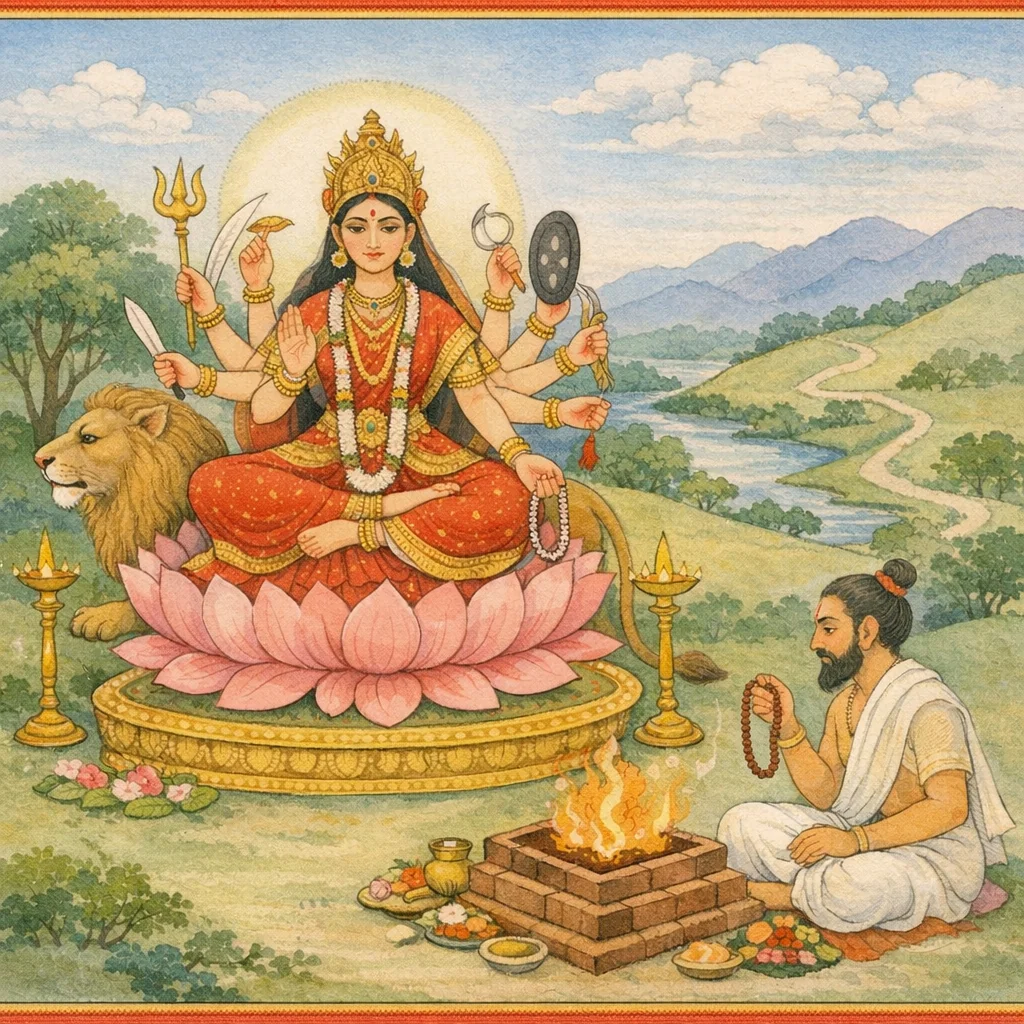
This chapter continues the Preta-kalpa’s aim of protecting the departed soul’s journey and securing auspicious stability for the living. Hari turns from general ritual duty to a Devī-centered protective discipline: beginning worship on Navamī, addressing Durgā with “Hrīṃ” as the Protectress, and invoking her forms—Gaurī, Kālī, Umā, Bhadrā, Kānti, and Sarasvatī. From the third day of the departed one’s passage, he prescribes sequential pūjā to Maṅgalā, Vijayā, Lakṣmī, Śivā, and Nārāyaṇī so that protection is not diminished. The chapter gives detailed dhyāna of the Goddess in multi-armed forms (18, 28, 12, 8, or 4 arms), listing weapons and emblems for visualization. It then sets out mantra discipline: a 108-name “garland” to be recited as japa with strict counts, paired with sesame/trimadhura homa offerings and optional rites such as mahāmāṁsa. It closes with a plea for protection and acceptance of bali, grounding later instructions in mantra, visualization, and phala (results).
Shlokas
Verse 1
नाम सप्तत्रिंशो ऽध्यायः हरिरुवाच / नवम्यादौ यजेद्दुर्गां ह्रीं दुर्गे रक्षिणीति च / मातर्मातर्वरे दुर्गे सर्वकामार्थसाधनि
Chapter Thirty-Seven—Hari (Lord Viṣṇu) said: “Beginning with the ninth lunar day (Navamī), one should worship Goddess Durgā, uttering the mantra, ‘Hrīṃ—O Durgā, the Protectress.’ (Pray:) ‘O Mother, most excellent of mothers; O Durgā, accomplisher of all desired aims and purposes.’”
Verse 2
अनेन बलिदानेन सर्वकामान्प्रयच्छ मे / गौरी काली उमा दुर्गा भद्रा कान्तिः सरस्वती
By this offering (bali), grant me the fulfillment of all desires—O Gaurī, Kālī, Umā, Durgā, Bhadrā, Kānti, and Sarasvatī.
Verse 3
मङ्गला विजया लक्ष्मीः शिवा नारायणी क्रमात् / मार्गे तृतीयामारभ्य पूजयेन्न वियोगभाक्
In due order, the goddesses Maṅgalā, Vijayā, Lakṣmī, Śivā, and Nārāyaṇī should be worshipped; beginning from the third day on the departed one’s journey, perform their worship so that separation from welfare and protection does not befall.
Verse 4
अष्टादशभुजां खेटकं घण्टां दर्पणं तर्जनीम् / धनुर्ध्वजं डमरुकं परशुं पाशमेव च
She is eighteen-armed, bearing a shield, a bell, a mirror, and an admonishing finger; also a bow, a banner, a ḍamaru drum, an axe, and a noose as well.
Verse 5
शक्तिमुद्ररशूलानि कपालशरकाङ्कुशान् / वज्र चक्रं शलाकां च अष्टादशभुजां स्मरेत्
One should meditate upon Her as eighteen-armed, bearing the śakti-spear, the mudrā, the trident, the skull, arrows, the goad, the thunderbolt (vajra), the discus (cakra), and a rod (śalākā).
Verse 6
मन्त्रः श्रीभगवत्याश्च प्रवक्ष्यामि जपादिकम्
I shall now declare the mantra of the revered Divine Goddess, along with the method of its japa (repetition) and the related observances.
Verse 7
ॐ नमो भगवति चामुण्डे श्मशानवासिनि कपालहस्ते महाप्रेतसमारूढे महाविमानमालाकुले कालरात्रि बहुगणपरिवृते महामुखे बहुभुजे सुघण्टाडमरुकिङ्किणीके अट्टाट्टहासे किलिकिलि हुं सर्वनादशब्दबहुले गजचर्मप्रावृतशरीरे रुधिरमांसदिग्धे लोलग्रजिह्वे महाराक्षसि रौद्रदंष्ट्राकराले भीमाट्टाट्टहासे स्फुरितविद्युत्समप्रभे चलचल करालनेत्रे हिलिहिलि ललज्जिह्वे ह्रैं ह्रीं भृकुटिमुखि ॐ कारभद्रासने कपालमालावेष्टिते जटामुकुटशशाङ्कधारिणि अट्टाट्टहासे किलिकिलि हुंहुं दंष्ट्राघोरान्धकारिणि सर्वविघ्नविनाशिनि इदं कर्म साधय साधय शीघ्रं कुरुकुरु कहकह अङ्कुशे समनुप्रवेशय वर्गंवर्गं (वङ्गवङ्ग) कम्पयकम्पय चलचल चालयचालय रुधिरमांसमद्यप्रिये हनहन कुट्टकुट्ट छिन्दछिन्द मारयमारय अनुबूम अनुबूम वज्रशरीरं साधयसाधय त्रैलोक्यगतमपि दुष्टमदुष्टं वा गृहीतमगृहीतम् आवेशय आवेशय क्रामयक्रमय नृत्यनृत्य बन्धबन्ध वल्गवल्ग कोटराक्षि उर्ध्वकेशि उलूकवदने करकिङ्किणि करङ्कमालाधारिणि दहदह पचपच गृह्णगह्ण मण्डलमध्ये प्रवेशयप्रवेशय किं विलम्बसि ब्रह्मसत्येन विष्णुसत्येन ऋषिसत्येन रुद्रसत्येन आवेशय आवेशय किलिकिलि खिलिखिलि मिलिमिलि चिलिचिलि विकृतरूपधारिणि कृष्णभुजङ्ग वेष्टितशरीर सर्वग्रहावेशिनि प्रलम्भोष्ठि भ्रूमग्ननासिके विकटमुखि कपिलजटे ब्राह्मि भञ्जभञ्ज ज्वलज्वल कालमुखि खलखल खरखरः पातयपा तय रक्ताक्षि धूर्णापयधूर्णापय भूमिं पातयपातय शिरो गृह्णगृह्ण चक्षुर्मोलयमीलय भञ्जभञ्ज पादौ गृह्णगृह्ण मुद्रां स्फोटयस्फोटय हुं हूं फट् विदारय विदारय त्रिशूलेन भेदयभेदय वज्रेण हनहन दण्डेन ताडयताडय चेक्रण छेदयछेदय शक्तिना भेदयभेदय दंष्ट्रया दंशयदंशय कीलकेन कीलय कीलय कर्तारिकया पाटयपाटय अङ्कुशेन गृह्णगृह्ण ब्रह्माणि एहि एहि माहेश्वरि एहि एहि कौमारि एहि एहि वाराहि एहि एहि ऐन्द्रि एहि एहि चामुण्डे एहि एहि वैष्णावि एहि एहि हिमवन्तचारिणि एहि एहि कैलासवारीणि एहि एहि परमन्त्रं छिन्धिछिन्धि किलिकिलि बिम्बे अघोरे घोररूपिणि चामुण्डे रुरुक्रोधान्धविनिः) सृते असुरक्षयङ्करि आकाशगामिनि पाशेन बन्धबन्ध समये तिष्ठतिष्ठ मण्डलं प्रवेशयप्रवेशय पातयपातय गृह्णगृह्ण मुखं बन्धबन्ध चक्षुर्बन्धयबन्धय हृदयं बन्धबन्ध हस्तपादौ च बन्धबन्ध दुष्टग्रहान् सर्वान् बन्धबन्ध दिशां बन्धबन्ध विदिशां बन्धबन्ध ऊर्ध्वं बन्धबन्ध अधस्ताद् बन्धबन्ध भस्मना पानीयेन मृतिकया सर्षपैर्वा आवेशय आवेशय पातयपातय चामुण्डे किलिकिलि विच्छेह्रीं(हुं) फट् स्वाह्
Om. Salutations to Bhagavatī Cāmuṇḍā—dweller in the cremation-ground, skull in hand, mounted upon the great preta, amid the throng of the vast aerial car; Kālārātrī, surrounded by many hosts, great-mouthed and many-armed, with auspicious bells, ḍamaru and tinkling ornaments; with the roaring aṭṭāṭṭa laughter—kiliki-kili, hūṃ—abounding in all sounds; her body clad in elephant-hide, smeared with blood and flesh, her tongue lolling; the great rākṣasī, fierce, with dreadful fangs, eyes flashing like lightning—hraiṃ hrīṃ—brow-knotted, seated on the blessed seat of Oṃ, wreathed in a garland of skulls, crowned with matted locks bearing the moon; hūṃhūṃ—destroyer of all obstacles: accomplish this rite, accomplish it; swiftly, kuru kuru… (the mantra continues as in the Sanskrit text) …vicche hrīṃ(huṃ) phaṭ svāhā.
Verse 8
अष्टोत्तरपदानां हि माला मन्त्रमयी जपः / एकैक्रपदमष्टसहस्रधा त्रिमधुराक्ततिलाष्टसहस्रहामेः
Indeed, the garland of the Divine Names of one hundred and eight words is itself a mantra-filled japa. Each single word is to be repeated eight thousand times, together with eight thousand sesame offerings mixed with the three sweet substances.
Verse 9
महामांसेन-त्रिमधुराक्तेन अष्टोत्तरसह्सत्रं च एकैकं च पदं यजेत् / तिलांस्त्रिमधुराक्तांश्च सहस्रं चाष्ट होमयेत्
With a great quantity of mahāmāṁsa (meat) anointed with trimadhura—the three sacred sweet substances—one should perform the offering in one thousand and eight repetitions, worshipping each word of the mantra. Likewise, sesame seeds anointed with trimadhura should be offered into the fire as homa—one thousand and eight oblations.
Verse 10
महामांसं त्रिमधुरादथ वा सर्वकर्मकृत् / वारिसर्षपभस्मादिक्षेपाद्युद्धादिके जयः
By offering mahāmāṁsa, or else by performing the rite of trimadhura, one becomes able to accomplish every undertaking. And by sprinkling water, mustard seeds, ash, and the like, victory is gained in battle and in contests of a similar kind.
Verse 11
अष्टाविंशभुजा ध्येया अष्टादशभुजाथवा / द्वादशाष्टभुजा वापि ध्येया वापि चतुर्भुजा
She is to be meditated upon as having twenty-eight arms, or eighteen arms; or again as having twelve or eight arms; or also as four-armed—any of these forms is fit for contemplation.
Verse 12
असिखेटान्वितौ हस्तौ गदादण्डयुतौ परौ / शरचापयुतौ चान्यौ खड्गमुद्ररसंयुतौ
Two hands are equipped with a sword and a shield; two others bear a mace (gadā) and a staff. Another pair holds arrows and a bow, and the remaining hands are furnished with sword-mudrās and emblems of weapons—fully armed in every way.
Verse 13
खङ्खघण्टान्वितौ चान्यौ ध्वजदण्डयुतौ परौ / अन्यौ परशुचक्राढ्यौ डमरुदर्पणान्वितौ
Two other hands are furnished with a conch (śaṅkha) and a bell; two more bear a banner and its staff. Another pair is equipped with an axe (paraśu) and a discus (cakra), and yet another pair carries a damaru drum and a mirror.
Verse 14
शक्तिहस्ताश्रितौ चान्यौ रटोणी मुसलान्वितौ / पाशतोमरसंयुक्तौ ढक्रापणवसंयुतौ
And there are two others as well: one bearing a spear in his hand, another equipped with a club; furnished with nooses and javelins, and accompanied by the loud sounds of the ḍhakkā-drum and the paṇava-drum.
Verse 15
तर्जयन्ती परेणैव अन्यं कलकलध्वनिम् / अभयस्वस्तिकाद्यौ च महिषघ्नी च सिंहगा
‘Tarjayantī’ (the intimidator) roars with a harsh, clamorous din, terrifying others; and there are others such as Abhayā, Svastikā and the rest—Mahiṣaghnī (the slayer of buffaloes) and Siṃhagā (the lion-rider) as well.
Verse 16
जय त्वं किल भूतेशे सर्वभूतसमावृते / रक्ष मां निजभूतेभ्यो वलिं गृह्ण नमो ऽस्तु ते
Victory to you indeed, O Lord of beings, encompassed by all beings. Protect me from your own spirits; accept this offering—salutations to you.
Frequently Asked Questions
Navamī is presented as an auspicious starting point for invoking Durgā’s protective agency; the chapter’s framing ties the timing to ensuring protection and fulfillment of aims during a sensitive transitional period.
The chapter links disciplined japa to homa and sprinkling rites; the karmic-ritual logic is that mantra (śabda-śakti) empowered through repetition and oblation produces siddhi, stated here as success in ventures and victory in contests.
The text explicitly permits several iconographic options, indicating that efficacy lies in correct devotional focus and mantra-anchored dhyāna rather than a single fixed visualization; any of the sanctioned forms is said to be fit for contemplation.