Adhyaya 224
Naimittika and Prākṛtika Pralaya (Periodic and Primordial Dissolution)
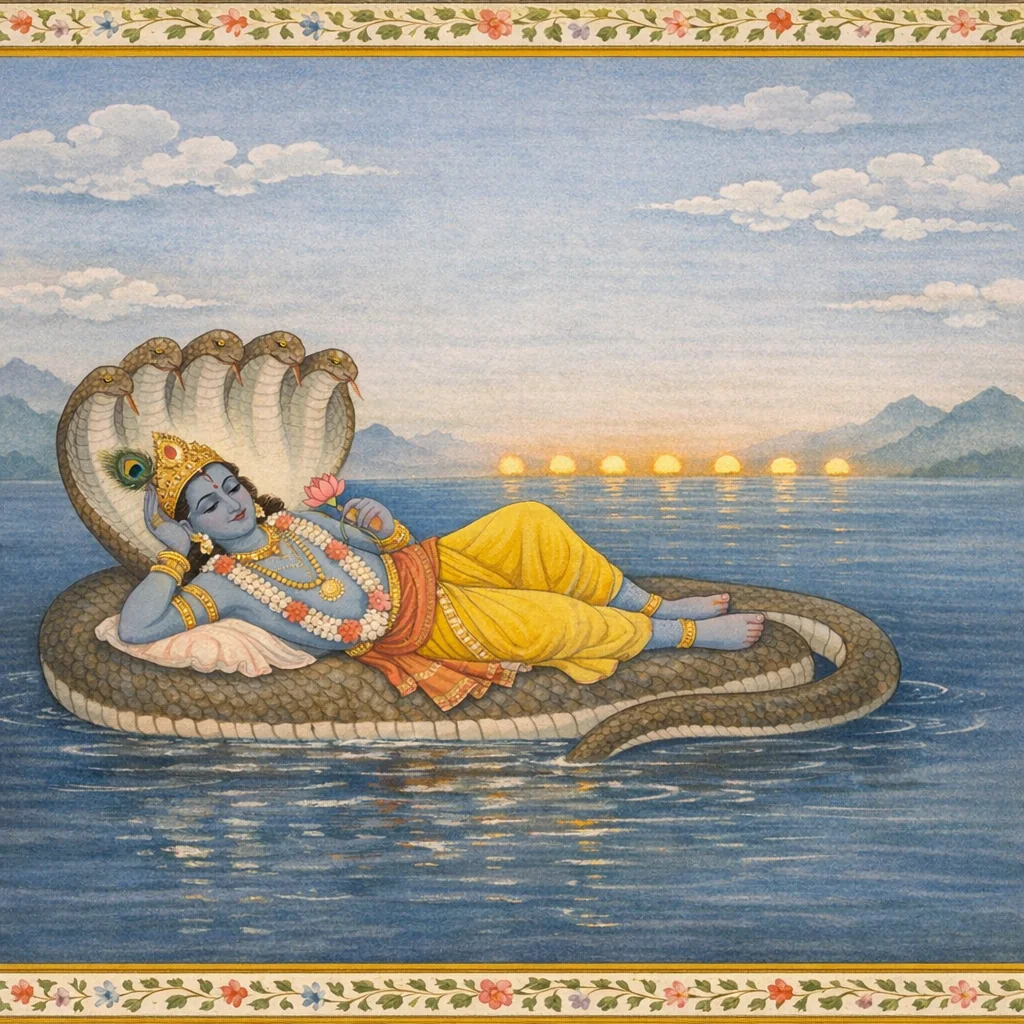
Continuing Sūta’s instruction to Śaunaka, this chapter turns from general cosmic time to the end-phases of a kalpa. It first describes naimittika pralaya: after a thousand cycles of the four yugas, a hundred-year drought comes; seven suns appear, drying the three worlds, and the heat reaches even the nether regions. Viṣṇu then manifests clouds from His mouth and sends rain for a hundred years, until only the cosmic flood remains; all moving and unmoving beings perish, and Hari alone endures, reclining upon Ananta. The discourse then shifts to prākṛtika pralaya: the deeper withdrawal of the universe by yogic power, the onward course of beings who reached Brahmā’s abode, and the splitting and dissolution of the cosmic egg when Brahmā’s lifespan ends. Finally it gives the laya-krama, the reabsorption sequence from earth up to puruṣa, concluding with Viṣṇu’s repose and the ordered re-manifestation from avyakta, linking dissolution to the next cycle of creation.
Shlokas
Verse 1
नाम त्रयोविंशत्यधिकद्विशततमो ऽध्यायः सूत उवाच / चतुर्युगसहस्रान्ते ब्राह्मो नैमित्तिको लयः / अनावृष्टिश्च कल्पान्ते जायते शतवार्षिकी
Sūta said: “This is the two-hundred-and-twenty-fourth chapter. At the completion of a thousand cycles of the four yugas, the Brahmā-related, periodic (naimittika) dissolution occurs; and at the end of the kalpa there arises a drought—no rainfall—for a hundred years.”
Verse 2
उतिष्ठन्ति तदा रौद्रा दिवि सप्त दिवाकराः / ते तु पीत्वा जलं सर्वं शोषयन्ति जगत्त्रयम्
Then, in the heavens, seven fierce suns arise; and having drunk up all the waters, they dry up the three worlds.
Verse 3
भूर्भुवः स्वर्महर्लोकं चराचरं जनस्तथा / विष्णुश्च रुद्रो भूत्वासौ पातालानि दहत्यधः
He burns up Bhūr, Bhuvaḥ, Svar, and Maharloka; all that moves and does not move, and also Janaloka. Becoming both Viṣṇu and Rudra, he scorches the netherworlds below—the Pātālas.
Verse 4
विष्णुर्दहेत्त्रिलोकञ्चि मुखान्मेघान् सृजत्यलम् / वर्षन्ते वै वर्षशतं नानावर्णा महाघनाः
Viṣṇu burns the three worlds, and from His mouth He abundantly brings forth clouds; those great, massive clouds of many hues then pour rain for a hundred years.
Verse 5
विष्णुरूपःशतं वाति वर्षाणां वायुरूर्जितः / विष्णुरे कार्णवी भूते वर्षे ब्रह्मस्वरूपधृक् / शेते ऽनन्तासने विष्णुर्नष्टे स्थावरजङ्गमे
For a hundred years the mighty wind blows in the form of Viṣṇu. When the cosmic flood (kārṇavī) arrives, Viṣṇu alone remains, bearing the form of Brahmā. When all that is stationary and moving has perished, Viṣṇu lies upon the endless throne, Ananta.
Verse 6
सुप्त्वा वर्षसहस्रं स जगद्भूयो ऽसृजद्धरिः / अथ प्राकृतिकं वक्ष्ये प्रलयं शृणु शौनक
After sleeping for a thousand years, that Hari created the world again. Now I shall describe the Prākṛtika dissolution—listen, O Śaunaka.
Verse 7
पूर्णे संवत्सरशते संहृत्य सकलं जगत् / ब्रह्माणं न्यस्य देहे हि मुक्तो योगबलैर्हरिः
When a full hundred years are completed, having withdrawn the entire universe, Hari—by the power of Yoga—becomes free, having indeed placed Brahmā within his own body.
Verse 8
ये गता ब्रह्मणः स्थानं ते ऽपि यान्ति परं पदम् / अनावृष्ट्यर्कसम्पन्ना आसन्मेघास्तथा द्विज / शतं वर्षाणि वर्षद्भिर्मेधैरण्डं प्रपूर्यते
Those who have reached the abode of Brahmā also proceed onward to the supreme state. Likewise, O twice-born, clouds filled with the sun’s heat yet withholding rain—by raining for a hundred years—fill up the cosmic egg, the universe.
Verse 9
अन्तर्गतेन तोयेन भिन्नमण्डं जगत्पतेः / पूर्णे ब्रह्मायुषि गते भिद्यते ऽम्भसि लीयते
When the waters within rise, the cosmic sphere of the Lord of the universe is split. And when Brahmā’s full lifespan is completed, it breaks apart and dissolves back into the primal waters.
Verse 10
एवं सा जगदाधारा तोये चोर्वो प्रलीयते / आपस्तेजसि लीयन्ते तेजो वायौ प्रलीयते
Thus the earth—the support of the world—dissolves into water. The waters are absorbed into fire, and fire, in turn, dissolves into wind.
Verse 11
वायुः खे खञ्च भूतादौ विशते च तदा महान् / महान्प्रपद्यते ऽव्यक्तं प्रकृतिः पुरुषे परे
Then the vital wind (vāyu) enters into space (kha/ākāśa), and the great principle (mahān, the mahat-tattva) dissolves into the Unmanifest (avyakta). Thereafter Prakṛti, primordial nature, merges into the Supreme Person (puruṣa), the Transcendent.
Verse 12
शतवर्षं हरिः शेते सृजत्यथ दिनगमे / अव्यक्तादिक्रमेणैव व्यक्तीभूतं चराचरम्
For a hundred years Hari lies in repose; then, at the end of the day, He creates again. In due sequence beginning from the Unmanifest, the entire moving and unmoving universe becomes manifest.
Frequently Asked Questions
It is a pralaya-marker indicating intensified cosmic heat that dries up waters and scorches the worlds, preparing the manifest universe for inundation and withdrawal; the image functions as a cosmological sign of the end of a cycle rather than an ordinary astronomical event.
Viṣṇu is portrayed as the sole remainder during dissolution—absorbing Brahmā, withdrawing the universe by yoga, and reclining on Ananta—yet also as the initiator of re-creation, manifesting the cosmos again in sequence beginning from the unmanifest (avyakta).