Adhyaya 34
Kārttavīrya–Paraśurāma-saṅgrāma-kathā (Sagara’s Inquiry and Vasiṣṭha’s Account)
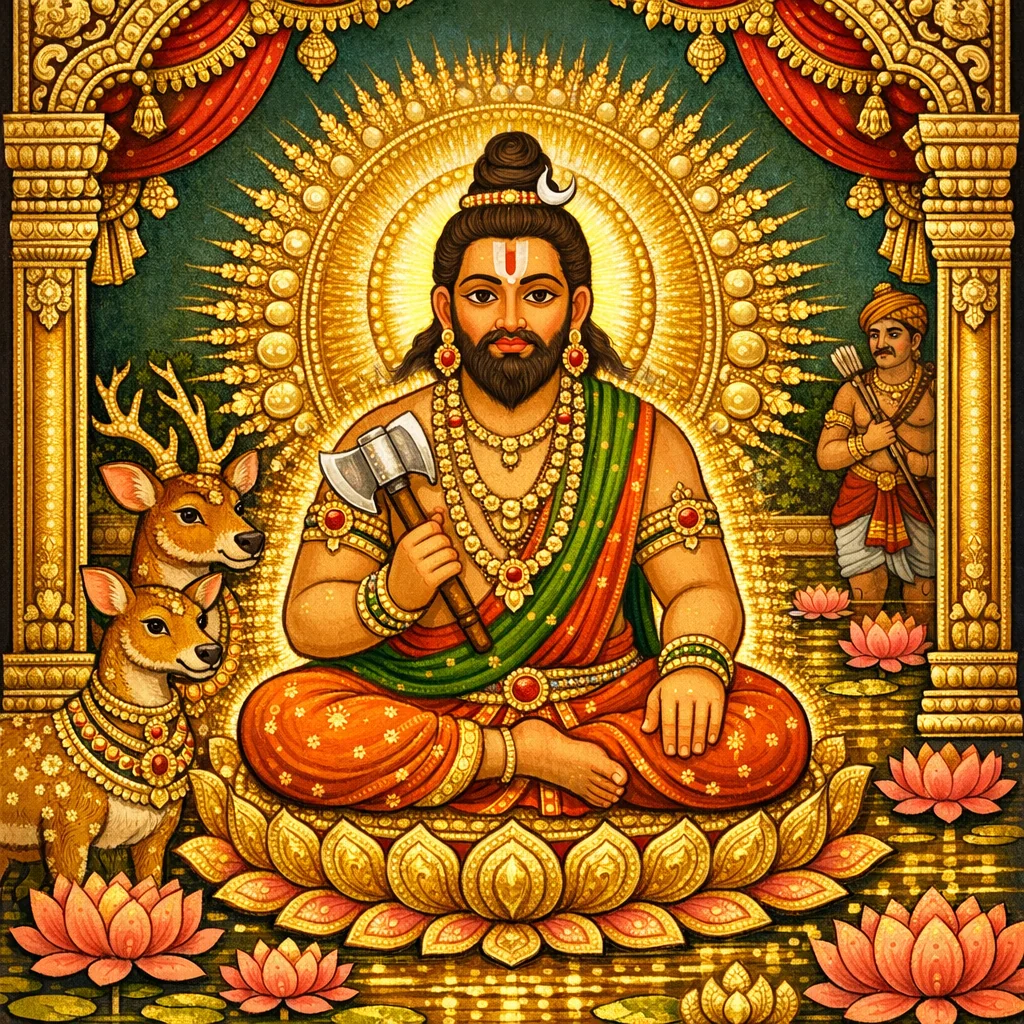
This adhyāya is cast as a courtly dialogue: King Sagara, addressing a venerable sage, acknowledges the revelation of a health-bestowing protective armour (kavaca) and the empowerment of weapon/astrā knowledge through Aurva’s grace. He then asks for a detailed account of how Rāma Bhārgava (Paraśurāma) brought down King Kārttavīrya Arjuna, and how two “favoured” heroes—Rāma (supported by Śiva/Datta in the narrative) and Kārttavīrya—came to clash. Vasiṣṭha begins the sin-destroying, purifying narration: Rāma receives kavaca and mantra from his guru, performs severe discipline at Puṣkara for a hundred years (thrice-daily bathing, sandhyā observance, sleeping on the ground), and daily gathers ritual materials for Bhṛgu’s tradition. Steady in meditation, he worships Kṛṣṇa as the remover of defilement. The story’s trigger arises when, during a bath at Madhyama Puṣkara, a hunted deer and doe flee a hunter and approach the water within Rāma’s sight, setting the ethical and martial turning point that leads toward the coming confrontation.
Shlokas
Verse 1
इति श्रीब्रह्माण्डे महापुराणे वायुप्रोक्ते मध्यमभागे तृतीय उपोद्धातपादे भार्गवचरिते त्रयस्त्रिंशत्तमो ऽध्यायः सगर उवाच ब्रह्मपुत्र महाभाग महान्मे ऽनुग्रहः कृतः / यदिदं कवचं मह्यं प्रकाशितमनामयम्
Thus, in the Śrī Brahmāṇḍa Mahāpurāṇa, proclaimed by Vāyu, in the middle section, in the third introductory pāda, within the Bhārgava narrative, ends the thirty-third chapter. Sagara said: “O son of Brahmā, O greatly blessed one, you have shown me immense grace by revealing to me this Kavacha, free from affliction.”
Verse 2
और्वेणानुगृहीतो ऽहं कृतास्त्रो यदनुग्रहात् / भवतस्तु कृपापात्रं जातो ऽहमधुना विभो
By the grace of Sage Aurva I have been blessed, and through his favor I have become accomplished in sacred weapons. O mighty Lord, now I have become a worthy recipient of your compassion.
Verse 3
रामेण भार्गवेन्द्रेण कार्त्तवीर्यो नृपो गुरो / यथा समापितो वीरस्तन्मे विस्तरतो वद
O Guru, tell me in full how Rama, foremost among the Bhargavas, brought the valiant king Karttavirya to his end.
Verse 4
कृपापात्रं स दत्तस्य राजा रामः शिवस्य च / उभौ तौ समरे वीरौ जघटाते कथं गुरो
O Guru, Rama the king, a recipient of Datta’s grace, and the one favored by Shiva—how did those two heroes clash in battle?
Verse 5
वसिष्ठ उवाच शृणु राजन्प्रवक्ष्यामि चरितं पापनाशनम् / कार्त्तवीर्यस्य भूपस्य रामस्य च महात्मनः
Vasistha said: “O King, listen; I shall recount a sin-destroying tale—the deeds of King Karttavirya and of the great-souled Rama.”
Verse 6
स रामः कवचं लब्ध्वा मन्त्रं चैव गुरोर्मुखात् / चकार माधनं तस्य भक्त्या परमया युतः
That Rama, having received the protective armor and the mantra from his guru’s lips, performed the prescribed worship and practice with supreme devotion.
Verse 7
भूमिशागी त्रिषवण स्नानसध्यापरायणः / उवासपुष्करे राम शतवर्षमतन्द्रितः
Rama, sleeping upon the bare earth and devoted to the thrice-daily bath and Sandhya worship, dwelt at Pushkara for a hundred years without slackening.
Verse 8
समित्पुष्पकुशादीनि द्रव्याण्यहरहर्भृगोः / आनीय काननाद्भूप प्रायच्छदकृतव्रणः
O king, that blameless observer of vows brought each day from the forest samit fuel, flowers, kusa grass, and other offerings, and presented them to Bhṛgu.
Verse 9
सततं ध्यानसंयुक्तो रामो मतिमतां वरः / आराधयामास विभुं कृष्णं कल्मषनाशनम्
Ever joined to meditation, Rama, foremost among the wise, worshiped the all-pervading Lord Kṛṣṇa, the destroyer of sinful taint.
Verse 10
तस्यैवं यजमानस्य रामस्य जगतीपते / गतं वर्षशतं तत्र ध्यानयुक्तस्य नित्यदा
O Lord of the world, as Rama thus performed sacrifice and remained ever absorbed in meditation, a full hundred years passed there.
Verse 11
एकदा तु महाराज रामः स्नातुं गतो महान् / मध्यमं पुष्करं तत्र ददर्शाश्वर्यमुत्तमम्
Once, O great king, the mighty Rama went to bathe; there, at the Middle Pushkara, he beheld a most excellent wonder.
Verse 12
मृग एकः समायातो मृग्य युक्तः पलायितः / व्याधस्य मृगयां प्राप्तो धर्मतप्तो ऽतिपीडितः
A lone deer came running, distraught and fleeing from the hunt. Caught in the hunter’s chase, it was sorely oppressed, scorched by the heat of dharma.
Verse 13
पिपासितो महाभाग जलपानसमुत्सुकः / रामस्य पश्यतस्तत्र सरसस्तटमागतः
That fortunate deer, parched with thirst and eager to drink, came to the lake’s edge there, even as Rama watched.
Verse 14
पश्चान्मृगी समायाता भीता सा चकितेक्षणा / उभो तौ पिबतस्तत्र जलं शङ्कितमानसौ
Afterwards a doe came, frightened, her eyes wide with alarm. The two drank water there, yet their minds were filled with misgiving.
Verse 15
तावत्समागतो व्याधो बाणपाणिर्धनुर्द्धरः / स दृष्ट्वा तत्र संविष्टं रामं भार्गवनन्दनम्
Just then the hunter arrived, arrow in hand and bow borne. Seeing Rama there, seated—the scion of Bhārgava—he beheld him.
Verse 16
अकृतव्रणसंयुक्तं तस्थौ दूरकृतेक्षणः / स चिन्तयामास तदा शङ्कितो भृगुनन्दनात्
Gazing from afar, he halted on seeing (Rama) untouched by any wound. Then, suspicious of Bhṛgu’s son, he began to ponder.
Verse 17
अयं रामो महावीरो दुष्टानामन्तकारकः / कथमेतस्य हन्म्येतौ पश्यतो मृगयामृगौ
This is Rama, the great hero, the destroyer of the wicked. How could I slay these two hunted deer while he is watching?
Verse 18
इति चिन्ता समाविष्टो व्याधो राजन्यसत्तम / तस्थौ तत्रैव रामस्य भयात्संत्रस्तमानसः
Thus, seized by anxious thought, O best of the royal warriors, the hunter stood there still, his mind trembling in fear of Rama.
Verse 19
रामस्तु तौ मृगों दृष्ट्वा पिबन्तौ सभ्यं जलम् / तर्कयामास मेधावी किमत्र भयकारणम्
Rama saw those two deer drinking clear water. The wise Rama then pondered: what is the cause of fear here?
Verse 20
नैवात्र व्याघ्रसेनादो न च व्याधो हि दृश्यते / केनैतौ कारणेनाहो शङ्कितौ चकितेक्षणौ
Here there is no roar of tigers, nor is any hunter to be seen. By what cause, then, are these two so wary, their eyes startled?
Verse 21
अथ वा मृगजातिर्हि निसर्गाच्चकितेक्षणा / चेनैतौ जलपाने ऽपि पश्यतश्चकितेक्षणौ
Or perhaps the deer-kind is by nature wide-eyed and easily startled; thus, even while drinking water, these two keep watching in alarm.
Verse 22
नैतावत्कारणं चात्र किन्तु खेदभयातुरौ / लक्षयेते खिन्नसर्वाङ्गौ कम्पयुक्तौ यतस्त्विमौ
Here that alone is not the cause; rather, these two are distressed by sorrow and fear. Therefore their whole bodies appear weary, and they are seized with trembling.
Verse 23
एवं संचिन्त्य मतिमान्स तस्थौ मध्यपुष्करे / शिष्येण संयुतो रामो यावत्तौ चापि संस्थितौ
Thus reflecting, the wise Rama stood in the midst of Puṣkara, accompanied by his disciple, as long as those two also remained standing there.
Verse 24
पीत्वा जलं ततस्तौ तु वृक्षच्छायासमाश्रितौ / रामं दृष्ट्वा महात्मानं कथां तौ चक्रतुर्मुदा
Then the two drank water and took refuge in the shade of a tree. Seeing Rama, the great-souled one, they spoke together in gladness.
Verse 25
मृग्युवाच कान्त चात्रैव तिष्ठावो यावद्रामो ऽत्रसंस्थितः / अस्य वीरस्य सांनिध्ये भयं नैवावयोर्भवेत्
The doe said, “Beloved, let us stay here as long as Rama remains in this place. In the presence of this hero, fear will not befall us.”
Verse 26
अत्राप्यागत्य चैव्द्याधौ ह्यावयोः प्रहरिष्यति / दृष्टमात्रो हि मुनिना भस्मीभूतो भविष्यति
That hunter may come here as well and strike at us; yet the moment the sage beholds him, he will be reduced to ashes.
Verse 27
इत्युक्ते वचने मृग्या रामर् शनतुष्टया / मृगश्चोवाच हर्षेण समाविष्टः प्रियां स्वकाम्
When those words were spoken, the doe—satisfied by the sight of Rāma—and the stag, filled with joy, spoke forth his dear, heart-desired words.
Verse 28
एवमेव महाभागे यद्वै वदसि भामिनि / जाने ऽहमपि रामस्य प्रभावं सुमहात्मनः
Just so, O most fortunate lady, O fair one—what you say is true; I too know the mighty glory of Rāma, that great Mahātman.
Verse 29
यो ऽयं संदृश्यते चास्य पार्श्वं शिष्यो ऽकृतव्रणः / सचाने न महाभागस्त्रातो व्याघ्रभयातुरः
This one seen at his side—his disciple, unscarred—was also saved by that great blessed one when he was distressed by fear of a tiger.
Verse 30
अयं रामो महाभागे जमदग्निसुतो ऽनुजः / पितरं कार्त्तवीर्येण दृष्ट्वा चैव तिरस्कृतम्
O most fortunate lady, this is Rāma, the younger son of Jamadagni; he saw his father insulted and slighted by Kārttavīrya.
Verse 31
चकारातितरां क्रुद्धः प्रतिज्ञां नृपघातिनीम् / तत्पूर्तिकामो ह्यगमद्ब्रह्मलोकं पुरा ह्ययम्
In fierce wrath he made a vow that would bring the slaying of kings; and, longing to fulfill it, he once went to Brahmaloka.
Verse 32
स ब्रह्मा दिष्टवांश्चैनं शिवलोकं व्रजेति ह / तस्य त्वाज्ञां समादाय गतो ऽसौ शिवसन्निधिम्
Then Brahmā commanded him, “Go to Śivaloka.” Taking up that order, he went into the presence of Śiva.
Verse 33
प्रोवाचाखिलवृत्तान्त राज्ञश्चप्यात्मनः पितुः / स कृपालुर्महादेवः सभाज्य भृगुनन्दनम्
He recounted the entire account concerning the king and his own father. Compassionate Mahādeva honored Bhṛgu’s son and received him.
Verse 34
ददौ कृष्णस्य सन्मन्त्रमभेद्यं कवचं तथा / स्वीयं पाशुपतं चास्त्रमन्यास्त्रग्राममेव च
He bestowed upon Kṛṣṇa a holy mantra, an inviolable armor, his own Pāśupata weapon, and also a host of other weapons.
Verse 35
विसर्जयामास मुदा दत्त्वा शस्त्राणि चादरात् / सो ऽयमत्रागतो भद्रे मेत्रसाधनतत्परः
Joyfully he dismissed him, after respectfully granting the weapons. O noble lady, that very one has come here, intent upon the practice of maitrī—sacred amity.
Verse 36
नित्यं जपति धर्मात्मा कृष्णस्य कवचं सुधीः / शतवर्षाणि चाप्यस्य गतानि सुमहात्मनः
That righteous and wise one continually recites Kṛṣṇa’s kavaca. For that great-souled man, a full hundred years have also passed.
Verse 37
मन्त्र साधयतो भद्रे न च तत्सिद्धिरेति हि / आत्रास्ति कारणं भक्तिः साव वै त्रिविधा मता
O Bhadrā, even for one who practices mantra-sādhana, its siddhi does not necessarily arise. Here the cause is bhakti, which is held to be threefold.
Verse 38
उत्तमा मध्यमा चैव कनिष्ठा तरलेक्षणे / शिवस्य नारदस्यापि शुकस्य च महात्मनः
O gentle-eyed one, bhakti is regarded as threefold—supreme, middling, and lesser—as seen in Śiva, in Nārada, and in the great-souled Śuka.
Verse 39
अंबरीष्स्य राजर्षे रन्तिदेवस्य मारुतेः / बलेर्विभीषणस्यापि प्रह्लादस्य महात्मनः
In Rājarṣi Ambarīṣa, in Rantideva, in Māruti (Hanumān), in Bali, in Vibhīṣaṇa, and in the great-souled Prahlāda too, distinctions of bhakti are spoken of.
Verse 40
उत्तमा भक्तिरेवास्ति गोपीनामुद्धवस्य च / वसिष्ठादिमुनीशानां मन्वादीनां शुभेक्षणे
O auspicious-eyed one, the highest bhakti is found in the Gopīs and in Uddhava; so too among the great sages beginning with Vasiṣṭha, and among the Manus and others.
Verse 41
मध्या च भक्तिरेवास्ति प्राकृतान्यजनेषु सा / मध्यभक्तिरयं रामो नित्यं यमपरायणः
Middling bhakti is found among ordinary people. This Rāma is a devotee of the middle kind, ever devoted to Yama (to dharma).
Verse 42
सेवते गोपिकाधीशं तेन सिद्धिं न चागतः / वसिष्ठ उवाच इत्युक्ता त्वरितं कान्तं सा मृगी हृष्टमानसा
He serves the Lord of the gopīs, yet by that he has not attained siddhi. Vasiṣṭha said: thus addressed, the doe, her heart rejoicing, swiftly went to her beloved.
Verse 43
पुनः पप्रच्छ भक्तेस्तु लक्षणं प्रेमदायकम् / मृग्युवाच साधुकान्त महाभाग वचस्ते ऽलौकिकं प्रिय / र्हदृग् ज्ञानं तव कथं संजातं तद्वदाधुना
Again she asked about the mark of bhakti that bestows love. The doe said: “O noble beloved, O greatly blessed one, your words are otherworldly and dear; how did this heart-seeing wisdom arise in you? Tell me now.”
Verse 44
मृग उवाच शृणु प्रिये महाभागे ज्ञानं पुण्येन जायते
The deer said: “Listen, beloved and blessed one: knowledge is born of merit (puṇya).”
Verse 45
तत्पुण्यमद्य संजातं भार्गवस्यास्य दर्शनात् / पुण्यात्मा भार्गवश्चायं कृष्णाभक्तो जितेन्द्रियः
That merit has arisen today from the darśana of this Bhārgava. This Bhārgava is a righteous soul, a devotee of Kṛṣṇa, and a conqueror of the senses (jitendriya).
Verse 46
गुरुशुश्रूषको नित्यं नित्यनैमित्तिकादरः / अतो ऽस्य दर्शनाज्जातं ज्ञानं मे/द्यैव भामिनि
He is ever devoted to serving the guru, and reverent toward the daily and occasional rites (nitya-naimittika). Therefore, O bhāminī, today itself, from his darśana, knowledge has arisen in me.
Verse 47
त्रैलोक्यस्थितसत्त्वानां शुभाशुभनिदर्शकम् / अद्यैव विदितं मे ऽभूद्रासस्यास्य महात्मनः
This reveals the auspicious and the inauspicious for beings abiding in the three worlds; today itself I have come to know the truth of this great-souled Rāsa.
Verse 48
चरितं पुण्यदं चैव पापघ्नं शृण्वतामिदम् / यद्यत्करिष्यते चैव तदपि ज्ञानगोचरम्
This sacred account grants merit and destroys sin for those who hear it; and whatever is done thereafter also lies within the reach of true knowledge.
Verse 49
योत्तमा भक्तिराख्याता तां विना नैव सिद्ध्यति / कवचं मन्त्रसहितं ह्यपि वर्षायुतायुतैः
Without the supreme bhakti that has been proclaimed, no attainment is perfected; even a kavaca joined with mantras, though recited for countless ages, bears no fruit.
Verse 50
यद्ययं भार्गवो भद्रे ह्यगस्त्यानुग्रहं लभेत् / कृष्णप्रेमामृतं नाम स्तोत्रमुत्तमभक्तिदम्
O blessed lady, if this Bhārgava gains the grace of Agastya, then this hymn called “Kṛṣṇa-premāmṛta” will bestow upon him the highest bhakti.
Verse 51
ज्ञात्वा च लप्स्यते सिद्धिं मन्त्रस्य कवचस्य च / स मुनिर्ज्ञाततत्त्वार्थः सानुकंपो ऽभयप्रदः
Knowing this, he will attain the siddhi of both the mantra and the kavaca; that sage understands the truth’s essence, is compassionate, and bestows fearlessness.
Verse 52
उपदेक्ष्यति चैवैनं तत्त्वज्ञानं मुदावहम् / श्रीकृष्णचारितं सर्वं नामभिर्ग्रथितं यतः
He will instruct him in the blissful knowledge of reality, for the entire story of Sri Krishna is woven together through His names.
Verse 53
कृष्णप्रेमामृतस्तोत्राज्ज्ञास्यते ऽस्य महामतिः / ततः संसिद्ध कवचौ राजनं हैहयाधिपम्
His great intellect will be revealed through the Krishna-prema-amrita-stotra. Then, having mastered the divine armor, he will confront the King of the Haihayas.
Verse 54
हत्वा सपुत्रामात्यं च ससुहृद्बलवाहनम् / त्रिः सप्तकृत्वो निर्भूपां करिष्यत्यवनीं प्रिय
Having slain him along with his sons, ministers, friends, and army, he will rid the earth of kings twenty-one times, O dear one.
Verse 55
वसिष्ठ उवाच एवमुक्त्वा मृगो राजन्विरराम मृगीं ततः / आत्मनो मृगभावस्य कारणं ज्ञातवांश्च ह
Vasistha said: O King, having spoken thus to the doe, the deer fell silent. He had indeed realized the karmic cause of his existence as a deer.
Frequently Asked Questions
The chapter situates the Bhārgava heroic cycle (Paraśurāma’s career) against royal power (Kārttavīrya Arjuna), using Sagara’s inquiry to frame how dynastic authority and ascetic lineage intersect and conflict.
Kavaca and mantra are presented as guru-authorized protections/empowerments, while the hundred-year Puṣkara discipline (triṣavaṇa snāna, sandhyā, ritual supply-gathering) functions as the legitimizing engine that ‘grounds’ martial victory in tapas rather than mere force.
It acts as a dharma-trigger: a tīrtha setting (Madhyama Puṣkara) and a vulnerable creature pursued by violence create a moral pressure point that transitions the narrative from ascetic practice to justified confrontation, aligning personal action with Purāṇic order.