Adhyaya 28
Rāja-prabodhana and Prātaḥ-kṛtya (Awakening of the King and Morning Observances)
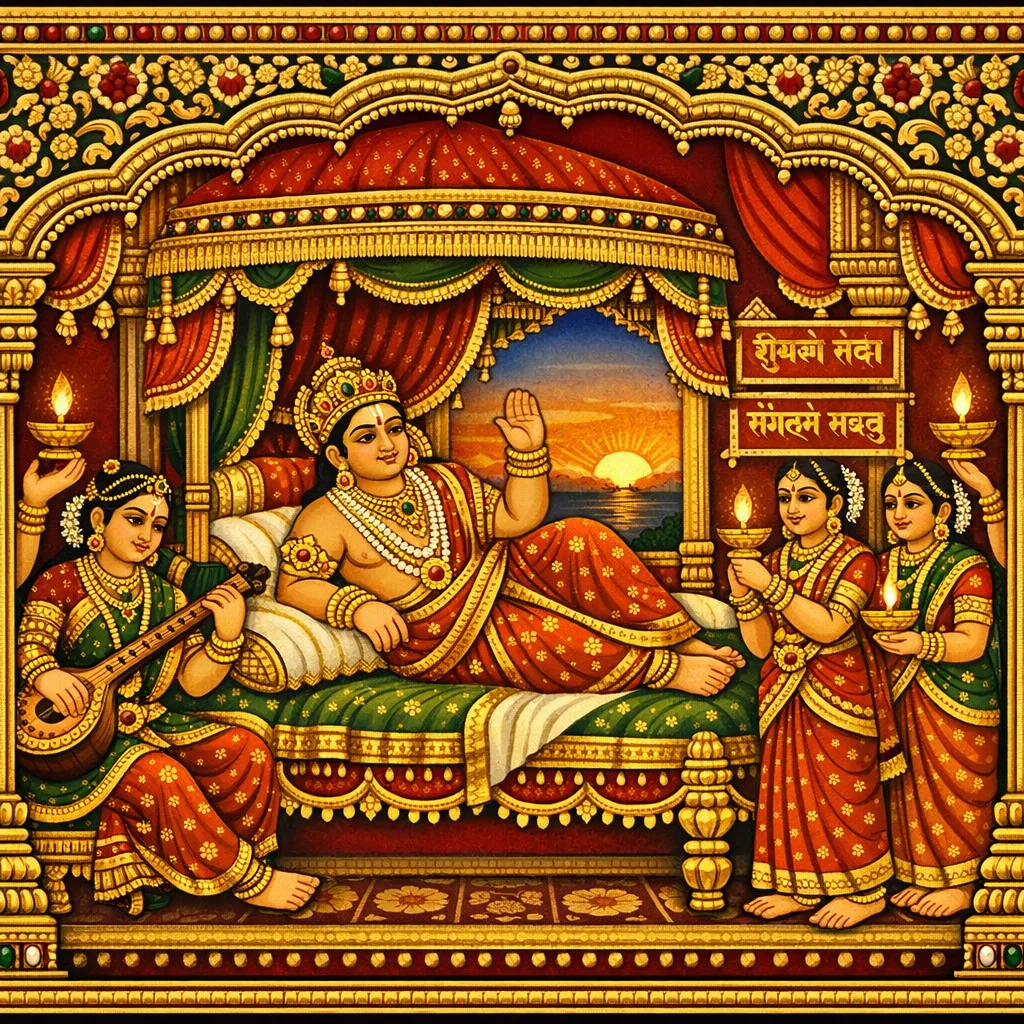
This adhyaya (as sampled), framed in Vasiṣṭha’s voice, portrays a royal morning routine as a template of dharma. At night’s end, Sūtas, Māgadhas, and Vandins arrive to awaken the sleeping king with exalted stuti, performed with musical ornament—vīṇā, veṇu, measured tāla, and clear mūrcchanā/scale cues. Their praise blends cosmic imagery—moonset and sunrise dispelling darkness—with royal eulogy, presenting kingship as aligned with the diurnal order. The king rises, attentively performs his prescribed nitya-karma, undertakes auspicious acts and adornment, gives dāna to petitioners, honors cows and brahmins, leaves the city, and worships the rising Sun (Bhāskara). Ministers, feudatories, and commanders assemble; the king proceeds with his retinue to a tapas-rich sage (taponidhi), bows, receives blessings, and is invited to sit as the sage inquires after his night’s well-being. The chapter thus encodes political ritual, daily dharma, and the court–sage interface as a microcosm of cosmic regularity and lineage governance.
Shlokas
Verse 1
इति श्रीब्रह्माण्डे महापुराणे वायुप्रोक्ते मध्यभागे तृतीय उपोद्धातपादेर्ऽजुनोपाख्याने सप्तविंशतितमो ऽध्यायः // २७// वसिष्ठ उवाच स्वपन्तमेत्य राजानं सूतमागधवन्दिनः / प्रवोधयितुमव्यग्रा जगुरुच्चैर्निशात्यये
Thus, in the Śrī Brahmāṇḍa Mahāpurāṇa, in the middle section spoken by Vāyu, within the third introductory portion of the Arjuna narrative, the twenty-seventh chapter concludes. Vasiṣṭha said: At the end of the night, the sūtas, māgadhas, and bards came to the sleeping king and, unhurried, sang aloud to awaken him.
Verse 2
वीणावेणुरवोन्मिश्रकलतालततानुगम् / समस्तश्रुतिसुश्राव्यप्रशस्तमधुरस्वरम्
Blended with the tones of vīṇā and veṇu, moving in step with beat and tāla; pleasing to every ear, praiseworthy, and sweet in sound.
Verse 3
स्निग्धकण्ठाः सुविस्पष्टमूर्च्छनाग्रामसूचितम् / जगुर्गेयं मनोहारि तारमन्द्रलयान्वितम्
With mellow throats, clearly revealing mūrchhanā and grāma, they sang a captivating song, endowed with the measured flow of both high and low registers.
Verse 4
ऊचुश्च तं महात्मानं राजानं सूतमागधाः / स्वपन्तं विविधा वाचो बुबोधयिषवः शनेः
Then the Sūtas and Māgadhas spoke to that great-souled king as he slept, wishing to awaken him gently, little by little, with varied words.
Verse 5
पस्यायमस्तमभ्येति राजेन्द्रेन्दुः पराजितः / विवर्द्धमानया नूनं तव वक्त्रांबुजश्रिया
Behold—this moon, like a sovereign among kings, is setting as though defeated, surely by the ever-growing splendor of your lotus-like face.
Verse 6
द्रष्टुं त्वदान नांभोजं समुत्सुक इवाधुना / तमांसि भिन्दन्नादित्यः संप्राप्तो ह्युदयं विभो
Now, as though eager to behold the lotus of your face, the Sun has cleft the darkness and, O Lord, has reached his rising.
Verse 7
राजन्नखिलशीतांशुवंशमौलिशिखामणे / निद्रया लं महाबुद्धे प्रतिवुध्यस्व सांप्रतम्
O King, crest-jewel upon the crown of the entire lunar line, O great-minded one—enough of sleep; awaken now.
Verse 8
इति तेषां वचः शृण्वन्नबुध्यत महीपतिः / क्षीराब्दौ शेषशयनाद्यथापङ्कजलोचनः
Though he heard their words, the lord of the earth did not awaken—like the lotus-eyed Viṣṇu reclining on Śeṣa’s couch in the Ocean of Milk.
Verse 9
विनिद्राक्षः समुत्थाय कर्म नैत्यकमादरात् / चकारावहितः सम्यग्जयादिकमशेषतः
With eyes free of sleep, he rose and reverently performed his daily rites. Then, attentive and composed, he carried out in full all duties, including those concerning victory.
Verse 10
देवतामभिवन्द्येष्टां गां दिव्यस्रग्गन्धभूषणः / कृत्वा दूर्वाञ्जनादर्शमङ्गल्यालम्बनानि च
Having bowed to his chosen deity, he adorned himself with divine garlands, fragrance, and ornaments. He also took durvā grass, collyrium, a mirror, and other auspicious tokens.
Verse 11
दत्त्वा दानानि चार्थिभ्यो नत्वा गोब्रह्मणानपि / निष्क्रम्य च पुरात्तस्मादुपतस्थे च भास्करम्
Having given gifts to those in need and bowed to cows and brahmins, he departed from that city and worshiped Bhāskara, the Sun-god.
Verse 12
तावदभ्याययुः सर्वं मन्त्रिसामन्तनायकाः / रचिताञ्जलयो राजन्नेमुश्च नृपसत्तमम्
Just then all the ministers, feudatory lords, and commanders arrived. With palms joined, O King, they bowed to the finest of rulers.
Verse 13
ततः स तैः परिवृतः समुपेत्य तपोनिधिम् / ननाम पादयोस्तस्य किरीटेनार्कवर्चसा
Then, surrounded by them, he approached that treasure of austerity and bowed at his feet, his crown shining with a radiance like the sun.
Verse 14
आशीर्भिरभिनन्द्याथ राजानं मुनिपुङ्गवः / प्रश्रयावनतं साम्ना तमुवाचास्यतामिति
The foremost of sages blessed and greeted the king, and with gentle words said to him, bowed in humility: “Be seated.”
Verse 15
तमासीनं नरपतिं महार्षिः प्रीतमानसः / उवाच रजनी व्युष्टा सुखेन तव किं नृप
To the king who had taken his seat, the great seer, pleased at heart, said: “The night has passed; O king, are you at ease and well?”
Verse 16
अस्माकमेव राजेन्द्र वने वन्येन जीवताम् / शक्यं मृगसधर्माणां येन केनापि वर्त्तितुम्
O Rajendra, we live in the forest on what the wild provides; for those whose ways are like the deer’s, it is possible to get by somehow.
Verse 17
अरण्ये नागराणां तु स्थितिरत्यन्तदुःसहा / अनभ्यस्तं हि राजेन्द्र ननु सर्वं हि दुष्करम्
Yet, O Rajendra, for those raised in cities, life in the wilderness is exceedingly hard to bear; what is unpractised—indeed, everything—becomes difficult.
Verse 18
वनवासपरिक्लेशं भवान्यत्सानुगो ऽसकृत् / आप्तस्तु भवतो नूनं सा गौरवसमुन्नतिः
You, together with your attendants, have repeatedly endured the hardships of dwelling in the forest; surely, that is a lofty rise in your honor and dignity.
Verse 19
इत्युक्तस्तेन मुनिना स राजा प्रीतिपूर्वकम् / प्रहसन्निव तं भूयो वचनं प्रत्यभाषत
Thus addressed by the muni, the king, with heartfelt joy, as though smiling, spoke to him again in reply.
Verse 20
ब्रह्मन्किमनया ह्युक्त्या दृष्टस्ते यादृशो महान् / अस्माभिमहिमा येन विस्मितं सकलं जगत्
O Brahman, what need is there for such words? We have beheld how great you are; by your majesty the whole world stands amazed.
Verse 21
भवत्प्रभावसंजातविभवाहतचेतसः / इतो न गन्तुमिच्छन्ति सैनिका मे महामुने
O great muni, their minds, struck by the splendor born of your power, make my soldiers unwilling to depart from here.
Verse 22
त्वादृशानां जगन्तीह प्रभावैस्तपसां विभो / ध्रियन्ते सर्वदा नूनमचिन्त्यं ब्रह्मवर्चसम्
O mighty one, by the power of austerities of sages like you this world is ever upheld; surely the inconceivable radiance of Brahman is sustained.
Verse 23
नैव चित्रं तव विभो शक्रोति तपसा भवान् / ध्रुवं कर्त्तुं हि लोकानामवस्थात्रितयं क्रमात्
O mighty one, it is no wonder that by your austerity you can, in due order, make firm the threefold states of the worlds.
Verse 24
सुदृष्टा ते तपःसिद्धिर्महती लोकपूजिता / गमिष्यामि पुरीं ब्रह्मन्ननुजानातु मां भवान्
Your ascetic attainment is truly splendid—great and revered by the world. O Brahmin, I shall go to the city; be pleased to grant me leave.
Verse 25
वसिष्ठ उवाच इत्युक्तस्तेनस मुनिः कार्त्तवीर्येण सादरम् / संभावयित्वा नितरां तथेति प्रत्यभाषत
Vasiṣṭha said: thus addressed with reverence by Kārttavīrya, the sage honored him greatly and replied, “So be it.”
Verse 26
मुनिना समनुज्ञातो विनिष्क्रम्य तदाश्रमात् / सैन्यैः परिवृतः सर्वैः संप्रतस्थे पुरीं प्रति
Granted leave by the sage, he departed that hermitage; surrounded by all his forces, he set out toward the city.
Verse 27
स गच्छंश्चिन्तयामास मनसा पथि पार्थिवः / अहो ऽस्य तपसः सिद्धिर्लोक विस्मयदायिनी
As he went along the road, the king pondered within: “Ah! The siddhi of this austerity is wondrous enough to astonish the world.”
Verse 28
यया लब्धेदृशी धेनुः सर्वकामदुहां वरा / किं मे सकलराज्येन योगर्द्ध्या वाप्यनल्पया
By this, such a supreme cow has been obtained—one that yields all desires. What need have I of an entire kingdom, or even of vast yogic prosperity?
Verse 29
गोरत्नभूता यदियं धेनुर्मुनिवरे स्थिता / अनयोत्पादिता नूनं संपत्स्वर्गसदामपि
O best of sages! If this cow, a jewel among cattle, abides in your hermitage, then surely from her arises prosperity—even for the dwellers of heaven.
Verse 30
ऋद्धमैन्द्रमपि व्यक्तं पदं त्रैलोक्यपूजितम् / अस्या धेनोरहं मन्ये कलां नार्हति षोडशीम्
Even Indra’s manifest, splendid station—revered throughout the three worlds—does not, in my view, equal even a sixteenth part of this cow’s glory.
Verse 31
इत्येवं चिन्तयानं तं पश्चादभ्येत्य पार्थिवम् / चन्द्रगुप्तो ऽब्रवीन्मन्त्री कृताञ्जलि पुटस्तदा
As the king pondered thus, the minister Candragupta approached from behind and then spoke with palms joined in reverence.
Verse 32
किमर्थं राजशार्दूल पुरीं प्रतिगमिष्यसि / रक्षितेन च राज्येन पुर्या वा किं फलं तव
O tiger among kings! Why do you wish to return to the city? What fruit will a guarded kingdom—or a guarded capital—bring to you?
Verse 33
गोरत्नभूता नृपतेर्यावर्धेनुर्न चालये / वर्त्तते नार्द्धमपि ते राज्यं शून्यं तव प्रभो
O lord! So long as the king’s cow—this jewel among cattle—does not move, your realm does not run even by half; it stands as though empty.
Verse 34
अन्यच्च दृष्टमाश्चर्यं मया राजञ्छृणुष्व तत् / भवनानि मनोज्ञानि मनोज्ञाश्च तथा स्त्रियः
O King, hear another wonder that I beheld: there were delightful mansions, and likewise women of captivating beauty.
Verse 35
प्रासादा विविधाकारा धनं चादृष्टसंक्षयम् / धेनो तस्यां क्षणेनैव विलीनं पश्यतो मम
There were palaces of many forms, and wealth that seemed to know no loss; yet all of it, before my very eyes, dissolved into that cow in a single moment.
Verse 36
तत्तपोवनमेवासीदिदानीं राजसत्तम / एवंप्रभावा सा यस्य तस्य किं दुर्लं भवेत्
O best of kings, what is here now was that very grove of austerity; for one who wields such power, what could ever be hard to obtain?
Verse 37
तस्माद्रत्नार्हसत्त्वेन स्वीकर्त्तव्या हि गौस्त्वया / यदि ते ऽनुमतं कृत्यमाख्येयमनुजीविभिः
Therefore you should accept this cow, whose very being is worthy of a jewel; if you consent, your attendants will declare what duty is to be done.
Verse 38
राजोवाच / एवमेवाहमप्येनां न जानामीत्यसांप्रतम् / ब्रह्मस्वं नापहर्तव्यमिति मे शङ्कते मनः
The King said: Even I do not yet know her for certain; my mind is troubled, for it doubts—“one must not seize what is sacred property of the Brahmins.”
Verse 39
एवं ब्रुवन्तं राजानमिदमाह पुरोहितः / गर्गो मतिमतां श्रेष्ठो गर्हयन्निव भूपते
As the king spoke thus, the royal priest Garga—foremost among the wise—addressed him, O lord of the earth, as though in reproof:
Verse 40
ब्रह्मस्वं नापहर्त्तव्यमापद्यपि कथञ्चन / ब्रह्मस्वसदृशं लोके दुर्जरं नेह विद्यते
A Brahmin’s property must never be seized, not even in calamity; for nothing in this world is so hard to endure as brahmasva.
Verse 41
विषं हन्त्युपयोक्तारं लक्ष्यभूतं तु हैहय / कुलं समूलं दहति ब्रह्मस्वारणिपावकः
Poison kills the one who consumes it, O Haihaya, the very target it strikes; but the fire of brahmasva, like flame born of the arani, burns a lineage down to its roots.
Verse 42
अनिवार्यमिदं लोके ब्रह्मस्वन्दुर्जरं विषम् / पुत्रपौत्रान्तफलदं विपाककटु पार्थिव
O king, in this world brahmasva is an inescapable poison, hard to endure; its fruit reaches even to sons and grandsons, and its ripening is bitter indeed.
Verse 43
एश्वर्यमूढं हि मनः प्रभूममसदात्मनाम् / किन्नामासन्न कुरुते नेत्रास द्विप्रलोभितम्
The minds of the unrighteous are deluded by power and prosperity; and when they draw near, what will they not do, if their eyes are lured by false desire and by greed for a Brahmin’s wealth?
Verse 44
वेदान्यस्त्वामृते को ऽन्यो विना दानान्नृपोत्तम / आदानं चिन्तयानो हि बाह्मणेष्वभिवाञ्छति
O best of kings, who else but you is famed for Vedic generosity? One who forsakes giving and thinks only of taking grows covetous even toward the Brahmanas.
Verse 45
ईदृशस्त्वं महाबाहो कर्म सज्जननिन्दितम् / मा कृथास्तद्धि लोकेषु यशोहानिकरं तव
O mighty-armed one, being such as you are, do not commit a deed condemned by the virtuous; for in the worlds it will diminish your fame.
Verse 46
वंशे महति जातस्त्वं वदान्यानां प्रहीभुजाम् / यशांशि कर्मणानेन संप्रतं माव्यनीवशः
You are born in a great lineage of generous kings; do not, by this deed, destroy your share of glory even now.
Verse 47
अहो ऽनुजीविनः किञ्चिद्भर्तारं व्यसनार्णवे / तत्प्रसादसमुन्नद्धा मज्जयं त्यनयोन्मुखाः
Alas, dependents, seeing their lord fall even slightly into the ocean of calamity, grow intoxicated with his favor, turn toward injustice, and drown him further.
Verse 48
श्रिया विकुर्वन्पुरुषकृत्यचिन्त्ये विचेतनः / तन्मतानुप्रवृत्तिश्च राजा सद्यो विषीदति
Warped by prosperity, the unthinking king who does not reflect on human duty, and who follows their counsel, falls at once into sorrow.
Verse 49
अज्ञातमुनयो मन्त्री राजानमनयांबुधौ / आत्मना सह दुर्बुद्धिर्लोहनौरिव मज्जयेत्
If a minister, like an unknowing muni, leads the king into the ocean of policy, that evil-minded folly will sink the king along with himself, like a boat of iron.
Verse 50
तस्मात्त्वं राजशार्दूल मूढस्य नयवर्त्मनि / मतमस्य सुदुर्बुद्धेर्नानुवर्त्तितुमर्हसि
Therefore, O tiger among kings, do not walk the path of policy laid by that fool; it is not fitting for you to follow the counsel of one so grievously misguided.
Verse 51
एवं हि वदतस्तस्य स्वामिश्रेयस्करं वचः / आक्षिप्य मन्त्री राजानमिदं भूयो ह्यभाषत
As he spoke thus, the minister—seizing upon words meant for his lord’s welfare—checked the king and again spoke as follows.
Verse 52
ब्राह्मणो ऽयं स्वजातीयहितमेव समीक्षते / महान्ति राजकार्याणि द्विजैर्वेत्तुं न शक्यते
This brahmin looks only to the advantage of his own kind; the great affairs of kingship cannot be fully understood by the twice-born.
Verse 53
राज्ञैव राजकार्याणि वेद्यानि स्वमनीषया / विना वै भोजनादाने कार्यं विप्रो न विन्दति
The affairs of the realm are to be understood by the king himself through his own discernment; without food offered and gifts bestowed, a vipra finds no success in any undertaking.
Verse 54
ब्राह्मणो नावमन्तव्यो वन्दनीयश्च नित्यशः / प्रतिसंग्राहयणीयश्च नाधिकं साधितं क्वचित्
A brāhmaṇa must never be slighted; he is ever worthy of reverence. He should be received with due honor—no higher sacred practice is found anywhere.
Verse 55
तस्मात्स्वीकृत्य तां धेनुं प्रयाहि स्वपुरं नृप / नोचेद्राज्यं परित्यज्य गच्छस्वतपसे वनम्
Therefore, O king, accept that cow and return to your own city. Otherwise, renounce the kingdom and go to the forest for austerity.
Verse 56
क्षमावत्त्वं ब्राह्मणानां दण्डः क्षत्रस्य पार्थिव / प्रसह्य हरणे वापि नाधर्मस्ते भविष्यति
O king, for brāhmaṇas the virtue is forbearance, while for kṣatriyas the duty is punishment. Even if you seize it by force, no adharma will be yours.
Verse 57
प्रसह्य हरणे दोषं यदि संपश्यसे नृप / दत्त्वा मूल्यं गवाश्वाद्यमृषेर्थेनुः प्रगृह्यताम्
O king, if you perceive fault in seizing by force, then pay its worth—cows, horses, and the like—and accept the sage’s cow.
Verse 58
स्वीकर्तव्या हि सा धेनुस्त्वया त्वं रत्नभागयतः / तपोधनानां हि कुतो रत्नसंग्रहणादरः
That cow must indeed be accepted by you, for you are the rightful sharer of treasures. But sages whose wealth is tapas—whence would they care to hoard jewels?
Verse 59
तपोधन बलः शान्तः प्रीतिमान्स नृप त्वयि / तस्मात्ते सर्वथा धेनुं याचितः संप्रदास्यति
O king, he is an ascetic rich in tapas, strong and serene, and he bears affection for you. Therefore, when you request it, he will surely grant you that sacred cow.
Verse 60
अथ वा गोहिरण्यद्यं यदन्यदभिवाञ्छितम् / संगृह्य वित्तं विपुलं धेनुं तां प्रतिदास्यति
Or else, gathering abundant wealth—cows, gold, and whatever else is desired—he will give it to you in exchange for that sacred cow.
Verse 61
अनुपेक्ष्यं महद्रत्नं राज्ञा वै भूतिमिच्छता / इति मे वर्त्तते बुद्धिः कथं वा मन्यते भवान्
A king who seeks prosperity should not disregard this great jewel—such is my judgment. What, then, do you think?
Verse 62
राजोवाच / गत्वा त्वमेव तं विप्रं प्रसाद्य च विशेषतः / दत्त्वा चाभीप्सितं तस्मै तां गामानय मन्त्रिक
The king said: “Go yourself, O minister, and especially win the brahmin’s favor; give him what he desires, and bring that cow here.”
Verse 63
वसिष्ठ उवाच एवमुक्तस्ततोराज्ञा स मन्त्री विधिचोदितः / निवृत्य प्रययौ शीघ्रं जमदग्नेरथाश्रमम्
Vasiṣṭha said: Thus addressed by the king, the minister, urged on by the ordinance of dharma, turned back and swiftly set out for Jamadagni’s hermitage.
Verse 64
गते तु नृपतौ तस्मिन्नकृतव्रणसंयुतः / समिदानयनार्थाय रामो ऽपि प्रययौ वनम्
When that king had departed, Rama, steadfast in his vow, also set out for the forest to gather sacred kindling (samidha).
Verse 65
ततः स मन्त्री सबलः समासाद्य तदाश्रमम् / प्रणम्य मुनिशार्दूलमिदं वचनमब्रवीत्
Then the minister, with his retinue, reached that hermitage; bowing to the tiger among sages, he spoke these words.
Verse 66
चन्द्रगुप्त उवाच ब्रह्मन्नृपतिनाज्ञप्तं राजा तु भुवि रत्नभाक् / रत्नभूता च धेनुः सा भुवि दोग्ध्रीष्वनुत्तमा
Candragupta said: “O Brahmin, this is the king’s command. The king is entitled to the treasures of the earth, and that cow is herself a treasure—unsurpassed among milk-givers.”
Verse 67
तस्माद्रत्नंसुवर्णं वा मूल्यमुक्त्वा यथोचितम् / आदाय गोरत्नभूतां धेनुं मे दातुमर्हसि
Therefore, taking a fitting price—gems or gold—please give me that cow, a jewel among cattle.
Verse 68
जमदग्निरुवाच होमधेनुरियं मह्यं न दातव्या हि कस्यचित् / राजा वदान्यः स कथं ब्रह्मस्वमभिवाञ्छति
Jamadagni said: “This cow for the fire-sacrifice is mine; it must not be given to anyone. If the king is truly generous, how can he desire what belongs to a Brahmin?”
Verse 69
मन्त्र्युवाच रत्नभाक्त्वंन नृपतिर्द्धेनुं ते प्रतिकाङ्क्षति / गवायुतेन तस्मात्त्वं तस्मै तां दातुमर्हसि
The minister said: “You are a sharer in treasures; the king desires your sacred cow. Therefore, for the worth of a thousand cows, you ought to give her to him.”
Verse 70
जमदग्निरुवाच क्रयविक्रययोर्नाहं कर्त्ता जातु कथञ्चन / हविर्धानीं च वै तस्मान्नोत्सहे दातुमञ्जसा
Jamadagni said: “I am never one to engage in buying and selling. Therefore I do not dare to give him Havirdhani, the sacrificial cow, so readily.”
Verse 71
मन्त्र्युवाच राज्यार्धेनाथ वा ब्रह्मन्सकलेनापि भूभृतः / देहि धेनुमिमामेकां तत्ते श्रेयो भविष्यति
The minister said: “O Brahmin, whether for half the kingdom or even the whole of the king’s realm, give this single sacred cow; it will be for your welfare.”
Verse 72
जमदग्निरुवाच जीवन्नाहं तु दास्यामि वासवस्यापि दुर्मते / गुरुणा याचितं किं ते वचसा नृपतेः पुनः
Jamadagni said: “Foolish one, while I yet live I will not give her even to Vasava, Indra. When my guru has been petitioned, what use to you are the king’s words again?”
Verse 73
मन्त्र्युवाच त्वमेव स्वेच्छया राज्ञे देहि धेनुं सुहृत्तया / यथा बलेन नीतायां तस्यां त्वं किं करिष्यसि
The minister said: “You yourself should give the sacred cow to the king, willingly and in goodwill. For if she is taken away by force, what will you be able to do?”
Verse 74
जमदग्निरुवाच दाता द्विजानां नृपतिः स यद्यप्याहरिष्यति / विप्रो ऽहं किं करिष्यामि स्वेच्छावितरणं विना
Jamadagni said: “The king is the giver to the twice-born; if he so wills, he will bestow it. But I am a brahmin—what can I do without a gift freely offered?”
Verse 75
वसिष्ठ उवाच इत्येवमुक्तः संक्रुद्धः स मन्त्री पापचेतनः / प्रसह्य नेतुमारेभे मुनेस्तस्य पयस्विनीम्
Vasiṣṭha said: “Hearing this, that minister of sinful mind grew enraged and, by force, began to carry off the sage’s milk-giving cow.”
Frequently Asked Questions
It formalizes the king’s transition from sleep to rule through a scripted sequence: panegyric awakening, nitya-karma, auspicious preparations, dāna, reverence to go-brahmana, and solar worship—presenting governance as disciplined alignment with cosmic time.
Sūtas/Māgadhas/Vandins function as ceremonial bards who awaken and legitimate the king through musically structured praise; ministers and commanders represent administrative order; the sage (taponidhi/munipuṅgava) anchors royal power in ascetic authority and blessing.
Not explicitly in the provided sample; instead it uses cosmological imagery (moonset/sunrise, darkness pierced by the sun) as a legitimizing metaphor and embeds dharmic practice that supports lineage continuity rather than cataloging lineages or measurements.