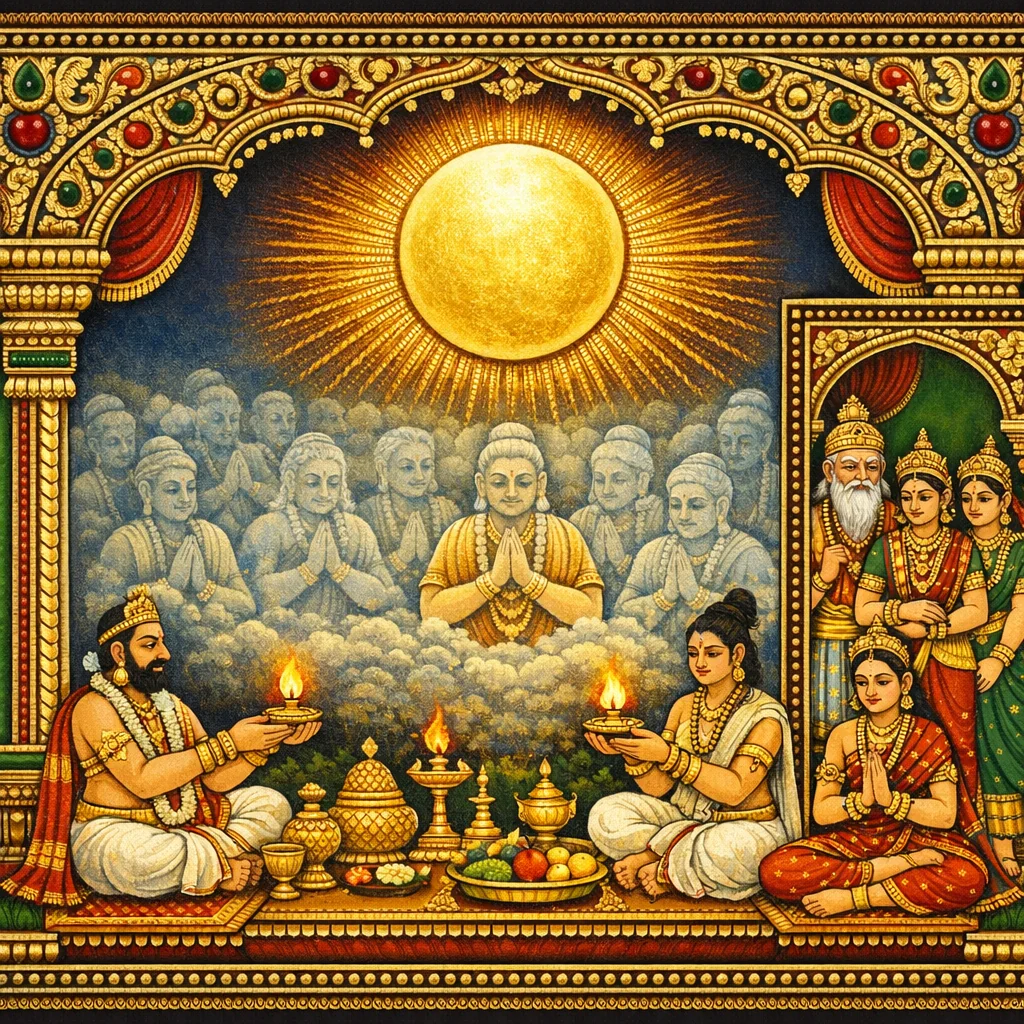
Adhyaya 10
Pitṛgaṇa-Vibhāga (Classification of the Pitṛs) and the Śrāddha–Soma Nourishment Cycle
This Adhyāya, taught by Bṛhaspati, lists the Pitṛgaṇas revered in Svarga and classifies them as mūrta (embodied) and amūrta (unembodied), promising their lokas, modes of manifestation (visarga), and genealogical ties (daughters and grandsons). Saṃtānaka-lokas are named as the station of the radiant amūrta Pitṛs—sons of Prajāpati—linked with Virāj and thus called Vairāja. It then sets forth a ritual-cosmic cycle: śrāddha offerings nourish the Pitṛs; nourished Pitṛs strengthen Soma; and Soma, strengthened, revitalizes the lokas, showing how human rites sustain cosmic vitality. The narrative turns to Menā, a mind-born daughter connected with the Pitṛs, her bond with Himavat and mountain progeny such as Maināka and Krāñca, and the three daughters Aparṇā, Ekaparṇā, and Ekapāṭalā. Their tapas—living on a single leaf or a single pāṭalā, and fasting—culminates in Aparṇā being called Umā by her mother’s words, affirming tapas as a creative power that steadies the world as long as Earth endures.
Shlokas
Verse 1
एति श्रीब्रह्माण्डे महापुराणे वायुप्रोक्ते मध्यभागे तृतीय उपोद्धातपादे पितृकल्पो नाम नवमो ऽध्यायः // ९// बृहस्पतिरुवाच सप्तैते जयतां श्रेष्ठाः स्वर्गे पितृगणाः स्मृताः / चत्वारो मुर्त्तिमन्तश्च त्रयस्तेषाममूर्त्तयः
Thus, in the holy Brahmāṇḍa Mahāpurāṇa, spoken by Vāyu, in the middle section, within the third Upoddhāta-pāda, is the ninth chapter called “Pitṛkalpa.” Bṛhaspati said: In heaven these seven hosts of the Pitṛs are remembered as the foremost among the victorious; four are embodied, and three are without form.
Verse 2
तेषां लोकान्विसर्गं च कीर्त्तयिष्ये निबोधत / यावै दुहितरस्तेषां दौहित्राश्चेव ये स्मृताः
I shall proclaim the emanation and spread of their worlds—listen well: their daughters in full number, and the grandsons through those daughters, as remembered in the Smṛti.
Verse 3
लोकाः संतानका नाम यत्र तिष्ठन्ति भास्वराः / अमूर्त्तयः पितृगणास्ते वै पुत्राः प्रजापतेः
There are worlds called Saṃtānaka, where the radiant, formless hosts of the Pitṛs abide; they are indeed the sons of Prajāpati.
Verse 4
विराजस्य द्विजश्रेष्ठा वैराजा इति विश्रुताः / एते वै पितरस्तात योगानां योगवर्धनाः
O best of the twice-born, those of Virāj are famed as the Vairājas. My son, they are the Pitṛs, increasers and nourishers of the powers of yoga.
Verse 5
अप्याययन्ति ये नित्यं योगायोगबलेन तु / श्राद्धैराप्यायितास्ते वै सोममाप्याययन्ति च
Those who ever bestow fullness by the power of yoga and non-yoga—when satisfied by the śrāddha rites, they in turn make Soma himself full and nourished.
Verse 6
आप्यायितस्ततः सोमो लोकानाप्याययत्युत / एतेषां मानसी कन्या मेना नाम महागिरेः
Then Soma, thus nourished, nourishes the worlds as well. Among them is a mind-born maiden named Menā, the daughter of the great mountain Mahāgiri.
Verse 7
पत्नी हिमवतः पुत्रो यस्या मैनाक उच्यते / पर्वतप्रवरः सो ऽथ क्रैञ्चश्चास्य गिरेः सुतः
The son born of Himavat’s queen, famed as Maināka, was foremost among mountains; and that very mountain had a son named Kraiñca as well.
Verse 8
तिस्रः कन्यास्तु मेनायां जनयामास शैलाराट् / अपर्णामेकपर्णां च तृतीयामेकपाटलाम्
In Menā, the lord of mountains begot three daughters—Aparṇā, Ekaparṇā, and the third, Ekapāṭalā.
Verse 9
न्यग्रोधमे कपर्णा तु पाठलं त्वेकपाटला / आशिते द्वे अपर्णा तु ह्यनिकेता तपो ऽचरत्
Ekaparṇā lived on the nyagrodha; Ekapāṭalā on the pāṭala blossom. But Aparṇā renounced both, and, without shelter, performed austerities.
Verse 10
शतं वर्षसहस्राणां दुश्चरं देवदानवैः / आहारमेकपर्णेन ह्येकपर्णा समाचरत्
For a hundred thousand years—an austerity hard even for gods and dānavas—Ekaparṇā practiced penance, sustaining herself on but a single leaf.
Verse 11
पाटलेनैव चैकेन व्यदधादेकपाटला / पूर्णे वर्षसहस्रे द्वे चाहारं वै प्रजक्रतुः
Ekapāṭalā sustained herself on a single pāṭala flower alone; and when two thousand years were complete, the two of them renounced even food itself.
Verse 12
एका तत्र निराहारा तां माता प्रत्यभाषत / निषेधयन्ती सोमेति मातृस्रेहेन दुःखिता
There a maiden remained without food; then her mother spoke to her—grieved by maternal love, restraining her and calling, “O Some!”
Verse 13
सा तथोक्ता तदापर्णा देवी दुश्चरचारिणी / उमेति हि महाभागा त्रिषु लोकेषु विश्रुता
Thus addressed, the Goddess who practiced arduous austerity was then called “Aparṇā”; and that most fortunate one is renowned in the three worlds as “Umā” as well.
Verse 14
तथैव नाम्ना तेनासौ निरुक्तोक्तेन कर्मणा / एतत्तु त्रिकुमारीकं जगत्स्थावरजङ्ग मम्
In the same way, by that deed as explained in the Nirukta, that very name was established for her. This account of the “three maidens” is famed throughout the world, among all that is immobile and mobile.
Verse 15
एतासां तपसा सृष्टं यावद्भूमिर्द्धरिष्यति / तपःशरीरास्ताः सर्वास्थिस्रो योगबलान्विताः
What was brought forth by the austerity of these maidens will endure as long as the earth upholds it. All of them were embodied tapas—reduced to bone—yet endowed with the power of yoga.
Verse 16
सर्वास्ताः सुमहाभागाः सर्वाश्च स्थिरयौवनाः / सर्वाश्च ब्रह्मवादिन्यः सर्वाश्चैवोर्ध्वरेतसः
All of them were greatly blessed; all of them possessed steadfast youth. All were proclaimers of Brahman, and all were ūrdhva-retas—firmly established in continence and self-restraint.
Verse 17
उमा तासां वरिष्ठा च श्रेष्ठा च वरवर्णिनी / महायोगबलोपेता महादेवमुपस्थिता
Among them, Umā was the foremost and the best, radiant in beauty; endowed with the power of great Yoga, she stood in attendance upon Mahādeva.
Verse 18
दत्तकश्चोशान्स्तस्याः पुत्रो वै भृगुनन्दनः / असितस्यैकपर्णा तु पत्नी साध्वी पतिव्रता
Her son was Uśān (Śukra), beloved of the Bhṛgus, renowned as “Dattaka”; and Ekaparṇā, wife of Asita, was a virtuous, husband-devoted pativratā.
Verse 19
दत्ता हिमवता तस्मै योगाचार्याय धीमते / देवलं सुषुवे सा तु ब्रह्मिष्ठं ज्ञानसंयुता
Himavān gave her to that wise master of Yoga; and she, endowed with sacred knowledge, bore Devala, steadfast in Brahman.
Verse 20
या वै तासां कुमारीणां तृतीया चैकपाटला / पुत्रं शतशलाकस्य जैगीषव्यमुपस्थिता
Of those maidens, the third was Ekapāṭalā; she stood in attendance upon Jaigīṣavya, the son of Śataśalāka.
Verse 21
तस्यापि शङ्खलिशितौ स्मृतौ पुत्रावयोनिजौ / इत्येता वै महाभागाः कन्या हिमवतः शुभाः
He too had two sons remembered as womb-unborn: Śaṅkhali and Śita; thus were these auspicious, greatly blessed daughters of Himavān.
Verse 22
रुद्राणी सा तु प्रवरा स्वैर्गुणैरतिरिच्यते / अन्योन्यप्रीतमनसोरुमाशङ्करयोरथ
Rudrani was foremost, surpassing all by her own virtues. Then the hearts of Uma and Shankara were filled with mutual love.
Verse 23
श्लेषं संसक्तयोर्ज्ञात्वा शङ्कितः किल वृत्रहा / ताभ्यां मैथुनशक्ताभ्यामपत्योद्भवभीरुणा
Knowing their close embrace, Vṛtrahā (Indra) grew anxious indeed; for both were endowed with the power of union, and he feared the birth of offspring.
Verse 24
तयोः सकाशमिन्द्रेण प्रेषितो हव्यवाहनः / अनायो रतिविघ्नं च त्वमाचर हुताशन
Havyavāhana (Agni), sent by Indra, went to them. (Indra said:) “O Hutāśana, without delay, bring about an obstacle to their love-play.”
Verse 25
सर्वत्र गत एव त्वं न दोषो विद्यते तव / इत्येवमुक्ते तु तदा वह्निना च तथा कृतम्
“You go everywhere; no fault lies in you.” Thus addressed, Vahni (Agni) then did exactly so.
Verse 26
उमां देवः समुत्सृज्य शुक्रं भूमौ व्यसर्जयत् / ततो रुषितया सद्यः शप्तो ऽग्निरुमया तया
The Deva (Shankara) withdrew from Uma and cast his śukra upon the earth. Then Uma, angered, at once pronounced a curse upon Agni.
Verse 27
इदं चोक्तवती वह्निं रोषगद्गदया गिरा / यस्मान्नाववितृप्ताभ्यां रतिविघ्नं हुताशन
Then she spoke to Agni in a voice choked with wrath: “O Hutāśana, while we were still unsated, you brought an obstacle to our love’s union.”
Verse 28
कृतवानस्य कर्त्तव्यं तस्मात्त्वमसि दुर्मतिः / यदेवं विगतं गर्भं रौद्रं शुक्रं महाप्रभम्
You have done what was to be done; therefore you are of wicked mind—since that fierce, greatly radiant seed has slipped away from the womb.
Verse 29
गर्भे त्वं धारयस्वैवमेषा ते दण्डधारणा / स शापदोषाद्रुद्राण्या अन्तर्गर्भो हुताशनः
So bear it within the womb—this shall be your burden of punishment. By the fault of Rudrāṇī’s curse, Hutāśana came to carry a fetus within.
Verse 30
बहून्वर्षगणान्गर्भं धारयामास वै द्विज / स गङ्गामभिगम्याह श्रूयतां सरिदुत्तमे
O twice-born one, for many years he bore that fetus. Then he approached the Gaṅgā and said: “Hear me, O best of rivers.”
Verse 31
सुमहान्परिखेदो मे जायते गर्भधारणात् / मद्धितार्थ मथो गर्भमिमं धारय निम्नगे
From bearing this fetus, a very great weariness comes upon me. For my welfare, O Nimnagā, take and carry this womb-born seed.
Verse 32
मत्प्रसादाच्च तनयो वरदस्ते भविष्यति / तथेत्युक्त्वा तदा सा तु संप्रत्दृष्टा महानदी
By my grace, you shall have a son who grants boons. Saying “So be it,” she assented; then the Great River (Gaṅgā) was seen manifest before them.
Verse 33
तं गर्भं धारयामास दह्यमानेन चेतसा / सापि कृच्छ्रेण महता खिद्यमाना महानदी
With a mind as though aflame, she bore that embryo; and the Great River too, tormented by immense hardship, grew weary with pain.
Verse 34
प्रकृष्टं व्यसृजद्गर्भं दीप्यमान मिवानलम् / रुद्राग्निगङ्गातनयस्तत्र जातो ऽरुणप्रभः
She released that most excellent embryo, blazing like fire itself. There was born Aruṇaprabha, the son of Rudra, of Agni, and of Gaṅgā.
Verse 35
आदित्यशतसंकाशो महातेजाः प्रतापवान् / तस्मिञ्जाते महाभागे कुमारे जाह्नवीसुते
He shone like a hundred suns—mighty in radiance and valor. When that most fortunate prince, the son of Jāhnavī (Gaṅgā), was born,
Verse 36
विमानयानैराकाशं पतत्र्रिभिरिवावृतम् / देवदुन्दुभयो नेदुराकाशे मधुरस्वनाः
With the vimāna-cars, the sky seemed covered as with flocks of birds. In the heavens, the divine kettledrums resounded with sweet tones.
Verse 37
मुमुचुः पुष्पवर्षं च खेचराः सिद्धचारणाः / जगुर्गन्धर्वमुख्याश्च सर्वशस्तत्र तत्र ह
The sky-roaming Khecaras, Siddhas, and Cāraṇas released a rain of flowers; and the foremost Gandharvas sang everywhere, here and there.
Verse 38
यक्षा विद्याधराः सिद्धाः किन्नराश्चैव सर्वशः / महानागसहस्राणि प्रवराश्च पतत्र्रिणः
Yakshas, Vidyādharas, Siddhas, and Kinnaras gathered from every side; and thousands of great Nāgas and noble birds as well.
Verse 39
उपतस्थुर्महाभागमाग्नेयं शङ्करात्मजम् / प्रभावेण हतास्तेन दैत्यवानरराक्षसाः
They drew near to attend the greatly blessed Agneya, the son of Śaṅkara; by his very splendor the Daityas, Vānaras, and Rākṣasas had been slain.
Verse 40
स हि सप्तर्षिभार्याभिरारादेवाग्निसंभवः / अभिषेकप्रयाताभिर्दृष्टो वर्ज्य त्वरुन्धतीम्
That god born of Agni was seen from afar by the wives of the Seven Ṛṣis as they went forth for the rite of abhiṣeka—Arundhatī alone excepted.
Verse 41
ताभिः स बालार्कनिभो रौद्रः परिवृतः प्रभुः / स्निह्यमानाभिरत्यर्थं स्वकभिरिव मातृभिः
Encircled by them, the Lord shone like the young sun, majestic in his raudra aspect; and they cherished him with boundless affection, as though they were his own mothers.
Verse 42
युगपत्सर्वदेवीभिर्दिधित्सुर्जाह्नवीं सुतः / षण्मुखान्यसृजच्छ्रीमांस्तेनायं षण्मुखः स्मृतः
The son of Jāhnavī, wishing to be borne at once by all the Goddesses, created six radiant faces; therefore he is remembered as Ṣaṇmukha, the Six‑faced Lord.
Verse 43
तेन जातेन महाता देवानामसहिष्णवः / स्कन्दिता दानवगणास्तस्मात्स्कन्दः प्रतापवान्
By the birth of that Great One, the hosts of Dānavas—unable to endure the Devas—were driven back and scattered; hence he is famed as Skanda, mighty in splendor.
Verse 44
कृत्तिकाभिस्तु यस्मात्स वर्द्धितो हि पुरातनः / कार्त्तिकेय इति ख्यातस्तस्मादसुरसूदनः
Since that ancient Deity was nurtured by the Kṛttikās, he became renowned as Kārttikeya—the slayer of the Asuras.
Verse 45
जृंभतस्तस्य दैत्यारेर्ज्वाला मालाकुला तदा / मुखाद्विनिर्गता तस्य स्वशक्तिरपराजिता
As the foe of the Daityas yawned, a garland of flames surged forth; from his mouth emerged his own Śakti, unconquered and invincible.
Verse 46
क्रीडार्थं चैव स्कन्दस्य विष्णुना प्रभविष्णुना / गरुडादतिसृष्टौ हि पक्षिणौ द्वौ प्रभद्रकौ
For Skanda’s sport, Viṣṇu the all‑powerful brought forth two birds called Prabhadraka, surpassing even Garuḍa.
Verse 47
मयूरः कुक्कुटश्चैव पताका चैव वायुना / यस्य दत्ता सरस्वत्या महावीणा महास्वना
The peacock, the cock, and the banner bestowed by Vāyu; and the great Vīṇā of mighty resonance given by Sarasvatī—these are his.
Verse 48
अजः स्वयंभुवा दत्तो मेषो दत्तश्च शंभुना / मायाविहरणे विप्र गिरौ क्रैञ्चे निपातिते
Svayambhū bestowed the goat, and Śambhu bestowed the ram; O brahmin, in the sport of Māyā, upon Mount Krañca it was cast down.
Verse 49
तारके चासुरवरे समुदीर्णे निपातिते / सेंद्रोपेन्द्रैर्महाभागैर्देवैरग्निसुतः प्रभुः
When Tāraka, the foremost of the asuras, rose in tumult and was struck down, the blessed gods—together with Indra and Upendra—exalted the Lord, the son of Agni.
Verse 50
सेनापत्येन दैत्यारिरभिषिक्तः प्रतापवान् / देवसेनापतिस्त्वेष पठ्यते सुरनायकः
The mighty foe of the daityas was anointed as Commander of the host; he is recited as Devasenāpati, the leader of the suras.
Verse 51
देवारिस्कन्दनः स्कन्दः सर्वलोकेश्वरः प्रभुः / प्रमथैर्विधैर्देवस्तथा भूतगणैरपि
Skanda, who crushes the foes of the gods, is the Lord, Sovereign of all worlds; he is attended by many kinds of pramathas and also by hosts of bhūtas.
Verse 52
मातृभिर्विविधाभिश्च विनायकगणैस्ततः / लोकाः सोमपदा नाम मरीचेर्यत्र वै सुताः
Thereafter are the worlds called Somapadā, together with the many Mothers and the hosts of Vināyaka; there indeed dwell the sons of Marīci.
Verse 53
तत्र ते दिवि वर्त्तन्ते देवास्तान्पूजयन्त्युत / श्रुता बर्हिषदो नाम पितरः सोमपास्तु ते
There they abide in heaven, and the gods too worship them. The Pitṛs renowned as Barhiṣada are indeed drinkers of Soma.
Verse 54
एतेषां मानसी कन्या अच्छोदा नाम निम्नगा / अच्छौदं नाम तद्दिव्यं सरो यस्मात्समुत्थिता
Their mind-born daughter is the river called Acchodā; and the divine lake from which she arose is named Acchauda.
Verse 55
तथा न दृष्टपूर्वास्तु वितरस्ते कदाचन / संभूता मानसी तेषां पितॄन्स्वान्नाभिजानती
Likewise, those Vitar Pitṛs had never beheld her before; and she, born of the mind, did not recognize her own ancestral fathers.
Verse 56
सा त्वन्यं पितरं वव्रे तानतिक्रम्य वै पितॄन् / अमावसुमिति ख्यातमैलपुत्रं नभश्चरम्
Passing beyond those Pitṛs, she chose another father—Amāvasu famed by name, the son of Aila, who moves through the sky.
Verse 57
अद्रिकाप्सरसा युक्तं विमानाधिष्ठितं दिवि / सा तेन व्यभिचारेण गगने नाप्रजारिणी
Joined with the apsaras Adrikā, she sat aloft in heaven upon a vimāna; yet by that act of infidelity, even in the sky she did not become a mother.
Verse 58
पितरं प्रार्थयित्वान्यं योगभ्रष्टा पपात ह / त्रीण्यवश्यद्विमानानि पतन्ती सा दिवश्च्युता
Having appealed to another Pitṛ, she, fallen from her yoga, plunged down; cast from heaven, as she fell she brought three vimānas under her sway.
Verse 59
त्रसरेणुप्रमाणानि तेषु चावस्थितान्पितॄन् / सुसूक्ष्मानपरिव्यक्तानग्नीनग्निष्विवाहितान्
Within them dwelt the Pitṛs, no larger than a trasareṇu—exceedingly subtle and unmanifest, like fire borne hidden within fire.
Verse 60
त्रायध्वमित्युवाचार्ता पतती चाप्यवाक्शिराः / तैरुका सा तु मा भैषी रित्यतो ऽधिष्ठिताभवत्
Falling headlong, distressed, she cried, “Save me!” They replied, “Fear not,” and from that moment she was upheld.
Verse 61
ततः प्रसादयत्सा वै सीदन्ती त्वनया गिरा / ऊचुस्ते पितरः कन्यां भ्रष्टैश्वर्यां व्यतिक्रमात्
Then, though sinking in weakness, she sought to win their grace with those words; and the Pitṛs said to the maiden: “By your transgression, your former glory has fallen away.”
Verse 62
भ्रष्टैश्वर्यां स्वदोषेण पतसि त्वं शुचिस्मिते / यैराचरन्ति कर्मणि शरीरैरिह देवताः
O pure-smiling one, by your own fault you fall, bereft of lordly fortune; for with such bodies the Devas here perform their sacred acts (karma).
Verse 63
तैरेव तत्कर्मभलं प्राप्नुवन्ति सदा स्म ह / सद्यः फलन्ति कर्माणि देवत्वे प्रेत्य मानुषे
By those very bodies they ever attain the fruit of that karma; deeds bear fruit at once—whether in godhood, or after death in human birth.
Verse 64
तस्मात्स्वतपसः पुत्रि प्रेत्य संप्राप्स्यसे फलम् / इत्युक्तया तु पितरः पुनस्ते तु प्रसादिताः
Therefore, O daughter of your own austerity, after death you shall attain the fruit; at these words your Pitṛs (ancestral fathers) were once more gracious to you.
Verse 65
ध्यात्वा प्रसादं ते चक्रुस्तस्यास्तदनुकंपया / अवश्यं भाविनं दृष्ट्वा ह्यर्थमूचुस्तदा तु ताम्
Pitying her, they bestowed their grace; seeing what was bound to come to pass, they then spoke to her and declared its meaning.
Verse 66
सोमपाः पितरः कन्यां रज्ञो ऽस्यैव त्वमावसोः / उत्पन्नस्य पृथिव्यां तु मानुषेषु महात्मनः
The Soma-drinking Pitṛs said: “O maiden, you shall belong to this very king, Āvasu—the great-souled one who will be born upon the earth among humankind.”
Verse 67
कन्या भूत्वा त्विमांल्लोकान्पुनः प्राप्स्यसि भामिनि / अष्टाविंशे भवित्री त्वं द्वापरे मत्स्ययोनिजा
O Bhāminī, becoming a maiden, you shall again attain these worlds. In the twenty-eighth Dvāpara age, you shall be born of a fish-born lineage (matsya-yoni).
Verse 68
अस्यैव राज्ञो दुहिता ह्यद्रिकायाममावसोः / पराशरस्य दायादमृषिं त्वं जनयिष्यसि
You shall be the daughter of this very king; on the bank of the Adrīkā, on the day of Amāvasyā (the dark moon), you shall bear a ṛṣi, the heir of Parāśara.
Verse 69
स वेदमेकं ब्रह्मर्षि श्चतुर्द्धा विभजिष्यति / महाभिषस्य पुत्रौ द्वौ शन्तनोः कीर्त्तिवर्द्धनौ
That brahmarṣi shall divide the one Veda into four. The two sons of Mahābhiṣa—Śantanu—shall be increasers of renown.
Verse 70
विचित्रवीर्यं धर्मज्ञं त्वमेवोत्पादयिष्यसि / चित्राङ्गदं च राजानं सर्वसत्त्वबलान्वितम्
You yourself shall bring forth Vicitravīrya, knower of dharma, and also King Citrāṅgada, endowed with the strength of all beings.
Verse 71
एतानुत्पादयित्वाथ पुनर्लोकानवा प्स्यसि / व्यभिचारात्पितॄणां त्वं प्राप्स्यसे जन्म कुत्सितम्
Having brought these forth, you shall again attain the worlds; yet, through transgression against the Pitṛs (ancestral spirits), you shall also obtain a censured birth.
Verse 72
तस्यैव राज्ञस्त्वं कन्या अद्रिकायां भविष्यसि / कन्या भूत्वा ततश्च त्वमिमांल्लोकानवाप्स्यसि
You shall become the daughter of that very king and be born in Adrikā. Having become a maiden, you shall then attain these worlds.
Verse 73
एवमुकत्वा तु दाशेयी जाता सत्यवती तु सा / अद्रिकायाः सुता मत्स्या सुता जाता ह्यमावसोः
Thus spoken, the fisher-born woman came forth as Satyavatī. She was Adrikā’s daughter, called Matsyā, born on the night of amāvasyā.
Verse 74
अदिकामत्स्यसंभूता गङ्गायमुनसंगमे / तस्या राज्ञो हि सा कन्या राज्ञो वीर्येण चैव हि
Born of Adrikā and Matsyā, she was at the confluence of the Gaṅgā and Yamunā. She was indeed that king’s daughter, formed by the king’s own potency.
Verse 77
विरजानाम ते लोका दिवि रोचन्ति ते गणाः / अग्निष्वात्ताः स्मृतास्तत्र पितरो भास्करप्रभाः पुलहस्य प्रजापतेः / एतेषां मानसी कन्या पीवरी नाम विश्रुता
The worlds called Virajā shine in heaven, and their hosts gleam there. There are remembered the Pitṛs known as Agniṣvātta, radiant as the sun, belonging to Prajāpati Pulaha. Their mind-born daughter is famed by the name Pīvarī.
Verse 78
योगिनी योगपत्नी च योगमाता तथैव च / भविता द्वापरं प्राप्य अष्टाविंशतिमेव तु
She shall be a yoginī, the yogin’s wife, and also the Mother of Yoga; and upon reaching the Dvāpara age, she shall be the twenty-eighth.
Verse 79
श्रीमान्व्यासो महायोगी योगस्तस्मिन्द्विजोत्तमाः / व्यासादरण्यां संभूतो विधूम इव पावकः
The illustrious Vyāsa was a great yogin—O best of the twice-born—within him Yoga stood established. From Vyāsa, in the forest, he arose like fire without smoke.
Verse 80
पराशरकुलोद्भूतः शुको नाम महातपाः / स तस्यां पितृकन्यायां पीवर्यां जनयद्विभुः
From the lineage of Parāśara arose the great ascetic named Śuka. That mighty Lord caused him to be born in Pīvarī, the daughter of the Pitṛs.
Verse 81
पुत्रान्पञ्च योगचर्यापरिबुर्णान्परिश्रुतान् / कृष्णा गौरं प्रभुं शंभुं तथा भूरिश्रुतं च वै
He had five sons, perfected in the discipline of Yoga and widely renowned—Kṛṣṇa, Gaura, Prabhu, Śambhu, and Bhūriśruta.
Verse 82
कन्यां कीर्तिमतीं चैव योगिनीं योगमातरम् / ब्रह्मदत्तस्य चननी महिषी त्वणुहस्य सा
He also had a daughter, Kīrtimatī, a yoginī revered as the ‘Mother of Yoga’. She became the mother of Brahmadatta and the queen-consort of Aṇuha.
Verse 83
आदित्यकिरणोपेतमपुनर्मार्गमास्थितः / सर्वव्यापी विनिर्मुक्तो भविष्यति महामुनिः
Clad in the rays of Āditya, he took his stand upon the path of no return. That great sage shall become all-pervading and wholly liberated.
Verse 84
त्रय एते गाणाः प्रोक्ताश्चतुः शेषान्निबोधत / तान्वक्ष्यामि द्विजश्रेष्ठाः प्रभामूर्त्तिमतो गणान्
These three hosts have been declared; now hear of the four that remain. O best of the twice-born, I shall speak of the hosts whose very form is radiance.
Verse 85
उत्पन्नास्तु स्वधायां ते काव्या ह्यग्नेः कवेः सुताः / पितरो देवलोकेषु ज्योतिर्भासिषु भास्वराः
They are the Kāvya, born of Svadhā, the sons of Agni the seer-poet. The Pitṛs in the worlds of the gods shine forth amid radiant lights.
Verse 86
सर्वकामसमृद्धेषु द्विजास्तान्भावयन्त्युत / एतेषां मानसी कन्या योगोत्पत्तिरितिश्रुता
In realms abounding in every desire, the twice-born meditate upon them in reverence. Their mind-born daughter is famed in tradition as ‘Yogotpatti’.
Verse 87
दत्ता सनत्कुमारेण शुक्रस्य महिषी तु या / एकशृङ्गेति विख्याता भृगूणां कीर्तिवर्द्धिनी
She whom Sanatkumāra bestowed as Śukra’s queen is famed as ‘Ekaśṛṅgī’, the increaser of the Bhṛgus’ renown.
Verse 88
मरीचि गर्भास्ते लोकाः समावृत्य दिवि स्थिताः / एते ह्यङ्गिरसः पुत्राः साध्यैः संवर्द्धिताः पुरा
Those worlds, conceived in Marīci’s womb, spread forth and abide in the heavens. They are the sons of Aṅgiras, once nurtured long ago by the Sādhyas.
Verse 89
उपहूताः स्मृतास्ते वै पितरो भास्वरा दिवि / तान्क्षत्रियगणाः सप्त भावयन्ति फलार्थिनः
Those Pitṛs, radiant in heaven, are remembered as “Upahūta.” Seeking sacred fruits, seven bands of Kṣatriyas revere and worship them with devotion.
Verse 90
एतेषां मानसी कन्या यशोदा नाम विश्रुता / मता या जननी देवी खट्वाङ्गस्य महात्मनः
They had a mind-born daughter, famed as Yaśodā; she is regarded as the Goddess-mother of the great-souled Khaṭvāṅga.
Verse 91
यज्ञे यस्य पुरा गीता गाथागीतैर्महर्षिभिः / अग्नेर्जन्म तदा दृष्ट्वा शाण्डिल्यस्य महात्मनः
In his sacrifice, long ago, the great Ṛṣis sang hymns in gāthā-songs; then the great-souled Śāṇḍilya beheld the birth of Agni.
Verse 92
यजमानं दिलीपं ये पश्यन्त्यत्र समाहिताः / सत्यव्रतं महात्मानं ते ऽपि स्वर्गजितो नराः
Whoever here, with mind composed, beholds Dilīpa the sacrificer—great-souled and vowed to truth—those people too win the realms of heaven.
Verse 93
आज्यपा नाम पितरः कर्दमस्य प्रजा पतेः / समुत्पन्नस्य पुलहादुत्पन्नास्तस्य ते सुताः
The Pitṛs known as Ājyapā belong to Prajāpati Kardama; born from Pulaha, they are spoken of as his sons.
Verse 94
लकिषु तेषु वैवर्ताः कामगोषु विहङ्गमाः / एतान्वैश्यगणाः श्राद्धे भाव यन्ति फलार्थिनः
Among those Lakṣis are the Vaivartas, and among the Kāmagōṣus the Vihangamas; the Vaiśyas, seeking the fruit of merit, devoutly contemplate them in the Śrāddha rite.
Verse 95
एतेषां मानसी कन्या विरजा नाम विश्रुता / ययातेर्जननी साध्वी पत्नी सा नहुषस्य च
Their mind-born maiden is famed as Virajā; she is a virtuous lady, the mother of Yayāti and also the wife of Nahuṣa.
Verse 96
सुकाला नाम पितरो वसिष्ठस्य महात्मनः / हैरण्यगर्भस्य सुताः शूद्रास्तां भावयन्त्युत
The Pitṛs of the great-souled Vasiṣṭha are called Sukālā; and even the Śūdras, sons of Hiraṇyagarbha, contemplate her with reverent devotion.
Verse 97
मानसा नाम ते लोका वर्तन्ते यत्र ते दिवि / एतेषां मानसी कन्या नर्मदा सरितां वरा
In heaven the realms where they abide are called Mānasā; their mind-born daughter is Narmadā, the finest of rivers.
Verse 98
सा भावयति भूतानि दक्षिणापथगामिनी / जननी सात्रसद्दस्योः पुरुकुत्सपरिग्रहः
She (Narmadā), flowing along the southern path, nourishes all beings; she is the mother of Sātrasaddasyu and the consort of Purukutsa.
Verse 99
एतेषामभ्युपगमान्मनुर्मन्वन्तरेश्वरः / मन्वन्तरादौ श्राद्धानि प्रवर्तयति सर्वशः
Accepting these ordinances, Manu, the lord of the Manvantara, at the very beginning of the Manvantara sets the Śrāddha rites in motion everywhere.
Verse 100
पितॄणामानुपूर्व्येण सर्वेषां द्विजसत्तमाः / तस्मादेतत्स्वधर्मेण देयं श्राद्धं च श्रद्धया
O best of the twice-born! In the due succession of all the ancestors; therefore, according to one’s own dharma, Śrāddha should be offered with reverent faith.
Verse 101
सर्वेषां राजतैः पात्रैरपि वा रजतान्वितैः / दत्तं स्वधां पुरोधाय श्राद्धं प्रीणाति वै पितॄन्
For all, a Śrāddha offered in silver vessels, or vessels adorned with silver, with the utterance ‘svadhā’ placed foremost, truly delights the Pitṛs.
Verse 102
सौम्यायने वाग्रयणे ह्यश्वमेधं तदप्नुयात् / सोमश्चाप्यायनं कृत्वा ह्यगनेर्वेवस्वतस्य च
At the Saumyāyana or the Vāgrayaṇa observance, one attains the merit of an Aśvamedha; and by performing āpyāyana, one also nourishes Soma and Agni Vaivasvata.
Verse 103
पितॄन्प्रीणाति यो वंश्यः पितरः प्रीणयन्ति तम् / पितरः पुष्टिकामस्य प्रजाकामस्य वा पुनः
The descendant who gladdens the Pitṛs is gladdened by the Pitṛs in return—especially one who seeks nourishment and prosperity, or again one who longs for progeny.
Verse 104
पुष्टिं प्रजास्तथा स्वर्गं प्रयच्छन्ति न संशयः / देवकार्यादपि सदा पितृकार्यं विशिष्यते
They bestow nourishment, progeny, and heaven—without doubt. Even above rites for the gods, the rite for the Pitṛs is ever held superior.
Verse 105
देवताभ्यः पितॄणां हि पूर्वमाप्यायनं स्मृतम् / न हि योग गतिः सूक्ष्मा पितॄणां न पितृक्षयः
It is remembered that the Pitṛs are to be nourished and satisfied before the gods. The course of the Pitṛs is subtle, and there is no wasting away of the Pitṛs.
Verse 106
तपसा विप्रसिद्धेन दृश्यते मासचक्षुषा / इत्येते पितरश्चैव लोका दुहितरश्च वै
By the austerity famed among the sages, this is beheld with the ‘month-eye’: these are the Pitṛs indeed, and these worlds are truly their daughters.
Verse 107
दौहित्रा यजमानाश्च प्रोक्ता ये भावयन्ति यान् / चत्वारो मूर्तिमन्तस्तु त्रयस्तेषाममूर्तयः
The dauhitras (daughter’s sons) and the yajamānas are spoken of as those who sustain and strengthen. Of them, four are embodied, while three are without form.
Verse 108
तेभ्यः श्राद्धानि सत्कृत्य देवाः कुर्वन्ति यत्नतः / भक्त्या प्राञ्जलयः सर्वेसेंद्रास्तद्गतमानसाः
Honoring them, even the gods perform the śrāddha rites with earnest care. All the gods, with Indra, stand with folded hands in devotion, their minds fixed upon them.
Verse 109
विश्वे च सिकताश्चैव पृश्निजाः शृङ्गिणस्तथा / कृष्णाः श्वेतांबुजाश्चैव विधिव त्पूजयन्त्युत
The Viśve, the Sikatās, the Pṛśnijas and the Śṛṅgins; likewise the Kṛṣṇas and the Śvetāmbujas worship them in due ritual order.
Verse 110
प्रशस्ता वातरसना दिवाकृत्यास्तथैव च / मेघाश्च मरुतश्चैव ब्रह्माद्याश्च दिवौकसः
The praised ones—Vātarasanā and Divākṛtyā as well—together with the clouds, the Maruts, and Brahmā and the other dwellers of heaven (are there).
Verse 111
अत्रिभृग्वङ्गिराद्याश्च ऋषयः सर्व एव ते / यक्षा नागाः सुपर्णाश्च किन्नरा राक्षसैः सह
All the Ṛṣis—Atri, Bhṛgu, Aṅgiras and the rest—along with Yakṣas, Nāgas, Suparṇas, Kinnaras, and even the Rākṣasas (are there).
Verse 112
पितॄंस्ते ऽपूजयन्सर्वे नित्यमेव फलार्थिनः / एवमेते महात्मानः श्राद्धे सत्कृत्य पूजिताः
Seeking the fruit of merit, they all continually worshipped the Pitṛs; thus, in the śrāddha rite, those great souls are honored and duly revered.
Verse 113
सर्वान्कामान्प्रयच्छन्ति शतशो ऽथ सहस्रशः / हित्वा त्रैलोक्यसंसारं जरामृत्युमयं तथा
They bestow all desires, by the hundreds and by the thousands; and they lead one to forsake the saṃsāra of the three worlds, filled with old age and death.
Verse 114
मोक्षं योगमथैश्वर्यं सूक्ष्मदेहमदेहिनाम् / कृत्स्नं वैराग्यमानन्त्यं प्रयच्छन्ति पितामहाः
The Pitāmahas (venerable Ancestors) bestow upon embodied beings: moksha, yoga, divine lordship, the subtle body, complete dispassion, and boundless infinitude.
Verse 115
एश्वर्यं विहितं योगमेश्वर्यं योग उच्यते / योगैश्वर्यमृते मोक्षः कथञ्चिन्नोपपद्यते
That discipline which is ordained with divine lordship is called yoga; without the lordly power of yoga, moksha cannot be attained in any way.
Verse 116
अपक्षस्येव गमनं गगने पक्षिणो यथा / वरिष्ठः सर्वधर्माणां मोक्षधर्मः सनातनः
As a bird without wings cannot move through the sky, so among all dharmas the eternal dharma of moksha is the highest.
Verse 117
पितॄणां हि प्रसादेन प्राप्यते स महात्मनाम् / मुक्तावैडूर्यवासांसि वाजिनागायुतानि च
By the grace of the Pitris, the great-souled attain that reward: garments adorned with pearls and vaidūrya, and also horses and elephants in ayutas (tens of thousands).
Verse 119
किङ्किणीजालनद्धानि सदा पुष्पफलानि च / विमानानां सहस्राणि युक्तान्यप्सरसां गणैः
There are thousands of vimānas, bound with nets of tinkling kinkiṇī bells, ever filled with flowers and fruits, and attended by companies of apsarās.
Verse 120
सर्वकामसमृद्धानि प्रयच्छन्ति पितामहाः / प्रजां पुष्टिं स्मृतिं मेधां राज्यमारोग्यमेव च / प्रीता नित्यं प्रयच्छन्ति मानुषाणां पितामहाः
When the Pitāmahas (ancestral Fathers) are pleased, they ever bestow upon humankind the fulfillment of all desires—offspring, nourishment, memory, intellect, sovereignty, and health.
Verse 1118
कोटिशश्चापि रत्नानिप्रयच्छन्ति पितामहाः / हंसबर्हिणयुक्तनि मुक्तावैढूर्यवन्ति च
The Pitāmahas bestow jewels by the crores—adorned with swan-feathers and peacock-plumes, and set with pearls and vaiḍūrya (cat’s-eye gems) as well.
Frequently Asked Questions
A Pitṛ-centered genealogy: amūrta Pitṛs are described as sons of Prajāpati (Vairājāḥ, linked to Virāj), and a downstream mythic lineage is introduced via Menā and Himavat, including their mountainous progeny and the three daughters Aparṇā/Ekaparṇā/Ekapāṭalā.
A ritual-cosmic supply chain: śrāddha offerings nourish the Pitṛs; nourished Pitṛs empower Soma; Soma then nourishes and revitalizes the lokas—presenting cosmic stability as dependent on ritual and ancestral mediation.
Through nirukti-style etymology: the mother’s prohibitive address (“u mā”—do not, dear) to the fasting ascetic is linked to Aparṇā’s identity, making ‘Umā’ a name grounded in tapas, maternal speech, and narrative causality.