Adhyaya 22
Kāla-cakra and the Motions of the Sun, Moon, Stars, and Grahas (Bhāgavata Jyotiṣa Framework)
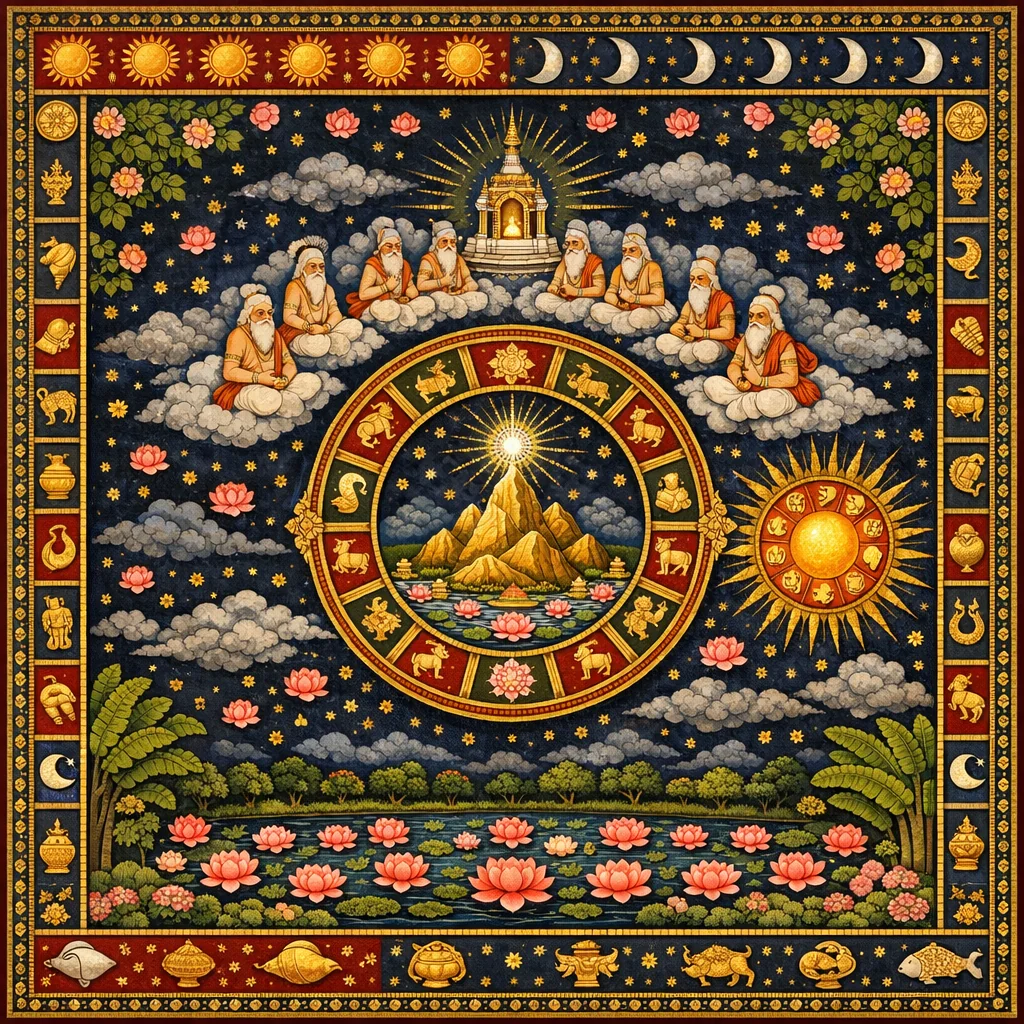
Continuing Skandha 5’s sacred survey of cosmic geography—after placing the regions around Sumeru and Dhruvaloka—Parīkṣit raises a logical doubt about the sun’s orientation: how can Sumeru and Dhruvaloka be said to lie both to the sun’s right and to its left? Śukadeva answers with the potter’s-wheel analogy, distinguishing the rotation of the zodiacal frame and the wheel of time (kāla-cakra) from the apparent motions of the “antlike” luminaries within it. The sun is then identified as an empowered manifestation of Nārāyaṇa, divided into twelve seasonal forms and twelve zodiacal names, establishing the year (saṁvatsara), months, fortnights, and ayanas. The narration ascends through the cosmic strata—moon, nakṣatras, Venus, Mercury, Mars, Jupiter, Saturn—describing their relative distances, characteristic movements, and auspicious or inauspicious effects, especially regarding rainfall and social well-being. It culminates with the Seven Sages (Saptarṣi-maṇḍala) circumambulating Dhruvaloka, preparing for further teachings on higher planetary arrangements and divine governance of time.
Shlokas
Verse 1
राजोवाच यदेतद्भगवत आदित्यस्य मेरुं ध्रुवं च प्रदक्षिणेन परिक्रामतो राशीनामभिमुखं प्रचलितं चाप्रदक्षिणं भगवतोपवर्णितममुष्य वयं कथमनुमिमीमहीति ॥ १ ॥
King Parīkṣit said: “My venerable lord, you have affirmed that the supremely powerful sun-god circumambulates Dhruvaloka, keeping Mount Meru and Dhruva on his right. Yet at the same time he faces the zodiacal signs and appears to keep Meru and Dhruvaloka on his left. How can we reasonably accept that he has Meru and Dhruvaloka simultaneously on both his right and his left?”
Verse 2
स होवाच यथा कुलालचक्रेण भ्रमता सह भ्रमतां तदाश्रयाणां पिपीलिकादीनां गतिरन्यैव प्रदेशान्तरेष्वप्युपलभ्यमानत्वादेवं नक्षत्रराशिभिरुपलक्षितेन कालचक्रेण ध्रुवं मेरुं च प्रदक्षिणेन परिधावता सह परिधावमानानां तदाश्रयाणां सूर्यादीनां ग्रहाणां गतिरन्यैव नक्षत्रान्तरे राश्यन्तरे चोपलभ्यमानत्वात् ॥ २ ॥
Śrī Śukadeva Gosvāmī answered clearly: Just as a potter’s wheel turns and the tiny ants upon it turn along with it, yet their motion seems different because they appear now in one place and now in another, so too the constellations and zodiac—like the wheel of time—move with Sumeru and Dhruvaloka on their right, and the sun and other planets move along with them. Still, the sun and planets are seen in different signs and constellations at different times; this shows that their motion differs from that of the zodiac and from the wheel of time itself.
Verse 3
स एष भगवानादिपुरुष एव साक्षान्नारायणो लोकानां स्वस्तय आत्मानं त्रयीमयं कर्मविशुद्धिनिमित्तं कविभिरपि च वेदेन विजिज्ञास्यमानो द्वादशधा विभज्य षट्सु वसन्तादिष्वृतुषु यथोपजोषमृतुगुणान् विदधाति ॥ ३ ॥
He is Bhagavān, the primeval Puruṣa—Nārāyaṇa Himself. For the welfare of all worlds and for the purification of karma, He manifests as the sun, embodying the essence of the three Vedas; then, dividing Himself into twelve, He arranges the six seasons beginning with spring, establishing their qualities such as heat, cold, and the rest.
Verse 4
तमेतमिह पुरुषास्त्रय्या विद्यया वर्णाश्रमाचारानुपथा उच्चावचै: कर्मभिराम्नातैर्योगवितानैश्च श्रद्धया यजन्तोऽञ्जसा श्रेय: समधिगच्छन्ति ॥ ४ ॥
Following the knowledge of the three Vedas and the path of varṇa and āśrama, people worship with faith Nārāyaṇa, present as the sun-god—the Paramātmā—through Vedic rites of higher and lower order and through the disciplines of yoga; thus they easily attain the supreme good.
Verse 5
अथ स एष आत्मा लोकानां द्यावापृथिव्योरन्तरेण नभोवलयस्य कालचक्रगतो द्वादश मासान् भुङ्क्ते राशिसंज्ञान् संवत्सरावयवान्मास: पक्षद्वयं दिवा नक्तं चेति सपादर्क्षद्वयमुपदिशन्ति यावता षष्ठमंशं भुञ्जीत स वै ऋतुरित्युपदिश्यते संवत्सरावयव: ॥ ५ ॥
The sun-god—Nārāyaṇa/Viṣṇu, the soul of all worlds—abides in outer space between heaven and earth and, moving on the wheel of time, passes through twelve months. By contact with the twelve zodiacal signs He bears twelve names. The total of these twelve months is called a saṁvatsara, a year. By lunar reckoning, two fortnights—waxing and waning—make one month; for Pitṛloka that same span is a day and a night. By stellar reckoning, a month equals two and a quarter constellations. When the sun travels for two months, one-sixth of the year is completed—this is called an ṛtu, a season; thus the seasons are limbs of the year.
Verse 6
अथ च यावतार्धेन नभोवीथ्यां प्रचरति तं कालमयनमाचक्षते ॥ ६ ॥
The time the sun takes to traverse half of its course along the celestial path is called an ayana—its northward or southward movement.
Verse 7
अथ च यावन्नभोमण्डलं सह द्यावापृथिव्योर्मण्डलाभ्यां कार्त्स्न्येन स ह भुञ्जीत तं कालं संवत्सरं परिवत्सरमिडावत्सरमनुवत्सरं वत्सरमिति भानोर्मान्द्यशैघ्र्यसमगतिभि: समामनन्ति ॥ ७ ॥
The sun-god has three speeds—slow, swift, and moderate. The time he takes to complete a full circuit of the spheres of heaven, earth, and space at these three rates is spoken of by the learned under five names: Saṁvatsara, Parivatsara, Iḍāvatsara, Anuvatsara, and Vatsara.
Verse 8
एवं चन्द्रमा अर्कगभस्तिभ्य उपरिष्टाल्लक्षयोजनत उपलभ्यमानोऽर्कस्य संवत्सरभुक्तिं पक्षाभ्यां मासभुक्तिं सपादर्क्षाभ्यां दिनेनैव पक्षभुक्तिमग्रचारी द्रुततरगमनो भुङ्क्ते ॥ ८ ॥
One hundred thousand yojanas above the sun’s rays is the moon. Moving swifter than the sun, it traverses in two lunar fortnights what the sun covers in a year; in two and a quarter days what the sun covers in a month; and in a single day what the sun covers in a fortnight.
Verse 9
अथ चापूर्यमाणाभिश्च कलाभिरमराणां क्षीयमाणाभिश्च कलाभि: पितृणामहोरात्राणि पूर्वपक्षापरपक्षाभ्यां वितन्वान: सर्वजीवनिवहप्राणो जीवश्चैकमेकं नक्षत्रं त्रिंशता मुहूर्तैर्भुङ्क्ते ॥ ९ ॥
As the moon waxes, its luminous portions increase day by day, making day for the devas and night for the pitṛs; as it wanes, it makes night for the devas and day for the pitṛs. Thus it passes each constellation in thirty muhūrtas (a full day). Pouring forth nectarean coolness that nourishes the grains, the moon-god is deemed the life of all beings and is therefore called Jīva.
Verse 10
य एष षोडशकल: पुरुषो भगवान्मनोमयोऽन्नमयोऽमृतमयो देवपितृमनुष्यभूतपशुपक्षिसरीसृपवीरुधां प्राणाप्यायनशीलत्वात्सर्वमय इति वर्णयन्ति ॥ १० ॥
The moon, complete with sixteen phases, embodies the influence of Bhagavān, the Supreme Personality of Godhead. As the presiding deity of the mind it is called Manomaya; as the giver of strength to herbs and plants, Annamaya; and as the source of life for all beings, Amṛtamaya. It delights devas, pitṛs, humans, animals, birds, reptiles, trees and plants; thus, pervading all, it is also called Sarvamaya.
Verse 11
तत उपरिष्टात्द्वि्लक्षयोजनतो नक्षत्राणि मेरुं दक्षिणेनैव कालायन ईश्वरयोजितानि सहाभिजिताष्टाविंशति: ॥ ११ ॥
Two hundred thousand yojanas above the moon are the stars (nakṣatras). By the supreme will of the Lord, they are fixed to the wheel of time and revolve with Mount Sumeru on their right, moving differently from the sun. There are twenty-eight principal stars, headed by Abhijit.
Verse 12
तत उपरिष्टादुशना द्विलक्षयोजनत उपलभ्यते पुरत: पश्चात्सहैव वार्कस्य शैघ्र्यमान्द्यसाम्याभिर्गतिभिरर्कवच्चरति लोकानां नित्यदानुकूल एव प्रायेण वर्षयंश्चारेणानुमीयते स वृष्टिविष्टम्भग्रहोपशमन: ॥ १२ ॥
About two hundred thousand yojanas above that constellation group is Venus (Uśanā). It moves almost in step with the sun—sometimes behind it, sometimes before it, and sometimes alongside it—showing swift, slow, and moderate motions. Venus pacifies the influence of planets that obstruct rainfall; thus its favorable course generally brings rain and is accepted by the learned as highly auspicious for all beings.
Verse 13
उशनसा बुधो व्याख्यातस्तत उपरिष्टाद्विलक्षयोजनतो बुध: सोमसुत उपलभ्यमान: प्रायेण शुभकृद्यदार्काद् व्यतिरिच्येत तदातिवाताभ्रप्रायानावृष्ट्यादिभयमाशंसते ॥ १३ ॥
Mercury, the son of the Moon, is said to resemble Venus: at times it moves behind the Sun, at times before it, and at times along with it. Situated sixteen lakhs of yojanas above Venus, it is generally auspicious for the beings of the universe; yet when it does not course together with the Sun, it foretells cyclones, dust, irregular rains, and waterless clouds, bringing fearful conditions through scant or excessive rainfall.
Verse 14
अत ऊर्ध्वमङ्गारकोऽपि योजनलक्षद्वितय उपलभ्यमानस्त्रिभिस्त्रिभि: पक्षैरेकैकशो राशीन्द्वादशानुभुङ्क्ते यदि न वक्रेणाभिवर्तते प्रायेणाशुभग्रहोऽघशंस: ॥ १४ ॥
Above it is Mars (Aṅgāraka), situated two lakhs of yojanas higher than Mercury. If it does not turn in a curved (retrograde) course, it passes through the twelve zodiacal signs one after another, spending three fortnights in each; yet it is generally an inauspicious planet, foretelling adversity, especially regarding rainfall and related influences.
Verse 15
तत उपरिष्टाद्विलक्षयोजनान्तरगता भगवान् बृहस्पतिरेकैकस्मिन् राशौ परिवत्सरं परिवत्सरं चरति यदि न वक्र: स्यात्प्रायेणानुकूलो ब्राह्मणकुलस्य ॥ १५ ॥
Above that, at an interval of sixteen lakhs of yojanas, is the venerable planet Jupiter, Bṛhaspati. It traverses each zodiacal sign over the span of one parivatsara; when its course is not curved, Jupiter is generally favorable to the brāhmaṇa communities of the universe, fostering dharma and sacred learning.
Verse 16
तत उपरिष्टाद्योजनलक्षद्वयात्प्रतीयमान: शनैश्चर एकैकस्मिन् राशौ त्रिंशन्मासान् विलम्बमान: सर्वानेवानुपर्येति तावद्भिरनुवत्सरै: प्रायेण हि सर्वेषामशान्तिकर: ॥ १६ ॥
Above that (above Jupiter), at a distance of two lakhs of yojanas, is Saturn, Śanaiścara. Moving slowly, it lingers thirty months in each sign and thus completes the zodiac in thirty anuvatsaras; it is generally a source of unrest for all beings and is regarded as highly inauspicious for the condition of the world.
Verse 17
तत उत्तरस्मादृषय एकादशलक्षयोजनान्तर उपलभ्यन्ते य एव लोकानां शमनुभावयन्तो भगवतो विष्णोर्यत्परमं पदं प्रदक्षिणं प्रक्रमन्ति ॥ १७ ॥
To the north of that, at an interval of eleven lakhs of yojanas, dwell the seven saintly sages. Ever intent upon the welfare of the universe’s inhabitants, they continually perform pradakṣiṇā, circumambulating the supreme abode of Lord Viṣṇu known as Dhruvaloka, the polestar.
Frequently Asked Questions
Śukadeva distinguishes between two motions: (1) the rotation of the zodiacal/stellar framework bound to the wheel of time (kāla-cakra), and (2) the relative motion of the sun and other planets within that rotating framework. Like ants on a potter’s wheel, the luminaries appear in different positions even though the larger system is rotating. Thus statements about “left/right” reflect reference frames—zodiacal rotation versus planetary traversal—rather than a single fixed physical orientation.
The chapter identifies the sun-god as Nārāyaṇa/Viṣṇu in an empowered solar form who benefits all planets, purifies fruitive work, and manifests seasonal divisions. Because the sun regulates time, seasons, and ritual calendars, people following varṇāśrama worship the Supreme as present in the sun through Vedic rites (e.g., agnihotra) and yogic discipline—aiming ultimately at the highest goal of life, not merely material prosperity.
Kāla-cakra is the cosmic “wheel of time” by which the Supreme’s administration becomes measurable as cycles—months, fortnights, seasons, ayanas, and years. In this chapter it is the governing structure to which constellations are fixed and within which the sun and grahas move, producing predictable changes (seasonal qualities) and karmic/ritual timing for embodied beings.
The Bhāgavata presents grahas as instruments within divine governance affecting terrestrial conditions that sustain life and dharma. Their described “favorable/unfavorable” effects—often framed around rainfall—signal how cosmic timing correlates with prosperity or distress in human society. The point is not fatalism but recognition that material conditions operate under higher order (poṣaṇa) and that wise persons align life with dharma and devotion rather than mere prediction.