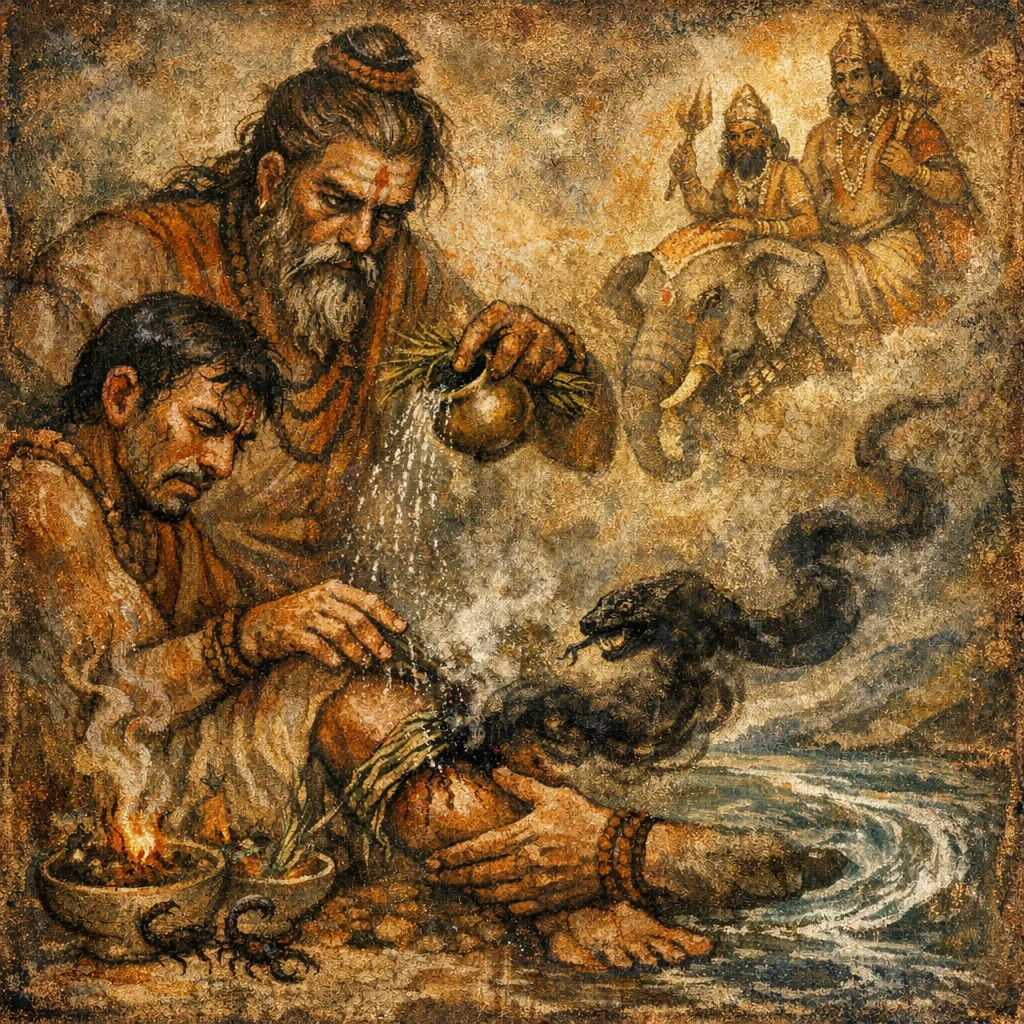
Sukta 4
Rishi: Atharvanic tradition (anti-venom corpus; specific r̥ṣi attribution varies by anukramaṇī).
Devata: Indra; the Gods collectively; Varuṇa (protective triad against serpent-force).
Chandas: Mixed/prose-like charm style with triadic formula (not a strict RV-style stanzaic meter)
Mantras
Mantra 1
सर्पविषदूरीकरणम्। इन्द्रस्य प्रथमो रथो देवानामपरो रथो वरुणस्य तृतीय इत्। अहीनामपमा रथ स्थाणुमारदथार्षत्
A driving-away of serpent-venom. Indra’s is the first chariot; the gods’ is the next chariot; Varuṇa’s is the third indeed: the chariot that drives away the serpents—toward a stump from afar then it rushed.
Mantra 2
दर्भः शोचिस्तरूणकमश्वस्य वारः परुषस्य वारः । रथस्य बन्धुरम्
Darbha-grass—bright, fresh; the horse’s tail-tuft, Paruṣa’s tail-tuft; the chariot’s binding-frame.
Mantra 3
अव श्वेत पदा जहि पूर्वेण चा परेण च । उदप्लुतमिव दार्वहीनामरसं विषं वारुग्रम्
Down, O White One—smite with thy foot, with forepart and with hinder part alike; as though cast up by water, make sapless the Dārvahīs’ venom, the fierce poison.
Mantra 4
अरंघुषो निमज्योन्मज्य पुनरब्रवीत्। उदप्लुतमिव दार्वहीनामरसं विषं वारुग्रम्
Araṅghuṣa, plunging down and rising up, spake once again: ‘As though cast up by water, make sapless the Dārvahīs’ venom, the fierce poison.’
Mantra 5
पैद्वो हन्ति कसर्णीलं पैद्वः श्वित्रमुतासितम्। पैद्वो रथर्व्याः शिरः सं बिभेद पृदाक्वाः
Paedva smites the Kasarṇīla; Paedva smites the white-spotted and the black. Paedva, the Speckled One, hath utterly cloven the head of Ratharvī.
Mantra 6
पैद्व प्रेहि प्रथमोऽनु त्वा वयमेमसि । अहीन् व्यऽस्यतात् पथो येन स्मा वयमेमसि
Go forth, O Paedva, first in the van; after thee we go. From the path whereon we fare, may he scatter the serpents far away.
Mantra 7
इदं पैद्वो अजायतेदमस्य परायणम्। इमान्यर्वतः पदाहिघ्न्यो वाजिनीवतः
This was Paedva born; this is his way of deliverance. These are the serpent-slaying tracks of the swift, the prize-winning steed.
Mantra 8
संयतं न वि ष्परद् व्यात्तं न सं यमत्। अस्मिन् क्षेत्रे द्वावही स्त्री च पुमांश्च तावुभावरसा
As one restrained, it sprang not forth; as one with jaws agape, it closed not on. In this our field are two serpents, female and male: let both of them be void of sap and strength.
Mantra 9
अरसास इहाहयो ये अन्ति ये च दूरके। घनेन हन्मि वृश्चिकमहिं दण्डेनागतम्
Sapless be the serpents here, whether they be near or whether far away. With the crushing club I smite the scorpion; with the staff the serpent that hath come upon us.
Mantra 10
अघाश्वस्येदं भेषजमुभयो स्वजस्य च । इन्द्रो मेऽहिमघायन्तमहिं पैद्वो अरन्धयत्
This is the remedy of Aghāśva, for both—yea, for our own folk as well. Indra for me subdued the serpent that wrought me harm; the Paidhva subdued the serpent.
Mantra 11
पैद्वस्य मन्महे वयं स्थिरस्य स्थिरधाम्नः। इमे पश्चा पृदाकवः प्रदीध्यत आसते
On Paidhva do we meditate, the steadfast, of steadfast seat. These spotted serpents, flashing bright, sit yonder in the rear—kept back.
Mantra 12
नष्टासवो नष्टविषा हता इन्द्रेण वज्रिणा । जघानेन्द्रो जघ्निमा वयम्
Their breath is perished, their poison perished: smitten are they by Indra, the wielder of the bolt. Indra hath slain; and we—yea, we have slain.
Mantra 13
हतास्तिरश्चिराजयो निपिष्टासः पृदाकवः । दर्विं करिक्रतं श्वित्रं दर्भेष्वसितं जहि
Smitten are the crosswise-creeping things; crushed down are the spotted ones. With the hand-wrought ladle smite the White one; among the darbhas slay the Black.
Mantra 14
कैरातिका कुमारिका सका खनति भेषजम्। हिरण्ययीभिरभ्रिभिर्गिरीणामुप सानुषु
The Kirāta woman, the maiden with her, digs up the remedy, with golden spades, upon the mountain-ridges.
Mantra 15
आयमगन् युवा भिषक् पृश्निहापराजितः । स वै स्वजस्य जम्भन उभयोर्वृश्चिकस्य च
Hither hath come the youthful leech, the Speckled-slayer, unconquered. Verily he is the crusher of the Svaja, and of both kinds of scorpion too.
Mantra 16
इन्द्रो मेऽहिमरन्धयन्मित्रश्च वरुणश्च । वातापर्जन्यो३भा
Indra hath subdued the serpent for me, and Mitra and Varuṇa; Wind and Parjanya … (the transmitted line here is defective/truncated).
Mantra 17
इन्द्रो मेऽहिमरन्धयत् पृदाकुं च पृदाक्वम्। स्वजं तिरश्चिराजिं कसर्णीलं दशोनसिम्
Indra for me hath subdued the serpent, the spotted one and the spotted kind; the Svaja, the crosswise-creeper, the dark-brown one, the ten-fanged.
Mantra 18
इन्द्रो जघान प्रथमं जनितारमहे तव । तेषामु तृह्यमाणानां कः स्वित् तेषामसद् रसः
Indra smote down first the begetter of thy serpent brood. Of them, now being crushed and pressed, who, pray, of them hath any sap remaining?
Mantra 19
सं हि शीर्षाण्यग्रभं पौञ्जिष्ठ इव कर्वरम्। सिन्धोर्मध्यं परेत्य व्यऽनिजमहेर्विषम्
For I have seized together the heads, as the mightiest seizes the speckled serpent: gone to the river’s midst, I have cast apart and stilled the serpent’s poison.
Mantra 20
अहीनां सर्वेषां विषं परा वहन्तु सिन्धवः । हतास्तिरश्चिराजयो निपिष्टासः पृदाकवः
Let the streams bear far away the poison of all serpents. Smitten are the side-gliding ones; crushed to powder are the speckled snakes.
Mantra 21
ओषधीनामहं वृण उर्वरीरिव साधुया। नयाम्यर्वतीरिवाहे निरैतु ते विषम्
Of herbs I make my choice, as one selects good fields with skill; I lead them on, as mares are driven: forth from the serpent let thy poison go.
Mantra 22
यदग्नौ सूर्ये विषं पृथिव्यामोषधीषु यत्। कान्दाविषं कनक्नकं निरैत्वैतु ते विषम्
What poison is in fire, in sun, what poison is in earth, in herbs—stalk-poison, the biting bane—forth let it go, yea, let thy poison go forth.
Mantra 23
ये अग्निजा ओषधिजा अहीनां ये अप्सुजा विद्युत आबभूवुः । येषां जातानि बहुधा महान्ति तेभ्यः सर्पेभ्यो नमसा विधेम
Those serpents that are fire-born, those that are herb-born; those that are water-born, that have arisen with the lightning-flash—whose births are manifold and mighty: to those serpents we, with reverence, would render worship.
Mantra 24
तौदी नामासि कन्याऽघृताची नाम वा असि । अधस्पदेन ते पदमा ददे विषदूषणम्
Taudī by name thou art, a maiden; ‘Unghṛtācī’ by name, forsooth, thou art. With the lower step I set for thee a station—poison-spoiling, poison-destroying.
Mantra 25
अङ्गादङ्गात् प्र च्यावय हृदयं परि वर्जय । अधा विषस्य यत् तेजोऽवाचीनं तदेतु ते
From limb to limb thrust it forth; from the heart turn it away. Then—whatever fiery might of poison is downward-bent—let that depart from thee.
Mantra 26
आरे अभूद् विषमरौद् विषे विषमप्रागपि ।अग्निर्विषमहेर्निरधात् सोमो निरणयीत्। दंष्टारमन्वगाद् विषमहिरमृत
Far off hath poison gone; with a cry is poison driven from poison—away, yea away. Agni hath cast out the serpent’s venom; Soma hath led it forth. After the biter hath the poison gone: O Amṛta, Immortal One!
Frequently Asked Questions
It is used to drive away snake-agency and neutralize venom—both as emergency support after a bite/exposure and as a protective ward in snake-prone settings.
They form a protective triad: Indra expels and breaks hostile forces, the Gods provide collective safeguarding, and Varuṇa restrains/binds danger so it cannot return or spread.
The ‘tracks’ symbolize a protected route of escape whose steps are imagined as serpent-slaying; the ‘station’ is a ritually fixed footing (often with a downward-pressing gesture) where poison is spoiled and rendered ineffective.