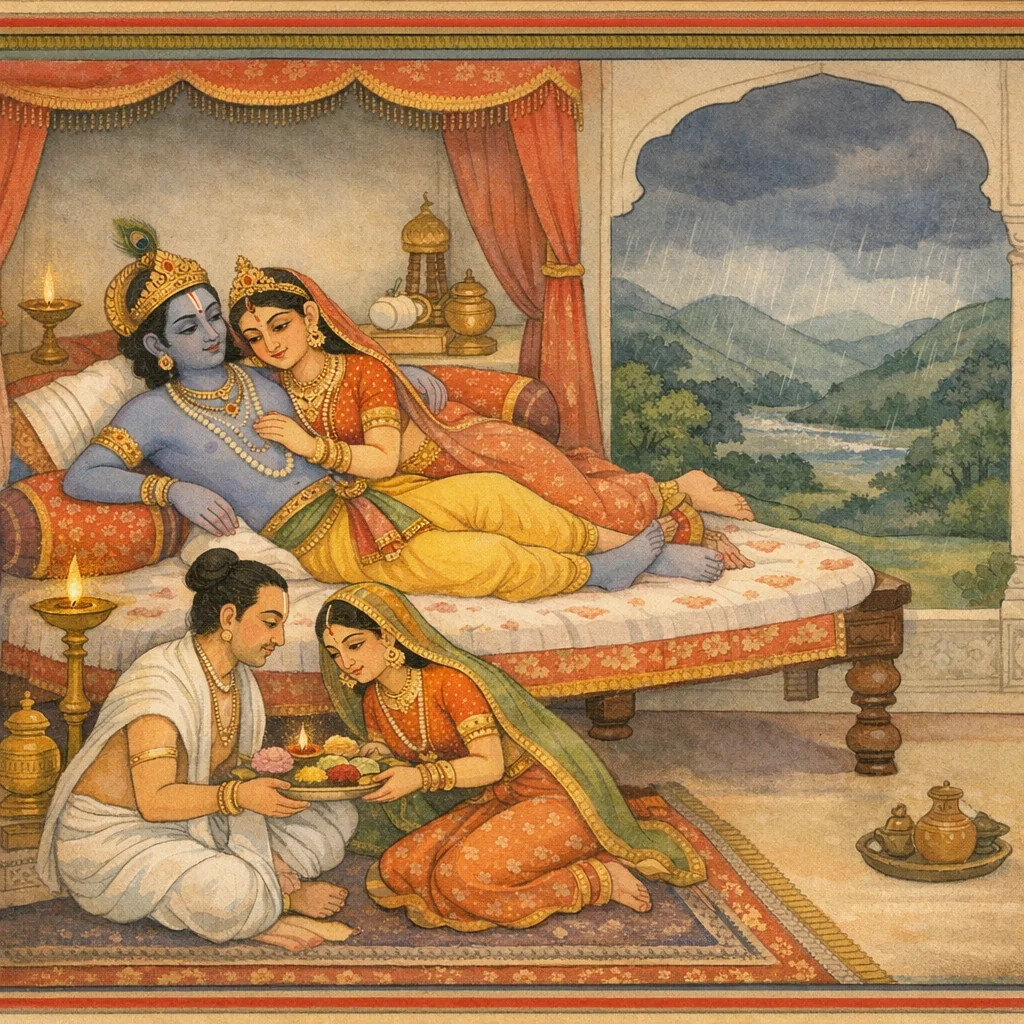
Adhyaya 17: The Caturmasya Observances and the Rite of Vishnu’s Sleep (Aśūnya-Śayana) and Shiva’s Monthly Vows
चातुर्मास्य-व्रत तथा अशून्य-शयन-विधि (Cāturmāsya-vrata tathā Aśūnya-śayana-vidhi)
Shiva's Monthly Vows
In this Adhyāya, the Vāmana Purāṇa presents a syncretic theology through the Pulastya–Nārada dialogue, framing ritual practice as a shared devotional grammar for both Hari (Viṣṇu/Keśava) and Hara (Śiva/Śarva). Pulastya explains the calendrical moment when the Lord of Śrī reclines (śayana) at the onset of the Cāturmāsya season, and how, in sequence, other divine classes (Gandharvas, Guhyakas, Yakṣas) and major deities enter ritual “sleep,” marking a cosmological rhythm aligned with dakṣiṇāyana and the rains. The chapter then details the Aśūnya-Śayana rite: iconographic worship of Viṣṇu with Lakṣmī on the couch, offerings placed upon the divine bed, and household-protective prayers emphasizing uninterrupted auspiciousness (gārhasthya). A second, extended cycle prescribes month-by-month Śaiva observances (notably Kālāṣṭamī and allied rites), specifying baths, flowers, incense, naivedya, mantras, and dāna, culminating in akṣaya-phala. The result is a practical manual of vow-rituals where sectarian boundaries are harmonized through parallel liturgical structures.
Divine Beings
Key Content Points
- Pulastya–Nārada framework: Pulastya enumerates desire-fulfilling (kāmya) vows for the worship (ārādhanā) of both Keśava and Śarva, establishing a syncretic ritual program.
- Cāturmāsya cosmology: Viṣṇu’s śayana is timed to the solar transition and tithis; successive ‘sleep’ of divine beings (Yakṣas, Brahmā, Skanda, Sādhyas, etc.) maps a ritualized sacred calendar tied to dakṣiṇāyana and prāvṛṭ (monsoon).
- Aśūnya-Śayana rite: Worship of Śrīvatsāṅka Hari with Lakṣmī on the couch; offerings on the bed, household-protective prayers, naktabhojana restrictions, and dāna to brāhmaṇas.
- Śaiva annual vow-cycle: From Nabhasya onward, Kālāṣṭamī and related monthly observances prescribe specific snāna media (gomūtra, pañcagavya, payas, kuśodaka, etc.), flowers (dhattūra, karavīra, tagara), incense resins, naivedya items, and graded dakṣiṇā (gold, silver, cattle, garments).
- Akṣaya-phala doctrine: Completion of the year-long discipline is said to yield inexhaustible desired results (akṣayān kāmān), grounded in Maheśvara’s authoritative promise.
Shlokas in Adhyaya 17
Verse 1
इति श्रीवामनपुराणे षोडशो ऽध्यायः नारद उवाच यानेतान् भगवान् प्राह कामिभिः शशिनं प्रति आराधनाय देवाभ्यां हरीशाभ्यां वदस्व तान्
Thus ends the sixteenth chapter in the Śrī Vāmana Purāṇa. Nārada said: ‘Tell me those (instructions) which the Lord spoke, for desire-filled people, concerning the Moon—(instructions) for propitiation by the two gods, Hari and Īśa.’
Verse 2
पुलस्त्य उवाच/ शृणुष्व कामिभिः प्रोक्तान् व्रतान् पुण्यान् कलिप्रिय आराधनाय शर्वस्य केशवस्य च धीमतः
Pulastya said: Listen, O beloved of Kali, to the meritorious vows (vratas) taught by those who seek desired ends—vows meant for the propitiation of Śarva (Shiva) and also of the wise Keśava (Vishnu).
Verse 3
यदा त्वाषाढी संयाति व्रजते चोत्तरायणम् तदा स्वपिति देवेशो भोगिभोगे श्रियः पतिः
When the (time of) Āṣāḍha arrives and the course turns to the northern solstice (Uttarāyaṇa), then the Lord of the gods—the पति of Śrī (Vishnu)—sleeps upon the couch of the serpent (Śeṣa).
Verse 4
प्रतिसुप्ते विभौ तस्मिन् देवगन्धर्वगुह्यकाः देवानां मातरश्चापि प्रसुप्ताश्चाप्यनुक्रमात्
When that all-pervading Lord has fallen asleep, the devas, gandharvas, and guhyakas—as well as the mothers of the gods—also fall asleep, in due sequence.
Verse 5
नारद उवाच/ कथयस्व कुरादीनां शयने विधिमुत्तमम् सर्वमनुक्रमेणैव पुरस्कृत्य जनार्दनम्
Nārada said: “Tell (me) the excellent procedure for the rite of ‘sleep’ (śayana) beginning with (the place/field) Kura and the others, explaining everything in due order, having first invoked (or placing foremost) Janārdana.”
Verse 6
पुलस्त्य उवाच मिथुनाभिगते सूर्ये शुक्लपक्षे तपोधन एकादश्यां जगत्स्वामी शयनं परिकल्पयेत्
Pulastya said: “O treasure of austerity, when the Sun has entered Mithuna (Gemini), in the bright fortnight, on the Ekādaśī (tithi), one should arrange the ‘sleep’ (śayana rite) of the Lord of the world.”
Verse 7
शेषाहिभोगपर्यङ्कं कृत्वा संपूज्य केशवम् कृत्वोपवीतकं चैव सम्यक्संपूज्य वै द्विजान्
Having prepared a couch/bed made of the coils (hoods) of Śeṣa, and having duly worshiped Keśava, and also having put on the sacred thread (in proper fashion), one should properly worship the twice-born (brāhmaṇas) as well.
Verse 8
अनुज्ञानं ब्राह्मणेभ्यश्च द्वादश्यां प्रयतः शुचिः लब्ध्वा पीताम्बरधरः स्वस्ति निद्रां समानयेत्
On the Dvādaśī (twelfth lunar day), being restrained and pure, having obtained permission from the brāhmaṇas, and wearing a yellow garment, one should take rest (sleep) auspiciously and in well-being.
Verse 9
त्रयोदश्यां ततः कामः स्वपते शयने शुभे कदम्बानां सुगन्धानां कुसुमैः परिकल्पिते
Then, on the Trayodaśī (thirteenth lunar day), Kāma sleeps upon an auspicious bed, prepared with the fragrant flowers of kadamba trees.
Verse 10
चतुर्दश्यां ततो यक्षाः स्वपन्ति सुखशीतले सौवर्णपङ्कजकृते सुखास्तीर्णोपधानके
Then, on the Caturdaśī (fourteenth lunar day), the Yakṣas sleep in a comfortably cool place, on bedding and pillows well-laid out and fashioned with golden-lotus designs.
Verse 11
पौर्ममास्यामुमानाथः स्वपते चर्मसंस्तरे वैयाघ्रे च जटाभारं समुद्ग्रन्थ्यान्यचर्मणा
On the full-moon day, Umānātha (Śiva) sleeps upon a bed of skins; and on a tiger-skin he binds up the heavy mass of his matted locks with another hide.
Verse 12
ततो दिवाकरो राशिं संप्रयाति च कर्कटम् ततो ऽमराणां रजनी भवते दक्षिणायनम्
Then the Sun moves into the zodiacal sign Cancer; from that point, the southern course (Dakṣiṇāyana) becomes the night of the immortals (the gods).
Verse 13
ब्रह्मा प्रतिपदि तथा नीलोत्पलमये ऽनघ तल्पे स्वपिति लोकानां दर्शयन् मार्गमुत्तमम्
Likewise, on the first lunar day (Pratipad), Brahmā sleeps upon a spotless couch made of blue lotuses, while showing the worlds the highest path.
Verse 14
विश्वकर्मा द्वितीयायां तृतीयायां गिरेः सुता विनायकश्चुर्थ्या तु पञ्चम्यामपि धर्मराट्
On the second lunar day (dvitīyā) [it is said that] Viśvakarman [rests]. On the third (tṛtīyā), the Daughter of the Mountain [rests]. On the fourth (caturthī), Vināyaka [rests]; and on the fifth (pañcamī) Dharmarāṭ (Yama), too [rests].
Verse 15
षष्ठ्यां स्कन्दः प्रस्वपिति सप्तम्यांभगवान् रविः कात्यायनी तथाष्टम्यां नवम्यां कमलालया
On the sixth lunar day (ṣaṣṭhī), Skanda is said to sleep. On the seventh (saptamī), the blessed Sun (Ravi) [sleeps]. Likewise on the eighth (aṣṭamī), Kātyāyanī [sleeps]; and on the ninth (navamī), Kamalālayā (Lakṣmī, ‘she who abides in the lotus’) [sleeps].
Verse 16
दशम्यां भुजगेन्द्राश्च स्वपन्ते वायुभोजनाः एकादश्यां तु कृष्णायां साध्या ब्रह्मन् स्वपन्ति च
On the tenth lunar day (daśamī), the lords of serpents (Nāga-kings) sleep—those who are ‘air-eaters’ (vāyubhojanāḥ). And on the eleventh, in the dark fortnight (kṛṣṇā ekādaśī), the Sādhyas also sleep, O Brahman.
Verse 17
एष क्रमस्ते गदितो नभादौ स्वपने मुने स्वपत्सु तत्र देवेषु प्रावृट्कालः समाययौ
“This sequence has been explained to you, O sage, regarding sleep in the month of Nabhas. While the gods were sleeping there, the season of Prāvṛṭ (the onset of the rains) arrived.”
Verse 18
कङ्काः समं बलाकाभिरारोहन्ति नगोत्तमान् वायसाश्चापि सुर्वन्ति नीडानि ऋषिपुङ्गव वायसाश्च स्वपन्त्येते ऋतौ गर्भभरालसाः
“Herons, together with cranes, ascend the best of mountains. Crows too make their nests, O best of sages; and these crows sleep in that season, made sluggish by the burden of pregnancy.”
Verse 19
यस्यां तिथ्यां प्रस्वपिति विश्वकर्मा प्रजापतिः द्वितीया सा शुभा पुण्या अशून्यशयनोदिता
“That lunar day (tithi) on which Viśvakarmā, the Lord of creatures (Prajāpati), sleeps—this is the second day (Dvitīyā), auspicious and meritorious, proclaimed as ‘Aśūnyaśayana’.”
Verse 20
तस्यां तिथावर्च्य हरिं श्रीवत्साङ्कं चतुर्भुजम् पर्यङ्कस्थं समं लक्ष्म्या गन्धपुष्पादिभिर्मुने
On that lunar day (tithi), having worshipped Hari—marked with the Śrīvatsa and four-armed—seated upon a couch together with Lakṣmī, with perfumes, flowers, and the like, O sage, (one should proceed further with the rite).
Verse 21
ततो देवाय शय्यायां फलानि प्रक्षिपेत् क्रमात् सुरभीणी निवेद्येत्थं विज्ञाप्यो मधुसूदनः
Then, for the god, one should place fruits upon the bed in due order; offering fragrant (items), thus should Madhusūdana be respectfully informed/petitioned.
Verse 22
यथा हि लक्ष्म्या न वियुज्यसे त्वं त्रिविक्रमानन्त जगन्निवास तथास्त्वशून्यं शयनं सदैव अस्माकमेवेह तव प्रसादात्
Just as you are not separated from Lakṣmī, O Trivikrama, O Ananta, abode of the world—so may (this) couch/bed never be without (her/auspiciousness), always, for us here, by your grace.
Verse 23
यथा त्वशून्यं तव देव तल्पं समं हि लक्ष्म्या वरदाच्युतेश सत्येन तेनामितवीर्य विष्णो गार्हस्थ्यनाशो मम नास्तु देव
“Just as, O God, your divine couch is never without (you) and is ever together with Lakṣmī, O boon-giving Acyuteśa—by that truth, O Viṣṇu of immeasurable prowess, may there not be the destruction of my householder-state, O Lord.”
Verse 24
इत्युच्चार्य प्रणम्येशं प्रसाद्य च पुनः पुनः नक्तां भुञ्जीत देवर्षे तैलक्षारविवर्जितमट्
“Having recited thus, and having bowed to the Lord and propitiated him again and again, O divine sage, one should eat the night-meal (only), avoiding oil and alkaline (foods).”
Verse 25
द्वितीये ऽह्नि द्विजाग्र्याय फलान् दद्याद् विचक्षणः लक्ष्मीधरः प्रीयतां मे इत्युच्चार्य निवेदयेत्
“On the second day, the discerning person should give fruits to an excellent Brahmin; reciting, ‘May Lakṣmīdhara be pleased with me,’ he should offer (them).”
Verse 26
अनेन तु विधानेन चातुर्मास्यव्रतं चरेत् यावद् चवृश्चिकराशिस्थः प्रतिभाति दिवाकरः
Following this prescribed procedure, one should observe the Cāturmāsya vow, until the Sun shines while situated in the zodiac sign of Scorpio.
Verse 27
ततो विबुध्यन्ति सुराः क्रमशः क्रमशो मुने तुलास्थेर्ऽके हरिः कामः शिवः पश्चाद्विबुध्यते
Then, O sage, the gods awaken one after another in due order. When the Sun is in Libra, Hari awakens; (then) Kāma, and afterward Śiva awakens.
Verse 28
तत्र दानं द्वितीयायां मूर्त्तिर्लक्ष्मीधरस्य तु सशय्यास्तरणोपेता यथा विभवमात्मनः
In that observance, on the second lunar day (Dvitīyā) one should give in charity an image of Lakṣmīdhara (Viṣṇu), furnished with a bed and coverings, according to one’s means.
Verse 29
एष व्रतस्तु प्रथमः प्रोक्तस्तव महामुने यस्मिंश् चीर्णे वियोगस्तु न भवेदिह कस्यचित्
O great sage, this is declared to you as the foremost (first) of vows; when it is duly observed, separation (viyoga) does not occur here for anyone.
Verse 30
नभस्ये मासि च तथा या स्यात्कृष्णाष्टमी शुभा युक्ता मृगशिरेणैव सा तु कालाष्टमी स्मृता
Likewise, in the month of Nabhas, that auspicious eighth lunar day of the dark fortnight (kṛṣṇāṣṭamī) which is conjoined specifically with the Mṛgaśīrṣa nakṣatra is remembered as Kālāṣṭamī.
Verse 31
तस्यां सर्वेषु लिङ्गेषु तिथौ स्वपिति शङ्करः वसते संनिधाने तु तत्र पूजाक्षया स्मृता
On that tithi, in all liṅgas, Śaṅkara is said to ‘sleep’ (abide in a special state). In his very proximity/presence there, worship is remembered as imperishable (yielding inexhaustible merit).
Verse 32
तत्र स्नायीन वै विद्वान् गोमूत्रेण जलेन च स्नातः संपूजयेत् पुष्पैर्धत्तूरस्य त्रिलोचनम्
There, a learned man, having bathed with cow-urine and with water, should, after bathing, duly worship Trilocana (the Three-eyed Lord) with flowers of dhattūra.
Verse 33
धूपं केसरनिर्यासं नैवेद्यं मधुसर्पिषी प्रीयतां मे विरूपाक्षस्त्वित्युच्चार्य च दक्षिणाम् विप्राय दद्यान्नैवेद्यं सहिरण्यं द्विजोत्तम
He should offer incense made of kesara-resin, and food-offering consisting of honey and ghee. Uttering, 'May Virūpākṣa be pleased with me,' he should then give the priestly fee; and he should give the food-offering, together with gold, to a brāhmaṇa, O best of twice-born.
Verse 34
तद्वदाश्वयुजे मासि उपवासी जितेन्द्रियः नवम्यां गोमयस्नानं कुर्यात्पूजां तु पङ्कजैः धूपयेत् सर्जनिर्यासं नैवेद्यं मधुमोदकैः
Likewise, in the month of Āśvayuja, fasting and self-controlled, on the ninth lunar day he should perform a bath with cow-dung, and worship with lotuses; he should offer incense of sarja-resin and present as food-offering honey-sweet cakes (modakas).
Verse 35
कृतोपवासस्तवष्टम्यां नवम्यां स्नानमाचरेत् प्रीयतां मे हिरण्याक्षो दक्षिणा सतिला स्मृता
Having observed a fast on the eighth lunar day (aṣṭamī), one should perform a bath on the ninth (navamī). (One should pray:) ‘May Hiraṇyākṣa be pleased with me.’ The prescribed priestly fee (dakṣiṇā) is remembered as being ‘with sesame’ (satilā).
Verse 36
कार्त्तिके पयसा स्नानं करवीरेण चार्चनम् धुपं श्रीवासनिर्यासं नैवेद्यं मधुपायसम्
In the month of Kārttika, one should bathe with milk; one should also worship with karavīra flowers. The incense should be the resin of śrīvāsa, and the food-offering (naivedya) should be sweet rice pudding with honey (madhu-pāyasa).
Verse 37
सनैवेद्यं च रजतं दातव्यं दानमग्रजे प्रीयतां गवान् स्थासुरिति वाच्यमनिष्ठुरम्
Along with the food-offering (naivedya), silver should be given as a gift, O elder (agraja). One should say gently (without harshness): ‘May the cows be pleased; may (they) remain steadfast/abide.’
Verse 38
कृत्वोपवासमष्टम्यां नवम्यां स्नानमाचरेत् मासि मार्गशिरे स्नानं दध्नार्चा भद्रया स्मृता
Having observed a fast on the eighth lunar day (Aṣṭamī), one should perform a ritual bath on the ninth (Navamī). In the month of Mārgaśīrṣa, the prescribed bath is accompanied by worship with curd (dadhi); this observance is remembered as ‘Bhadrā’.
Verse 39
धूपं श्रीवृक्षनिर्यासं नैवेद्यं मधुनोदनम् संनिवेद्या रक्तशालिर्दक्षिणा परिकीर्त्तिता नमो ऽस्तु प्रीयतां शर्वस्त्विति वाच्यं च पण्डितैः
One should offer incense made from the resin of the śrīvṛkṣa, and present as food-offering (naivedya) sweetened rice prepared with honey. Having duly offered these, red śāli-rice is declared to be the priestly fee (dakṣiṇā). The learned state that one should also recite: ‘Homage be; may Śarva be pleased.’
Verse 40
पौषे स्नानं च हविषा पूजा स्यात्तगरैः सुभैः धूपो मधुकनिर्यासो नैवेद्यं मधु शष्कुली
In the month of Pauṣa, the bath is to be performed with havis; worship should be done with auspicious tagara (fragrant offering). The incense is the resin of the madhūka tree, and the food-offering is honey and śaṣkulī (a fried cake/pastry).
Verse 41
समुद्गा दक्षिणा प्रोक्ता प्रीमनाय जगद्गुरोः वाच्यं नमस्ते देवेश त्र्यम्बकेति प्रकीर्तयेत्
A casket (samudgā) is declared to be the priestly fee (dakṣiṇā) for pleasing the Guru of the world. One should recite: “Salutations to you, O Lord of gods—Tryambaka.”
Verse 42
माघे कुशोदकस्नानं मृगमदेन चार्च्यनम् धूपः पदम्बनिर्यासो नैवेद्यं सतिलोदनम्
In the month of Māgha, one should bathe with water sanctified by kuśa grass, and perform worship with musk. The incense is resin/exudation of padamba, and the food-offering (naivedya) is rice prepared with sesame.
Verse 43
पयोभक्तं सनैवेद्यं सरुक्मं प्रतिपादयेत् प्रीयतां मे महादेव उमापतिरितीरयेत्
One should present milk-rice as the food offering, together with gold. One should utter: “May Mahādeva, the Lord of Umā, be pleased with me.”
Verse 44
एवमेव समुद्दिष्टं षड्भिर्मासैस्तु पारणम् पारणान्ते त्रिनेत्रस्य स्नपनं कारयेत्क्रमात्
Thus, the concluding rite (pāraṇa) is prescribed after six months. At the end of the pāraṇa, one should duly arrange the ritual bathing (snāpana) of the Three-eyed Lord (Śiva), in proper order.
Verse 45
गोरोचनायाः सहिता गुडेन देवं समालभ्य च पूजयेत प्रीयस्व दीनो ऽस्मि भवन्तमीश मच्छोकनाशं प्रकुरुष्व योग्यम्
Having prepared (the offering/unctuous application) with gorocanā together with jaggery, one should touch/approach the Lord and worship him, saying: “Be pleased; I am afflicted. O Lord, do what is fitting to destroy my sorrow.”
Verse 46
ततस्तु फाल्गुने मासिं कृष्णाष्टम्यां यतव्रत उपवासं समुदीतं कर्तव्यं द्विजसत्तम
Then, in the month of Phālguna, on the eighth lunar day of the dark fortnight (Kṛṣṇāṣṭamī), O best of twice-born, one who is restrained in vows should undertake the prescribed fast (upavāsa).
Verse 47
द्वितीये ऽह्नि ततः स्नानं पञ्चगव्येन कारयेत् पूजयेत्कुन्दकुसुमैर्धूपयेत् चन्दनं त्वपि
Then, on the second day, one should have the bath performed with pañcagavya. One should worship with jasmine blossoms, and also offer sandalwood as incense/fumigation.
Verse 48
नैवेद्यं सघृतं दद्यात् ताम्रपात्रे गुडोदनम् दक्षिणां च द्विजातिभ्यो नैवेद्यसहितां मुने वासोयुगं प्रीणयेच्च रुद्रमुच्चार्य नामतः
One should offer naivedya together with ghee—sweetened rice (guḍodana) in a copper vessel. And, O sage, one should give dakṣiṇā to the twice-born, together with the food-offering. One should also gladden (propitiate) Rudra by presenting a pair of garments, reciting his names.
Verse 49
चैत्रे चोदुम्बरफलैः स्नानं मन्दारकार्चनम् गुग्गुलुं महिषाख्यं च घृताक्तं धूपयेद् बुधः
And in the month of Caitra, one should bathe using udumbara fruits, and perform worship with mandāra flowers. The wise person should offer as incense guggulu and also mahiṣākhya, anointed with ghee.
Verse 50
समोदकं तथा सर्पिः प्रीणनं विनिवेदयेत् दक्षिणा च सनैवेद्यं सृगाजिनमुदाहृतम्
One should present the pleasing offering consisting of water mixed (with something) and also ghee. And the fee (dakṣiṇā), together with that food-offering (naivedya), is said to be a deer-skin.
Verse 51
नाट्येश्वर नमस्ते ऽस्तु इदमुच्चार्य नारद प्रीणनं देवनाथाय कुर्याच्छ्रद्धासमन्वितः
‘O Nāṭyeśvara, may there be salutations to you’—having uttered this, O Nārada, one should perform the propitiatory offering for the Lord of the gods, endowed with faith (śraddhā).
Verse 52
वैशाखे स्नानमुदितं सुगन्धकुसुमाम्भसा पूजनं शङ्करस्योक्तं चूतमञ्जरिभिर्विभो
In Vaiśākha, bathing is prescribed with water (infused) with fragrant flowers. Worship of Śaṅkara is enjoined with clusters of mango blossoms, O revered one.
Verse 53
धूपं सर्जाज्ययुक्तं च नैवेद्यं सफलं घृतम् नामजप्यमपीशस्य कालघ्नेति विपश्चिता
One should offer incense mixed with sarja-resin and ghee, and a food-offering (naivedya) consisting of ghee along with fruits. Even the repetition of the Lord Īśa’s names—so the wise declare—becomes ‘kālaghna’, a destroyer of Time (i.e., death/inauspicious fate).
Verse 54
जलकुम्भान् सनैवेद्यान् ब्राह्मणाय निवेदयेत् सोपवीतान् सहान्नाद्यांस्तच्चित्तैस्तत्परायणैः
One should present to a brāhmaṇa water-pots together with food-offerings; (and give) sacred threads (upavīta) as well, along with grains and other eatables—doing so with the mind fixed on Him and devoted to Him alone.
Verse 55
ज्येष्ठे स्नानं चामलकैः पूजार्ऽककुसुमैस्तथा धूपयेत्तत्त्रिनेत्रं च आयत्यां पुष्टिकारकम्
In the month of Jyeṣṭha, one should bathe using āmalaka (emblic myrobalan) and likewise perform worship with arka flowers. One should also offer incense to that Three-eyed Lord; in the future it becomes a cause of nourishment and prosperity (puṣṭi).
Verse 56
सक्तूंश्च सघृतान् देवे दध्नाक्तान् विनिवेदयेत् उपानद्यगलं छत्रं दानं दद्याच्च भक्तिमान्
With devotion, one should offer to the deity roasted barley-flour (saktu) mixed with ghee and smeared/combined with curd. The devoted person should also give gifts such as footwear, a garment/cloak, and an umbrella.
Verse 57
नमस्ते भगनेत्रघ्न पूष्णो दशननाशन इदमुच्चारयेद्भक्त्या प्रीणनाय जगत्पतेः
‘Salutations to you, slayer of Bhaga’s eye; destroyer of Pūṣan’s teeth.’ One should recite this with devotion in order to please the Lord of the world.
Verse 58
आषाढे स्नानमुदितं श्रीफलैरर्चनं तथा धत्तूरकुसुमैः शुक्लैर्धूपयेत् सिल्हकं तथा
In the month of Āṣāḍha, bathing is prescribed; worship (arcana) should be performed with śrīphala (coconuts). One should also offer incense/fumigation using white dhattūra flowers and likewise with silhaka (a fragrant resin/benzoin-like incense).
Verse 59
नैवेद्याः सघृताः पूपाः दक्षिणा सघृता यवाः नमस्ते दक्षयज्ञघ्न इदमुच्चैरुदीरयेत्
Let one offer as naivedya sweet cakes mixed with ghee; and as a priestly gift (dakṣiṇā), barley mixed with ghee. One should then loudly recite: “Salutations to you, O destroyer of Dakṣa’s sacrifice.”
Verse 60
श्रावणे मृगभोज्येन स्नानं कृत्वार्ऽचयेद्धरम् श्रीवृक्षपत्रः सफलैर्धूपं दद्यात् तथागुरुम्
In the month of Śrāvaṇa, having bathed, one should worship Dhara. With leaves of the śrī-tree, together with fruits, one should offer incense, and likewise offer aguru (fragrant aloe/agarwood).
Verse 61
नैवेद्यं सघृतं दद्यात् दधि पूपान् समोदकान् दध्योदनं सकृसरं माषधानाः सशष्कुलीः
One should offer as naivedya food mixed with ghee: curd; cakes; sweet dumplings (modakas); rice with curd; rice with kṛsara (a mixed preparation); boiled/roasted black-gram grains; and śaṣkulī (a fried sweet).
Verse 62
दक्षिणां श्वेतवृषभं धेनुं च कपिलां शुभाम् कनकं रक्कवसनं प्रदद्याद् ब्राह्मणाय हि गङ्गाधरेति जप्तव्यं नाम शंभोश्च पण्डितैः
As a priestly fee (dakṣiṇā), one should give a white bull, an auspicious tawny cow, gold, and red garments to a brāhmaṇa. The learned should also recite the name of Śambhu as “Gaṅgādhara.”
Verse 63
अमीभिः षड्भिरपरैर्मासैः पारणमुत्तमम् एवं संवत्सरं पूर्णं संपूज्य षभध्वजम् अक्षयान् लभते कामान् महेश्वरवचो यथा
With these other six months, the excellent concluding rite (pāraṇa) is performed. Thus, completing a full year and duly worshipping Ṣaḍbhadhvaja, one obtains imperishable desired benefits, in accordance with Maheśvara’s words.
Verse 64
इदमुक्तं व्रतं पुण्यं सर्वाक्षयकरं शुभम् स्वयं रुद्रण देवर्षे तत्तथा न तदन्यथा
This vow has been declared to be meritorious, auspicious, and productive of every kind of imperishable result—spoken by Rudra himself, O divine seer; it is so and not otherwise.
Frequently Asked Questions
It uses a shared ritual architecture—vrata, snāna, arcana, dhūpa, naivedya, mantra, and dāna—applied in parallel to Keśava (Hari) and Śarva (Hara). Viṣṇu’s Aśūnya-Śayana is taught as a household-protective rite with Lakṣmī, while Śiva’s Kālāṣṭamī-centered annual cycle mirrors the same liturgical logic. The chapter thus advances a syncretic theology where sectarian devotion is harmonized through calendrical discipline and equivalent devotional technologies.
This Adhyāya is primarily calendrical and ritual-prescriptive rather than topographical: it does not foreground Kurukṣetra, Sarasvatī, or named tīrthas. Its ‘sacred geography’ is temporal—mapping holiness onto tithis, months, and solar transitions (uttarāyaṇa/dakṣiṇāyana, prāvṛṭ)—thereby sanctifying time as the principal pilgrimage-field for vrata performance.
The devotee worships Viṣṇu marked with Śrīvatsa, four-armed, reclining with Lakṣmī, places fruits/offerings upon the divine couch, and recites prayers requesting that the Lord’s bed never be ‘empty’ (aśūnya) and that the householder’s prosperity and marital/household stability (gārhasthya) not be destroyed. The rite is paired with dietary restraint (naktabhojana, avoiding oil/alkali) and dāna to brāhmaṇas.