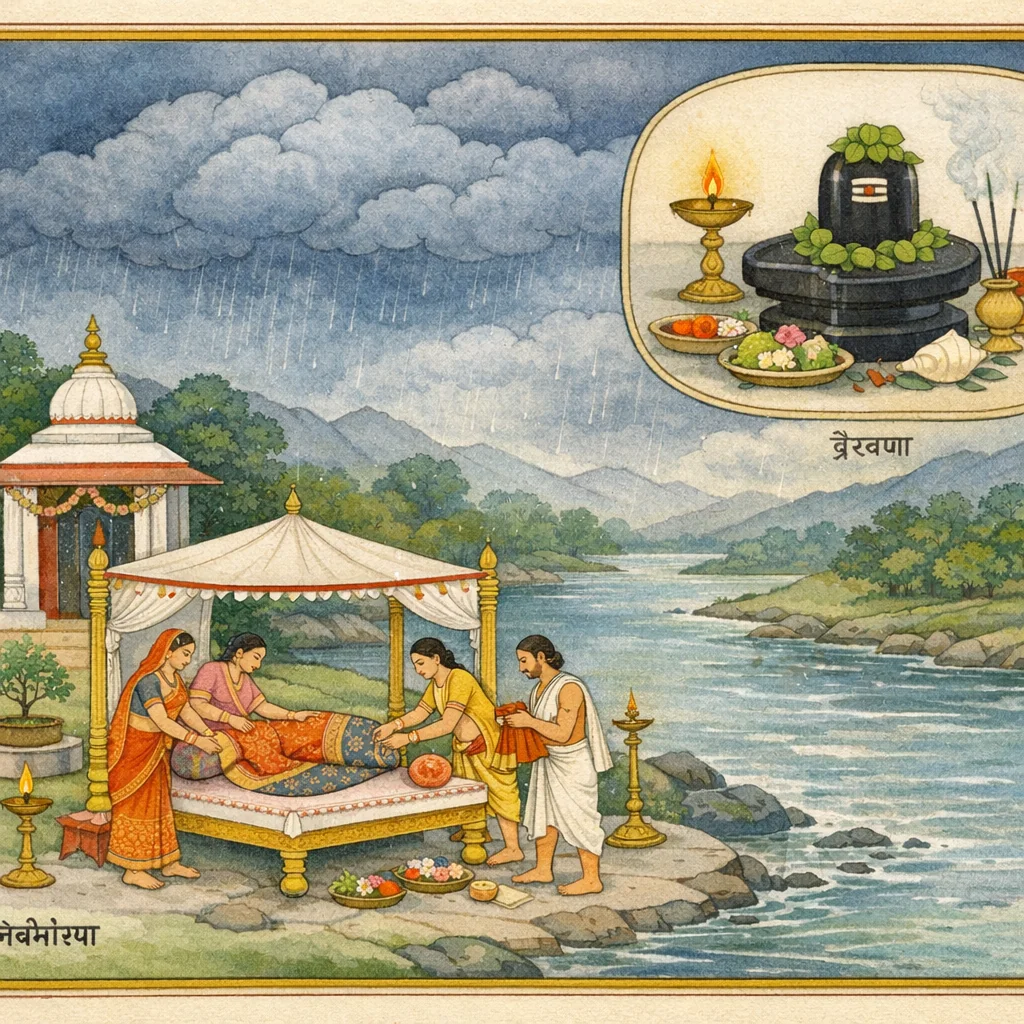
Adhyaya 16: The Cāturmāsya Observances and the Sleeping–Awakening Cycle of the Gods (Hari–Hara Worship)
चातुर्मास्यव्रत-विधिः तथा देव-शयन-जागरण-क्रमः (Cāturmāsya-vrata-vidhiḥ tathā Deva-śayana-jāgaraṇa-kramaḥ)
The Sleeping-Awakening Cycle of the Gods
Adhyāya 16 unfolds within the Pulastya–Nārada dialogue-frame, presenting a syncretic theology in which devotional practice is explicitly directed to both Keśava (Viṣṇu) and Śarva/Śaṅkara (Śiva). The chapter anchors ritual time in the calendrical transition around Āṣāḍha and the onset of Cāturmāsya, describing the iconographic and liturgical procedure for arranging the Lord’s śayana (divine couch) on Ekādaśī and continuing observances through the rainy season. A striking cosmological motif is introduced: as Viṣṇu enters yoganidrā, other divine classes and deities follow a graded “sleeping” sequence across tithis, culminating in a seasonal sacralization of prāvṛṭ (monsoon) as a period of restrained conduct and intensified worship. The text then details specific monthly vrata-modules—bathing media, flowers, incense-resins, naivedya, mantras, and dāna—especially for Śiva on auspicious lunar days, promising akṣaya-phala (imperishable merit) and household stability. The chapter thus integrates Vaiṣṇava śayana-rites with Śaiva vrata-discipline, modeling Harihara-oriented piety through precise ritual prescriptions rather than sectarian exclusivity.
Divine Beings
Key Content Points
- Pulastya instructs Nārada on desire-fulfilling (kāmya) vratas for the joint ārādhanā of Keśava (Viṣṇu) and Śarva (Śiva), establishing a syncretic devotional program.
- A calendrical-cosmological sequence is given: Viṣṇu’s śayana is instituted around Ekādaśī in the bright fortnight when the sun is in Mithuna; other divine beings ‘sleep’ in an ordered tithi progression, linking ritual time to seasonal change (prāvṛṭ/Cāturmāsya).
- Detailed vrata-rituals are prescribed across months (Nabhāsya onward): specific snāna substances, flowers, dhūpa resins, naivedya items, mantras, and dāna (including cows, garments, metals), with emphasis on Śiva-liṅga proximity and akṣaya-pūjā results.
Shlokas in Adhyaya 16
Verse 1
पुलस्त्य उवाच ततः सुकेशिर्देवर्षे गत्वा स्वपुरमुत्तमम् सम्हूयाब्रवीत् सर्वान् राक्षसान् धार्मिकं वचः
Pulastya said: Then Sukeśī, having gone (back) to his excellent city, assembled all the Rākṣasas and spoke to them words grounded in dharma.
Verse 2
अहिंसा सत्यमस्तेयं शौचमिन्द्रियसंयमः दानं दया च क्षान्तिश्व ब्रह्मचर्यममानिता
Non-violence, truth, non-stealing, purity, restraint of the senses, charity, compassion, and forbearance, along with celibacy and humility—(these constitute) the ancient dharma.
Verse 3
शुभा सत्या च मधुरा वाङ् नित्यं सत्क्रिया रतिः सदाचारनिषेवित्वं परलोकप्रदायकाः
Speech that is auspicious, truthful, and sweet; constant delight in good deeds; and adherence to right conduct—these are what grant (merit leading to) the other world.
Verse 4
इत्यूचुर्मुनयो मह्यं धर्ममाद्यं पुरातनम् सोहमाज्ञापये सर्वान् क्रियतामविकल्पतः
Thus the sages spoke to me of the primordial, ancient dharma. Therefore I instruct everyone: let it be practiced without doubt or hesitation.
Verse 5
पुलस्त्य उवाच ततः सुकेशिवचनात् सर्व एव निशाचराः त्रयोदशाङ्गं ते धर्म चक्रुर्मुदितमानसाः
Pulastya said: Then, at Sukeśī’s instruction, all the night-rangers (Rākṣasas) together established a dharma consisting of thirteen parts, with delighted minds.
Verse 6
ततः प्रवृद्धिं सुतरामगच्छन्त निशाचराः पुत्रपौत्रार्थसंयुक्ताः सदाटारसमन्विताः
Thereafter the night-rangers attained very great increase, endowed with sons and grandsons and with wealth/resources, and accompanied by attendants/retainers.
Verse 7
तज्जयोतिस्तेजस्तेषां राक्षसानं महात्मनाम् गन्तुं नाशक्तुवन् सूर्यो नक्षत्राणि न चन्द्रमाः
Such was the light and fiery radiance of those great-souled Rākṣasas that the Sun could not proceed, nor the stars, nor the Moon.
Verse 8
ततस्त्रिभुवने ब्रह्मन् निशाचरपुरो ऽभवत् दिवा चन्द्रस्य सदृशः क्षणदायां च सूर्यवत्
Then, O brāhmaṇa, a city of the night-rangers (niśācaras) came into being in the three worlds—by day resembling the moon, and at night resembling the sun.
Verse 9
न ज्ञायते गतिर्व्योम्नि भास्करस्य ततो ऽम्बरे शशङ्कमिति तेजस्त्वादमन्यन्त पुरोत्तमम्
Then, in the sky, the course of the sun could not be discerned; and because of that radiance, they considered that excellent city to be the moon.
Verse 10
स्वं विकासं विमुञ्चन्ति निशामिति व्यचिन्तयन् कमलाकरेषु कमला मित्रमित्यवगम्य हि रात्रौ विकसिता ब्रह्मन् विभूतिं दातुमीप्सवः
Thinking, ‘They abandon their own blossoming at night,’ and understanding that in the lotus-ponds the lotus is a friend (of the night/moon), they, O brāhmaṇa, blossomed at night—desiring to bestow prosperity (vibhūti).
Verse 11
कौशिका रात्रिसमयं बुद्ध्वा निरगमन् किल तान् वायसास्तदा ज्ञात्वा दिवा निघ्नन्ति कौशिकान्
The owls (kauśikāḥ), knowing it was the time of night, indeed came out. Then the crows, recognizing them, kill the owls in the daytime.
Verse 12
स्नातकास्त्वापगास्वेव स्नानजप्यपरायणाः आकण्ठमग्नास्तिष्ठन्ति रात्रौ ज्ञात्वाथ वासरम्
But the snātakas, devoted to bathing and the recitation (of mantras), stand in the rivers, immersed up to the neck at night, and then (remain) until they know (the coming of) daytime.
Verse 13
न व्ययुज्यन्त चक्रआश्च तदा वै पुरदर्शने मन्मानास्तु दिवसमिदमुच्चैर्ब्रुवन्ति च
And the ‘cakrāḥ’ did not separate/turn away then, indeed, at the sight of the city. But, thinking (thus), they also loudly speak this about the day—(the sense is unclear due to textual difficulty).
Verse 14
नूनं कान्ताविहीनेन केनचिच्चक्रपत्त्रिणा उत्सृष्टं जीवितं शून्ये फूत्कृत्य सरितस्तटे
Surely, by some man—deprived of his beloved—his life has been cast away in this desolate place, after uttering a loud cry on the bank of the river.
Verse 15
ततो ऽनुकृपयाविष्टो विवस्वास्तीव्ररश्मिभिः संतापयञ्जगत् सर्वं नास्तमेति कथञ्चन
Then Sūrya (Vivasvān), as though overcome by compassion, with his fierce rays scorched the entire world and, in some way, did not set at all.
Verse 16
अन्ये वदन्ति चक्रआह्वो नृनं कश्चिन् मृतो भवेत् तत्कान्तया तपस्तप्तं भर्तृशोकार्त्तया बत
Others say: ‘Some man called Cakrāhva has died.’ Alas—his beloved, afflicted by sorrow for her husband, has performed austerity (tapas) in her anguish.
Verse 17
आराधितस्तु भगवांस्तपसा वै दिवाकरः तेनासौ शशिनिर्जेता नास्तमेति रविर्ध्रुवम्
The blessed Sun (Divākara) was indeed propitiated by austerity; by that, he became a conqueror of the Moon, and the Sun certainly does not set—(remaining) fixed/constant.
Verse 18
यज्विनो होमशालासु सह ऋत्विग्भिरध्वरे प्रावर्त्तयन्त कर्माणि रात्रावपि महामुने
O great sage, the sacrificers, together with the officiating priests in the sacrifice, carried on the rites in the fire-halls even at night.
Verse 19
महाभागवताः पूजां विष्णोः कुर्वन्ति भक्तितः रवौ शशिनि चैवान्ये ब्रह्मणो ऽन्ये हरस्य च
The greatly fortunate devotees perform worship of Viṣṇu with devotion; and others (perform worship) of the Sun and the Moon; others (worship) Brahmā, and others Hara (Śiva) as well.
Verse 20
कामिनश्चाप्यमन्यन्त साधु चन्द्रमसा कृतम् यदियं रजनी रम्या कृता सततकौमुदी
Even lovers (kāminas) thought it a fine deed done by the Moon, in that this delightful night has been made into the ‘Satatakaumudī’—a night of abundant moonlight.
Verse 21
अन्ये ऽब्रुवंल्लोकगुरुरस्माभिश्चक्रभृद् वशी निर्व्याजेन महागन्धैरर्चितः कुसुमैः शुभैः
Others said: ‘The World-Teacher—He who bears the discus, the sovereign—has been worshipped by us sincerely, with excellent perfumes and with auspicious flowers.’
Verse 22
सह लक्ष्म्या महायोगी नभस्यादिचतुर्ष्वपि अशून्यशयना नाम द्वितीया सर्वकामदा
Together with Lakṣmī, the great Yogin (the Lord) [is worshipped] also on the four (months) beginning with Nabhasya; the second lunar day (Dvitīyā) is called ‘Aśūnyaśayanā’, the giver of all desires.
Verse 23
तेनासौ भगवान् प्रीतः प्रादाच्छयनमुत्तमम् अशून्यं च महाभोगैरनस्तमितशेखरम्
Pleased by that (act of devotion), the Blessed Lord granted an excellent couch—never lacking in great enjoyments and crowned with an unfading splendor.
Verse 24
अनये ऽब्रुवन् ध्रुवं देव्या रोहिण्याशशिनः क्षयम् दृष्ट्वा तप्तं तपो घोरं रुद्राराधनकाम्यया
Then they declared with certainty to the goddess Rohiṇī the waning of the Moon; seeing her performing fierce austerity, desiring to propitiate Rudra.
Verse 25
पुण्यायामक्षयाष्टम्यां वेदोक्तविधिना स्वयम् तुष्टेन शंभुना दत्तं वरं चास्यै यदृच्छया
On the sacred Akṣayāṣṭamī, following the procedure taught in the Vedas, a boon was granted to her by Śambhu himself, being pleased—freely (of his own accord).
Verse 26
अन्ये ऽब्रुवन् चन्द्रमसा ध्रुवमाराधितो हरिः व्रतेनेह त्वखण्डेन तेनाखण्डः शशी दिवि
Others said: “Hari was steadfastly worshiped by the Moon (Candra) through an unbroken vow here; therefore the Moon is ‘unbroken’ (undiminishing/whole) in heaven.”
Verse 27
अन्ये ऽब्रवञ्छशाङ्केन ध्रुवं रक्षा कृतात्मनः पदद्वयं समभ्यर्च्य विष्णोरमिततेजसः
Others said: “Surely, protection was secured by the Moon, whose self was disciplined, by duly worshiping the two feet (padadvaya) of Viṣṇu of immeasurable splendor.”
Verse 28
तेनासौ दीप्तिमांश्चन्द्रः परिभूय दिवाकरम् अस्माकमानन्दकरो दिवा तपति सूर्यवत्
Therefore that radiant Moon, surpassing the Sun, becomes a giver of joy to us; by day it blazes like the Sun.
Verse 29
लक्ष्यते कारणैरन्यैर्बहुभिः सत्यमेव हि शशङ्कनिर्जितः सूर्यो न विभाति यथा पुरा
Truly indeed, (a thing) is recognized by many other causes/signs. Thus, when the Sun is overcome by the Moon, it does not shine as it did before.
Verse 30
यथामी कमलाः श्लक्ष्णा रणद्भृङ्गणावृताः विकचाः प्रतिभासन्ते जातः सूर्योदयो ध्रुवम्
Just as these smooth lotuses, surrounded by humming bees, appear fully opened and radiant—so it is certain that sunrise has occurred.
Verse 31
यथा चामी विभासन्ति विकचाः कुमुदाकराः अतो विज्ञायते चन्द्र उदितश्च प्रतापवान्
And just as these water-lily clusters shine, fully opened—therefore it is understood that the glorious Moon has risen.
Verse 32
एवं संभाषतां तत्र सूर्यो वाक्यानी नारद अमन्यत किमेतद्धि लोको वक्ति शुभाशुभम्
As they were conversing there, Sūrya (the Sun) reflected, addressing Nārada: “What indeed is this that people speak of as auspicious and inauspicious?”
Verse 33
एवं संचिन्त्य भगवान् दध्यौ ध्यानं दिवाकरः आसमन्ताज्जगद् ग्रस्तं त्रैलोक्यं रजनीचरैः
Having thus contemplated, the revered Divākara (Sun) entered meditation; he beheld the entire world—indeed the three worlds—everywhere overwhelmed by the night-rangers (demons of the night).
Verse 34
ततस्तु भगवाञ्ज्ञात्वा तेदजसो ऽप्यसहिष्णुताम् निशाचरस्य वृद्धिं तामचिन्तयत योगवित्
Then the revered one—knower of yoga—understanding that the night-ranger could not endure even (his) radiance, considered that very growth/ascendancy of the nocturnal being.
Verse 35
ततो ऽज्ञासीच्च तान् सर्वान् सदाचाररताञ्शुचीन् देवब्राह्मणपूजासु संसक्तान् धर्मसंयुतान्
Then he came to know that all of them were pure, devoted to good conduct, diligently engaged in the worship of the gods and brāhmaṇas, and established in dharma.
Verse 36
ततस्तु रक्षःक्षयकृत् तिमिरद्विपकेसरी महांशुनखरः सूर्यस्तद्विघातमचिन्तयत्
Then Sūrya—who brings about the destruction of rākṣasas, the lion to the elephant of darkness, whose nails are his great rays—pondered how to thwart that (threat/obstruction).
Verse 37
ज्ञातवांश्च ततश्छिद्रं राक्षसानां दिवस्पतिः स्वधर्मविच्युतिर्नाम सर्वधर्मविघातकृत्
And then Divaspati (the lord of the day) discovered the rākṣasas’ vulnerability: (a force/condition) called ‘deviation from one’s own dharma’, which brings about the obstruction of all dharmas.
Verse 38
ततः क्रोधाभिभूतेन भानुना रिपुभेदिभिः भानुभी राक्षसपुरं तद् दृष्टं च यथैच्छया
Then Bhānu, overcome by anger, together with the Bhānus who were destroyers of enemies, beheld that city of the Rākṣasas, according to his wish.
Verse 39
स भानुना तदा दृष्टः क्रोधाध्मातेन चत्रुषा निपपाताम्बराद् भ्रष्टः क्षीणपुण्य इव ग्रहः
He was then seen by Bhānu—his eyes swollen with anger; fallen from the sky, he dropped down like a planet whose merit is exhausted.
Verse 40
पतमानं समालोक्य पुरं शालकटङ्कटः नमो भवाय शर्वाय इदमुच्चैरुदीरयत्
Seeing the city falling, Śālakaṭaṅkaṭa loudly uttered: ‘Homage to Bhava, homage to Śarva.’
Verse 41
तमाक्रन्दितमाकर्ण्य चारणा गगनेचराः हा देति चुक्रुशुः सर्वे हरभक्तः पतत्यसौ
Hearing that cry of lamentation, the Cāraṇas who move in the sky all cried out, “Alas!”—for that devotee of Hara (Śiva) was falling.
Verse 42
तच्चारणवचः शर्वः श्रुतवान् सर्वगो ऽव्ययः श्रुत्वा संचिन्तयामास केनासौ पात्यते भुवि
Śarva (Śiva)—all-pervading and imperishable—heard the words of the Cāraṇas. Having heard, he reflected: “By whom is that one being cast down to the earth?”
Verse 43
ज्ञातवान् देवपतिना सहस्रकिरणेन तत् पातितं राक्षसपुरं ततः क्रुद्धस्त्रिलोचनः
He came to know that the city of the Rākṣasas had been brought down by the lord of the gods, the thousand-rayed one. Then the three-eyed (Śiva) became wrathful.
Verse 44
क्रुद्धस्तु भगवन्तं तं भानुमन्तमपश्यत दृष्टमात्रस्त्रिणेत्रेण निपपात ततो ऽमबरात्
Enraged, (he) looked upon that radiant one (Bhānumant). The moment he was merely seen by the Three-eyed Lord, he fell down from the sky.
Verse 45
गगनात् स परिभ्रष्टः पथि वायुनिषेविते यदृच्छया निपतितो यन्त्रमुक्तो यथोपलः
Having slipped/fallen from the sky, along a path swept by the wind, he fell down helplessly—like a stone released from a mechanism.
Verse 46
ततो वायुपथान्मुक्तः किंशुकोज्ज्वलविग्रहः निपपातान्तरिक्षात् स वृतः किन्नरचारणैः
Then, released from the path of the winds, with a form bright like the kiṃśuka flower, he fell from mid-air—surrounded by Kinnaras and Cāraṇas.
Verse 47
चारणेर्वेष्टितो भानुः प्रविभात्यम्बरात् पतन् अर्द्धपक्वं यथा तालात् फलं कपिभिरावृतम्
Surrounded by the Cāraṇas, Bhānu (the Sun) shone forth while falling from the sky—like a half-ripe palm-fruit covered all around by monkeys.
Verse 48
ततस्तु ऋषयो ऽभ्येत्य प्रत्यूचुर्भानुमालिनम् निपतस्व हरिक्षेत्रे यदि श्रेयो ऽभिवाञ्छसि
Then the sages approached and replied to Bhānumālin (the radiant Sun): “Fall (descend) into Harikṣetra, if you desire the highest good (śreyas).”
Verse 49
ततो ऽव्रवीत् पतन्नेव विवस्वांस्तांस्तपोधनान् किं तत् क्षेत्रं हरेः पुण्यं वदध्वं शीघ्रमेव मे
Then, even as he was falling, Vivasvān (the Sun) said to those sages rich in austerity: “What is that sacred field of Hari? Tell me quickly.”
Verse 50
तमूचुर्मुनयः सूर्यं शृणु क्षेत्रं महाफलम् साम्प्रतं वासुदेवस्य भावि तच्छङ्करस्य च
The sages said to Sūrya: “Listen to this sacred region that yields great fruit; at present it belongs to Vāsudeva, and in the future it will be Śaṅkara’s as well.”
Verse 51
योगशायिनमारभ्य यावत् केशवदर्शनम् एतत् क्षेत्रं हरेः पुण्यं नाम्ना वाराणसी पुरी
From (the shrine of) Yogaśāyin to (the point of) Keśava’s दर्शन, this is the holy region of Hari; the city is named Vārāṇasī.
Verse 52
तच्छ्रुत्वा भगवान् भानुर्भवनेत्राग्नितापितः वरणायास्तथैवास्यास्त्वन्तरे निपपात ह
Having heard that, the blessed Bhānu (Sūrya), scorched by the fire of Bhava’s (Śiva’s) eye, fell down—into the interval/space of that very Varuṇā (river).
Verse 53
ततः प्रदह्यति तनौ निमज्यास्यां लुलद् रविः वरणायां समभ्येत्य न्यमज्जत यथेच्छया
Then, as his body was burning, the Sun—shaking/trembling—entered into her (the river) and, having approached the Varṇā, submerged there according to his own will.
Verse 54
भुयो ऽसिं वरणां भूयो भूयो ऽपि वरणामसिम् लुलंस्त्रिणेत्रवह्न्यार्त्तो भ्रमते ऽलातचक्रवत्
Again I entered the Varṇā—again and again indeed I entered the Varṇā. Shaking and distressed by the fire of the Three-eyed (Śiva), he whirled about like a circling firebrand.
Verse 55
एतस्मिन्नन्तरे ब्रह्मन् ऋषयो यक्षराक्षसाः नागा विद्याधराश्चापि पक्षिणो ऽप्सरसस्तथा
Meanwhile, O Brāhmaṇa, Ṛṣis, Yakṣas and Rākṣasas, Nāgas and Vidyādharas as well, and also birds and Apsarases (gathered there).
Verse 56
यावन्तो भास्कररथे भूतप्रेतादयः स्थिताः तावन्तो ब्रह्मसदनं गता वेदयितुं मुने
O sage, as many beings—bhūtas, pretas, and the like—as were stationed upon Bhāskara’s chariot, that many went to Brahmā’s abode to report (the matter).
Verse 57
ततो ब्रह्म सुरपतिः सुरैः सार्ध समभ्यगातट् रम्यं महेश्वरावासं मन्दरं रविकारणात्
Then Brahmā, the lord of the gods, accompanied by the gods, went to the delightful dwelling of Maheśvara—Mandara—because of (the matter concerning) Ravi (the Sun).
Verse 58
गत्वा दृष्ट्वा च देवेशं शङ्करं शूलपाणिनम् प्रसाद्य भास्करार्थाय वाराणस्यामुपानयत्
Having gone and beheld the Lord of the gods—Śaṅkara, the trident-bearer—he propitiated him and, for the sake of Bhāskara’s purpose, led (him/the matter) to Vārāṇasī.
Verse 59
ततो दिवाकरं भूयः पाणिनादाय शङ्करः कृत्वा नामास्य लोलेति रथमारोपयत् पुनः
Then Śaṅkara, taking the Sun (Divākara) again in his hand, and having given him the name “Lola,” placed him once more upon his chariot.
Verse 60
आरोपिते दिनकरे ब्रह्माभ्येत्य सुकेशिनम् सबान्धवं सनगरं पुनरारोपयद् दिवि
When the Sun had been set back (on his chariot), Brahmā approached and restored Sukeśin—together with his kinsmen and his city—once again to heaven.
Verse 61
समारोप्य सुकेशिं च परिष्वज्य च शङ्करम् प्रणम्य केशवं देवं वैराजं स्वगृहं गतः
And having (thus) re-established Sukeśī, and having embraced Śaṅkara, he bowed to the god Keśava and then went to his own abode, Vairāja.
Verse 62
एवं पुरा नारद भास्करेण पुरं सुकेशेर्भुवि सन्निपातितम् दिवाकरो भूमितले भवेन क्षिप्तस्तु दृष्ट्या न च संप्रदग्धः
Thus, O Nārada, in former times the city of Sukeśa was made to fall down upon the earth by Bhāskara (the Sun). And the Day-maker (the Sun), though cast down to the ground by Bhava (Śiva) with a mere glance, was not burned up.
Verse 63
आरोपितो भृमितलाद् भवेन भूयो ऽपि भानुः प्रतिभासनाय स्वयंभुवा चापि निशाचरेन्द्रस् त्वारोपितः खे सपुरः सबन्धुः
Then Bhānu (the Sun) was raised up again from the surface of the earth by Bhava (Śiva) so that he might shine once more. And by Svayambhū (Brahmā) the lord of the night-roamers (the Asuras/Rākṣasas) was also lifted up into the sky—together with his city and his kinsmen.
Frequently Asked Questions
It explicitly frames the vratas as ārādhanā for both Śarva (Śiva) and Keśava (Viṣṇu), placing Vaiṣṇava Devāśayana (Viṣṇu’s yoganidrā with Lakṣmī on the śeṣa-couch) alongside sustained Śaiva observances (liṅga-focused pūjā, Kālāṣṭamī, Tryambaka/Umāpati mantras). The result is a practice-based Harihara synthesis: shared calendrical discipline, complementary iconography, and parallel dāna–naivedya structures rather than doctrinal polemic.
This Adhyāya is primarily calendrical and ritual-technical, not topographical: it does not sanctify a named tīrtha, river, forest, or sarovara in the transmitted verses. Its ‘sacral geography’ is implicit and portable—centered on liṅga-sannidhāna (proximity to Śiva’s emblem) and domestic/temple ritual space—rather than a Kurukṣetra–Sarasvatī basin itinerary.
Pulastya prescribes instituting Viṣṇu’s śayana on Ekādaśī (bright fortnight) with śeṣa-couch iconography, worship of Keśava and brāhmaṇas, and regulated diet (night-meal without oil/alkali). The observance continues through Cāturmāsya until the sun’s later zodiacal position, followed by a graded ‘awakening’ (jāgaraṇa) of deities and specified dāna (including a Lakṣmīdhara image with bedding). Parallel monthly modules for Śiva specify snāna media, flowers, incense-resins, naivedya, mantra-japa, and dakṣiṇā to secure akṣaya merit and household stability.