Sarga 67
कुम्भकर्णवधः — The Slaying of Kumbhakarna
युद्धकाण्ड
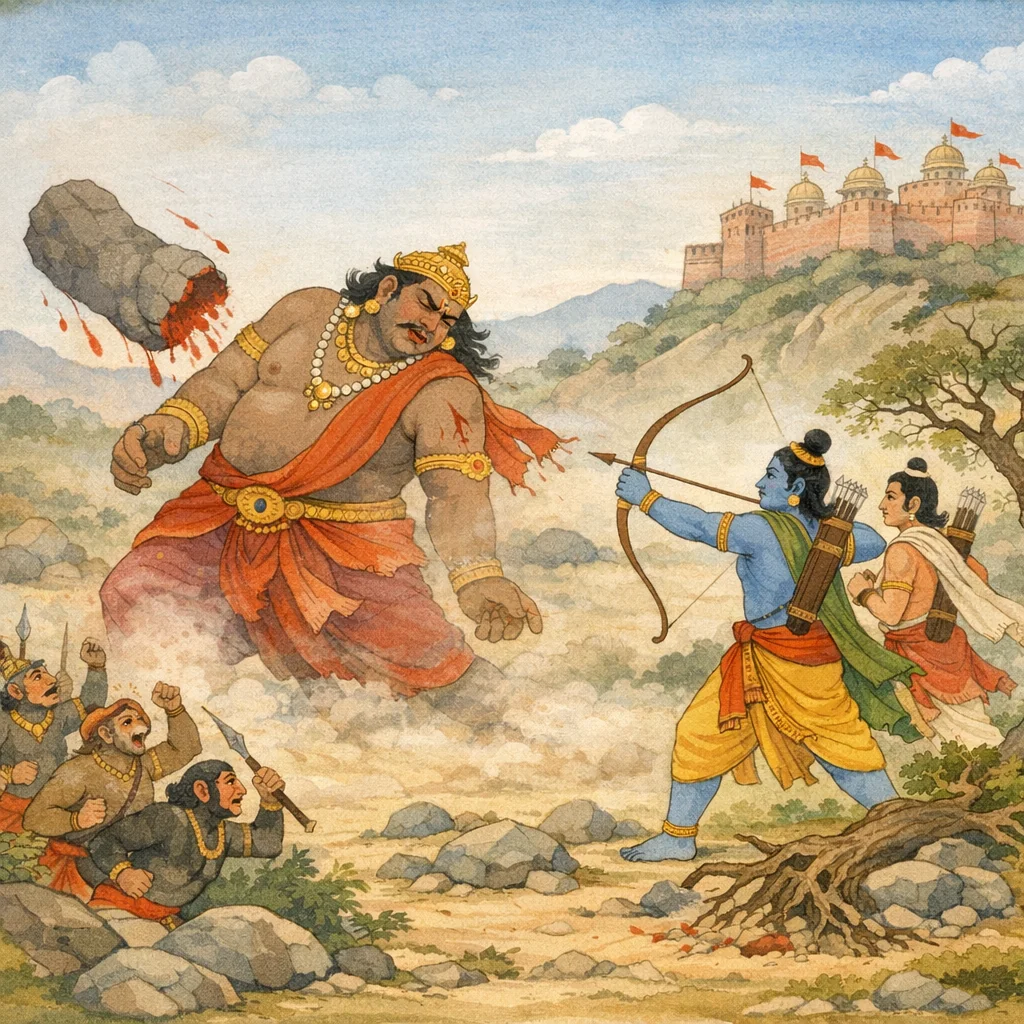
Sarga 67 intensifies the Lanka battlefield by focusing on Kumbhakarna’s overwhelming, almost cosmic-scale violence and the Vanara coalition’s attempts to stabilize morale. Angada’s exhortation restores the Vanaras’ resolve to re-enter combat. Multiple Vanara champions (including Angada, Sugriva, Hanuman, Nīla, Ṛṣabha, Śarabha, Gavākṣa, and Gandhamādana) engage Kumbhakarna with trees, rocks, and mountain-peaks; many attacks prove ineffectual, emphasizing the Rakshasa’s near-invulnerability and the asymmetry of force. Kumbhakarna counters by devouring combatants and scattering formations, while also issuing disdainful, boast-laden challenges that reframe the duel as a contest against death itself. The narrative then pivots to Rāma’s direct intervention: he reassures the Vanaras, advances with bow and quiver, and employs divine missiles (notably Vāyavya and later Indra-charged weaponry). A key turning point occurs when Rāma severs Kumbhakarna’s arm; the severed limb, likened to a mountain peak, falls into the Vanara ranks and causes casualties—an instance of collateral devastation that underscores war’s tragic spillover even on the righteous side. Despite losing limbs, Kumbhakarna continues to attack, forcing a methodical escalation: further severing of arms and feet, disabling his capacity to fight, and culminating in Rāma’s final, radiant arrow that beheads him. The chapter closes with cosmic resonance—earth and mountains tremble, celestial beings rejoice, and the Vanaras regain confidence—marking Kumbhakarna’s death as a strategic and moral inflection in the war.
Shlokas
Verse 1
तेनिवृत्तामहाकायाश्श्रुत्वाङ्गदवचस्तदा ।नैष्ठिकींबुद्धिमास्थायसर्वेसङ्ग्रामकाङ्क्षिणः ।।।।
Then those mighty-bodied Vānaras, having heard Aṅgada’s words, adopted an unwavering resolve; all of them, eager for battle, turned back.
Verse 2
समुदीरितवीर्यास्तेसमारोपितविक्रमाः ।पर्यवस्थापितावाक्यैरङ्गदेनवलीमुखाः ।।।।प्रयाताश्चगताहर्षंमरणेकृतश्चयाः ।चक्रुस्सुतुमुलंयुद्धंवानरास्त्यक्तजीविताः ।।।।
Thus the Vānara leaders, their valor stirred and their martial resolve rekindled by Aṅgada’s words, advanced with gladness—having made up their minds even for death—and waged a fiercely tumultuous battle, staking their very lives.
Verse 3
समुदीरितवीर्यास्तेसमारोपितविक्रमाः ।पर्यवस्थापितावाक्यैरङ्गदेनवलीमुखाः ।।6.67.2।।प्रयाताश्चगताहर्षंमरणेकृतश्चयाः ।चक्रुस्सुतुमुलंयुद्धंवानरास्त्यक्तजीविताः ।।6.67.3।।
Roused to remembrance of their valor and set again in martial resolve by Aṅgada’s words, the Vānara leaders returned with joy, determined even upon death; staking their lives, they waged a most tumultuous battle.
Verse 4
अथवृक्षान्महाकायास्सानूनिसुमहान्ति च ।वानरास्तूर्णमुद्यम्यकुम्भकर्णमभिद्रुताः ।।।।
Then the mighty-bodied Vānara warriors, quickly lifting up enormous trees and huge mountain-peaks, rushed straight at Kumbhakarṇa.
Verse 5
कुम्भकर्णस्सङ्कृद्धोगदामुद्यम्यवीर्यवान् ।अर्थयन्समहाकायस्समन्ताद् व्यक्षिपद्रिपून् ।।।।
Kumbhakarṇa, valiant and greatly enraged, raised his mace; that विशाल-bodied warrior struck down the foes on every side, cutting them down in sweeping arcs.
Verse 6
शतानिसप्तचाष्टौ च सहस्राणि च वानराः ।प्रकीर्णाःशेरतेभूमौकुम्भकर्णेनपोधिताः ।।।।
Hundreds—seven or eight—and even thousands of Vānaras, seized and flung down by Kumbhakarṇa, lay scattered upon the ground.
Verse 7
षोडशाष्टौ च दश च विंशत्रतिंशस्तथैव च ।परिक्षिप्य च बाहुभ्यांखादन्विपरिधावति ।।।।भक्ष्यन् भृशसङ्क्रुद्धोगरुडःपन्नगानिव ।
In furious anger, he seized groups—sixteen, eight, ten, and likewise twenty and thirty—encircling them with his arms, devouring them as he rushed about, like Garuḍa consuming serpents.
Verse 8
कृच्छ्रेणचसमाश्वस्ताःसङ्गम्यचततस्ततः ।।।।वृक्षाद्रिहस्ताहरयस्तस्थुस्सङ्ग्राममूर्थनि ।
Regaining courage with difficulty, gathering from here and there, the vānaras—trees and mountains in their hands—stood again at the very forefront of the fight.
Verse 9
ततःपर्वतमुत्पाट्यद्विविदःप्लवगर्षभः ।।।।दुद्रावगिरिशृङ्गाभंविलम्बइवतोयदः ।
Then Dvivida, a bull among the Vānaras, tore up a mountain and charged forward—like a looming thundercloud, and like a mountain-peak in form.
Verse 10
तंसमुत्पत्यचिक्षेपकुम्भकर्णायवानरः ।।।।तमप्राप्यमहाकायंतस्यसैन्येऽपतत्तधा ।
A Vānara leapt up and hurled (the weapon) at Kumbhakarṇa; missing that huge-bodied foe, it fell instead upon his army.
Verse 11
ममर्दाश्वान्गजांश्चापिरथांश्चापिनगोत्तमः ।।।।तानिचान्यानिरक्षांसिएवंचान्यगदिरेःशिरः ।
A towering mountain-crest crushed horses, elephants, and chariots; and in the same way it crushed other rākṣasas as well—when the peak of another mountain was hurled.
Verse 12
तच्चैलवेगाभिहतंहताश्वंहतसारथि ।।।।रक्षसांरुधिरक्लिन्नंबभूवायोधनंमहत् ।
That great battlefield—where chariots were struck with the mountain’s rushing force, horses were crushed and charioteers slain—became soaked with the blood of the Rākṣasas.
Verse 13
रथिनोवानरेन्द्राणांशरैःकालान्तकोपमैः ।।।।शिरांसिनर्दतांजह्रुस्सहसाभीमनिस्स्वना ।
The Rakshasa charioteers, thundering with dreadful cries, severed the heads of the roaring Vanara chiefs with arrows as fatal as Death at the end of time.
Verse 14
वानराश्चमहात्मानस्समुत्पाट्यमहाद्रुमान् ।।।।रथावश्वान्गजानुष्ट्रान्राक्षसानभ्यसूदयन् ।
The great-souled vānaras, uprooting massive trees, set about destroying chariots, horses, elephants, camels, and the rākṣasas themselves.
Verse 15
हनुमान् शैलशृङ्गाणिशिलाश्चविविधान् द्रुमान् ।।।।ववर्षकुम्भकर्णस्यशिरस्यम्बरमास्थितः ।
Stationed in the sky, Hanumān showered mountain-peaks, rocks, and various trees down upon Kumbhakarṇa’s head.
Verse 16
तानिपर्वतशृङ्गाणिशूलेन स बिभेद ह ।।।।बभञ्जवृक्षवर्षं च कुम्भकर्णोमहाबलः ।
Those mountain peaks he split with his spear; and mighty Kumbhakarṇa shattered the onslaught of trees as well.
Verse 17
ततोहरीणांतदनीकमुग्रंदुद्रावशूलंनिशितंप्रगृह्य ।तस्थौ स तस्यापततःपुरस्तान्महीधराग्रंहनुमान् प्रगृह्य ।।।।
Then, gripping a keen, sharp pike, he rushed fiercely upon that formidable army of the Vānara-s. But Hanumān, seizing the peak of a mountain, stood firm and placed it before himself as the attacker charged toward him.
Verse 18
स कुम्भकर्णंकुपितोजघानवेगेनशैलोत्तमभीमकायम् ।स चक्षुभेतेनतदाभिभूतोमेदार्द्रगात्रोरुधिरावसिक्तः ।।।।
Enraged, he struck Kumbhakarṇa—whose fearsome body was like a mighty mountain—with swift force. Overwhelmed by that blow, Kumbhakarṇa reeled, his limbs smeared with fat and drenched in blood.
Verse 19
स शूलमासाद्यतटित्प्रकाशंगिरिर्यथाप्रज्वलिताग्रशृङ्गम् ।बाह्वन्तरेमारुतिमाजघानगुहोऽचलंक्रौञ्चमिवोग्रशक्त्या ।।।।
Seizing a spear that flashed like lightning, like a mountain with a blazing peak, he struck Māruti between the arms (at the chest) with fierce power—like Guha striking the Krauñca mountain.
Verse 20
शूलनिर्भिन्नमहाभुजान्तरःप्रविह्वलःशोणितमुद्वमन् मुखात् ।ननादभीमंहनुमान् महाहवेयुगान्तमेघस्न्तितस्वनोपमम् ।।।।
In that great battle, Hanūmān—his chest pierced by the spear—reeled and spat blood from his mouth; yet he roared terribly, like the thunder of end-time clouds.
Verse 21
ततोविनेदुःसहसाप्रहृष्टारक्षोगणास्तंव्यथितंसमीक्ष्य ।प्लवङ्गमास्तुव्यथिताभयर्ताःप्रदुद्रुवुःसंयतिकुम्भकर्णात् ।।।।
Then the rākṣasa troops, suddenly elated on seeing him in distress, raised cries of triumph. But the Vānara hosts—shaken and stricken with fear—ran away in the battle from Kumbhakarṇa.
Verse 22
ततस्तुनीलोबलवान् पर्यवस्थापयन्बलम् ।प्रविचिक्षेपशैलाग्रंकुम्भकर्णायधीमते ।।।।
Then the mighty Nīla, steadying and re-forming the ranks, hurled a mountain-peak at the wise Kumbhakarṇa.
Verse 23
तदापतन्तंसम्प्रेक्ष्यमुष्टिनाभिजघान ह ।मुष्टिप्रहाराभिहतंतच्छैलाग्रंव्यशीर्यत ।।।।सविस्फुलिंगंसज्वालनिपपातमहेतले ।
Seeing that mountain-peak rushing toward him, he struck it with his fist. Shattered by the blow, the peak broke apart and fell to the earth, blazing with flames and scattering sparks.
Verse 24
ऋषभश्शरभोनीलोगवाक्षोगन्धमादनः ।।।।पञ्चवानरशार्दूलाःकुम्बुकर्णमुपाद्रवन् ।
Ṛṣabha, Śarabha, Nīla, Gavākṣa, and Gandhamādana—five tiger-like champions among the Vānaras—charged upon Kumbhakarṇa.
Verse 25
शैलैर्ववृक्षैस्तलैःपादैर्मुष्टिभिश्चमहाबलाः ।।।।कुम्भकर्णंमहाकायंसर्वतोऽभिप्रदुद्रुवुः ।
Those immensely strong Vānaras rushed at the huge-bodied Kumbhakarṇa from every side, striking with rocks and trees, and with palms, feet, and fists.
Verse 26
स्पर्शानिवप्रहारांस्तान्वेद्वयानो न विव्यथे ।।।।ऋषभंतुमहावेगंबाहुभ्यांपरिषस्वजे ।
Feeling those blows as though they were mere touches, he did not suffer pain; then, with great force, he seized Ṛṣabha in his arms and crushed him in an embrace.
Verse 27
कुम्भकर्णभुजाभ्यांतुपीडितोवानरर्षभः ।।।।निपपातर्षभोभीमःप्रमुखाद्वान्तशोणितः ।
Pressed by Kumbhakarṇa’s arms, Ṛṣabha—the bull among the Vānaras, fierce in aspect—collapsed, vomiting blood from his mouth.
Verse 28
मुष्टिनाशरभंहत्वाजानुनानीलमाहवे ।।।।आजघानगवाक्षंतुलेनेन्द्ररिपुस्तदा ।पादेनाभ्यहनत्कृद्धस्तरसागन्धमादनम् ।।।।
Then that foe of Indra, enraged in battle, struck Śarabha with his fist, battered Nīla with his knee, smote Gavākṣa with a slap of his palm, and with a swift kick of his foot drove at Gandhamādana.
Verse 29
मुष्टिनाशरभंहत्वाजानुनानीलमाहवे ।।6.67.28।।आजघानगवाक्षंतुलेनेन्द्ररिपुस्तदा ।पादेनाभ्यहनत्कृद्धस्तरसागन्धमादनम् ।।6.67.29।।
This verse repeats the same action: in battle, the enraged Kumbhakarṇa—Indra’s foe—struck Śarabha with his fist, drove his knee into Nīla, slapped Gavākṣa with his palm, and kicked Gandhamādana with force.
Verse 30
दत्तप्रहारव्यथितामुमुहुश्शोणितोक्षिताः ।निपेतुस्तेतुमेदिन्यांनिकृत्ताइवकिंशुकाः ।।।।
Struck and pained by the blows, their eyes drenched in blood, the Vānaras fainted and fell upon the earth, like kiṃśuka trees cut down.
Verse 31
तेषुवानरमुख्येषुपातितेषुमहात्मसु ।वानराणांसहस्राणिकुम्बकर्णंप्रदद्रुवुः ।।।।
When those great Vānara leaders had been struck down, thousands of Vānaras rushed straight toward Kumbhakarṇa.
Verse 32
तंशैलमिवशैलाभाःसर्वेतुप्लवगर्षभाः ।समारुह्यसमुत्पत्यददंशुश्चमहाबलाः ।।।।
All those mighty bulls among the Vānaras, themselves like mountains, climbed upon him as though he were a mountain, leapt up, and bit him.
Verse 33
तंनखैर्धशनैश्चापिमुष्टिभिर्बाहुभिस्तथा ।कुम्भकर्णंमहाबाहहुंतेजघ्नुःप्लवगर्षभाः ।।।।
Those bulls among the Vānaras struck mighty-armed Kumbhakarṇa with claws and teeth, and also with fists and arms.
Verse 34
स वानरसहस्त्रैरजितः पर्वतोपमैः ।रराजराक्षसव्याघ्रोगिरिरात्मरुहैरिव ।।।।
Covered over by thousands of Vānaras like mountains, that tiger among Rākṣasas shone forth like a mountain thick with trees growing upon it.
Verse 35
बाहुभ्यांवानरान्सर्वान्प्रगृह्य स महाबलः ।भक्ष्यामाससङ्क्रुद्धोगरुडःपन्नगानिव ।।।।
Seizing all the Vānaras with his arms, that immensely strong one—enraged—began to devour them, like Garuḍa devouring serpents.
Verse 36
प्रक्षिप्ताःकुम्बकर्णेनवक्त्रेपातालसन्निभे ।नासापुटाभ्यांनिर्जग्मुःकर्णाभ्यांचैववानराः ।।।।
Cast by Kumbhakarṇa into his mouth, like the very netherworld, the Vānaras came out through his nostrils—and through his ears as well.
Verse 37
भक्ष्यन्भृशसङ्क्रुद्धो हरीन् पर्वतसन्निभः ।बभञ्जवानरान् सर्वान् सङ्क्रुद्धोराक्षसोत्तमः ।।।।
Eating the Vānaras in furious rage, that foremost of Rākṣasas—mountain-like—crushed and mangled all the Vānaras in his wrath.
Verse 38
मांसशोणितसंक्लेदाकुर्वन् भूमिं स राक्षसः ।चचारहरिनैन्येषुकालानगिरिवमूर्छितः ।।।।
That Rākṣasa moved through the Vānara ranks, making the earth slick with flesh and blood—reeling like a dark mountain, like the fire of dissolution in its sweep.
Verse 39
वज्रहस्तोयथाशक्रःपाशहस्तइवान्तकः ।शूलहस्तोबभौयुद्धेकुम्बकर्णोमहाबलः ।।।।
On the battlefield, mighty Kumbhakarṇa, holding a spear, blazed forth like Śakra with the thunderbolt in hand, and like Antaka with the noose in hand.
Verse 40
यथाशुष्काण्यरण्यानिग्रीष्मेदहतिपावकः ।तथावानरसैन्यानिकुम्बकर्णोविनिर्दहत् ।।।।
As fire in summer consumes dried-out forests, so Kumbhakarṇa was burning through the ranks of the Vānara army.
Verse 41
ततस्तेवध्यमानास्तुहतयूथाविनायकाः ।वानराभयसंविग्नाविनेदुर्विस्वरंभृशैः ।।।।
Then those Vānara warriors, being slain and with their troop-leaders fallen, shaken by fear, cried out loudly in harsh, discordant voices.
Verse 42
अनेकशोवध्यमानाःकुम्भकर्णेनवानराः ।राघवंशरणंजग्मुर्व्यथिताःभिन्नचेतसः ।।।।
Struck down in many ways by Kumbhakarṇa, the Vānara warriors—distressed and broken in spirit—went to Rāghava, seeking his protection.
Verse 43
प्रभग्नान् वानरान् दृष्टवावज्रहस्तात्मजात्मजः ।अभ्यधावतवेगेनकुम्भकर्णंमहाहवे ।।।।
Seeing the Vānara forces routed, Angada—descended from Vajrahasta (Indra)—rushed at speed toward Kumbhakarṇa in that great battle.
Verse 44
शैलशृङ्गंमहद्गृह्यविनदंश्चमुहुर्मुहुः ।त्रासयन्राक्षसान्सर्वान् कुम्भकर्णपदानुगान् ।।।।चिक्षेपशैलशिखरंकुम्भकर्णस्यमूर्धनि ।
Grasping a massive mountain-peak and roaring again and again, Angada terrified all the Rākṣasas who followed in Kumbhakarṇa’s wake, and hurled that mountain-summit onto Kumbhakarṇa’s head.
Verse 45
स तेनाभिहतोमूर्ध्निशैलेनेन्द्ररिपुस्तदा ।।।।कुम्भकर्णःप्रजज्वालक्रोधेनमहतातदा ।सोऽभ्यधावतवेगेनवालिपुत्रममर्षणम् ।।।।
Struck on the head by that mountain, Kumbhakarṇa—Indra’s foe—blazed with great anger, and then charged at Vāli’s son, the unenduring Angada, with swift force.
Verse 46
स तेनाभिहतोमूर्ध्निशैलेनेन्द्ररिपुस्तदा ।।6.67.45।।कुम्भकर्णःप्रजज्वालक्रोधेनमहतातदा ।सोऽभ्यधावतवेगेनवालिपुत्रममर्षणम् ।।6.67.46।।
Struck on the head by that mountain, Kumbhakarṇa—Indra’s foe—flared up with fierce anger and rushed swiftly at Vāli’s son Angada.
Verse 47
कुम्भकर्णोमहानादस्त्रासयन् सर्ववानरान् ।शूलंससर्जवैरोषादङ्गदेतुमहाबलः ।।।।
Kumbhakarṇa, mighty and thundering, terrifying all the Vānaras, angrily hurled a śūla (pike) at Angada.
Verse 48
त मापतन्तंबुद्ध्वातुयुद्धमार्गविशारदः ।लाघवान्मोचयामाबलवान् वानरर्षभः ।।।।
Recognizing it as it came rushing toward him, Angada—the powerful bull among Vānaras, skilled in the ways of battle—escaped it with agile swiftness.
Verse 49
उत्पत्यचैनंतरसातलेनोरस्यताडयत् ।स तेनाभिहतःकोपात्प्रमुमोहाचलोपमः ।।।।
Leaping up, Aṅgada struck him hard on the chest with the palm of his hand. Smitten by that blow in fury, Kumbhakarṇa—mountain-like—fell into a swoon.
Verse 50
स लब्दसंज्ञोबलवान्मुष्टिमावर्त्यराक्षसः ।अपहास्तेनचिक्षेपविसंज्ञः स पपात ह ।।।।
Regaining consciousness, the mighty rākṣasa clenched and drew back his fist, then struck with the back of his hand. Aṅgada, losing his senses, fell to the ground.
Verse 51
तस्मिन् प्लवगशार्दूलेविसंज्ञेपतितेभुवि ।तच्छूलंसमुपादायसुग्रीवमभिदुद्रुवे ।।।।
When that tiger among monkeys lay senseless on the ground, Kumbhakarṇa seized his pike and rushed straight at Sugrīva.
Verse 52
तमापतन्तंसम्प्रेक्ष्यकुम्भकर्णंमहाबलम् ।उत्पपाततदावीरस्सुग्रीवोवानराधिपः ।।।।
Seeing mighty Kumbhakarṇa rushing in, the valiant Sugrīva—the lord of the Vānaras—leapt forward to meet him.
Verse 53
स पर्वताग्रमुत्क्षिप्यसमाविध्यमहाबलः ।अभिदुद्राववेगेनकुम्भकर्णंमहाबलम् ।।।।
Sugrīva, of great might, lifted a mountain-peak, whirled it, and charged at Kumbhakarṇa with speed.
Verse 54
तमापतन्तंसम्प्रेक्ष्यकुम्भकर्णःप्लवङ्गमम् ।तस्थौविवृतसर्वाङ्गोवानरेन्द्रस्यसम्मुखः ।।।।
Watching the monkey-lord rushing in, Kumbhakarṇa stood facing him, bracing his whole body for the clash.
Verse 55
कपिशोणितदिग्धाङ्गंभक्ष्यन्तंप्लवङ्गमान् ।कुम्भकर्णंस्थितंदृष्टवासुग्रीवोवाक्यमब्रवीत् ।।।।
Seeing Kumbhakarṇa standing there—his body smeared with the blood of monkeys as he devoured the Vānaras—Sugrīva spoke to him.
Verse 56
कपिशोणितदिग्धाङ्गंभक्ष्यन्तंप्लवङ्गमान् ।कुम्भकर्णंस्थितंदृष्टवासुग्रीवोवाक्यमब्रवीत् ।।6.67.55।।
Seeing Kumbhakarṇa standing there—smeared with monkey-blood as he devoured the Vānaras—Sugrīva spoke. (This line appears as a repetition/variant numbering in the supplied source.)
Verse 57
त्वजतद्वानरानीकंप्राकृतैःकिंकरिष्यसि ।सहस्वैकंनिपातंमेपर्वतस्यास्यराक्षस ।।।।
“Leave off this Vānara host—what will you accomplish by slaughtering mere creatures of nature? First, rākṣasa, endure a single blow from this mountain that I hurl.”
Verse 58
तद्वाक्यंहरिराजस्यसत्त्वधैर्यसमन्वितम् ।श्रुत्वाराक्षसशार्दूलःकुम्भकर्णोऽब्रवीद्वचः ।।।।
Hearing the Vānara-king’s words—filled with courage and steadfastness—Kumbhakarṇa, the tiger among the Rākṣasas, replied.
Verse 59
प्रजापतेस्तुपौत्रस्त्वंतथैवरक्षरजस्सुतः ।श्रुतपौरुषसम्पन्नःकस्माद्गर्जसिवानर ।।।।
“O Vānara, you are the grandson of Prajāpati and the son of Ṛkṣarajas—renowned and richly endowed with valor. Why, then, do you roar so?”
Verse 60
स कुम्भकर्णस्यवचोनिशम्यव्याविध्यशैलंसहसामुमोच ।तेनाजघानोरसिकुम्भकर्णंशैलेनवज्राशनिसन्निभेन ।।।।
Hearing Kumbhakarṇa’s words, Sugrīva swiftly whirled a mountain and hurled it with force, striking Kumbhakarṇa on the chest with a crag like a thunderbolt.
Verse 61
तच्छैलशृङ्गंसहसाविकीर्णंभुजान्तरेतस्यतदाविशाले ।ततोनिषेदुःसहसाप्लवङ्गारक्षोगणाश्चापिमुदाविनेदुः ।।।।
That mountain-peak shattered at once between his broad shoulders. Then the Vānaras sank in dismay, while the hosts of Rākṣasas roared in joy.
Verse 62
स शैलशृङ्गाभिहतश्चुकोपननादरोषाच्चविवृत्यवक्त्रम् ।व्याविध्यशूलं च तटित्प्रकाशंचिक्षेपहर्यृक्षिपतेर्वधाय ।।।।
Struck by the mountain-peak, he flared with rage; opening his mouth, he roared. Then, whirling a lightning-bright pike, he hurled it to slay Sugrīva, lord of the Vānaras and bears.
Verse 63
तत्कुम्भकर्णस्यभुजप्रविद्धंशूलंशितंकाञ्चनदामजुष्टम् ।क्षिप्रंसमुत्पत्यनिगृह्यदोर्भ्यांबभञ्जवेगेनसुतोऽनिलस्य ।।।।
But Hanumān, son of the Wind, sprang up at once; seizing with both arms that sharp pike cast by Kumbhakarṇa—adorned with golden bands—he shattered it with force.
Verse 64
कृतंभारसहस्रस्यशूलंकालायसंमहत् ।बभञ्जजानुमारोप्यतदाहृष्टःप्लवङ्गमः ।।।।
That great pike of black iron, made to the weight of a thousand bhāras, the Vānara—rejoicing—set upon his knee and snapped apart.
Verse 65
शूलंभग्नंहनुमतादृष्टवावानरवाहिनी ।हृष्टाननादबहुशस्सर्वतश्चापिदुद्रुवे ।।।।
Seeing the pike broken by Hanumān, the Vānara host rejoiced; again and again it raised a roar, and from every side surged forward.
Verse 66
बभूवथपरित्रस्तोराक्षसोविमुखोऽभवत् ।सिंहनादं च तेचक्रुःप्रहृष्टावनगोचराः ।।।।मारुतिंपूजयाञ्चक्रुर्दृष्टवाशूलंतथागतम् ।
Then the Rākṣasa became shaken and turned away. The forest-ranging Vānaras, delighted, raised lion-roars; and seeing the pike thus broken, they honored Māruti (Hanumān).
Verse 67
स तत्तथाभग्नमवेक्ष्यशूलंचुकोपरक्षोधिपतिर्महात्मा ।उत्पाट्यलङ्कामलयात्सशृङ्गंजघानसुग्रीवमुपेत्यतेन ।।।।
Seeing his spear shattered in that manner, the great lord of the Rākṣasas flared up in rage. Tearing up the Malaya mountain of Laṅkā with its peak, he struck Sugrīva as Sugrīva came toward him.
Verse 68
स शैलशृङ्गाभिहतोविसंज्ञःपपातभूमौयुधिवानरेन्द्रः ।तंप्रेक्ष्यभूमौपतितंविसंज्ञनेदुःप्रहृष्टास्त्वथयातुधानाः ।।।।
Struck by the mountain peak, the lord of the Vānaras fell on the battlefield, senseless. Seeing him lying unconscious on the ground, the Rākṣasas exulted and raised triumphant cries.
Verse 69
मभ्युपेत्याद्भुतघोरवीर्यं स कुम्भकर्णोयुधिवानरेन्द्रम् ।जहारसुग्रीवमभिप्रगृह्ययथानिलोमेघमतिप्रचण्डः ।।।।
Kumbhakarṇa, of astonishing and dreadful prowess, came up to the Vānara king in battle; seizing Sugrīva, he carried him off like a violently raging wind bearing away a cloud.
Verse 70
स तंमहामेघनिकाशरूपमुत्पाट्यगच्छन्युधिकुम्भकर्णः ।रराजमेरुप्रतिमानरूपोमेरुर्यथाभ्युछ्रचितघोरशृङ्गः ।।।।
Bearing him off, Kumbhakarṇa moved through the battle—his form like a massive cloud—shining like Mount Meru itself, marked by towering and fearsome peaks.
Verse 71
ततस्तमादायजगामवीरस्संस्तूयमानोयुधिराक्षसेन्द्रैः ।शृण्वन्निनादंत्रिदिवालयानांप्लवङ्गराजग्रहविस्मितानाम् ।।।।
Then the hero went off, bearing him away, praised by the lords among the Rākṣasas in the midst of battle—while he heard the clamour of the denizens of heaven, astonished at the capture of the monkey-king.
Verse 72
ततस्तमादायतदा स मेनेहरीन्द्रमिन्द्रोपममिन्द्रवीर्यः ।अस्मिन् हतेसर्वमिदंहतंस्यात्सराघवंसैन्यमितीन्द्रशत्रुः ।।।।
Having seized him, the Indra’s foe—mighty as Indra in prowess—judged the monkey-lord, Sugrīva, to be Indra-like: “If he is slain, it will be as though the entire host, Rāghava’s forces included, were slain.”
Verse 73
विद्रुतांवाहिनींदृष्टवावानराणामितस्ततः ।कुम्भकर्णेनसुग्रीवंगृहीतंचापिवानरम् ।।।।हनुमांश्चिन्तयामासमतिमान् मारुतात्मजः ।
Seeing the Vānara host fleeing in all directions, and Sugrīva captured by Kumbhakarṇa, Hanumān—the wise son of Māruta—began to deliberate.
Verse 74
एवंगृहीतेसुग्रीवेकिंकर्तव्यंमयाभवेत् ।।।।यद्वैन्यायंमयाकर्तुंतत्करिष्यामिसर्वधा ।भूत्वापर्वतसङ्काशोनाशयिष्यामिराक्षसम् ।।।।
“Now that Sugrīva has been seized, what must be done by me? Whatever is right for me to do, that I shall do without fail. Becoming mountain-like in might, I will destroy the Rākṣasa.”
Verse 75
एवंगृहीतेसुग्रीवेकिंकर्तव्यंमयाभवेत् ।।6.67.74।।यद्वैन्यायंमयाकर्तुंतत्करिष्यामिसर्वधा ।भूत्वापर्वतसङ्काशोनाशयिष्यामिराक्षसम् ।।6.67.75।।
“Now that Sugrīva has been seized, what must be done by me? Whatever is right for me to do, that I shall do without fail. Becoming mountain-like in might, I will destroy the Rākṣasa.”
Verse 76
मयाहतेसंयतिकुम्भकर्णेमहाबलेमुष्टिविशीर्णदेहे ।विमोचितेवानरपार्थिवे च भवन्तुहृष्टाःप्लवगास्समस्ताः ।।।।
When mighty Kumbhakarṇa has been slain by me in the duel—his body shattered by blows—and when the king of the vānaras is freed, then let all the monkeys rejoice.
Verse 77
अथवास्वयमप्येषमोक्षंप्राप्स्यतिपार्थिव ।गृहीतोऽयंयदिभवेत्रिदशैस्सासुरोरगैः ।।।।
Or else, O king, he will win his own release—even if he were seized by the gods together with demons and nāgas.
Verse 78
मन्ये न तावदात्मानंबुध्यतेवानराधिपः ।शैलप्रहाराभिहतःकुम्भकर्णेनसंयुगे ।।।।
I think the lord of the vānaras is not yet fully aware of himself, for in the battle Kumbhakarṇa struck him with a mountain-blow.
Verse 79
अयंमुहूर्तात्सुग्रीवोलब्दसंज्ञोमहाहवे ।आत्मनोवानराणां च यत्पथ्यंतत्करिष्यति ।।।।
In a short while, in this great battle, Sugrīva will regain consciousness and do what is beneficial—both for himself and for the vānaras.
Verse 80
मयातुमोक्षितस्यास्यसुग्रीवस्यमहात्मनः ।अप्रीतिश्चभवेत्कष्टाकीर्तिनाशश्चशाश्वतः ।।।।
But if I were to free this great-souled Sugrīva myself, it would bring him bitter displeasure—and a lasting loss of honor.
Verse 81
तस्मान्मुहूर्तंकाङ्क्षिष्येविक्रमंपार्थिवस्यतु ।भिन्नं च वानरानीकंतावदाश्वासयाम्यहम् ।।।।
Therefore I shall wait a moment to witness the king’s prowess; meanwhile, I will hearten and steady the scattered vānara host.
Verse 82
इत्येवंचिन्तयित्वातुहनुमान्मारुतात्मजः ।भूयःसंस्तम्भयामासवानराणांमहाचमूम् ।।।।
Having thought thus, Hanumān—the son of the Wind—once again strengthened the resolve of the great vānara host.
Verse 83
स कुम्भकर्णोऽथविवेशलङ्कांस्पुरन्तमादायमहाकपिंतम् ।विमानचर्यागृहगोपुरस्थैःपुष्पाग्य्रवर्षैरवकीर्यमाणः ।। ।
Then Kumbhakarṇa entered Laṅkā carrying that great ape, trembling and struggling—while those stationed on terraces, mansions, and gate-towers rained down showers of choice flowers upon him.
Verse 84
लाजगन्धोदवर्षैस्तुसिच्यमानश्सनैश्शनैः ।राजवीथ्यास्तुशीतत्वात्संज्ञांप्रापमहाबलः ।।।।
Bathed in showers of parched grain and scented water, and cooled by the chill of the royal avenue, the mighty one gradually regained consciousness.
Verse 85
ततस्ससंज्ञामुपलभ्यकृच्छ्राद्बलीयसस्तस्यभुजान्तरस्थः ।अवेक्षमाणःपुरसाजमार्गंविचिन्तयामासमुहुर्महात्मा ।।।।
Then, with difficulty regaining consciousness while still held within the powerful rākṣasa’s arms, the great-souled Sugrīva looked toward the royal road of the city and, for a moment, pondered in bewilderment what should be done.
Verse 86
एवंगृहीतेनकथंनुनामशक्यंमयासम्प्रतिकर्तुमद्य ।तथाकरिष्यामियथाहरीणांभविष्यतीष्टं च हितं च कार्यम् ।।।।
“Seized like this, what can I possibly do right now?” he thought. “Yet I shall act in such a way that it becomes both beneficial and welcome for the Vānara host—and that the needed task is accomplished.”
Verse 87
ततःकराग्रैःसहसासमेत्यराजाहरीणाममरेन्द्रशत्रुम् ।खरैश्चकर्णौदशनैश्चनासांददंशपार्श्वेषु च कुम्भकर्णम् ।।।।
Thereupon the Vānara-king sprang into action: with sharp nails he tore at Kumbhakarṇa—the foe of Indra—ripping at his ears; with his teeth he bit off his nose, and he mauled his sides as well.
Verse 88
स कुम्भकर्णोहृतकर्णनासोविदारितस्तेनरदैर्नखैश्च ।रोषाभिभूतःक्षतजार्द्रगात्रःसुग्रीवमाविध्यपिपेषभूमौ ।।।।
Kumbhakarṇa—his ears and nose torn away, his body ripped by teeth and nails—was overcome with rage. With limbs wet with blood from his wounds, he hurled Sugrīva down and crushed him against the ground.
Verse 89
स भूतलेभीमबलाभिपिष्टस्सुरारिभिस्स्सैरभिहन्यमानः ।जगामखंवेगवदभ्युपेत्यपुनश्चरामेणसमाजगाम ।।।।
Though pounded down upon the earth by those enemies of the gods with dreadful strength, he sprang up with speed into the open sky—and then returned again to rejoin Rāma.
Verse 90
कर्णनासाविहीनस्तुकुम्भकर्णोमहाबलः ।रराजशोणितैःसिक्तोगिरिःप्रस्रवणैरिव ।।।।
But mighty Kumbhakarṇa, now without ears and nose, shone even so—drenched in blood like a mountain streaming with springs.
Verse 91
शोणितार्द्रोमहाकायोराक्षसोभीमविक्रमः ।युद्धायाभिमुखोभीमोमनश्चक्रेनिशाचरः ।।।।नीलाञ्जनचयप्रख्यःसस्नध्यइवतोयदः ।अमर्षाच्छोणितोद्गारीशुशुभेरावणानुजीः ।।।।
That night-roaming rākṣasa—gigantic, terrible in prowess, and drenched in blood—set his mind once more on battle and turned to face the fight. Dark as a mass of collyrium, like a dense cloud at dusk, Rāvaṇa’s younger brother looked fearsome, spattering blood in his wrath.
Verse 92
शोणितार्द्रोमहाकायोराक्षसोभीमविक्रमः ।युद्धायाभिमुखोभीमोमनश्चक्रेनिशाचरः ।।6.67.91।।नीलाञ्जनचयप्रख्यःसस्नध्यइवतोयदः ।अमर्षाच्छोणितोद्गारीशुशुभेरावणानुजीः ।।6.67.92।।
This input line reproduces the same two-part description of Kumbhakarṇa (labeled 6.67.91–92). Read as a continuation: blood-soaked and gigantic, he fixed his mind on battle; dark like a dense dusk-cloud, Rāvaṇa’s younger brother appeared terrible, spattering blood in rage.
Verse 93
गतेतुतस्मिन् सुरराजशत्रुःक्रोधात्प्रदुद्रावरणायभूयः ।अनायुधोऽस्मीतिविचिन्त्यरौद्रोघोरंतदामुद्गरमाससाद ।।।।
When he (Sugrīva) had gone, the enemy of the Lord of the gods rushed again toward battle in anger. Thinking, “I am without a weapon,” the fierce one then seized a dreadful iron mallet.
Verse 94
ततस्सपुर्यास्ससहसामहात्मानिष्क्रम्यतद्वानरसैन्यमुग्रम् ।बभक्षरक्षोयुधिकुम्भकर्णःप्रजायुगान्तानगिरिवप्रवृद्धः ।।।।
Then the great-souled Kumbhakarṇa, rushing out from the city at once, plunged into the fierce Vānara host in battle and devoured them—like the conflagration at the end of an age consuming living beings.
Verse 95
बुभुक्षितःशोणइतमांसगृध्नुःप्रविव्यतद्वानरसैन्यमुग्रम् ।चखादरक्षांसिहरीन् पिशाचान् ऋक्षांश्चमोहाद्युधिकुम्भकर्णः ।यथैवमृत्युर्हरतेयुगान्ते स भक्ष्यामासहरींश्चमुख्यान् ।।।।
Famished and craving blood and flesh, Kumbhakarṇa forced his way into the fierce Vānara host. In battle, out of delusion, he devoured even rākṣasas, vānara warriors, piśācas, and bears; and he began seizing the foremost Vānaras just as Death carries beings off at the end of time.
Verse 96
एकंद्वौत्रीन् बहून् क्रुद्धोवानरान्सहराक्षसैः ।समादायैकहस्तेनप्रचिक्षेपत्वरन्मुखे ।।।।
Enraged, he would snatch up one, two, three—indeed many—Vānara warriors, along with rākṣasas, and in haste fling them into his mouth with a single hand.
Verse 97
सम्प्रस्रवंस्तदामेदश्शोणिते च महाबलः ।वध्यमानोनगेन्द्राग्रैर्भक्ष्यामासवानरान् ।।।।
Then the mighty one—while being struck with mountain-peaks—kept devouring the Vānaras, as fat and blood streamed forth.
Verse 98
तेभक्ष्यमाणाहरयोरामंजुग्मुस्तदागतिम् ।कुम्भकर्णोभृशंक्रुद्धःकपीन् खादन् प्रधावति ।।।।
As they were being devoured, those Vānara warriors then went to Rāma for refuge; but Kumbhakarṇa, fiercely enraged, chased after them, still eating the monkeys as he ran.
Verse 99
शतानिसप्तचाष्टौ च विंशत्रतिंशत्तथैव च ।सम्परिष्वज्यबाहुभ्यांखादवनिपरिधावति ।।।।
Spreading his arms all around, he would seize them in great numbers—by hundreds, by sevens and eights, by twenties and thirties—and run about devouring them.
Verse 100
मेदोवसाशोणितदिग्धगात्रःकरायवसक्तग्रथितान्त्रमालः ।ववर्षशूलानिसतीक्षणदंष्ट्रःकालोयुगान्तस्थइववृद्धः ।।।।
With limbs smeared in fat and blood, and with garlands of tangled entrails hanging from his ears, his fangs razor-sharp, he rained down spears—like Death itself, swollen and terrible as at the world’s end.
Verse 101
तस्मिन् कालेसुमित्रायाःपुत्रःपरबलार्दनः ।चकारलक्ष्मणःक्रुद्धोयुद्धंपरपुरञ्जयः ।।।।
At that time Lakṣmaṇa—Sumitrā’s son, a crusher of hostile forces and a conqueror of enemy strongholds—angered, entered into battle.
Verse 102
स कुम्भकर्णस्यशरान् शरीरेसप्तवीर्यवान् ।निचखादाददेचान्यावनिससर्ज च लक्ष्मणः ।।।।
Then the valiant Lakṣmaṇa drove seven arrows into Kumbhakarṇa’s body; and taking up other arrows, he released them again in volleys.
Verse 103
पीड्यमानस्तदस्त्रंतुविशेषंतत्सराक्षसः ।ततश्चुकोपबलवान्सुमित्रानन्दवर्दनः ।।।।
Tormented by that weapon, the rākṣasa countered it and nullified its special force; then the mighty Lakṣmaṇa—who increased Sumitrā’s joy—flared up in anger.
Verse 104
अथास्यकवचंशुभ्रंजाम्भूनदमयंशुभम् ।प्रच्छादयामासशरैस्सन्ध्याभ्रमिवमारुतः ।।।।
Then he blanketed that shining, splendid golden armor with arrows, like the wind covering the evening cloud-mass.
Verse 105
नीलाञ्जनचयप्रख्यश्शरैःकाञ्चनभूषणैः ।अपीड्यमानश्शुशुभेमेघैस्सूर्यइवांशुमान् ।।।।
Dark as a heap of blue collyrium, adorned with golden ornaments and bristling with arrows, he still did not seem distressed; he shone like the sun with its rays, veiled by clouds.
Verse 106
ततस्सराक्षसोभीमस्सुमित्रानन्दवर्धनम् ।सावज्ञमेवप्रोवाचवाक्यंमेघौघनिस्स्वनः ।।।।
Thereupon that dreadful rākṣasa, whose voice rumbled like masses of thunderclouds, spoke to Lakṣmaṇa—Sumitrā’s joy—in a tone of contempt.
Verse 107
अन्तकस्याप्यकष्टेन युधि जेतारमाहवे ।युध्यतामामभीतेनख्यापितावीरतात्वया ।।।।
“By fighting me without fear, you have made your valor known—me, who in battle has overcome even Antaka (Death) with ease.”
Verse 108
प्रगृहीतायुधस्येहमृत्योरिवमहामृधे ।तिष्ठन्नप्रग्रतःपूज्यःकिमुयुद्धप्रदायकः ।।।।
“Here, in this great battle, one who stands before me—weapon in hand—like Death himself, is worthy of honor; how much more one who offers battle (so boldly)!”
Verse 109
ऐरावतंबलेनसमारूढोवृतःसर्वामरैःप्रभुः ।नैवशक्रोऽपिसमरेस्थितपूर्वःकदाचन ।।।।
“Even Śakra (Indra) himself—lord of the gods—mounted on mighty Airāvata and surrounded by all the immortals, has never stood facing me in battle, not ever.”
Verse 110
अद्यत्वयाहम्सौमित्रेबालेनापि , नापिपराक्रमैः ।तोषितोगन्तुमिच्छामित्यामनुज्ञाप्यराघवम् ।।।।
“Saumitri, today I am satisfied with you—though you are still young—by your prowess. Having taken leave, I wish to go to Rāghava (Rāma).”
Verse 111
यत्तुवीर्यबलोत्साहैस्तोषितोऽहंरणेत्वया ।राममेवैकमिच्छामिहन्तुंयस्मिन् हतेहतम् ।।।।
“It is true that in battle you have pleased me by your valour, strength, and ardour; yet I desire to kill Rāma alone—when he is slain, all is as good as slain.”
Verse 112
रामेमयात्रनिहतेयेऽन्येस्थास्यन्तिसंयुगे ।तानहंयोधयिष्यामिस्वबलेनप्रमाथिना ।।।।
“When Rāma has been slain here by me, whoever else remains standing in the battle—I shall then engage them with my own crushing force (and army).”
Verse 113
इत्युक्तवाक्यंतद्रक्षःप्रोवाचस्तुतिसंहितम् ।मृधेघोरतरंवाक्यंसौमित्रिःप्रहसन्निव ।।।।
When that rākṣasa had spoken such boast-laden, dreadful words on the battlefield, Saumitri—almost as if laughing—replied.
Verse 114
यस्त्वंशक्रादिभिर्वरैरसह्यःप्राप्यपौरुषम् ।तत्सत्यंनान्यथावीरदृष्टस्तेऽद्यपराक्रमः ।।।।एषदाशरथीरामस्तिष्ठत्यद्रिरिवाचलः ।
“Hero, it is true that the manliness you have attained makes you hard to withstand even for Indra and the like. Your prowess has indeed been seen today. But here stands Rāma, son of Daśaratha—immovable like a mountain.”
Verse 115
इतिश्रुत्वाह्यनादृत्यलक्ष्मणं स निशाचरः ।।।।अतिक्रम्य च सौमित्रिंकुम्भकर्णोमहाबलः ।राममेवाभिदुद्रावकम्पयन्निवमेदिनीम् ।।।।
Hearing this, that night-ranging rākṣasa, mighty Kumbhakarṇa, disregarded Lakṣmaṇa, passed by Saumitri, and rushed only at Rāma—seeming to shake the earth.
Verse 116
इतिश्रुत्वाह्यनादृत्यलक्ष्मणं स निशाचरः ।।6.67.115।।अतिक्रम्य च सौमित्रिंकुम्भकर्णोमहाबलः ।राममेवाभिदुद्रावकम्पयन्निवमेदिनीम् ।।6.67.116।।
Hearing this, the mighty night-ranger Kumbhakarṇa disregarded Lakṣmaṇa, passed Saumitri by, and rushed straight at Rāma, as though the earth itself were trembling.
Verse 117
अथदाशरथींरामोरौद्रमस्त्रंप्रयोजयन् ।कुम्भकर्णस्यहृदयेससर्जनिशितान् शरान् ।।।।
Then Rāma, son of Daśaratha, deploying the Raudra weapon, sent forth sharp arrows into Kumbhakarṇa’s heart-region.
Verse 118
तस्यरामेणविद्धस्यसहसाभिप्रधावतः ।अङ्गालमिश्राःक्रुद्धस्यमुखान्निश्चेरुरर्चिषः ।।।।
Struck by Rāma, as he rushed forward in sudden fury, flames mixed with live embers burst forth from his mouth.
Verse 119
रामास्त्रविद्धोघोरंवैनदन्राक्षसपुङ्गवः ।अभ्यधावतसङ्कृद्धोहरीन् निद्रावयन् रणे ।।।।
Pierced by Rāma’s missiles, the foremost of rākṣasas roared terribly and, in great fury, rushed forward—scattering the vānaras across the battlefield.
Verse 120
तस्योरसिनिमग्नास्तेशराबर्हिणवाससः ।हस्ताच्छास्यपरिभ्रष्टागदाचोर्व्यांपपात ह ।।।।
Those arrows, adorned with peacock-feathered trim, sank into his chest; and from his hand his mace slipped and fell upon the earth.
Verse 121
आयुधानि च सर्वाणिविप्राकीर्यन्तभूतले ।स निरायुधमात्मानंयदामेनेमहाबलः ।।।।मुष्टिभ्यां च चरणाभ्यां च चकारकदनंमहत् ।
When all his weapons were scattered upon the ground, the mighty one, finding himself weaponless, wrought great devastation with fists and feet.
Verse 122
स बाणैरतिविद्धाङ्गःक्षतजेनसमुक्षितः ।।।।रुधिरंपरिसुस्रावगिरिःप्रस्रवणंयथा ।
Pierced all over by arrows and drenched in blood from his wounds, he streamed blood like a mountain pouring forth a spring.
Verse 123
स तीव्रेण च कोपेनरुधिरेण च मूर्छितः ।।।।वानरान्राक्षसानृक्षान्खादन्विपरिधावति ।
Maddened by fierce rage and by blood, he ran about devouring Vānaras, Rākṣasas, and bears.
Verse 124
अथशृङ्गंसमाविध्यभीमंभीमपराक्रमः ।चिक्षेपराममुद्धिश्यबलवानन्तकोपमः ।।।।
Then that strong one of dreadful prowess, resembling Death in fury, whirled a terrifying mountain-peak and hurled it toward Rāma.
Verse 125
अप्राप्तमन्तरारामःसप्तभिस्तमजिह्मगैः ।चिच्छेदगिरिशृङ्गंतंपुनःसन्धायकार्मुकम् ।।।।
Before it could reach, Rāma—stringing his bow again—shattered that mountain-peak with seven unfaltering, straight-flying arrows.
Verse 126
ततस्तुरामोधर्मात्मातस्यशृङ्गंमहत्तदा ।।।।शरैःकाञ्चनचित्राङ्गैश्चिच्छेदपुरुषर्षभः ।
Then Rāma, righteous-souled and best among men, at that moment split that great peak with arrows gleaming with golden adornment.
Verse 127
तन्मेरुशिखराकारंद्योतमानमिवश्रिया ।।।।द्वेशतेवानराणां च पतमानमपातयत् ।
That mass, shaped like a peak of Meru and shining as though with splendor, as it fell struck down two hundred Vānaras.
Verse 128
तस्मिन् काले स धर्मात्मालक्ष्मणोराममब्रवीत् ।।।।कुम्भकर्णवधेयुक्तोयोगान् परिमृशन्बहून् ।
At that time Lakṣmaṇa, righteous at heart, intent upon Kumbhakarṇa’s destruction and weighing many stratagems, spoke to Rāma.
Verse 129
नैवायंवानरान्राजन्नविजानातिराक्षसान् ।।।।मत्तश्शोणितगन्धे न स्वान् परांश्चैवखादति ।
O King, intoxicated by the smell of blood, he can no longer distinguish Vanaras from Rakshasas; he devours indiscriminately—his own and the enemy alike.
Verse 130
साध्वेनमधिरोहस्तुसर्वतोवानरर्षभाः ।।।।यूथपाश्चयथामुख्यास्तिष्ठन्त्वस ।
Let the best of the Vanaras mount him from every side, and let the troop-leaders and foremost fighters take their positions all around him.
Verse 131
अप्ययंदुर्मतिःकालेगुरुभारप्रपीडितः ।।।।प्रपतन्राक्षसोभूमौनान्यान्हन्यात्ल्पवङ्गमान् ।
Even this evil-minded Rakshasa—crushed for the moment by heavy weight and fallen to the ground—will not be able to strike down other Vanaras.
Verse 132
तस्यतद्वचनंश्रुत्वाराजपुत्रस्यधीमतः ।।।।तेसमारुरुहुर्हृष्टाःकुम्भकर्णंप्लवङ्गमाः ।
Hearing the wise prince’s words, the Vanaras rejoiced and climbed upon Kumbhakarna.
Verse 133
कुम्भकर्णस्तुसङ्कृद्धस्समारूढःप्लवङ्गमैः ।।।।व्यधूनयत्तान्वेगेनदुष्टहस्तीवहस्तिपान् ।
But Kumbhakarna, enraged as the Vanaras mounted him, shook them off with force—like a vicious elephant flinging off its rider.
Verse 134
तान् न्दृष्टवानिर्धुतान्रामोदुष्टोऽयमितिराक्षसः ।।।।समुत्पपातवेगेनधनुरुत्तममाददे ।
Seeing them flung away, Rama judged, “This Rakshasa is cruel,” and sprang forward swiftly, taking up his finest bow.
Verse 135
क्रोधरक्तेक्षणोवीरोनिर्दहन्निवचक्षुषा ।।।।राघवोराक्षसंरोषाभिदुद्राववेगितः ।यूथपान्हर्षयन्सर्वान्कुम्भकर्णभयार्दितान् ।।।।
The heroic Raghava, his eyes red with anger as though burning with his gaze, rushed swiftly at the Rakshasa; and he heartened all the troop-leaders, who were shaken by fear of Kumbhakarna.
Verse 136
क्रोधरक्तेक्षणोवीरोनिर्दहन्निवचक्षुषा ।।6.67.135।।राघवोराक्षसंरोषाभिदुद्राववेगितः ।यूथपान्हर्षयन्सर्वान्कुम्भकर्णभयार्दितान् ।।6.67.136।।
This verse is repeated in the IIT Kanpur Southern Recension as a doublet (6.67.135–136): Raghava, blazing with anger, rushed at the Rakshasa and revived the spirits of the Vanara leaders terrified by Kumbhakarna.
Verse 137
स चापमादायभुजङ्गकल्पंधृढज्यमुग्रंतपनीयचित्रम् ।हरीन् समाश्वास्यसमुत्पपातरामोनिबद्धोत्तमतूणबाणः ।।।।
Taking up his bow—serpent-like in form, tightly strung, fierce, and splendid with golden sheen—Rama sprang forward, reassuring the Vanaras, his quiver fastened and filled with excellent arrows.
Verse 138
स वानरगणैस्तैस्तुवृतःपरमदुर्जयः ।लक्ष्मणानुचरोरामस्सम्प्रतस्थेमहाबलः ।।।।
Rāma—mighty and all but unconquerable—set forth with firm resolve, accompanied by Lakṣmaṇa and surrounded by the troops of vānaras.
Verse 139
स ददर्शमहात्मानंकिरीटिनमरिन्दमम् ।शोणितावृतरक्ताक्षंकुम्भकर्णंमहाबलम् ।।।।
He beheld Kumbhakarṇa—mighty, crowned, a subduer of foes—his eyes reddened and his body smeared with blood.
Verse 140
सर्वान् समभिधावन्तंयथारुष्टंदिशागजम् ।मार्गमाणंहरीन्कक्रुद्धंराक्षसैःपरिवारितम् ।।।।
Surrounded by rākṣasas, he rushed about in fury, seeking the vānaras—like an enraged guardian elephant of the quarters charging at all before it.
Verse 141
व्निध्यमन्दरसङ्काशंकाञ्चनाङ्गदभूषणम् ।स्रवन्तंरुधिरंवक्त्राद्वर्षामेघमिवोथतितम् ।।।।
Like Vindhya or Mandara in stature and adorned with golden armlets, he poured blood from his mouth, as though a rain-cloud were releasing its downpour.
Verse 142
जिह्वयापरिलिह्यन्तंसृक्किणीशोणितेक्षणम् ।मृद्नन्तंवानरानीकंकालान्तकयमोपमम् ।। ।।
With blood-reddened eyes, licking the corners of his mouth with his tongue and crushing the vānaras’ ranks, he resembled Yama, the death-bringer at the end of time.
Verse 143
तंदृष्टवाराक्षसश्रेष्ठंप्रदीप्तानलवर्चसम् ।विस्फारयामासतदाकार्मुकंपुरुषर्षभः ।।।।
Seeing that foremost of rākṣasas, blazing like fire, Rāma—the bull among men—then drew his bow taut.
Verse 144
स तस्यचापनिर्घोषात्कुपितोराक्षसर्षभः ।अमृष्यमाणस्तंघोषमभिदुद्रावराघवम् ।।।।
Enraged by the thunderous twang of his bow, the bull among rākṣasas—unable to endure that sound—charged straight at Rāghava.
Verse 145
ततस्तुवातोद्धतमेघकल्पंभुजङ्गराजोत्तमभोगबाहुम् ।तमापतन्तंधरणीराभमुवाचरामोकुम्भकर्णम् ।।।।
Then Rāma addressed Kumbhakarṇa as he came charging—mountain-like, with arms like the coils of the serpent-king, and like a cloud driven by the wind.
Verse 146
आगच्छरक्षोधिपमाविषादमवस्थितोऽहंप्रगृहीतचापः ।अवेहिमांराक्षसवंशनाशनंयस्त्वंमुहूर्ताद्भविता ।।।।
“Come, O lord of rākṣasas—do not sink into despair. I stand here with my bow in hand. Know me: in but a moment you will become the destroyer of your own rākṣasa lineage.”
Verse 147
रामोऽयमितिविज्ञायजहासविकृतस्वनम् ।अभ्यधावतसङ्ककृद्धोहरीवनिद्रावयन्रणे ।।।।
Recognizing, “This is Rāma,” Kumbhakarṇa laughed with a distorted, unnatural roar and, enraged, charged forward in battle, scattering the monkeys.
Verse 148
पातयन्निवसर्वेषांहृदयनिवनौकसाम् ।प्रहस्यविकृतंभीमंसमेघस्न्तितोपमम् ।।।।कुम्भकर्णोमहातेजाराघवंवाक्यमब्रवीत् ।
Laughing terribly in a hideous way—his sound like the rumbling of cloud-thunder, as though shattering the hearts of the forest-dwellers—mighty Kumbhakarṇa then spoke to Rāghava.
Verse 149
नाहंविराधोविज्ञेयो न कबन्दःखरो न च ।न वाली न च मारीचःकुम्भकर्णःसमागतः ।।।।
“Know me: I am not Virādha, nor Kabandha, nor Khara; not Vālī, nor Mārīca. I am Kumbhakarṇa, and I have come.”
Verse 150
पश्यमेमुद्गरंभीमंसर्वकालायसंमहत् ।अनेननिर्जितादेवादानवाश्चपुरामया ।।।।
“Look at my terrible, massive iron club. With this I once conquered even the gods and the Dānavas.”
Verse 151
विकर्णवासइतिमांनावज्ञातुंत्वमर्हसि ।स्वल्पाऽपिहि न मेपीडार्णनासाविनाशनात् ।।।।
“You should not despise me as ‘one without ears and nose.’ From the loss of ears and nose, I feel not even a little pain.”
Verse 152
दर्शयेक्ष्वाकुशार्दूलवीर्यंगात्रेषुमेलघु ।ततस्त्वांभक्षयिष्यामिदृष्टपौरुषविक्रमम् ।।।।
“O tiger of the Ikṣvāku line, show your valor upon my body. After I have seen your manly prowess, I shall devour you.”
Verse 153
स कुम्भकर्णस्यवचोनिशम्यरामस्सुपुङ्खान् विससर्जन् ।तैराहतोवज्रसमवेगैर्नचुक्षुभे न व्यथतेसुरारिः ।।।।
Hearing Kumbhakarṇa’s words, Rāma loosed well-feathered arrows. Though struck by those shafts swift as a thunderbolt, the enemy of the gods neither reeled nor showed distress.
Verse 154
यैस्सायकैस्सालवरानिकृत्तावालीहतोवानरपुङ्गवश्च ।तेकुम्भकर्णस्यतदाशरीरंवज्रोपमं न व्यधयांप्रचक्रुः ।।।।
Those very arrows by which the mighty sāla trees were cut down and by which Vālī, the foremost of monkeys, was struck—those thunderbolt-like shafts then failed to pierce Kumbhakarṇa’s body.
Verse 155
स वारिधाराइवसायकास्तान् पिबन् शरीरेणमहेन्द्रशत्रुः ।जघानरामस्यशरप्रवेगंव्याविध्यतंमुग्रवेगम् ।।।।
Like torrents of rain, he ‘drank’ those arrows into his body; then Mahendra’s foe, whirling his club, struck to check the force of Rāma’s arrow-flight with the rushing power of his mace.
Verse 156
ततस्तुरक्षःक्षतजावलिप्तंवित्रासनंदेवमहचमूनाम् ।व्याविध्यतंमुद्गरमुग्रवेगंनिद्रावयामासचमूंम् ।।।।
Then that rākṣasa—smeared with blood from wounds and terrifying even to the great hosts of the gods—whirled his club with violent speed and drove the monkey forces into rout and collapse.
Verse 157
वायव्यमादायततोमहास्त्रंरामःप्रचिक्षेपनिशाचराय ।समुद्गरंतेनजघानबाहुं स कृत्तबाहुस्तुमुलंनाद ।।।।
Thereupon Rāma took up the great Vāyavya weapon and hurled it at the night-roaming foe; with it he struck down the arm that bore the club, and Kumbhakarṇa—his arm cut off—roared terribly.
Verse 158
स तस्यबाहुर्गिरिशृङ्गकल्पःसमुद्गरोराघवबाणकृत्तः ।पपाततस्मिन् हरिराजसैन्येजघानतांवानरवाहिनीं ।।6.17.158।।
His severed arm—still clasping the club and huge as a mountain peak, cut off by Rāghava’s arrow—fell upon the monkey-king’s troops and struck down the vānara ranks.
Verse 158
स तस्यबाहुर्गिरिशृङ्गकल्पःसमुद्गरोराघवबाणकृत्तः ।पपाततस्मिन् हरिराजसैन्येजघानतांवानरवाहिनीं ।।6.17.158।।
His severed arm—still clasping the club and huge as a mountain peak, cut off by Rāghava’s arrow—fell upon the monkey-king’s troops and struck down the vānara ranks.
Verse 159
तेवानराभग्नहतावशेषाःपर्यन्तमाश्रित्यतदाविषण्णाः ।प्रपीडिताङ्गाददृशुस्सुघोरंनरेन्द्ररक्षोधिपन्निपातम् ।।।।
Then the vānara survivors—broken, wounded, and grief-stricken—drew near, their bodies crushed with pain, and beheld the dread encounter between the king (Rāma) and the lord of rākṣasas (Kumbhakarṇa).
Verse 160
स कुम्भकर्णोऽस्त्रनिकृत्तबाहुर्महासिकृत्ताग्रइवाचलेन्द्रः ।उत्पाटयामासकरेणवृक्षंततोऽभिदुद्रावरणेनरेन्द्रम् ।।।।
Kumbhakarṇa, his arm cut off by a weapon, looked like a great mountain whose peak has been hewn away; then, wrenching up a palmyra tree with his hand, he rushed at the king in the midst of battle.
Verse 161
स तस्यबाहुंसहतालवृक्षंसमुद्यतंपन्नगभोगकल्पम् ।इन्द्रास्त्रयुक्तेनजघानरामोबाणेनजाम्भूनदचित्रितेन ।।।।
As he raised that arm holding the palmyra tree—coiled like a serpent’s hood—Rāma struck it with an arrow empowered by Indra’s weapon, gleaming with jambūnada-gold.
Verse 162
स कुम्भकर्णस्यभुजोनिकृत्तःपपातभूमौगिरिसन्निकाशः ।विवेष्टमानोनिजाघनवृक्षान् शैलान्शिलावानरराक्षसांश्च ।।।।
That severed arm of Kumbhakarṇa, mountain-like in bulk, fell to the earth; spinning as it fell, it smashed trees, rocks, and boulders, crushing vānara and rākṣasa warriors alike.
Verse 163
तंछिन्नबाहुंसमवेक्ष्यरामःसमापतन्तंसहसानदन्तम् ।द्वावर्धचन्द्रौनिशितौप्रगृह्यचिच्छेदपादौयुधिराक्षसस्य ।।।।
Seeing him—arm severed—still charging forward and roaring, Rāma swiftly took two sharp crescent-headed arrows and in battle cut the rākṣasa’s feet.
Verse 164
तौतस्यपादौप्रदिशोदिशश्चगिरेर्गुहाश्चैवमहार्णवं च ।लङ्कां च सेनांकपिराक्षसानांविनादयन्तौविनिपेततुश्च ।।।।
Both his feet fell with a thunderous crash, making the quarters and directions resound—echoing through the mountain-caves and even the great ocean—so that Laṅkā and the armies of vānaras and rākṣasas alike shook with the din.
Verse 165
निकृत्तबाहुद्विनिकृत्तपादोविदार्यवक्त्रंबडबामुखाभम् ।दुद्रावरामंसहसाभिगर्जन् राहुर्यथाचन्द्रमिवान्तऽरिक्षे ।।।।
Though his arms were severed and both his feet cut off, he tore open his mouth—blazing like the mare-faced fire—and, roaring suddenly, rushed at Rāma, like Rāhu in the sky rushing upon the moon.
Verse 166
अपूरयत्तस्यमुखंशिताग्रैरामश्शरैर्हेमपिनद्धपुङ्खैः ।स पूर्णवक्त्रो न शशाकवक्तुंचुकूजकृच्छ्रेणमुमूर्छचापि ।।।।
Rāma filled his mouth with sharp-pointed arrows, their fletching bound with gold. With his mouth choked full, he could not speak; he cried out with difficulty and then fainted as well.
Verse 167
अथाददेसूर्यमरीचिकल्पं स ब्रह्मदण्डान्तककाकलकल्पम् ।अरिष्टमैन्द्रंनिशितंसुपुङ्खंरामश्शरंमारुततुल्यवेगम् ।।।।
Then Rāma took up that arrow—radiant like a sunbeam, like the rod of Brahmā and like Death-Time itself—an Indra-charged missile, destructive, razor-sharp, well-feathered, and swift as the wind.
Verse 168
तंवज्रजाम्भूनदचारुपुङ्खंप्रदीप्तसूर्यज्वलनप्रकाशम् ।महेन्द्रवज्राशनितुल्यवेगंरामःप्रचिक्षेपनिशाचराय ।।।।
Rāma hurled at that night-roaming demon an arrow with a beautiful shaft plated in gold and set with diamonds—blazing with the radiance of the sun and fire, and swift as Mahendra’s thunderbolt.
Verse 169
स सायकोराघवबाहुचोदितोदिशस्स्वभासादशसम्प्रकाशयन् ।विधूमवैश्वानरभीमदर्शनोजगामशक्राशनिवीर्यविक्रमः ।।।।
That arrow, impelled by Rāghava’s arm, illuminated the ten directions with its own radiance. Terrifying to behold like smokeless fire, it sped forth with the force and stride of Indra’s thunderbolt.
Verse 170
स तन्महापर्वतकूटसन्निभंविवृत्तदंष्ट्रंचलचारुकुण्डलम् ।चकर्तरक्षोधिपतेश्शिरस्तदायथैववृत्रस्यपुरापुरन्दरः ।।।।
Then he severed the head of the lord of the rākṣasas—whose form was like the lofty peak of a great mountain, with protruding fangs and beautiful earrings that swayed—just as, in former times, Purandara (Indra) cut off the head of Vṛtra.
Verse 171
कुम्भकर्णशिरोभातिकुण्डलालङ्कृतंमहत् ।आदित्येऽभ्युदितेरात्रौमध्यस्थइवचन्द्रमाः ।।।।
The huge head of Kumbhakarna, adorned with earrings, shone like the moon situated in the middle of the sky at night when the constellation presided by Aditi has risen.
Verse 172
तद्रामबाणाभिहतंपपातरक्षःशिरःपर्वतसन्निकाशम् ।बभञ्जचर्यागृहगोपुराणिप्राकारमुच्चंतमपातयच्च ।।।।
Struck by Rāma’s arrow, that rākṣasa’s head—huge like a mountain—fell down; and as it crashed, it smashed the houses and lofty gateways, and brought down that high rampart as well.
Verse 173
तच्चातिकायंहिमहत्प्रकाशंरक्षस्तदातोयनिधौपपात ।ग्राहान्परान् मीनवरान्भुजङ्गान् ममर्दभूमिच तदाविवेश ।।।।
Then that rākṣasa—of enormous size and blazing brilliance—fell into the ocean. As he plunged, he crushed other creatures there—crocodiles, great fish, and serpents—and then sank down as though entering the very earth.
Verse 174
तस्मिन्हतेब्राह्मणदेवशत्रौमहाबलेसंयतिकुम्भकर्णे ।चचालभूर्भूमिधराश्चसर्वेहर्षाच्चदेवास्तुमुलंविनेदुः ।।।।
When the mighty Kumbhakarṇa—an enemy of Brahmins and the gods—was slain in battle, the earth and all the mountains shook; and the gods, rejoicing, raised a tremendous shout.
Verse 175
ततस्तुदेवर्षिमहर्षिपन्नगाःसुराश्चभूतानिसुपर्णगुह्यकाः ।सयक्षगन्धर्वगणानभोगताःप्रहर्षितारामपराक्रमेण ।।।।
Then the celestial seers and great sages, the serpents, the gods, and all beings—along with Garuḍa’s kind, the Guhyakas, and the hosts of Yakṣas and Gandharvas moving through the sky—rejoiced greatly at Rāma’s prowess.
Verse 176
ततस्तुतेतस्यवधेनभूरिणामनस्विनोनैरृतराजबान्धवाः ।विनेदुरुच्चैर्व्यथितारघूत्तमंहरिंसमीक्ष्यैवयथासुरार्धिताः ।।।।
Thereupon the steadfast kinsmen of the lord of the Rākṣasas, deeply shaken by his death, cried out loudly in distress—fearing the best of the Raghus, just as elephants panic at the sight of the god worshipped by the Devas (Indra).
Verse 177
स देवलोकस्यतमोनिहत्यसूर्योयथाराहुमुखाद्विमुक्तः ।तथाव्यभासीद्धरिसैन्यमध्येनिहत्यरामोयुधिकुम्भकर्णम् ।।।।
As the sun, freed from Rāhu’s mouth, shines after dispelling darkness from the realm of the gods—so too did Rāma shine in the midst of the Vānara host after slaying Kumbhakarṇa in battle.
Verse 178
प्रहर्षमीयुर्भवश्चवानराःप्रबुद्धपद्मप्रतिमैरिवाननैः ।अपूजयन् राघवमिष्टभागिनंहतेरिसौभीमबलेदुरासदम् ।।।।
Many Vānaras, their faces like fully opened lotuses, were filled with joy; and because the formidable, hard-to-approach enemy of dreadful strength had been slain, they honored Rāghava as one who secures what is cherished.
Verse 179
स कुम्भकर्णंसुरसैन्यमर्धनम् महत्सुयुद्धेषुकदाचनाजितम् ।नन्दहत्वाभरताग्रजोरणेमहासुरंवृत्रमिवामराधिपः ।।।।
Bharata’s elder brother, having slain in battle Kumbhakarṇa—the crusher of the gods’ armies, never before conquered in great wars—rejoiced, like the lord of the immortals after killing the great demon Vṛtra.
Frequently Asked Questions
The chapter foregrounds dharma under catastrophic force: Rāma must intervene decisively to protect collapsing allied formations, yet even righteous violence produces collateral loss (notably when Kumbhakarna’s severed arm falls into the Vanara ranks and kills many).
Boastful claims of invincibility (Kumbhakarna’s ‘death-conqueror’ rhetoric) are answered by dharmic steadiness and calibrated action: courage is validated not by bravado but by disciplined endurance, protection of the vulnerable, and unwavering aim toward restoring order.
Laṅkā is the primary war-theatre; Malaya mountain is invoked as a physically uprooted weapon; celestial-cultural references include Indra on Airāvata and Rudra/Indra-linked astras, situating the duel within a cosmological frame of divine warfare imagery.