Adhyaya 181
Karma, Preta-gati, and the Continuity of Phala (Mārkaṇḍeya’s Instruction)
Upa-parva: Mārkaṇḍeya–Yudhiṣṭhira Saṃvāda (Karma-gati and Phala Discourse)
Vaiśaṃpāyana reports that Yudhiṣṭhira, observing his own fall from comfort and the rise of unethical Dhārtarāṣṭras, presses a technical question: if a person is the doer of auspicious and inauspicious acts and consumes their results, in what sense is there an overarching controller, and when/where do karmic residues operate—here, after death, or in another embodiment? Mārkaṇḍeya validates the inquiry and explains a moral-causal model: Prajāpati’s earlier order is described as one in which beings were pure and self-regulated; later, desire, anger, deceit, greed, and delusion lead to abandonment of higher states and repeated maturation of suffering through varied births. He then outlines continuity: at life’s end the body is relinquished, rebirth occurs without an “intermediate non-existence,” and one’s own karma follows like a shadow, fructifying as conditions of pleasure or pain and as observable auspicious/inauspicious traits. The teaching distinguishes the trajectory of the unwise from the superior path of the disciplined—marked by self-control, truth, study, and service—culminating in a comparative schema of who gains welfare in this world, the next, both, or neither.
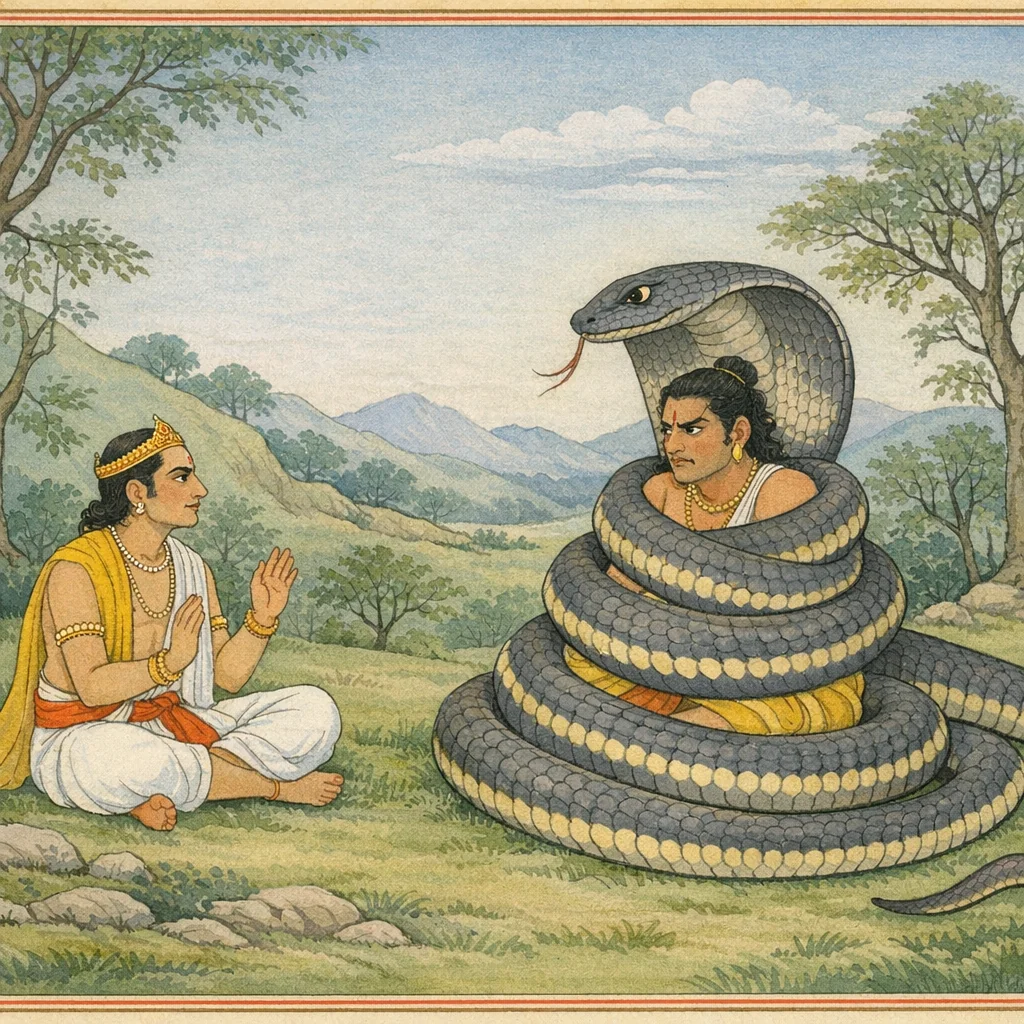
Chapter Arc: वैशम्पायन जनमेजय से कहते हैं—युधिष्ठिर अपने प्रिय भाई भीम को सर्प के शरीर में जकड़ा हुआ पाते हैं और उसी क्षण प्रश्नों की वर्षा से संकट का मूल जानना चाहते हैं। → भीम बताता है कि यह कोई साधारण नाग नहीं, राजर्षि नहुष है—अहंकार के पतन से सर्प-योनि में पड़ा हुआ। युधिष्ठिर और सर्प के बीच प्रश्नोत्तर आरम्भ होता है, जहाँ जीवन, सुख-दुःख और ‘जाति’ जैसे कठिन विषयों पर परीक्षा ली जाती है; भीम का जीवन उत्तरों पर टिका है। → युधिष्ठिर ‘जाति’ के प्रश्न पर निर्णायक तर्क रखता है—मनुष्यत्व में वर्ण-जाति का संकर और आचरण-संस्कार की प्रधानता; बिना संस्कार-वेदाध्ययन के मनुष्य शूद्रवत् है—यह मनु-निर्णय का संकेत देकर वह सर्प की बौद्धिक चुनौती को भेद देता है। → सर्प (नहुष) युधिष्ठिर के ज्ञान और विवेक को स्वीकार करता है—‘तुम सब जानने योग्य जानते हो’—और भीम को भक्षण करने का विचार त्यागकर उसे मुक्त करने की ओर प्रवृत्त होता है; संवाद से शाप-बंधन ढीला पड़ता है। → नहुष के उद्धार/शाप-निवृत्ति की शर्तें और मुक्त होने के बाद की परिणति अगले प्रसंग की ओर संकेत करती है।
Shlokas
Verse 1
वैशम्पायनजी कहते हैं--जनमेजय! सर्पके शरीरसे बँधे हुए अपने प्रिय भाई भीमसेनके पास पहुँचकर परम बुद्धिमान् युधिष्ठिरने इस प्रकार पूछा--
Vaiśampāyana said: “O Janamejaya, when the supremely wise Yudhiṣṭhira reached his beloved brother Bhīmasena, who had been bound by the coils of a serpent’s body, he questioned him in this manner.”
Verse 2
कुन्तीमात: कथमिमामापदं त्वमवाप्तवान् । कश्षायं पर्वताभोगप्रतिम: पन्नगोत्तम:,“कुन्तीनन्दन! तुम कैसे इस विपत्तिमें फँस गये? और यह पर्वतके समान लम्बा-चौड़ा श्रेष्ठ नाग कौन है?' अपने बड़े भ्राता धर्मराज युधिष्ठिरको वहाँ उपस्थित देख भाई भीमसेनने अपने पकड़े जाने आदिकी सारी चेष्टाएँ कह सुनायीं
Vaiśampāyana said: “O son of Kuntī, how have you fallen into this calamity? And who is this foremost of serpents, vast and massive like a mountain range?” Seeing his elder brother Dharmarāja Yudhiṣṭhira present there, Bhīmasena then recounted in full the events—how he was seized and all that he had attempted thereafter.
Verse 3
स धर्मराजमालक्ष्य भ्राता भ्रातरमग्रजम् । कथयामास तत् सर्व ग्रहणादि विचेष्टितम्,“कुन्तीनन्दन! तुम कैसे इस विपत्तिमें फँस गये? और यह पर्वतके समान लम्बा-चौड़ा श्रेष्ठ नाग कौन है?' अपने बड़े भ्राता धर्मराज युधिष्ठिरको वहाँ उपस्थित देख भाई भीमसेनने अपने पकड़े जाने आदिकी सारी चेष्टाएँ कह सुनायीं
Seeing Dharmarāja Yudhiṣṭhira there, the younger brother (Bhīma) approached his elder brother and recounted everything that had happened—beginning with his being seized—explaining the strange course of events. In effect he asks how Yudhiṣṭhira has come into such peril and who this mighty, mountain-like serpent is, thereby placing the episode within the ethical frame of responsibility to kin and the duty to report truthfully in crisis.
Verse 4
भीम उवाच अयमार्य महासत्वो भक्षार्थ मां गृहीतवान् । नहुषो नाम राजर्षि: प्राणवानिव संस्थित:,भीम बोले--आर्य! ये वायुभक्षी सर्पके रूपमें बैठे हुए महान् शक्तिशाली साक्षात् राजर्षि नहुष हैं, इन्होंने मुझे अपना आहार बनानेके लिये पकड़ रखा है
Bhīma said: “O noble one, this mighty being has seized me as food. He is the royal sage named Nahuṣa, sitting here as though alive.”
Verse 5
युधिछिर उवाच मुच्यतामयमायुष्मन् भ्राता मेडमितविक्रम: । वयमाहारमन्यं ते दास्याम: क्षुज्ञिवारणम्,तब युधिष्ठटिरने सर्पसे कहा--आयुष्मन्! आप मेरे इस अनन्त पराक्रमी भाईको छोड़ दें। हमलोग आपकी भूख मिटानेके लिये दूसरा भोजन देंगे
Yudhiṣṭhira said: “O venerable one, release this brother of mine, whose prowess is blazing. We shall give you other food, enough to remove your hunger.”
Verse 6
सर्प उवाच आहाते राजपुत्रो5यं मया प्राप्तो मुखागतः । गम्यतां नेह स्थातव्यं श्वो भवानपि मे भवेत्,सर्प बोला--राजन्! यह राजकुमार मेरे मुखके पास स्वयं आकर मुझे आहाररूपमें प्राप्त हुआ है। तुम जाओ, यहाँ ठहरना उचित नहीं है; अन्यथा कलतक तुम भी मेरे आहार बन जाओगे
The serpent said, “O king, this prince has come to the very mouth of mine and has thus become my food. Go away; it is not fitting for you to remain here. Otherwise, by tomorrow you too may become my prey.”
Verse 7
व्रतमेतन्महाबाहो विषयं मम यो व्रजेत् स मे भक्षो भवेत् तात त्वं चापि विषये मम,महाबाहो! मेरा यह नियम है कि मेरी अधिकृत भूमिके भीतर जो भी आ जायगा, वह मेरा भक्ष्य बन जायगा। तात! इस समय तुम भी मेरे अधिकारकी सीमामें ही आ गये हो
The serpent said: “O mighty-armed one, this is my vow: whoever enters my domain becomes my food. Dear child, you too have now come within the bounds of my authority.”
Verse 8
चिरेणाद्य मया55हार: प्राप्तोडयमनुजस्तव । नाहमेनं विमोक्ष्यामि न चान्यमभिकाड्क्षये,दीर्घकालतक उपवास करनेके बाद आज यह तुम्हारा छोटा भाई मुझे आहाररूपमें प्राप्त हुआ है, अतः न तो मैं इसे छोडूँगा और न इसके बदलेमें दूसरा आहार ही लेना चाहता हूँ
The serpent said: “After a long time of fasting, today this younger brother of yours has come into my hands as food. Therefore I will not release him, nor do I desire any other meal in exchange.”
Verse 9
युधिष्ठिर उवाच देवो वा यदि वा दैत्य उरगो वा भवान् यदि । सत्यं सर्प वचो ब्रूहि पृच्छति त्वां युधिष्ठिर: । किमर्थ च त्वया ग्रस्तो भीमसेनो भुजड़म,युधिछिरने कहा--सर्प! तुम कोई देवता हो या दैत्य अथवा वास्तवमें सर्प ही हो? सच बताओ, तुमसे युधिष्ठिर प्रश्न कर रहा है। भुजंगम! किस लिये तुमने भीमसेनको ही अपना ग्रास बनाया है?
Yudhiṣṭhira said: “Whether you are a god, or a demon, or truly a serpent—tell me the truth, O serpent; Yudhiṣṭhira questions you. And for what reason have you swallowed Bhīmasena, O great snake?”
Verse 10
किमाह्त्य विदित्वा वा प्रीतिस्ते स्याद् भुजड़म् । किमाहारं प्रयच्छामि कथं मुज्चेद् भवानिमम्,बोलो, तुम्हारे लिये क्या ला दिया जाय? अथवा तुम्हें किस बातका ज्ञान करा दिया जाय? जिससे तुम प्रसन्न होओगे। मैं कौन-सा आहार दे दूँ अथवा किस उपायका अवलम्बन करूँ, जिससे तुम इन्हें छोड़ सकते हो?
Yudhiṣṭhira said: “O serpent, what shall I bring you, or what knowledge shall I impart, so that you may be pleased? What food should I offer, or by what means may you release this one?”
Verse 11
सर्प उवाच नहुषो नाम राजाहमासं पूर्वस्तवानघ । प्रथित: पजचम: सोमादायो: पुत्रो नराधिप,सर्प बोला--निष्पाप नरेश! मैं पूर्वजन्ममें तुम्हारा विख्यात पूर्वज नहुष नामका राजा था। चन्द्रमासे पाँचवीं पीढ़ीमें जो आयु नामक राजा हुए थे, उन्हींका मैं पुत्र हूँ
The serpent said: “O sinless king, in a former birth I was your renowned ancestor, the king named Nahuṣa. O ruler of men, I am the celebrated fifth in descent from Soma (the Moon), the son of Āyu.”
Verse 12
क्रतुभिस्तपसा चैव स्वाध्यायेन दमेन च । त्रैलोक्यैश्वर्यमव्यग्र॑ प्राप्तोडहं विक्रमेण च,मैंने अनेक यज्ञ किये, तपस्या की, स्वाध्याय किया तथा अपने मन और इन्द्रियोंके संयमरूप योगका अभ्यास किया। इन सत्कर्मोंसे तथा अपने पराक्रमसे भी मुझे तीनों लोकोंका निष्कण्टक साम्राज्य प्राप्त हुआ था
The Serpent said: “By sacrifices, by austerity, by study of sacred lore, and by self-restraint, I attained—without distraction or impediment—the sovereign lordship of the three worlds; and I gained it also through my own valor.”
Verse 13
तदैश्वर्य समासाद्य दर्पो मामगमत् तदा । सहसं हि द्विजातीनामुवाह शिबिकां मम,तब उस ऐश्वर्यको पाकर मेरा अहंकार बढ़ गया। मैंने सहस्रों ब्राह्यगोंसे अपनी पालकी ढुलवायी। तदनन्तर ऐश्वर्यके मदसे उन्मत्त हो मैंने बहुत-से ब्राह्मगोंका अपमान किया। पृथ्वीपते! इससे कुपित हुए महर्षि अगस्त्यने मुझे इस अवस्थाको पहुँचा दिया। पाण्डुनन्दन नरेश! उन्हीं महात्मा अगस्त्यकी कृपासे आजतक मेरी स्मरणशक्ति मुझे छोड़ नहीं सकी है। (मेरी स्मृति ज्यों-की-त्यों बनी हुई है)
“When I attained prosperity and power, pride seized me. Indeed, I had my palanquin carried by a thousand twice-born men (brāhmaṇas).” The serpent confesses that wealth bred arrogance, leading him to misuse and humiliate the learned—an ethical warning that status without humility becomes the cause of one’s downfall.
Verse 14
ऐश्वर्यमदमत्तो5हमवमन्य ततो द्विजान् । इमामगस्त्येन दशामानीत: पृथिवीपते,तब उस ऐश्वर्यको पाकर मेरा अहंकार बढ़ गया। मैंने सहस्रों ब्राह्यगोंसे अपनी पालकी ढुलवायी। तदनन्तर ऐश्वर्यके मदसे उन्मत्त हो मैंने बहुत-से ब्राह्मगोंका अपमान किया। पृथ्वीपते! इससे कुपित हुए महर्षि अगस्त्यने मुझे इस अवस्थाको पहुँचा दिया। पाण्डुनन्दन नरेश! उन्हीं महात्मा अगस्त्यकी कृपासे आजतक मेरी स्मरणशक्ति मुझे छोड़ नहीं सकी है। (मेरी स्मृति ज्यों-की-त्यों बनी हुई है)
The serpent said: “Intoxicated by the pride of power and prosperity, I despised the twice-born. O lord of the earth, the sage Agastya reduced me to this condition. Drunk with wealth, I had my palanquin carried by thousands of Brahmins; then, maddened by that prosperity, I insulted many Brahmins. Enraged by this, the great seer Agastya brought me to this state. Yet by that great soul’s grace, my memory has not left me even today—my awareness remains intact.”
Verse 15
न तु मामजहात् प्रज्ञा यावदद्येति पाण्डव | तस्यैवानुग्रहाद् राजन्नगस्त्यस्य महात्मन:,तब उस ऐश्वर्यको पाकर मेरा अहंकार बढ़ गया। मैंने सहस्रों ब्राह्यगोंसे अपनी पालकी ढुलवायी। तदनन्तर ऐश्वर्यके मदसे उन्मत्त हो मैंने बहुत-से ब्राह्मगोंका अपमान किया। पृथ्वीपते! इससे कुपित हुए महर्षि अगस्त्यने मुझे इस अवस्थाको पहुँचा दिया। पाण्डुनन्दन नरेश! उन्हीं महात्मा अगस्त्यकी कृपासे आजतक मेरी स्मरणशक्ति मुझे छोड़ नहीं सकी है। (मेरी स्मृति ज्यों-की-त्यों बनी हुई है)
“But my understanding has not abandoned me up to this very day, O Pāṇḍava. It is solely by the grace of that great-souled sage Agastya, O king, that my memory and discernment have remained intact.”
Verse 16
षष्ठे काले मया55हार: प्राप्तोड्यमनुजस्तव । नाहमेन॑ विमोक्ष्यामि न चान्यदपि कामये,महर्षिके शापके अनुसार दिनके छठे भागमें तुम्हारा यह छोटा भाई मुझे भोजनके रूपमें प्राप्त हुआ है। अतः मैं न तो इसे छोडूँगा और न इसके बदले दूसरा आहार लेना चाहता हूँ
The serpent said: “At the sixth appointed time, in accordance with the rishi’s curse, this younger brother of yours has come to me as my food. Therefore I will not release him, nor do I desire any other substitute in his place.”
Verse 17
प्रश्नानुच्चारितानद्य व्याहरिष्यसि चेन्मम । अथ पश्चाद् विमोक्ष्यामि भ्रातरं ते वकोदरम्,परंतु एक बात है, यदि तुम मेरे पूछे हुए कुछ प्रश्नोंका अभी उत्तर दे दोगे, तो उसके बाद मैं तुम्हारे भाई भीमसेनको छोड़ दूँगा
The serpent said: “If today you will speak out the answers to the questions I have posed, then afterwards I shall release your brother Vakodara (Bhīma).” In ethical terms, the serpent makes liberation conditional upon truthful, timely knowledge—testing whether wisdom and right speech can become the means to save a life.
Verse 18
युधिछिर उवाच ब्रृहि सर्प यथाकामं प्रतिवक्ष्यामि ते वच: । अपि चेच्छकनुयां प्रीतिमाहर्तु ते भुजज्म,युधिष्ठिरने कहा--सर्प! तुम इच्छानुसार प्रश्न करो। मैं तुम्हारी बातका उत्तर दूँगा। भुजंगम! यदि हो सका, तो तुम्हें प्रसन्न करनेका प्रयत्न करूँगा
Yudhiṣṭhira said: “Speak, O serpent, whatever you wish. I shall reply to your words. And if it is possible, O nāga, I will strive to bring you satisfaction.”
Verse 19
वेद्यं च ब्राह्मणेनेह तद् भवान् वेत्ति केवलम् | सर्पराज ततः: श्र॒त्वा प्रतिवक्ष्यामि ते वच:,सर्पराज! ब्राह्मणको इस जीवनमें जो कुछ जानना चाहिये, वह केवल तत्त्व तुम जानते हो या नहीं। यह सुनकर मैं तुम्हारे प्रश्नोंका उत्तर दूँगा
Yudhiṣṭhira said: “Here, what a brāhmaṇa ought to know—you alone, O Serpent-King, know it in its entirety. Having heard this, O Sarparāja, I shall reply to your words (and questions).”
Verse 20
सर्प उवाच ब्राह्मण: को भवेद् राजन् वेद्यं कि च युधिष्ठिर । ब्रवीह्मतिमतिं त्वां हि वाक्यैरनुमिमीमहे,सर्प बोला--राजा युधिष्ठिर! यह बताओ कि ब्राह्मण कौन है और उसके लिये जाननेयोग्य तत्त्व क्या है? तुम्हारी बातें सुननेसे मुझे ऐसा अनुमान होता है कि तुम अतिशय बुद्धिमान् हो
The serpent said: “O king Yudhiṣṭhira, who truly is a brāhmaṇa, and what is the essential truth that ought to be known? Speak. From your words I infer that you are a man of exceptional intelligence.”
Verse 21
युधिछिर उवाच सत्यं दानं क्षमा शीलमानृशंस्यं तपो घृणा । दृश्यन्ते यत्र नागेन्द्र स ब्राह्मण इति स्मृत:,युधिष्ठिरने कहा--नागराज! जिसमें सत्य, दान, क्षमा, सुशीलता, क्रूरताका अभाव, तपस्या और दया--से सद्गुण दिखायी देते हों, वही ब्राह्मण कहा गया है
Yudhiṣṭhira said: “O lord of serpents, the one in whom truthfulness, generosity, forbearance, good conduct, freedom from cruelty, austerity, and compassion are seen—such a person is remembered as a brāhmaṇa.”
Verse 22
वेद्य॑ सर्प परं ब्रह्म निर्दुः:खमसुखं च यत् । यत्र गत्वा न शोचन्ति भवत: कि विवक्षितम्,सर्प! जाननेयोग्य तत्त्व तो परम ब्रह्म ही है, जो दुःख और सुखसे परे है तथा जहाँ पहुँचकर अथवा जिसे जानकर मनुष्य शोकके पार हो जाता है। बताओ, तुम्हें अब इस विषयमें क्या कहना है?
Yudhiṣṭhira said: “Knowable, O serpent, is the supreme Brahman—beyond sorrow and beyond pleasure. Having reached it (or having realized it), people do not grieve. Tell me, O serpent: what is it that you now intend to say on this matter?”
Verse 23
सर्प उवाच चातुर्वर्ण्य प्रमाणं च सत्यं च ब्रह्म चैव हि | शूद्रेष्वपि च सत्यं च दानमक्रोध एव च । आनृशंस्यमहिंसा च घृणा चैव युधिछिर,सर्प बोला--युथधिष्ठिर! सत्य एवं प्रमाणभूत ब्रह्म तो चारों वर्णोके लिये हितकर है। सत्य, दान, अक्रोध, क्रूरताका अभाव, अहिंसा और दया आदि सदगुण तो शाद्रोंमें भी रहते हैं
The serpent said: “O Yudhiṣṭhira, truth and the authoritative standard of the fourfold social order, and indeed Brahman itself, are for the good of all the varṇas. Even among Śūdras are found truthfulness, generosity, and freedom from anger; also compassion, non-violence, and tender-heartedness. Virtue is not confined to birth.”
Verse 24
वेद्यं यच्चात्र निर्दुः:खमसुखं च नराधिप । ताभ्यां हीन॑ पद चान्यन्न तदस्तीति लक्षये,नरेश्वर! तुमने यहाँ जो जाननेयोग्य तत्त्वको दुःख और सुखसे परे बताया है, सो दुःख और सुखसे रहित किसी दूसरी वस्तुकी सत्ता ही मैं नहीं देखता हूँ
The serpent said: “O king, the knowable principle you describe here as beyond both sorrow and pleasure—I do not perceive any other state or reality that exists apart from these two. To me, nothing else is found that is wholly free of both pain and happiness.”
Verse 25
युधिछिर उवाच शूद्रे तु यद् भवेल्लक्ष्म द्विजे तच्च न विद्यते । न वै शूद्रो भवेच्छूद्रो ब्राह्मणो न च ब्राह्मण:,युधिष्ठिरने कहा--यदि शूद्रमें सत्य आदि उपर्युक्त लक्षण हैं और ब्राह्मणमें नहीं हैं तो वह शूद्र शूद्र नहीं है और वह ब्राह्मण ब्राह्मण नहीं है। सर्प! जिसमें ये सत्य आदि लक्षण मौजूद हों, वह ब्राह्मण माना गया है और जिसमें इन लक्षणोंका अभाव हो, उसे शूद्र कहना चाहिये
Yudhiṣṭhira said: “If the marks (of virtue) are found in a Śūdra but are not found in a twice-born man, then that Śūdra is not truly a Śūdra, and that Brahmin is not truly a Brahmin. One should recognize as a Brahmin the person in whom such qualities as truthfulness are present; and one should call a person a Śūdra when those qualities are absent.”
Verse 26
यत्रैतल्लक्ष्यते सर्प वृत्तं स ब्राह्मण: स्मृतः । यत्रैतन्न भवेत् सर्प तं शूद्रमिति निर्दिशेत्,युधिष्ठिरने कहा--यदि शूद्रमें सत्य आदि उपर्युक्त लक्षण हैं और ब्राह्मणमें नहीं हैं तो वह शूद्र शूद्र नहीं है और वह ब्राह्मण ब्राह्मण नहीं है। सर्प! जिसमें ये सत्य आदि लक्षण मौजूद हों, वह ब्राह्मण माना गया है और जिसमें इन लक्षणोंका अभाव हो, उसे शूद्र कहना चाहिये
Yudhiṣṭhira said: “O Serpent, wherever this conduct—marked by the stated signs such as truthfulness and the like—is found, that person is to be regarded as a brāhmaṇa. But where these qualities are absent, O Serpent, one should designate that person a śūdra.”
Verse 27
यत् पुनर्भवता प्रोक्तं न वेद्यं विद्यतीति च । ताभ्यां हीनमतो<न्यत्र पदमस्तीति चेदपि,अब तुमने जो यह कहा कि सुख-दुःखसे रहित कोई दूसरा वेद्य तत्त्व है ही नहीं, सो तुम्हारा यह मत ठीक है। सुख-दुःखसे शून्य कोई पदार्थ नहीं है। किंतु एक ऐसा पद है भी। जिस प्रकार बर्फमें उष्णता और अग्निमें शीतलता कहीं नहीं रहती, उसी प्रकार जो वेद्य-पद है, वह वास्तवमें सुख-दुःखसे रहित ही है। नागराज! मेरा तो यही विचार है, फिर आप जैसा मानें
Yudhiṣṭhira said: “But as for what you have stated—that there exists no knowable reality beyond (the field of) experience—my view differs. Nothing within ordinary experience is truly free from pleasure and pain; yet there is indeed a ‘state’ (pada) elsewhere, beyond them. Just as heat is not found in ice, nor coolness in fire, so that knowable state is in truth devoid of pleasure and pain. O lord of serpents, this is my understanding; you may accept it as you see fit.”
Verse 28
एवमेतन्मतं सर्प ताभ्यां हीनं॑ न विद्यते | यथा शीतोष्णयोर्मध्ये भवेन्नोष्णं न शीतता,अब तुमने जो यह कहा कि सुख-दुःखसे रहित कोई दूसरा वेद्य तत्त्व है ही नहीं, सो तुम्हारा यह मत ठीक है। सुख-दुःखसे शून्य कोई पदार्थ नहीं है। किंतु एक ऐसा पद है भी। जिस प्रकार बर्फमें उष्णता और अग्निमें शीतलता कहीं नहीं रहती, उसी प्रकार जो वेद्य-पद है, वह वास्तवमें सुख-दुःखसे रहित ही है। नागराज! मेरा तो यही विचार है, फिर आप जैसा मानें
Yudhiṣṭhira said: “So it is, O serpent; your view is sound—that among knowable things nothing is found that is wholly devoid of those two, pleasure and pain. Yet there is also a highest state to be known: in truth it is free from pleasure and pain. Just as heat is not present in ice, and coolness is not present in fire, so too that supreme knowable state is genuinely beyond both happiness and suffering. This is my considered understanding, O king of serpents; accept it as you see fit.”
Verse 29
एवं वै सुखदु:खाभ्यां हीनमस्ति पद क्वचित् | एषा मम मति: सर्प यथा वा मन्यते भवान्,अब तुमने जो यह कहा कि सुख-दुःखसे रहित कोई दूसरा वेद्य तत्त्व है ही नहीं, सो तुम्हारा यह मत ठीक है। सुख-दुःखसे शून्य कोई पदार्थ नहीं है। किंतु एक ऐसा पद है भी। जिस प्रकार बर्फमें उष्णता और अग्निमें शीतलता कहीं नहीं रहती, उसी प्रकार जो वेद्य-पद है, वह वास्तवमें सुख-दुःखसे रहित ही है। नागराज! मेरा तो यही विचार है, फिर आप जैसा मानें
Yudhiṣṭhira said: “Indeed, is there anywhere any state wholly devoid of pleasure and pain? This is my understanding, O serpent—yet let it be as you deem. For in ordinary experience nothing is found entirely empty of happiness and sorrow; and yet there is spoken of a ‘state’ that is truly beyond them. Just as heat is not found in ice, nor coolness in fire, so that knowable highest state is, in truth, free from pleasure and pain. This is my considered view, O lord of serpents; decide as you will.”
Verse 30
सर्प उवाच यदि ते वृत्ततो राजन ब्राह्मण: प्रसमीक्षित: । वृथा जातिस्तदा<<युष्मन् कृतियविन्न विद्यते,सर्प बोला--आयुष्मन् नरेश! यदि आचारसे ही ब्राह्मणकी परीक्षा की जाय, तब तो जबतक उसके अनुसार कर्म न हो जाति व्यर्थ ही है
The serpent said: “O king, if a Brahmin is to be judged by conduct alone, then—O noble one—birth becomes meaningless unless it is matched by the deeds that accord with that conduct.”
Verse 31
युधिछिर उवाच जातिरत्र महासर्प मनुष्यत्वे महामते | संकरात् सर्ववर्णानां दुष्परीक्ष्येति मे मति:,युधिष्ठिरने कहा--महासर्प! महामते! मनुष्योंमें जातिकी परीक्षा करना बहुत ही कठिन है; क्योंकि इस समय सभी वर्णोका परस्पर संकर (सम्मिश्रण) हो रहा है, ऐसा मेरा विचार है
Verse 32
सर्वे सर्वास्वपत्यानि जनयन्ति सदा नरा: | वाड्मैथुनमथो जन्म मरणं च सम॑ नृणाम्,सभी मनुष्य सदा सब जातियोंकी स्त्रियोंसे संतान उत्पन्न कर रहे हैं। वाणी, मैथुन तथा जन्म और मरण--ये सब मनुष्योंमें एक-से देखे जाते हैं। इस विषयमें यह आर्षप्रमाण भी मिलता है--'ये यजामहे' यह श्रुति जातिका निश्चय न होनेके कारण ही जो हमलोग यज्ञ कर रहे हैं, ऐसा सामान्यरूपसे निर्देश करती है। इसलिये जो तत्त्वदर्शी विद्वान हैं, वे शीलको ही प्रधानता देते हैं और उसे ही अभीष्ट मानते हैं
Yudhiṣṭhira said: “All men, at all times, beget offspring with women of every group. Speech, sexual union, and likewise birth and death—these are seen as the same among human beings. Therefore, those who truly discern reality give primacy to conduct and character, and regard that alone as the decisive standard.”
Verse 33
इदमार्ष प्रमाणं च ये यजामह इत्यपि । तस्माच्छील प्रधानेष्टं विदुर्ये तत््वदर्शिन:,सभी मनुष्य सदा सब जातियोंकी स्त्रियोंसे संतान उत्पन्न कर रहे हैं। वाणी, मैथुन तथा जन्म और मरण--ये सब मनुष्योंमें एक-से देखे जाते हैं। इस विषयमें यह आर्षप्रमाण भी मिलता है--'ये यजामहे' यह श्रुति जातिका निश्चय न होनेके कारण ही जो हमलोग यज्ञ कर रहे हैं, ऐसा सामान्यरूपसे निर्देश करती है। इसलिये जो तत्त्वदर्शी विद्वान हैं, वे शीलको ही प्रधानता देते हैं और उसे ही अभीष्ट मानते हैं
Yudhiṣṭhira said: “Here too there is an ancient, seer-sanctioned authority: the Vedic expression ‘ye yajāmahe’—‘we who perform sacrifice’—speaks in a general way, without fixing any rigid determination of birth-based category. Therefore, those wise people who truly see reality regard conduct (character) as the primary criterion, and they hold that alone to be what is most to be desired.”
Verse 34
प्राइनाभिवर्धनात् पुंसो जातकर्म विधीयते । तत्रास्य माता सावित्री पिता त्वाचार्य उच्यते
Yudhiṣṭhira said: “Because the vital life-force of a person is fostered and strengthened, the rite called jātakarma is prescribed. In that context, the Sāvitrī (the sacred Gāyatrī/Sāvitrī mantra that awakens spiritual life) is spoken of as his mother, and the teacher (ācārya) is called his father.”
Verse 35
जब बालकका जन्म होता है, तब नालच्छेदनके पूर्व उसका जातकर्म-संस्कार किया जाता है। उसमें उसकी माता सावित्री कहलाती है और पिता आचार्य ।। तावच्छूद्रसमो होष यावद् वेदे न जायते । तस्मिन्नेवं मतिद्वैथे मनु: स्वायम्भुवोडब्रवीत्
So long as one has not been ‘born into the Veda’—that is, initiated into Vedic study—one is regarded as equal to a Śūdra. When such doubt of understanding arose on this point, Manu, the self-born progenitor, declared the rule, clarifying how true status is grounded in discipline and sacred learning rather than mere physical birth.
Verse 36
कृतकृत्या: पुनर्वर्णा यदि वृत्तं न विद्यते । संकरस्त्वत्र नागेन्द्र बलवान् प्रसमीक्षित:
Yudhiṣṭhira said: “If, after all has been duly accomplished, there is still no clear account of what has occurred, then here—O lord of serpents—one must carefully consider the powerful factor of confusion and intermixture (saṅkara) that can distort events and understanding.”
Verse 37
जबतक बालकका संस्कार करके उसे वेदका स्वाध्याय न कराया जाय, तबतक वह शूद्रहीके समान है। जातिविषयक संदेह होनेपर स्वायम्भुव मनुने यही निर्णय दिया है। नागराज! यदि वैदिक संस्कार करके वेदाध्ययन करनेपर भी ब्राह्मणादि वर्णोमें अपेक्षित शील और सदाचारका उदय नहीं हुआ तो उसमें प्रबल वर्णसंकरता है, ऐसा विचारपूर्वक निश्चय किया गया है ।। यत्रेदानीं महासर्प संस्कृतं वृत्तमिष्यते । त॑ ब्राह्मणमहं पूर्वमुक्तवान् भुजगोत्तम,महासर्प! भुजंगमप्रवर! इस समय जिसमें संस्कारके साथ-साथ सदाचारकी उपलब्धि हो, वही ब्राह्मण है। यह बात मैं पहले ही बता चुका हूँ
Yudhiṣṭhira said: “So long as a boy, even after undergoing the rites of refinement, is not set to the disciplined study of the Veda, he is regarded as no different from a Śūdra. When there is doubt about one’s caste-status, Svāyambhuva Manu has given this very ruling. O king of serpents! Even if a person has received Vedic sacraments and has studied the Veda, if the expected virtues and good conduct that should arise in the Brahmin and other orders do not manifest, then—after due reflection—it is concluded that there is a strong admixture and confusion of varṇas in him. Therefore, O great serpent, O best of serpents: whoever is now found to possess cultivated conduct together with the refining sacraments—him I call a Brahmin. This is what I have already told you.”
Verse 38
सर्प उवाच श्रुतं विदितवेद्यस्थ तव वाक्य युधिष्ठिर । भक्षयेयमहं कस्माद् भ्रातरं ते वकोदरम्,सर्प बोला--युधिष्ठिर! तुम जाननेयोग्य सभी बातें जानते हो। मैंने तुम्हारी बात अच्छी तरह सुन ली। अब मैं तुम्हारे भाई भीमसेनको कैसे खा सकता हूँ?
The serpent said: “Yudhiṣṭhira, I have heard your words well; you are one who stands grounded in what is to be known and understood. In that case, on what grounds could I now devour your brother, Bhīma—he of the mighty belly?”
Verse 180
इति श्रीमहाभारते वनपर्वणि आजगरपर्वणि युधिष्ठिरसर्पसंवादे अशीत्यधिकशततमोडयाय:,इस प्रकार श्रीमह्याभारत वनपर्वके अन्तर्गत आजगरपर्वमें युधिष्टिरसर्पसंवादाविषयक एक सौ अस्सीवाँ अध्याय पूरा हुआ
Thus, in the Śrī Mahābhārata, within the Vana Parva—specifically the Ājagara episode—ends the dialogue between Yudhiṣṭhira and the serpent; this concludes the one-hundred-and-eightieth chapter. The colophon marks the completion of a teaching-centered exchange in which dharma is examined through questioning and reflection rather than through force.
Frequently Asked Questions
Yudhiṣṭhira’s dilemma is whether suffering is merely imposed by an external controller or is primarily the consequence of personal and collective moral agency—i.e., how responsibility is assigned for pleasure and pain amid apparent injustice.
The chapter teaches continuity of moral causation: actions accumulate and accompany the agent across death and rebirth, while disciplined conduct (restraint, truth, study, and teacher-service) is presented as a higher trajectory that stabilizes welfare across worlds.
Rather than a formal phalaśruti, the chapter embeds a meta-claim: correct understanding of karma-gati reduces doubt and supports steadiness (sthiti) in adversity, positioning insight itself as a functional benefit within the dharma framework.