Adhyaya 125
Cyavana’s Reconciliation with Indra; Tīrtha-Indexing at Ārcīka-parvata and Yamunā (Chapter 125)
Upa-parva: Tīrtha-yātrā Parva (Pilgrimage Cycle within Āraṇyaka Parva)
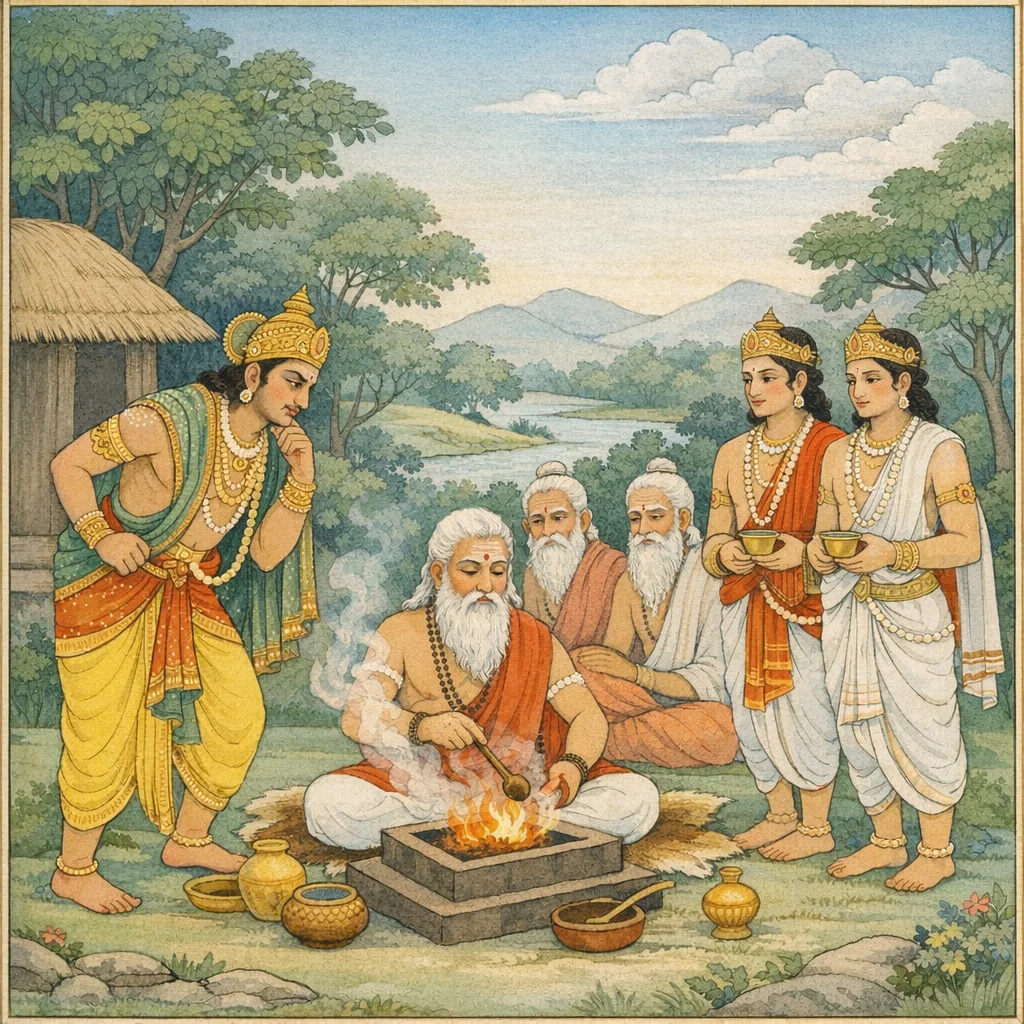
Lomāśa recounts a climactic moment in the Cyavana narrative: Indra (Śatakratu) confronts the sage in fear as Cyavana appears with a terrifying, open-mouthed aspect, poised to consume him. Indra seeks appeasement, affirming that the Aśvinīkumāras are henceforth worthy of Soma and ratifying Cyavana’s act as truthful and properly grounded. Cyavana’s anger subsides; he releases Indra and redistributes ‘mada’ (here framed as a force associated with indulgence and excess) into domains such as drink, sexuality, gaming, and hunting, indicating a regulated re-allocation of disruptive potency rather than its total erasure. The narration then pivots from mythic resolution to pilgrimage cartography: Lomāśa points out Cyavana’s celebrated lake, instructs ritual offerings (tarpana) to ancestors and deities, and directs the Pandavas toward Saindhava forest features, channels (kulyā), and multiple Puṣkara waters. Further, he indexes Ārcīka-parvata as a residence of sages, a locus of Maruts, and a landscape dense with divine shrines; he names associated ascetic groups (Vaikhānasas, Vālakhilyas) and recommends circumambulation and bathing at three sacred peaks and three springs. The chapter concludes with additional sacred-historical markers—figures who dwelt or performed rites there (including references to Śaṃtanu, Śunaka, Nara-Nārāyaṇa), the inexhaustible Yamunā stream, and exemplary royal sacrifices—positioning geography as an archive of dharma-practice and reputation.
Chapter Arc: लोमश ऋषि युधिष्ठिर को सौकन्योपाख्यान के अगले मोड़ पर ले जाते हैं—च्यवन ऋषि के यज्ञ में अश्विनीकुमारों के ‘भाग’ को लेकर देवसभा में असंतुलन की आहट सुनाई देती है। → अश्विनीकुमारों को यज्ञ-भाग दिलाने का निर्णय इन्द्र के अधिकार और प्रतिष्ठा को चुनौती देता है। इन्द्र भय से जकड़ा, क्रोध और असुरक्षा के बीच च्यवन के सामने खड़ा होता है; देव-व्यवस्था में ‘कौन किसका अधिकारी’—यह प्रश्न तीखा हो उठता है। → च्यवन के तपोबल और वचन-बल के सामने देवराज इन्द्र भयपीड़ित होकर झुकता है और स्वीकार करता है कि अश्विनीकुमारों को सोम/यज्ञ-भाग मिलना चाहिए—यही क्षण देवताओं के अहं का टूटना और ऋषि-तेज की सर्वोच्चता का उद्घोष बनता है। → इन्द्र संकट-मुक्त होता है—विरोध छोड़कर प्रसाद मांगता है, और च्यवन का यज्ञ ‘मिथ्या न हो’ इस प्रकार व्यवस्था स्थिर होती है। लोमश इस प्रसंग को तीर्थयात्रा के नैतिक पाठ की तरह युधिष्ठिर के सामने रखकर आगे के तीर्थ-वर्णन की ओर कथा को मोड़ते हैं। → तीर्थ-परिक्रमा के अगले चरण में लोमश ‘स्थाणु-मन्त्र’ और संधि-काल (त्रेता-द्वापर) की सिद्धि-सूचना देते हुए संकेत करते हैं कि आगे के तीर्थों में और भी गूढ़ फल-श्रुतियाँ तथा रहस्य खुलेंगे।
Shlokas
Verse 1
हि >> न () है 7-2 पजञ्चविशर्त्याधिकशततमो< ध्याय: अश्िनीकुमारोंका यज्ञमें भाग स्वीकार कर लेनेपर इन्द्रका संकट-मुक्त होना तथा लोमशजीके द्वारा अन्यान्य तीर्थोंके महत्त्वका वर्णन लोगमश उवाच तं॑ दृष्टवा घोरवदनं मर्द देव: शतक्रतुः । आयान्तं भक्षयिष्यन्तं व्यात्ताननमिवान्तकम्,लोमशजी कहते हैं--युधिष्ठिर! मुँह बाये हुए यमराजकी भाँति भयंकर मुखवाले उस मदासुरको निगलनेके लिये आते देख देवराज इन्द्र भयसे व्याकुल हो गये। जिनकी भुजाएँ स्तब्ध हो गयी थीं, वे इन्द्र मृत्युके डरसे घबराकर बार-बार ओएष्ठप्रान्त चाटने लगे। उसी अवस्थामें उन्होंने महर्षि च्यवनसे कहा--'भृगुनन्दन! ये दोनों अश्विनीकुमार आजसे सोमपानके अधिकारी होंगे। मेरी यह बात सत्य है, अतः आप मुझपर प्रसन्न हों
Lomaśa said: Seeing that terrifying, dreadful-faced Marda approaching—his mouth gaping wide like Death itself, as though he would devour him—Indra, the lord of the gods and performer of a hundred sacrifices, was seized by fear. The episode frames a moral pressure-point: even the mighty are humbled when pride and exclusion in sacred rites provoke consequences, and safety is regained through truthful concession and restoration of rightful participation.
Verse 2
भयात् संस्तम्भितभुज: सृक्किणी लेलिहन् मुहुः । ततोअब्रवीद् देवराजश्व्यवनं भयपीडित:,लोमशजी कहते हैं--युधिष्ठिर! मुँह बाये हुए यमराजकी भाँति भयंकर मुखवाले उस मदासुरको निगलनेके लिये आते देख देवराज इन्द्र भयसे व्याकुल हो गये। जिनकी भुजाएँ स्तब्ध हो गयी थीं, वे इन्द्र मृत्युके डरसे घबराकर बार-बार ओएष्ठप्रान्त चाटने लगे। उसी अवस्थामें उन्होंने महर्षि च्यवनसे कहा--'भृगुनन्दन! ये दोनों अश्विनीकुमार आजसे सोमपानके अधिकारी होंगे। मेरी यह बात सत्य है, अतः आप मुझपर प्रसन्न हों
Lomaśa said: Struck with fear, his arms rigid, repeatedly licking the corners of his mouth, the king of the gods—tormented by terror—then spoke to Cyavana. Seeing the dreadful Mada-demon advancing to swallow him like Death itself, Indra, shaken by the fear of destruction, sought refuge in a pledge of justice: he promised that from that day the two Aśvin twins would be entitled to drink Soma, and he affirmed the truth of his word to win the sage’s favor.
Verse 3
सोमाहविश्विनावेतावद्यप्रभृति भार्गव । भविष्यत: सत्यमेतद् वचो विप्र: प्रसीद मे,लोमशजी कहते हैं--युधिष्ठिर! मुँह बाये हुए यमराजकी भाँति भयंकर मुखवाले उस मदासुरको निगलनेके लिये आते देख देवराज इन्द्र भयसे व्याकुल हो गये। जिनकी भुजाएँ स्तब्ध हो गयी थीं, वे इन्द्र मृत्युके डरसे घबराकर बार-बार ओएष्ठप्रान्त चाटने लगे। उसी अवस्थामें उन्होंने महर्षि च्यवनसे कहा--'भृगुनन्दन! ये दोनों अश्विनीकुमार आजसे सोमपानके अधिकारी होंगे। मेरी यह बात सत्य है, अतः आप मुझपर प्रसन्न हों
Lomaśa said: “O Bhārgava, from this very day the two Aśvins shall be entitled to drink Soma. This statement will indeed prove true. O brāhmaṇa, be gracious to me.”
Verse 4
न ते मिथ्या समारम्भो भवत्वेष परो विधि: । जानामि चाह ं विप्रर्षे न मिथ्या त्वं करिष्यसि,तस्मात् प्रसाद कुरु मे भवत्वेवं यथेच्छसि । “आपके द्वारा किया हुआ यह यज्ञका आयोजन मिथ्या न हो। आपने जो कर दिया वही उत्तम विधान हो। ब्रह्मर्षे! मैं जानता हूँ, आप अपना संकल्प कभी मिथ्या न होने देंगे। आज आपने इन अश्विनीकुमारोंको जैसे सोमपानका अधिकारी बनाया है उसी प्रकार मेरा भी कल्याण कीजिये। भृूगुनन्दन! आपकी अधिक-से-अधिक शक्ति प्रकाशमें आवे तथा जगत्में सुकन््या और इसके पिताकी कीर्तिका विस्तार हो। इस उद्देश्यसे मैंने यह आपके बल-वीर्यको प्रकाशित करनेवाला कार्य किया है। अतः आप प्रसन्न होकर मेरे ऊपर कृपा करें। आप जैसा चाहते हैं, वैसा ही होगा”
Lomasha said: “May this sacrificial undertaking of yours not prove fruitless; let what you have set in motion stand as the highest ordinance. O brahmarṣi, I know you—your resolve will never turn false. Therefore, be gracious to me; let it be as you wish.”
Verse 5
सोमाहविश्चिनावेतौ यथा वाद्य कृतौ त्वया । भूय एव तु ते वीर्य प्रकाशेदिति भार्गव
Lomasa said: “These two—Somāhavi and Cinā—have been fashioned by you like instruments meant to be played. Yet, O Bhārgava, may your prowess be revealed once again.”
Verse 6
सुकन्याया: पितुश्नास्य लोके कीर्ति: प्रथेदिति । अतो मयैतद् विहितं तव वीर्यप्रकाशनम्
Lomasa said: “So that Sukanyā’s father may gain renown in the world, I have arranged this—namely, the public manifestation of your prowess. In this way, merit and fame accrue through a deed that reveals true strength for a worthy purpose.”
Verse 7
एवमुक्तस्य शक्रेण भार्गवस्य महात्मन:,इन्द्रके ऐसा कहनेपर भृगुनन्दन महामना च्यवनका क्रोध शीघ्र शान्त हो गया और उन्होंने देवेन्द्रको (उसी क्षण) सम्पूर्ण दुःखोंसे, मुक्त कर दिया। राजन! उन शक्तिशाली ऋषिने मदको, जिसे पहले उन्होंने ही उत्पन्न किया था, मद्यपान, स्त्री, जूआ और मृगया (शिकार)--इन चार स्थानोंमें पृथक्ू-पृथक् बाँट दिया। इस प्रकार मदको दूर हटाकर उन्होंने देवराज इन्द्र और अश्विनीकुमारोंसहित सम्पूर्ण देवताओंको सोमरससे तृप्त किया तथा राजा शर्यातिका यज्ञ पूर्ण कराकर समस्त लोकोंमें अपनी अद्भुत शक्तिको विख्यात करके वक्ताओंमें श्रेष्ठ च्यवन ऋषि अपनी मनोनुकूल पत्नी सुकन्याके साथ वनमें विहार करने लगे। युधिष्ठिर! यह जो पक्षियोंके कलरवसे गूँजता हुआ सरोवर सुशोभित हो रहा है, महर्षि च्यवनका ही है
When Indra spoke thus, the great Bhargava sage’s anger quickly subsided, and in that very moment he released the lord of the gods from all suffering. O King, that mighty seer then divided “Mada” (the intoxicating arrogance he himself had earlier brought forth) and assigned it separately to four seats: drinking, women, gambling, and hunting. Having thus driven Mada away, he satisfied Indra, the Aśvin twins, and all the gods with Soma, and he brought King Śaryāti’s sacrifice to completion. After making his wondrous power renowned throughout the worlds, the eloquent sage Cyavana went to dwell in the forest with his beloved wife Sukanyā. O Yudhiṣṭhira, this lake, resonant with the calls of birds and shining with beauty, belongs to that very sage Cyavana.
Verse 8
स मन्युर्व्यगमच्छीघ्रं मुमोच च पुरंदरम् । मर्द च व्यभजद् राजन पाने स्त्रीषु च वीर्यवान्,इन्द्रके ऐसा कहनेपर भृगुनन्दन महामना च्यवनका क्रोध शीघ्र शान्त हो गया और उन्होंने देवेन्द्रको (उसी क्षण) सम्पूर्ण दुःखोंसे, मुक्त कर दिया। राजन! उन शक्तिशाली ऋषिने मदको, जिसे पहले उन्होंने ही उत्पन्न किया था, मद्यपान, स्त्री, जूआ और मृगया (शिकार)--इन चार स्थानोंमें पृथक्ू-पृथक् बाँट दिया। इस प्रकार मदको दूर हटाकर उन्होंने देवराज इन्द्र और अश्विनीकुमारोंसहित सम्पूर्ण देवताओंको सोमरससे तृप्त किया तथा राजा शर्यातिका यज्ञ पूर्ण कराकर समस्त लोकोंमें अपनी अद्भुत शक्तिको विख्यात करके वक्ताओंमें श्रेष्ठ च्यवन ऋषि अपनी मनोनुकूल पत्नी सुकन्याके साथ वनमें विहार करने लगे। युधिष्ठिर! यह जो पक्षियोंके कलरवसे गूँजता हुआ सरोवर सुशोभित हो रहा है, महर्षि च्यवनका ही है
Lomasa said: “His anger quickly subsided, and he released Purandara (Indra) from his affliction. Then that mighty sage, O king, apportioned ‘Mada’—the intoxicating delusion he had earlier brought forth—into separate domains: drinking, women, and (by implication in the received narrative) other corrupting pursuits. Thus, by removing the force of intoxication from its single overwhelming form and distributing it into specific temptations, he restored balance among the gods and re-established order. The episode underscores a moral logic: uncontrolled pride and intoxication ruin discernment, while restraint and wise regulation preserve dharma and social harmony.”
Verse 9
अक्षेषु मृगयायां च पूर्वसृष्टं पुनः पुन: । तदा मद विनिक्षिप्य शक्रं संतर्प्प चेन्दुना,इन्द्रके ऐसा कहनेपर भृगुनन्दन महामना च्यवनका क्रोध शीघ्र शान्त हो गया और उन्होंने देवेन्द्रको (उसी क्षण) सम्पूर्ण दुःखोंसे, मुक्त कर दिया। राजन! उन शक्तिशाली ऋषिने मदको, जिसे पहले उन्होंने ही उत्पन्न किया था, मद्यपान, स्त्री, जूआ और मृगया (शिकार)--इन चार स्थानोंमें पृथक्ू-पृथक् बाँट दिया। इस प्रकार मदको दूर हटाकर उन्होंने देवराज इन्द्र और अश्विनीकुमारोंसहित सम्पूर्ण देवताओंको सोमरससे तृप्त किया तथा राजा शर्यातिका यज्ञ पूर्ण कराकर समस्त लोकोंमें अपनी अद्भुत शक्तिको विख्यात करके वक्ताओंमें श्रेष्ठ च्यवन ऋषि अपनी मनोनुकूल पत्नी सुकन्याके साथ वनमें विहार करने लगे। युधिष्ठिर! यह जो पक्षियोंके कलरवसे गूँजता हुआ सरोवर सुशोभित हो रहा है, महर्षि च्यवनका ही है
Lomaśa said: “The intoxication (mada) that had been created earlier was again and again assigned to its familiar outlets—dice and the hunt. Having thus set aside that ‘mada’, the sage then satisfied Śakra (Indra) with the Soma (moon-like nectar), restoring him from distress. The episode underscores how uncontrolled exhilaration and pride are redirected into limited spheres, so that the gods and the world may return to order and ritual balance.”
Verse 10
अश्रिभ्यां सहितान् देवान् याजयित्वा च त॑ नृपम् । विख्याप्य वीर्य लोकेषु सर्वेषु वदतां वर:,इन्द्रके ऐसा कहनेपर भृगुनन्दन महामना च्यवनका क्रोध शीघ्र शान्त हो गया और उन्होंने देवेन्द्रको (उसी क्षण) सम्पूर्ण दुःखोंसे, मुक्त कर दिया। राजन! उन शक्तिशाली ऋषिने मदको, जिसे पहले उन्होंने ही उत्पन्न किया था, मद्यपान, स्त्री, जूआ और मृगया (शिकार)--इन चार स्थानोंमें पृथक्ू-पृथक् बाँट दिया। इस प्रकार मदको दूर हटाकर उन्होंने देवराज इन्द्र और अश्विनीकुमारोंसहित सम्पूर्ण देवताओंको सोमरससे तृप्त किया तथा राजा शर्यातिका यज्ञ पूर्ण कराकर समस्त लोकोंमें अपनी अद्भुत शक्तिको विख्यात करके वक्ताओंमें श्रेष्ठ च्यवन ऋषि अपनी मनोनुकूल पत्नी सुकन्याके साथ वनमें विहार करने लगे। युधिष्ठिर! यह जो पक्षियोंके कलरवसे गूँजता हुआ सरोवर सुशोभित हो रहा है, महर्षि च्यवनका ही है
Lomaśa said: Having conducted the sacrifice for the gods together with the Aśvins, and having also caused that king to perform the rite, the sage—foremost among speakers—made his extraordinary power renowned in all the worlds. In the surrounding narrative, Cyavana’s anger subsides; he frees Indra from distress, and, to protect cosmic order, he disperses the dangerous force of intoxication into four channels—drink, women, gambling, and hunting—so that excess may be contained rather than allowed to ruin society unchecked. Thus the gods are satisfied with Soma, the royal sacrifice is completed, and the story underscores restraint and right regulation as essential to dharma.
Verse 11
सुकन्यया सहारण्ये विजहारानुकूलया । तस्यैतद् द्विजसंघुष्टं सरो राजन् प्रकाशते,इन्द्रके ऐसा कहनेपर भृगुनन्दन महामना च्यवनका क्रोध शीघ्र शान्त हो गया और उन्होंने देवेन्द्रको (उसी क्षण) सम्पूर्ण दुःखोंसे, मुक्त कर दिया। राजन! उन शक्तिशाली ऋषिने मदको, जिसे पहले उन्होंने ही उत्पन्न किया था, मद्यपान, स्त्री, जूआ और मृगया (शिकार)--इन चार स्थानोंमें पृथक्ू-पृथक् बाँट दिया। इस प्रकार मदको दूर हटाकर उन्होंने देवराज इन्द्र और अश्विनीकुमारोंसहित सम्पूर्ण देवताओंको सोमरससे तृप्त किया तथा राजा शर्यातिका यज्ञ पूर्ण कराकर समस्त लोकोंमें अपनी अद्भुत शक्तिको विख्यात करके वक्ताओंमें श्रेष्ठ च्यवन ऋषि अपनी मनोनुकूल पत्नी सुकन्याके साथ वनमें विहार करने लगे। युधिष्ठिर! यह जो पक्षियोंके कलरवसे गूँजता हुआ सरोवर सुशोभित हो रहा है, महर्षि च्यवनका ही है
Lomaśa said: Together with Sukanyā—his agreeable, devoted wife—(the sage Cyavana) sported in the forest. O King, this very lake, resonant with the calls of birds, shines forth as his. The passage situates Cyavana’s restored serenity and household harmony as the fruit of restraint and right ordering: after removing the force of intoxication from the gods’ sphere, he returns to a life of measured enjoyment within dharma, accompanied by a faithful spouse, in a place sanctified by ascetic presence.
Verse 12
अत्र त्वं सह सोदर्य: पितृन् देवांश्व॒ तर्पय । एतद् दृष्टवा महीपाल सिकताक्षं च भारत
Lomasa said: “Here, together with your brothers, offer the rites of satisfaction to the Pitṛs and to the gods. O king, O Bhārata—having seen this, and also the sandy-eyed (sandy-hued) one, act accordingly.”
Verse 13
सैन्धवारण्यमासाद्य कुल्यानां कुरु दर्शनम् | पुष्करेषु महाराज सर्वेषु च जल॑ स्पृश
Lomasa said: “Having reached the Saindhava forest, O great king, go and behold the irrigation channels; and at every one of the Pushkara lakes, touch the water.”
Verse 14
स्थाणोर्मन्त्राणि च जपन् सिद्धि प्राप्स्यसि भारत । संधिद्वयोर्नरश्रेष्ठ त्रेताया द्वापरस्य च
Lomāśa said: “O Bhārata, by continually reciting the mantras of Sthāṇu (Śiva), you will attain success. O best of men, this is especially so at the two junctions of the ages—at the transition into Tretā and into Dvāpara.”
Verse 15
तुम भाइयोंसहित इसमें स्नान करके देवताओं और पितरोंका तर्पण करो। भूपाल! भरतनन्दन! इस सरोवरका और सिकताक्षतीर्थका दर्शन करके सैन्धवारण्यमें पहुँचकर वहाँकी छोटी-छोटी नदियोंके दर्शन करना। महाराज! यहाँके सभी तालाबमें जाकर जलका स्पर्श करो। भारत! स्थाणु (शिव)-के मन्त्रोंका जप करते हुए उन तीर्थोंमें स्नान करनेसे तुम्हें सिद्धि प्राप्त होगी। नरश्रेष्ठ! यह त्रेता और द्वापरकी संधिके समय प्रकट हुआ तीर्थ है ।। १२ -१४ ।। अयं हि दृश्यते पार्थ सर्वपापप्रणाशन: । अत्रोपस्पृश्य चैव त्वं सर्वपापप्रणाशने,युधिष्ठिर! यह सब पापोंका नाश करनेवाला तीर्थ दिखायी देता है। इस सर्वपापनाशन तीर्थमें स्नान करके तुम शुद्ध हो जाओगे
Lomāśa said: “O Pārtha, this sacred ford is indeed seen here as a destroyer of all sin. O Yudhiṣṭhira, by bathing and ritually touching the waters at this ‘All-sin-destroying’ tīrtha, you will be purified.”
Verse 16
आर्चीकपर्वतश्चैव निवासो वै मनीषिणाम् | सदाफल: सदास्रोतो मरुतां स्थानमुत्तमम्,इसके आगे आर्चीक पर्वत है, जहाँ मनीषी पुरुष निवास करते हैं। वहाँ सदा फल लगे रहते हैं और निरन्तर पानीके झरने बहते हैं। इस पर्वतपर अनेक देवताओंके उत्तम स्थान हैं
Lomasa said: “Beyond lies the mountain Ārcīka, a dwelling-place of the wise. It is ever laden with fruit and ever fed by flowing springs. Upon that mountain are excellent abodes of the gods, and it is a supreme station of the Maruts.”
Verse 17
चैत्याश्वैते बहुविधास्त्रिदशानां युधिष्ठिर । एतच्चन्द्रमसस्तीर्थमृषय: पर्युपासते । वैखानसा बालखिल्या: पावका वायुभोजना:,युधिष्ठिर! ये देवताओंके अनेकानेक मन्दिर दिखायी देते हैं, जो नाना प्रकारके हैं। यह चन्द्रतीर्थ है, जिसकी बहुत-से ऋषिलोग उपासना करते हैं। यहाँ बालखिल्य नामक वैखानस महात्मा रहते हैं जो वायुका आहार करनेवाले और परम पावन हैं। यहाँ तीन पवित्र शिखर और तीन झरने हैं। इन सबकी इच्छानुसार परिक्रमा करके स्नान करो
Lomāśa said: “O Yudhiṣṭhira, here are many shrines of the gods, of diverse kinds. This is the sacred ford of the Moon, revered and attended by seers. Here dwell the Vaikhānasa sages known as the Bālakhilyas—pure and sanctifying, living on air. Therefore, circumambulate these holy peaks and springs as you wish, and then bathe; for such disciplined pilgrimage and reverent bathing purify the mind and steady one in dharma.”
Verse 18
शृज्भाणि त्रीणि पुण्यानि त्रीणि प्रस्रवणानि च । सर्वाण्यनुपरिक्रम्प यथाकाममुपस्पृश,युधिष्ठिर! ये देवताओंके अनेकानेक मन्दिर दिखायी देते हैं, जो नाना प्रकारके हैं। यह चन्द्रतीर्थ है, जिसकी बहुत-से ऋषिलोग उपासना करते हैं। यहाँ बालखिल्य नामक वैखानस महात्मा रहते हैं जो वायुका आहार करनेवाले और परम पावन हैं। यहाँ तीन पवित्र शिखर और तीन झरने हैं। इन सबकी इच्छानुसार परिक्रमा करके स्नान करो
Lomasha said: “O Yudhiṣṭhira, here are three sacred peaks and three holy springs. Circumambulate them all in due order as you wish, and then bathe (perform ritual ablution) according to your desire.”
Verse 19
शान्तनुश्नात्र राजेन्द्र शुनकश्न नराधिप: । नरनारायणौ चोभौ स्थान प्राप्ताः:सनातनम्,राजेन्द्र! यहाँ राजा शान्तनु, शुनक और नर-नारायण--ये सभी नित्य धाममें गये हैं
Lomasha said: “O best of kings, O Rājendra, King Śāntanu, the royal sage Śunaka, and the two divine seers Nara and Nārāyaṇa—all have attained the eternal abode. Their lives exemplify the passage from righteous kingship and ascetic wisdom to the imperishable goal.”
Verse 20
इह नित्यशया देवा: पितरश्न महर्षिभि: । आर्चीकपर्वते तेपुस्तानू यजस्व युधिछिर,युधिष्ठिर! इस आर्चीक पर्वतपर नित्य निवास करते हुए महर्षियोंसहित जिन देवताओं और पितरोंने तपस्या की है, तुम उन सबकी पूजा करो
Here, on Mount Ārcīka, the gods and the Pitṛs, together with great seers, have long dwelt and performed austerities. Therefore, O Yudhiṣṭhira, worship them all—honouring the sacred presence of those who practiced tapas here and aligning yourself with the path of reverence and dharma.
Verse 21
इह ते वै चरून् प्राश्नन्नषयश्न विशाम्पते । यमुना चाक्षयस्रोता कृष्णश्वेह तपोरत:,राजन! यहाँ देवताओं और ऋषियोंने चरुभोजन किया था। इसके पास ही अक्षय प्रवाहवाली यमुना नदी बहती है। यहीं भगवान् कृष्णने भी तपस्या की है। शत्रुदमन! नकुल, सहदेव, भीमसेन, द्रौपदी और हम सब लोग तुम्हारे साथ इसी स्थानपर चलेंगे। पाण्डुनन्दन! यह इन्द्रका पवित्र झरना है। नरेश्वर! यह वही स्थान है जहाँ धाता, विधाता और वरुण ऊर्ध्वलोक गये हैं
Lomasha said: “Here, O lord of the people, the sages once partook of the sacred caru-offering. Nearby flows the Yamunā, whose stream is unfailing. Here too Kṛṣṇa engaged in austerities. This place is thus sanctified by sacrifice, ascetic discipline, and the ever-flowing river—worthy of reverence and restraint in conduct.”
Verse 22
यमौ च भीमसेनश्व कृष्णा चामित्रकर्शन | सर्वे चात्र गमिष्यामस्त्वयैव सह पाण्डव,राजन! यहाँ देवताओं और ऋषियोंने चरुभोजन किया था। इसके पास ही अक्षय प्रवाहवाली यमुना नदी बहती है। यहीं भगवान् कृष्णने भी तपस्या की है। शत्रुदमन! नकुल, सहदेव, भीमसेन, द्रौपदी और हम सब लोग तुम्हारे साथ इसी स्थानपर चलेंगे। पाण्डुनन्दन! यह इन्द्रका पवित्र झरना है। नरेश्वर! यह वही स्थान है जहाँ धाता, विधाता और वरुण ऊर्ध्वलोक गये हैं
Lomasha said: “O subduer of foes, O Pāṇḍava king, the twin brothers Nakula and Sahadeva, Bhīmasena, and Kṛṣṇā (Draupadī)—indeed all of us—will go to this very place together with you. This is a sacred spot, remembered as a place where gods and seers partook of ritual offerings; nearby flows the Yamunā with its unfailing current. Here too the Lord Kṛṣṇa is said to have practiced austerities. Such holy places strengthen resolve, purify intention, and guide a ruler toward dharma through remembrance of divine and ṛṣi traditions.”
Verse 23
एतत् प्रस्रवर्णं पुण्यमिन्द्रस्य मनुजेश्वर । यत्र धाता विधाता च वरुणश्षोर्ध्वमागता:,राजन! यहाँ देवताओं और ऋषियोंने चरुभोजन किया था। इसके पास ही अक्षय प्रवाहवाली यमुना नदी बहती है। यहीं भगवान् कृष्णने भी तपस्या की है। शत्रुदमन! नकुल, सहदेव, भीमसेन, द्रौपदी और हम सब लोग तुम्हारे साथ इसी स्थानपर चलेंगे। पाण्डुनन्दन! यह इन्द्रका पवित्र झरना है। नरेश्वर! यह वही स्थान है जहाँ धाता, विधाता और वरुण ऊर्ध्वलोक गये हैं
Lomasha said: “O lord among men, this is Indra’s sacred spring. It is the very place where Dhātā and Vidhātā, and Varuṇa as well, ascended to the higher worlds.”
Verse 24
इह ते5प्यवसन् राजन क्षान्ता: परमधर्मिण: । मैत्राणामृजुबुद्धीनामयं गिरिवर: शुभ:,राजन! वे क्षमाशील और परम धर्मात्मा पुरुष यहीं रहते थे। सरल बुद्धि तथा सबके प्रति मैत्रीभाव रखनेवाले सत्पुरुषोंके लिये यह श्रेष्ठ पर्वत शुभ आश्रय है
O King, here too there once dwelt men who were forbearing and devoted to the highest dharma. For the kindly and straightforward-minded—those who bear friendship toward all—this excellent mountain is a blessed refuge.
Verse 25
एषा सा यमुना राजन् महर्षिगणसेविता । नानायज्ञचिता राजन् पुण्या पापभयापहा,राजन! यही वह महर्षिगणसेवित पुण्यमयी यमुना है जिसके तटपर अनेक यज्ञ हो चुके हैं। यह पापके भयको दूर भगानेवाली है। कुन्तीनन्दन! यहीं महान् धनुर्धर राजा मान्धाताने स्वयं यज्ञ किया था। दानिशिरोमणि सहदेव-कुमार सोमकने भी इसीके तटपर यज्ञानुष्ठान किया
Lomasha said: “O King, this is that sacred Yamunā, frequented and revered by hosts of great seers. Upon her banks many sacrifices have been performed. Holy in herself, she drives away the fear born of sin.”
Verse 26
अत्र राजा महेष्वासो मान्धातायजत स्वयम् | साहदेविश्व कौन्तेय सोमको ददतां वर:,राजन! यही वह महर्षिगणसेवित पुण्यमयी यमुना है जिसके तटपर अनेक यज्ञ हो चुके हैं। यह पापके भयको दूर भगानेवाली है। कुन्तीनन्दन! यहीं महान् धनुर्धर राजा मान्धाताने स्वयं यज्ञ किया था। दानिशिरोमणि सहदेव-कुमार सोमकने भी इसीके तटपर यज्ञानुष्ठान किया
Here is that holy Yamunā, revered and frequented by great seers, on whose banks many sacrifices have been performed. It drives away the fear of sin. O son of Kuntī, it was on this very shore that the mighty archer-king Māndhātṛ himself offered sacrifice; and here too Somaka, foremost among givers and the son of Sahadeva, carried out sacrificial rites. The passage underscores how sacred places and righteous acts—especially yajña and dāna—are remembered as enduring models of dharma.
Verse 63
तस्मात् प्रसाद कुरु मे भवत्वेवं यथेच्छसि । “आपके द्वारा किया हुआ यह यज्ञका आयोजन मिथ्या न हो। आपने जो कर दिया वही उत्तम विधान हो। ब्रह्मर्षे! मैं जानता हूँ, आप अपना संकल्प कभी मिथ्या न होने देंगे। आज आपने इन अश्विनीकुमारोंको जैसे सोमपानका अधिकारी बनाया है उसी प्रकार मेरा भी कल्याण कीजिये। भृूगुनन्दन! आपकी अधिक-से-अधिक शक्ति प्रकाशमें आवे तथा जगत्में सुकन््या और इसके पिताकी कीर्तिका विस्तार हो। इस उद्देश्यसे मैंने यह आपके बल-वीर्यको प्रकाशित करनेवाला कार्य किया है। अतः आप प्रसन्न होकर मेरे ऊपर कृपा करें। आप जैसा चाहते हैं, वैसा ही होगा”
Therefore, be gracious to me. Let it be exactly as you wish. (Lomāśa, having set forth his request and purpose, now submits himself to the sage’s will and seeks a favorable response.)
Verse 124
इस प्रकार श्रीमह्याभारत वनपर्वके अन्तर्गत तीर्थयात्रापर्वमें लोगशती र्थयात्राके प्रसंगमें सुकन्योपाख्यानविषयक एक सौ चौबीसवाँ अध्याय पूरा हुआ
Thus ends the one hundred and twenty-fourth chapter concerning the tale of Sukanyā, narrated in the context of the pilgrimage to sacred fords (tīrthas) within the Tīrthayātrā section of the Vana Parva of the revered Mahābhārata. The colophon marks the completion of this unit, framing the episode as part of a larger ethical and devotional journey undertaken through holy places and exemplary narratives.
Verse 125
इति श्रीमहाभारते वनपर्वणि तीर्थयात्रापर्वणि लोमशतीर्थयात्रायां सौकन्ये पज्चविंशत्यधिकशततमो< ध्याय:,इस प्रकार श्रीमहाभारत वनपर्वके अन्तर्गत तीर्थयात्रापर्वमें लोमशती र्थयात्राके प्रसंगमें युकन्योपाख्यानविषयक एक सौ पचीसवाँ अध्याय पूरा हुआ
Thus, in the Śrī Mahābhārata, within the Vana Parva, in the Tīrtha-yātrā Parva, in the episode of Lomāśa’s pilgrimage, the one-hundred-and-twenty-fifth chapter—concerning the narrative of Sukanyā—comes to an end. The colophon signals closure and frames the preceding account as part of a sacred itinerary, where exemplary conduct and the fruits of righteous action are taught through pilgrimage and story.
Frequently Asked Questions
The dilemma concerns how power and offense are resolved without escalating harm: Indra’s fear and Cyavana’s capacity for retaliation are redirected into a negotiated settlement grounded in truth-claims, ritual legitimacy, and controlled release of anger.
The chapter models restraint as a superior form of strength: disruptive forces (anger, excess, pride) are not merely denied but ethically regulated, while sacred geography is presented as a practical curriculum for sustaining dharma through prescribed acts (tarpana, bathing, circumambulation).
No explicit phalaśruti formula is stated; instead, merit is implied through the repeated injunctions to perform tarpana, visit and circumambulate designated sites, and engage tīrthas correctly—suggesting reputational and purificatory outcomes within the pilgrimage economy of the epic.