Adhyaya 45
कālacakra-वर्णनम् तथा āśrama-धarma-निरूपणम् (The Wheel of Time and the Norms of the Āśramas)
Upa-parva: Kālacakra–Āśrama-Dharma Upadeśa (Brahmopadeśa episode)
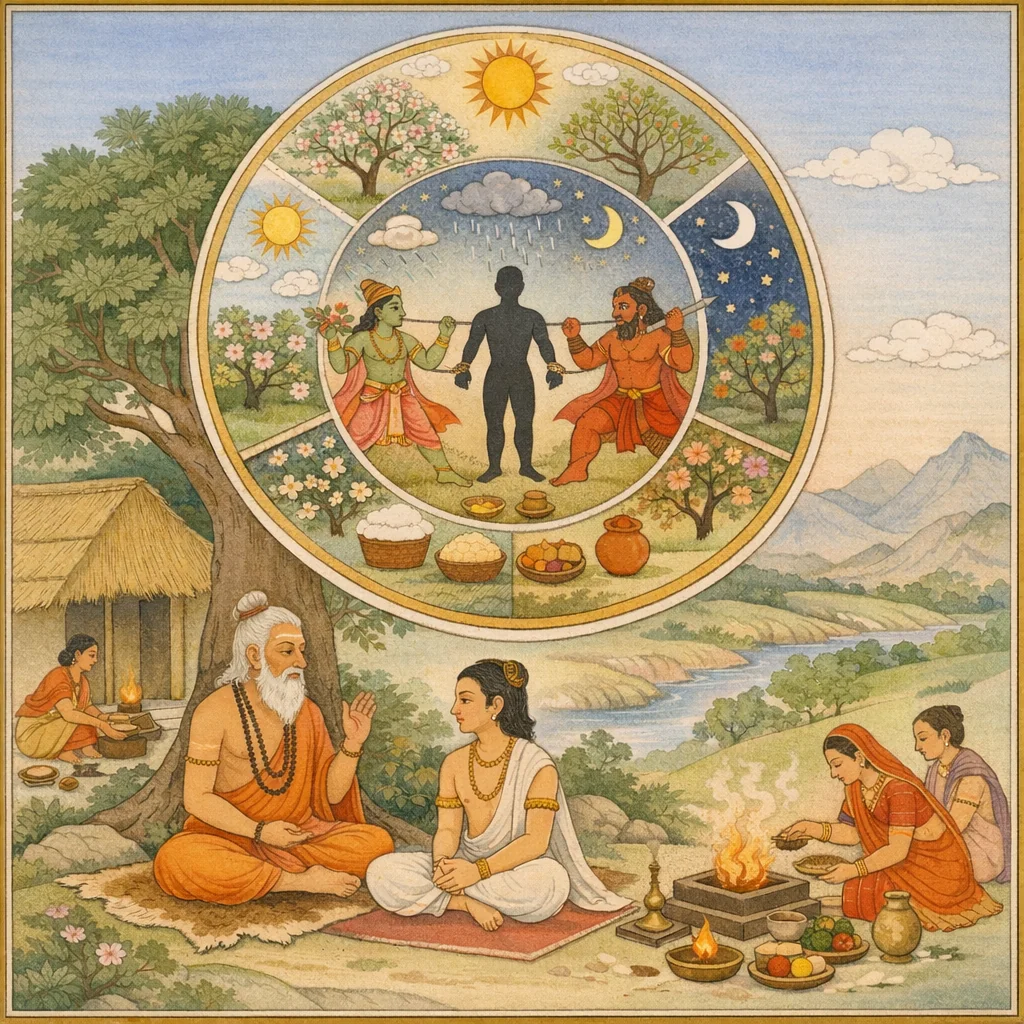
Brahmā describes the kālacakra as an impersonal, unconscious process that binds embodied beings through the mind–sense complex and the great elements, cycling through dualities and embodied conditions: aging, grief, disease, exertion, heat and cold, day and night, hunger and thirst, and the agitation of the guṇas. He states that one who knows the wheel’s true operation—its pravṛtti and nivṛtti—does not succumb to delusion and becomes free from afflictions and moral impurities, attaining a highest goal (paramā gati). The discourse then shifts from cosmological diagnosis to social prescription: the four āśramas are listed, with the gṛhastha presented as their support. A model of disciplined household conduct is outlined—fidelity, restraint, śiṣṭācāra, pañca-mahāyajñas, hospitality, regulated speech and bodily composure, purity, and association with the learned. Finally, Brahmin vocational duties are enumerated (study/teaching, sacrificing/officiating, giving/receiving), with cautions for careful performance and virtues of friendliness, forbearance, and impartiality toward beings; such practice is said to yield auspicious posthumous attainment while maintaining social order.
Chapter Arc: ब्रह्मा गुरु-शिष्य संवाद में देह को ‘कालचक्र’ कहकर खोलते हैं—बुद्धि, मन, इन्द्रियाँ और उनके बन्धन से बना यह चक्र मनुष्य को कैसे घुमाता है। → श्लोकों में देह-कालचक्र के दाँत-दाँत गिनाए जाते हैं: जरा-शोक, व्याधि-व्यसन, देश-काल का दबाव, श्रम-व्यायाम की थकान, अहोरात्र का परिक्षेप, शीत-उष्ण का घेरा, सुख-दुःख का संयोग, क्षुधा-पिपासा की कीलें, तम का कीचड़ और रज का वेग—और साथ ही भय-मोह, काम-क्रोध की पकड़। → निर्णायक वाक्य यह है कि जो मनुष्य इस देहमय कालचक्र की ‘प्रवृत्ति’ और ‘निवृत्ति’ को तत्त्वतः जान लेता है, वह प्राणियों के बीच रहते हुए भी मोह में नहीं पड़ता—ज्ञान ही चक्र से बाहर निकलने का द्वार बनता है। → इसके बाद गृहस्थ-ब्राह्मण के धर्म का व्यावहारिक विधान आता है: स्वधर्म में स्थित रहना, शिष्टाचार, जितेन्द्रियता, अपनी पत्नी में निष्ठा, और श्रद्धा सहित पंचमहायज्ञों का अनुष्ठान—यथाशक्ति शुचिता से करने वाला गृहस्थ स्वर्ग/उन्नति को प्राप्त होता है।
Shlokas
Verse 1
ऑपन-आक्रा बछ। अं पजञज्चचत्वारिशो< ध्याय: देहरूपी कालचक्रका तथा गृहस्थ और ब्रह्मणके धर्मका कथन ब्रह्मोवाच बुद्धिसारं मनःस्तम्भमिन्द्रियग्रामबन्धनम् । महाभूतपरिस्कन्धं निवेशपरिवेशनम्
Brahmā said: “The body is a constructed abode: its essence is intellect, its pillar is the mind, and it is bound together by the community of senses. It is a mass formed of the great elements, a dwelling-place and an enclosure.” In this teaching, the speaker frames embodied life as a structured but impermanent mechanism, urging discernment and restraint as the basis for righteous living.
Verse 2
जराशोकसमादविहष्ट व्याधिव्यसनसम्भवम् | देशकालविचारीदं श्रमव्यायामनि:स्वनम्
Vāyu said: “This sound arises from hardship and exertion—born of illness and misfortune, and intensified by old age, grief, and distress. It varies according to place and time, and is the very noise of fatigue and strenuous effort.”
Verse 3
अहोरात्रपरिक्षेपं शीतोष्णपरिमण्डलम् | सुखदु:खान्तसंश्लेषं क्षुत्पिपासावकीलकम्
Vāyu-deva said: “This embodied existence is hemmed in by the cycle of day and night, enclosed by the alternation of cold and heat, bound to the joining and separation of pleasure and pain, and obstructed by the compulsions of hunger and thirst.”
Verse 4
छायातपविलेखं च निमेषोन्मेषविद्धलम् | घोरमोहजलाकीर्ण वर्तमानमचेतनम्
Vāyu-deva said: “This (worldly existence) is scarred by alternating shade and heat, battered by the ceaseless blinking of time, flooded with the waters of dreadful delusion, and moves on without true awareness.”
Verse 5
मासार्धमासगणितं विषमं लोकसंचरम् । तमोनियमपड्कं च रजोवेगप्रवर्तकम्
Vāyu-deva said: “It moves through the worlds in an uneven course, reckoned by months and half-months; it is a mire governed by darkness (tamas), and it sets in motion the impetuous surge of passion (rajas).”
Verse 6
महाहंकारदीप्तं च गुणसंजातवर्तनम् | अरतिग्रहणानीकं॑ शोकसंहारवर्तनम्
Vāyu said: “It blazes with great egoism, and it moves along a course born of the guṇas. Its army is made of grasping and discontent, and its path is one that gathers up and multiplies sorrow.”
Verse 7
क्रियाकारणसंयुक्तं रागविस्तारमायतम् । लोभेप्सापरिविक्षोभ॑ विचित्राज्ञानसम्भवम्
Vāyu-deva said: “It is bound up with action and its causes; it spreads out through attachment and grows long and far-reaching. It is agitated by greed and craving, and it arises from a bewildering, many-formed ignorance.”
Verse 8
भयमोहपरीवारं भूतसम्मोहकारकम् | आनन्दप्रीतिचारं च कामक्रोधपरिग्रहम्
Vāyu-deva said: “It is surrounded by fear and delusion, and it becomes a cause of bewilderment for living beings. It moves about in the guise of joy and affection, yet it is in fact seized by desire and anger.”
Verse 9
महदादिविशेषान्तमसक्तं प्रभवाव्ययम् । मनोजवं मनःकान्तं कालचक्रं प्रवर्तते
Vāyu said: “The wheel of Time moves on—beginning with the great principles and ending in the particular forms; unattached, yet the source of all; imperishable. Swift as thought and captivating to the mind, it rolls forward, carrying all beings and events within its unceasing course.”
Verse 10
ब्रह्माजीने कहा--महर्षियो! मनके समान वेगवाला (देहरूपी) मनोरम कालचक्र निरन्तर चल रहा है। यह महत्तत्त्वसे लेकर स्थूल भूतोंतक चौबीस तत्त्वोंसे बना हुआ है। इसकी गति कहीं भी नहीं रुकती। यह संसार-बन्धनका अनिवार्य कारण है। बुढ़ापा और शोक इसे घेरे हुए हैं। यह रोग और दुर्व्यसनोंकी उत्पत्तिका स्थान है। यह देश और कालके अनुसार विचरण करता रहता है। बुद्धि इस काल-चक्रका सार, मन खम्भा और इन्द्रियसमुदाय बन्धन हैं। पठचमहाभूत इसका तना है। अज्ञान ही इसका आवरण है। श्रम तथा व्यायाम इसके शब्द हैं। रात और दिन इस चक्रका संचालन करते हैं। सर्दी और गर्मी इसका घेरा है। सुख और दुःख इसकी सन्धियाँ (जोड़) हैं। भूख और प्यास इसके कीलक तथा धूप और छाया इसकी रेखा हैं। आँखोंके खोलने और मीचनेसे इसकी व्याकुलता (चंचलता) प्रकट होती है। घोर मोहरूपी जल (शोकाश्रु)-से यह व्याप्त रहता है। यह सदा ही गतिशील और अचेतन है। मास और पक्ष आदिके द्वारा इसकी आयुकी गणना की जाती है। यह कभी भी एक-सी अवस्थामें नहीं रहता। ऊपर-नीचे और मध्यवर्ती लोकोंमें सदा चक्कर लगाता रहता है। तमोगुणके वशमें होनेपर इसकी पापपड़कमें प्रवृत्ति होती है और रजोगुणका वेग इसे भिन्न-भिन्न कर्मोमें लगाया करता है। यह महान् दर्पसे उद्दीप्त रहता है। तीनों गुणोंके अनुसार इसकी प्रवृत्ति देखी जाती है। मानसिक चिन्ता ही इस चक्रकी बन्धनपट्टिका है। यह सदा शोक और मृत्युके वशीभूत रहनेवाला तथा क्रिया और कारणसे युक्त है। आसक्ति ही उसका दीर्घ विस्तार (लंबाई-चौड़ाई) है। लोभ और तृष्णा ही इस चक्रको ऊँचे-नीचे स्थानोंमें गिरानेके हेतु हैं। अद्भुत अज्ञान (माया) इसकी उत्पत्तिका कारण है। भय और मोह इसे सब ओरसे घेरे हुए हैं। यह प्राणियोंको मोहमें डालनेवाला, आनन्द और प्रीतिके लिये विचरनेवाला तथा काम और क्रोधका संग्रह करनेवाला है ।। १ -९% || एतद् द्वन्द्समायुक्ते कालचक्रमचेतनम् । विसूजेत् संक्षिपेच्चापि बोधयेत् सामरं जगत्,यह रागदद्वेषादि द्वद्दोंसे युक्त जड देहरूपी कालचक्र ही देवताओंसहित सम्पूर्ण जगत्की सृष्टि और संहारका कारण है। तत्त्वज्ञानकी प्राप्तिका भी यही साधन है
This insentient Wheel of Time—bound up with the pairs of opposites (such as attraction and aversion)—is what brings forth the entire world, even with its gods, and also draws it back again in dissolution. Yet the very same wheel, when rightly understood, becomes a means for awakening: it impels beings toward discernment and thus serves as an instrument for attaining knowledge of reality.
Verse 11
कालचक्रप्रवृत्तिं च निवृत्तिं चैव तत्त्वतः । यस्तु वेद नरो नित्यं न स भूतेषु मुह्ृति,जो मनुष्य इस देहमय कालचक्रकी प्रवृत्ति और निवृत्तिको सदा अच्छी तरह जानता है, वह कभी मोहमें नहीं पड़ता
Vāyu said: “The man who constantly understands, in truth, both the onward turning and the withdrawal of the wheel of time that operates through embodied existence—he does not fall into delusion amid living beings.”
Verse 12
विमुक्त: सर्वसंस्कारै: सर्वद्वन्द्रविवर्जित: । विमुक्त: सर्वपापेभ्य: प्राप्नोति परमां गतिम्,वह सम्पूर्ण वासनाओं, सब प्रकारके द्वद्धों और समस्त पापोंसे मुक्त होकर परम गतिको प्राप्त होता है
Vāyu-deva said: One who is freed from all conditioning impressions, who has gone beyond every pair of opposites, and who is released from all sins attains the highest state. The verse presents liberation as an ethical and inner purification: freedom from reactive dualities and accumulated moral taint culminates in the supreme goal.
Verse 13
गृहस्थो ब्रह्मचारी च वानप्रस्थो5थ भिक्षुक: । चत्वार आश्रमा: प्रोक्ता: सर्वे गार्हस्थ्यमूलका:,ब्रह्मचर्य, गार्हस्थ्य, वानप्रस्थ और संन्यास--ये चार आश्रम शास्त्रोंमें बताये गये हैं। गृहस्थ आश्रम ही इन सबका मूल है
Vāyu said: “The householder, the celibate student, the forest-dweller, and the mendicant—these four stages of life are taught in the scriptures. Yet all of them are rooted in the householder’s way of life.” The verse underscores that social, ritual, and ethical order is sustained by the gṛhastha, whose support and responsibility make the other āśramas practically possible.
Verse 14
यः कश्षिदिह लोके5स्मिन्नागम: परिकीर्तित: । तस्यान्तगमन श्रेय: कीर्तिरेषा सनातनी,इस संसारमें जो कोई भी विधि-निषेधरूप शास्त्र कहा गया है, उसमें पारंगत विद्धान् होना गृहस्थ द्विजोंके लिये उत्तम बात है। इसीसे सनातन यशकी प्राप्ति होती है
Vāyu said: “Whatever authoritative teaching (āgama) is proclaimed in this world—setting forth what is to be done and what is to be avoided—mastery of it is a highest good for twice-born householders. From such disciplined understanding arises enduring renown, a fame held to be timeless.”
Verse 15
संस्कारै: संस्कृत: पूर्व यथावच्चरितव्रत: । जातौ गुणविशिष्टायां समावर्तेत तत्त्ववित्,पहले सब प्रकारके संस्कारोंसे सम्पन्न होकर वेदोक्त विधिसे अध्ययन करते हुए ब्रह्मचर्य-व्रतका पालन करना चाहिये। तत्पश्चात् तत्त्ववेत्ताको उचित है कि वह समावर्तन- संस्कार करके उत्तम गुणोंसे युक्त कुलमें विवाह करे
Vāyu said: “First, having been duly refined by the prescribed sacraments, one should live the brahmacarya discipline properly, studying according to Vedic rule. Thereafter, the knower of truth should complete the rite of graduation (samāvartana) and enter household life by marrying into a family distinguished by noble qualities.”
Verse 16
स्वदारनिरतो नित्यं शिष्टाचारो जितेन्द्रिय: । पज्चभिश्न महायज्ञै: श्रद्दधानो यजेदिह,अपनी ही स्त्रीपर प्रेम रखना, सदा सत्पुरुषोंक आचारका पालन करना और जितेन्द्रिय होना गृहस्थके लिये परम आवश्यक है। इस आश्रममें उसे श्रद्धापूर्वक पठचमहायज्ञोंके द्वारा देवता आदिका यजन करना चाहिये
Vāyu said: “A householder should always be devoted to his own lawful wife, follow the conduct of the cultured and righteous, and keep his senses under control. In this stage of life, with faith, he should perform worship and sacred duties through the five great sacrifices, thereby honoring gods and all beings and sustaining the moral order.”
Verse 17
देवतातिथिशिष्टाशी निरतो वेदकर्मसु । इज्याप्रदानयुक्तश्चन यथाशक्ति यथासुखम्,गृहस्थको उचित है कि वह देवता और अतिथियोंको भोजन करानेके बाद बचे हुए अन्नका स्वयं आहार करे। वेदोक्त कर्मोंके अनुष्ठानमें संलग्न रहे। अपनी शक्तिके अनुसार प्रसन्नतापूर्वक यज्ञ करे और दान दे
Vāyu said: “A householder should eat only what remains after first feeding the gods (through offerings) and the guest. He should remain devoted to the duties enjoined by the Veda, and, according to his capacity and with a contented mind, perform worship and sacrifice and also give gifts in charity.”
Verse 18
न पाणिपादचपलो न नेत्रचपलो मुनि: । न च वागड्भचपल इति शिष्टस्य गोचर:,मननशील गृहस्थको चाहिये कि हाथ, पैर, नेत्र, वाणी तथा शरीरके द्वारा होनेवाली चपलताका परित्याग करे अर्थात् इनके द्वारा कोई अनुचित कार्य न होने दे। यही सत्पुरुषोंका बर्ताव (शिष्टाचार) है
Verse 19
नित्यं यज्ञोपवीती स्याच्छुक्लवासा: शुचिव्रत: । नियतो यमदानाभ्यां सदा शिष्टैश्न संविशेत्,सदा यज्ञोपवीत धारण किये रहे, स्वच्छ वस्त्र पहने, उत्तम व्रतका पालन करे, शौच- संतोष आदि नियमों और सत्य-अहिंसा आदि यमोंके पालनपूर्वक यथाशक्ति दान करता रहे तथा सदा शिष्ट पुरुषोंके साथ निवास करे
Vāyu said: “Let a person always wear the sacred thread, dress in clean white garments, and observe pure and disciplined vows. Let him be self-restrained through the practice of yama (ethical restraints) and through giving according to his capacity, and let him always keep company with the cultured and well-conducted, never dwelling among the unrefined.”
Verse 20
जितशिक्षोदरो मैत्र: शिष्टाचारसमन्वित: । वैणवीं धारयेद् यष्टिं सोदक॑ च कमण्डलुम्,शिष्टाचारका पालन करते हुए जिह्नला और उपस्थको काबूमें रखे। सबके साथ मित्रताका बर्ताव करे। बाँसकी छड़ी और जलसे भरा हुआ कमण्डलु सदा साथ रखे
Vāyu-deva said: “Let him be one who has conquered the urges of the tongue and the belly, who is friendly toward all, and who is endowed with the conduct of the cultured. He should carry a bamboo staff and a water-filled mendicant’s pot—living with disciplined restraint and exemplary etiquette.”
Verse 21
(त्रीणि धारयते नित्यं कमण्डलुमतन्द्रित: । एकमाचमनार्थाय एकं॑ वै पादधावनम् । एकं शौचविधानार्थमित्येतत् त्रितयं तथा ।॥) वह आलस्य छोड़कर सदा तीन कमण्डलु धारण करे। एक आचमनके लिये, दूसरा पैर धोनेके लिये और तीसरा शौच-सम्पादनके लिये। इस प्रकार कमण्डलु धारणके ये तीन प्रयोजन हैं ।। अधीत्याध्यापनं कुर्यात् तथा यजनयाजने । दान॑ प्रतिग्रहं वापि षड्गुणां वृत्तिमाचरेत्,ब्राह्मणफो अध्ययन-अध्यापन, यजन-याजन और दान तथा प्रतिग्रह--इन छः: वृत्तियोंका आश्रय लेना चाहिये
Vāyudeva said: “A man, casting off sloth, should always carry three water-pots. One is for sipping water in purification (ācamana), one for washing the feet, and one for attending to bodily cleanliness. Such are the three purposes for carrying the kamaṇḍalu. Likewise, one should live by the sixfold Brahminical duties: studying and teaching, performing sacrifice and officiating for others, giving gifts and accepting gifts.”
Verse 22
त्रीणि कर्माणि जानीत ब्राह्मणानां तु जीविका । याजनाध्यापने चोभे शुद्धाच्चापि प्रतिग्रह:,इनमेंसे तीन कर्म--याजन (यज्ञ कराना), अध्यापन (पढ़ाना) और श्रेष्ठ पुरुषोंसे दान लेना--ये ब्राह्मणकी जीविकाके साधन हैं
Vāyu said: “Know that there are three rightful means of livelihood for Brahmins: officiating at sacrifices for others, teaching sacred learning, and accepting pure gifts (given in a righteous manner).” The verse frames Brahmin livelihood as a dharmic economy—service through ritual and instruction, and only such receiving as is ethically ‘clean’ and appropriate.
Verse 23
अथ शेषाणि चान्यानि त्रीणि कर्माणि यानि तु । दानमध्ययन यज्ञो धर्मयुक्तानि तानि तु,शेष तीन कर्म-दान, अध्ययन तथा यज्ञानुष्ठान करना-ये धर्मोपार्जनके लिये हैं
Vāyu said: “Now, as for the other remaining three duties—giving (charity), study (of sacred learning), and the performance of sacrifice—these are actions aligned with dharma, undertaken for the acquisition and strengthening of righteousness.”
Verse 24
तेष्वप्रमाद॑ कुर्वीत त्रिषु कर्मसु धर्मवित् दान्तो मैत्र: क्षमायुक्त: सर्वभूतसमो मुनि:,धर्मज्ञ ब्राह्मगको इनके पालनमें कभी प्रमाद नहीं करना चाहिये। इन्द्रियसंयमी, मित्रभावसे युक्त, क्षमावान, सब प्राणियोंके प्रति समानभाव रखनेवाला, मननशील, उत्तम व्रतका पालन करनेवाला और पवित्रतासे रहनेवाला गृहस्थ ब्राह्मण सदा सावधान रहकर अपनी शक्तिके अनुसार यदि उपर्युका नियमोंका पालन करता है तो वह स्वर्गलोकको जीत लेता है
Vāyu said: “A knower of dharma should never be negligent regarding those three duties. Self-controlled, friendly in disposition, endowed with forbearance, and equal-minded toward all beings, the reflective sage should remain vigilant in conduct.”
Verse 25
सर्वमेतद् यथाशक्ति विप्रो निर्वर्तयन् शुचि: । एवं युक्तो जयेत् स्वर्ग गृहस्थ: संशितव्रत:,धर्मज्ञ ब्राह्मगको इनके पालनमें कभी प्रमाद नहीं करना चाहिये। इन्द्रियसंयमी, मित्रभावसे युक्त, क्षमावान, सब प्राणियोंके प्रति समानभाव रखनेवाला, मननशील, उत्तम व्रतका पालन करनेवाला और पवित्रतासे रहनेवाला गृहस्थ ब्राह्मण सदा सावधान रहकर अपनी शक्तिके अनुसार यदि उपर्युका नियमोंका पालन करता है तो वह स्वर्गलोकको जीत लेता है
Vāyu said: “A pure brāhmaṇa, carrying out all these duties to the best of his ability, and thus disciplined and well-yoked to right conduct—steadfast in his vows as a householder—wins the world of heaven.”
Verse 44
इस प्रकार श्रीमह्याभारत आश्वमेधिकपर्वके अन्तर्गत अनुगीतापर्वमें गुरु-शिष्य- संवादविषयक चौवालीसवाँ अध्याय पूरा हुआ
Thus ends the forty-fourth chapter of the Guru–Disciple dialogue section within the Anugītā sub-parvan, contained in the Aśvamedhika Parvan of the revered Mahābhārata. The narrative here marks a formal closure, emphasizing the transmission of ethical and spiritual instruction through disciplined teacher–student discourse.
Verse 45
इति श्रीमहाभारते आश्वमेधिके पर्वणि अनुगीतापर्वणि गुरुशिष्यसंवादे पज्चचत्वारिंशो5 ध्याय:,इस प्रकार श्रीमह्याभारत आश्वमेधिकपर्वके अन्तर्गत अनुगीतापर्वमें गुरु-शिष्य- संवादविषयक पैंतालीसवाँ अध्याय पूरा हुआ
Thus, in the Śrī Mahābhārata, within the Āśvamedhika Parva—specifically in the Anugītā section—ends the forty-fifth chapter of the dialogue between teacher and disciple. In this manner, the forty-fifth chapter on the teacher–disciple conversation, belonging to the Anugītā portion contained in the Āśvamedhika Parva, is concluded.
Frequently Asked Questions
The chapter frames the dilemma of agency under constraint: how to live responsibly when embodied life is driven by impersonal time, sensory binding, and dualities; the proposed resolution is disciplined conduct grounded in accurate knowledge of kāla’s operation.
Understanding the kālacakra’s pravṛtti and nivṛtti reduces delusion and affliction; liberation-oriented clarity is paired with practical ethics—restraint, purity, hospitality, and regulated livelihood—so that knowledge becomes socially stabilizing conduct.
Yes: the text asserts that the knower of time’s true operation does not become deluded among beings and, being freed from afflictions and moral impurities, attains the “highest goal” (paramā gati); additionally, disciplined gṛhastha practice is linked to attaining svarga and auspicious outcomes.