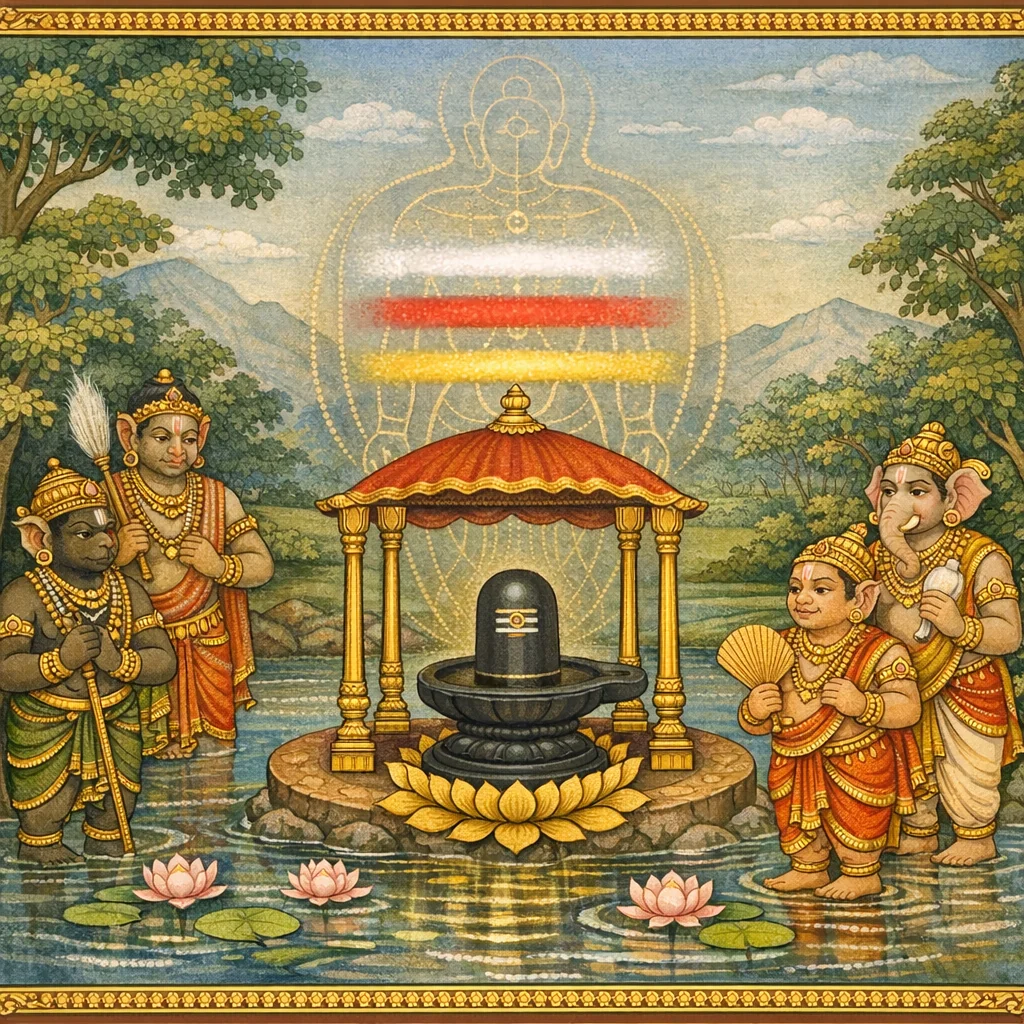
Adhyaya 13
Adhyāya 13 weaves together sacred geography of Kāśī, doctrinal praise, and an edifying devotee tale. The Gaṇas describe a fragrant holy precinct and point out a liṅga connected with Vāyu (Prabhañjana), declaring that by worshipping Śrī Mahādeva, Vāyu attains the rank of a dikpāla, guardian of a direction. It then recounts Pūtatmā’s long tapas in Vārāṇasī and the स्थापना of the purifying liṅga Pavaneśvara/Pavamāneśvara, asserting that mere darśana can cast off sin as an ethical-ritual transformation. A sustained stotra praises Śiva as both transcendent and immanent, explains Śiva–Śakti in terms of jñāna, icchā, and kriyā śaktis, and maps a “cosmic body” that integrates social orders and cosmic elements into a theological cosmogram. The chapter also gives practical location and observance: the liṅga is near Vāyu-kuṇḍa and west of Jyeṣṭheśa, with fragrant bathing and aromatic offerings prescribed. The narration shifts to another legend of Alakā-like splendor and a devotee’s rise (with later kingship motifs), and closes with a phalaśruti assurance that hearing this account removes sins.
Shlokas
Verse 1
गणावूचतुः । इमां गंधवतीं पुण्यां पुरीं वायोर्विलोकय । वारुण्या उत्तरे भागे महाभाग्यनिधे द्विज
The gaṇas said: “Behold this fragrant, holy city of Vāyu. In the northern part of Vāruṇī, O brāhmaṇa—treasury of great fortune—it is to be seen.”
Verse 2
अस्यां प्रभंजनो नाम जगत्प्राणोदिगीश्वरः । आराध्य श्रीमहादेवं दिक्पालत्वमवाप्तवान्
Here Prabhañjana—Vāyu, the life-breath of the world and lord of the quarters—having worshiped glorious Mahādeva, attained the office of a guardian of direction.
Verse 3
पुरा कश्यपदायादः पूतात्मेति च विश्रुतः । धूर्जटे राजधान्यां स चचार विपुलं तपः
Formerly, a descendant of Kaśyapa, famed as “Pūtātman” (the Purified-souled), performed abundant austerity in the royal city of Dhūrjaṭi (Śiva).
Verse 4
वाराणस्यां महाभागो वर्षाणामयुतं शतम् । स्थापयित्वा महालिंगं पावनं पवनेश्वरम्
In Vārāṇasī, that greatly fortunate one—after ten thousand years and a further hundred—established the great liṅga, the purifier known as Pavaneśvara.
Verse 5
यस्य दर्शनमात्रेण पूतात्मा जायते नरः । पापकंचुकमुत्सृज्य स वसेत्पावने पुरे
By the mere sight of him, a person becomes purified in soul. Casting off the cloak of sin, let him dwell in the city of the Purifier, Pāvana.
Verse 6
पलायमानो निहतः क्षणात्पंचत्वमागतः । अभक्षयच्च नैवेद्यं भाविपुण्यबलान्न सः
While fleeing, he was struck down and in an instant met death. Yet, by the power of merit that was to arise for him, he did not partake of the offered naivedya.
Verse 7
उवाच च प्रसन्नात्मा करुणामृतसागरः । उत्तिष्ठोत्तिष्ठ पूतात्मन्वरं वरय सुव्रत
Then the Lord—serene at heart, an ocean of compassion and nectar—spoke: “Rise, rise, O Pūtātmā. O you of excellent vows, choose a boon.”
Verse 8
अनेन तपसोग्रेण लिंगस्याराधनेन च । तवादेयं न पूतात्मंस्त्रैलोक्ये सचराचरे
“By this intense austerity, and by your worship of the Liṅga, nothing in the three worlds—moving and unmoving—remains ungrantable to you, O Pūtātmā.”
Verse 9
पूतात्मोवाच । देवदेवमहादेव देवानामभयप्रद । ब्रह्मनारायणेंद्रादि सर्वदेवपदप्रद
Pūtātmā said: “O God of gods, O Mahādeva, giver of fearlessness to the deities; bestower of the very stations of all gods—Brahmā, Nārāyaṇa, Indra, and the rest.”
Verse 10
वेदास्त्वां न च विंदंति किमात्मक इति प्रभो । प्राप्ताः शतपथत्वं च नेतिनेतीतिवादिनः
“The Vedas do not fully fathom You—what Your essential nature is, O Lord. Proclaiming ‘not this, not this,’ they have taken a hundred paths of approach.”
Verse 11
ब्रह्मविष्ण्वोपि गिरां गोचरो न च वाक्पतेः । प्रमथेशं कथं स्तोतुं मादृशः प्रभवेत्प्रभो
Even Brahmā and Viṣṇu are beyond the reach of speech—nor even the Lord of speech (Bṛhaspati). How could one like me be able to praise You, O Lord of the Pramathas?
Verse 12
प्रसह्य प्रमिमीतेश भक्तिर्मांस्तुतिकर्मणि । करोमि किं जगन्नाथ न वश्यानींद्रियाणि मे
O Lord, devotion forcefully drives me into the act of praise. Yet what can I do, O Jagannātha, Master of the world? My senses are not under my control.
Verse 13
विश्वं त्वं नास्ति वै भेदस्त्वमेकः सर्वगो यतः । स्तुत्यं स्तोता स्तुतिस्त्वं च सगुणो निर्गुणो भवान्
You are the universe; truly there is no difference, for You are One and all-pervading. You are the One to be praised, the praiser, and the praise itself; You are both with attributes and beyond attributes.
Verse 14
सर्गात्पुरा भवानेको रूपनाम विवर्जितः । योगिनोपि न ते तत्त्वं विंदंति परमार्थतः
Before creation, You alone existed, devoid of form and name. Even yogins do not truly know Your reality in its highest sense.
Verse 15
यदैकलो न शक्नोषि रंतुं स्वैरचर प्रभो । तदिच्छा तवयोत्पन्ना सेव्या शक्तिरभूत्तव
When You, O Lord who roams freely, could not delight alone, then from Your will there arose Your Power—worthy of worship—Your Śakti.
Verse 16
त्वमेको द्वित्वमापन्नः शिवशक्तिप्रभेदतः । त्वं ज्ञानरूपो भगवान्स्वेच्छा शक्तिस्वरूपिणी
Though One, You appear as two through the distinction of Śiva and Śakti. You, O Blessed Lord, are of the nature of consciousness and knowledge; and Your Power is the form of Your own free will.
Verse 17
उभाभ्यां शिवशक्तिभ्या युवाभ्यां निजलीलया । उत्पादिता क्रियाशक्तिस्ततः सर्वमिदं जगत्
From you two—Śiva and Śakti—by your own divine play, the power of action (kriyā-śakti) was brought forth; and from that, this entire universe has arisen.
Verse 18
ज्ञानशक्तिर्भवानीश इच्छाशक्तिरुमा स्मृता । क्रियाशक्तिरिदं विश्वमस्य त्वं कारणं ततः
O Lord of Bhavānī, Bhavānī is remembered as the power of knowledge, and Umā as the power of will; this universe is the power of action—therefore You are its ultimate cause.
Verse 19
दक्षिणांगं तव विधिर्वामांगं तव चाच्युतः । चंद्रसूर्याग्निनेत्रस्त्वं त्वन्निःश्वासः श्रुतित्रयम्
Brahmā is Your right side, and Acyuta (Viṣṇu) is Your left. Your eyes are the Moon, the Sun, and Fire; and the three Vedas are Your very breath.
Verse 20
त्वत्स्वेदादंबुनिधयस्तव श्रोत्रं समीरणः । बाहवस्ते दशदिशो मुखं ते ब्राह्मणाः स्मृताः
From Your sweat arose the oceans. The wind is Your ear; the ten directions are Your arms; and the Brāhmaṇas are remembered as Your mouth.
Verse 21
राजन्यवर्यास्ते बाहु वैश्या ऊरुसमुद्भवाः । पद्भ्यां शूद्रस्तवेशान केशास्ते जलदाः प्रभो
O Īśāna, the noble Kṣatriyas are your arms; the Vaiśyas are born from your thighs; the Śūdra is from your feet; and your hair, O Lord, is the mass of clouds.
Verse 22
त्वं पुं प्रकृतिरूपेण ब्रह्मांडमसृजः पुरा । मध्ये ब्रह्मांडमखिलं विश्वमेतच्चराचरम्
You, as Puruṣa and as Prakṛti, created the cosmic egg in the beginning; and within that cosmic egg is contained this entire moving-and-unmoving universe.
Verse 23
अतस्त्वत्तो न मन्येऽहं किंचिद्भिन्नं जगन्मय । त्वयि सर्वाणि भूतानि सर्वभूतमयो भवान्
Therefore, O one who pervades the world, I do not consider anything to be separate from you. In you are all beings, and you yourself are formed of all beings.
Verse 24
नमस्तुभ्यं नमस्तुभ्यं नमस्तुऽभ्यं नमोनमः । अयमेव वरो नाथ त्वयि मेऽस्तु स्थिरा मतिः
Salutations to you—salutations to you—salutations to you, again and again. This alone is the boon, O Lord: may my understanding remain steadfast in you.
Verse 25
इत्युक्तवति देवेश स्तस्मिन्पूतात्मनि प्रभुः । स्वमूर्तित्वं समारोप्य दिक्पालपदमादधे
When that pure-souled one had spoken thus to the Lord of gods, the Lord assumed him into His own form and bestowed upon him the status of a guardian of the directions (Dikpāla).
Verse 26
सर्वगो मम रूपेण सर्वतत्त्वावबोधकः । सर्वेषामायुषोरूपं भवानेव भविष्यति
In my own form you shall be all-pervading, the awakener of the understanding of all tattvas; and you alone shall become the very embodiment of the lifespan of all beings.
Verse 27
तव लिंगमिदं दिव्यं ये द्रक्ष्यंतीह मानवाः । सर्वभोगसमृद्धास्ते त्वल्लोकसुखभागिनः
Those who behold here this divine Liṅga of yours become endowed with every enjoyment and prosperity, and they partake of the happiness of your own world.
Verse 28
पवमानेश्वरं लिंगं मध्ये जन्मसकृन्नरः । यथोक्तविधिना पूज्य सुगंधस्नपनादिभिः
A person, even once in the midst of life, should worship the Liṅga of Pavamāneśvara according to the prescribed rite—by fragrant bathing and other offerings.
Verse 29
सुगंधचंदनैः पुष्पैर्मम लोके महीयते । ज्येष्ठेशात्पश्चिमेभागे वायुकुंडोत्तरेण तु
With fragrant sandal and flowers he is honored in my world. (This Pavamāneśvara is situated) to the western side of Jyeṣṭheśa, and to the north of Vāyu-kuṇḍa.
Verse 30
पावमानं समाराध्य पूतो भवति तत्क्षणात् । इति दत्त्वा वरान्देवस्तस्मिंल्लिंगे लयं ययौ
Having duly propitiated Pāvamāna (Pavamāneśvara), one becomes purified instantly. Having thus granted these boons, the Deva merged and entered dissolution in that very Liṅga.
Verse 31
गणावूचतुः । इति गंधवती पुर्याः स्वरूपं ते निरूपितम् । तस्याः प्राच्यां कुबेरस्य श्रीमत्येषालकापुरी
The Gaṇas said: “Thus the true nature of the Fragrant City has been set forth to you. To its east lies Kubera’s splendid city—Alakā.”
Verse 32
शंभोः सखित्वमापेदे नाथोस्या भक्तियोगतः । निधीनां पद्ममुख्यानां दाता भोक्ता हरार्चनात्
By the power of devotion, her lord attained friendship with Śambhu; and through worship of Hara he became both the giver and the enjoyer of treasures—chief among them Padma, the great Nidhi.
Verse 33
शिवशर्मोवाच । कोसौ कस्य पुनः कीदृग्भक्तिरस्य सदाशिवे । यया सखित्वमापन्नो देवदेवस्यधूर्जटेः
Śivaśarman said: “Who is he, and whose lord is he? What kind of devotion does he bear toward Sadāśiva, by which he attained friendship with Dhūrjaṭi, the God of gods?”
Verse 34
इति श्रोतुं मम मनः श्रुतिगोचरतां गतम् । युवयोर्वाक्सुधास्वाद मेदुरोदरमंथरम्
Thus my mind has turned wholly toward hearing this account. The nectar-like savor of your speech stirs even the slow-moving, heavy-laden mind into motion.
Verse 35
गणावूचतुः । शिवशर्मन्महाप्राज्ञ परिशुद्धेंद्रियेश्वर । सुतीर्थक्षालिताशेषजन्मजातमहामल
The Gaṇas said: “O Śivaśarman, greatly wise, lord of purified senses—your vast impurities born of countless births have been washed away by excellent tīrthas.”
Verse 36
सुहृदि प्रेमसंपन्ने त्वय्यनुद्यं न किंचन । साधुभिः सह संवादः सर्वश्रेयोऽभिवृद्धये
In you—our loving friend, filled with goodwill—there is nothing at all blameworthy. Conversation with the virtuous is for the increase of every highest good.
Verse 37
आसीत्कांपिल्यनगरे सोमयाजिकुलोद्भवः । दीक्षितो यज्ञदत्ताख्यो यज्ञविद्याविशारदः
In the city of Kāṃpilya there lived a consecrated Brahmin, born in a lineage of Soma-sacrificers, named Yajñadatta—highly skilled in the science of ritual sacrifice.
Verse 38
वेदवेदांगवेदार्थान्वेदोक्ताचारचंचुरः । राजमान्यो बहुधनो वदान्यः कीर्तिभाजनम्
He knew the Vedas, the Vedāṅgas, and the meanings of Vedic teaching; he was diligent in conduct enjoined by the Veda, honored by kings, wealthy, generous, and a vessel of good repute.
Verse 39
अग्निशुश्रूषणरतो वेदाध्ययनतत्परः । तस्य पुत्रो गुणनिधिश्चंद्रबिंबसमाकृतिः
He was devoted to attentive service of the sacred fire and intent on Vedic study. His son was Guṇanidhi, whose face was like the orb of the moon.
Verse 40
कृतोपनयनः सोथ विद्यां जग्राह भूरिशः । अथ पित्रानभिज्ञातो द्यूतकर्मरतोऽभवत्
Having undergone the sacred-thread rite, he learned much. But later—without his father’s knowledge—he became devoted to the practice of gambling.
Verse 41
आदायादाय बहुशो धनं मातुः सकाशतः । ददाति द्यूतकारेभ्यो मैत्री तैश्च चकार सः
Again and again he took money from his mother and gave it to gamblers, forging friendships with them.
Verse 42
संत्यक्त ब्राह्मणाचारः संध्यास्नानपराङ्मुखः । निंदको वेदशास्त्राणां देवब्राह्मणनिंदकः
He abandoned the conduct proper to a Brahmin, turned away from the sandhyā prayers and ritual bathing, and became a reviler of the Vedas and śāstras—one who slandered both gods and Brahmins.
Verse 43
स्मृत्याचारविहीनस्तु गीतवाद्यविनोदभाक् । नटपाखंडिभंडैश्च बद्धप्रेमपरंपरः
Bereft of the conduct taught in Smṛti, he delighted in songs and instruments, and became bound by a chain of attachments to actors, impostors, and buffoons.
Verse 44
प्रेरितोपि जनन्या स न याति पितुरंतिकम् । गृहकार्यांतरव्यग्रो दीक्षितो दीक्षितायिनीम्
Though urged by his mother, he did not go near his father. Preoccupied with other household affairs, he kept troubling the initiated lady of the house (dīkṣitā).
Verse 45
यदा यदैव तां पृच्छेदयेगुणनिधिः सुतः । न दृश्यते मया गेहे क्व याति विदधाति किम्
Whenever her son Guṇanidhi questioned her—“I do not see him in the house; where does he go, and what does he do?”
Verse 46
तदा तदेति सा ब्रूयादिदानीं स बहिर्गतः । स्नात्वा समर्च्य वै देवानेतावंतमनेहसम्
Then she would answer each time: “Just now he has gone outside—having bathed and duly worshipped the gods; that is all, nothing more.”
Verse 47
अधीत्याध्ययनार्थं स द्वित्रैर्मित्रैः समं ययौ । एकपुत्रेति तन्माता प्रतारयति दीक्षितम्
Having completed his earlier studies, he went out for further learning together with two or three companions. But his mother—thinking, “He is my only son”—kept coaxing and deceiving Dīkṣita, indulging him and covering for him.
Verse 48
न तत्कर्म च तद्वृत्तं किंचिद्वेत्ति स दीक्षितः । स च केशांतकर्मास्य कृत्वा वर्षेऽथ षोडशे
Dīkṣita knew nothing at all of that deed and that misconduct. And then, when the keśānta rite had been performed for him, in his sixteenth year…
Verse 49
गृह्योक्तेन विधानेन पाणिग्राहमकारयत् । प्रत्यहं तस्य जननी सुतं गुणनिधिं मृदु
According to the procedure taught in the Gṛhya-sūtras, she had his marriage—the taking of the hand—performed. Day after day, his mother would gently address her son: “O treasure-house of virtues…”
Verse 50
शास्ति स्नेहार्द्रहृदया क्रोधनस्ते पितेत्यलम् । यदि ज्ञास्यति ते वृत्तं त्वां च मां ताडयिष्यति
With a heart softened by affection she would admonish him: “Enough—your father is quick to anger. If he comes to know your behavior, he will beat both you and me.”
Verse 51
आच्छादयामि ते नित्यं पितुरग्रे कुचेष्टितम् । लोकमान्योस्ति ते तातः सदाचारैर्न वै धनैः
I continually conceal your misdeeds before your father. Your father, my son, is honored by the world not through wealth, but through righteous conduct.
Verse 52
ब्राह्मणानां धनं पुत्र सद्विद्या साधुसंगमः । सच्छ्रोत्रियास्त्वनूचाना दीक्षिताः सोमयाजिनः
O son, a brāhmaṇa’s true wealth is right knowledge and the company of the virtuous—worthy śrotriyas, learned reciters, consecrated dīkṣitas, and performers of the Soma-sacrifice.
Verse 53
इति रूढिमिह प्राप्तास्तव पूर्वपितामहाः । त्यक्त्वा दुर्वृत्तसंसर्गं साधुसंगरतो भव
Thus your forefathers attained here this established tradition. Abandon the company of the ill-conducted, and become devoted to the company of the virtuous.
Verse 54
सद्विद्या सुमनो धेहि ब्राह्मणाचारमाचर । तवानुरूपारूपेण वयसाकुलशीलतः
Establish true learning and a well-disposed mind; practice brāhmaṇa conduct. For whether you keep to what befits you or stray from it—because of the restless nature of youth…
Verse 55
ऊनविंशतिकोऽसि त्वमेषा षोडशवार्षिकी । तव पत्नी गुणनिधे साध्वी मधुरभाषिणी
You are not yet twenty, and she is sixteen years of age. Your wife, O treasure of virtues, is a sādhvī—chaste and sweet of speech.
Verse 56
एतां संवृणु सद्वृत्तां पितृभक्तियुता भव । श्वशुरोपि हि ते मान्यः सर्वत्र गुणशीलतः
Accept and cherish this wife of good conduct, and be endowed with devotion to your father. For your father-in-law too is worthy of honor everywhere, because of his virtues and character.
Verse 57
ततोऽपत्रपसे किं न त्यज दुर्वृत्ततां शिशो । मातुलास्तेऽतुलाः पुत्र विद्याशीलकुलादिभिः
Why do you not feel shame, my child, and abandon your wicked conduct? Your maternal uncles are exemplary, my son—renowned for learning, good character, and noble family.
Verse 58
तेभ्योपि न बिभेषि त्वं शुद्धोस्युभय वंशतः । पश्यैतान्प्रतिवेश्मस्थान्ब्राह्मणानां कुमारकान्
Do you not fear even them, though you are of pure lineage on both sides? Look at these boys of the brāhmaṇas, living in the neighboring houses.
Verse 59
गृहेपि शिष्यान्पश्यैतान्पितुस्ते विनयोचितान् । राजापि श्रोष्यति यदा तव दुश्चेष्टितं सुत
Even at home, look at these students of your father—trained in proper discipline. For when the king hears of your misdeeds, my son, the consequences will follow.
Verse 60
श्रद्धां विहाय ते ताते वृत्तिलोपं करिष्यति । बालचेष्टितमेवैतद्वदंत्यद्यापि ते जनाः
Your father, losing faith in you, will cut off your maintenance. Even now people say, “This is nothing but childish behavior.”
Verse 61
अनंतरं हसिष्यंति युक्तं दीक्षिततास्त्विति । सर्वेप्याक्षारयिष्यंति तव विप्रं च मां च वै
After that they will laugh, saying, “So this is the ‘proper’ dīkṣā (initiation)!” And because of you, everyone will reproach both your brāhmaṇa preceptor and me as well.
Verse 62
मातुश्चरित्रं तनयो धत्ते दुर्भाषणैरिति । पिता पितेन पापीयाञ्च्छ्रुतिस्मृतिपथीनकिम्
People will say, “By his abusive speech the son reveals the mother’s character.” And, “The father is worse because of the father before him—are they not followers of the path of Śruti and Smṛti?”
Verse 63
तदंघ्रिलीनमनसो मम साक्षी महेश्वरः । न चर्तुस्नातयापीह मुखं दुष्टस्य वीक्षितम्
For me, whose mind is fixed at His feet, Maheśvara is my witness. And here, not even one purified by the “fourfold bath” has looked upon the face of a wicked man.
Verse 64
अहो बलीयान्सविधिर्येन जाता भवानिति । प्रतिक्षणं जनन्येति शिक्ष्यमाणोतिदुर्मदः
“Ah, mighty indeed is the destiny by which you were born!”—so they speak. Yet even while being instructed, at every moment he runs to his mother, exceedingly arrogant.
Verse 65
न तत्याज च तद्धर्मं दुर्बोधो व्यसनी यतः । मृगया मद्य पैशुन्य वेश्याचौर्यदुरोदरैः
He did not abandon that way of life, for he was dull-witted and addicted—to hunting, liquor, slander, consorting with prostitutes, theft, and ruinous gambling.
Verse 66
सपारदारैर्व्यसनैरेभिः कोत्र न खंडितः । यद्यन्मध्ये गृहे पश्येत्तत्तन्नीत्वा सुदुर्मतिः
With these vices—adultery among them—who in this world is not shattered? Whatever he saw within the household, that very thing he would seize and carry away, for his mind was utterly depraved.
Verse 67
अर्पयेद्द्यूतकाराणां सकुप्यं वसनादिकम् । नवरत्नमयीं मातुः करतः पितुरूर्मिकाम
He would hand over to the gamblers household goods, clothing, and the like; he even gave away his mother’s nine-gem ring and his father’s finger-ring.
Verse 68
स्वपंत्यास्त्वेकदाऽदाय दुरोदरिकरेऽर्पयत् । एकदा गच्छता राजभवनान्निजमुद्रिका
Once, taking it while she slept, he placed it into the hand of a gambler. And once, as he was going to the royal palace, he carried his own signet-ring.
Verse 69
दीक्षितेन परिज्ञाता दैवाद्द्यूतकृतः करे । उवाच दीक्षितस्तं च कुतो लब्धा त्वयोर्मिका । पृष्टस्तेनाथ निर्बंधादसकृत्प्रत्युवाच किम्
By chance, the consecrated brāhmaṇa noticed it upon the gambler’s hand. The dīkṣita said, “From where did you obtain this ring?” Questioned insistently again and again, what did he reply?
Verse 70
ममाक्षिपसि विप्रोच्चैः किं मया चौर्य कर्मणा । लब्धा मुद्रा त्वदीयेन पुत्रेणैषा ममार्पिता
“Why do you accuse me so loudly, O brāhmaṇa? What have I to do with theft? This seal-ring I obtained from your own son—he himself gave it to me.”
Verse 71
मम मातुर्हि पूर्वे द्युर्जित्वानीतो हि शाटकः । न केवलं ममाप्येतदंगुलीयं समर्पितम्
“Earlier, after winning at play, he carried off my mother’s garment; and not only that—he also handed over this ring of mine.”
Verse 72
अन्येषां द्यूतकर्तृणां भूरि तेनार्पितं वसु । रत्नकुप्यदुकूलानि भृंगारुप्रभृतीनि च
“And to other gamblers as well, he gave abundant wealth—jewels, household valuables, fine garments, and ornaments such as armlets and the like.”
Verse 73
भाजनानि विचित्राणि कांस्य ताम्रमयानि च । नग्नीकृत्यप्रति दिनं बद्ध्यंते द्यूतकारिभिः
“They even had various vessels—made of bell-metal and copper—stripped away; and day after day, they were bound (and dragged into misery) by gamblers.”
Verse 74
न तेन सदृशः कश्चिदाक्षिको भूमिमंडले । अद्य यावत्त्वया विप्र दुरोदरशिरोमणिः
“On the face of the earth there is no dice-player equal to him. Up to this very day, O brāhmaṇa, he is the crest-jewel among gamblers.”
Verse 75
कथं नाज्ञायि तनयो ऽविनयानयकोविदः । इति श्रुत्वा त्रपाभार विनम्रतरकंधरः
“How was the son—so skilled in leading one into impropriety—not recognized?” Hearing this, weighed down by shame, he bowed his neck even lower.
Verse 76
प्रावृत्य वाससा मौलिं प्राविशन्निजमंदिरम् । महापतिव्रतामास्य पत्नीं प्रोवाच तामथ
Covering his head with his cloth, he entered his own home. Then he spoke to his wife, a great exemplar of wifely fidelity and virtue.
Verse 77
दीक्षितायिनि कुत्रासि क्व ते गुणनिधिः सुतः । अथ तिष्ठतु किं तेन क्व सा मम शुभोर्मिका
“O Dīkṣitāyinī, where are you? Where is your son, that treasure of virtues? Let him be—what of him? But where is my auspicious ring?”
Verse 78
अंगोद्वर्तन काले या त्वया मेंऽगुलितो हृता । नवरत्नमयीं शीघ्रं तामानीय प्रयच्छ मे
“The one you took from my finger at the time of rubbing unguents on the body—bring that ring back quickly, the one set with nine gems, and give it to me.”
Verse 79
इति श्रुत्वाथ तद्वाक्यं भीता सा दीक्षितायिनी । प्रोवाच सा तु माध्याह्नीं क्रियां निष्पादयत्वथ
Hearing those words, Dīkṣitāyinī became afraid. Then she replied, “First let the midday duty be completed.”
Verse 80
व्यग्रास्मि देवपूजार्थमुपहारादि कर्मणि । समयोयमतिक्रामेदतिथीनां प्रियातिथे
“I am busy with the worship of the gods and the tasks of offerings and such. This is the appointed time—let it not be overstepped, O dear one who loves guests.”
Verse 81
इदानीमेव पक्वान्नकरणव्यग्रया मया । स्थापिता भाजने क्वापि विस्मृतेति न वेद्म्यहम्
Just now, being busy with preparing the cooked food, I placed it somewhere in a vessel; but, having forgotten, I do not know where it was set.
Verse 82
दीक्षित उवाच । हंहो सत्पुत्रजननि नित्यं सत्यप्रभाषिणि । यदायदा त्वां संपृच्छे तनयः क्व गतस्त्विति
Dīkṣita said: “Ah! O mother of a worthy son, you who ever speak the truth—whenever I ask you, ‘Where has the boy gone?’”
Verse 83
तदातदेति त्वं ब्रूया नाथेदानीं स निर्गतः । अधीत्याध्ययनार्थं च द्वित्रैर्मित्रैः सयुग्बहिः
“You keep saying, ‘then and then.’ But now, lady, he has gone out—together with two or three friends—after studying, for the sake of further lessons, outside.”
Verse 84
कुतस्त्वच्छाटकः पत्नि मांजिष्ठो यो मयाऽर्पितः । लंबते वस्त्रधान्यांयस्तथ्यं ब्रूहि भयं त्यज
“Where is that reddish garment, wife—the one I gave you? It used to hang in the clothes-store; speak the truth and cast off fear.”
Verse 85
सांप्रतं नेक्ष्यते सोपि भृंगारुर्मणिमंडितः । पट्टसूत्रमयीसापि त्रिपटी क्व नृपार्पिता
“Now even that jeweled vessel is not to be seen. And where, too, is that threefold silk band—the one bestowed by the king?”
Verse 86
क्व दाक्षिणात्यं तत्कांस्यं गौडी ताम्रघटी क्व सा । नागदंतमयी सा क्व सुखकौतुकमंचिका
Where is that southern bronze vessel? Where is that Gauḍa copper pot? Where is that little ivory couch, fashioned for comfort and delight?
Verse 87
क्व सा पर्वतदेशीया चंद्रकांतशिलोद्भवा । दीपिका व्यग्रहस्ताग्रा सालंकृच्छालभंजिका
Where is that lamp from the mountain-land, born of chandrakānta moonstone? Its flame wavers at the tip of a restless hand—adorned in splendor, as though it outshone the radiance of a mansion.
Verse 88
किं बहूक्तेन कुलजे तुभ्यं कुप्याम्यहं वृथा । तदाभ्यवहरिष्येहमुपयंस्याम्यहं यदा
What use is much speaking, O noble-born one? In vain do I grow angry with you. When the time comes, I shall myself take the needed steps, and I shall myself provide.
Verse 89
अनपत्योस्मि तेनाहं दुष्टेन कुलदूषिणा । उत्तिष्ठानय दर्भांबु तस्मै दद्यां तिलांजलिम्
I am without a worthy son because of that wicked one who stains the family. Rise—bring kuśa-grass and water; I shall offer him a sesame-and-water libation, as one does for the dead.
Verse 90
अपुत्रत्वं वरं नृणां कुपुत्रात्कुलपांसनात् । त्यजेदेकं कुलस्यार्थे नीतिरेषा सनातनी
For men, childlessness is better than a wicked son—the filth of the family. For the sake of the lineage, one may renounce a single person; this is the eternal rule of dharma.
Verse 91
स्नात्वा नित्यविधिं कृत्वा तस्मिन्नेवाह्निकस्यचित् । श्रोत्रियस्य सुतां प्राप्य पाणिं जग्राह दीक्षितः
Having bathed and performed the daily rites, on that very day Dīkṣita obtained the daughter of a Veda-learned brāhmaṇa and took her hand in marriage.
Verse 92
श्रुत्वा तथा स वृत्तांतं प्राक्तनं स्वं विनिंद्य च । कांचिद्दिशं समालोच्य निर्ययौ दीक्षितांगजः
Hearing that account and reproaching his own former conduct, Dīkṣita’s son considered a certain direction and departed.
Verse 93
चिंतामवाप महतीं क्व यामि करवाणि किम् । नाहमभ्यस्तविद्योस्मि न चैवास्ति धनोस्म्यहम्
He fell into great anxiety: “Where shall I go? What shall I do? I have not mastered learning, and I have no wealth at all.”
Verse 94
देशांतरे ह्यस्ति धनः सद्विद्यः सुखमेधते । भयमस्ति धने चौरात्सविद्यः सर्वतोऽभयः
Wealth may be found in another land, but true learning flourishes in happiness. Wealth brings fear of thieves; the learned person is fearless everywhere.
Verse 95
यायजूके कुले जन्म क्वक्व मे व्यसनं तथा । अहो बलीयान्स विधिर्भाविकर्मानुसंधयेत्
Born in a priestly family of yajña-officiants—and yet, how and where has such misfortune come upon me! Alas, destiny is stronger; it follows the thread of deeds that are to bear fruit.
Verse 96
भिक्षितुं नाधिगच्छामि न मे परिचितः क्वचित् । न च पार्श्वे धनं किंचित्किमत्र शरणं भवेत्
I cannot even find a way to beg; I have no acquaintance anywhere. Nor do I have any money at my side—what refuge can there be for me here?
Verse 97
सदाभ्युदिते भानौ प्रसूर्मे मृष्टभोजनम् । दद्यादद्यात्र कं याचे याचेह जननी न मे
He reflected: “When the sun rises each day, my mother would today give me a fine meal. Yet here and now—whom can I beg? In this place I have no mother to appeal to.”
Verse 98
इति चिंतयतस्तस्य भानुरस्ताचलं गतः । एतस्मिन्नेव समये कश्चिन्माहेश्वरो नरः
While he was thinking thus, the sun went down to the mountain of setting. At that very time, a certain man devoted to Maheśvara (Śiva) appeared.
Verse 99
महोपहारानादाय नगराद्बहिरभ्यगात् । समभ्यर्चितुमीशानं शिवरात्रावुपोषितः
Taking splendid offerings, he went out from the city to worship Īśāna (Śiva), having observed a fast on the night of Śivarātri.
Verse 100
पक्वान्नगंधमाघ्राय क्षुधितः स तमन्वगात् । इदमन्नं मया ग्राह्यं शिवायोपस्कृतं निशि
Smelling the fragrance of cooked food, hungry as he was, he followed him, thinking: “This food should be taken by me—though it has been prepared at night as an offering for Śiva.”
Verse 110
कुलाचारप्रतीपोयं पित्रोर्वाक्यपराङ्मुखः । सत्यशौचपरिभ्रष्टःसंध्यास्नानविवर्जितः
This one is hostile to the customs of his lineage, turns away from the words of his parents, has fallen from truth and purity, and has forsaken the rites of sandhyā—twilight prayer—and sacred bathing.
Verse 120
कलिंगराजोभविताऽधुनाविधुतकल्मषः । एष द्विजवरो दूता यूयं यात यथागताः
He shall now become the king of Kaliṅga, his sins washed away. This excellent brāhmaṇa is my messenger—O envoys, depart and return as you came.
Verse 130
स्वार्थदीपदशोद्योत लिंगमौलि तमोहरः । कलिंगविषये राज्यं प्राप्तो धर्मरतिः सदा
A remover of darkness, with the liṅga as his crest, shining forth with ten lamps of his own purpose—he attained sovereignty in the land of Kaliṅga, ever delighting in dharma.
Verse 140
तावत्तताप स तपस्त्वगस्थिपरिशेषितम् । यावद्बभूव तद्वर्ष्म वर्षाणामयुतं शतम्
He performed austerities (tapas) until only skin and bones remained, and he continued until his body endured thus for a hundred myriads of years.
Verse 150
क्रूरदृग्वीक्षते यावत्पुनःपुनरिदं वदन् । तावत्पुस्फोट तन्नेत्रं वामं वामा विलोकनात
As long as he kept staring with a cruel gaze, repeating these words again and again, so long did his left eye burst—because of the Lady’s leftward glance.
Verse 160
देवेन दत्ता ये तुभ्यं वराः संतु तथैव ते । कुबेरो भव नाम्ना त्वं मम रूपेर्ष्यया सुत
“May the boons the god has granted you remain exactly as they are. By name you shall be Kubera, O son—born from my jealousy of beauty.”
Verse 166
पुर्यां यक्षेश्वराणां ते स्वरूपमिति वर्णितम् । यच्छ्रुत्वा सर्वपापेभ्यो नरो मुच्येदसंशयम्
Thus has the true nature of the Yakṣeśvaras in this sacred city been described to you. Hearing it, a man is freed from all sins—of this there is no doubt.