Adhyaya 19
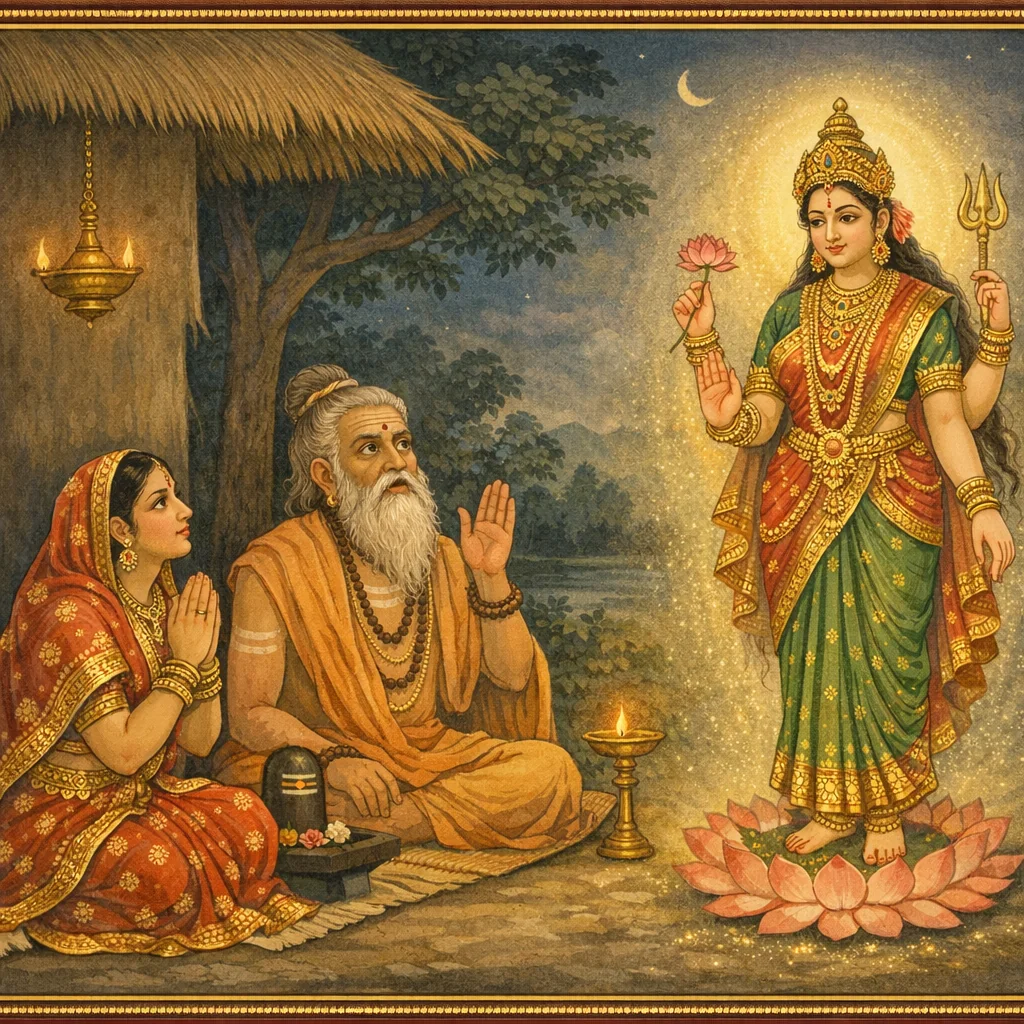
Chapter 19, narrated by Sūta, unfolds a closely linked sacred account. The young woman Śāradā completes a year-long great vow with strict niyamas near her guru and performs the udyāpana by feeding brāhmaṇas and giving fitting gifts. During a night vigil, guru and devotee intensify japa, arcana, and meditation; Devī Bhavānī (Gaurī) manifests in a “dense,” embodied form, and the sage who had been blind instantly regains his sight. When Devī offers a boon, the sage asks that his promise to Śāradā be fulfilled: long companionship with a husband and the birth of an excellent son. Devī explains the karmic causes—Śāradā’s former-life act of creating marital discord led to repeated widowhood, yet her prior worship of the Goddess neutralized the remaining sin. A subtle ethical resolution follows: Śāradā experiences nightly dream-union with her husband (reborn elsewhere), conceives through that extraordinary means, and faces public accusations. A disembodied voice vindicates her chastity and warns slanderers of immediate consequences; elders then interpret the event through precedent tales of unusual conception. The chapter culminates in the birth and education of a brilliant son, and at Gokarṇa the spouses recognize one another, transmit the “fruit of the vow” through the child, and finally attain a divine abode. The phalaśruti proclaims that hearing or reciting this chapter removes sin, grants prosperity and health, brings auspicious well-being to women, and leads to the highest attainment.
Shlokas
Verse 1
सूत उवाच । एवं महाव्रतं तस्याश्चरंत्या गुरुसन्निधौ । संवत्सरो व्यतीयाय नियमासक्तचेतसः
Sūta said: Thus, as she practiced that great vow in the presence of her guru, a full year passed by for her, her mind firmly devoted to discipline and sacred observance.
Verse 2
संवत्सरांते सा बाला तत्रैव पितृमंदिरे । चकारोद्यापनं सम्यग्विप्रभोजनपूर्वकम्
At the end of the year, the young maiden, there in her father’s house, duly performed the concluding rite (udyāpana), beginning with feeding the brāhmaṇas.
Verse 3
दत्त्वा च दक्षिणां तेभ्यो ब्राह्मणेभ्यो यथार्हतः । विसृज्य तान्नमस्कृत्य पितृभ्यामभिनंदिता
Having given those brāhmaṇas fitting dakṣiṇā according to their due, she took leave of them with reverent salutations; and her parents praised and blessed her.
Verse 4
उपोषिता स्वयं तस्मिन्दिने नियममाश्रिता । जजाप परमं मंत्रमुपदिष्टं महात्मना
Fasting on that very day and taking refuge in disciplined observance, she repeatedly recited the supreme mantra taught to her by the great-souled sage.
Verse 5
अथ प्रदोषसमये प्राप्ते संपूज्य शंकरम् । तस्मिन्गृहांतिकमठे गुरोस्तस्य च सन्निधौ
Then, when the time of pradoṣa arrived, having duly worshipped Śaṅkara, she stayed in that hermitage near the house, in the very presence of her guru.
Verse 6
जपार्चनरता साध्वी ध्यायती परमेश्वरम् । तस्मिञ्जागरणे रात्रावुपविष्टा शिवांतिके
That virtuous woman, devoted to japa and worship, meditated upon the Supreme Lord; and during that night of vigil she sat near Śiva, in His presence.
Verse 7
युग्मम् । तस्यां रात्रौ तया सार्धं स मुनिर्जगदंबिकाम् । जपध्यान तपोभिश्च तोषयामास पार्वतीम्
(A couplet.) On that night, together with her, the sage pleased Pārvatī—the Mother of the world—through japa, meditation, and the ascetic disciplines of tapas.
Verse 8
तस्याश्च भक्त्या व्रतभाविताया मुनेस्तपोयोगसमाधिना च । तुष्टा भवानी जगदेकमाता प्रादुर्बभूवा कृतसांद्रमूर्तिः
Pleased by her devotion, ripened through sacred vows, and by the sage’s austerity, yogic discipline, and deep samādhi, Bhavānī—the one Mother of the universe—manifested before them in a fully substantial, tangible form.
Verse 9
प्रादुर्भूता यदा गौरी तयोरग्रे जगन्मयी । अन्धोऽपि तत्क्षणादेव मुनिः प्राप दृशोर्द्वयम्
When Gaurī—the all-pervading embodiment of the universe—appeared before the two of them, the sage, though blind, instantly regained the sight of both eyes.
Verse 10
तां वीक्ष्य जगतां धात्रीमाविर्भूतां पुरःस्थिताम् । निपेततुस्तत्पदयोः स मुनिः सा च कन्यका
Seeing the Sustainer of the worlds standing manifested before them, the sage and the maiden both fell down at her feet.
Verse 11
तौ भक्तिभावोच्छ्वसितामलाशयावानंदबाष्पोक्षित सर्वगात्रौ । उत्थाप्य देवी कृपया परिप्लुता प्रेम्णा बभाषे मृदुवल्गुभाषिणी
Their hearts purified and uplifted by devotion, their whole bodies sprinkled with tears of joy—seeing them so, the Goddess, overflowing with compassion, raised them up and spoke lovingly in gentle, sweet words.
Verse 12
देव्युवाच । प्रीतास्मि ते मुनिश्रेष्ठ वत्से प्रीतास्मि तेऽनघे । किं वा ददाम्यभिमतं देवानामपि दुर्लभम्
The Goddess said: “O best of sages, I am pleased with you; dear child, O sinless one, I am pleased with you. What cherished boon shall I grant—one that is difficult to obtain even for the gods?”
Verse 13
मुनिरुवाच । एषा तु शारदा नाम कन्या तु गतभतृका । मया प्रतिश्रुतं चास्यै तुष्टेन गतचक्षुषा
The sage said: “This maiden is named Śāradā, and she has lost her husband. Though I was then without sight, my heart was content, and I gave her my promise.”
Verse 14
सह भर्त्रा चिरं कालं विहृत्य सुतमुत्तमम् । लभस्वेति मया प्रोक्तं सत्यं कुरु नमोऽस्तु ते
“I told her: ‘After dwelling long in happiness with your husband, may you obtain an excellent son.’ O Goddess, make my words come true—obeisance to You.”
Verse 15
श्रीदेव्युवाच । एषा पूर्वभवे बाला द्राविडस्य द्विजन्मनः । आसीद्द्वितीया दयिता भामिनी नाम विश्रुता
The Blessed Goddess said: “In a former birth, this girl was the second beloved wife of a brāhmaṇa born in Drāviḍa, renowned by the name Bhāminī.”
Verse 16
सा भर्तृप्रेयसी नित्यं रूपमाधुर्यपेशला । भर्तारं वशमानिन्ये रूपवश्यादिकैतवैः
Ever dear to her husband, graced with charming beauty and sweetness, she brought him under her sway through deceptive arts—ensnaring him by her beauty and other stratagems.
Verse 17
अस्यां चासक्तहृदयः स विप्रो मोहयंत्रितः । कदाचिदपि नैवागाज्ज्येष्ठपत्नीं पतिव्रताम्
His heart bound to her, that brāhmaṇa—ensnared by delusion—never even once went to his elder wife, though she was a devoted pativratā.
Verse 18
अनभ्यागमनाद्भर्तुः सा नारी पुत्रवर्जिता । सदा शोकेन संतप्ता कालेन निधनं गता
Because her husband did not return, that woman remained without a son; ever scorched by grief, in due course she met her end.
Verse 19
अस्या गृहसमीपस्थो यः कश्चिद्ब्राह्मणो युवा । इमां वीक्ष्याथ चार्वंगीं कामार्तः करमग्रहीत्
Near her house there lived a certain young brāhmaṇa; seeing her—fair-limbed—he, afflicted by desire, seized her hand.
Verse 20
अनया रोषताम्राक्ष्या स विप्रस्तु निवारितः । इमां स्मरन्दिवानक्तं निधनं प्रत्यपद्यत
Restrained by her—her eyes reddened with anger—that brāhmaṇa was turned back; yet, thinking of her day and night, he met his death.
Verse 21
एषा संमोह्य भर्तारं ज्येष्ठपत्न्यां पराङ्मुखम् । चकार तेन पापेन भवेस्मिन्विधवाऽभवत्
Having deluded her husband and turned him away from his senior wife, she acted thus; by that sin, in this life she became a widow.
Verse 22
याः कुर्वंति स्त्रियो लोके जायापत्योश्च विप्रियम् । तासां कौमारवैधव्यमेकविंशतिजन्मसु
Those women in the world who create enmity and discord between wife and husband—for them there is widowhood from maidenhood across twenty-one births.
Verse 23
यदेतया पूर्वभवे मत्पूजा महती कृता । तेन पुण्येन तत्पापं नष्टं सर्वं तदैव हि
But because in a former birth she offered me great worship, by the merit of that puṇya that sin was wholly destroyed, then and there.
Verse 24
यो विप्रो विरहार्तः सन्मृतः कामविमोहितः । सोऽस्याः पाणिग्रहं कृत्वा भवेस्मिन्निधनं गतः
That brāhmaṇa—tormented by separation and deluded by desire—died; and in this life, having taken her hand in marriage, he met death once again.
Verse 25
प्राग्जन्मपतिरेतस्याः पांड्यराष्ट्रेषु सोऽधुना । जातो विप्रवरः श्रीमान्सदारः सपरिच्छदः
Her husband from a former birth has now been born in the land of the Pāṇḍyas as a distinguished and prosperous brāhmaṇa, with wife and with household and possessions.
Verse 26
तेन भर्त्रा प्रतिनिशं सैषा प्रेम्णाभिसंगता । स्वप्ने रतिसुखं यातु श्रेष्ठं जागरणादपि
With that husband she is united each night through love; in dreams she attains the bliss of union, greater even than in waking life.
Verse 27
षष्ट्युत्तरत्रिशतयोजनदूरसंस्थो देशादितो द्विजवरः स च कर्मगत्या । एनां वधूं प्रतिनिशं मनसोभिरामां स्वप्नेषु पश्यति चिरं रतिमादधानः
Though that excellent brāhmaṇa dwells in a land more than three hundred and sixty yojanas from here, by the course of karma he beholds this beloved bride each night in dreams, long delighting in union with her.
Verse 28
सैषा वै स्वप्नसंगत्या पत्युः प्रतिनिशं सती । कालेन लप्स्यते पुत्रं वेदवेदांगपारगम्
By nightly union with her husband in dreams, this virtuous woman will, in due course of time, obtain a son—one who has crossed to the far shore of the Vedas and the Vedāṅgas.
Verse 29
एतस्यां तनयं जातमात्मनश्चिरसंगमात् । सोऽपि विप्रोऽनिशं स्वप्ने द्रक्ष्यति प्रेमभावितम्
From her, through a long-ordained union, a son will be born; and that son too, a brāhmaṇa, will continually behold (his beloved) in dreams, his heart suffused with love.
Verse 30
अनयाराधिता पूर्वे भवे साहं महामुने । अस्यैव वरदानाय प्रादुर्भूतास्मि सांप्रतम्
O great sage, in a former birth I was worshipped by her; therefore, for the very purpose of granting her this boon, I have manifested now.
Verse 31
सूत उवाच । अथोवाच महादेवी तां बालां प्रति सादरम् । अयि वत्से महाभागे शृणु मे परमं वचः
Sūta said: Then the Great Goddess spoke to that young girl with affection: “O dear child, most fortunate one, hear my supreme word.”
Verse 32
यदा कदापि भर्त्तारं क्वापि देशे पुरातनम् । द्रक्ष्यसि स्वप्नदृष्टं प्राक्ज्ञास्यसे त्वं विचक्षणा
Whenever, in some place of ancient repute, you behold that husband whom you had previously seen in a dream, you—being discerning—will recognize him at once.
Verse 33
त्वां द्रक्ष्यति स विप्रोपि सुनयां स्वप्नलक्षणाम् । तदा परस्परालापो युवयोः संभविष्यति
That brāhmaṇa too will behold you—O Su-nayā, marked by the sign of the dream—and then discourse shall arise between you both.
Verse 34
तदा स्वतनयं भद्रे तस्मै देहि बहुश्रुतम् । फलमस्य व्रतस्याग्र्यं तस्य हस्ते समर्पय
At that time, O auspicious one, give to him your own son, well instructed in sacred learning; and place into his hand the choicest fruit of this vow.
Verse 35
ततः प्रभृति तस्यैव वशे तिष्ठ सुमध्यमे । युवयोदैहिकः संगो माभूत्स्वप्नरतादृते
From that time onward, O slender-waisted one, remain under his guidance; and let there be no bodily union between you two—except as delight in dream.
Verse 36
कालात्पंचत्वमापन्ने तस्मिन्ब्राह्मणसत्तमे । अग्निं प्रविश्य तेनैव सह यास्यसि मत्पदम्
When, in course of time, that excellent brāhmaṇa meets his end, entering the fire, you will go together with him to my abode.
Verse 37
पुत्रस्ते भविता सुभ्रु सर्वलोकमनोरमः । संपदश्च भविष्यंति प्राप्स्यते परमं पदम्
O fair-browed one, you will have a son who delights all worlds; prosperity will arise, and the supreme state will be attained.
Verse 38
सूत उवाच । इत्युक्त्वा त्रिजगन्माता दत्त्वा तस्यै मनोरथम् । तयोः संपश्यतोरेव क्षणेनादर्शनं गता
Sūta said: Having spoken thus, the Mother of the three worlds granted her the boon she desired; and while the two still looked on, she vanished from sight in an instant.
Verse 39
सापि बाला वरं लब्ध्वा पार्वत्याः करुणानिधेः । अवाप परमानंदं पूजयामास तं गुरुम्
That young girl too, having obtained the boon from Pārvatī, the ocean of compassion, attained supreme joy and worshipped that guru (the sage).
Verse 40
तस्यां रात्र्यां व्यतीतायां स मुनिर्लब्धलोचनः । तस्याः पित्रोश्च तत्सर्वं रहस्याचष्ट धर्मवित्
When that night had passed, the sage regained his sight; and, being a knower of dharma, he confidentially explained the whole matter to her parents.
Verse 41
अथ सर्वानुपामंत्र्य शारदां च यशस्विनीम् । विधायानुग्रहं तेषां ययौ स्वैरगतिर्मुनिः
Then, having taken leave of everyone—especially the illustrious Śāradā—and having bestowed his blessing upon them, the sage departed, moving at will.
Verse 42
एवं दिनेषु गच्छत्सु सा बाला च प्रतिक्षणम् । भर्तुः समागमं लेभे स्वप्ने सुख विवर्धनम्
Thus, as the days passed, the young woman, at every moment, experienced union with her husband in dreams—an experience that continually increased her happiness.
Verse 43
गौर्या वरप्रदानेन शारदा विशदव्रता । दधार गर्भं स्वप्नेपि भर्तुः संगानुभावतः
Through Gaurī’s granting of the boon, Śāradā—steadfast in her pure vow—conceived even in a dream, by the potency of her husband’s union as experienced therein.
Verse 44
तां श्रुत्वा भर्तृरहितां शारदां गर्भिणी सतीम् । सर्वे धिगिति प्रोचुस्तां जारिणीति जगुर्जनाः
Hearing that Śāradā—though without her husband—was nevertheless pregnant, all cried, “Shame!”; the townsfolk even branded her an adulteress.
Verse 45
संपरेतस्य तद्भर्तुर्ये जातिकुलवबांधवाः । तां वार्तां दुःसहां श्रुत्वा ययुस्तत्पितृमंदिरम्
Those relatives of her departed husband—kinsmen bound by birth and lineage—upon hearing that unbearable report, went to her father’s house.
Verse 46
अथ सर्वे समायाता ग्रामवृद्धाश्च पंडिताः । समाजं चक्रिरे तत्र कुलवृद्धैः समन्वितम्
Then all assembled there—the village elders and learned men—and they convened an assembly, together with the senior members of the family.
Verse 47
अन्तर्वत्नीं समाहूय शारदां विनताननाम् । अतर्जयन्सुसंक्रुद्धाः केचिदासन्पराङ्मुखाः
Summoning Śāradā, pregnant and downcast, some—furiously enraged—threatened and berated her, while others turned their faces away in disapproval.
Verse 48
अयि जारिणि दुर्बुद्धे किमेतत्ते विचेष्टितम् । अस्मत्कुले सुदुष्कीर्त्तिं कृतवत्यसि बालिशे
O adulteress, O wicked-minded one—what is this conduct of yours? O foolish girl, you have brought a grievous disgrace upon our family line.
Verse 49
इति संतर्जयंतस्ते ग्रामवृद्धा मनीषिणः । सर्वे संमंत्रयामासुः किं कुर्म इति भाषिणः
Thus, having threatened and scolded her, the wise elders of the village all began to deliberate together, saying, “What are we to do?”
Verse 50
तत्रोचुः के च वृद्धास्तां बालां प्रति विनिर्दयाः । एषा पापमतिर्बाला कुलद्वयविनाशिनी
There some elders, merciless toward the young woman, said: “This girl is of sinful intention—one who will ruin both families.”
Verse 51
कृत्वास्याः केशवपनं छित्त्वा कर्णौ च नासिकाम् । निर्वास्यतां बहिर्ग्रामात्परित्यज्य स्वगोत्रतः
“Let her head be shaved; let her ears and nose be cut off; and let her be driven out beyond the village, cast out from her own lineage.”
Verse 52
इति सर्वे समालोच्य तां तथा कर्तुमुद्यताः । अथांतरिक्षे संभूता शुश्रुवे वागगोचरा
Having thus conferred, they were ready to do so; then, from the sky, there was heard a voice beyond ordinary perception.
Verse 53
अनया न कृतं पापं न चैव कुलदूषणम् । व्रतभंगो न चैतस्यास्सुचरित्रेयमंगना
By her no sin has been committed, nor any stain upon the family line. No vow has been broken; this woman is of noble and pure conduct.
Verse 54
इतः परमियं नारी जारिणीति वदंति ये । तेषां दोषविमूढानां सद्यो जिह्वा विदीर्यते
From this moment onward, whoever calls this woman “an adulteress”—those deluded by their own fault—will have their tongues split at once.
Verse 55
इत्यंतरिक्षे जनितां वाणीं श्रुत्वाऽशरीरिणीम् । सर्वे प्रजहृषुस्तस्या जननीजनकादयः
Hearing that disembodied voice arising in the sky, all her people—her mother, father, and the rest—rejoiced exceedingly.
Verse 56
ततः ससंभ्रमाः सर्वे ग्रामवृद्धाः सभाजनाः । मुहूर्त्तं मौनमालंब्य भीतास्तस्थुरधोमुखाः
Then all the village elders and the assembled people, struck with alarm, fell silent for a moment and stood in fear, their faces cast down.
Verse 57
तत्र केचिदविश्वस्ता मिथ्यावाणीत्यवादिषुः । तेषां जिह्वा द्विधा भिन्ना ववमुस्ते कृमीन्क्षणात्
There, some who did not believe said, “It is a false voice.” Instantly their tongues split in two, and at once they vomited worms.
Verse 58
ततः संपूजयामासुस्तां बालां ज्ञातिबांधवाः । बांधवाश्च स्त्रियो वृद्धाः शशंसुः साधुसाध्विति
Then her kinsmen and relatives honored that young girl; and the elder women of the family praised her again and again, saying, “Well done, well done!”
Verse 59
मुमुचुः केचिदानंदबाष्पबिंदून्कुलोत्तमाः । कुलस्त्रियः प्रमुदितास्तामुद्दिश्य समाश्वसन्
Some noble members of the family shed drops of tears born of joy; and the women of the household, delighted, spoke words of comfort with her in mind.
Verse 60
अथ तत्रापरे प्रोचुर्देवो वदति नानृतम् । कथमेषां दधौ गर्भं शीलान्न चलिता ध्रुवम्
Then others there said, “The deity does not speak falsehood. Yet how did she conceive a pregnancy? Surely she has not deviated from good conduct.”
Verse 61
इति सर्वान्सभ्यजना न्संशयाविष्टचेतसः । विलोक्य वृद्धस्तत्रैको सर्वज्ञो लोकतत्त्ववित्
Seeing all the respectable people thus possessed by doubt, a certain elder there—omniscient and versed in the principles of the world—looked on.
Verse 62
मायामयमिदं विश्वं दृश्यते श्रूयते च यत् । किं भाव्यं किमभाव्यं वा संसारेऽस्मिन्क्षणात्मके
This universe—whatever is seen and whatever is heard—is made of māyā. In this fleeting, momentary world, what is truly ‘possible’ and what ‘impossible’?
Verse 64
यूपकेतोश्च राजर्षेः शुक्रं निपतितं जले । सशुक्रं तज्जलं पीत्वा वेश्या गर्भं दधौ किल
The semen of the royal sage Yūpaketu fell into water; and it is said that a courtesan drank that water mixed with it and thereby conceived.
Verse 65
मुनेर्विभांडकस्यापि शुक्रं पीत्वा सहांभसा । हरिणी गर्भिणी भूत्वा ऋष्यशृंगमसूयत
Likewise, a doe drank, along with water, the semen of the sage Vibhāṇḍaka; becoming pregnant, she gave birth to Ṛṣyaśṛṅga.
Verse 66
सुराष्ट्रस्य तथा राज्ञः करं स्पृष्ट्वा मृगांगना । तत्क्षणाद्गर्भिणी भूत्वा मुनिं प्रासूत तापसम्
So too, a doe, merely by touching the hand of the king of Surāṣṭra, became pregnant at that very moment and gave birth to an ascetic sage.
Verse 67
तथा सत्यवती नारी शफरीगर्भसंभवा । तथैव महिषीगर्भो जातश्च महिषासुरः
Likewise, the woman Satyavatī was born from the womb of a śapharī fish; and in the same way, Mahiṣāsura was born from the womb of a she-buffalo.
Verse 68
तथा संति पुरा नार्यः कारुण्याद्गर्भसंभवाः । तथा हि वसुदेवेन रोहिण्या स्तनयोऽभवत्
So also, in ancient times there were women who conceived through compassion, by extraordinary circumstance. Indeed, in the same manner, Rohiṇī came to have a child through Vasudeva.
Verse 69
देवतानां महर्षीणां शापेन च वरेण च । अयुक्तमपि यत्कर्म युज्यते नात्र संशयः
By the curse and also by the boon of the gods and great seers, even an act that seems improper can become fitting—of this there is no doubt.
Verse 70
सांबस्य जठराज्जातं मुसलं मुनिशापतः । युवनाश्वस्य गर्भोऽभून्मुनीनां मंत्रगौरवात्
From Sāmba’s belly arose a club because of the sages’ curse; and Yuvanāśva became pregnant because of the weighty power of the sages’ mantras.
Verse 71
नूनमेषापि कल्याणी महर्षेः पादसेवनात् । महाव्रतानुभावाच्च धत्ते गर्भमनिं दिता
Surely this auspicious, blameless woman bears a child through serving the feet of the great seer and through the power of her great vows.
Verse 72
अस्मिन्नर्थे रहस्येनां सत्यं पृच्छंतु योषितः । ततो निवृत्तसंदेहो भविष्यति महाजनः
In this matter, let the women privately ask her the truth; then the public will become free of doubt.
Verse 73
ततस्तद्वचनादेव तामपृच्छन्स्त्रियो मिथः । ताभ्यः शशंस तत्सर्वं सा स्ववृत्तं महाद्भुतम्
Then, just as advised, the women questioned her among themselves; and she narrated to them the entirety of her own wondrous experience.
Verse 74
विजानंतस्ततः सर्वे मानयित्वा च तां सतीम् । मोदमानाः प्रशंसंतः प्रययुः स्वं स्वमालयम्
Having understood it, all honored that virtuous lady; rejoicing and praising her, they departed to their respective homes.
Verse 75
अथ काले शुभे प्राप्ते शारदा विमलाशया । असूत तनयं बाला बालार्कसमतेजसम्
Then, when the auspicious time arrived, Śāradā—pure in intention—gave birth to a son, a child radiant like the rising sun.
Verse 76
स कुमारो महोदारलक्षणः कमलेक्षणः । अवाप्य महतीं विद्यां बाल्य एव महामतिः
That boy, marked by noble signs and lotus-eyed, attained great learning while still in childhood—truly a man of vast intellect.
Verse 77
अथोपनीतो गुरुणा काले लोकमनोरमः । स शारदेय एवेति लोके ख्याति मवाप ह
In due course, his teacher invested him with the sacred thread; charming to the world, he became renowned among people by the name ‘Śāradeya’.
Verse 78
ऋग्वेदमष्टमे वर्षे नवमे यजुषां गणम् । दशमे सामवेदं च लीलयाध्यगमत्सुधीः
In his eighth year he mastered the Ṛgveda; in the ninth, the collections of the Yajurveda; and in the tenth, the Sāmaveda—effortlessly, as though in play, that wise one learned them.
Verse 79
अथ त्रिलोकमहिते संप्राप्ते शिवपर्वणि । गोकर्णं प्रययुः सर्वे जनाः सर्वनिवासिनः
Then, when the Śiva festival—revered throughout the three worlds—arrived, all the people dwelling in every region set out for Gokarṇa.
Verse 80
शारदापि स्वपुत्रेण गोकर्णं प्रययौ सती
Śāradā too—the virtuous lady—went to Gokarṇa together with her own son.
Verse 81
तत्रापश्यत्समायातं सदा स्वप्नेषु लक्षितम् । पूर्वजन्मनि भर्त्तारं द्विजबंधुजनावृतम्
There she saw him arrive—the very man she had continually recognized in dreams: her husband from a former birth, surrounded by kinsmen and companions among the twice-born.
Verse 82
तं दृष्ट्वा प्रेमनिर्विण्णा पुलकांकितविग्रहा । निरुद्धबाष्पप्रसरा तस्थौ तन्न्यस्तलोचना
Seeing him, she stood overwhelmed with love—her body thrilled with horripilation—holding back the flow of tears, her eyes fixed upon him.
Verse 83
स च विप्रोऽपि तां दृष्ट्वा रूपलक्षणलक्षिताम् । स्वप्ने सदा भुज्यमानामात्मनो रतिदायिनीम्
That brāhmaṇa too, seeing her—distinguished by her beauty and auspicious marks—recognized the very woman whom he continually enjoyed in dreams, the giver of delight to his heart.
Verse 84
तं कुमारमपि स्वप्ने दृष्ट्वा चात्म शरीरजम् । विलोक्य विस्मयाविष्टस्तदंतिकमुपाययौ
And seeing the boy as well—whom he had seen in a dream, born of his own body—he gazed in wonder and drew near to them.
Verse 85
भद्रे त्वां प्रष्टुमिच्छामि यत्किंचिन्मनसि स्थितम् । इति प्रथममाभाष्य रहः स्थानं निनाय ताम्
“O gentle lady, I wish to ask you whatever rests within your mind.” Saying this first, he spoke to her and led her to a secluded place.
Verse 86
का त्वं कथय वामोरु कस्य भार्यासि सुव्रते । को देशः कस्य वा पुत्री किन्नामेत्यब्रवीच्च ताम्
He said to her: “Who are you? Tell me, O fair-thighed one—whose wife are you, O woman of good vows? From what land are you, whose daughter, and what is your name?”
Verse 87
इति तेन समापृष्टा सा नारी बाष्पलोचना । व्याजहारात्मनोवृत्तं बाल्ये वैधव्यकारणम्
Thus questioned by him, the woman—her eyes brimming with tears—recounted her own story, including the cause of her widowhood in childhood.
Verse 88
पुनः पप्रच्छ तां बालां पुत्रः कस्यायमुत्तमः । कथं धृतो वा जठरे बालोऽयं चंद्रसन्निभः
Again he asked the young woman: “Whose excellent son is this? And how was this moon-like child conceived and carried in the womb?”
Verse 90
इति तस्या वचः श्रुत्वा विहस्य ब्राह्मणोत्तमः । प्रोवाच कष्टात्कष्टं हि चरितं तव भामिनि
Hearing her words, the excellent brāhmaṇa smiled and said: “O passionate lady, your life-story is indeed hardship upon hardship.”
Verse 91
पाणिग्रहणमात्रं ते कृत्वा भर्त्ता मृतः किल । कथं चायं सुतो जातस्तस्य कारणमुच्यताम्
“After merely performing the hand-taking (marriage rite) with you, your husband is said to have died. Then how was this son born? Tell me the reason for that.”
Verse 92
इति तेनोदितां वाणीमाकर्ण्यातीव लज्जिता । क्षणं चाश्रुमुखी भूत्वा धैर्यादित्थमभाषत
Hearing those words spoken by him, she became deeply embarrassed; for a moment her face filled with tears, and then, gathering courage, she spoke as follows.
Verse 93
शारदोवाच । तदलं परिहासोक्त्या त्वं मां वेत्सि महामते । त्वामहं वेद्मि चार्थेऽस्मिन्प्रमाणं मन आवयोः
Śāradā said: “Enough of joking words. O great-minded one, you know me—and I too know you. In this matter, the only proof is the understanding within our hearts.”
Verse 94
इत्युक्त्वा सर्वमावेद्य देव्या दत्तं वरादिकम् । व्रतस्यार्धं कुमारं तं ददौ तस्मै धृतव्रतम्
Having said this, she disclosed everything—how the Goddess had granted her boons and the like—and she gave that boy, who was (as it were) ‘half the fruit of her vow,’ to that brāhmaṇa who was steadfast in his observances.
Verse 95
सोऽपि प्रमुदितो विप्रः कुमारं प्रतिगृह्य तम् । पित्रोरनुमतेनैव तां निनाय निजालयम्
That brāhmaṇa too, rejoicing, accepted the boy; and with his parents’ consent, he took her to his own home.
Verse 96
सापि स्थित्वा बहून्मासांस्तस्य विप्रस्य मंदिरे । तस्मिन्कालवशं प्राप्ते प्रविश्याग्निं तमन्वगात्
She too lived for many months in that brāhmaṇa’s house. When he came under the power of Time (i.e., died), she entered the fire and followed him.
Verse 97
ततस्तौ दंपती भूत्वा विमानं दिव्यमास्थितौ । दिव्यभोगसमायुक्तौ जग्मतुः शिवमंदिरम्
Then the two became a couple and mounted a divine aerial chariot; endowed with celestial enjoyments, they went to Śiva’s abode.
Verse 98
इत्येततत्पुण्यमाख्यानं मया समनुवर्णितम् । पठतां शृण्वतां सम्यग्भुक्तिमुक्तिफलप्रदम्
Thus this meritorious narrative has been fully recounted by me. For those who properly read it or hear it, it bestows the fruits of worldly enjoyment and liberation.
Verse 99
आयुरारोग्यसंपत्तिधनधत्यविवर्द्धनम् । स्त्रीणां मंगलसौभाग्यसंतानसुखसाधनम्
It increases lifespan, health, prosperity, wealth, and abundance of grain; and for women it brings auspiciousness, good fortune, offspring, and happiness.
Verse 100
एतन्महाख्यानमघौघनाशनं गौरीमहेशव्रतपुण्यकीर्तनम् । भक्त्या सकृद्यः शृणुयाच्च कीर्त्तयेद्भुक्त्वा स भोगान्पदमेति शाश्वतम्
This great sacred narrative destroys torrents of sin and proclaims the merit of the vow of Gaurī and Maheśa. Whoever, even once, hears it with devotion and also recites it—after enjoying worthy prosperities—attains the eternal state.