Adhyaya 18
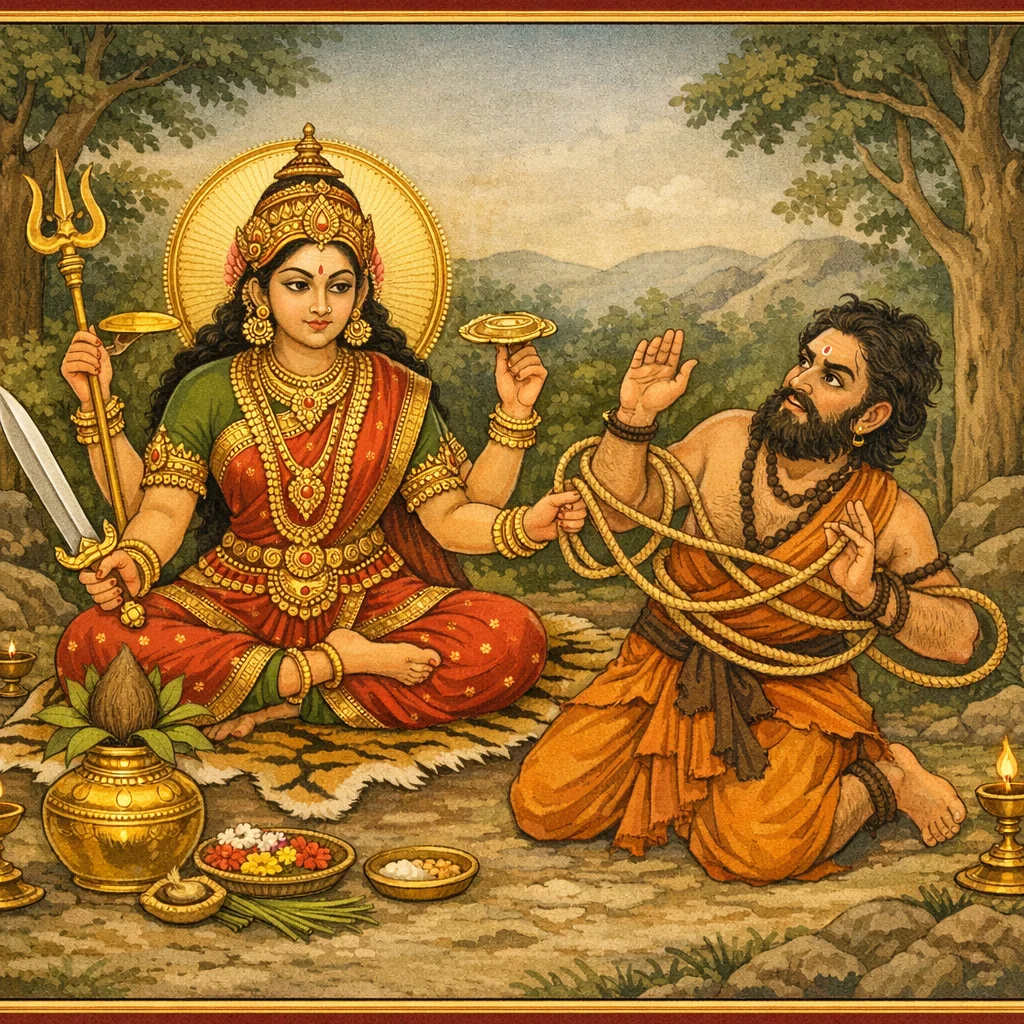
Sūta presents a case-based theological teaching centered on the Umā–Maheśvara-vrata, praised as a complete vow for sarvārtha-siddhi (fulfillment across many aims). The narrative begins in the home of the learned brāhmaṇa Vedaratha: his daughter Śāradā is married to a wealthy dvija, but the groom dies soon after the wedding from a snakebite, and Śāradā is suddenly widowed. A blind aged sage, Naidhruva, arrives as a guest. Śāradā serves him with exemplary atithi-sevā—washing his feet, fanning, anointing, arranging his bath and worship, and offering food—treating ethical hospitality as ritual merit. Pleased, the sage blesses her with renewed married life, a virtuous son, and public renown; Śāradā questions how this can be, given karma and widowhood. Naidhruva then prescribes the Umā–Maheśvara-vrata and lays out its full protocol: auspicious timing (Caitra or Mārgaśīrṣa, bright fortnight), saṅkalpa on aṣṭamī and caturdaśī, a decorated maṇḍapa, a lotus diagram with specified petal counts, and installation of a rice mound, sacred kūrca, water-filled kalaśa, cloth, and golden images of Śiva and Pārvatī. He details abhiṣeka with pañcāmṛta, japa of Rudra-ekādaśa and pañcākṣara in prescribed counts, prāṇāyāma and saṅkalpa for sin-destruction and prosperity, dhyāna with iconographic descriptions of Śiva and the Devī, external worship with arghya mantras, naivedya, homa, and a reverent conclusion. The vow is observed for a year (both fortnights) and culminates in udyāpana with mantra-bathing, gifts to the guru (kalaśa, gold, cloth), feeding brāhmaṇas, and dakṣiṇā; the phalaśruti promises uplift of lineages and progressive enjoyment of divine realms ending in proximity to Śiva. At the family’s request, the sage stays nearby in their maṭha while Śāradā undertakes the vow as instructed.
Shlokas
Verse 1
सूत उवाच । अथाहं संप्रवक्ष्यामि सर्वधर्मोत्तमोत्तमम् । उमामहेश्वरं नाम व्रतं सर्वार्थसिद्धिदम्
Sūta said: Now I shall expound the best of the best among all dharmas—the vow called ‘Umāmaheśvara’, a vrata that bestows the fulfillment of all aims.
Verse 2
आनर्त्त संभवः कश्चिन्नाम्ना वेदरथो द्विजः । कलत्रपुत्रसंपन्नो विद्वानुत्तमवंशजः
There was a certain twice-born man named Vedaratha, born in Ānarta—endowed with wife and children, learned, and descended from a noble lineage.
Verse 3
तस्यैवं वर्तमानस्य ब्राह्मणस्य गृहाश्रमे । बभूव शारदानाम कन्या कमललोचना
While that brāhmaṇa thus lived in the householder stage, a daughter was born to him named Śāradā, lotus-eyed.
Verse 4
तां रूपलक्षणोपेतां बालां द्वादशहायनाम् । ययाचे पद्मनाभाख्यो मृतदारश्च स द्विजः
That maiden—endowed with beauty and auspicious marks, twelve years of age—was sought in marriage by a twice-born brāhmaṇa named Padmanābha, whose wife had died.
Verse 5
महाधनस्य शांतस्य सदा राजसखस्य च । याञ्चाभंगभयात्तस्य तां कन्यां प्रददौ पिता
Because he was very wealthy, calm, and ever a friend of the king, the girl’s father—fearing the disgrace of refusing his request—gave him that daughter.
Verse 6
मध्यंदिने कृतोद्वाहः स विप्रः श्वशुरालये । संध्यामुपासितुं सायं सरस्तटमुपाययौ
The wedding having been performed at midday in his father-in-law’s house, that brāhmaṇa went in the evening to the bank of a lake to perform the sandhyā worship.
Verse 7
उपास्य संध्यां विधिवत्प्रत्यागच्छत्तमोवृते । मार्गे दष्टो भुजंगेन ममार निजकर्मणा
Having duly performed the sandhyā worship, he returned when darkness had spread. On the way he was bitten by a serpent and died—through the working of his own karma.
Verse 8
तस्मिन्मृते कृतोद्वाहे सहसा तस्य बांधवाः । चुक्रुशुः शोकसंतप्तौ श्वशुरावस्य कन्यका
When he died suddenly—his wedding only just completed—his relatives cried out in anguish; and his father-in-law and the young bride were scorched by grief.
Verse 9
निर्हृत्य तं बंधुजना जग्मुः स्वं स्वं निवेशनम् । शारदा प्राप्तवैधव्या पितुरेवालये स्थिता
After carrying him away for the final rites, the relatives returned, each to his own home. Śāradā, having fallen into widowhood, remained in her father’s house.
Verse 10
भूताच्छादनभोज्येन भर्त्रा विरहिता सती । निनाय कतिचिन्मासान्सा बाला पितृमंदिरे
Separated from her husband—who had provided her with clothing and food—the virtuous young woman spent several months in her father’s home.
Verse 11
एकदा नैध्रुवो नाम कश्चिद्वृद्धतरो मुनिः । अन्धः शिष्यकरग्राही तन्मंदिरमुपाययौ
Once, an elderly sage named Naidhruva—blind and holding the hand of his disciple—came to that house.
Verse 12
तस्मिन्वृद्धे गृहं प्राप्ते क्वापि यातेषु बंधुषु । साक्षादिवात्मनो दैवं सा बाला समुपागमत्
When that aged sage arrived at the house and the relatives had gone elsewhere, the young girl approached him as though he were her very visible destiny—divine providence.
Verse 13
स्वागतं ते महाभाग पीठेस्मिन्नुपविश्यताम् । नमस्ते मुनिनाथाय प्रियं ते करवाणि किम्
“Welcome to you, most fortunate one. Please be seated on this seat. Salutations to you, lord among sages—what may I do that will be pleasing to you?”
Verse 14
इत्युक्त्वा भक्तिमास्थाय कृत्वा पादावनेजनम् । वीजयित्वा परिश्रांतं तं मुनिं पर्यतोषयत्
Having spoken thus and taking refuge in devotion, she washed his feet; then, fanning the weary muni, she fully satisfied him through her service.
Verse 15
श्रांतं पीठे समावेश्य कृत्वाभ्यंगं स्वपाणिना । कृतस्नानं च विधिवत्कृतदेवार्चनं मुनिम्
Seating the tired sage upon a seat, she anointed and massaged him with her own hands; and she saw to it that he bathed properly and worshiped the Deity according to rule.
Verse 16
सुखासनोपविष्टं तं धूपमाल्यानुलेपनैः । अर्चयित्वा वरान्नेन भोजयामास सादरम्
When he was seated comfortably, she honored him with incense, garlands, and fragrant unguents; then, with respectful care, she fed him excellent food.
Verse 17
भुक्त्वा च सम्यक्छनकैस्तृप्तश्चानंदनिर्भरः । चकारांधमुनिस्तस्यै सुप्रीतः परमाशिषम्
After eating properly, slowly and at ease, the blind sage became satisfied and filled with joy; greatly pleased, he bestowed upon her the highest blessing.
Verse 18
विहृत्य भर्त्रा सहसा च तेन लब्ध्वा सुतं सर्वगुणैर्वरिष्ठम् । कीर्तिं च लोके महतीमवाप्य प्रसादयोग्या भव देवतानाम्
“Soon you shall enjoy life together with a husband; you shall obtain a son, the best in every virtue. Gaining great fame in the world, become one worthy of the gods’ favor.”
Verse 19
इत्यभिव्याहृतं तेन मुनिना गतचक्षुषा । निशम्य विस्मिता बाला प्रत्युवाच कृतांजलिः
Hearing those words spoken by the sage who had lost his sight, the young woman—astonished—replied with folded hands.
Verse 20
ब्रह्मंस्त्वद्वचनं सत्यं कदाचिन्न मृषा भवेत् । तदेतन्मंदभाग्यायाः कथमेतत्फलिष्यति
“O Brahman-sage, your word is truth; it can never be false. Yet how will this bear fruit for one so ill-fated as I?”
Verse 21
शिलाग्र्यामिव सद्वृष्टिः शुनक्यामिव सत्क्रिया । विफला मंदभाग्यायामाशीर्ब्रह्मविदामपि
“Like fine rain falling upon a rocky peak, like a good rite performed for an unworthy recipient—so too, for the ill-fated, even the blessings of knowers of Brahman become fruitless.”
Verse 22
सैषाहं विधवा ब्रह्मन्दुष्कर्मफलभागिनी । त्वदाशीर्वचनस्यास्य कथं यास्यामि पात्रताम्
“Indeed, I am a widow, O Brahman, one who bears the fruit of evil deeds. How shall I become a worthy vessel for this blessing-word of yours?”
Verse 23
मुनिरुवाच । त्वामनालक्ष्य यत्प्रोक्तमंधेनापि मयाऽधुना । तदेतत्साधयिष्यामि कुरु मच्छासनं शुभे
The sage said: “Though I am blind and spoke just now without recognizing you, I shall certainly bring that very promise to fulfillment. O auspicious one, do as I instruct.”
Verse 24
उमामहेश्वरं नाम व्रतं यदि चरिष्यसि । तेन व्रतानुभावेन सद्यः श्रेयोऽनुभोक्ष्यसे
If you undertake the vow called “Umā–Maheśvara,” then by the power of that observance you will at once enjoy the highest good.
Verse 25
शारदोवाच । त्वयोपदिष्टं यत्नेन चरिष्याम्यपि दुश्चरम् । तद्व्रतं ब्रूहि मे ब्रह्मन्विधानं वद विस्तरात्
Śārada said: “Even if it is difficult, I will practice with effort what you have taught. O Brahman, tell me that vow—explain its procedure in detail.”
Verse 26
मुनिरुवाच । चैत्रे वा मार्गशीर्षे वा शुक्लपक्षे शुभे दिने । व्रतारंभं प्रकुर्वीत यथावद्गुर्वनुज्ञया
The sage said: “In Caitra or in Mārgaśīrṣa, on an auspicious day in the bright fortnight, one should begin the vow properly—having obtained the teacher’s permission.”
Verse 27
अष्टम्यां च चतुर्दश्यामुभयोरपि पर्वणोः । संकल्पं विधिवत्कृत्वा प्रातःस्नानं समाचरेत्
On both sacred occasions—the eighth and the fourteenth lunar days—having duly made the formal resolve (saṅkalpa), one should perform the morning bath.
Verse 28
सन्तर्प्य पितृदेवादीन्गत्वा स्वभवनं प्रति । मंडपं रचयेद्दिव्यं वितानाद्यैरलंकृतम्
Having satisfied the Pitṛs and the Devas (and other revered beings) with offerings, and then returning to one’s home, one should construct a splendid pavilion (maṇḍapa) adorned with canopies and the like.
Verse 29
फलपल्लवपुष्पाद्यैस्तोरणैश्च समन्वितम् । पंचवर्णैश्च तन्मध्ये रजोभिः पद्ममुद्धरेत्
Adorn the worship-space with festoons (toraṇas) made of fruits, tender leaves, flowers, and the like; and in the center, with powders of five colors, draw a lotus-design.
Verse 30
चतुर्दशदलैर्बाह्ये द्वाविंशद्भिस्तदंतरे । तदंतरं षोडशभिरष्टभिश्च तदंतरे
On the outer lotus-ring it should have fourteen petals; within that, twenty-two; within that, sixteen; and further within, eight petals.
Verse 31
एवं पद्मं समुद्धत्य पंचवर्णैर्मनोरमम् । चतुरस्रं ततः कुर्यादंतर्वर्तुलमुत्तमम्
Having thus drawn the charming lotus in five colors, one should then make a square enclosure, and within it an excellent circle.
Verse 32
व्रीहितंडुलराशिं च तन्मध्ये च सकूर्चकम् । कूर्चोपरि सुसंस्थाप्य कलशं वारिपूरितम्
And there place a heap of rice-grains, and in its midst a kūrca (a ritual tuft of darbha); upon the kūrca set firmly a water-filled pot (kalaśa).
Verse 33
कलशोपरि विन्यस्य वस्त्रं वर्णसमन्वितम् । तस्योपरिष्टात्सौवर्ण्यौ प्रतिमे शिवयोः शुभे । निधाय पूजयेद्भक्त्या यथाविभवविस्तरम्
Placing a colored cloth upon the kalaśa, and above that setting the auspicious golden images of Śiva and His consort, one should worship them with devotion, expanding the offerings according to one’s means.
Verse 34
पंचामृतैस्तु संस्नाप्य तथा शुद्धोदकेन च । रुद्रैकादशकं जप्त्वा पंचाक्षरशताष्टकम्
After bathing the Deity with the five amṛtas and also with pure water, one should recite the Rudra hymn eleven times, and then chant the five-syllabled mantra one hundred and eight times.
Verse 35
अभिमंत्र्य पुनः स्थाप्य पीठं मध्ये तथार्चयेत् । स्वयं शुद्धासनासीनो धौतशुक्लांबरः सुधीः
Having consecrated it with mantra and then placing the pīṭha again in the center, one should worship accordingly; the wise worshipper should himself sit on a pure seat, wearing washed white garments.
Verse 36
पीठमामंत्र्य मंत्रेण प्राणायामान्समाचरेत् । संकल्पं प्रवदेत्तत्र शिवाग्रे विहितांजलिः
Invoking the pīṭha with mantra, one should perform prāṇāyāma; then, with hands joined before Śiva, one should declare the saṅkalpa, the ritual intention.
Verse 37
यानि पापानि घोराणि जन्मांतरशतेषु मे । तेषां सर्वविनाशाय शिवपूजां समारभे
Whatever terrible sins of mine have accrued across hundreds of former births—for the complete destruction of all of them, I commence the worship of Śiva.
Verse 38
सौभाग्यविजयारोग्यधर्मैश्वर्याभिवृद्धये । स्वर्गापवर्गसिद्ध्यर्थं करिष्ये शिवपूजनम्
For the increase of good fortune, victory, health, dharma, and prosperity—and for attaining heaven and liberation—I shall perform the worship of Śiva.
Verse 39
इति संकल्पमुच्चार्य यथावत्सुसमाहितः । अंगन्यासं ततः कृत्वा ध्यायेदीशं च पार्वतीम्
Thus, having duly uttered the saṅkalpa with complete concentration, one should perform the aṅga-nyāsa; thereafter one should meditate upon Lord Īśa (Śiva) and Goddess Pārvatī.
Verse 40
कुंदेंदुधवलाकारं नागाभरणभूषितम् । वरदाभयहस्तं च बिभ्राणं परशुं मृगम्
Meditate on Him whose form is white like jasmine and the moon, adorned with serpent-ornaments; one hand bestowing boons and another granting fearlessness, while He also bears an axe and a deer.
Verse 41
सूर्यकोटिप्रतीकाशं जगदानंदकारणम् । जाह्नवीजलसंपर्काद्दीर्घपिंगजटाधरम्
Radiant like ten million suns, the very cause of the world’s bliss, He bears long tawny matted locks, sanctified by contact with the waters of Jāhnavī (Gaṅgā).
Verse 42
उरगेंद्रफणोद्भूतमहामुकुटमंडितम् । शीतांशुखंडविलसत्कोटीरांगदभूषणम्
Adorned with a great crown rising from the hoods of the serpent-king, and ornamented with a diadem and armlets gleaming like a fragment of the cool-rayed moon.
Verse 43
उन्मीलद्भालनयनं तथा सूर्येंदुलोचनम् । नीलकंठं चतुर्बाहुं गजेंद्राजिनवाससम्
With the forehead-eye opening, and with the sun and moon as His eyes; blue-throated, four-armed, wearing the hide of the lordly elephant.
Verse 44
रत्नसिंहासनारूढं नागाभरणभूषितम् । देवीं च दिव्यवसनां बालसूर्यायुतद्युतिम्
Seated upon a jeweled throne, adorned with serpent-ornaments; and beside Him the Goddess, robed in divine garments, radiant like ten thousand rising suns.
Verse 45
बालवेषां च तन्वंगीं बालशीतांशुशेखराम् । पाशांकुशवराभीतिं बिभ्रतीं च चतुर्भुजाम्
And the Goddess—youthful in appearance, slender-limbed, crowned with the tender crescent moon—four-armed, bearing a noose and a goad, and displaying boon-giving and fearlessness.
Verse 46
प्रसादसुमुखीमंबां लीलारसविहारिणीम् । लसत्कुरबकाशोकपुन्नागनवचंपकैः
The Mother with a gracious, radiant face—sporting in the delight of divine play—resplendent amid kurabaka, aśoka, punnāga, and fresh campaka blossoms.
Verse 47
कृतावतंसामुत्फुल्लमल्लिकोत्कलितालकाम् । कांचीकलापपर्यस्तजघनाभोगशालिनीम्
Wearing a floral ear-ornament, with locks interwoven with fully-bloomed jasmine; adorned with a girdle whose strands rest upon her rounded hips.
Verse 48
उदारकिंकिणीश्रेणीनूपुराढ्यपदद्वयाम् । गंडमंडलसंसक्तरत्नकुंडलशोभिताम्
Her two feet adorned with anklets and rich rows of tinkling bells; her beauty enhanced by jeweled earrings fastened close to the circles of her cheeks.
Verse 49
बिंबाधरानुरक्तांशुलसद्दशन कुड्मलाम् । महार्हरत्नग्रेवेयतारहारविराजिताम्
Meditate upon the Goddess: Her lips glow like the ripe bimba-fruit, Her teeth shine like budding blossoms, and She is radiant with a precious jeweled collar and a star-like necklace of gems.
Verse 50
नवमाणिक्यरुचिरकंकणांगदमुद्रिकाम् । रक्तांशुकपरीधानां रत्नमाल्यानुलेपनाम्
Meditate upon Her, adorned with bracelets, armlets, and rings lovely with the luster of fresh rubies; clad in red garments, and beautified with jeweled garlands and fragrant unguents.
Verse 51
उद्यत्पीनकुचद्वंद्वनिंदितांभोजकुड्मलाम् । लीलालोलासितापांगीं भक्तानुग्रहदायिनीम्
Meditate upon Her whose full, uplifted bosom surpasses the beauty of lotus buds; whose playful, gently moving sidelong glance bestows grace and favor upon devotees.
Verse 52
एवं ध्यात्वा तु हृत्पद्मे जगतः पितरौ शिवौ । जप्त्वा तदात्मकं मंत्रं तदंते बहिरर्चयेत्
Thus, having meditated in the lotus of the heart upon Śiva and Śivā, the parents of the world, one should recite the mantra embodying Them; and at its conclusion, perform external worship.
Verse 53
आवाह्य प्रतिमायुग्मे कल्पयेदासनादिकम् । अर्घ्यं च दद्याच्छिवयोर्मंत्रेणानेन मंत्रवित्
Having invoked Them into the paired images, the knower of mantra should arrange the seat and the other offerings, and then present arghya to Śiva and Śivā with this very mantra.
Verse 54
नमस्ते पार्वतीनाथ त्रैलोक्यवरदर्षभ । त्र्यंबकेश महादेव गृहाणार्घ्यं नमोऽस्तु ते
Salutations to You, Lord of Pārvatī—O bull-like bestower of boons to the three worlds! O Three-eyed One, Mahādeva, accept this arghya; salutations be to You.
Verse 55
नमस्ते देवदेवेशि प्रपन्नभयहारिणि । अंबिके वरदे देवि गृहाणार्घ्यं शिवप्रिये
Salutations to You, consort of the God of gods, remover of the fear of those who seek refuge. O Ambikā, bestower of boons—O Devī, beloved of Śiva—accept this arghya.
Verse 56
इति त्रिवारमुच्चार्य दद्यादर्घ्यं समाहितः । गन्धपुष्पाक्षतान्सम्यग्धूपदीपान्प्रकल्पयेत्
Thus, having recited it three times, the focused worshipper should offer arghya; and then properly arrange fragrance, flowers, unbroken rice, incense, and lamps.
Verse 57
नैवेद्यं पायसान्नेन घृताक्तं परिकल्पयेत् । जुहुयान्मूलमंत्रेण हविरष्टोत्तरं शतम्
One should prepare as naivedya sweet rice pudding (pāyasa) mixed with ghee; and with the root-mantra, one should offer oblations one hundred and eight times.
Verse 58
तत उद्वास्य नैवेद्यं धूपनीराजनादिकम् । कृत्वा निवेद्य तांबूलं नमस्कुर्यात्समाहितः
Thereafter, having performed the udvāsa (ritual dismissal) and completed the naivedya along with incense, the waving of lights (ārati), and the rest, one should offer tāmbūla and, with a composed mind, bow in salutation.
Verse 59
अथाभ्यर्च्योपचारेण भोजयेद्विप्रदंपती
Then, having duly honoured them with proper offerings and courtesies, one should feed the Brahmin couple.
Verse 60
एवं सायंतनीं पूजां कृत्वा विप्रानुमोदितः । भुंजीत वाग्यतो रात्रौ हविष्यं क्षीरभावितम्
Thus, after performing the evening worship and receiving the Brahmins’ approval, he should eat at night in silence, taking haviṣya-food prepared with milk.
Verse 61
एवं संवत्सरं कुर्याद्व्रतं पक्षद्वये बुधः । ततः संवत्सरे पूर्णे व्रतोद्यापनमाचरेत्
In this manner, the wise person should observe the vow for a full year, in both fortnights; then, when the year is completed, he should perform the concluding rite (udyāpana) of the vrata.
Verse 62
शतरुद्राभिजप्तेन स्नापयेत्प्रतिमे जलैः । आगमोक्तेन मन्त्रेण संपूज्य गिरिजाशिवौ
One should bathe the images with water sanctified by the recitation of the Śatarudrīya; and, using the mantra taught in the Āgamas, one should duly worship Girijā and Śiva.
Verse 63
सवस्त्रं ससुवर्ण च कलशं प्रति मान्वितम् । दत्त्वाचार्याय महते सदाचाररताय च । ब्राह्मणान्भोजयेद्भक्त्या यथाशक्त्याभिपूज्य च
Having given to the venerable teacher—devoted to right conduct—a kalaśa together with garments and gold, and accompanied by an image, one should then feed the Brahmins with devotion and honour them according to one’s capacity.
Verse 64
दद्याच्च दक्षिणां तेभ्यो गोहिरण्यांबरादिकम् । भुंजीत तदनुज्ञातः सहेष्टजनबंधुभिः
And one should offer them dakṣiṇā, the priestly fee—cows, gold, garments, and the like. Then, with their permission, he should partake of the meal together with dear ones and kinsmen.
Verse 65
एवं यः कुरुते भक्त्या व्रतं त्रैलोक्यविश्रुतम् । त्रिःसप्तकुलमुद्धृत्य भुक्त्वा भोगान्यथेप्सि तान्
Whoever thus performs with devotion this vow renowned in the three worlds—having uplifted thrice seven generations of his lineage—enjoys the attainments and blessings he desires.
Verse 66
इन्द्रादिलोकपालानां स्थानेषु रमते धुवम् । ब्रह्मलोके च रमते विष्णुलोके च शाश्वते
He surely delights in the realms of Indra and the other world-guardians; and he delights in Brahmā’s world, and in the eternal world of Viṣṇu as well.
Verse 67
शिवलोकमथ प्राप्य तत्र कल्पशतं पुनः । भुक्त्वा भोगान्सुविपुलाञ्छिवमेव प्रपद्यते
Then, attaining Śiva’s world, he again enjoys exceedingly abundant blessings there for a hundred kalpas; and ultimately he takes refuge in Śiva alone and attains Him.
Verse 68
महाव्रतमिदं प्रोक्तं त्वमपि श्रद्धया चर । अत्यंतदुर्लभं वापि लप्स्यसे च मनोरथम्
This great vow has been declared; you too should practise it with faith. Even what is exceedingly difficult to obtain, you will gain—along with the fulfilment of your cherished wish.
Verse 69
इत्यादिष्टा मुनींद्रेण सा बाला मुदिता भृशम् । प्रत्यग्रहीत्सुविश्रब्धा तद्वाक्यं सुमनोहरम्
Thus instructed by the venerable sage, the young girl rejoiced greatly; with complete trust and calm assurance she received his words—so sweet, so heart-enchanting.
Verse 70
अथ तस्याः समायाताः पितृमातृ सहोदराः । तं मुनिं सुखमासीनं ददृशुः कृतभोजनम्
Then her father, mother, and siblings arrived, and they beheld the sage seated in ease, his meal already finished.
Verse 71
सहसागत्य ते सर्वे नमश्चक्रुर्महात्मने । प्रसीद नः प्रसीदेति गृणतः पर्यपूज यन्
Hurrying in, they all bowed before the great-souled sage, repeatedly praying, “Be gracious to us, be gracious!”—and they honored him with reverent worship.
Verse 72
श्रुत्वा च ते तया साध्व्या पूजितं परमं मुनिम् । अनुग्रहवतं तस्यै श्रुत्वा हर्षं परं ययुः
Hearing that the supreme sage had been worshiped by that virtuous woman, and hearing that he had shown her favor, they were filled with the highest joy.
Verse 73
ते कृतांजलयः सर्वे तमूचुर्मुनि पुंगवम्
Then all of them, with hands folded in reverence, spoke to that foremost of sages.
Verse 74
अद्य धन्या वयं सर्वे तवागमनमात्रतः । पावितं नः कुलं सर्वं गृहं च सफलीकृतम्
Today we are all blessed by your mere arrival. Our entire lineage has been purified, and our home has been made fruitful and fulfilled.
Verse 75
इयं च शारदा नाम कन्या वैधव्यमागता । केनापि कर्मयोगेन दुर्विलंघ्येन भूयसा
And this girl, named Śāradā, has fallen into widowhood—through some overpowering chain of karma, difficult indeed to overcome.
Verse 76
सैषाद्य तव पादाब्जं प्रपन्ना शरणं सती । इमां समुद्धरासह्यात्सुघोराद्दुःख सागरात्
Therefore, today she has taken refuge at your lotus feet in sincerity. Please lift her up from this unbearable, most dreadful ocean of sorrow.
Verse 77
त्वयापि तावदत्रैव स्थातव्यं नो गृहांतिके । अस्मद्गृहमठेऽप्यस्मिन्स्नानपूजाजपोचिते
And you too should remain here for a while, near our home—indeed, in this very household hermitage of ours, made fit for bathing, worship, and japa.
Verse 78
एषा बालापि भगवन्कुर्वंती त्वत्पदार्चनम् । व्रतं त्वत्सन्निधावेव चरिष्यति महामुने
O Blessed One, even though she is young, she is performing worship of your feet; and, O great sage, she will observe her vow in your very presence.
Verse 79
यावत्समाप्तिमायाति व्रतमस्यास्त्वदंतिके । उषित्वा तावदत्रैव कृतार्थान्कुरु नो गुरो
O Guru, until her vow is brought to completion in your very presence, please remain here for that time and, by your guidance and blessing, make us fulfilled.
Verse 80
एवमभ्यर्थितः सर्वैस्तस्या भ्रातृजनादिभिः । तथेति स मुनिश्रेष्ठस्तत्रोवास मठे शुभे
Thus, entreated with reverence by all—by her brothers and other kinsmen—the best of sages replied, “So be it,” and stayed there in the auspicious hermitage.
Verse 81
सापि तेनोपदिष्टेन मार्गेण गिरिजाशिवौ । अर्चयंती व्रतं सम्यक्चचार विमला सती
She too—pure and virtuous—followed the method taught by him; duly worshipping Girijā and Śiva, she observed the vow fully and in proper form.