Sarga 42
गङ्गावतरण-प्रार्थना (Bhagīratha’s Petition for the Descent of Gaṅgā)
बालकाण्ड
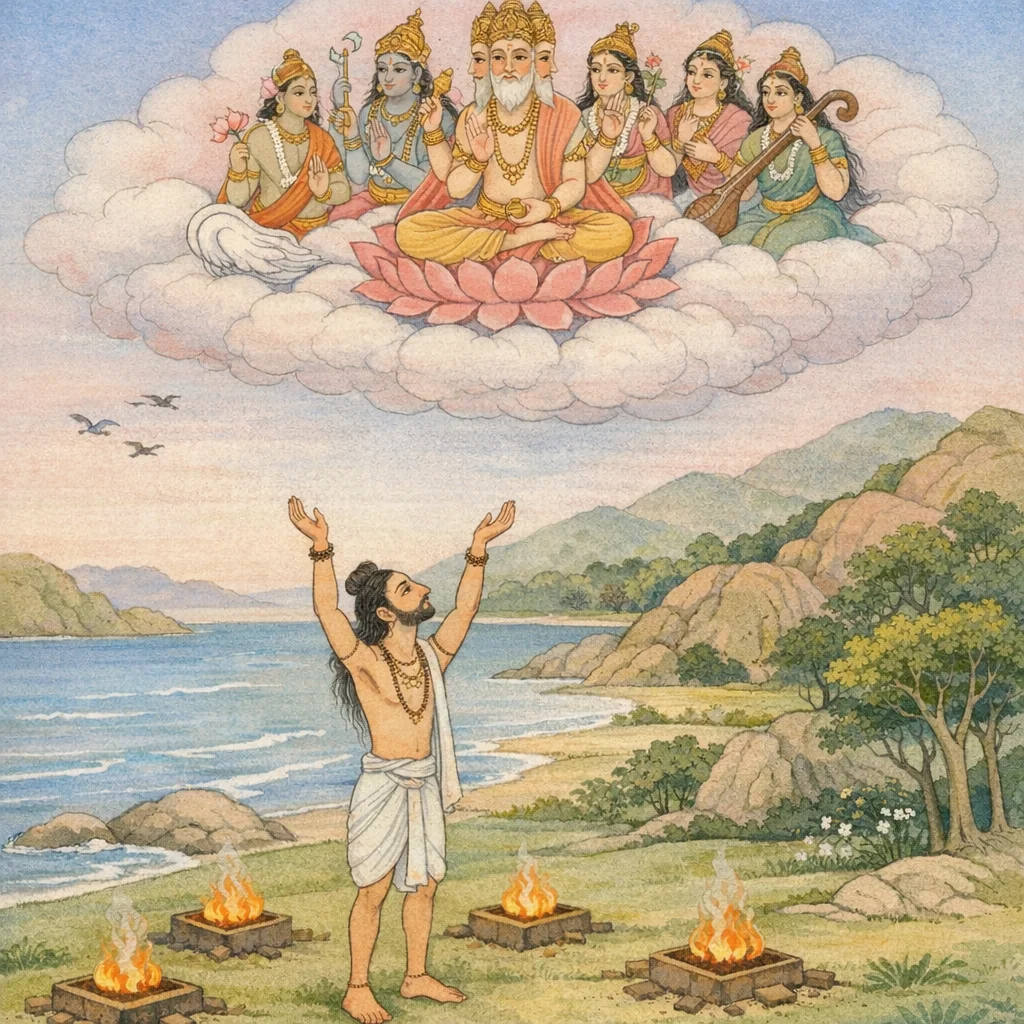
Sarga 42 continues the Ikṣvāku line and the ritual quest to liberate Sagara’s sons. After Sagara’s death, the people enthrone the virtuous Aṁśumān as king. In time Aṁśumān hands the kingdom to Dilīpa and performs fierce austerities on Himavat’s sacred peak; he attains heaven, yet the aim remains unfulfilled. Dilīpa grieves for the ancestral calamity and cannot find a way to bring down Gaṅgā or perform the required water-rites (jalakriyā), remaining lost in contemplation. A righteous son, Bhagīratha, is born to him. Dilīpa rules for many years with sacrifices, crowns Bhagīratha, and by merit departs to Indra’s realm. Bhagīratha, childless but intent on continuing the dynasty and saving his forefathers, entrusts governance to his ministers and undertakes prolonged panchatapa at Gokarṇa—arms raised, senses restrained, taking food only once a month—until Brahmā appears, well pleased. Bhagīratha petitions for Gaṅgā’s waters to complete the rites that will free Sagara’s sons and to secure the continuity of the Ikṣvāku line. Brahmā grants the boon, yet declares that only Śiva can bear the force of Gaṅgā’s descent; therefore Śiva must be entreated. Brahmā then returns to heaven with the gods.
Shlokas
Verse 1
कालधर्मं गते राम सगरे प्रकृतीजना:।राजानं रोचयामासुरंशुमन्तं सुधार्मिकम्।।1.42.1।।
O Rāma, when Sagara met the law of time (death), the ministers and the people approved and installed the highly righteous Anuśumān as king.
Verse 2
स राजा सुमहानासीदंशुमान् रघुनन्दन ।तस्य पुत्रो महानासीद्दिलीप इति विश्रुत:।।1.42.2।।
O Rāma, delight of the Raghu line—Aṁśumān became a very great king; and to him was born a renowned and noble son named Dilīpa.
Verse 3
तस्मिन् राज्यं समावेश्य दिलीपे रघुनन्दन।हिमवच्छिखरे पुण्ये तपस्तेपे सुदारुणम्।।1.42.3।।
Thus, O delight of the Raghus, having entrusted the kingdom to Dilīpa, Aṁśumān performed exceedingly severe austerities upon the sacred peak of Himavat.
Verse 4
द्वात्रिंशच्च सहस्राणि वर्षाणि सुमहायशा:।तपोवनं गतो राम स्वर्गं लेभे तपोधन:।।1.42.4।।
O Rāma, for thirty-two thousand years the greatly renowned Anuśumān dwelt in the forest of austerities; rich only in tapas, he attained heaven—yet without fulfilling his aim.
Verse 5
दिलीपस्तु महातेजाश्श्रुत्वा पैतामहं वधम्।दु:खोपहतया बुद्ध्या निश्चयं नाध्यगच्छत।।1.42.5।।
But mighty, radiant Dilīpa, hearing of the death of his forefathers, was struck by grief; his mind overwhelmed by sorrow, he could not arrive at a firm resolve.
Verse 6
कथं गङ्गावतरणं कथं तेषां जलक्रिया।तारयेयं कथं चैतानिति चिन्तापरोऽभवत्।।1.42.6।।
“How shall Gaṅgā be brought down? How shall the water-rites for them be performed? And how shall I deliver them?”—thus he became wholly absorbed in anxious reflection.
Verse 7
तस्य चिन्तयतो नित्यं धर्मेण विदितात्मन:।पुत्रो भगीरथो नाम जज्ञे परमधार्मिक:।।1.42.7।।
As he constantly reflected in righteousness—he whose inner self was known through dharma—a supremely virtuous son was born to him, named Bhagīratha.
Verse 8
दिलीपस्तु महातेजा यज्ञैर्बहुभिरिष्टवान्।त्रिंशद्वर्षसहस्राणि राजा राज्यमकारयत्।।1.42.8।।
The radiant king Dilīpa performed many sacrifices and ruled his kingdom for thirty thousand years.
Verse 9
अगत्वा निश्चयं राजा तेषामुद्धरणं प्रति ।व्याधिना नरशार्दूल कालधर्ममुपेयिवान्।।1.42.9।।
O tiger among men, the king—without reaching a settled decision about their deliverance—fell ill and met the law of time, that is, death.
Verse 10
इन्द्रलोकं गतो राजा स्वार्जितेनैव कर्मणा।राज्ये भगीरथं पुत्रमभिषिच्य नरर्षभ:।।1.42.10।।
That best of men, the king—having crowned his son Bhagiratha in the kingdom—departed to Indra’s world, won by his own meritorious deeds.
Verse 11
भगीरथस्तु राजर्षिर्धार्मिको रघुनन्दन।अनपत्यो महातेजा: प्रजाकामस्स चाप्रज:।।1.42.11।।
O delight of the Raghus, Bhagiratha—the righteous royal sage, radiant with great splendor—had no son; though longing for offspring, he remained without progeny.
Verse 12
मन्त्रिष्वाधाय तद्राज्यं गङ्गावतरणे रत:।स तपो दीर्घमातिष्ठद्गोकर्णे रघुनन्दन।।1.42.12।।ऊर्ध्वबाहु: पञ्चतपा मासाहारो जितेन्द्रिय:।
O Raghunandana, intent on bringing Gaṅgā down to earth, he entrusted the kingdom to his ministers and for long years practiced austerities at Gokarṇa—arms raised, enduring the five fires, eating only once a month, and mastering his senses.
Verse 13
तस्य वर्षसहस्राणि घोरे तपसि तिष्ठत:।।1.42.13।।अतीतानि महाबाहो तस्य राज्ञो महात्मन:। सुप्रीतो भगवान् ब्रह्मा प्रजानां पतिरीश्वर:।।1.42.14।।
O mighty-armed one, as that great-souled king stood firm in fierce austerity, thousands of years passed; then the Blessed Brahmā—Lord and protector of creatures—was exceedingly pleased with him.
Verse 14
तस्य वर्षसहस्राणि घोरे तपसि तिष्ठत:।।1.42.13।।अतीतानि महाबाहो तस्य राज्ञो महात्मन:। सुप्रीतो भगवान् ब्रह्मा प्रजानां पतिरीश्वर:।।1.42.14।।
O mighty-armed one, as that great-souled king stood firm in fierce austerity, thousands of years passed; then the Blessed Brahmā—Lord and protector of creatures—was exceedingly pleased with him.
Verse 15
ततस्सुरगणैस्सार्धमुपागम्य पितामह:।भगीरथं महात्मानं तप्यमानमथाब्रवीत्।।1.42.15।।
Then the Grandsire (Brahmā), arriving together with the hosts of gods, spoke to the great-souled Bhagiratha as he continued his austerities.
Verse 16
भगीरथ महाभाग प्रीतस्तेऽहं जनेश्वर।तपसा च सुतप्तेन वरं वरय सुव्रत।।1.42.16।।
“O Bhagiratha, greatly fortunate one—O lord among men! I am pleased with your well-performed austerities; O you of excellent vows, choose a boon.”
Verse 17
तमुवाच महातेजा: सर्वलोकपितामहम्।भगीरथो महाभाग: कृताञ्जलिरुपस्थित:।।1.42.17।।
Then the splendid and noble Bhagiratha, approaching with palms joined, addressed the Grandsire of all the worlds (Brahmā).
Verse 18
यदि मे भगवन् प्रीतो यद्यस्ति तपस: फलम्।सगरस्यात्मजास्सर्वे मत्तस्सलिलमाप्नुयु:।।1.42.18।।
O Bhagavān—if You are pleased with me, and if my austerity bears fruit, may all the sons of Sagara receive from me the libation of water that completes their funeral rites.
Verse 19
गङ्गायास्सलिलक्लिन्ने भस्मन्येषां महात्मनाम्।स्वर्गं गच्छेयुरत्यन्तं सर्वे मे प्रपितामहा:।।1.42.19।।
May the ashes of those great-souled ones, moistened by the waters of Gaṅgā, lead all my forefathers at last to heaven.
Verse 20
देया च सन्ततिर्देव नावसीदेत्कुलं च न:।इक्ष्वाकूणां कुले देव एष मेऽस्तु वर:पर:।।1.42.20।।
And, O Lord, grant that progeny be bestowed, and that our line not come to an end. In the Ikṣvāku dynasty, O Lord, let this be my further boon.
Verse 21
उक्तवाक्यं तु राजानं सर्वलोकपितामह:।प्रत्युवाच शुभां वाणीं मधुरां मधुराक्षराम्।।1.42.21।।
Then the Grandsire of all worlds, addressing the king who had spoken thus, replied in auspicious words—sweet in tone and gentle in syllables.
Verse 22
मनोरथो महानेष भगीरथ महारथ।एवं भवतु भद्रं ते इक्ष्वाकुकुलवर्धन।।1.42.22।।
O Bhagīratha, great warrior—truly great is your desire. So may it be; blessings upon you, increaser of the Ikṣvāku line.
Verse 23
इयं हैमवती गङ्गा ज्येष्ठा हिमवतस्सुता।तां वै धारयितुं शक्तो हरस्तत्र नियुज्यताम्।।1.42.23।।
This Gaṅgā is Haimavatī, the eldest daughter of Himavat; only Hara (Śiva) is able to bear her—therefore let him be appointed to that task.
Verse 24
गङ्गाया: पतनं राजन् पृथिवी न सहिष्यति।तां वै धारयितुं वीर नान्यं पश्यामि शूलिन:।।1.42.24।।
O King, the earth cannot endure Gaṅgā’s descent. O hero, I see none other than the trident-bearer, Śiva, who can hold her.
Verse 25
तमेवमुक्त्वा राजानं गङ्गां चाभाष्य लोककृत्।जगाम त्रिदिवं देवस्सहदेवैर्मरुद्गणै:।।1.42.25।।
Having spoken thus to the king, and also addressing Gaṅgā, the Creator of the worlds departed for heaven, accompanied by the gods and the hosts of the Maruts.
Frequently Asked Questions
The sarga frames a rājadharma dilemma across generations: how a king should discharge pitṛ-ṛṇa (ancestral debt) when ordinary means fail. The decisive action is Bhagīratha’s renunciatory governance model—entrusting the kingdom to ministers and undertaking extreme tapas—to secure Gaṅgā’s descent for jalakriyā and the liberation of Sagara’s sons.
Merit (puṇya) and austerity (tapas) are presented as instruments of moral causality, but not as unilateral power: even a granted boon must align with cosmic constraints. Brahmā’s instruction that Śiva alone can bear Gaṅgā teaches mediated agency—human striving succeeds when coordinated with dharma, divine order, and appropriate spiritual intermediaries.
Gokarṇa is highlighted as a sacred austerity-site where Bhagīratha performs panchatapa. The Himavat peak and tapovana signify ascetic geography, while Indraloka/Tridiva mark posthumous reward. Culturally, jalakriyā (water-based funerary rites) and the concept of Gaṅgā’s purificatory waters are central ritual landmarks.