Sarga 118
अनसूयोपदेशः तथा सीताया स्वयंवरकथा (Anasuya’s Counsel and Sita’s Swayamvara Narrative)
अयोध्याकाण्ड
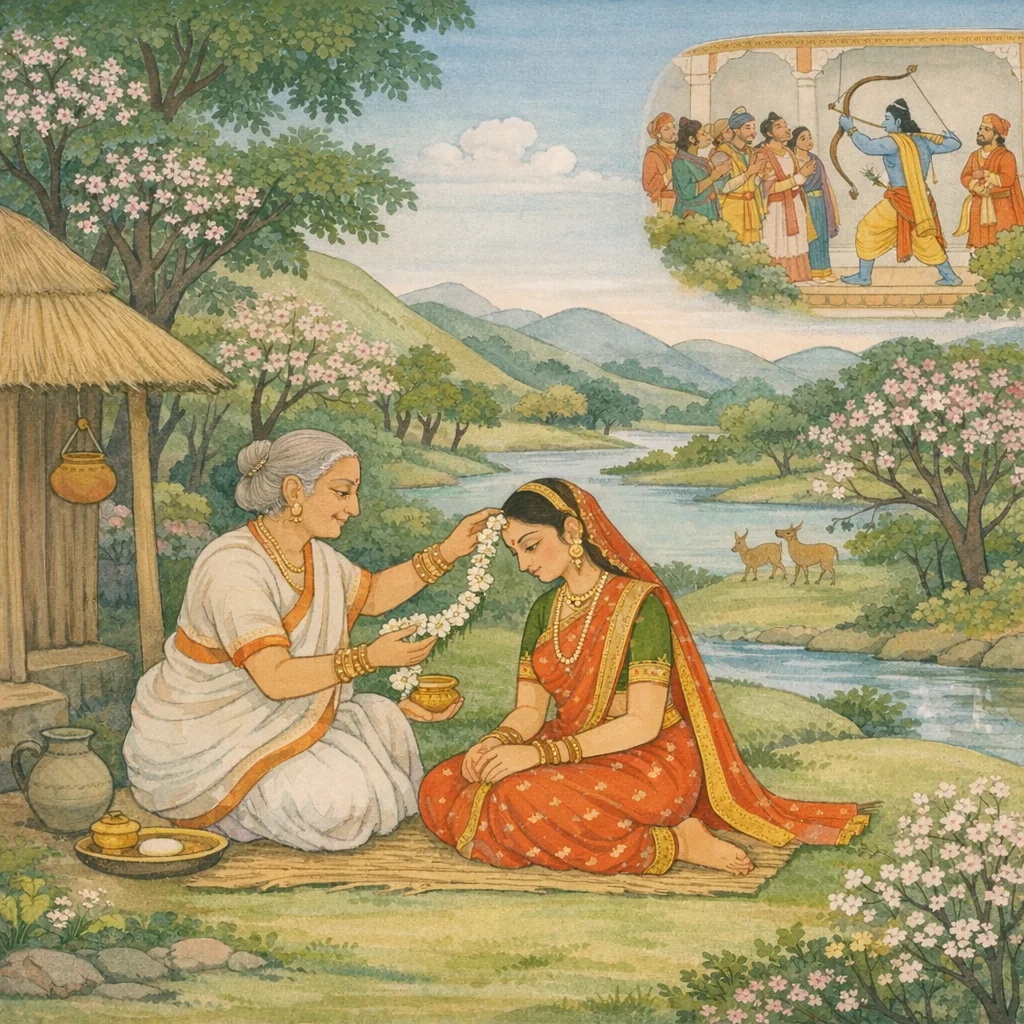
Sarga 118 unfolds as a didactic exchange within the reverent hospitality of a forest āśrama. When Anasūyā addresses Vaidehī (Sītā), Sītā replies with humility, affirming that a husband is a wife’s guru and that devoted service to one’s husband (patiśuśrūṣā) is a chief tapas for women. Exempla are cited—Sāvitrī, honored in heaven through fidelity, and Rohiṇī, inseparable from the Moon—setting forth a moral order of steadfast marital vows. Pleased, Anasūyā bestows divine adornments—garland, raiment, jewelry, fragrant unguents, and a precious ointment—said to be enduring, never fading and always suitable. She links Sītā’s beautification to Śrī (Lakṣmī) enhancing Viṣṇu, thereby sacralizing conjugal harmony. The sarga then turns to origins and marriage history: Anasūyā asks for Sītā’s birth and wedding account. Sītā recounts her ayoni-jā emergence from the earth during Janaka’s sacrificial ploughing, her adoption and nurturing by the chief queen, Janaka’s concern to find a worthy husband, and the svayaṃvara centered on Varuṇa’s heavy divine bow, which the assembled kings cannot lift. When Rāma arrives with Viśvāmitra and Lakṣmaṇa, he strings and breaks the bow at once. Bound to truth, Janaka resolves to offer Sītā to Rāma, yet Rāma pauses until Daśaratha’s consent is obtained. The chapter closes with the lawful completion of the marriage arrangement and Sītā’s declaration of her dhārmic devotion to Rāma.
Shlokas
Verse 1
सात्वेवमुक्ता वैदेही अनसूयाऽनसूयया। प्रतिपूज्य वचो मन्दं प्रवक्तुमुपचक्रमे।।2.118.1।।
Thus addressed by Anasūyā, Vaidehī—free from malice—honoured her words in return and began to speak gently.
Verse 2
नैतदाश्चर्यमार्याया यन्मां त्वमभिभाषसे। विदितन्तु ममाप्येतद्यथा नार्याः पतिर्गुरुः।।2.118.2।।
It is no surprise that a noble lady should counsel me so. I too know this well: for a woman, her husband is to be revered as a guru.
Verse 3
यद्यप्येष भवेद्भर्ता ममाऽर्ये वृत्तवर्जितः।अद्वैधमुपचर्तव्यस्तथाप्येष मया भवेत्।।2.118.3।।
O noble lady, even if it should happen that my husband is devoid of good conduct, even so he must be attended upon by me without wavering.
Verse 4
किं पुनर्यो गुणश्लाघ्य स्सानुक्रोशो जितेन्द्रियः।स्थिरानुरागो धर्मात्मा मातृवत्पितृवत्प्रियः।।2.118.4।।
How much more so if the husband is praiseworthy in virtue—compassionate, self-controlled, steadfast in affection, righteous by nature, and dear like a mother and a father.
Verse 5
यां वृत्तिं वर्तते रामः कौसल्यायां महाबलः।तामेव नृपनारीणामन्यासामपि वर्तते।।2.118.5।।
Mighty Rāma treats the other queens of the king in the very same manner as he treats Kausalyā.
Verse 6
सकृद्दृष्टास्वपि स्त्रिषु नृपेण नृपवत्सलः।मातृवद्वर्तते वीरो मानमुत्सृज्य धर्मवित्।।2.118.6।।
Even those women whom the king had looked upon but once, heroic Rāma—devoted to the king and knowing dharma—sets aside pride and treats them as a mother.
Verse 7
आगच्छन्त्याश्च विजनं वनमेवं भयावहम्।समाहितं मे श्वश्र्वा च हृदये तद्धृतं महत्।।2.118.7।।
As I set out for this desolate and fearsome forest, the great counsel imparted to me by my mother-in-law was placed within me, and I have held it firmly in my heart.
Verse 8
पाणिप्रदानकाले च यत्पुरात्वग्नि सन्निधौ।अनुशिष्टा जनन्याऽस्मि वाक्यं तदपि मे धृतम्।।2.118.8।।
And the words with which my mother instructed me earlier, at the time my hand was given in marriage in the presence of the sacred fire—those too I have kept fast within me.
Verse 9
नवीकृतं तु तत्सर्वं वाक्यैस्ते धर्मचारिणि।पतिशुश्रूषणान्नार्यास्तपो नान्यद्विधीयते।।2.118.9।।
O woman who practices dharma, your words have refreshed all of that instruction for me; for a wife, no other austerity is enjoined than devoted service to her husband.
Verse 10
सावित्री पतिशुश्रूषां कृत्वा स्वर्गे महीयते।तथावृत्तिश्च याता त्वं पतिशुश्रूषया दिवम्।।2.118.10।।
Sāvitrī, by devoted service to her husband, is honoured in heaven; you too, following that same course, will reach heaven through such service.
Verse 11
वरिष्ठा सर्वनारीणामेषा च दिवि देवता।रोहिणी न विनाचन्द्रं मुहूर्तमपि दृश्यते।।2.118.11।।
Rohiṇī, best among women and a goddess in the heavens, is never seen in the sky even for a moment without the Moon.
Verse 12
एवंविधाश्च प्रवराः स्त्रियो भर्तृदृढव्रताः।देवलोके महीयन्ते पुण्येन स्वेन कर्मणा।।2.118.12।।
Women of this kind—excellent and firm in their vows to their husbands—are honoured in the world of the gods by the merit of their own deeds.
Verse 13
ततोऽनसूया संहृष्टा श्रुत्वोक्तं सीतया वचः।शिरस्याघ्राय चोवाच मैथिलीं हर्षयन्त्युत।।2.118.13।।
Hearing Sītā’s words, Anasūyā rejoiced; she kissed her upon the forehead and spoke to the princess of Mithilā, seeking to gladden her heart.
Verse 14
नियमैर्विविधैराप्तं तपो हि महदस्ति मे।तत्संश्रित्य बलं सीते छन्दये त्वां शुचिव्रते।।2.118.14।।
O Sītā, pure in your vows, I possess great ascetic power gained through many disciplines; relying on that strength, I shall grant you what you desire, for your contentment.
Verse 15
उपपन्नं मनोज्ञं च वचनं तव मैथिलि।प्रीता चास्म्युचितं किं ते करवाणि ब्रवीहि मे।।2.118.15।।
O Maithilī, your words are both fitting and pleasing. I am delighted—tell me what it is proper for me to do for you.
Verse 16
तस्यास्तद् वचनं श्रूत्वा विस्मिता मन्दविस्मया। कृतमित्यब्रवीत् सीता तपोबलसमन्विताम्।।2.118.16।।
Hearing those words, Sītā—mildly smiling in wonder—said to Anasūyā, endowed with ascetic power: “It is already accomplished.”
Verse 17
सा त्वेवमुक्ता धर्मज्ञा तया प्रीततराऽभवत्।सफलं च प्रहर्षं ते हन्त सीते करोम्यहम्।।2.118.17।।
Thus addressed, Anasūyā, knower of dharma, became even more pleased with Sītā and said: “Indeed, O Sītā, I shall make my joy in you bear fruit.”
Verse 18
इदं दिव्यं वरं माल्यं वस्त्रमाभरणानि च।अङ्गरागं च वैदेहि महार्हं चानुलेपनम्।।2.118.18।।मया दत्तमिदं सीते तव गात्राणि शोभयेत्।अनुरूपमसंक्लिष्टं नित्यमेव भविष्यति।।2.118.19।।
O Vaidehī, here are a divine and excellent garland, garments, and ornaments, along with fragrant unguents and a precious ointment. Bestowed by me, O Sītā, these will adorn your limbs; they will remain fitting, unspoiled, and ever-fresh.
Verse 19
इदं दिव्यं वरं माल्यं वस्त्रमाभरणानि च।अङ्गरागं च वैदेहि महार्हं चानुलेपनम्।।2.118.18।।मया दत्तमिदं सीते तव गात्राणि शोभयेत्।अनुरूपमसंक्लिष्टं नित्यमेव भविष्यति।।2.118.19।।
O Vaidehī, here are a divine and excellent garland, garments, and ornaments, along with fragrant unguents and a precious ointment. Bestowed by me, O Sītā, these will adorn your limbs; they will remain fitting, unspoiled, and ever-fresh.
Verse 20
अङ्गरागेण दिव्येन लिप्ताङ्गी जनकात्मजे।शोभयिष्यसि भर्तारं यथा श्रीर्विष्णुमव्ययम्।।2.118.20।।
O daughter of Janaka, anointed with this divine unguent, you will enhance your husband’s splendor—just as Śrī (Lakṣmī) adorns the imperishable Viṣṇu.
Verse 21
सा वस्त्रमङ्गरागं च भूषणानि स्रजस्तथा।मैथिली प्रतिजग्राह प्रीतिदानमनुत्तमम्।।2.118.21।।
Maithilī accepted those incomparable gifts of affection—garments, unguents, ornaments, and garlands.
Verse 22
प्रतिगृह्य च तत्सीता प्रीतिदानं यशस्विनी।श्लिष्टाञ्जलिपुटा तत्र समुपास्त तपोधनाम्।।2.118.22।।
Illustrious Sītā accepted that affectionate gift; then, with her palms cupped together in reverent salutation, she sat close by the ascetic woman rich in austerity.
Verse 23
तथा सीतामुपासीनामनसूया दृढव्रता।वचनं प्रष्टुमारेभे काञ्चित्प्रियकथामनु।।2.118.23।।
Seeing Sītā seated thus, Anasūyā—steadfast in her vows—began to question her, wishing to hear a cherished account.
Verse 24
स्वयं वरे किल प्राप्ता त्वमनेन यशस्विना।राघवेणेति मे सिते कथा श्रुतिमुपागता।।2.118.24।।
“O Sītā, I have heard that in the svayaṃvara you were won by this illustrious Rāghava; such is the report that has reached my ears.”
Verse 25
तां कथां श्रोतुमिच्छामि विस्तरेण च मैथिलि।यथाऽनुभूतं कार्त्स्न्येन तन्मे त्वं वक्तुमर्हसि।।2.118.25।।
“O Maithilī, I wish to hear that story in full detail; please tell it to me completely, exactly as you experienced it.”
Verse 26
एवमुक्ता तु सा सीता तां ततो धर्मचारिणीम्।श्रूयतामिति चोक्त्वा वै कथयामास तां कथाम्।।2.118.26।।
Thus addressed, Sītā said to that righteous practitioner, “Listen,” and then proceeded to recount the entire story.
Verse 27
मिथिलाधिपतिर्वीरो जनको नाम धर्मवित्।क्षत्रधर्मे ह्यभिरतो न्यायतश्शास्ति मेदिनीम्।।2.118.27।।
“In Mithilā there was a heroic king named Janaka, well-versed in dharma; devoted to the duties of a kṣatriya, he governed the earth in accordance with justice.”
Verse 28
तस्य लाङ्गलहस्तन्य कर्षतः क्षेत्रमण्डलम्।अहं किलोत्थिता भित्वा जगतीं नृपतेस्सुता।।2.118.28।।
As he, plough in hand, was tilling the sacred sacrificial plot, it is said that I arose, breaking open the earth; thus I became the king’s daughter.
Verse 29
स मां दृष्ट्वा नरपतिर्मुष्टिविक्षेपतत्परः।पांसुकुण्ठितसर्वाङ्गीं जनको विस्मितोऽभवत्।।2.118.29।।
Then King Janaka—intent on scattering fistfuls (of seed)—saw me with my whole body dust-covered, and he was filled with astonishment.
Verse 30
अनपत्येन च स्नेहादङ्कमारोप्य च स्वयम्।ममेयं तनयेत्युक्त्वा स्नेहो मयि निपातितः।।2.118.30।।
Since he had no child, he himself, out of affection, lifted me onto his lap; saying, ‘This is my daughter,’ he poured his love upon me.
Verse 31
अन्तरिक्षे च वागुक्ताऽप्रतिमाऽमानुषी किल।एवमेतन्नरपते धर्मेण तनया तव।।2.118.31।।
And then a voice was heard from the sky, incomparable and not of human origin: “So it is, O king—by dharma, she is your daughter.”
Verse 32
ततः प्रहृष्टो धर्मात्मा पिता मे मिथिलाधिपः।अवाप्तो विपुलां बुद्धिं मामवाप्य नराधिपः।।2.118.32।।
Thereafter my father—the righteous lord of Mithilā—was filled with joy; and having gained me, the king attained a broad and noble resolve.
Verse 33
दत्ता चास्मीष्टवद्देव्यै ज्येष्ठायै पुण्यकर्मणा।तया सम्भाविता चास्मि स्निग्धया मातृसौहृदात्।।2.118.33।।
And that meritorious king entrusted me—like a most cherished gift—to the chief queen; and she, affectionate by nature, raised me with a mother’s loving care.
Verse 34
पतिसंयोगसुलभं वयो दृष्ट्वा तु मे पिता।चिन्तामभ्यगमद्धीनो वित्तनाशादिवाधनः।।2.118.34।।
But when my father saw I had reached the age fit for marriage, he fell into anxiety—like a poor man desolate after losing his wealth.
Verse 35
सदृशाच्चापकृष्टाच्च लोके कन्यापिता जनात्।प्रधर्षणामवाप्नोति शक्रेणापि समो भुवि।।2.118.35।।
For in this world, the father of an unmarried girl meets humiliation from people—whether equal to him or even inferior—though he may be as great on earth as Indra himself.
Verse 36
तां धर्षणामदूरस्थां दृष्ट्वा चात्मनि पार्थिवः।चिन्तार्णवगतः पारं नाससादाप्लवो यथा।।2.118.36।।
Seeing that humiliation was close at hand for himself, the king sank into an ocean of worry—like a man without a float who cannot reach the far shore.
Verse 37
अयोनिजां हि मां ज्ञात्वा नाध्यगच्छद्विचिन्तयन्।सदृशं चानुरूपं च महीपालः पतिं मम।।2.118.37।।
Knowing that I was not born of a womb, the ruler of the earth, though he pondered long, could not find for me a husband both equal and truly fitting.
Verse 38
तस्य बुद्धिरियं जाता चिन्तयानस्य सन्ततम्।स्वयंवरं तनूजायाः करिष्यामीति धीमतः।।2.118.38।।
As he pondered continually, this resolve arose in the wise king: “I shall hold a svayaṁvara for my daughter.”
Verse 39
महायज्ञे तदा तस्य वरुणेन महात्मना।दत्तं धनुर्वरं प्रीत्या तूणी चाक्षयसायकौ।।2.118.39।।
At that time, during his great sacrifice, the magnanimous Varuṇa, pleased at heart, bestowed upon him an excellent bow, along with quivers and two inexhaustible arrows.
Verse 40
असञ्चाल्यं मनुष्यैश्च यत्नेनापि च गौरवात्।तन्न शक्ता नमयितुं स्वप्नेष्वपि नराधिपाः।।2.118.40।।
So heavy was that bow that no man could even move it, despite great effort; and the kings were unable to bend it—not even in their dreams.
Verse 41
तद्धनुः प्राप्य मे पित्रा व्याहृतं सत्यवादिना।समवाये नरेन्द्राणां पूर्वमामन्त्र्य पार्थिवान्।।2.118.41।।
After my father, true to his word, had obtained that bow, he first summoned the kings to an assembly and there made his proclamation.
Verse 42
इदं च धनुरुद्यम्य सज्यं यः कुरुते नरः।तस्य मे दुहिता भार्या भविष्यति न संशयः।।2.118.42।।
“Whoever among men can lift this bow and string it, he shall have my daughter as his wife—of this there is no doubt.”
Verse 43
तच्च दृष्ट्वा धनुश्श्रेष्ठं गौरवाद्गिरिसन्निभम्। अभिवाद्य नृपा जग्मुरशक्तास्तस्य तोलने।।2.118.43।।
Seeing that supreme bow, awe-inspiring and heavy as a mountain, the kings—unable even to lift it—paid their respects and departed.
Verse 44
सुदीर्घस्य तु कालस्य राघवोऽयं महाद्युतिः।विश्वामित्रेण सहितो यज्ञं द्रष्टुं समागतः।।2.118.44।।लक्ष्मणेन सह भ्रात्रा राम स्सत्यपराक्रमः।
After a long time, this resplendent Rāghava—Rāma, whose valor is grounded in truth—arrived with his brother Lakṣmaṇa and with Viśvāmitra, to witness the sacrifice (yajña).
Verse 45
विश्वामित्रस्तु धर्मात्मा मम पित्रा सुपूजितः।।2.118.45।।प्रोवाच पितरं तत्र भ्रातरौ रामलक्ष्मणौ।
There the righteous Viśvāmitra, duly honored by my father, spoke to him about those two brothers—Rāma and Lakṣmaṇa.
Verse 46
सुतौ दशरथस्येमौ धनुर्दर्शकाङ्क्षिणौ।धनुर्दर्शय रामाय राजपुत्राय दैविकम्।।2.118.46।।
“These two are the sons of Daśaratha, eager to behold the bow. Show the divine bow to Prince Rāma.”
Verse 47
इत्युक्तस्तेन विप्रेण तद्धनुस्समुपानयत्।।2.118.47।।निमेषान्तरमात्रेण तदाऽनम्य महाबलः।ज्यां समारोप्य झडिति पूरयामास वीर्यवान्।।2.118.48।।
Thus addressed by that sage, my father brought forth the bow. Then mighty, valorous Rāma bent it, swiftly set the string upon it, and drew it—within the blink of an eye.
Verse 48
इत्युक्तस्तेन विप्रेण तद्धनुस्समुपानयत्।।2.118.47।।निमेषान्तरमात्रेण तदाऽनम्य महाबलः।ज्यां समारोप्य झडिति पूरयामास वीर्यवान्।।2.118.48।।
Thus addressed by that sage, my father brought forth the bow. Then mighty, valorous Rāma bent it, swiftly set the string upon it, and drew it—within the blink of an eye.
Verse 49
तेन पूरयता वेगान्मध्ये भग्नं द्विधा धनुः।तस्य शब्दो भवद्भीमः पतितस्याशनेरिव।।2.118.49।।
As he drew it with force, the bow snapped in the middle into two; and the sound that arose was terrifying—like a thunderbolt crashing down.
Verse 50
ततोऽहं तत्र रामाय पित्रा सत्याभिसन्धिना।निश्चिता दातुमुद्यम्य जलभाजनमुत्तमम्।।2.118.50।।
Then, there, my father—firmly resolved upon truth—raised an excellent vessel of water, determined to give me to Rāma.
Verse 51
दीयमानां न तु तदा प्रतिजग्राह राघवः।अविज्ञाय पितुश्छन्दमयोध्याऽधिपतेः प्रभोः।।2.118.51।।
But at that moment Rāghava did not accept me as I was being offered, not yet knowing the intention of his father—the lord, king of Ayodhyā.
Verse 52
तत श्श्वशुरमामन्त्र्य वृद्धं दशरथं नृपम्।मम पित्रा त्वहं दत्ता रामाय विदितात्मने।।2.118.52।।
Then, having invited my father-in-law—the aged king Daśaratha—my father gave me to Rāma, a man renowned for discernment and self-knowledge.
Verse 53
मम चैवानुजा साध्वी ऊर्मिला प्रियदर्शना।भार्यार्थे लक्ष्मणस्यापि दत्ता पित्रा मम स्वयम्।।2.118.53।।
And my younger sister, the virtuous Urmilā, fair to behold, was likewise given by my father, of his own accord, as a wife for Lakṣmaṇa.
Verse 54
एवं दत्ताऽस्मि रामाय तदा तस्मिन्स्वयंवरे।अनुरक्ताऽस्मि धर्मेण पतिं वीर्यवतां वरम्।।2.118.54।।
Thus, at that svayaṁvara, I was given to Rāma; and in keeping with dharma I remain devoted to my husband, foremost among the valiant.
Frequently Asked Questions
The sarga formalizes a dharma-framework for household life: Sītā articulates unwavering obedience and service to her husband as a normative vow—even hypothetically if the husband lacks good conduct—while also demonstrating restraint and propriety in accepting gifts and narrating her past within a righteous setting.
Patiśuśrūṣā is presented as a central tapas for women in the text’s ethical register, supported by exempla (Sāvitrī, Rohiṇī). The narrative also teaches that legitimacy in marriage and kingship ethics depends on truth-bound procedure and consent (Rāma waits for Daśaratha’s approval).
Cultural institutions include the svayaṃvara and sacrificial ground (the ploughed ritual plot where Sītā emerges). Geographical anchors include Mithilā (Janaka’s realm) and Ayodhyā (Daśaratha’s kingship), with the forest āśrama serving as the dialogic setting for instruction.
Read Valmiki Ramayana in the Vedapath app
Scan the QR code to open this directly in the app, with audio, word-by-word meanings, and more.