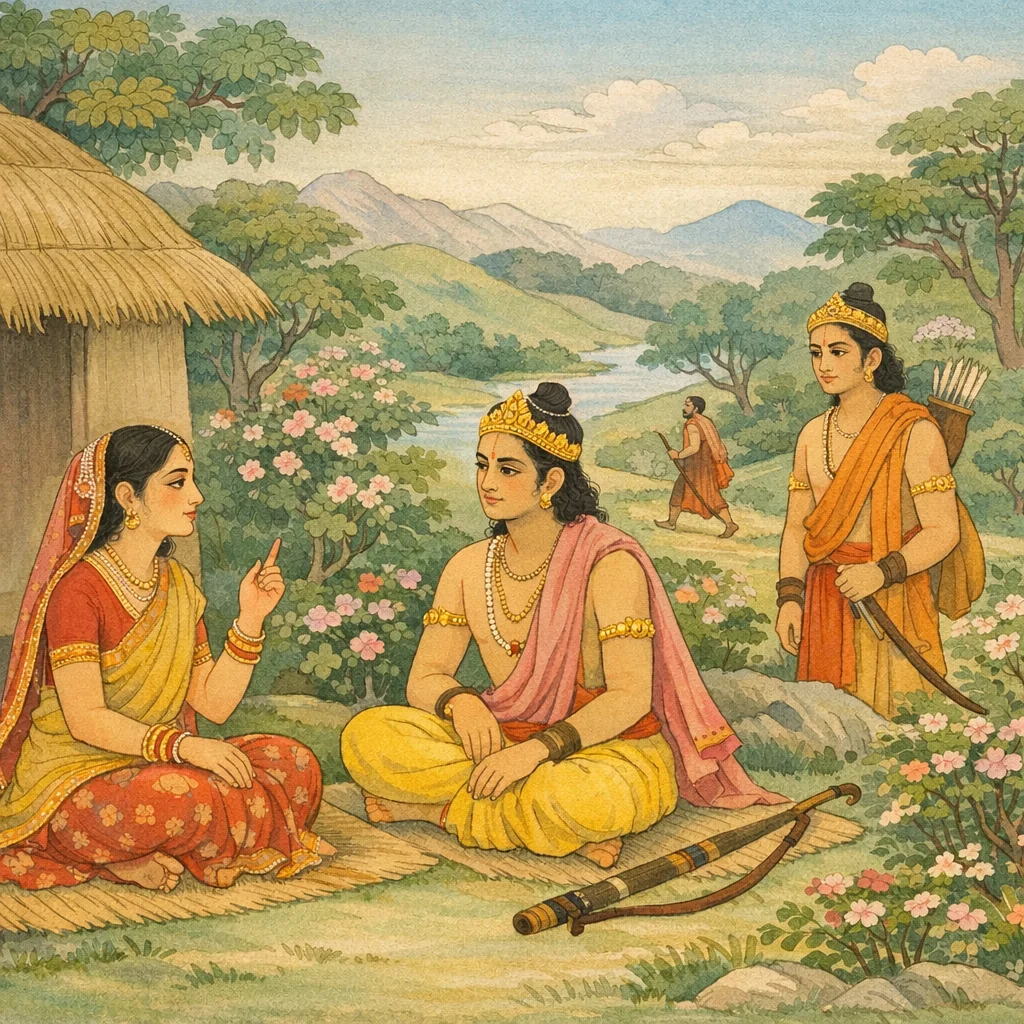
Sarga 9
सीताया धर्मोपदेशः—शस्त्रसंयोगदोषकथा (Sita’s Counsel on Dharma and the Peril of Weapon-Association)
अरण्यकाण्ड
As Rāma prepares to depart with Sūtīkṣṇa’s permission, Sītā speaks to him with affection and clear discernment. She affirms Rāma’s truthfulness, fidelity, and self-mastery, yet points to a dharma-danger: the “third vice”—violence without enmity—which can draw near when one dwells in the forest while bearing weapons. She recalls Rāma’s vow to protect the sages of Daṇḍakāraṇya and acknowledges the reason for entering the wilderness armed with Lakṣmaṇa. Still, she warns that constant association with weapons can taint the mind. To illustrate, she recounts an example of an ascetic entrusted with Indra’s sword; by carrying it continually, his tapas-born resolve gradually weakened, a fierce temper arose, and he fell from righteousness. Sītā urges that the bow’s proper use in the forest is defensive protection of the distressed, not preemptive killing without offense. Concluding, she defers to Rāma’s higher judgment—asking him to deliberate with Lakṣmaṇa and act swiftly according to dharma—offering her words as a loving reminder rather than an instruction.
Shlokas
Verse 1
सुतीक्ष्णेनाभ्यनुज्ञातं प्रस्थितं रघुनन्दनम्।हृद्यया स्निग्धया वाचा भर्तारमिदमब्रवीत्।।3.9.1।।
When Rāma, delight of the Raghus, had set out with Sutīkṣṇa’s permission, Sītā spoke to her husband in words that were heartfelt and tender.
Verse 2
अयं धर्मस्सुसूक्ष्मेण विधिना प्राप्यते महान्।निवृत्तेन तु शक्योऽयं व्यसनात्कामजादिह।।3.9.2।।
This great path of dharma is attained only through a most subtle discipline; here it is achievable only by one who has withdrawn from the miseries and addictions born of desire.
Verse 3
त्रीण्येव व्यसनान्यत्र कामजानि भवन्त्युत।मिथ्यावाक्यं परमकं तस्माद्गुरुतरावुभौ।।3.9.3।।परदाराभिगमनं विना वैरं च रौद्रता।
Here indeed there are only three vices born of desire: false speech is their chief root; therefore the other two are graver—approaching another man’s wife, and violence committed without any enmity.
Verse 4
मिथ्यावाक्यं न ते भूतं न भविष्यति राघव।।3.9.4।।कुतोऽभिलाषणं स्त्रीणां परेषां धर्मनाशनम्।
O Rāghava, false speech has never been yours, nor shall it ever be. How then could desire for other men’s women arise in you—an act that destroys their dharma?
Verse 5
तव नास्ति मनुष्येन्द्र न चाभूत्ते कदाचन।।3.9.5।।मनस्यपि तथा राम न चैतद्विद्यते क्वचित्।
O lord among men, this is not in you, nor has it ever been. So too, O Rāma, it is found in you nowhere and at no time—not even in thought.
Verse 6
स्वदारनिरतस्त्वं च नित्यमेव नृपात्मज।।3.9.6।।धर्मिष्ठस्सत्यसन्धश्च पितुर्निर्देशकारकः।
O prince, you are ever devoted to your own wife; steadfast in dharma, true to your word, and one who carries out your father’s commands.
Verse 7
सत्यसन्ध महाभाग श्रीमल्लक्ष्मणपूर्वज।।3.9.7।।त्वयि धर्मश्च सत्यं च त्वयि सर्वं प्रतिष्ठितम्।
O you who are true to your pledge—fortunate and illustrious elder brother of Lakshmana—in you abide both dharma and truth; indeed, in you all is firmly established.
Verse 8
तच्च सर्वं महाबाहो शक्यं धर्तुं जितेन्द्रियैः।।3.9.8।।तव वश्येन्द्रियत्वं च जानामि शुभदर्शन।
And all of that, O mighty-armed one, can be sustained only by those who have conquered their senses. O fair to behold, I know that you possess mastery over your senses.
Verse 9
तृतीयं यदिदं रौद्रं परप्राणाभिहिंसनम्।।3.9.9।।निर्वैरं क्रियते मोहात्तच्च ते समुपस्थितम्।
But the third fault—this fierce impulse to harm the lives of others even without enmity—is born of delusion; and that has now come upon you.
Verse 10
प्रतिज्ञातस्त्वया वीर दण्डकारण्यवासिनाम्।।3.9.10।।ऋषीणां रक्षणार्थाय वधस्संयति रक्षसाम्।
O valiant one, you have pledged to protect the sages dwelling in the Daṇḍaka forest by slaying the rākṣasas in battle.
Verse 11
एतन्निमित्तं च वनं दण्डका इति विश्रुतम्।।3.9.11।।प्रस्थितस्त्वं सह भ्रात्रा धृतबाणशरासनः।
For this very reason the forest is famed as “Daṇḍaka”; and for this cause you set out there with your brother, bearing bow and arrows.
Verse 12
ततस्त्वां प्रस्थितं दृष्ट्वा मम चिन्ताकुलं मनः।।3.9.12।।त्वद्वृत्तं चिन्तयन्त्या वै भवेन्निश्श्रेयसं हितम्।
Therefore, seeing you set forth, my mind is shaken with anxious care; as I ponder your course, I seek what is truly beneficial—your highest good.
Verse 13
त्वां चैव प्रस्थितं दृष्ट्वा राम चिन्ताकुलं मनः।।3.9.13।।सर्वतचशिन्तय्नत्या मे तव निश्श्रेयसं नृप।न हि मे रोचते वीर गमनं दण्डकान्प्रति।।3.9.14।।कारणं तत्र वक्ष्यामि वदन्त्याश्श्रूयतां मम।
Seeing you set out, O Rāma, my mind is filled with anxiety; thinking on every side for your highest welfare, O king, I do not approve, O hero, of your going toward Daṇḍaka. I will state the reason for this—please listen to what I say.
Verse 14
त्वां चैव प्रस्थितं दृष्ट्वा राम चिन्ताकुलं मनः।।3.9.13।।सर्वतचशिन्तय्नत्या मे तव निश्श्रेयसं नृप।न हि मे रोचते वीर गमनं दण्डकान्प्रति।।3.9.14।।कारणं तत्र वक्ष्यामि वदन्त्याश्श्रूयतां मम।
Seeing you set out, O Rāma, my mind is filled with anxiety; thinking on every side for your highest welfare, O king, I do not approve, O hero, of your going toward Daṇḍaka. I will state the reason for this—please listen to what I say.
Verse 15
त्वं हि बाणधनुष्पाणिर्भ्रात्रा सह वनं गतः।।3.9.15।।दृष्ट्वा वनचरान्सर्वान्कच्चित्कुर्याश्शरव्ययम्।
For you go into the forest with your brother, holding bow and arrows; on seeing all the forest-dwellers, might you then resort to the spending of arrows—shooting them forth?
Verse 16
क्षत्रियाणामपि धनुर्हुताशस्येन्धनानि च।।3.9.16।।समीपतस्स्थितं तेजो बलमुच्छ्रयते भृशम्।
Even for kṣatriyas, a bow is like fuel for fire: when it is close at hand, it greatly heightens one’s ardor and strength.
Verse 17
पुरा किल महाबाहो तपस्स्वी सत्यवाक्छुचिः।।3.9.17।।कस्मिंश्चिदभवत्पुण्ये वने रतमृगद्विजे।
Long ago, O mighty-armed one, there lived in a certain sacred forest an ascetic—pure and truthful—where deer and birds moved about in peace.
Verse 18
तस्यैव तपसो विघ्नं कर्तुमिन्द्रश्शचीपतिः।।3.9.18।।खङ्गपाणिरथागच्छदाश्रमं भटरूपधृत्।
To hinder that very ascetic’s austerities, Indra—the lord of Śacī—came to the hermitage, sword in hand, disguised as a soldier-attendant.
Verse 19
तस्मिंस्तदाश्रमपदे निशितः खङ्ग उत्तमः।।3.9.19।।स न्यासविधिना दत्तः पुण्ये तपसि तिष्ठतः।
At that hermitage-site, while the sage remained established in holy austerity, that finest keen-edged sword was entrusted, by the rite of nyāsa, as a sacred deposit.
Verse 20
स तच्छस्त्रमनुप्राप्य न्यासरक्षणतत्परः।।3.9.20।।वने तु विचरत्येव रक्षन्प्रत्ययमात्मनः।
Having received that weapon, he wandered through the forest, intent on guarding the deposit and preserving his own trustworthiness.
Verse 21
यत्र गच्छत्युपादातुं मूलानि च फलानि च।।3.9.21।।न विना याति तं खङ्गं न्यासरक्षणतत्परः।
Wherever he went to gather roots and fruits, he would not go without that sword—so intent was he on guarding the entrusted deposit.
Verse 22
नित्यं शस्त्रं परिवहन्क्रमेण स तपोधनः।।3.9.22।।चकार रौद्रीं स्वां बुद्धिं त्यक्त्वा तपसि निश्चयम्।
Carrying the weapon constantly, that ascetic-wealthy sage gradually abandoned his resolve in austerity and made his own mind fierce.
Verse 23
ततस्सरौद्रेऽभिरतः प्रमत्तोऽधर्मकर्शितः।।3.9.23।।तस्य शस्त्रस्य संवासाज्जगाम नरकं मुनिः।
Then, delighting in violence, heedless and pulled along by unrighteousness, the sage—through dwelling in association with that weapon—went to hell.
Verse 24
एवमेतत्पुरा वृत्तं शस्त्रसंयोगकारणम्।।3.9.24।।अग्निसंयोगवद्धेतुश्शस्त्रसंयोग उच्यते।स्नेहाच्च बहुमानाच्च स्मारये त्वां न शिक्षये।।3.9.25।।
Thus did this happen in the past, caused by contact with weapons. Weapon-association is said to be a cause like contact with fire. Out of affection and respect, I remind you—this is not a reprimand.
Verse 25
एवमेतत्पुरा वृत्तं शस्त्रसंयोगकारणम्।।3.9.24।।अग्निसंयोगवद्धेतुश्शस्त्रसंयोग उच्यते।स्नेहाच्च बहुमानाच्च स्मारये त्वां न शिक्षये।।3.9.25।।
Thus did this happen in the past, caused by contact with weapons. Weapon-association is said to be a cause like contact with fire. Out of affection and respect, I remind you—this is not a reprimand.
Verse 26
न कथञ्चन सा कार्या गृहीतधनुषा त्वया।बुद्धिर्वैरं विना हन्तुं राक्षसान्दण्डकाश्रितान्।।3.9.26।।अपराधं विना हन्तुं लोकान्वीर न कामये।
By you who bear the bow, such an intention should never be formed—to slay the rākṣasas dwelling in Daṇḍaka without enmity or provocation. O hero, I do not wish for anyone to be killed without an offence having been committed.
Verse 27
क्षत्रियाणां तु वीराणां वनेषु निरतात्मनाम्।।3.9.27।।धनुषा कार्यमेतावदार्तानां त्वभिरक्षणम्।
For valiant kṣatriyas dwelling in the forests with self-restraint, the bow has but this rightful task: to protect those in distress.
Verse 28
क्वच शस्त्रं क्व च वनं क्व च क्षात्रं तपः क्वच।।3.9.28।।व्याविद्धमिदमस्माभिर्द्देशधर्मस्तु पूज्यताम्।
Where is the bearing of weapons, and where is life in the forest? Where is the kṣatriya’s code, and where is ascetic tapas? Our presence here is like an encroachment; therefore let the custom and law of this land be honored.
Verse 29
तदार्य कलुषा बुद्धिर्जायते शस्त्रसेवनात्।।3.9.29।।पुनर्गत्वा त्वयोध्यायां क्षत्रधर्मं चरिष्यसि।
Then, O noble one, the mind becomes tainted by constant service to weapons. After returning again to Ayodhyā, you may practice the kṣatriya’s dharma.
Verse 30
अक्षया तु भवेत्प्रीतिश्श्वश्रूश्वशुरयोर्मम।।3.9.30।।यदि राज्यं परित्यज्य भवेस्त्वं निरतो मुनिः।
If, having renounced the kingdom, you had become steadfast as a muni, an ascetic sage, then unending joy would have arisen for my mother-in-law and father-in-law.
Verse 31
धर्मादर्थः प्रभवति धर्मात्प्रभवते सुखम्।।3.9.31।।धर्मेण लभते सर्वं धर्मसारमिदं जगत्।
From dharma arises prosperity; from dharma arises happiness. Through dharma one attains everything—this world has dharma as its very essence.
Verse 32
आत्मानं नियमैस्तैस्तै कर्शयित्वा प्रयत्नतः।।3.9.32।।प्राप्यते निपुणैर्धर्मो न सुखाल्लभ्यते सुखम्।
By disciplined observances—one after another—carefully and with effort, the wise make themselves austere and thereby attain dharma; happiness is not obtained merely from comfort.
Verse 33
नित्यं शुचिमतिस्सौम्य चर धर्मं तपोवने।।3.9.33।।सर्वं हि विदितं तुभ्यं त्रैलोक्यमपि तत्त्वतः।
O gentle one, ever move through this forest of austerity with a pure mind, abiding in dharma; for to you, indeed, all things—even the three worlds—are known in their true nature.
Verse 34
From a woman’s fickle impulse I have spoken all this. Who could truly instruct you in dharma? Consider with your own understanding, together with your younger brother, and do what seems right to you—do not delay.
Frequently Asked Questions
The dilemma is whether a weapon-bearing kṣatriya in the forest may slide into unjustified violence: Sītā warns Rāma against killing rākṣasas (or anyone) ‘without enmity’ and ‘without offense,’ distinguishing defensive protection from proactive harm.
The upadeśa is that dharma depends on intention and restraint: association with instruments of force can reshape cognition and habit, so righteous power must be governed by self-control and limited to the protection of the vulnerable.
Daṇḍakāraṇya is foregrounded as a culturally charged ascetic landscape (tapo-vana/ṛṣi-network), contrasted with Ayodhyā as the proper locus for full kṣātra governance; the āśrama setting anchors the exemplum about entrusted weapons.