Sarga 6
षष्ठस्सर्गः — तपस्विरक्षणे राजधर्मोपदेशः (Sarga 6: The Sages’ Appeal and Instruction on Royal Duty)
अरण्यकाण्ड
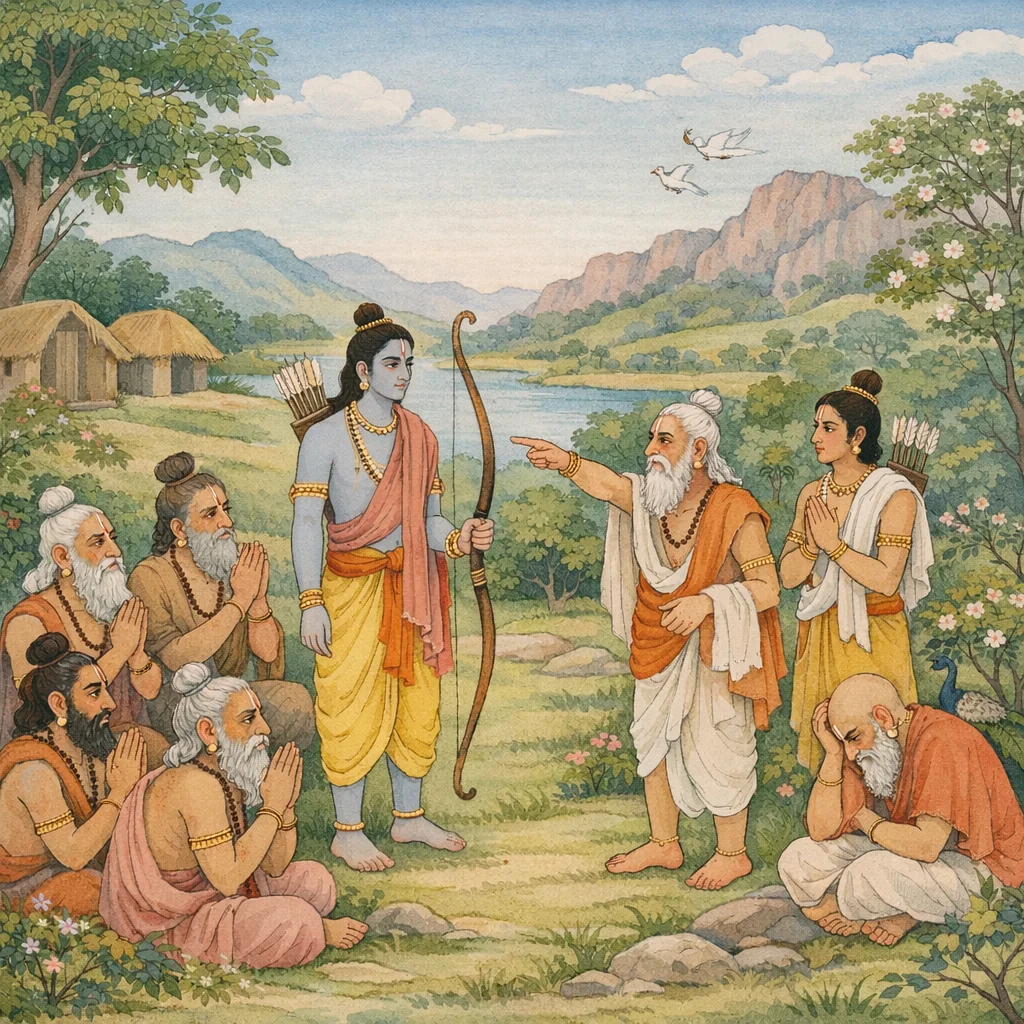
After Śarabhanga attains heaven, many assemblies of ascetics arrive at his hermitage and approach Rama, blazing with fire-like radiance. They praise his fame, valor, filial devotion, truthfulness, and steadfast dharma, then apologize for coming before him as needy petitioners. The sages set forth the rule of rāja-dharma: a king who takes the traditional one-sixth tax yet fails to protect his subjects commits grave injustice; but a ruler who guards the people like beloved sons wins enduring renown and reaches Brahmā’s world. They add that a share of ascetics’ merit (puṇya) accrues to the king who protects righteously, joining worldly protection to spiritual fruit. They show signs of rākṣasa atrocities—slain ascetics’ bodies and widespread killing near Pampā, Mandākinī, and Citrakūṭa—and seek refuge in Rama as the highest protector on earth. Rama replies humbly that ascetics may command him; he entered the forest to fulfill his father’s charge and to repel rākṣasa aggression. Assuring them of safety, Rama sets out with Lakshmana toward the sage Sūtīkṣṇa.
Shlokas
Verse 1
शरभङ्गे दिवं प्राप्ते मुनिसङ्घास्समागताः।अभ्यगच्छन्त काकुत्स्थं रामं ज्वलिततेजसम्।।।।
After Śarabhaṅga had attained heaven, companies of sages assembled and approached Rāma of the Kakutstha line, blazing with radiant tejas.
Verse 2
वैखानसा वालखिल्यास्सम्प्रक्षाला मरीचिपाः।अश्मकुट्टाश्च बहवः पत्राहाराश्च तापसाः।।।।दन्तोलूखलिनश्चैव तथैवोन्मज्जकाः परे।गात्रशय्या अशय्याश्च तथैवाभ्रावकाशकाः।।।।मुनयस्सलिलाहारावायुभक्षा स्तथापरे।आकाशनिलयाश्चैव तथा स्थण्डिलशायिनः।।।।व्रतोपवासिनो दान्तास्तथाऽर्द्रपटवाससः।सजपाश्च तपोनित्यास्तथा पञ्चतपोऽन्विताः।।।।सर्वे ब्राह्म्या श्रिया जुष्टा दृढयोगास्समाहिताः।शरभङ्गाश्रमे राममभिजग्मुश्च तापसाः।।।।
Vaikhānasas and Vālakhilyas; those who ceaselessly purify themselves; those who “drink the rays”; many who mortify the body with stones and many who live on leaves; those with teeth like a mortar, and others who perform austerities immersed in water; those who sleep upon their own bodies without comforts, those who never lie down, and those who live exposed to cloud and sky; sages who subsist on water, and others who subsist on air; those who dwell beneath the open heavens and those who sleep on bare ground; observers of vows and fasts, the self-restrained, those clad in perpetually wet garments; those devoted to japa, those constant in tapas, and those practicing the five-fire austerity—all of them endowed with brahmanic radiance, firm in yoga, and deeply collected—came to Rāma at Śarabhaṅga’s hermitage.
Verse 3
वैखानसा वालखिल्यास्सम्प्रक्षाला मरीचिपाः।अश्मकुट्टाश्च बहवः पत्राहाराश्च तापसाः।।3.6.2।।दन्तोलूखलिनश्चैव तथैवोन्मज्जकाः परे।गात्रशय्या अशय्याश्च तथैवाभ्रावकाशकाः।।3.6.3।।मुनयस्सलिलाहारावायुभक्षा स्तथापरे।आकाशनिलयाश्चैव तथा स्थण्डिलशायिनः।।3.6.4।।व्रतोपवासिनो दान्तास्तथाऽर्द्रपटवाससः।सजपाश्च तपोनित्यास्तथा पञ्चतपोऽन्विताः।।3.6.5।।सर्वे ब्राह्म्या श्रिया जुष्टा दृढयोगास्समाहिताः।शरभङ्गाश्रमे राममभिजग्मुश्च तापसाः।।3.6.6।।
Vaikhānasas and Vālakhilyas; those who ceaselessly purify themselves; those who “drink the rays”; many who mortify the body with stones and many who live on leaves; those with teeth like a mortar, and others who perform austerities immersed in water; those who sleep upon their own bodies without comforts, those who never lie down, and those who live exposed to cloud and sky; sages who subsist on water, and others who subsist on air; those who dwell beneath the open heavens and those who sleep on bare ground; observers of vows and fasts, the self-restrained, those clad in perpetually wet garments; those devoted to japa, those constant in tapas, and those practicing the five-fire austerity—all of them endowed with brahmanic radiance, firm in yoga, and deeply collected—came to Rāma at Śarabhaṅga’s hermitage.
Verse 4
वैखानसा वालखिल्यास्सम्प्रक्षाला मरीचिपाः।अश्मकुट्टाश्च बहवः पत्राहाराश्च तापसाः।।3.6.2।।दन्तोलूखलिनश्चैव तथैवोन्मज्जकाः परे।गात्रशय्या अशय्याश्च तथैवाभ्रावकाशकाः।।3.6.3।।मुनयस्सलिलाहारावायुभक्षा स्तथापरे।आकाशनिलयाश्चैव तथा स्थण्डिलशायिनः।।3.6.4।।व्रतोपवासिनो दान्तास्तथाऽर्द्रपटवाससः।सजपाश्च तपोनित्यास्तथा पञ्चतपोऽन्विताः।।3.6.5।।सर्वे ब्राह्म्या श्रिया जुष्टा दृढयोगास्समाहिताः।शरभङ्गाश्रमे राममभिजग्मुश्च तापसाः।।3.6.6।।
Vaikhānasas and Vālakhilyas; those who ceaselessly purify themselves; those who “drink the rays”; many who mortify the body with stones and many who live on leaves; those with teeth like a mortar, and others who perform austerities immersed in water; those who sleep upon their own bodies without comforts, those who never lie down, and those who live exposed to cloud and sky; sages who subsist on water, and others who subsist on air; those who dwell beneath the open heavens and those who sleep on bare ground; observers of vows and fasts, the self-restrained, those clad in perpetually wet garments; those devoted to japa, those constant in tapas, and those practicing the five-fire austerity—all of them endowed with brahmanic radiance, firm in yoga, and deeply collected—came to Rāma at Śarabhaṅga’s hermitage.
Verse 5
वैखानसा वालखिल्यास्सम्प्रक्षाला मरीचिपाः।अश्मकुट्टाश्च बहवः पत्राहाराश्च तापसाः।।3.6.2।।दन्तोलूखलिनश्चैव तथैवोन्मज्जकाः परे।गात्रशय्या अशय्याश्च तथैवाभ्रावकाशकाः।।3.6.3।।मुनयस्सलिलाहारावायुभक्षा स्तथापरे।आकाशनिलयाश्चैव तथा स्थण्डिलशायिनः।।3.6.4।।व्रतोपवासिनो दान्तास्तथाऽर्द्रपटवाससः।सजपाश्च तपोनित्यास्तथा पञ्चतपोऽन्विताः।।3.6.5।।सर्वे ब्राह्म्या श्रिया जुष्टा दृढयोगास्समाहिताः।शरभङ्गाश्रमे राममभिजग्मुश्च तापसाः।।3.6.6।।
Vaikhānasas and Vālakhilyas; those who ceaselessly purify themselves; those who “drink the rays”; many who mortify the body with stones and many who live on leaves; those with teeth like a mortar, and others who perform austerities immersed in water; those who sleep upon their own bodies without comforts, those who never lie down, and those who live exposed to cloud and sky; sages who subsist on water, and others who subsist on air; those who dwell beneath the open heavens and those who sleep on bare ground; observers of vows and fasts, the self-restrained, those clad in perpetually wet garments; those devoted to japa, those constant in tapas, and those practicing the five-fire austerity—all of them endowed with brahmanic radiance, firm in yoga, and deeply collected—came to Rāma at Śarabhaṅga’s hermitage.
Verse 6
वैखानसा वालखिल्यास्सम्प्रक्षाला मरीचिपाः।अश्मकुट्टाश्च बहवः पत्राहाराश्च तापसाः।।3.6.2।।दन्तोलूखलिनश्चैव तथैवोन्मज्जकाः परे।गात्रशय्या अशय्याश्च तथैवाभ्रावकाशकाः।।3.6.3।।मुनयस्सलिलाहारावायुभक्षा स्तथापरे।आकाशनिलयाश्चैव तथा स्थण्डिलशायिनः।।3.6.4।।व्रतोपवासिनो दान्तास्तथाऽर्द्रपटवाससः।सजपाश्च तपोनित्यास्तथा पञ्चतपोऽन्विताः।।3.6.5।।सर्वे ब्राह्म्या श्रिया जुष्टा दृढयोगास्समाहिताः।शरभङ्गाश्रमे राममभिजग्मुश्च तापसाः।।3.6.6।।
Vaikhānasas and Vālakhilyas; those who ceaselessly purify themselves; those who “drink the rays”; many who mortify the body with stones and many who live on leaves; those with teeth like a mortar, and others who perform austerities immersed in water; those who sleep upon their own bodies without comforts, those who never lie down, and those who live exposed to cloud and sky; sages who subsist on water, and others who subsist on air; those who dwell beneath the open heavens and those who sleep on bare ground; observers of vows and fasts, the self-restrained, those clad in perpetually wet garments; those devoted to japa, those constant in tapas, and those practicing the five-fire austerity—all of them endowed with brahmanic radiance, firm in yoga, and deeply collected—came to Rāma at Śarabhaṅga’s hermitage.
Verse 7
अभिगम्य च धर्मज्ञा रामं धर्मभृतां वरम्।ऊचुः परमधर्मज्ञमृषिसङ्घास्समाहिताः।।।।
Having approached Rāma, knower of dharma and foremost among its upholders, the assembled companies of sages—composed and collected—addressed him, the supreme knower of dharma.
Verse 8
त्वमिक्ष्वाकुकुलस्यास्य पृथिव्याश्च महारथ।प्रधानश्चासि नाथश्च देवानां मघवानिव।।।।
O great charioteer, you are the foremost and the lord of this Ikṣvāku lineage and of the earth—like Maghavān (Indra) among the gods.
Verse 9
विश्रुतस्त्रिषु लोकेषु यशसा विक्रमेण च।पितृभक्तिश्च सत्यं च त्वयि धर्मश्च पुष्कलः।।।।
You are famed in the three worlds for your renown and valor; and in you abide devotion to your father, truthfulness, and a full measure of dharma.
Verse 10
त्वामासाद्य महात्मानं धर्मज्ञं धर्मवत्सलम्।अर्थित्वान्नाथ वक्ष्यामस्तच्च नः क्षन्तुमर्हसि।।।।
Having come to you—great-souled, knowing dharma and devoted to dharma—we, being in need, will speak, O lord; and you should forgive us for it.
Verse 11
अधर्मस्सुमहांस्तात भवेत्तस्य महीपतेः।यो हरेद्बलिषड्भागां न च रक्षति पुत्रवत्।।।।
O dear lord, a king commits a very great wrong if he takes the sixth share of revenue yet does not protect his subjects as a father protects his children.
Verse 12
युञ्जानस्स्वानिव प्राणान्प्राणैरिष्टान्सुतानिव।नित्ययुक्तस्सदा रक्षन्सर्वान्विषयवासिनः।।।।प्राप्नोति शाश्वतीं राम कीर्तिं स बहुवार्षिकीम्।ब्रह्मणस्स्थानमासाद्य तत्र चापि महीयते।।।।
O Rāma, the ruler who, ever steadfast, protects all who dwell in his realm as though they were his own dear sons—loved more than life itself—wins enduring fame for long years; and, reaching Brahmā’s world, is honored there as well.
Verse 13
युञ्जानस्स्वानिव प्राणान्प्राणैरिष्टान्सुतानिव।नित्ययुक्तस्सदा रक्षन्सर्वान्विषयवासिनः।।3.6.12।।प्राप्नोति शाश्वतीं राम कीर्तिं स बहुवार्षिकीम्।ब्रह्मणस्स्थानमासाद्य तत्र चापि महीयते।।3.6.13।।
O Rāma, the ruler who, ever steadfast, protects all who dwell in his realm as though they were his own dear sons—loved more than life itself—wins enduring fame for long years; and, reaching Brahmā’s world, is honored there as well.
Verse 14
यत्करोति परं धर्म मुनिर्मूलफलाशनः।तत्र राज्ञश्चतुर्भाग प्रजा धर्मेण रक्षितः।।।।
Whatever supreme merit a sage gains by living on roots and fruits—one fourth of that accrues to the king, when the people are protected righteously.
Verse 15
सोऽयं ब्राह्मणभूयिष्ठो वानप्रस्थगणो महान्।त्वन्नाथोऽनाथवद्राम राक्षसैर्वध्यते भृशम्।।।।
O Rāma, this great community of forest-dwelling sages—mostly brahmins—though having you as our lord, is being slain fiercely by rākṣasas, as if we were without a protector.
Verse 16
एहि पश्य शरीराणि मुनीनां भावितात्मनाम्।हतानां राक्षसैर्घोरैर्बहूनां बहुधा वने।।।।
Come—behold the bodies of many sages, their spirits disciplined, slain in diverse ways in this forest by the dreadful rākṣasas.
Verse 17
पम्पानदीनिवासानामनुमन्दाकिनीमपि।चित्रकूटालयानां च क्रियते कदनं महत्।।।।
A great slaughter is being wrought among those dwelling by the Pampā, those living along the Mandākinī, and those settled on Citrakūṭa.
Verse 18
एवं वयं न मृष्यामो विप्रकारं तपस्विनाम्।क्रियमाणं वने घोरं रक्षोभिर्भीमकर्मभिः।।।।
In such a plight, we ascetics cannot endure this grievous outrage—this dreadful wrong being done in the forest by rākṣasas of terrifying deeds.
Verse 19
ततस्त्वां शरणार्थं च शरण्यं समुपस्थिताः।परिपालय नो राम वध्यमानान्निशाचरैः।।।।
Therefore we have come before you—worthy to grant refuge—seeking protection. O Rāma, protect us, for we are being slain by the night-roamers.
Verse 20
परा त्वत्तो गतिर्वीर पृथिव्यां नोपपद्यते।परिपालय न स्सर्वान्राक्षसेभ्यो नृपात्मज।।।।
O hero, on this earth no higher refuge than you is to be found. Therefore, O prince, protect all of us from the rākṣasas.
Verse 21
एतच्छ्रुत्वा तु काकुत्स्थस्तापसानां तपस्विनाम्।इदं प्रोवाच धर्मात्मा सर्वानेव तपस्विनः।।।।
Hearing this, Rāma of the Kakutstha line—righteous-souled—spoke these words to all those ascetics devoted to tapas.
Verse 22
नैवमर्हथ मां वक्तुमाज्ञाप्योऽहं तपस्विनाम्।केवलेनात्मकार्येण प्रवेष्टव्यं मया वनं।।।।
You should not address me in this manner; I am one who ought to be commanded by ascetics. Nor have I entered the forest merely for a private purpose alone.
Verse 23
विप्रकारमपाक्रष्टुं राक्षसैर्भवतामिमम्।पितुस्तु निर्देशकरः प्रविष्टोऽहमिदं वनम्।।।।
To drive away this outrage done to you by the rākṣasas—and in obedience to my father’s command—I have entered this forest.
Verse 24
भवतामर्थसिद्ध्यर्थमागतोऽहं यदृच्छया।तस्य मेऽयं वने वासो भविष्यति महाफलः।।।।
By auspicious fortune I have come for the very fulfillment of your purpose; therefore, for me, this dwelling in the forest shall bear great fruit.
Verse 25
तपस्विनां रणे शत्रून्हन्तुमिच्छामि राक्षसान्।पश्यन्तु वीर्यमृषयस्सभ्रातुर्मे तपोधनाः।।।।
I wish to slay in battle the rākṣasas, enemies of the ascetics. Let the ṛṣis, rich in tapas, witness my valor together with my brother.
Verse 26
दत्त्वाऽभयं चापि तपोधनानां धर्मे धृतात्मा सह लक्ष्मणेन।तपोधनैश्चापि सभाज्यवृत्तः सुतीक्ष्णमेवाभिजगाम वीरः।।।।
Steadfast in dharma, the brave Rāma—whose conduct was worthy of reverence—granted the ascetics, rich in the wealth of tapas, an assurance of safety; and with Lakṣmaṇa, and with those very sages, he went on to Sutīkṣṇa.
Frequently Asked Questions
The legitimacy of royal taxation is tested: the sages argue that taking the one-sixth share without protecting subjects is a grave adharma, while protection of vulnerable communities authorizes the ruler’s coercive action against rākṣasas.
Rāja-dharma is defined as protective responsibility: safeguarding people like one’s own children yields lasting fame and higher spiritual attainment, and even shares in ascetic merit, integrating political duty with moral and soteriological outcomes.
Śarabhanga’s hermitage as a hub of ascetic lineages; and the threatened sacred geographies of Pampa, Mandākinī, and Citrakūṭa, presented as zones where rākṣasa violence disrupts ritual life and forest communities.
Read Valmiki Ramayana in the Vedapath app
Scan the QR code to open this directly in the app, with audio, word-by-word meanings, and more.