Sarga 58
सीतावियोगे रामस्य विलापः — Rama’s Lament and Inquiry on Sita’s Disappearance
अरण्यकाण्ड
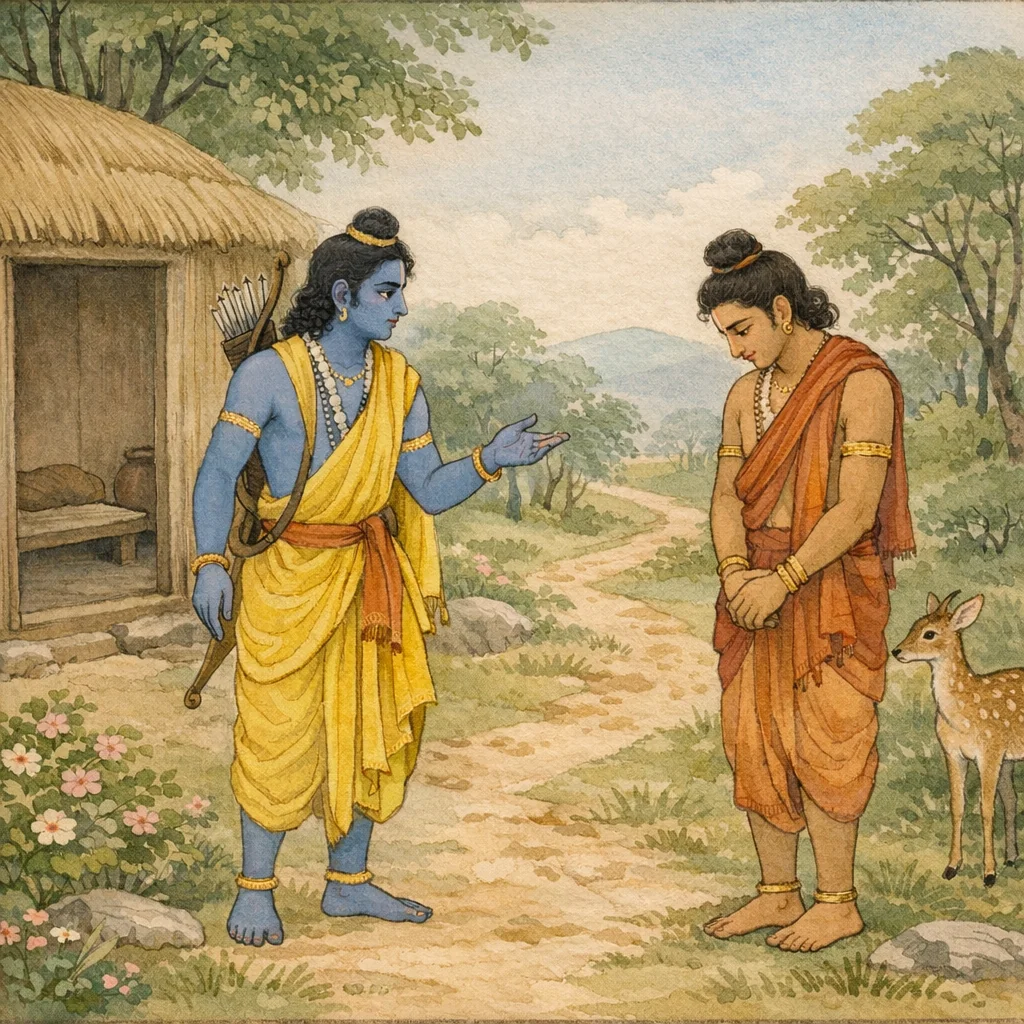
In Sarga 58, Rāma sees Lakṣmaṇa return to the āśrama without Vaidehī (Sītā). His questioning shifts from the urgent “Where is Sītā?” to a grief-stricken confession that life is impossible without her. In the same breath he senses a dark moral causality: leaving Sītā alone has given cruel rākṣasas an opening to seek revenge for Khara’s death. Rāma proposes that a deceptive cry—an imitation of his own voice calling “Lakṣmaṇa”—may have frightened Sītā and drawn Lakṣmaṇa away. His speech swings between lament, reproach, and sharp inference, showing how sorrow can cloud judgment while still yielding investigative hypotheses. At last they rush back toward Janasthāna and search the hermitage and the places where Sītā used to walk. The empty dwelling becomes the decisive proof that turns anxiety into certainty and sets the search for Sītā in motion.
Shlokas
Verse 1
स दृष्ट्वा लक्ष्मणं दीनं शून्ये दशरथात्मजः।पर्यपृच्छत धर्मात्मा वैदेहीमागतं विना।।।।
Seeing Lakṣmaṇa dejected in that empty place, the righteous son of Daśaratha questioned him, for he had returned without Vaidehī (Sītā).
Verse 2
प्रस्थितं दण्डकारण्यं या मामनुजगाम ह।क्व सा लक्ष्मण वैदेही यां हित्वा त्वमिहागतः।।।।
Where is that Vaidehī who followed me into the Daṇḍaka forest? O Lakṣmaṇa, why have you come here after leaving her behind?
Verse 3
राज्यभ्रष्टस्य दीनस्य दण्डकान्परिधावतः।क्व सा दुःखसहाया मे वैदेही तनुमध्यमा।।।।
Where is that slender-waisted Vaidehī who shared my hardships, as I, cast out from the kingdom and wretched, wandered through the Daṇḍaka forest?
Verse 4
यां विना नोत्सहे वीर मुहूर्तमपि जीवितुम्।क्व सा प्राणसहाया मे सीता सुरसुतोपमा।।।।
O hero, without her I cannot bear to live even for a moment. Where is that Sītā, my very support of life, radiant like a divine maiden?
Verse 5
पतित्वममराणां वा पृथिव्याश्चापि लक्ष्मण।तां विना तपनीयाभां नेच्छेयं जनकात्मजाम्।।।।
O Lakṣmaṇa, without that golden-hued daughter of Janaka, I desire neither sovereignty over the gods nor dominion over the earth.
Verse 6
कच्चिज्जीवति वैदेहि प्राणैः प्रियतरा मम।कच्चित्प्रव्राजनं सौम्य न मे मिथ्या भविष्यति।।।।
O gentle Lakṣmaṇa—does Vaidehī still live, she who is dearer to me than my very life? And will my exile not turn out to have been in vain, as though untrue?
Verse 7
सीतानिमित्तं सौमित्रे मृते मयि गते त्वयि।कच्चित्सकामा सुखिता कैकेयी सा भविष्यति।।।।
O Saumitri, if I die because of Sītā and you return, will that Kaikeyī—with her wish fulfilled—indeed live content and happy?
Verse 8
सपुत्रराज्यां सिद्धार्थां मृतपुत्रा तपस्विनी।उपस्थास्यतिकौसल्या कच्चित्सौम्य न केकयीम्।।।।
O gentle one—will Kausalya, bereft of her son and living like an ascetic in sorrow, be compelled to attend upon Kaikeyi, whose aim is fulfilled and who enjoys the kingdom with her son?
Verse 9
यदि जीवति वैदेही गमिष्याम्याश्रमं पुनः।सुवृत्ता यदि वृत्ता प्राणांस्त्यक्ष्यामि लक्ष्मण।।।।
Lakshmana, only if Vaidehi lives will I return again to the hermitage; but if that virtuous lady has perished, I will relinquish my life.
Verse 10
यदि मामाश्रमगतं वैदेही नाभिभाषते।पुनः प्रहसिता सीता विनशिष्यामि लक्ष्मण।।।।
If, when I return to the hermitage (āśrama), Vaidehī—Sītā of gentle smile—does not speak to me again, O Lakṣmaṇa, I will perish.
Verse 11
ब्रूहि लक्ष्मण वैदेही यदि जीवति वा न वा।त्वयि प्रमत्ते रक्षोभिर्भक्षिता वा तपस्विनी।।।।
Tell me, Lakṣmaṇa—does Vaidehī live, or does she not? While you were heedless, was that ascetic lady devoured by the rākṣasas?
Verse 12
सुकुमारी च बाला च नित्यं चादुःखदर्शिनी।मद्वियोगेन वैदेही व्यक्तं शोचति दुर्मनाः।।।।
Vaidehī is delicate and young, and ever one who had not beheld suffering. Separated from me, she surely grieves, her mind distressed.
Verse 13
सर्वदा रक्षसा तेन जिह्मेन सुदुरात्मना।वदता लक्ष्मणेत्युच्चैस्तवापि जनितं भयम्।।।।
That crooked, utterly wicked rākṣasa, loudly crying “Lakṣmaṇa!”, must surely have stirred fear even in you.
Verse 14
श्रुतस्तु शङ्के वैदेह्या स स्वरस्सदृशो मम।त्रस्तया प्रेषितस्त्वं च द्रष्टुं मां शीघ्रमागतः।।।।
I suspect Vaidehī heard a voice resembling mine; frightened, she sent you to look for me, and you came quickly.
Verse 15
सर्वथा तु कृतं कष्टं सीतामुत्सृजता वने।प्रतिकर्तुं नृशंसानां रक्षसां दत्तमन्तरं।।।।
A grave wrong has been done by leaving Sītā alone in the forest; it has given the pitiless rākṣasas the opening they sought for retaliation.
Verse 16
दुःखिताः खरघातेन राक्षसाः पिशिताशनाः।तैस्सीता निहता घोरैर्भविष्यति न संशयः।।।
The flesh-eating rākṣasas, embittered by Khara’s slaying, are surely dreadful enough to have killed Sītā—of this I have no doubt.
Verse 17
अहोऽस्मिन् व्यसने मग्नस्सर्वथा शत्रुसूदन।किं न्विदानीं करिष्यामि शङ्के प्राप्तव्यमीदृशम्।।।।
Alas, O slayer of foes, I am wholly plunged into this calamity. What shall I do now? I fear such suffering was fated to befall me.
Verse 18
इति सीतां वरारोहां चिन्तयन्नेव राघवः।आजगाम जनस्थानं त्वरया सह लक्ष्मणः।।।।
Thinking only of Sītā, that noble lady, Rāghava hurried to Jana-sthāna with Lakṣmaṇa.
Verse 19
विगर्हमाणोऽनुजमार्तरूपं क्षुधा श्रमाच्चैव पिपासया च।विनिश्श्वसन् शुष्कमुखो विवर्णः प्रतिश्रयं प्राप्य समीक्ष्य शून्यम्।।।।स्वमाश्रमं सम्प्रविगाह्य वीरो विहारदेशाननुसृत्य कांश्चित्।एतत्तदित्येव निवासभूमौ प्रहृष्टरोमा व्यथितो बभूव।।।।
Reproaching his downcast younger brother, the heroic Rāma—sighing heavily, his face dried and pale from hunger, fatigue, and thirst—reached the dwelling and saw it empty. He searched through his hermitage and followed the spots where she used to move about; then, on the very ground of their abode, he realized, “This is it,” and stood pained, his hairs bristling.
Frequently Asked Questions
The pivotal dilemma is guardianship versus responsiveness: Lakṣmaṇa’s departure (prompted by a perceived crisis) results in Sītā being left unprotected, and Rāma frames this lapse (pramāda) as enabling rākṣasas to exploit an opportunity.
The sarga illustrates how grief can both cloud and sharpen judgment: righteous persons must discipline emotion to avoid unjust blame, yet also convert distress into reasoned inquiry, hypothesis-testing, and duty-bound action.
Janasthāna and the forest of Daṇḍakāraṇya are foregrounded, along with the āśrama as a cultural-religious space; the ‘empty hermitage’ functions as a narrative landmark marking the transition from domestic exile-life to the epic’s search campaign.