Sarga 43
मायामृगदर्शनम् (The Vision of the Illusory Deer)
अरण्यकाण्ड
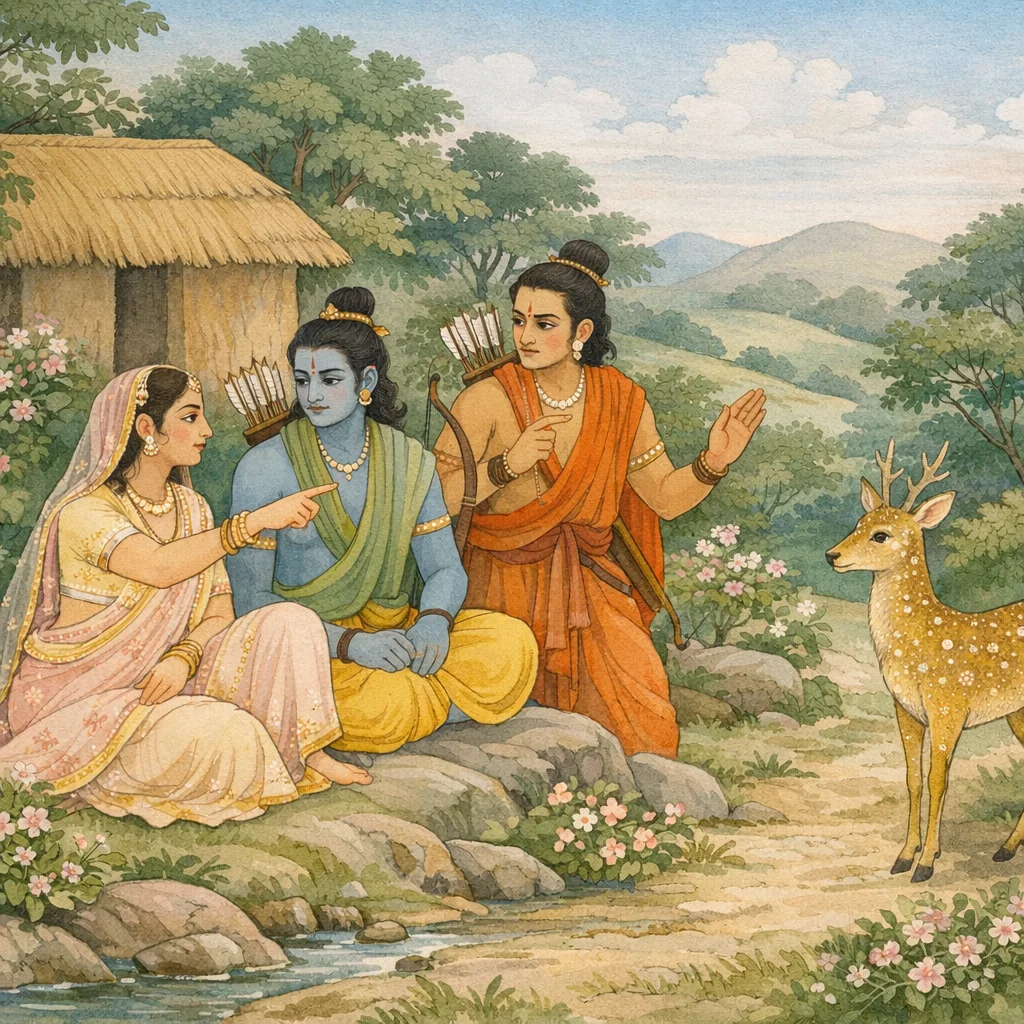
While gathering flowers near the āśrama, Sītā beholds an extraordinary deer: its flanks gleam with gold and silver, its body seems gem-studded, and its radiance is moonlike. Enchanted, she calls Rāma and Lakṣmaṇa, saying she has seen many forest creatures but never one like this, and asks that it be captured alive as a future marvel for the palace—or, failing that, slain for its splendid hide. Lakṣmaṇa suspects a ruse and identifies the deer as Mārīca in disguise, arguing that such a jewel-like animal cannot truly exist and must be māyā, an illusion. Yet Sītā, overcome by longing for the beauty of its skin, continues to press her request. Rāma too is tempted, but he frames his resolve within his duty to protect: he instructs Lakṣmaṇa to remain at the āśrama, guard Maithilī with unwavering vigilance, and seek Jaṭāyu’s aid. Then Rāma departs, declaring he will swiftly seize or kill the deer—thus setting in motion the fateful separation that enables the next phase of the epic’s crisis.
Shlokas
Verse 1
सा तं सम्प्रेक्ष्य सुश्रोणी कुसुमान्यपचिन्वती।हेमराजतवर्णाभ्यां पार्श्वाभ्यामुपशोभितम्।।।।प्रहृष्टा चानवद्याङ्गी मृष्टहाटकवर्णिनी।भर्तारमपि चक्रन्द लक्ष्मणं चापि सायुधम्।।।।
As she gathered flowers, Sītā—slim-hipped, flawless-limbed, and radiant with a pure golden hue—caught sight of that deer, its flanks adorned with gold and silver coloring. Delighted, she called out to her husband and to Lakṣmaṇa, who stood armed.
Verse 2
सा तं सम्प्रेक्ष्य सुश्रोणी कुसुमान्यपचिन्वती।हेमराजतवर्णाभ्यां पार्श्वाभ्यामुपशोभितम्।।3.43.1।।प्रहृष्टा चानवद्याङ्गी मृष्टहाटकवर्णिनी।भर्तारमपि चक्रन्द लक्ष्मणं चापि सायुधम्।।3.43.2।।
As she gathered flowers, Sītā—slender-hipped, flawless-limbed, and radiant like pure gold—caught sight of that deer, made all the more lovely by gold-and-silver hues along its flanks. Delighted, she called out to her husband and to Lakṣmaṇa as well, armed and ready.
Verse 3
तयाऽऽहूतौ नरव्याघ्रौ वैदेह्या रामलक्ष्मणौ।वीक्षमाणौ तु तौ देशं तदा ददृशतुर्मृगम्।।।।
Summoned by Vaidehī, those two tiger-like men—Rāma and Lakṣmaṇa—looked about the place, and then they saw the deer.
Verse 4
शङ्कमानस्तु तं दृष्ट्वा लक्ष्मणो राममब्रवीत्।तमेवैनमहं मन्ये मारीचं राक्षसं मृगम्।।।।
Seeing it and growing suspicious, Lakṣmaṇa said to Rāma: “I believe this very deer is none other than the rākṣasa Mārīca.”
Verse 5
चरन्तोमृगयां हृष्टाः पापेनोपाधिना वने।अनेन निहता राजन् राजानः कामरूपिणा।।।।
O King, many kings—delighting as they roamed the forest on the hunt—have been slain by this shape-shifter through sinful deception.
Verse 6
अस्य मायाविदो मायामृगरूपमिदं कृतम्।भानुमत्पुरुषव्याघ्र गन्धर्वपुरसन्निभम्।।।।
O tiger among men, this is the illusory deer-form fashioned by the magic of that master of deception—radiant in appearance, like a Gandharva-city, a marvelous spectacle without true substance.
Verse 7
मृगो ह्येवंविधो रत्नविचित्रो नास्ति राघव।जगत्यां जगतीनाथ मायैषा हि न संशयः।।।।
O Rāghava, lord of the world—no such deer, glittering with jewel-like brilliance, exists anywhere on earth. This is surely a deception; there is no doubt.
Verse 8
एवं ब्रुवाणं काकुत्स्थं प्रतिवार्य शुचिस्मिता।उवाच सीता संहृष्टा चर्मणा हृतचेतना।।।।
As Rāma spoke thus, Sītā—smiling gently—interrupted him. Delighted, and her judgment carried away by the deer’s beautiful hide, she began to speak.
Verse 9
आर्यपुत्राभिरामोऽसौ मृगो हरति मे मनः।आनयैनं महाबाहो क्रीडार्थं नो भविष्यति।।।।
O noble prince, that charming deer has stolen my heart. Bring it, O long-armed one—let it become a playmate for us.
Verse 10
इहाश्रमपदेऽस्माकं बहवः पुण्यदर्शनाः।मृगाश्चरन्ति सहिताश्चमरास्सृमरास्तथा।।।।
“Here on the grounds of our hermitage, many gentle creatures of auspicious appearance roam in herds—deer, and also camaras and antelopes.”
Verse 11
ऋक्षाः पृषतसङ्घाश्च वानराः किन्नरास्तथा।विचरन्ति महाबाहो रुपश्रेष्ठा मनोहराः।।।।
“O long-armed one, bears, herds of spotted antelopes, monkeys, and even kinnaras wander here—creatures of splendid and enchanting form.”
Verse 12
न चास्य सदृशो राजन्दृष्टपूर्वो मृगो मया।तेजसा क्षमया दीप्त्या यथाऽयं मृगसत्तमः।।।।
“O prince, never before have I seen a deer like this finest of deer—so radiant in splendor, so gentle in bearing, and so brilliant in sheen.”
Verse 13
नानावर्णविचित्राङ्गो रत्नबिन्दुसमाचितः।द्योतयन्वनमव्यग्रं शोभते शशिसन्निभः।।।।
“With limbs dazzling in many colors and dotted with gem-like specks, it shines like the moon, lighting up the tranquil forest.”
Verse 14
अहो रूपमहो लक्ष्मीस्स्वरसम्पच्च शोभना।मृगोऽद्भुतो विचित्राङ्गो हृदयं हरतीव मे।।।।
Ah, what a form! Ah, what beauty—and what a delightful richness of voice! This marvelous deer, with its wondrous limbs, seems to steal away my heart.
Verse 15
यदि ग्रहणमभ्येति जीवन्नेव मृगस्तव।आश्चर्यभूतं भवति विस्मयं जनयिष्यति।।।।
If this deer could be captured alive for you, it would indeed be a marvel and would awaken great wonder.
Verse 16
समाप्तवनवासानां राज्यस्थानां च नः पुनः।अन्तःपुरविभूषार्थो मृग एष भविष्यति।।।।
When our forest exile is completed and we are established again in the kingdom, this deer will serve to adorn the inner apartments as a prized marvel.
Verse 17
भरतस्यार्यपुत्रस्य श्वश्रूणां मम च प्रभो।मृगरूपमिदं व्यक्तं विस्मयं जनयिष्यति।।।।
O lord, this deer-form—so unmistakably wondrous—will arouse amazement in Bharata, in the royal mothers, in you, and in me as well.
Verse 18
जीवन्न यदि तेऽभ्येति ग्रहणं मृगसत्तमः।अजिनं नरशार्दूल रुचिरं मे भविष्यति।।।।
O tiger among men, if this finest of deer cannot be captured alive by you, then its lovely hide will become mine.
Verse 19
निहतस्यास्य सत्त्वस्य जाम्बूनदमयत्वचि।शष्पबृस्यां विनीतायामिच्छाम्यहमुपासितुम्।।।।
If this creature is slain, then upon a cushion of tender grass, with its golden hide spread out, I would like to sit there.
Verse 20
कामवृत्तमिदं रौद्रं स्त्रीणामसदृशं मतम्।वपुषा त्वस्य सत्त्वस्य विस्मयो जनितो मम।।।।
This wish, born of desire, may seem harsh and unseemly for a woman; yet the creature’s beauty has indeed awakened wonder in me.
Verse 21
तेन काञ्चनवर्णेन मणिप्रवरशृङ्गिणा।तरुणादित्यवर्णेन नक्षत्रपथवर्चसा।।।।बभूव राघवस्यापि मनो विस्मयमागतम्।
With its golden hue, its horns set with excellent gems, its color like the young rising sun, and its radiance like the starry path—even Rāghava’s mind was filled with astonishment.
Verse 22
एवं सीतावचः श्रुत्वा तं दृष्ट्वा मृगमद्भुतम्।।।।लोभितस्तेन रूपेण सीतया च प्रचोदितः।उवाच राघवो हृष्टो भ्रातरं लक्ष्मणं वचः।।।।
Thus, hearing Sītā’s words and seeing that wondrous deer, Rāghava—tempted by its appearance and urged on by Sītā—spoke joyfully to his brother Lakṣmaṇa.
Verse 23
एवं सीतावचः श्रुत्वा तं दृष्ट्वा मृगमद्भुतम्।।3.43.22।।लोभितस्तेन रूपेण सीतया च प्रचोदितः।उवाच राघवो हृष्टो भ्रातरं लक्ष्मणं वचः।।3.43.23।।
Hearing Sītā and beholding the marvelous deer, Rāma—drawn by its beauty and encouraged by her—addressed Lakṣmaṇa with eager words.
Verse 24
पश्य लक्ष्मण वैदेह्याः स्पृहां मृगगतामिमाम्।रूपश्रेष्ठतया ह्येष मृगोऽद्य न भविष्यति।।।।न वने नन्दनोद्धेशे न चैत्ररथसंश्रये।कुतःपृथिव्यां सौमित्रे योऽस्य कश्चित्समो मृगः।।।।
Look, Lakṣmaṇa, at Vaidehī’s longing fixed upon this deer. In the excellence of its beauty it has no equal—such a creature is found neither in this forest, nor in Indra’s Nandana grove, nor in Kubera’s Caitraratha park. How then, O Saumitrī, could any deer on earth be its match?
Verse 25
पश्य लक्ष्मण वैदेह्याः स्पृहां मृगगतामिमाम्।रूपश्रेष्ठतया ह्येष मृगोऽद्य न भविष्यति।।3.43.24।।न वने नन्दनोद्धेशे न चैत्ररथसंश्रये।कुतःपृथिव्यां सौमित्रे योऽस्य कश्चित्समो मृगः।।3.43.25।।
Not in this forest, nor even in Nandana—the famed grove of Indra—nor in Caitraratha, Kubera’s pleasure-garden, is there any deer equal to this one. How then, O Saumitrī, could such a match be found anywhere on earth?
Verse 26
प्रतिलोमानुलोमाश्च रुचिरा रोमराजयः।शोभन्ते मृगमाश्रित्य चित्राः कनकबिन्दवः।।।।
Upon the deer, the lovely lines of hair—some lying with the grain and some against it—shine beautifully; and the variegated golden spots upon its body appear splendid.
Verse 27
पश्यास्य जृम्भमाणस्य दीप्तामग्निशिखोपमाम्।जिह्वां मुखान्निस्सरन्तीं मेघादिव शतह्रदाम्।।।।
Behold: as it yawns, its tongue stretches forth from its mouth—glowing like the crest of flame, like lightning flashing from a cloud.
Verse 28
मसारगल्लर्कमुखश्शङ्खमुक्तानिभोदरः।कस्य नामाभिरूप्योऽसौ न मनो लोभयेन्मृगः।।।।
Its face is like an emerald vessel, its belly like a conch or a pearl. Whose mind would not be enticed by such a captivating deer?
Verse 29
कस्य रूपमिदं दृष्ट्वा जाम्बूनद मयप्रभम्।नानारत्नमयं दिव्यं न मनो विस्मयं व्रजेत्।।।।
On seeing this divine form—shining like refined gold and studded with many kinds of gems—whose mind would not be struck with wonder?
Verse 30
मांसहेतोरपि मृगान्विनोदार्थं च धन्वनः।घ्नन्ति लक्ष्मण राजानो मृगयायां महावने।।।।
O Lakṣmaṇa, kings who are archers, while on a hunt in the great forest, kill deer both for meat and also for sport.
Verse 31
धनानि व्यवसायेन विचीयन्ते महावने।धातवो विविधाश्चापि मणिरत्नसुवर्णिनः।।।।
In the great forest, wealth is gathered through steadfast effort—various minerals too, including gems and gold.
Verse 32
तत्सारमखिलं नृ़णां धनं निचयवर्धनम्।मनसा चिन्तितं सर्वं यथा शुक्रस्य लक्ष्मण।।।।
O Lakṣmaṇa, this is, in essence, the whole of men’s wealth—what increases one’s stores; all of it is first conceived in the mind, as prosperity is conceived in connection with Śukra.
Verse 33
अर्थी येनार्थकृत्येन संव्रजत्यविचारयन्।तमर्थमर्थशास्त्रज्ञाः प्राहुरर्थ्याश्च लक्ष्मण।।।।
O Lakṣmaṇa, this is, in essence, the whole of men’s wealth—what increases one’s stores; all of it is first conceived in the mind, as prosperity is conceived in connection with Śukra.
Verse 34
एतस्य मृगरत्नस्य परार्ध्ये काञ्चनत्वचि।उपवेक्ष्यति वैदेही मया सह सुमध्यमा।।3.43.34।।
Vaidehī—slender-waisted Sītā—will sit with me upon the splendid, golden hide of this jewel-like deer.
Verse 35
न कादली न प्रियकी न प्रवेणी न चाविकी।भवेदेतस्य सदृशी स्पर्शनेनेति मे मतिः।।।।
In my judgment, by mere touch no hide—neither of the kādalī, nor priyakī, nor the praveṇī, nor even sheep’s wool—can match this one.
Verse 36
एष चैव मृगश्श्रीमान् यश्च दिव्यो नभश्चरः।उभावेतौ मृगौ दिव्यौ तारामृगमहीमृगौ।।।।
This deer is splendid; and that other deer, divine and moving in the sky—both are wondrous: the ‘deer among the stars’ and the deer upon the earth.
Verse 37
यदि वाऽयं तथा यन्मां भवेद्वदसि लक्ष्मण।मायैषा राक्षसस्येति कर्तव्योस्य वधो मया।।।।
Lakṣmaṇa, even if it proves exactly as you say—an illusion wrought by a rākṣasa—then all the more is it my duty to slay him.
Verse 38
एतेन हि नृशंसेन मारीचेनाकृतात्मना।वने विचरता पूर्वं हिंसिता मुनिपुङ्गवाः।।।।
For earlier, while roaming in this forest, that cruel Mārīca, wicked of soul, tormented the foremost of sages.
Verse 39
उत्थाय बहवो येन मृगयायां जनाधिपाः।निहताः परमेष्वासास्तस्माद्वध्यस्त्वयं मृगः।।।।
Many kings—mighty archers—who set out on hunts were slain by him; therefore this ‘deer’ deserves to be killed.
Verse 40
पुरस्तादिह वातापिः परिभूय तपस्विनः।उदरस्थो द्विजान्हन्तिस्वगर्भोऽश्वतरीमिव।।।।
Formerly here, Vātāpi used to oppress ascetics; lodged within their bellies, he would kill the twice-born—like a fetus destroying a she-mule from within her own womb.
Verse 41
स कदाचिच्चिराल्लोभादाससाद महामुनिम्।अगस्त्यं तेजसा युक्तं भक्षस्तस्य बभूव ह।।।।
After a long time, driven by greed, he once approached the great sage Agastya, radiant with spiritual power—and became his food.
Verse 42
समुत्थाने व तद्रूपं कर्तुकामं समीक्ष्य तम्।उत्स्मयित्वा तु भगवान्वातापिमिदमब्रवीत्।।।।
When he rose, the venerable one saw Vātāpi wishing to resume his own form; smiling, the blessed sage spoke to him as follows.
Verse 43
त्वयाऽविगण्य वातापे परिभूतास्स्वतेजसा।जीवलोके द्विजश्रेष्ठास्तस्मादसि जरां गतः।।।।
O Vātāpi—because you, relying on your own power, disregarded and humiliated the noblest of brahmins among living beings, you therefore met your end by being digested.
Verse 44
तदेवं न भवेद्रक्षोवातापिरिव लक्ष्मण।मद्विधं योऽतिमन्येत धर्मनित्यं जितेन्द्रियम्।।।।भवेद्धतोऽयं वातापिरगस्त्येनेव मां गतः।
So too, O Lakṣmaṇa, this rākṣasa will not survive like Vātāpi: whoever presumes to overstep one such as me—ever steadfast in dharma and self-controlled—will be destroyed, as Vātāpi was by Agastya.
Verse 45
इह त्वं भव सन्नद्दो यन्त्रितो रक्ष मैथिलीम्।।।।अस्यामायत्तमस्माकं यत्कृत्यं रघुनन्दन।
Stay here, fully prepared and disciplined, and protect Maithilī. For whatever duty lies before us depends upon her safety, O delight of the Raghu line.
Verse 46
अहमेनं वधिष्यामि ग्रहीष्याम्यपि वा मृगम्।।।।यावद्गच्छामि सौमित्रे मृगमानयितुं द्रुतम्।
I shall go swiftly, O Saumitri, to bring that deer—either I will slay it or seize it alive.
Verse 47
पश्य लक्ष्मण वैदेहीं मृगत्वचि गतस्पृहाम्।।।।त्वचा प्रधानया ह्येष मृगोऽद्य न भविष्यति।
Look, Lakṣmaṇa—Vaidehī’s longing has settled upon the deerskin. For that prized hide, this deer shall not live today.
Verse 48
अप्रमत्तेन ते भाव्यमाश्रमस्थेन सीतया।।।।यावत्पृषतमेकेन सायकेन निहन्म्यहम्।हत्वैतच्चर्म चादाय शीघ्रमेष्यामि लक्ष्मण।।।।
Stay here at the hermitage with Sītā, vigilant and uncareless. With a single arrow I will kill the speckled deer, take its hide, and return swiftly, Lakṣmaṇa.
Verse 49
अप्रमत्तेन ते भाव्यमाश्रमस्थेन सीतया।।3.43.48।।यावत्पृषतमेकेन सायकेन निहन्म्यहम्।हत्वैतच्चर्म चादाय शीघ्रमेष्यामि लक्ष्मण।।3.43.49।।
Remain at the hermitage with Sītā, fully vigilant. With a single arrow I will kill the speckled deer, take its hide, and return quickly, Lakṣmaṇa.
Verse 50
प्रदक्षिणेनातिबलेन पक्षिणा जटायुषा बुद्धिमता च लक्ष्मण।भवाप्रमत्तः परिगृह्य मैथिलीं प्रतिक्षणं सर्वत एव शङ्कितः।।।।
O Lakṣmaṇa, guard Maithilī without negligence—suspecting danger at every moment from every direction—and rely also on Jaṭāyu, the mighty and wise bird who keeps watch on his rounds.
Frequently Asked Questions
The pivotal dilemma is whether to act on aesthetic desire and wonder (Sītā’s request for capture/skin) when signs indicate deception; the decisive action is Rāma’s choice to pursue the deer while delegating strict protective duty to Lakṣmaṇa, balancing temptation with procedural safeguards.
The chapter teaches that sensory brilliance can function as māyā, and that dharma in uncertain environments requires viveka and apramāda: desire must be examined, warnings weighed, and protective responsibilities maintained even when pursuing a seemingly minor objective.
The āśrama setting anchors the forest-exile geography; cultural-cosmic comparanda include Indra’s Nandana and Kubera’s Chaitraratha gardens (as benchmarks of beauty), along with astral imagery (nakṣatra-patha/Milky Way) used to intensify the deer’s uncanny, non-natural splendor.