Sarga 35
मारीचाश्रमगमनम् (Ravana’s Journey to Maricha’s Hermitage)
अरण्यकाण्ड
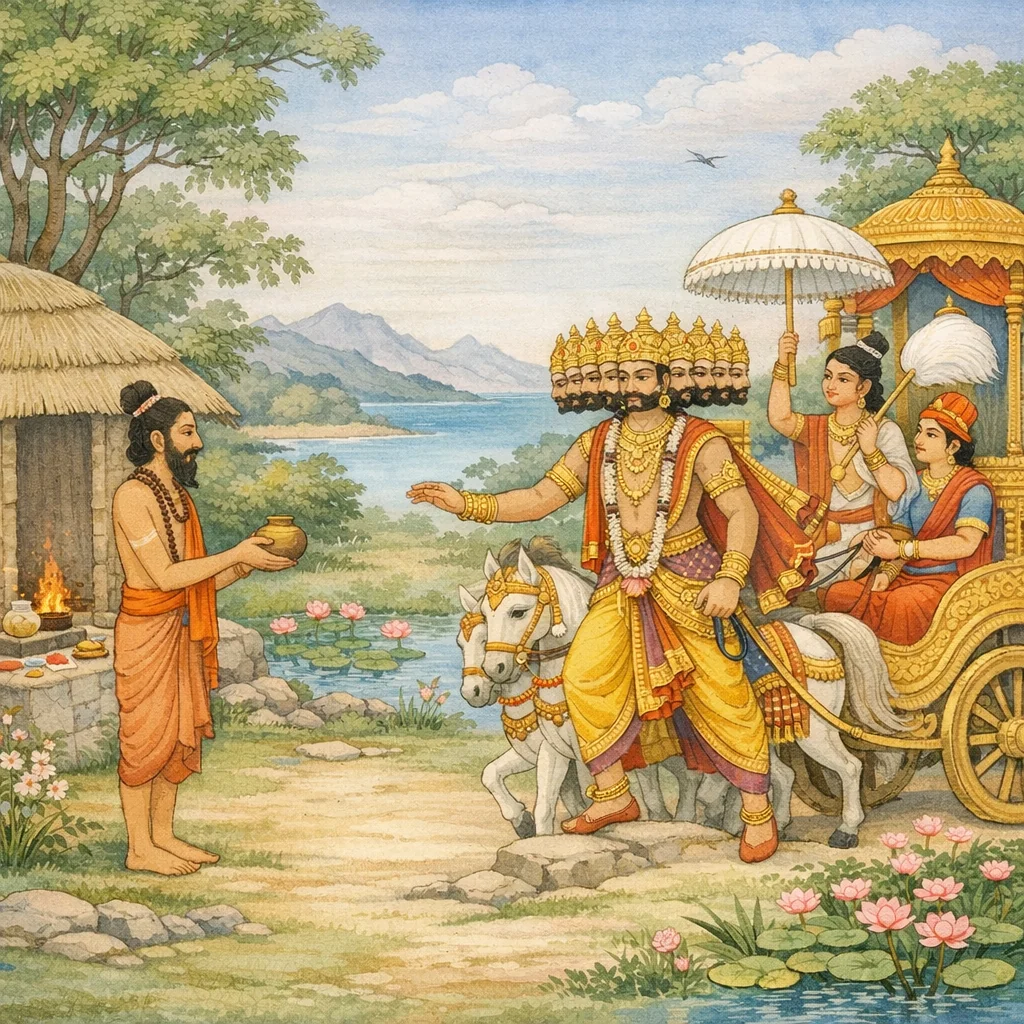
Sarga 35 traces Ravana’s shift from sudden rage to deliberate design. Hearing Surpanakha’s hair-raising report, he formally withdraws from his ministers, weighs gains and losses and the balance of strength, and secretly goes to the yanasala to have a chariot harnessed. The narration heightens his regal-terror imagery—ten heads, twenty arms, white parasols and yak-tail fans, gold earrings—and a desire-driven chariot, with cloud-and-lightning similes marking sovereign motion. His journey becomes a survey of coast and forest: sea-side mountains, lotus ponds, hermitages with altars, fragrant sandal and aguru groves, pearls drying on the shore, conches and corals, heaps of gold and silver, and cities abundant in grain, women, and war-animals. A digression fixes a mythic landmark, the banyan “Subhadra,” whose branch Garuda once broke while carrying an elephant and tortoise, saving sages, and later resolving to seize amrita from Indra’s mansion. Crossing to the farther shore, Ravana reaches a secluded sacred hermitage and finds Maricha living as an ascetic in deerskin and bark with a regulated diet. Maricha receives him with formal hospitality and asks after Lanka and Ravana’s urgent purpose; Ravana is about to declare his intent, and the sarga ends on the threshold of counsel and conspiracy.
Shlokas
Verse 1
ततश्शूर्पणखावाक्यं तच्छ्रुत्वा रोमहर्षणम्।सचिवानभ्यनुज्ञाय कार्यं बुद्ध्वा जगाम ह।।।।
Then, hearing Śūrpaṇakhā’s hair-raising account, he took leave of his ministers and departed, reflecting on the task he intended to pursue.
Verse 2
तत्कार्यमनुगम्याथ यथावदुपलभ्य च।दोषाणां च गुणानां च सम्प्रधार्य बलाबलम्।।।इति कर्तव्यमित्येव कृत्वा निश्चयमात्मनः।स्थिरबुद्धिस्ततो रम्यां यानशालां जगाम ह।।।।
Having reflected on the task before him and understood it rightly—after weighing faults and merits and judging strength and weakness—he resolved within himself, “This is what must be done.” Firm in mind, he then went to the delightful chariot-shed.
Verse 3
तत्कार्यमनुगम्याथ यथावदुपलभ्य च।दोषाणां च गुणानां च सम्प्रधार्य बलाबलम्।3.35.2।।इति कर्तव्यमित्येव कृत्वा निश्चयमात्मनः।स्थिरबुद्धिस्ततो रम्यां यानशालां जगाम ह।।3.35.3।।
Having resolved within himself, “This indeed is what must be done,” he, steadfast in purpose, then went to the delightful coach-shed.
Verse 4
यानशालां ततो गत्वा प्रच्छन्नो राक्षसाधिपः।सूतं सञ्चोदयामास रथस्संयोज्यतामिति।।।।
Then the lord of the rākṣasas went secretly to the chariot-shed and commanded the charioteer, “Harness the chariot.”
Verse 5
एवमुक्तः क्षेणेनैव सारथिर्लघुविक्रमः।रथं संयोजयामास तस्याभिमतमुत्तमम्।।।।
Thus commanded, the swift-acting charioteer at once harnessed an excellent chariot, just as his master desired.
Verse 6
काञ्चनं रथमास्थाय कामगं रत्नभूषितम्।पिशाचवदनैर्युक्तं खरैः काञ्चनभूषणैः।।।।मेघप्रतिमनादेन स तेन धनदानुजः।राक्षसाधिपतिश्श्रीमान्ययौ नदनदीपतिम्।।।।
Mounting a golden chariot that could go wherever one wished, adorned with gems and yoked to donkey steeds with piśāca-like faces, decked in gold, Rāvaṇa—Kubera’s younger brother, the splendid lord of the rākṣasas—set out with a roar like thunderclouds toward the lord of rivers, the ocean.
Verse 7
काञ्चनं रथमास्थाय कामगं रत्नभूषितम्।पिशाचवदनैर्युक्तं खरैः काञ्चनभूषणैः।।3.35.6।।मेघप्रतिमनादेन स तेन धनदानुजः।राक्षसाधिपतिश्श्रीमान्ययौ नदनदीपतिम्।।3.35.7।।
Mounting a golden chariot that could go wherever one wished, adorned with gems and yoked to donkey steeds with piśāca-like faces, decked in gold, Rāvaṇa—Kubera’s younger brother, the splendid lord of the rākṣasas—set out with a roar like thunderclouds toward the lord of rivers, the ocean.
Verse 8
स श्वेतवालव्यजनः श्वेतच्छत्रो दशाननः।स्निग्धवैदूर्यसंकाश स्तप्तकाञ्चनकुण्डलः।।।।विंशद्भुजो दशग्रीवो दर्शनीयपरिच्छदः।त्रिदशारिर्मुनीन्द्रघ्नो दशशीर्ष इवाद्रिराट्।।।।कामगं रथमास्थाय शुशुभे राक्षसेश्वरः।विद्युन्मण्डलवान्मेघस्सबलाक इवाम्बरे।।।।
With white yak-tail fans and a white parasol, the ten-faced Rāvaṇa—gleaming like polished vaidūrya, wearing heated-gold earrings—ten-necked and twenty-armed, splendidly adorned, foe of the gods and slayer of great sages, like a mountain-king with ten peaks, shone as he mounted the wish-moving chariot, like a cloud in the sky ringed with lightning and attended by cranes.
Verse 9
स श्वेतवालव्यजनः श्वेतच्छत्रो दशाननः।स्निग्धवैदूर्यसंकाश स्तप्तकाञ्चनकुण्डलः।।3.35.8।।विंशद्भुजो दशग्रीवो दर्शनीयपरिच्छदः।त्रिदशारिर्मुनीन्द्रघ्नो दशशीर्ष इवाद्रिराट्।।3.35.9।।कामगं रथमास्थाय शुशुभे राक्षसेश्वरः।विद्युन्मण्डलवान्मेघस्सबलाक इवाम्बरे।।3.35.10।।
With white yak-tail fans and a white parasol, the ten-faced Rāvaṇa—gleaming like polished vaidūrya, wearing heated-gold earrings—ten-necked and twenty-armed, splendidly adorned, foe of the gods and slayer of great sages, like a mountain-king with ten peaks, shone as he mounted the wish-moving chariot, like a cloud in the sky ringed with lightning and attended by cranes.
Verse 10
स श्वेतवालव्यजनः श्वेतच्छत्रो दशाननः।स्निग्धवैदूर्यसंकाश स्तप्तकाञ्चनकुण्डलः।।3.35.8।।विंशद्भुजो दशग्रीवो दर्शनीयपरिच्छदः।त्रिदशारिर्मुनीन्द्रघ्नो दशशीर्ष इवाद्रिराट्।।3.35.9।।कामगं रथमास्थाय शुशुभे राक्षसेश्वरः।विद्युन्मण्डलवान्मेघस्सबलाक इवाम्बरे।।3.35.10।।
Mounting his wish-moving chariot, the lord of the rākṣasas shone forth—like a cloud in the sky, ringed with lightning and accompanied by cranes.
Verse 11
स शैलं सागरानूपं वीर्यवानवलोकयन्।नानापुष्पफलैर्वृक्षैरनुकीर्णं सहस्रशः।।।।
That valiant one gazed upon the mountain by the sea’s marshy shore, strewn everywhere—thousandfold—with trees bearing many kinds of flowers and fruits.
Verse 12
शीतमङ्गलतोयाभिः पद्मिनीभिस्समन्ततः।विशालैराश्रमपदैर्वेदिमद्भिस्समावृतम्।।।।
All around it was encircled by lotus-ponds filled with cool, auspicious waters, and by spacious hermitage-sites furnished with sacred altars.
Verse 13
कदल्याढकिसम्बाधं नारिकेलोपशोभितम्।सालैस्तालैस्तमालैश्च पुष्पितैस्तरुभिर्वृतम्।।।।
It was thick with banana groves, beautified by coconut palms, and encircled by flowering trees—śāla, palm, and tamāla.
Verse 14
नागैस्सुपर्णैर्गन्धैर्वैः किन्नरैश्च सहस्रशः।अजैर्वैखानसैर्माषैर्वालखिल्यैर्मरीचिपैः।।।।अत्यन्तनियताहारैश्शोभितं परमर्षिभिः।जितकामैश्च सिद्धैश्च चारणैरुपशोभितम्।।।।
It was thronged in thousands by nāgas, suparṇas, gandharvas, and kinnaras; and graced by ascetic lineages—Ajas, Vaikhānasas, Māṣas, Vālakhilyas, and Marīcipas—great rishis of strict discipline in food, conquerors of desire, along with siddhas and cāraṇas, making the region shine with sanctity.
Verse 15
नागैस्सुपर्णैर्गन्धैर्वैः किन्नरैश्च सहस्रशः।अजैर्वैखानसैर्माषैर्वालखिल्यैर्मरीचिपैः।।3.35.14।।अत्यन्तनियताहारैश्शोभितं परमर्षिभिः।जितकामैश्च सिद्धैश्च चारणैरुपशोभितम्।।3.35.15।।
It was thronged in thousands by nāgas, suparṇas, gandharvas, and kinnaras; and graced by ascetic lineages—Ajas, Vaikhānasas, Māṣas, Vālakhilyas, and Marīcipas—great rishis of strict discipline in food, conquerors of desire, along with siddhas and cāraṇas, making the region shine with sanctity.
Verse 16
दिव्याभरणमाल्याभिर्दिव्यरूपाभिरावृतम्।क्रीडारतिविधिज्ञाभिरप्सरोभिस्सहस्रशः।।।।
It was filled with thousands of apsarases—of divine beauty—adorned with heavenly ornaments and garlands, skilled in the arts of play and love.
Verse 17
सेवितं देवपन्तीभिश्श्रीमतीभिश्श्रियाऽऽवृतम्।देवदानवसङ्घैश्च चरितं त्वमृताशिभिः।।।।
It was frequented by the illustrious wives of the gods, endowed with splendor; and it was traversed by hosts of gods and dānavas, living on amṛta, the nectar of immortality.
Verse 18
हंसक्रौञ्चप्लवाकीर्णं सारसैस्सम्प्रणादितम्।वैढूर्यप्रस्तरं रम्यं स्निग्धं सागरतेजसा।।।।
It was crowded with hamsas, krauñca-birds, and plavas, resonant with the calls of sārasas; delightful with stretches of vaidūrya-stone, and gleaming with the sea’s radiance.
Verse 19
पाण्डुराणि विशालानि दिव्यमाल्ययुतानि च।तूर्यगीताभिजुष्टानि विमानानि समन्ततः।।।।तपसा जितलोकानां कामगान्यभिसम्पतन्।गन्धर्वाप्सरसश्चैव ददर्श धनदानुजः।।।।
Speeding onward, Kubera’s younger brother beheld on every side vast, pale-bright vimānas, adorned with heavenly garlands and filled with instrumental music and song—wish-moving craft of those who had won the higher worlds through tapas. He also saw Gandharvas and Apsarases.
Verse 20
पाण्डुराणि विशालानि दिव्यमाल्ययुतानि च।तूर्यगीताभिजुष्टानि विमानानि समन्ततः।।3.35.19।।तपसा जितलोकानां कामगान्यभिसम्पतन्।गन्धर्वाप्सरसश्चैव ददर्श धनदानुजः।।3.35.20।।
Speeding onward, Kubera’s younger brother beheld on every side vast, pale-bright vimānas, adorned with heavenly garlands and filled with instrumental music and song—wish-moving craft of those who had won the higher worlds through tapas. He also saw Gandharvas and Apsarases.
Verse 21
निर्यासरसमूलानां चन्दनानां सहस्रशः।वनानि पश्यन्सौम्यानि घ्राणतृप्तिकराणि च।।।।
He beheld, by the thousand, forests of sandalwood trees whose trunks exuded fragrant resin—gentle and pleasing, satisfying even the sense of smell.
Verse 22
अगरूणां च मुख्यानां वनान्युपवनानि च।तक्कोलानां च जात्यानां फलानां च सुगन्धिनाम्।।।।
He beheld forests of choice aguru trees and delightful pleasure-groves, along with fragrant takkola fruits and the aromatic produce of jāti.
Verse 23
पुष्पाणि च तमालस्य गुल्मानि मरिचस्य च।मुक्तानां च समूहानि शुष्यमाणानि तीरतः।।।।
He saw tamāla blossoms, thickets of pepper, and heaps of pearls spread out to dry along the shore.
Verse 24
शङ्खानां प्रसरं चैव प्रवालनिचयं तथा।काञ्चनानि च शैलानि राजतानि च सर्वशः।।।।
He saw broad stretches of conches and shells, heaps of coral, and everywhere mounds—some of gold and some of silver.
Verse 25
प्रस्रवाणि मनोज्ञानि प्रसन्नानि ह्रदानि च।धनधान्योपपन्नानि स्त्रीरत्नैश्शोभितानि च।।।।हस्त्यश्वरथगाढानि नगराण्यवलोकयन्।
He kept gazing upon enchanting waterfalls and clear lakes, and upon cities rich in wealth and grain—adorned with excellent women and crowded with elephants, horses, and chariots.
Verse 26
तं समं सर्वतस्निग्धं मृदुसंस्पर्शमारुतम्।अनूपं सिन्धुराजस्य ददर्श त्रिदिवोपमम्।।।।
He saw that region—level and lovely on every side, with breezes gentle to the touch—where the sea-king’s backwaters spread, a landscape like the very heavens.
Verse 27
तत्रापश्यत्स मेघाभं न्यग्रोधमृषिभिर्वृतम्।।।।समन्ताद्यस्य ताश्शाखाश्शतयोजनमायताः।
There he beheld a cloud-hued nyagrodha banyan, encircled by sages, whose branches spread on every side for a hundred yojanas.
Verse 28
यस्य हस्तिनमादाय महाकायं च कच्छपम्।।।।भक्षार्थं गरुडश्शाखामाजगाम महाबलः।
On that very tree, the mighty Garuḍa once came to a branch, bearing an elephant and a huge tortoise, intending to eat them.
Verse 29
तस्य तां सहसा शाखां भारेण पतगोत्तमः।।।।सुपर्णः पर्णबहुलां बभञ्ज च महाबलः।
Under the sheer weight of the best of birds—mighty Suparṇa (Garuḍa)—that leaf-laden branch suddenly snapped.
Verse 30
तत्र वैखानसा माषा वालखिल्या मरीचिपाः।।।।अजा बभूवुर्धूम्राश्च सङ्गताः परमर्षयः।
There, gathered together, were great seers—the Vaikhānasas, Māṣas, Vālakhilyas, Marīcipas, as well as the Ajās and the Dhūmras.
Verse 31
तेषां दयार्थं गरुडस्तां शाखां शतयोजनाम्।।।।जगामादाय वेगेन तौ चोभौ गजकच्छपौ।
Out of compassion for them, Garuḍa swiftly bore away that branch, a hundred yojanas in length, carrying with it both the elephant and the tortoise.
Verse 32
एकपादेन धर्मात्मा भक्षयित्वा तदामिषम्।।।।निषादविषयं हत्वा शाखया पतगोत्तमः।प्रहर्षमतुलं लेभे मोक्षयित्वा महामुनीन्।।।।
Standing on a single foot, the righteous best of birds ate that flesh; then, with the branch, he destroyed the Niṣāda settlement, and having delivered the great sages, he attained boundless joy.
Verse 33
एकपादेन धर्मात्मा भक्षयित्वा तदामिषम्।।3.35.32।।निषादविषयं हत्वा शाखया पतगोत्तमः।प्रहर्षमतुलं लेभे मोक्षयित्वा महामुनीन्।।3.35.33।।
Standing on a single foot, the righteous best of birds ate that flesh; then, with the branch, he destroyed the Niṣāda settlement, and having delivered the great sages, he attained boundless joy.
Verse 34
स तेनैव प्रहर्षेण द्विगुणीकृतविक्रमः।अमृतानयनार्थं वै चकार मतिमान्मतिम्।।।।
Buoyed by that very joy, his prowess redoubled; the wise one resolved to bring back amṛta, the nectar of immortality.
Verse 35
अयोजालानि निर्मथ्य भित्वा रत्नमयं गृहम्।महेन्द्रभवनाद्गुप्तमाजहारामृतं ततः।।।।
Twisting apart the iron lattices and breaking into the gem-built chamber, he then secretly carried off the amṛta from Mahendra’s (Indra’s) palace.
Verse 36
तं महर्षिगणैर्जुष्टं सुपर्णकृतलक्षणम्।नाम्ना सुभद्रं न्यग्रोधं ददर्श धनदानुजः।।।।
Rāvaṇa, Kubera’s younger brother, beheld the nyagrodha banyan called Subhadra—frequented by companies of great ṛṣis and bearing the mark left by Suparṇa (Garuḍa).
Verse 37
तं तु गत्वा परं पारं समुद्रस्य नदीपतेः।ददर्शाश्रममेकान्ते रम्ये पुण्ये वनान्तरे।।।।
Having crossed to the far shore of the ocean—the lord of rivers—he beheld a hermitage, secluded, beautiful, and sacred, deep within the forest.
Verse 38
तत्र कृष्णाजिनधरं जटावल्कलधारिणम्।ददर्श नियताहारं मारीचं नाम राक्षसाम्।।।।
There he saw the rākṣasa named Mārīca—clad in a dark deerskin, wearing matted locks and bark-garments, living on measured fare.
Verse 39
स रावणस्समागम्य विधिवत्तेन रक्षसा।मारीचेनार्चितो राजा सर्वकामैरमानुषैः।।।।
When King Rāvaṇa arrived, the rākṣasa Mārīca received and honored him according to proper custom, offering him superhuman luxuries that satisfied every desire.
Verse 40
तं स्वयं पूजयित्वा तु भोजनेनोदकेन च।अर्थोपहितया वाचा मारीचो वाक्यमब्रवीत्।।।।
After personally honoring him with food and water, Mārīca spoke to him in words weighted with purpose.
Verse 41
कच्चित्सुकुशलं राजन्लङ्कायां राक्षसेश्वर।केनार्थेन पुनस्त्वं वै तूर्णमेवमिहागतः।।।।
“O King, O lord of rākṣasas—may all be well in Laṅkā. For what purpose have you come here again, and so quickly?”
Verse 42
एवमुक्तो महातेजा मारीचेन स रावणः।ततः पश्चादिदं वाक्यमब्रवीद्वाक्यकोविदः।।।।
Thus addressed by Mārīca, the radiant Rāvaṇa—skilled in speech—then replied with these words.
Frequently Asked Questions
The pivotal action is Ravana’s shift from emotional reaction to intentional strategy: he weighs strengths and weaknesses (balābala), decides on a course, and initiates a covert mission to recruit Maricha. Ethically, the text frames this as calculated adharma—planning harm through deception—contrasted with the surrounding imagery of disciplined ascetic life.
Two instructional contrasts emerge: (1) deliberation can serve either dharma or adharma depending on intent, demonstrating that “intelligence” is morally qualified by purpose; (2) the Garuda exemplum links power with compassion—strength becomes righteous when used to protect sages and restore order, not to exploit it.
Key landmarks include the sea-shore mountain belt and backwaters, lotus-laden ponds, sprawling hermitages with altars, fragrance-rich forests (sandalwood/aguru), and the Subhadra banyan tree associated with Garuda’s mythic act. Culturally, the sarga highlights āśrama institutions, regulated ascetic diets, and formal hospitality (ātithya) extended by Maricha.