Sarga 2
Virādha-saṃvādaḥ — Encounter with Virādha in the Daṇḍakāraṇya (Aranya Kanda, Sarga 2)
अरण्यकाण्ड
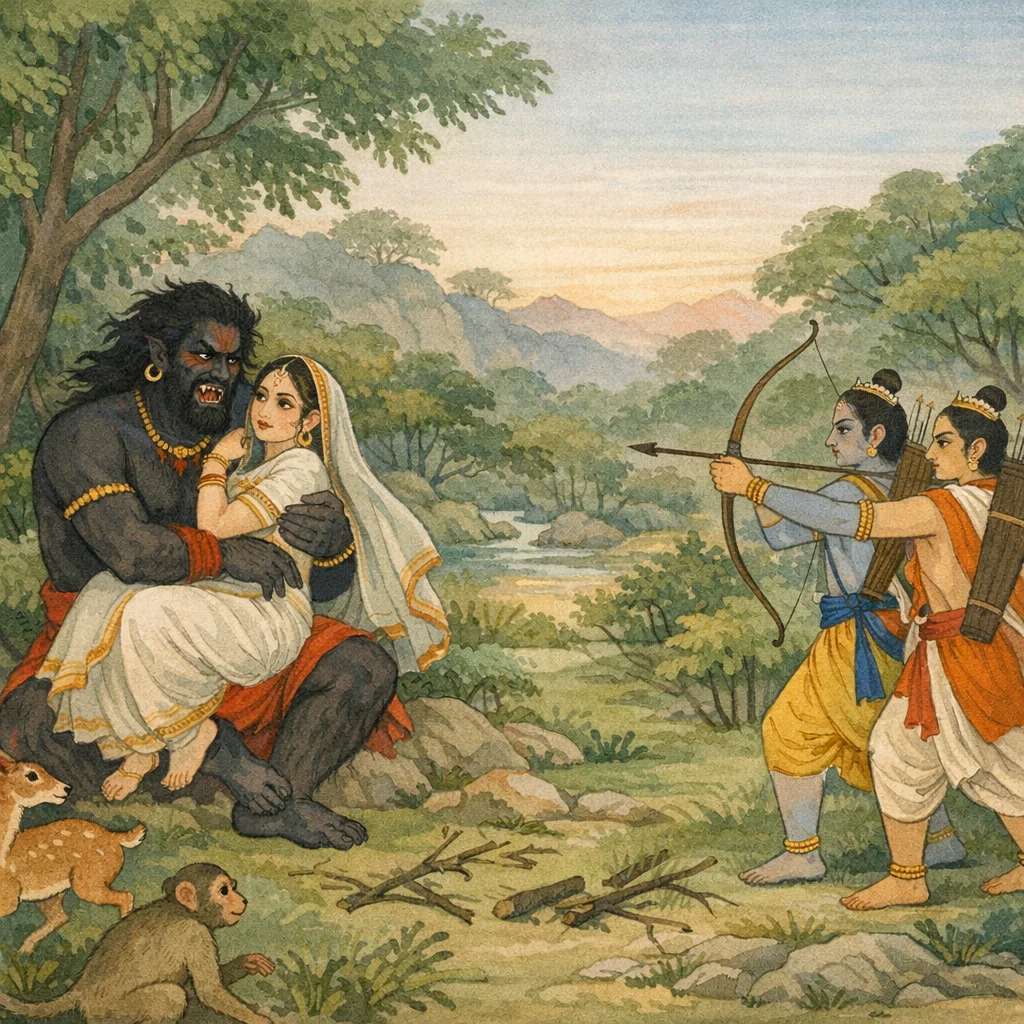
At sunrise, having formally taken leave of the sages, Rāma, accompanied by Lakṣmaṇa and Sītā, penetrates deeper into the Daṇḍaka forest. Amidst a terrain marked by ominous sounds and disrupted vegetation—signals of demonic intrusion—they encounter the terrifying rākṣasa Virādha. The demon seizes Sītā, mocking the brothers' ascetic appearance while threatening to devour them and drink their blood. Rāma expresses profound anguish at Sītā’s defilement by another's touch, deeming this violation more painful than the loss of his kingdom or the death of his father. Lakṣmaṇa, channeling controlled and righteous fury, reaffirms Rāma’s sovereignty and vows to slay the demon immediately, marking a tactical shift from ascetic endurance to the sanctioned use of force for protection.
Shlokas
Verse 1
कृतातिथ्योऽथ रामस्तु सूर्यस्योदयनं प्रति।आम्नत्ऱ्य स मुनीन्सर्वान्वनमेवान्वगाहत।।।।
Then Rāma, having duly received hospitality, took leave of all the sages at sunrise and entered deeper into the forest.
Verse 2
नानामृगगणाकीर्णमृक्षशार्दूल सेवितम्।ध्वस्तवृक्षलतागुल्मं दुर्दर्शसलिलाशयम्।।।।निष्कूजनानाशकुनिझिल्लिकागणनादितम्।लक्ष्मणानुगतो रामो वनमध्यं ददर्श ह।।।।
With Lakṣmaṇa following him, Rāma beheld the heart of the forest—crowded with many herds of wild animals, frequented by bears and tigers; its trees, creepers, and shrubs crushed, its water-sources hard to find, and its depths echoing with the calls of many birds and the chirping of crickets.
Verse 3
नानामृगगणाकीर्णमृक्षशार्दूल सेवितम्।ध्वस्तवृक्षलतागुल्मं दुर्दर्शसलिलाशयम्।।3.2.2।।निष्कूजनानाशकुनिझिल्लिकागणनादितम्।लक्ष्मणानुगतो रामो वनमध्यं ददर्श ह।।3.2.3।।
With Lakṣmaṇa following him, Rāma beheld the forest’s interior, resonant with the calls of many birds and the chirping of swarms of crickets.
Verse 4
सीतया सह काकुत्स्थस्तस्मिनघोरमृगायुते।ददर्श गिरिशृङ्गाभं पुरुषादं महास्वनम्।।।।
As Kakutstha Rāma moved with Sītā through that region teeming with dreadful beasts, he beheld a man-eating rākṣasa, roaring mightily and towering like a mountain peak.
Verse 5
गम्भीराक्षं महावक्त्रं विकटं विषमोदरम्।बीभत्सं विषमं दीर्घं विकृतं घोरदर्शनम्।।।।
He was deep-eyed and huge-faced, grotesque and pot-bellied—loathsome, misshapen, very tall, deformed, and dreadful to behold.
Verse 6
वसानं चर्म वैयाघ्रं वसार्द्रं रुधिरोक्षितम्।त्रासनं सर्वभूतानां व्यादितास्यमिवान्तकम्।।।।
He wore a tiger-skin soaked with fat and spattered with blood; he terrified all beings, like Death itself with jaws gaping wide.
Verse 7
त्रीन्सिम्हान्श्चतुरो व्याघ्रान्द्वौ वृकौ पृषतान्दश।सविषाणं वसादिग्धं गजस्य च शिरो महत्।अवसज्यायसे शूले विनदन्तं महास्वनम्।।।।
Roaring loudly, he bore an iron spear on which were skewered three lions, four tigers, two wolves, ten deer, and the massive head of an elephant—its tusks smeared with fat.
Verse 8
स रामं लक्ष्मणं चैव सीतां दृष्ट्वा च मैथिलीम्।अभ्यधावत्सुसङ्कृद्धः प्रजाः काल इवान्तकः।।।।
Seeing Rāma and Lakṣmaṇa, and also Sītā, the princess of Mithilā, he rushed at them in raging fury—like Death-Time charging upon living beings.
Verse 9
स कृत्वा भैरवं नादं चालयन्निव मेदिनीम्।अङ्केनादाय वैदेहीमपक्रम्य ततोऽब्रवीत्।।।।
Raising a dreadful roar as though shaking the earth, he seized Vaidehī onto his lap, stepped away, and then spoke.
Verse 10
युवां जटाचीरधरौ सभार्यौ क्षीणजीवितौ।प्रविष्टौ दण्डकारण्यं शरचापासिधारिणौ।।।।
You two, wearing matted hair and bark-garments, accompanied by your wife, bearing arrows, bow, and sword—having entered the Daṇḍaka forest—are as good as men with their lives cut short.
Verse 11
कथं तापसयोर्वां च वासः प्रमदया सह।अधर्मचारिणौ पापौ कौ युवां मुनिदूषकौ।।।।
How can you two, dressed as ascetics, live together with a woman? You unrighteous sinners—who are you, corrupters of the sages’ discipline?
Verse 12
अहं वनमिदं दुर्गं विराधो नाम राक्षसः।चरामि सायुधो नित्यमृषिमांसानि भक्षयन्।।।।
I am the rākṣasa named Virādha. I roam this dense, perilous forest always armed, feeding on the flesh of sages.
Verse 13
इयं नारी वरारोहा मम भार्या भविष्यति।युवयोः पापयोश्चाहं पास्यामि रुधिरं मृधे।।।।
This woman of lovely form will become my wife; and in battle I will drink the blood of you two sinners.
Verse 14
तस्यैवं ब्रुवतो दुष्टं विराधस्य दुरात्मनः।श्रुत्वा सगर्वितं वाक्यं सम्भ्रान्ता जनकात्मजा।।।।
Hearing the cruel, boastful words thus spoken by that wicked-souled Virādha, Janaka’s daughter was shaken with fear and confusion.
Verse 15
सीता प्रवेपतोद्वेगात् प्रावाते कदली यथा।।।।तां दृष्ट्वा राघवः सीतां विराधाङ्कगतां शुभाम्।अब्रवील्लक्ष्मणं वाक्यं मुखेन परिशुष्यता।।।।
Sītā trembled in distress, like a plantain tree in a strong wind. Seeing the auspicious Sītā seated in Virādha’s lap, Rāghava—his mouth gone dry—spoke these words to Lakṣmaṇa.
Verse 16
सीता प्रवेपतोद्वेगात् प्रावाते कदली यथा।।3.2.15।।तां दृष्ट्वा राघवः सीतां विराधाङ्कगतां शुभाम्।अब्रवील्लक्ष्मणं वाक्यं मुखेन परिशुष्यता।।3.2.16।।
Seeing the auspicious Sītā seated in Virādha’s lap, Rāghava—his face parched with shock—spoke these words to Lakṣmaṇa.
Verse 17
पश्य सौम्य नरेन्द्रस्य जनकस्यात्मसम्भवाम्।मम भार्यां शुभाचारां विराधाङ्के प्रवेशिताम्।।।।अत्यन्तसुखसंमव़ृद्धां राजपुत्रीं यशस्विनीम्।
“Look, gentle one—Janaka’s illustrious daughter, my wife of noble conduct, reared in the highest comfort, the renowned princess—has been forced into Virādha’s lap!”
Verse 18
यदभिप्रेतमस्मासु प्रियं वरवृतं च यत्।।।।कैकेय्यास्तु सुसंवृत्तं क्षिप्रमद्यैव लक्ष्मण।
“Lakṣmaṇa, what Kaikeyī desired—what she sought as a ‘boon’ and took as her pleasure against us—has come to fruition today, and swiftly.”
Verse 19
या न तुष्यति राज्येन पुत्रार्थे दीर्घदर्शिनी।।।।ययाहं सर्वभूतानां प्रियः प्रस्थापितो वनम्।अद्येदानीं सकामा सा या माता मध्यमा मम।।।।
That far-sighted woman—who was not satisfied with a kingdom for her son—by whom I, beloved of all beings, was sent away to the forest: today, now, that middle mother of mine has her wish fulfilled.
Verse 20
या न तुष्यति राज्येन पुत्रार्थे दीर्घदर्शिनी।।3.2.19।।ययाहं सर्वभूतानां प्रियः प्रस्थापितो वनम्।अद्येदानीं सकामा सा या माता मध्यमा मम।।3.2.20।।
By her I—beloved of all beings—was sent to the forest; today, now, that middle mother of mine has her desire fulfilled.
Verse 21
परस्पर्शात्तु वैदेह्याः न दुःखतरमस्तिमे।पितुर्विनाशात्सौमित्रे स्वराज्यहरणात्तथा।।।।
Saumitri, for me there is no grief more painful than Vaidehī being touched by another man—more painful than my father’s death, and even than the loss of my own kingdom.
Verse 22
इति ब्रुवति काकुत्स्थे बाष्पशोकपरिप्लुते।अब्रवील्लक्ष्मणः क्रुद्धो रुद्धो नाग इव श्वसन्।।।।
As Kakutstha (Rāma) spoke thus, overwhelmed with tears and grief, Lakṣmaṇa—angered—spoke, breathing hard like a confined serpent.
Verse 23
अनाथ इव भूतानां नाथस्त्वं वासवोपमः।मया प्रेष्येण काकुत्स्थ किमर्थं परितप्यसे।।।।
O Kakutstha, you are the lord of beings, like Vāsava (Indra). Why do you grieve like one without refuge, when I stand here as your servant?
Verse 24
शरेण निहतस्याद्य मया क्रुद्धेन रक्षसः।विराधस्य गतासोर्हि मही पास्यति शोणितम्।।।।
Struck down today by my angry arrow, that rākṣasa Virādha—his life gone—will have his blood drunk by the earth.
Verse 25
राज्यकामे मम क्रोधो भरते यो बभूव ह।तं विराधे प्रमोक्ष्यामि वज्री वज्रमिवाचले।।।।
Like Indra hurling his thunderbolt upon a mountain, I will now unleash on Virādha the anger that arose in me toward Bharata, who coveted the kingdom.
Verse 26
मम भुजबलवेगवेगितः पततु शरोऽस्य महान्महोरसि।व्यपनयतु तनोश्च जीवितं पततु ततस्समहीं विघूर्णितः।।।।
Driven by the swift force of my arm-strength, let my great arrow strike his broad chest, sever life from his body; then, reeling, let him fall to the earth.
Frequently Asked Questions
The dharma crisis is Virādha’s seizure of Sītā and his accusation that ascetic dress combined with living with a woman is adharma; the narrative resolves this by asserting legitimacy through conduct (śubhācāra) and by authorizing protective violence against a rākṣasa who preys on sages and violates marital integrity.
The chapter teaches that external markers (tapas attire) do not define righteousness; dharma is measured by protection of the vulnerable, restraint until action is necessary, and unwavering commitment to maryādā—especially the inviolability of Sītā and the safeguarding of ascetic communities.
Daṇḍakāraṇya is presented as a culturally charged wilderness: a forest zone of ascetic habitation and ritual discipline, yet destabilized by rākṣasa movement (crushed vegetation, scarce water sources), making it a narrative landmark where exile ethics are practically tested.
Read Valmiki Ramayana in the Vedapath app
Scan the QR code to open this directly in the app, with audio, word-by-word meanings, and more.