Sarga 18
शूर्पणखाविरूपणम् (The Disfigurement of Śūrpaṇakhā)
अरण्यकाण्ड
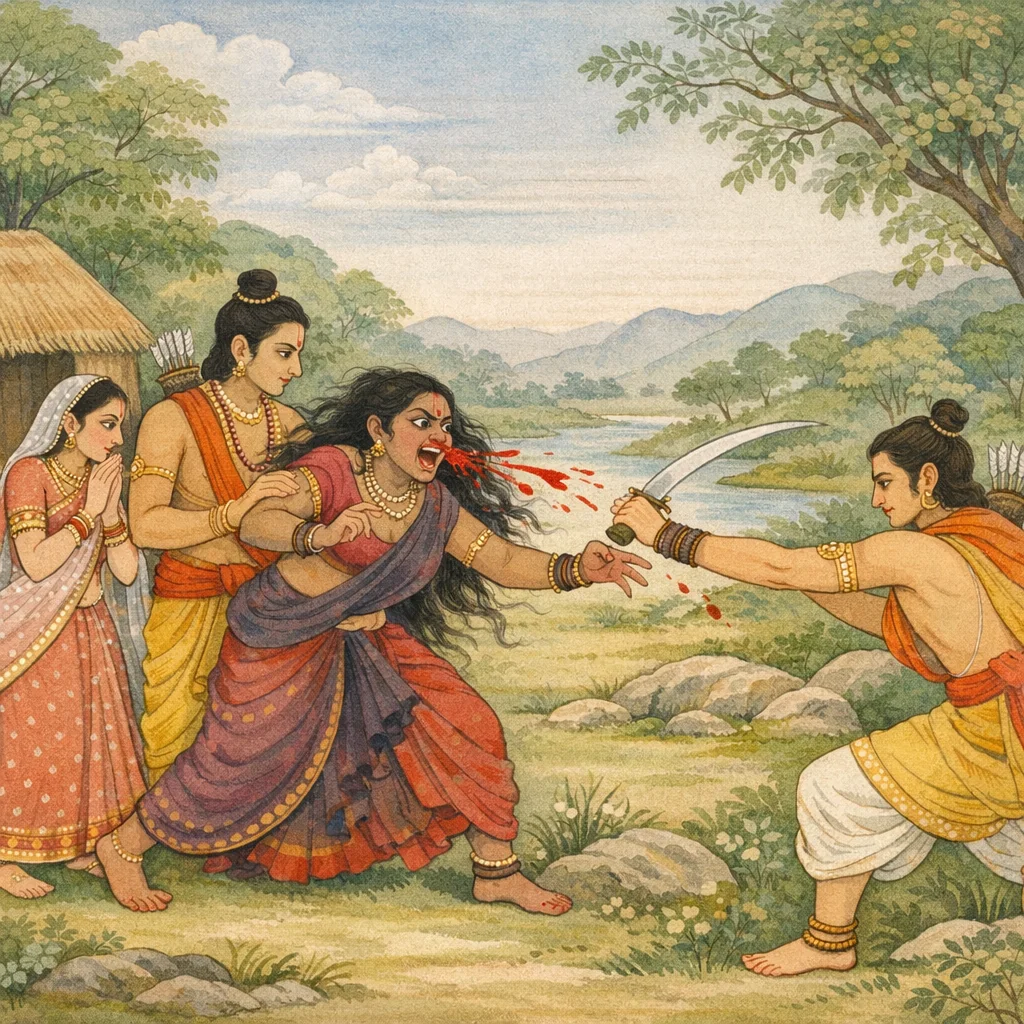
Sarga 18 presents a tightly structured dialogue-to-action sequence. Rāma first responds to Śūrpaṇakhā’s erotic approach with measured clarity, stating his married status and redirecting her toward Lakṣmaṇa, framing co-wifehood as painful and thereby discouraging pursuit. Śūrpaṇakhā then turns to Lakṣmaṇa, who—skilled in speech—deploys irony and mock-offers that invert social hierarchies to deflect her advances. Misreading the mockery as sincere, she returns to Rāma and, in a surge of passion and jealousy, threatens Sītā directly, escalating from insult to attempted violence. Rāma restrains her mid-attack and corrects Lakṣmaṇa: jesting with cruel, uncivilized persons is improper when life is at stake. He then authorizes punitive deformation as a protective and deterrent act; Lakṣmaṇa cuts off her nose and ears with a sword. The chapter closes with Śūrpaṇakhā’s bloodied flight into the forest and her report to her brother Khara at Janasthāna, setting the stage for organized retaliation.
Shlokas
Verse 1
ततश्शूर्पणखां रामः कामपाशावपाशिताम्।स्वच्छया श्लक्ष्णया वाचा स्मितपूर्वमथाब्रवीत्।।।।
Then Rāma, seeing Śūrpaṇakhā bound fast by the noose of passion, spoke to her with a smile, in words that were clear and gentle.
Verse 2
कृतदारोऽस्मि भवति भार्येयं दयिता मम।त्वद्विधानां तु नारीणां सुदुःखा ससपत्नता।।।।
“Lady, I am already married; this is my wife, dear to me. For women like you, becoming a co-wife is indeed a great sorrow.”
Verse 3
अनुजस्त्वेष मे भ्राता शीलवान्प्रियदर्शनः।श्रीमानकृतदारश्च लक्ष्मणो नाम वीर्यवान्।।।।
“This is my younger brother, Lakṣmaṇa by name—well-mannered, pleasing to behold, illustrious, and mighty in valor; and he is unmarried.”
Verse 4
अपूर्वी भार्यया चार्थी तरुणः प्रियदर्शनः।अनुरूपश्च ते भर्ता रूपस्यास्य भविष्यति।।।।
“He is not accompanied by a wife and seeks one; he is young and handsome. He will indeed be a husband well-suited to you and to your beauty.”
Verse 5
एनं भज विशालाक्षि भर्तारं भ्रातरं मम।असपत्ना वरारोहे मेरुमर्कप्रभा यथा।।।।
“O wide-eyed, fair-hipped lady—take him, my brother, as your husband. Without a rival wife, you would shine, O noble maiden, like the sun’s radiance upon Mount Meru.”
Verse 6
इति रामेण सा प्रोक्ता राक्षसी काममोहिता।विसृज्य रामं सहसा ततो लक्ष्मणमब्रवीत्।।।।
Thus addressed by Rāma, the rākṣasī—deluded by desire—abruptly left him and then spoke to Lakṣmaṇa.
Verse 7
अस्य रूपस्य ते युक्ता भार्याहं वरवर्णिनी।मया सह सुखं सर्वान्दण्डकान्विचरिष्यसि।।।।
“I, a woman of radiant beauty, am a fitting wife for your form. With me you will wander happily through all the forests of Daṇḍaka.”
Verse 8
एवमुक्तस्तु सौमित्री राक्षस्या वाक्यकोविदः।ततश्शूर्पणखीं स्मित्वा लक्ष्मणो युक्तमब्रवीत्।।।।
Thus addressed by the demoness, Lakṣmaṇa—son of Sumitrā, skilled in speech—smiled and then replied to Śūrpaṇakhā in a fitting manner.
Verse 9
कथं दासस्य मे दासी भार्या भवितुमिच्छसि।सोऽहमार्येण परवान्भ्रात्रा कमलवर्णिनि।।।।
“O lotus-hued lady, how could you wish to become my wife—when I am a servant, indeed a servant’s servant? For I am wholly dependent upon my noble elder brother.”
Verse 10
समृद्धार्थस्य सिद्धार्था मुदितामलवर्णिनी।आर्यस्य त्वं विशालाक्षि भार्या भव यवीयसी।।।।
O large-eyed one of clear complexion—become the younger wife of my noble master, a man of abundant prosperity, and live content and fulfilled.
Verse 11
एनां विरूपामसतीं करालां निर्णतोदरीम्।भार्यां वृद्धां परित्यज्य त्वामेवैष भजिष्यति।।।।
Casting off that wife—ugly, unfaithful, frightful, and slack-bellied, an old woman—he will choose you alone and cleave to you.
Verse 12
को हि रूपमिदं श्रेष्ठं संत्यज्य वरवर्णिनि।मानुषीषु वरारोहे कुर्याद्भावं विचक्षणः।।।।
O fair-hued lady of peerless form, best among women—what discerning man would forsake such excellent beauty as yours and set his heart on any mortal woman?
Verse 13
इति सा लक्ष्मणेनोक्ता कराला निर्णतोदरी।मन्यते तद्वचस्तथ्यं परिहासाविचक्षणा।।।।
Thus addressed by Lakṣmaṇa, that frightful, slack-bellied woman—unable to discern jest—took his words to be true.
Verse 14
सा रामं पर्णशालायामुपविष्टं परन्तपम्।सीतया सह दुर्दर्षमब्रवीत्काममोहिता।।।।
Deluded by desire, she spoke to Rāma—the foe-scorcher, formidable to assail—who sat in the leaf-hut together with Sītā.
Verse 15
एनां विरूपामसतीं करालां निर्णतोदरीम्।वृद्धां भार्यामवष्टभ्य मां न त्वं बहुमन्यसे।।।।
Clinging to that wife—ugly, unfaithful, frightful, slack-bellied, and old—you do not value me.
Verse 16
अद्येमां भक्षयिष्यामि पश्यतस्तव मानुषीम्।त्वया सह चरिष्यामि निस्सपत्ना यथासुखम्।।।।
Today, even as you look on, I will devour this human woman; then I shall roam with you in happiness, with no rival wife.
Verse 17
इत्युक्त्वा मृगशाबाक्षीमलातसदृशेक्षणा।अभ्यधावत्सुसङ्कृद्धा महोल्कां रोहिणीमिव।।।।
Having spoken thus, the enraged one—her eyes like burning embers—rushed at the fawn-eyed Sītā, like a great meteor hurtling toward Rohiṇī.
Verse 18
तां मृत्युपाशप्रतिमामापतन्तीं महाबलः।निगृह्य रामः कुपित स्ततो लक्ष्मणमब्रवीत्।।।।
Mighty Rāma, enraged, restrained her as she rushed in—like the very noose of Death—and then spoke to Lakṣmaṇa.
Verse 19
क्रूरैरनार्यै स्सौमित्रे परिहासः कथञ्चन।न कार्यः पश्यवैदेहीं कथञ्चित्सौम्य जीवतीम्।।।।
“Saumitra, one must never jest with the cruel and uncivilized. Look—Vaidehī has somehow been spared and still lives.”
Verse 20
इमां विरूपामसतीमतिमत्तां महोदरीम्।राक्षसीं पुरुषव्याघ्र विरूपयितुमर्हसि।।।।
Tiger among men, you should disfigure this rākṣasī—ugly, unchaste, maddened with passion, and big-bellied.
Verse 21
इत्युक्तो लक्ष्मणस्तस्याः क्रुद्धो रामस्य पार्श्वतः।उद्धृत्य खङ्गं चिच्छेद कर्णनासं महाबलः।।।।
Thus instructed, mighty Lakṣmaṇa, standing beside Rāma and angered, raised his sword and cut off her ears and nose.
Verse 22
निकृत्तकर्णनासा तु विस्वरं सा विनद्य च।यथागतं प्रदुद्राव घोरा शूर्पणखा वनम्।।।।
With her ears and nose cut off, dreadful Śūrpaṇakhā cried out in a hoarse voice and fled into the forest, back the way she had come.
Verse 23
सा विरूपा महाघोरा राक्षसी शोणितोक्षिता।ननाद विविधान्नादान्यथा प्रावृषि तोयदः।।।।
Disfigured and most dreadful, drenched in blood, the rākṣasī bellowed with many kinds of cries, like a rain-cloud in the monsoon season.
Verse 24
सा विक्षरन्ती रुधिरं बहुधा घोरदर्शना।प्रगृह्य बाहू गर्जन्ती प्रविवेश महावनम्।।।।
Dripping blood in streams, frightful to behold, she raised her arms and—roaring—entered the great forest.
Verse 25
ततस्तु सा राक्षससङ्घसंवृतं खरं जनस्थानगतं विरूपिता।उपेत्य तं भ्रातरमुग्रदर्शनं पपात भूमौ गगनाद्यथाऽशनिः।।।।
Then she, disfigured, approached her fierce-looking brother Khara—dwelling at Jana-sthāna and surrounded by a host of rākṣasas—and fell upon the earth like a thunderbolt from the sky.
Verse 26
ततस्सभार्यं भयमोहमूर्छिता सलक्ष्मणं राघवमागतं वनम्।विरूपणं चात्मनि शोणितोक्षिता शशंस सर्वं भगिनी खरस्य सा।।।।
Then Khara’s sister—overcome by fear and bewilderment, drenched in blood—told him everything: that Rāghava had come to the forest with his wife and with Lakṣmaṇa, and how she herself had been disfigured.
Frequently Asked Questions
The chapter tests proportional response and protective duty: when Śūrpaṇakhā shifts from solicitation to attempted harm against Sītā, Rāma restrains the threat and authorizes a deterrent punishment (disfigurement) to prevent immediate danger and signal boundary enforcement.
Speech has moral weight: Lakṣmaṇa’s mockery demonstrates how irony can misfire with malicious actors, while Rāma’s correction (3.18.19) teaches that humor toward the cruel is imprudent when it obscures risk to life and dharma.
The parṇaśālā (forest hermitage hut) situates the domestic-in-exile setting; Janasthāna anchors the rākṣasa political-military presence under Khara; Daṇḍaka provides the broader cultural landscape of ascetic forest life and contested security.