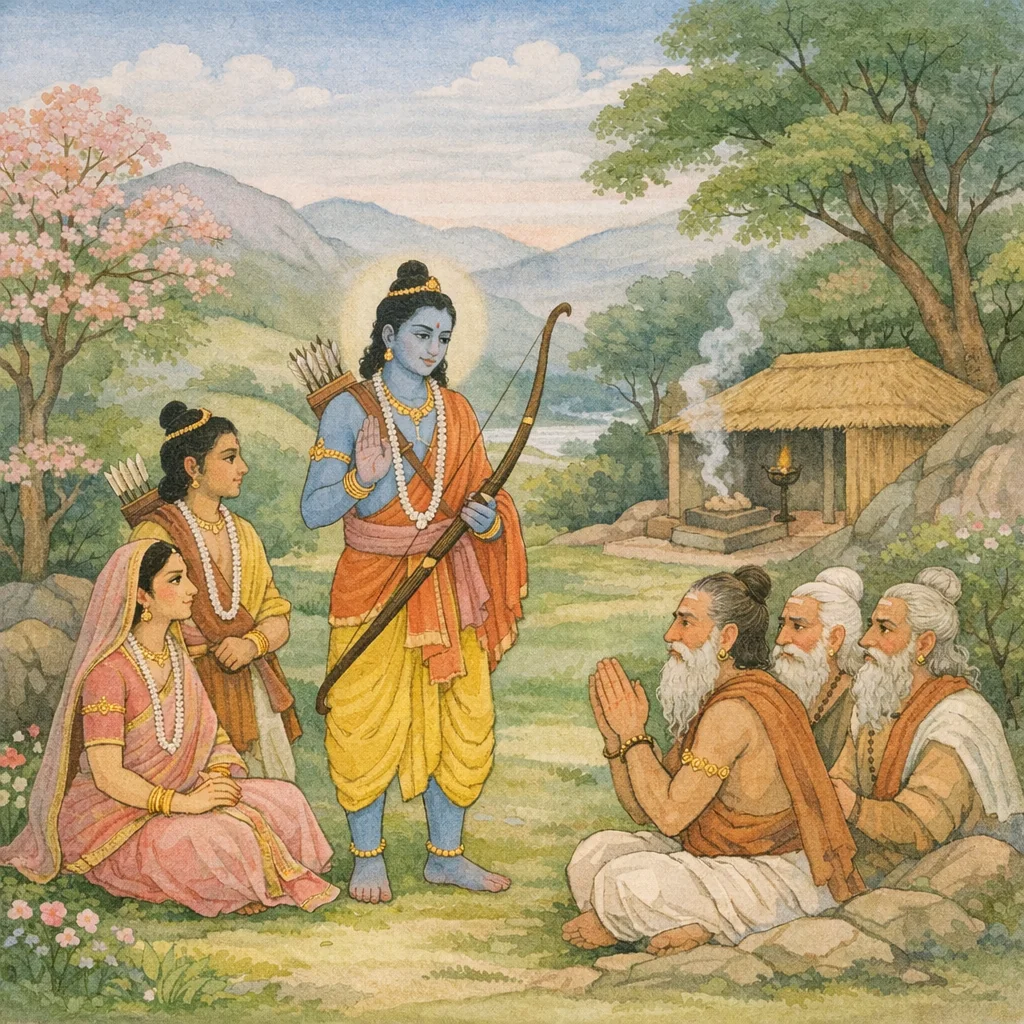
Sarga 10
दशमः सर्गः — Rama’s Vow to Protect the Sages of Daṇḍaka (Dharma of Refuge)
आरण्यकाण्ड
This sarga unfolds as an ethical dialogue shaped by Sītā’s devoted bhartṛ-bhakti and Rāma’s steadfast dharma-niṣṭhā. Rāma first accepts Sītā’s affectionate admonition as worthy of her lineage and of her role as his sadharma-cāriṇī, a companion who walks with him in dharma. He then explains the kṣatriya reason for bearing arms: the bow stands for preventing “ārta-śabda,” the cry of distress in society. Rāma recounts how the ascetics of Daṇḍaka personally sought his refuge, describing rākṣasa harassment aimed especially at sacrificial times (homa-kāla) and at lunar and ritual observances (parva-kāla), endangering both lives and the continuity of sacred rites. The sages affirm that, though empowered by tapas to retaliate, they refuse to squander hard-won austerity through violence or curses, and therefore request protection from Rāma and Lakṣmaṇa. Rāma declares that he promised complete protection and insists that truthfulness (satya) binds him even above personal safety; he would rather give up his life than break a pledge made to brāhmaṇas. Concluding, he reassures Sītā, approves her counsel, and proceeds with Lakṣmaṇa, bow in hand, through the delightful tapo-vanas.
Shlokas
Verse 1
वाक्यमेतत्तु वैदेह्या व्याहृतं भर्तृभक्तया।श्रुत्वा धर्मे स्थितो रामः प्रत्युवाचाथ मैथिलीम्।।।।
Hearing these words spoken by Vaidehī out of devotion to her husband, Rāma—steadfast in dharma—then replied to Maithilī.
Verse 2
हितमुक्तं त्वया देवि स्निग्धया सदृशं वचः।कुलं व्यपदिशन्त्या च धर्मज्ञे जनकात्मजे।।।।
O Devi, O Janaka’s daughter who understands dharma—what you have said, affectionately and with regard for your noble lineage, is wholesome and fitting.
Verse 3
किन्तु वक्ष्याम्यहं देवि त्वयैवोक्तमिदं वचः।क्षत्रियैर्धार्यते चापो नार्तशब्दो भवेदिति।।।।
Yet, O Devi, I will say this: you yourself have spoken these words—when a kṣatriya bears the bow, there should be no cry of distress.
Verse 4
ते चार्ता दण्डकारण्ये मुनयस्संशितव्रताः।मां सीते स्वयमागम्य शरण्याश्शरणं गताः।।।।
O Sita, those sages in distress in the Dandaka forest—men of firm vows—came to me in person and sought refuge in one who is fit to grant protection.
Verse 5
वसन्तो धर्मनिरता वने मूलफलाशनाः।न लभन्ते सुखं भीता राक्षसैः क्रूरकर्मभिः।।।।
The sages, dwelling in the forest, living on roots and fruits and steadfast in dharma, cannot find happiness—terror-stricken by the rākṣasas whose deeds are cruel.
Verse 6
काले काले च निरता नियमैर्विविधैर्वने।भक्ष्यन्ते राक्षसैर्भीमैर्नरमांसोपजीविभिः।।।।
Though constantly engaged in varied disciplines and observances in the forest, they are being devoured by dreadful rākṣasas who live by human flesh.
Verse 7
ते भक्ष्यमाणा मुनयो दण्डकारण्यवासिनः।अस्मानभ्यवपद्येति मामूचुर्द्विजसत्तमा।।।।
Those sages of Daṇḍakāraṇya, being thus preyed upon, the best of the twice-born, said to me: “Come to our rescue; in you we seek refuge.”
Verse 8
मया तु वचनं श्रुत्वा तेषामेवं मुखाच्च्युतम्।कृत्वा चरणशुश्रूषां वाक्यमेतदुदाहृतम्।।।।
Hearing those words that fell from their lips, I bowed in reverence at their feet and then spoke these words.
Verse 9
प्रसीदन्तु भवन्तो मे ह्रीरेषा हि ममातुला।यदीदृशैरहं विप्रैरुपस्थेयैरुपस्थितः।।।।
“Be gracious to me, I pray; for immeasurable is my shame that such venerable brāhmaṇa-sages—worthy of my approach—have instead come to approach me.”
Verse 10
किं करोमीति च मया व्याहृतं द्विजसन्निधौ।सर्वैरेतैस्समागम्य वागियं समुदाहृता।।।।
In the presence of the brāhmaṇas I asked, “What shall I do?” Then all of them, gathering together, spoke this reply with one voice.
Verse 11
राक्षसैर्दण्डकारण्ये बहुभिः कामरूपिभिः।अर्दितास्स्म दृढं राम भवान्नस्तत्र रक्षतु।।।।
“O Rāma, in the Daṇḍaka forest we are grievously tormented by many rākṣasas who can assume forms at will. Protect us from them.”
Verse 12
होमकालेषु सम्प्राप्ताः पर्वकालेषु चानघ।धर्षयन्ति सुदुर्धर्षा राक्षसाः पिशिताशनाः।।।।
“O sinless one, those flesh-eating rākṣasas—hard to resist—arrive at the very times of our homa offerings and on festival or lunar observance days, and they violate and attack us.”
Verse 13
राक्षसैर्धर्षितानां च तापसानां तपस्विनाम्।गतिं मृगयमाणानां भवान्नः परमा गतिः।।।।
“For us ascetics, harassed by rākṣasas—helpless and seeking refuge—you are our highest shelter.”
Verse 14
कामं तपःप्रभावेन शक्ता हन्तुं निशाचरान्।चिरार्जितं तु नेच्छामस्तपः खण्डयितुं वयम्।।3.10.14।।
“Indeed, by the power of our austerities we are able to slay the night-roamers; yet we do not wish to shatter the penance we have accumulated over long years.”
Verse 15
बहुविघ्नं तपो नित्यं दुश्चरं चैव राघव।तेन शापं न मुञ्चामो भक्ष्यमाणाश्च राक्षसैः।।।।
O Rāghava, penance is ever beset with many obstacles and is hard to practice. Therefore we do not unleash curses, even though rākṣasas may devour us.
Verse 16
तदर्ध्यमानान्रक्षोभिर्दण्डकारण्यवासिभिः।रक्ष नस्त्वं सह भ्रात्रा त्वन्नाथा हि वयं वने।।।।
Therefore protect us, tormented by the rākṣasas who dwell in the Daṇḍaka forest. In this wilderness you are indeed our lord; protect us together with your brother.
Verse 17
मया चैतद्वचश्श्रुत्वा कार्त्स्न्येन परिपालनम्।ऋषीणां दण्डकारण्ये संश्रुतं जनकात्मजे।।।।
O daughter of Janaka, having heard their words in full, I solemnly pledged to protect the sages of the Dandaka forest wholly and without remainder.
Verse 18
संश्रुत्य च न शक्ष्यामि जीवमानः प्रतिश्रवम्।मुनीनामन्यथा कर्तुं सत्यमिष्टं हि मे सदा।।।।
And having given my word, so long as I live I cannot act otherwise than the promise made to the sages, for truth is ever dear to me.
Verse 19
अप्यहं जीवितं जह्यां त्वां वा सीते सलक्ष्मणाम्।न तु प्रतिज्ञां संश्रुत्य ब्राह्मणेभ्यो विशेषतः।।।।
O Sita, I might even relinquish my life—or even you together with Lakshmana—but I will not break the vow I have solemnly made, especially to the brāhmaṇas.
Verse 20
तदवश्यं मया कार्यमृषीणां परिपालनम्।अनुक्तेनापि वैदेहि प्रतिज्ञाय तु किं पुनः।।।।
Therefore, O Vaidehi, I must surely carry out the protection of the sages—even had they not asked; how much more so when I have promised it.
Verse 21
मम स्नेहाच्च सौहार्दादिदमुक्तंत्वयाऽनघे।परितुष्टोऽस्म्यहं सीते न ह्यनिष्टोऽनुशिष्यते।।।।
O blameless Sita, you spoke this out of love and goodwill toward me; I am pleased, for what is harmful is never truly to be advised.
Verse 22
सदृशं चानुरूपं च कुलस्य तव चात्मनः।सधर्मचारिणी मे त्वं प्राणेभ्योऽपि गरीयसी।।।।
Your words are fitting and in harmony with your lineage and your own character. You walk with me in dharma; therefore you are dearer to me than my very life.
Verse 23
इत्येवमुक्त्वा वचनं महात्मा सीतां प्रियां मैथिलराजपुत्रीम्।रामो धनुष्मान्सह लक्ष्मणेन जगाम रम्याणि तपोवनानि।।।।
Having spoken thus to his beloved Sita, the daughter of the king of Mithila, the great-souled Rama—bow in hand—went on with Lakshmana to the lovely forests of ascetic practice.
Frequently Asked Questions
Rāma must reconcile Sītā’s affectionate caution with his kṣatriya obligation to protect ascetics: he chooses to uphold a public duty and a formal vow (pratijñā) to safeguard ṛṣis in Daṇḍaka, even at the cost of personal risk.
The sarga teaches that dharma is sustained through truthful commitments and protective responsibility: satya binds action, and righteous force is legitimized when it preserves refuge, ritual order, and the security of the vulnerable.
Daṇḍakāraṇya is presented as a ritual landscape where homa-times and parva observances are attacked; the tapo-vanas function as cultural institutions of ascetic practice whose continuity depends on the protector’s maryādā.