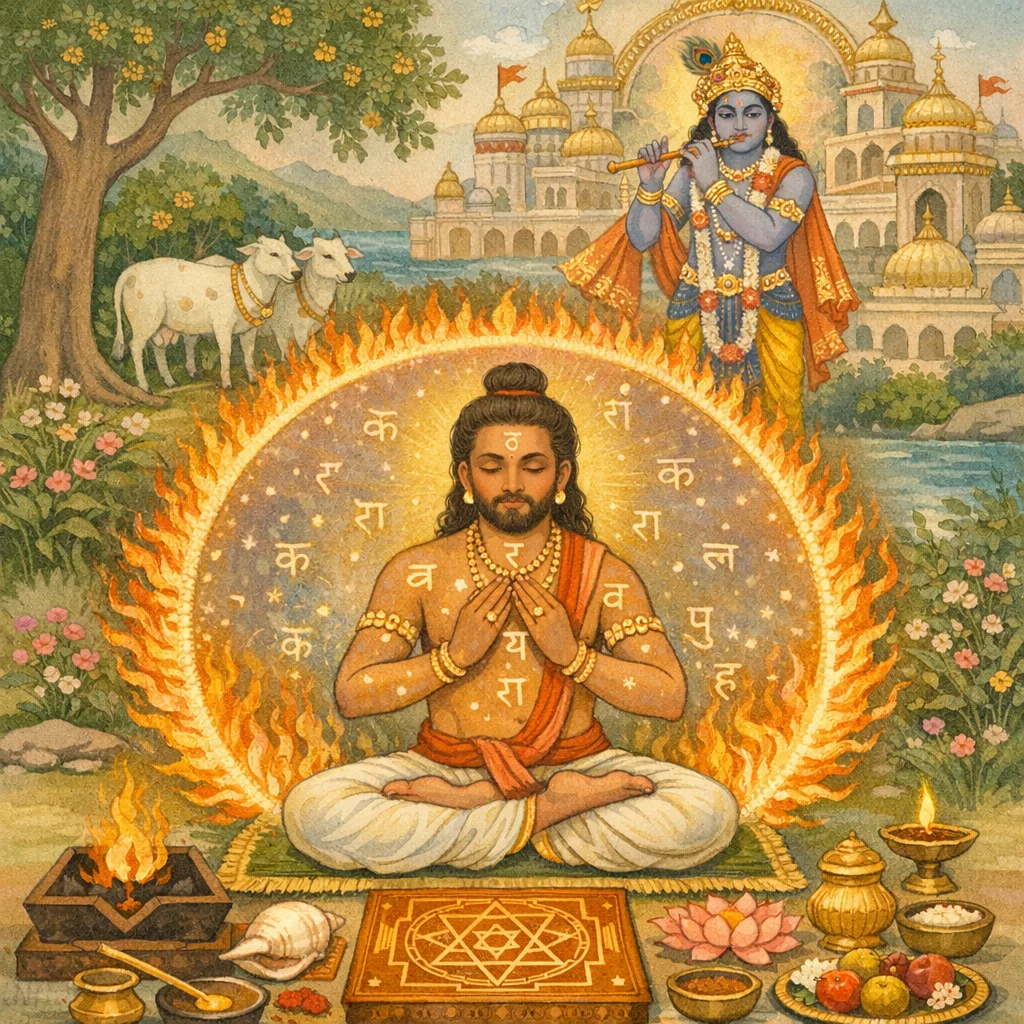
The Exposition of the Krishna Mantra (Kṛṣṇa-mantra-prakāśa): Nyāsa, Dhyāna, Worship, Yantra, and Prayoga
Sūta relates that after hearing the earlier protective hymns, Nārada again questions Sanatkumāra. Sanatkumāra gives an extensive teaching on Kṛṣṇa-mantras that bestow both worldly enjoyment (bhoga) and liberation (mokṣa), first stating the mantra’s ritual identifiers (ṛṣi, chandas, devatā, bīja, śakti, niyoga). He then lays out a strict nyāsa regimen: installing seer/metre/deity, pañcāṅga and tattva-nyāsa from jīva through the mahābhūtas, followed by mātṛkā-nyāsa, vyāpaka-nyāsa, and sṛṣṭi-sthiti-saṃhāra placements. Protective acts such as Sudarśana digbandhana and mudrās (veṇu, bilva, varma, weapon-release) are taught. The sādhaka is guided through elaborate dhyāna of Vṛndāvana and Dvārakā, with āvaraṇa-arcana (attendant deities, queens, weapons, lokapālas), prescribed japa/homa counts, and tarpaṇa rules with specific substances and prohibitions. The chapter also presents kāmya-homa uses for prosperity, control, rain/fever pacification, progeny rites, and enemy-warding—while warning against killing rites—and culminates in constructing the Gopāla-yantra and a ten-syllabled “king of mantras” with its own nyāsa. The promised fruits are mantra-siddhi, the aṣṭa-siddhis, prosperity, and final attainment of Viṣṇu’s abode.
Shlokas
Verse 1
सूत उवाच । श्रुत्वा तु नारदो विप्राः कुमारवचनं मुनिः । यत्पप्रच्छ पुनस्तच्च युष्मभ्यं प्रवदाम्यहम् ॥ १ ॥
Sūta said: O Brahmins, having heard the words of the Kumāras, the sage Nārada again asked whatever he wished to know; that too I shall now relate to you.
Verse 2
कार्तवीर्यस्य कवचं तथा हनुमतोऽपि च । चरितं च महत्पुण्यं श्रुत्वा भूयोऽब्रवीद्वचः ॥ २ ॥
Having heard the protective hymn (kavaca) of Kārtavīrya, and also that of Hanumān, and the greatly meritorious account of Hanumān, he again spoke these words.
Verse 3
नारद उवाच । साधु साधु मुनिश्रेष्ठ त्वयातिकरुणात्मना । श्रावितं चरितं पुण्यं शिवस्य च हनूमतः ॥ ३ ॥
Nārada said: “Well done, well done, O best of sages! With a heart overflowing with compassion, you have caused me to hear the holy, meritorious account of Śiva and of Hanumān.”
Verse 4
तन्त्रस्यांस्य क्रमप्राप्तं कथनीयं च यत्त्वया । तत्प्रब्रूहि महाभाग किं पृष्ट्वान्यद्विदांवर ॥ ४ ॥
O illustrious one, please explain what you are bound to teach, in due sequence, regarding this Tantra. Speak it forth, O great soul—what else is there to ask of you, O best among the wise?
Verse 5
सनत्कुमार उवाच । अथ वक्ष्ये कृष्णमंत्रान्भुक्तिमुक्तिफलप्रदान् । ब्रह्माद्या यान्समाराध्य सृष्ट्यादिकरणे क्षमाः ॥ ५ ॥
Sanatkumāra said: Now I shall expound the Kṛṣṇa-mantras that bestow the fruits of both worldly enjoyment and liberation—mantras by which even Brahmā and the other gods, having duly worshiped Him, become competent to carry out creation and the other cosmic functions.
Verse 6
कामः कृष्णपदं ङतं गोविंदं च तथाविधम् । गोपीजनपदं पश्चाद्वल्लभायाग्निसुंदरी ॥ ६ ॥
Kāma, the deity of desire, is said to have gone to Kṛṣṇa’s sacred Feet and likewise to Govinda; thereafter Agnisundarī, the fair one of Fire, went to the settlement of the gopīs to become Vallabhā’s beloved consort.
Verse 7
अष्टादशार्णो मंत्रोऽयं दुर्गाधिष्ठातृदैवतः । नारदोऽस्य मुनिश्छंदो गायत्री देवता पुनः ॥ ७ ॥
This is an eighteen-syllabled mantra, presided over by Durgā as its governing deity. For it, Nārada is the seer (ṛṣi), the meter is Gāyatrī, and the invoked deity is again declared to be Gāyatrī.
Verse 8
श्रीकृष्णः परमात्मा च कामो बीजं प्रकीर्तितम् । स्वाहा शक्तिर्नियोगस्तु चतुर्वर्गप्रसिद्धये ॥ ८ ॥
Śrī Kṛṣṇa is the Paramātmā, the Supreme Self; “Kāma” is proclaimed as the bīja, the seed-syllable. “Svāhā” is the śakti, the empowering formula, and the niyoga, the ritual intention, is for attaining the four aims of life—dharma, artha, kāma, and mokṣa.
Verse 9
ऋषिं शिरसि वक्त्रे तु छंदश्च हृदि देवताम् । गुह्ये बीजं पदोः शक्तिं न्यसेत्साधकसत्तमः ॥ ९ ॥
The foremost practitioner should perform nyāsa: placing the ṛṣi upon the head, the chandas upon the mouth, the deity within the heart, the bīja in the secret region, and the śakti upon the feet.
Verse 10
युगेवदाब्धि निगमैर्द्वाभ्यां वर्णैर्मनूद्भवैः । पंचांगानि प्रविन्यस्य तत्त्वन्यासं समाचरेत् ॥ १० ॥
Using the Vedic mantras—together with the two syllables born of Manu—one should duly arrange the five limbs (pañcāṅga), and then perform tattva-nyāsa, the nyāsa of the principles (tattvas).
Verse 11
हृदंतिमादिकांतार्णमपराद्यानि चात्मने । मत्यंतानि च तत्वानि जीवाद्यानि न्यसेत्क्रमात् ॥ ११ ॥
Beginning from the heart and proceeding up to the innermost end (the crown), for the sake of the Ātman one should perform nyāsa, placing the higher principles; and likewise, in due order, place the principles beginning with the jīva and ending at the mortal, bodily level.
Verse 12
जीवं प्राणं मतिमहंकारं मनस्तथैव च । शब्दं स्पर्शं रूपरसौ गंधं श्रोत्रं त्वचं तथा ॥ १२ ॥
The jīva (individual self), prāṇa (vital breath), mati (intellect), ahaṅkāra (ego-sense), and manas (mind); sound, touch, form and taste, smell; and likewise the ear and the skin—these are enumerated.
Verse 13
नेत्रं च रसनांघ्राणं वाचं पाणिं पदेंद्रियम् । पायुं शिश्नमथाकाशं वायुं वह्निं जलं महीम् ॥ १३ ॥
The eye; the tongue and the nose; speech (vāc); the hand; the foot as an organ of action; the anus; the generative organ; and then space, wind, fire, water, and earth—these are enumerated.
Verse 14
जीवं प्राणं च सर्वागे मत्यादित्रितयं हृदि । मूर्द्धास्यहृद्गुह्य पादेष्वथ शब्दादिकान्न्यसेत् ॥ १४ ॥
By nyāsa one should place the jīva and the prāṇa throughout all the limbs; the triad beginning with mati in the heart; and then place sound and the rest upon the head, mouth, heart, the secret region, and the feet.
Verse 15
कर्णादिस्वस्वस्थानेषु श्रोत्रादीनींद्रियाणि च । तथा वागादींद्रियाणि स्वस्वस्थानषु विन्यसेत् ॥ १५ ॥
One should place the sense-faculties—beginning with hearing—into their own proper seats, starting with the ear; and likewise set the organs of action—beginning with speech—into their respective proper places.
Verse 16
मूद्धस्यहृद्गुह्यपादेष्वाकाशादीन्न्यसेत्ततः । हृत्पुंडरीकमर्केन्दुह्निबिंबान्यनुक्रमात् ॥ १६ ॥
Then one should perform nyāsa, mentally placing the elements beginning with ākāśa upon the head, the heart, the secret region, and the feet; thereafter, in proper sequence, one should visualize within the lotus of the heart the radiant orbs of the sun, the moon, and sacred fire.
Verse 17
द्विषट्ह्यष्टदशकलाव्याप्तानि च तथा मतः । भूताष्टां गाक्षिपदगैर्वर्णैः प्रग्विन्न्यसेद्धृदि ॥ १७ ॥
These too are said to pervade the eighteen kalās; and the eight bhūtas are to be placed within the heart by arranging, in proper order, the syllables beginning with “ga” together with those indicated by the “akṣi” and “pada” groups.
Verse 18
अथाकाशादिस्थलेषु वासुदेवादिकांस्ततः । वासुदेवः संकर्षणः प्रद्युम्नश्चानिरुद्धकः ॥ १८ ॥
Then, in the spheres beginning with ākāśa and the other elemental regions, one should contemplate the divine forms beginning with Vāsudeva—Vāsudeva, Saṅkarṣaṇa, Pradyumna, and Aniruddha.
Verse 19
नारायणश्च क्रमशः परमेष्ठ्यादिभिर्युताः । परमेष्ठिपुमांच्छौ चविश्वनिवृत्तिसर्वकाः ॥ १९ ॥
And Nārāyaṇa, in due order, is described together with the states beginning with Parameṣṭhī; likewise the designations Parameṣṭhī and Pumān are stated—these are all terms indicating nivṛtti, the retraction of the universe, and the all-inclusive supreme Principle.
Verse 20
श्वेतानिलाग्न्यंबुभूमिवर्णैः प्राग्वत्प्रविन्यसेत् । स्वबीजाद्यं कोपतत्वं नृसिंहं व्यापकेन च ॥ २० ॥
As before, one should perform the placement (nyāsa) with the syllables associated with the colors—white, wind, fire, water, and earth—in the same order. Then, beginning with one’s own bīja, one should place Nṛsiṃha in His wrathful principle (kopa-tattva), together with the all-pervading aspect (vyāpaka).
Verse 21
प्राग्वद्विन्यस्य सर्वाङ्गे तत्त्वन्यासोऽयमीरितः । मकाराद्या आद्यवर्णाः सर्वे स्युश्चंद्रभूषिताः ॥ २१ ॥
Having placed them upon the entire body as before, this is declared to be tattva-nyāsa, the installation of the principles. All the initial letters beginning with “ma” should be adorned with candra, the moon.
Verse 22
वासुदेवादिका ज्ञेया ङेंताः साधकसत्तमैः । प्राणायामं ततः कृत्वा पूरकुम्भकरेचकैः ॥ २२ ॥
The best of practitioners should understand the mantric syllables beginning with “Vāsudeva” as the guiding set. Then, performing prāṇāyāma, one should proceed with pūraka (inhalation), kumbhaka (retention), and recaka (exhalation).
Verse 23
चतुर्भिः षड्भर्द्वाभ्यां च मूलमंत्रेण मंत्रवित् । केचिदाहुरिहाचार्याः प्राणायामोत्तरं पुनः ॥ २३ ॥
The knower of mantra should perform the practice with the root-mantra, counting it four times, or six times, or twice. Some teachers here also say that it should be done again after the prāṇāyāma.
Verse 24
पीठन्यासं विधायाथ न्यासानन्यान्समाचरेत् । दशतत्त्वादि विन्यस्य वक्ष्यमाणविधानतः ॥ २४ ॥
Having first performed the pīṭha-nyāsa, one should then carry out the other nyāsas. Placing (invoking) the ten tattvas and the rest, one should proceed exactly according to the procedure that will be described.
Verse 25
मूर्तिपंजरनामानं पूर्वोक्तं विन्यसेद्बुधः । सर्वांगे व्यापकं कृत्वा किरीटमनुना सुधीः ॥ २५ ॥
The wise practitioner should perform the previously taught nyāsa of the set of names called “Mūrti-pañjara.” Having made it pervade all the limbs of the body, the discerning one should then seal it with the “Kirīṭa” mantra.
Verse 26
ततस्तारपुटं मंत्रं व्यापय्य करयोस्त्रिशः । पंचांगुलीषु करयोः पंचांगं विन्यसेत्ततः ॥ २६ ॥
Then, having placed the “tāra-puṭa” mantra, one should pervade both hands with it three times; thereafter, upon the five fingers of the hands, one should install the fivefold set (pañcāṅga) in due order.
Verse 27
त्रिशो मूलेन मूर्द्धादिपादांतं व्यापकं न्यसेत् । सकृद्व्यापय्य तारेण मंत्रन्यासं ततश्चरेत् ॥ २७ ॥
With the root-mantra, one should perform the all-pervading nyāsa from the crown of the head down to the ends of the feet three times. Then, having pervaded the body once with the Tāra mantra, one should proceed to mantra-nyāsa in due order.
Verse 28
शिरोललाटे भ्रूमध्ये कर्णयोश्चक्षुषोस्तथा । घ्राणयोर्वदने कंठे हृदि नाभौ तथा पुनः ॥ २८ ॥
Upon the head and the forehead, in the middle of the eyebrows, in the ears and likewise in the eyes; in the nostrils, in the mouth, in the throat, in the heart, and again in the navel—one should establish it there (by nyāsa).
Verse 29
कट्यां लिंगे जानुनोश्च पादयोर्विन्यसेत्क्रमात् । हृदंतान्मंत्रवर्णांश्च ततो मूर्ध्नि ध्रुवं न्यसेत् ॥ २९ ॥
In due sequence, one should place the mantra at the waist, the generative organ, the knees, and the feet. Then, having placed the mantra’s syllables up to the heart, one should finally fix the steady (dhruva) placement upon the head.
Verse 30
पुनर्नयनयोरास्ये हृदि गुह्ये च पादयोः । विन्यसेद्धृदयांतानि मनोः पंचपदानि च ॥ ३० ॥
Again, one should place the five words of the mantra—ending with “hṛdaya”—upon the two eyes, the mouth, the heart, the secret region, and the feet.
Verse 31
भूयो मुन्यादिकं न्यस्य पंचांगं पूर्ववन्न्यसेत् । अथ वक्ष्ये महागुह्यं सर्वन्यासोत्तमोत्तमम् ॥ ३१ ॥
Again, having performed the nyāsa beginning with the muni (ṛṣi) and the rest as before, one should place the fivefold set of limbs (pañcāṅga) in nyāsa as previously taught. Now I shall declare the great secret—the supreme of all nyāsas, the most excellent of the most excellent.
Verse 32
यस्य विज्ञानमात्रेण जीवन्मुक्तो भवेन्नरः । अणिमाद्यष्टसिद्धीनामीश्वरः स्यान्न संशयः ॥ ३२ ॥
By the mere realization (vijñāna) of this, a man becomes liberated while still living (jīvanmukta); and he becomes the master of the eight siddhis beginning with aṇimā—of this there is no doubt.
Verse 33
यस्याराधनतो मंत्री कृष्णसंनिध्यतां व्रजेत् । ताराद्याभिर्व्याहृतिभिः संपुटं विन्यसेन्मनुम् ॥ ३३ ॥
That mantra-practitioner whose worship leads to the close presence of Kṛṣṇa should arrange the mantra within a ‘saṃpuṭa’ (ritual enclosure), using tārā—Oṃ—and the sacred utterances (vyāhṛtis) as the enclosing formulas.
Verse 34
मंत्रेण पुटितांश्चापि प्रणवाद्यांस्ततो न्यसेत् । गायत्र्या पुटुतं मंत्रं विन्यसेन्मातृकास्थले ॥ ३४ ॥
Then one should place in nyāsa the syllables beginning with the Praṇava (Oṃ), which have been ‘sealed and empowered’ (pūṭita) by the mantra. And the mantra empowered by the Gāyatrī should be installed at the seat of the Mātṛkās—the matrix of letters.
Verse 35
मंत्रेण पुटितां तां च गायत्रीं विन्यसेत्क्रमात् । मातृकापुटितं मूलं विन्यसेत्साधकोत्तमः ॥ ३५ ॥
Then the excellent practitioner should, in due sequence, perform nyāsa of that Gāyatrī which has been sealed and strengthened (pūṭita) by the mantra; and he should also place by nyāsa the root-mantra (mūla-mantra), sealed by the Mātṛkā—the letters.
Verse 36
मूलेन पुटितां चैव मातृकां विन्यसेत्क्रमात् । तृचं न मातृकावर्णान्पूर्वं तत्तत्स्थले सुधीः ॥ ३६ ॥
The wise sādhaka should then, in proper sequence, place (perform nyāsa of) the Mātṛkā letters, each enclosed and safeguarded by the root-mantra. He should not first place the three ṛc-verses; rather, he should first install the Mātṛkā syllables in their respective locations.
Verse 37
विन्यसेन्न्यासषट्कं च षोढा न्यासोऽयमीरितः । अनेन न्यासवर्येण साक्षात्कृष्णसमो भवेत् ॥ ३७ ॥
One should perform the sixfold nyāsa; this is declared to be nyāsa in sixteen parts. By this most excellent nyāsa, one becomes directly equal to Kṛṣṇa (in divine proximity and empowerment).
Verse 38
न्यासेन पुटितं दृष्ट्वा सिद्धगंधर्वकिन्नराः । देवा अपि नमंत्येनं किंपुनर्मानवा भुवि ॥ ३८ ॥
Seeing him consecrated and fortified by nyāsa, the Siddhas, Gandharvas, and Kinnaras bow to him; even the gods pay him reverence—how much more, then, will human beings upon the earth?
Verse 39
सुदर्शनस्य मंत्रेण कुर्याद्दिग्बंधनं ततः । देवं ध्यायन्स्वहृदये सर्वाभीष्टप्रदायकम् ॥ ३९ ॥
Then, using the mantra of Sudarśana, one should perform the binding of the directions (protective sealing). Meditating within one’s own heart on the Lord—the bestower of all desired aims—one should proceed.
Verse 40
उत्फुल्लकुसुमव्रातनम्रशाखैर्वरद्रुमैः । सस्मेयमंजरीवृंदवल्लरीवेष्टितैः शुभैः ॥ ४० ॥
That place shone with wish-fulfilling trees whose branches bent low beneath clusters of fully blossomed flowers, and with auspicious creepers entwined around them, adorned with bunches of blossoms as if smiling.
Verse 41
गलत्परागधूलिभिः सुरभीकृतदिङ्मुखः । स्मरेच्छिशिरितं वृंदावनं मंत्रीसमाहितः ॥ ४१ ॥
As drifting pollen-dust perfumes the faces of all directions, the mantra-practitioner—mind wholly gathered in samādhi—should contemplate Vṛndāvana, cooled as though by sacred remembrance.
Verse 42
उन्मीलन्नवकंजालिविगलन्मधुसंचयैः । लुब्धांतः करणैर्गुंजद्द्विरेफपटलैः शुभम् ॥ ४२ ॥
Auspicious was that vision: newly opening clusters of lotuses let fall their stored honey, while swarms of humming bees resounded all around, their inner senses greedily drawn to the nectar.
Verse 43
मरालपरभृत्कीरकपोतनिकरैर्मुहुः । मुखरीकृतमानृत्यन्मायूरकुलमंजुलम् ॥ ४३ ॥
Again and again the grove rang out with flocks of swans, cuckoos, parrots, and pigeons; and charming companies of peacocks, dancing, enlivened it with their calls.
Verse 44
कालिंद्या लोलकल्लोलविप्रुषैर्मंदवाहिभिः । उन्निद्रांबुरुहव्रातरजोभिर्धूसरैः शिवैः ॥ ४४ ॥
From the Kāliṇdī (Yamunā), the spray of her gently rolling waves was borne upon soft breezes; and the auspicious air, tawny with the pollen-dust of fully blossomed lotus-clusters, pervaded the place with serene beneficence.
Verse 45
प्रदीपित स्मरैर्गोष्ठसुंदरीमृदुवाससाम् । विलोलनपरैः संसेवितं वा तैर्निरंतरम् ॥ ४५ ॥
Or else, when passion is kindled, they continually consort with the lovely maidens of the cowherd settlement, softly clad and devoted to playful dalliance.
Verse 46
स्मरेत्तदंते गीर्वाणभूरुहं सुमनोहरम् । तदधः स्वर्णवेद्यां च रत्नपीठमनुत्तमम् ॥ ४६ ॥
At the end of that visualization, one should remember a most delightful divine wish-fulfilling tree; and beneath it, a golden altar and an unsurpassed jeweled pedestal.
Verse 47
रत्नकुट्टिमपीठेऽस्मिन्नरुणं कमलं स्मरेत् । अष्टपत्रं च तन्मध्ये मुकुंदं संस्मरेत्स्थितम् ॥ ४७ ॥
Upon this jeweled, tessellated pedestal, one should visualize a crimson lotus; and in its center—within the eight-petaled lotus—one should remember Mukunda as abiding there.
Verse 48
फुल्लेंदीवरकांतं च केकिबर्हावतंसकम् । पीतांशुकं चंद्रमुखं सरसीरुहनेत्रकम् ॥ ४८ ॥
He is radiant like a fully-bloomed blue lotus, adorned with a peacock-feather crest; clad in yellow garments, with a moon-like face and eyes like lotus petals.
Verse 49
कौस्तुभोद्भासितांगं च श्रीवत्सांकं सुभूषितम् । व्रजस्त्रीनेत्रकमलाभ्यर्चितं गोगणावृतम् ॥ ४९ ॥
His body shone with the Kaustubha jewel; He was splendidly adorned and marked with the auspicious Śrīvatsa. He was worshipped by the lotus-like eyes of the women of Vraja, and surrounded by herds of cows.
Verse 50
गोपवृंदयुतं वंशीं वादयंतं स्मरेत्सुधीः । एवं ध्यात्वा जपेदादावयुतद्वितयं बुधः ॥ ५० ॥
The wise should remember the Lord accompanied by a host of cowherds, playing the flute. Having thus meditated, the learned person should, at the outset, repeat the mantra twenty thousand times.
Verse 51
जुहुयादरुणांभोजैस्तद्दशांशं समाहितः । जपेत्पश्चान्मंत्रसिद्ध्यै भूतलक्षं समाहितः ॥ ५१ ॥
With a collected mind, one should offer into the sacred fire a tenth portion with red lotuses; thereafter, remaining composed, one should perform japa of one hundred thousand recitations upon the earth, for the attainment of mantra-siddhi.
Verse 52
अरुणैः कमलैहुत्वा सर्वसिद्धीश्वरो भवेत् । पूर्वोक्ते वैष्णवे पीठे मूर्तिं संकल्प्य मूलतः ॥ ५२ ॥
Having offered oblations with red lotuses, one becomes the lord of all attainments. In the previously described Vaiṣṇava sacred seat (pīṭha), one should, from the very foundation, establish by saṅkalpa the deity’s form.
Verse 53
तस्यामावाह्य चाभ्यर्चेद्गोपीजनमनोहरम् । मुखे वेणुं समभ्यर्च्य वनमालां च कौस्तुभम् ॥ ५३ ॥
Having invoked Him therein, one should worship the Lord who enchants the hearts of the gopīs; and, worshipping the flute (veṇu) at His mouth, one should also offer worship to the forest-garland (vanamālā) and the Kaustubha jewel.
Verse 54
श्रीवत्सं च हृदि प्रार्च्य ततः पुष्पांजलिं क्षिपेत् । ततः श्वेतां च तुलसीं शुक्लचंदनपंकिलाम् ॥ ५४ ॥
After duly worshipping the Śrīvatsa mark upon His chest, one should then offer a handful of flowers. Thereafter, one should offer white tulasī leaves, smeared with white sandal paste.
Verse 55
रक्तां च तुलसीं रक्तंचदनाक्तां क्रसात्सुधीः । अर्पयेद्दक्षिणे जद्वयमश्वारियुग्मकम् ॥ ५५ ॥
A wise person should offer, as dakṣiṇā, red tulasī and a pair of offerings anointed with red sandal paste—together with a pair of horses: a stallion and a mare.
Verse 56
हयमारद्वयेनैव हृदि मूर्ध्नि तथा पुनः । पद्मद्वयं च विधिवत्ततः शीर्षे समर्पयेत् ॥ ५६ ॥
Using only the pair of “Hayamāra” mantric syllables, one should place them in the heart and then again upon the crown of the head; thereafter, according to the proper rule, one should duly offer the pair of “Padma” (lotus-mantras) upon the head.
Verse 57
तुलसीद्वयमंभोजद्वयमश्वारियुग्मकम् । ततः सर्वाणि पुष्पाणि सर्वाङ्गेषु समर्पयेत् ॥ ५७ ॥
One should offer two sprigs of tulasī, two lotus flowers, and a pair of aśvāri-flowers; thereafter, one should present all other flowers upon all the limbs of the Deity.
Verse 58
दक्षिणे वासुदेवाख्यं स्वच्छं चैतन्यमव्ययम् । वामे च रुक्मिणीं तदून्नित्यां रक्तां रजोगुणाम् ॥ ५८ ॥
On the right is Vāsudeva—pure, radiant consciousness, imperishable. On the left is Rukmiṇī—His eternal counterpart—reddish in hue and characterized by the rajas quality, the power of dynamic activity.
Verse 59
एवं संपूज्य गोपालं कुर्यादावरणार्चनम् । यजेद्दामसुदामौ च वसुदामं च किंकिणीम् ॥ ५९ ॥
Thus, after duly worshipping Gopāla, one should perform āvaraṇa-arcana, the worship of the surrounding deities. One should also offer worship to Dāma and Sudāma, to Vasudāma, and to Kiṅkiṇī.
Verse 60
पूर्वाद्याशासु दामाद्या ङेंनमोन्तध्रुवादिकाः । अग्निनैर्ऋतिवाय्वीशकोणेषु हृदयादिकान् ॥ ६० ॥
In the directions beginning with the East, one should place the mantras beginning with “dāma” and the set beginning with “ṅeṃ, namaḥ, anta, dhruva,” and so on; and in the corners—Agni (southeast), Nairṛti (southwest), Vāyu (northwest), and Īśa (northeast)—one should place the aṅga-nyāsa beginning with “hṛdaya” (the heart), and the rest.
Verse 61
दिक्ष्वस्त्राणि समभ्यर्च्य पत्रेषु महिषीर्यजेत् । रुक्मिणी सत्यभामा च नाग्नजित्यभिधा पुनः ॥ ६१ ॥
Having duly worshipped the divine weapons in the eight directions, one should then offer worship to the queens upon leaf-plates: Rukmiṇī, Satyabhāmā, and again the one known as Nāgnajitī.
Verse 62
सुविंदा मित्रविंदा च लक्ष्मणा चर्क्षजा ततः । सुशीला च लसद्रम्यचित्रितांबरभूषणा ॥ ६२ ॥
Suvindā and Mitravindā, and then Lakṣmaṇā, and Arkṣajā thereafter; and Suśīlā too—radiant and charming, adorned with beautifully patterned garments and ornaments.
Verse 63
ततो यजेद्दलाग्रेषु वसुदेवञ्च देवकीम् । नंदगोपं यशोदां च बलभद्रं सुभद्रिकाम् ॥ ६३ ॥
Then, upon the tips of the leaves, one should make offerings in worship—first to Vasudeva and Devakī, and also to Nandagopa and Yaśodā, and to Balabhadra and Subhadrā.
Verse 64
गोपानूगोपीश्च गोविंदविलीनमतिलोचनान् । ज्ञानमुद्राभयकरौ पितरौ पीतपांडुरौ ॥ ६४ ॥
He should visualize the cowherd men and cowherd women as having their minds and eyes wholly absorbed in Govinda; and he should visualize the two venerable elders, pale-yellow in hue, with their hands showing the gesture of knowledge and the gesture of fearlessness.
Verse 65
दिव्यमाल्यांबरालेपभूषणे मातरौ पुनः । धारयंत्यौ चरुं चैव पायसीं पूर्णपात्रिकाम् ॥ ६५ ॥
Then again, the two mothers—adorned with divine garlands, garments, unguents, and ornaments—carried a ritual offering of cooked rice (caru), and also a full bowl of sweet milk-rice (pāyasī).
Verse 66
अरुणश्यामले हारमणिकुं डलमंडिते । बलः शंखेंदुधवलो मुशलं लांगलं दधत् ॥ ६६ ॥
He is dark-hued with a faint reddish glow, adorned with a necklace and jewel-studded earrings. Balarāma—white as the conch and the moon—bears the club and the plough.
Verse 67
हालालोलो नीलवासा हलवानेककुंडलः । कला या श्यामला भद्रा सुभद्रा भद्रभूषणा ॥ ६७ ॥
She is the playful, swaying one, clad in blue and adorned with many earrings. She is the divine Kalā—dark-hued, auspicious, most auspicious, and ornamented with auspicious adornments.
Verse 68
वराभययुता पीतवसना रूढयौवना । वेणुवीणाहेमयष्टिशंखश्रृंगादिपाणयः ॥ ६८ ॥
They are endowed with the boon-giving and fear-dispelling gestures, clad in yellow garments and established in youthful vigor; in their hands are a flute, a vīṇā, a golden staff, a conch, a horn, and other such emblems.
Verse 69
गोपा गोप्यश्च विविधप्राभृतान्नकरांबुजाः । मंदारदींश्च तद्बाह्ये पूजयेत्कल्पपादपान् ॥ ६९ ॥
The cowherd men and women, their lotus-hands bearing various gifts and foods, should worship the wish-fulfilling trees outside that place—such as the mandāra and the like.
Verse 70
मंदारश्च तथा संतानको वै पारिजातकः । कल्पद्रुमस्ततः पश्चाद्ध्वरिचन्दनसंज्ञकः ॥ ७० ॥
There is the Mandāra, as well as the Saṃtānaka and the Pārijāta; then comes the Kalpadruma, and after that, the one known as Dhvari-candana.
Verse 71
मध्ये दिक्षु समभ्यर्च्य बहिः शक्रादिकान्यजेत् । तदस्त्राणि च संपूज्य यजेत्कृष्णाष्टकेन च ॥ ७१ ॥
Having duly worshipped the principal Deity in the center and in all directions, one should then make offerings outside to Indra and the other devas. After fully honoring their divine weapons as well, one should perform worship by reciting the Kṛṣṇāṣṭaka, the eight-verse hymn to Kṛṣṇa.
Verse 72
कृष्णं च वासुदेवं च देवकीनन्दनं तथा । नारायणं यदुश्रेष्ठं वार्ष्णेयं धर्मपालकम् ॥ ७२ ॥
I bow to Kṛṣṇa—Vāsudeva, the son of Devakī; to Nārāyaṇa, the foremost among the Yadus; to the Vārṣṇeya hero, the protector and upholder of Dharma.
Verse 73
असुराक्रांतभूभारहारिणं पूजयेत्ततः । एभिरावरणैः पूजा कर्तव्यासुखैरिणः ॥ ७३ ॥
Thereafter one should worship the Lord who removes the earth’s burden when it is overrun by the Asuras. Worship of the Bestower of happiness is to be performed using these prescribed āvaraṇa-circles, the attendant layers of deities.
Verse 74
संसारसागरोत्थीर्त्यै सर्वकामाप्तये बुधः । एवं पूजादिभिः सिद्धा भवद्वैश्रवणो यमः ॥ ७४ ॥
For crossing over the ocean of saṃsāra and for attaining all desired aims, the wise should act in this manner; by such worship and related observances, the favor of Vaiśravaṇa (Kubera) and Yama is also accomplished for you.
Verse 75
त्रिकालपूजनं चास्य वक्ष्ये सर्वार्थसिद्धिदम् । श्रीमदुद्यानसंवीतिहेमभूरत्नमंडपे ॥ ७५ ॥
I shall now describe his worship performed three times daily, which bestows the accomplishment of all aims—carried out in a jeweled pavilion with a golden floor, surrounded by splendid gardens.
Verse 76
लसत्कल्पद्रुमाधस्थरत्नाब्जपीठसंस्थितम् । सुत्रामरत्नसंकाशं गुडस्निग्धालकं शिशुम् ॥ ७६ ॥
He beheld a child seated upon a jeweled lotus-throne beneath the radiant wish-fulfilling Kalpadruma—shining like a flawless string of pearls, with curls glossy and dark as molasses.
Verse 77
चलत्कनककुंडलोल्लसितचारुगंडस्थलं सुघोणधरमद्भुतस्मितमुखांवुतं सुन्दरम् । स्फुरद्विमलरत्नयुक्कनकसूत्रनद्धं दधत्सुवर्णपरिमंडितं सुभगपौंडरीकं नखम् ॥ ७७ ॥
His lovely cheeks shone, lit by swaying golden earrings; his nose was well-shaped, and his beautiful face was veiled in a wondrous smile. Upon his auspicious lotus-like nail gleamed a gold thread set with flawless jewels, adorned all around with gold.
Verse 78
समुद्धूसरोरस्थले धेनुधूल्या सुपुष्टांगमष्टापदाकल्पदीप्तम् । कटीलस्थले चारुजंघान्तयुग्मं पिनद्धं क्वणत्किंकिणीजालदाम्ना ॥ ७८ ॥
His chest was lightly dusted with the fine powder raised by cows, and his well-nourished body shone like purified gold. Around his waist, his beautiful lower legs were bound with a netted girdle of tiny bells, chiming sweetly as they rang.
Verse 79
हसन्तं हसद्वंधुजीवप्रसूनप्रभापाणिपादांबुजोदारकांत्या । दधानं करो दक्षिणे पायसान्न सुहैयंगवीनं तथा वामहस्ते ॥ ७९ ॥
Smiling—his lotus-like hands and feet shining with splendid radiance like the glowing bandhujīva flower—he held in his right hand sweet rice, pāyasa, and in his left hand fresh butter, haiyaṅgava.
Verse 80
लसद्गोपगोपीगवां वृंदमध्ये स्थितं वासवाद्यैः सुरैरर्चितांध्रिम् । महाभारभूतामरारातियूथांस्ततः पूतनादीन्निहंतुं प्रवृत्तम् ॥ ८० ॥
He stood amid the radiant circle of cowherds, cowherd-maidens, and cows—his feet worshipped by the gods led by Vāsava (Indra). Then he set forth to destroy Pūtanā and the other vast hosts of demons, foes of the gods, who had become a heavy burden upon the earth.
Verse 81
एवं ध्यात्वार्च्चयेद्देवं पूर्ववत्स्थिरमानसः । दध्ना गुडेन नैवेद्यं दत्वा दशशतं जपेत् ॥ ८१ ॥
Having thus meditated, with a steady mind one should worship the Lord as before; then, offering naivedya of curd and jaggery, one should repeat the mantra one thousand times.
Verse 82
मध्यंदिने यजेदेवं विशिष्यरूपधारिणम् । नारदाद्यैर्मुनिगणैः सुरवृन्दैश्च पूजितम् ॥ ८२ ॥
At midday one should worship that Lord, who assumes a most excellent form—He who is worshipped by hosts of sages beginning with Nārada, and also by multitudes of gods.
Verse 83
लसद्गोपगोपीगवां वृन्दमध्यस्तितं सांद्रमेघप्रभंसुंन्दरांगम् । शिखंडिच्छदापीडमब्जायताक्षं लसञ्चिल्लिकं पूर्णचद्राननं च ॥ ८३ ॥
He stands amidst the radiant circle of cowherds, cowherd maidens, and cows—His beautiful limbs shining with the hue of dense rain-clouds; crowned with a peacock-feather crest, lotus-long-eyed, with gleaming curls, and a face like the full moon.
Verse 84
चलत्कुण्डलोल्लासिगंडस्थलश्रीभरं सुन्दरं मंदहासं सुनासम् । सुकार्तस्वराभांबरं दिव्यभूषं क्वणत्किंकिणीजालमत्तानुलेपम् ॥ ८४ ॥
He was beautiful—his cheeks radiant with the splendor of swaying earrings; his smile gentle and his nose well-shaped. His garments shone like refined gold; he wore divine ornaments; a net of tinkling bells resounded, and he was anointed with an exquisite, intoxicatingly fragrant unguent.
Verse 85
वेणुं धमंतं स्वकरे दधानं सव्ये दरं यष्टिमुदारवेषम् । दक्षे तथैवेप्सितदानदक्षं ध्यात्वार्चयेन्नंदजमिंदिराप्त्यै ॥ ८५ ॥
Meditating on Nanda’s son—holding a flute and playing it, bearing in his left hand a staff, adorned in splendid attire, and with his right hand skillful in granting the desired boons—one should worship him for the attainment of Śrī (prosperity and divine grace).
Verse 86
एवं ध्यात्वार्चयेत्कृष्णं पूर्ववद्वैष्णवोत्तमः । अपूपपायसान्नाद्यैर्नैवैद्यं परिकल्पयेत् ॥ ८६ ॥
Thus, having meditated, the foremost among Vaiṣṇavas should worship Kṛṣṇa as described earlier, and prepare naivedya—an offering of apūpa cakes, sweet milk-rice (pāyasa), cooked rice, and similar foods.
Verse 87
हुत्वा चाष्टत्तरशतं पयोऽनैः सर्पिषाप्लुतैः । स्वस्वदिक्षु बलिं दद्याद्दिशेदाचमनं ततः ॥ ८७ ॥
Having performed one hundred and eight oblations (homa) with milk and food, drenched in clarified butter (ghee), one should then offer bali in each direction as prescribed; thereafter one should perform ācamana, the purifying ritual sipping of water.
Verse 88
अष्ट्त्तरसहस्रं च प्रजपेन्मंत्रमुत्तमम् । अह्नो मध्ये यजेदेवं यः कृष्णं वैष्णवोत्तमः ॥ ८८ ॥
The foremost Vaiṣṇava—devoted to Kṛṣṇa—should recite in japa the supreme mantra one thousand and eight times, and at midday should worship the Lord in this prescribed manner.
Verse 89
देवाः सर्वे नमस्यंति लोकानां वल्लभो नरः । मेधायुःश्रीकांतियुक्तः पुत्रैः पौत्रैश्च वर्द्धते ॥ ८९ ॥
All the gods bow to that man who is beloved of the people; endowed with intelligence, longevity, prosperity, and radiance, he flourishes with sons and grandsons.
Verse 90
तृतीयकालपूजायामस्ति कालविकल्पना । सायाह्ने निशि वेत्यत्र वदंत्येके विपश्चितः ॥ ९० ॥
In the worship performed at the third time-period of the day, there is a difference of opinion regarding the proper time: some learned authorities say it should be done in the late afternoon toward evening, while others say it should be done at night.
Verse 91
दशाक्षरेण चेद्रात्रौ सायाह्नेऽष्टादशार्णतः । उभयीमुभयेनैव कुर्यादित्यपरे जगुः ॥ ९१ ॥
If the rite is performed at night, it should be done with the ten-syllabled mantra; but at the evening twilight it should be done with the eighteen-syllabled mantra. Others declare that the rite which grants both fruits should be performed by joining both mantras together.
Verse 92
सायाह्ने द्वारवत्यां तु चित्रोद्यानोपशोभिते । अष्टसाहस्रसंख्यातैर्भवनैरुपमंडिते ॥ ९२ ॥
In the evening, in Dvāravatī—adorned with splendid, wondrous gardens and beautified by houses numbering eight thousand—such was the scene.
Verse 93
हंससारससंकीर्णकमलोत्पलशालिभिः । सरोभिर्नीलांभोभिः परीते भवनोत्तमे ॥ ९३ ॥
That most excellent abode was surrounded by lakes filled with blue waters, crowded with swans and sarasa-cranes, and rich with lotuses and blue water-lilies.
Verse 94
उद्यत्प्रद्योतनोद्योतद्युतौ श्रीमणिमंडले । हेमांभोजासनासीनं कृष्णं त्रैलोक्यमोहनम् ॥ ९४ ॥
Upon a splendid jeweled dais, radiant with the glow of rising brilliance, sat Kṛṣṇa upon a golden lotus-seat—He who enchants the three worlds.
Verse 95
मुनिवृंदैः परिवृतमात्मतत्त्वविनिर्णये । तेभ्यो मुनिभ्यः स्वं धाम दिशंतं परमक्षरम् ॥ ९५ ॥
Surrounded by hosts of sages intent on determining the truth of the Self, that Supreme Imperishable One was revealing to those sages His own abode, His dhāma.
Verse 96
उन्निद्रेंदीवरश्यामं पद्मपत्रायतेक्षणम् । स्निग्धं कुंतलसंभिन्नकिरीटवनमालिनम् ॥ ९६ ॥
He was dark-hued like a fully blossomed blue lotus, with eyes long as lotus petals; his hair was glossy, his crown partly veiled by curling locks, and he was adorned with a vanamālā, a garland of forest-flowers.
Verse 97
चारुप्रसन्नवदनं स्फुरन्मकरकुंडलम् । श्रीवत्सवक्षसं भ्राजत्कौस्तुभं सुमनोहरम् ॥ ९७ ॥
He had a charming, serene face; his makara-shaped earrings gleamed. Upon his chest shone the Śrīvatsa mark, and the radiant Kaustubha jewel—altogether supremely captivating.
Verse 98
काश्मीरकपिशोरस्कं पीतकौशेयवाससम् । हारकेयूरकटककटिसूत्रैरलंकृतम् ॥ ९८ ॥
His chest was radiant with Kashmir saffron; he was clad in yellow silk, and adorned with necklace, armlets, bracelets, and a girdle-cord (kati-sūtra).
Verse 99
हृतविश्वंभराभूरिभारं मुदितमानसम् । शंखचक्रगदापद्मराजद्भुजचतुष्टयम् ॥ ९९ ॥
His heart was relieved of the immense burden of sustaining the universe, and his mind filled with joy—(he beheld) the Lord with four resplendent arms, shining with conch, discus, mace, and lotus.
Verse 100
एवं ध्यात्वार्चयेन्मन्त्री स्यादंगैः प्रथमावृत्तिः । द्वितीया महिषीभिस्तु तृतीयायां समर्चयेत् ॥ १०० ॥
Having thus meditated, the mantra-knower should perform arcanā (worship): the first recitation-cycle is done with the deity’s aṅgas (auxiliary limb-mantras); the second with the divine consorts (mahiṣīs); and in the third cycle he should worship fully and completely.
Verse 101
नारदं पर्वतं जिष्णुं निशठोद्धवदारुकान् । विष्वक्सेनं च शैनेयं दिक्ष्वग्रे विनतासुतम् ॥ १०१ ॥
The Lord stationed Nārada, Parvata, Jiṣṇu, Niśaṭha, Uddhava, and Dāruka; also Viṣvaksena and Śaineya—and, foremost in the directions, Vinatā’s son, Garuḍa.
Verse 102
लोकपालैश्च वज्राद्यैः पूजयेद्वैष्णवोत्तमः । एवं संपूज्य विधिवत्पायसं विनिवेदयेत् ॥ १०२ ॥
The foremost devotee of Viṣṇu should also worship the Lokapālas, together with Indra and the other divine powers. Having thus performed the worship in due ritual order, he should then duly present sweet milk-rice (pāyasa) as the food-offering.
Verse 103
तर्पयित्वा खंडमिश्रदुग्धबुद्ध्या जलैरिह । जपेदष्टशतं मन्त्री भावयन्पुरुषोत्तमम् ॥ १०३ ॥
Having performed tarpaṇa here with water, mentally regarding it as milk mixed with sugar, the mantra-practitioner should recite the mantra eight hundred times, while meditating on Puruṣottama (Viṣṇu).
Verse 104
पूजासु होमं सर्वासु कुर्यान्मध्यंदिनेऽथवा । आसनादर्घ्यपर्यंतं कृत्वा स्तुत्वा नमेत्सुधीः ॥ १०४ ॥
In every act of worship one should perform a homa, or else do it at midday. Having completed the offerings from the rite of offering a seat up to the offering of arghya, the wise person should praise the deity and then bow in reverence.
Verse 105
समर्थात्मानमुद्वास्य स्वीयहृत्सरसीरुहे । विन्यस्य तन्मयो भूत्वा पुनरात्मानमर्चयेत् ॥ १०५ ॥
Having respectfully dismissed the empowered indwelling Self invoked for worship, and placing Him again upon the lotus of one’s own heart-lake, becoming wholly absorbed in That, one should once more worship the Self within.
Verse 106
सायाह्ने वासुदेवं यो नित्यमेवं समर्चयेत् । सर्वान्कामानवाप्यांते स याति परमां गतिम् ॥ १०६ ॥
Whoever, at evening, worships Vāsudeva daily in this manner—having gained all desired aims, in the end attains the supreme state.
Verse 107
रात्रौ चेन्मदनाक्रांतचेतसं नन्दनन्दनम् । यजेद्रासपरिश्रांतं गोपीमंडलमध्यगम् ॥ १०७ ॥
If, at night, the mind is overcome by passion, one should worship Nanda’s son, Śrī Kṛṣṇa, as weary after the Rāsa dance, standing amid the circle of the gopīs.
Verse 108
विकसत्कुंदकह्लारमल्लिकाकुसुमोद्गतैः । रजोभिर्धूसरैर्मंदमारुतैः शिशिरीकृते ॥ १०८ ॥
It was cooled by gentle breezes, and dusted with the pale pollen rising from blossoming jasmine, water-lilies, and mallikā flowers.
Verse 109
उन्मीलन्नवकैरवालिविगलन्माध्वीकलब्धांतरं भ्राम्यन्मत्तमिलिंदगीतललिते सन्मल्लिकोज्जृम्भिते । पीयूषांशुकरैर्विशालितहरित्प्रांते स्मरोद्दीपने कालिन्दीपुलिनांगणे स्मितमुखं वेणुं रणंतं मुहुः ॥ १०९ ॥
On the sandy courtyard of Kāliṇdī’s bank—where fresh clusters of white lotuses open and honey seeps within, where intoxicated bees roam singing sweetly, and where noble jasmine blossoms unfold—there, in the green expanse widened by moonlike, nectar-cool rays that kindle love, he smiles and again and again sounds the flute.
Verse 110
अन्तस्तोयलसन्नवांबुदघटासंघट्टकारत्विषं चंचञ्चिल्लिकमंबुजायतदृशं बिम्बाधरं सुन्दरम् । मायूरच्छदबद्धमौलिविलसद्धम्मिल्लमालं चलं दीप्यत्कुण्डलरत्नरश्मिविलसद्गंडद्वयोद्बासितम् ॥ ११० ॥
Beautiful is that face: dark with the lustre of a rain-cloud heavy with water, with restless eyes like lotus-petals and lips like the bimba fruit. Upon the head shines a crown bound with peacock-feathers, with moving garlands of hair; and the two cheeks are illumined by the radiant rays of gem-studded earrings.
Verse 111
कांचीनूपुरहारकंकणलसत्केयूरभूषान्वितं गोपीनां द्वितयां तरे सुललितं वन्यप्रसूनस्रजम् । अन्योन्यं विनिबद्धगोपदयितादोर्वल्लिवीतं लसद्रासक्रीडनलोलुपं मनसिजाक्रांतं मुकुन्दं भवेत् ॥ १११ ॥
May Mukunda dwell within the heart—adorned with waist-belt, anklets, necklace, bracelets, and shining armlets; exquisitely graceful between two gopīs; wearing a garland of wild flowers; entwined by the vine-like arms of the cowherd maidens as they clasp one another; eager for the radiant rāsa-dance; and overcome by the power of love.
Verse 112
विविधश्रुतिभिन्नमनोज्ञतरस्वरसप्तकमूर्छनतानगणैः । भ्रममाणममूभिरुदारमणिस्फुटमंडनसिंजितचारुतनुम् ॥ ११२ ॥
With delightful clusters of notes, varied in pitch, together with the seven svaras and their mūrchanās and tānas, it moved about in performance; and its lovely form was adorned by the clear, ringing jingle of splendid jeweled ornaments.
Verse 113
इतरेतरबद्धकरप्रमदागणकल्पितरासविहारविधौ । मणिशंकुगमप्यमुना वपुषा बहुधा विहितस्वकदिव्यतनुम् ॥ ११३ ॥
In the rite-like sport of the rāsa-dance, devised by groups of maidens with hands linked to one another, He—even while moving like a jewel-topped pillar—by His own body manifested His divine form in many ways, multiplying Himself.
Verse 114
एवं ध्यात्वार्चयेन्मन्त्री स्यादंगैः प्रथमावृतिः । श्रीकामः सस्वराद्यानि कलाब्जैर्वैष्णवोत्तमः ॥ ११४ ॥
Having thus meditated, the knower of mantra should perform arcanā (worship); the first enclosure (āvaraṇa) is to be done with the aṅga-mantras. The foremost Vaiṣṇava, desiring śrī (prosperity and auspicious grace), should worship the syllabic parts beginning with the svaras (vowels) by means of the “lotuses of the kalās” (kalā-abjas).
Verse 115
यजेत्केशवकीर्त्यादिमिथुनानि च षोडश । इन्द्राद्यानपि वज्रादीन्पूजयेत्तदनन्तरम् ॥ ११५ ॥
One should worship the sixteen paired deities beginning with Keśava and Kīrti; thereafter, one should also worship Indra and the other devas, together with the Vajra and the rest of their insignia and attributes.
Verse 116
पृंथु सुवृत्तं मसृणं वितस्तिमात्रोन्नतं कौ विनिखन्य शंकुम् । आक्रम्य पद्भ्यामितरेतरैस्तु हस्तैर्भ्रमोऽयं खलु रासगोष्ठी ॥ ११६ ॥
Drive firmly into the earth a peg that is broad, perfectly round, smooth, and raised to the height of a span; then, stepping with the feet in alternation and turning it with the hands—this very whirling is indeed like a gathering of the rāsa-dance.
Verse 117
सपूज्यैवं च पयसा ससितो पलसर्पिषा । नैवेद्यमर्चयित्वा तु चषकैर्नृपसंख्यकैः ॥ ११७ ॥
Thus, after duly honoring the Deity, one should offer naivedya of milk mixed with sugar and with ghee measured as one pala, and then present it in cups equal in number to the prescribed royal count.
Verse 118
सतं पापप्ते मंत्री मिथुनेष्वर्पयेत्क्रमात् । विधाय पूर्ववच्छेषं सहस्रं प्रजपेन्मनुम् ॥ ११८ ॥
If the mantra-practitioner incurs a fault amounting to a hundredfold sin, he should, in due order, offer the prescribed oblations into the paired offerings; then, completing the remainder as before, he should recite the mantra a thousand times.
Verse 119
स्तुत्वा नत्वा च संप्रार्थ्य पूजाशेषं समापयेत् । एवं यः पूजयेत्कृष्णं स सस्मृद्धेः पदं भवेत् ॥ ११९ ॥
Having praised Him, bowed down, and earnestly prayed, one should duly conclude the remaining rites of worship. Thus, whoever worships Kṛṣṇa in this manner attains the station of prosperity and well-being.
Verse 120
अणिमाद्यष्टसिद्धीनामीश्वरः स्यान्न संशयः । भुक्त्वेह विविधान्भोगानंते विष्णुपदं व्रजेत् ॥ १२० ॥
He becomes the master of the eight siddhis beginning with aṇimā—there is no doubt. Having enjoyed various pleasures here, in the end he attains Viṣṇu-pada, the abode of Viṣṇu.
Verse 121
एवं पूजादिभिः सिद्धे मनौकाम्यानि साधयेत् । अष्टाविंशतिवारं वा त्रिकालं पूजयेत्सुधीः ॥ १२१ ॥
When the rite has thus been perfected through worship and allied observances, one may accomplish the desired aims by the mantra. Or else, the wise should perform the worship twenty-eight times, or worship at the three daily junctures.
Verse 122
स्वकालविहितान् भूयः परिवारांश्च तर्पयेत् । प्रातर्द्दध्ना गुडाक्तेन मध्याह्ने पयसा पुनः ॥ १२२ ॥
Again, at the times prescribed for each, one should perform tarpaṇa (satiating offerings) for the attendant deities as well: in the morning with curd mixed with jaggery, and at midday once more with milk.
Verse 123
नवनीतयुतेनाथ सायाह्ने तर्पयेत्पुनः । ससितोपलमिश्रेण पयसा वैष्णवोत्तमः ॥ १२३ ॥
Then, in the evening, the best of Vaiṣṇava devotees should again perform tarpaṇa, using milk mixed with fresh butter and blended with sugar-crystals.
Verse 124
तर्पयामिपदं योज्यं मंत्रांते स्वेषु नामसु । द्वितीयांतेषु तु पुनः पूजाशेषं समापयेत् ॥ १२४ ॥
One should append the word “tarpayāmi” (“I satisfy/offer libation”) at the end of the mantra, after one’s own names; and again, when the second case-ending is used at the end, one should conclude the remaining portion of the worship.
Verse 125
अभ्युक्ष्यतत्प्रसादाद्भिरात्मानं प्रपबेदपः । तत्तृत्पस्तमथोद्वास्य तन्मयः प्रजपेन्मनुम् ॥ १२५ ॥
Having sprinkled himself with that sanctified water (prasāda), he should then drink the water of that rite. When he is satisfied, he should thereafter dismiss (udvāsa) the deity/rite; becoming absorbed in That, he should repeat the mantra.
Verse 126
अथ द्रव्याणि काम्येषु प्रोच्यंते तर्पणेषु च । तानि प्रोक्तविधानानामाश्रित्यान्यतमं भजेत् ॥ १२६ ॥
Now are described the substances to be used in desire-motivated rites, and also in the tarpaṇa rites (water-oblations of ritual satisfaction). Relying on the procedures already taught, one should adopt whichever is applicable to the rite one intends.
Verse 127
पायसं दाधिकं चाज्यं गौडान्नं कृसरं पयः । दधीनि कदली मोचा चिंचा रजस्वला तथा ॥ १२७ ॥
Rice pudding (pāyasa), curd-preparations and ghee, sweetened rice, kṛsara (rice with pulses), milk, curds, bananas, plantain, tamarind (ciñcā)—and likewise a menstruating woman: in this ritual context these are regarded as restricted and to be avoided.
Verse 128
अपूपा मोदका लाजाः पृथुका नवनीतकम् । द्रव्यषोडशकं ह्येतत्कथितं पद्मजादिभिः ॥ १२८ ॥
Cakes (apūpa), sweet dumplings (modaka), parched grains (lāja), flattened rice (pṛthukā), and fresh butter (navanīta)—these are (among) the sixteen ritual substances, as declared by Padmajā (Brahmā) and the other sages and deities.
Verse 129
लाजांते पृथुकं प्राक्च समर्प्य च सितोपलम् । चतुःसप्ततिवारं यः प्रातरेवं प्रतर्पयेत् ॥ १२९ ॥
First offering lājā (parched grain), then pṛthukā (flattened rice), and also presenting sitopala (white sugar-candy), whoever thus performs the morning prātarpaṇa (tarpaṇa at dawn) seventy-four times attains the stated ritual merit.
Verse 130
ध्यात्वा कृष्णपदं मत्री मंडलादिष्टमाप्नुयात् । धारोष्णपक्कपयसा नवनीतं दधीनि च ॥ १३० ॥
Having meditated upon the sacred mantra connected with Kṛṣṇa’s lotus-feet, the practitioner attains the fruit enjoined by the Maṇḍala (ritual ordinance). And for the offering, one should use navanīta (fresh butter) and dadhi (curds) prepared from milk cooked while still warm and flowing.
Verse 131
दौग्धाम्रमाज्यं मत्स्यंडी क्षौद्रं कीलालमेव च । पूजयेन्नवभिर्द्रव्यैः प्रत्येकं रविसंख्यया ॥ १३१ ॥
With milk, mango (or its juice), ghee, sugar-candy, honey, and also the fermented drink called kīlāla, one should worship with these nine substances, offering each item in a number equal to the Sun’s number.
Verse 132
एवमष्टोतरशतंसंख्याकं तर्पणं पुनः । यः कुर्याद्वैष्णवश्रेष्टः पूर्वोक्तं फलमाप्नुयात् ॥ १३२ ॥
Thus, if an excellent devotee of Viṣṇu again performs tarpaṇa in the count of one hundred and eight, he attains the result stated earlier.
Verse 133
किं बहूक्तेन सर्वेष्टदायकं तर्पणं त्विदम् । ससितोपलधारोष्णदुग्धबुद्ध्या जलेन वै ॥ १३३ ॥
What need is there to say more? This tarpaṇa bestows all desired aims; indeed, it is to be performed with water, contemplating it as a stream of moonlight, as warm milk, and as a flow of white crystal.
Verse 134
कृष्णं प्रतपर्यन् ग्रामं व्रजन्प्राप्नोति साधकः । धनवस्त्राणि भोज्यं च परिवारगणैः सह ॥ १३४ ॥
The practitioner who reverently worships Kṛṣṇa and then proceeds to the village attains prosperity—wealth, garments, and food—together with his household and dependents.
Verse 135
यावत्संतर्पयेन्मंत्री तावत्संख्यं जपेन्मनुम् । तर्पणेनैव कार्याणि साधयेदखिलान्यपि ॥ १३५ ॥
For as long as, and in whatever count, the mantra-practitioner performs tarpaṇa to bring satisfaction, in that same count he should repeat the mantra. Indeed, by tarpaṇa alone he may accomplish all other ritual aims as well.
Verse 136
काम्यहोममथो वक्ष्ये साधकानां हिताय च । श्रीपुष्पैर्जुहुयान्मंत्री श्रियमिच्छन्निनिंदिताम् ॥ १३६ ॥
Now I shall describe the kāmya-homa, the fire-offering performed for a desired result, for the welfare of practitioners. The mantra-knowing officiant should offer oblations with auspicious flowers, if he seeks prosperity that is not censured—prosperity gained through dharma.
Verse 137
साज्येनान्नेन जुहुयात्घृतान्नस्य समृद्धये । वन्यपुष्पैर्द्विजान् जातीपुष्पैश्च पृथिवीपतीन् ॥ १३७ ॥
To increase the abundance of food prepared with ghee, one should offer oblations of cooked food mixed with ghee. With wild flowers one should honor the twice-born (brāhmaṇas), and with jasmine flowers one should honor kings, the lords of the earth.
Verse 138
असितैः कुसुमैर्वैश्यान् शूद्रान्नीलोत्पलैस्तथा । वशयेल्लवणैः सर्वानंबुजैर्युवतीजनम् ॥ १३८ ॥
With dark-colored flowers one brings Vaiśyas under control; likewise, with blue lotuses, Śūdras. With salts one brings all under control; with lotuses, young women.
Verse 139
गोशालासु कृतो होमः पायसेन ससर्पिषा । गवां शांतिं करोत्याशु गोपालो गोकुलेश्वरः ॥ १३९ ॥
A fire-offering performed in cowsheds with milk-rice (pāyasa) mixed with ghee quickly brings peace and well-being to the cattle—for Gopāla, the Lord of Gokula, is the one who grants their protection.
Verse 140
शिक्षावेषधरं कृष्णं किंकिणीजालशोभितम् । ध्यात्वा प्रतर्पयेन्मंत्री दुग्धबुद्ध्या शुभैर्जलैः ॥ १४० ॥
Having meditated on Kṛṣṇa, who is clad in the guise of Śikṣā (the Vedāṅga of phonetics) and adorned with a net of tiny bells, the mantra-knower should perform the rite of satisfying the deity by offering auspicious water, mentally regarding it as milk.
Verse 141
धनं धान्यं सुतान्कीर्तिं प्रीतस्तस्मै ददाति सः । ब्रह्मवृक्षसमिद्भिर्वा कुशैर्वा तिलतंदुलैः ॥ १४१ ॥
Pleased with him, He bestows wealth, grain, sons, and fame—whether the rite is performed with sacred fuel-sticks from the brahma-tree, or with kuśa grass, or with sesame and rice-grains.
Verse 142
जुहुयादयुतं मंत्री त्रिमध्वाक्तैर्हुताशने । वशयेद्ब्राह्मणांश्चाथ राजवृक्षसमुद्भवैः ॥ १४२ ॥
The knower of mantras should offer ten thousand oblations into the sacred fire, using offerings anointed with tri-madhu—three honeyed substances; and then, by means of products obtained from the rājavṛkṣa tree, he should bring brāhmaṇas under his influence.
Verse 143
प्रसूनैः क्षत्रियान्वैश्यान्कुरंङकुसुमैस्तथा । पाटलोत्थैश्च कुसुमैर्वशयेदंतिमान्सुधीः ॥ १४३ ॥
With flowers—such as the buds and blossoms of the pāṭalā tree—a wise person should bring the proud and self-willed under control.
Verse 144
श्वेतपद्मै रक्तपप्दैश्चंपकैः पाटलैः क्रमात् । हुत्वायुतं त्रिमध्वाक्तैर्वशयेत्तद्वरांगनाः ॥ १४४ ॥
Using white lotuses, red lotuses, campaka blossoms, and pāṭalā flowers in due order, and offering ten thousand oblations anointed with tri-madhu—three honeyed substances—one may bring the desired noble women under one’s influence.
Verse 145
नित्यं हयारिकुसुमौर्निशीथे त्रिमधुप्लुतैः । वरस्त्रीर्वशयेत्प्राज्ञः सम्यग्धृत्वा दिनाष्टकम् ॥ १४५ ॥
At midnight, a wise man should regularly perform the rite with hayāri flowers soaked in tri-madhu—three honeyed substances; having properly maintained the observance for eight days, he is said to bring excellent women under his influence.
Verse 146
अयुतत्रितयं रात्रौ सिद्धार्थैस्त्रिमधुप्लुतैः । प्रत्यहं जुह्वतो मासात्सुरेशोऽपि वशीभवेत् ॥ १४६ ॥
If, at night, one offers into the homa-fire thirty thousand white mustard-seeds (siddhārtha) soaked in three kinds of honey, performing it daily for a month, even the lord of the gods comes under one’s influence.
Verse 147
आहृत्य बल्लवीवस्त्राण्यारूढं नीपभूरुहे । स्मरेत्कृष्णं जपेद्रात्रौ सहस्रं खेंदूहात्सुधीः ॥ १४७ ॥
Having brought the garments of the cowherd maidens (gopīs) and having ascended a neem tree, the wise should remember Kṛṣṇa and, at night, repeat His name/mantra a thousand times, facing the sky and the moon.
Verse 148
हठादाकर्षयेच्छीघ्रमुर्वशीमपि साधकः । बहुना किमिहोक्तेन मंत्रोऽयं सर्ववश्यकृत् ॥ १४८ ॥
By sheer force, the practitioner (sādhaka) can swiftly draw even Urvaśī to himself. What need is there to say more here? This mantra is said to accomplish universal subjugation (sarva-vaśya).
Verse 149
रहस्यं परमं चाथ वक्ष्ये मोक्षप्रदं नृणाम् । ध्यायेत्स्वहृत्सरसिजे देवकीनंदनं विभुम् ॥ १४९ ॥
Now I shall declare the supreme secret that grants liberation to human beings: one should meditate, within the lotus of one’s own heart, upon the all-pervading Lord—the son of Devakī.
Verse 150
श्रीमत्कुन्देंदुगौरं सरसिजनयनं शङ्खचक्रे गदाब्जे बिभ्राणं हस्तपद्मैर्नवनलिनलसन्मालयादीप्यमानम् । वंदे वेद्यं मुनींद्रैः कणिकमुनिलसद्दिव्यभूषाभिरामं दिव्यांगालेपभासं सकलभयहरं पीतवस्त्रं नुरारिम् ॥ १५० ॥
I bow to Nārāyaṇa—radiant and fair like the kunda-jasmine and the moon, lotus-eyed; bearing conch and discus, and holding mace and lotus in His lotus-hands; shining with garlands like fresh lotuses. Knowable to the foremost sages through the Vedas, delightful with divine ornaments; resplendent with celestial unguents upon His limbs; the remover of every fear; clad in yellow garments; the foe of the asuras.
Verse 151
एवं ध्यात्वा पुमांसं स्फुटहृदयसरोजासनासीनमाद्यं सांद्रांभोदाच्छबिंबाद्भुतकनकनिभं संजपेदर्कलक्षम् । मन्वोरेकं द्वितारांतरितमथः हुनेदर्कसाहस्रमिध्मैः क्षीरिद्रूत्थर्यथोक्तैः समधुघृतसितेनाथवा पायसेन ॥ १५१ ॥
Thus, having meditated on the Primordial Person seated upon the clearly blossomed lotus of the heart—radiant like the sheen of a dense rain-cloud and wondrously golden—one should repeat the Arka-mantra one hundred thousand times. Then, taking a single mantra and inserting within it two “tārā” syllables (the sacred sound oṃ), one should offer a thousand fire-oblations to Arka (the Sun) with the prescribed fuel, using milk, honey, ghee, and sugar together—or else with pāyasa (rice-pudding).
Verse 152
एवं लोकेश्वराराध्यं कृष्णं स्वहृदयांबुजे । ध्यायन्ननुदिनं मंत्री त्रिसहस्रं जपेन्मनुम् ॥ १५२ ॥
Thus, meditating each day on Kṛṣṇa—the Lord of the worlds, worthy of worship—seated upon the lotus of one’s own heart, the mantra-practitioner should repeat the sacred mantra three thousand times.
Verse 153
सायाह्नोक्तेन विधिना संपूज्य हवनं पुनः । कृत्वा पूर्वोक्तविधिना मन्त्री तद्गतमानसः ॥ १५३ ॥
Then, following the prescribed evening procedure, one should complete the worship and again perform the fire-offering. Having carried it out according to the method stated earlier, the mantra-practitioner should keep the mind absorbed in Him (and in that mantra).
Verse 154
एवं यो भजते नित्यं विद्वान् गोपालनंदनम् । समुत्तीर्य भवांभोधिं स याति परमं पदम् ॥ १५४ ॥
Thus, the wise person who worships Gopāla’s beloved Son every day crosses over the ocean of worldly becoming and attains the supreme state.
Verse 155
मध्ये केणेषु बाह्येष्वनलपुरपुटस्यालिखेत्कर्णिकायां कंदर्पं साध्ययुक्तं विवरगतषडर्णद्विषः केशरेषु । शक्तिः श्रीपूर्विकाणिद्विनवलिपिमनोरक्षराणिच्छदानां मध्ये वर्णान्दशान्तो दशलिपिमनुवर्यस्य वैकैकशोऽब्जम् ॥ १५५ ॥
In the central and outer angles of the lotus-diagram (the enclosure called the “city of fire”), one should inscribe in the pericarp the Kāma-bīja together with the intended aim (sādhya). Upon the petals one should place the six-syllabled mantra, the “enemy of the six openings,” which restrains the six gates of the senses. Then, placing Śakti and Śrī in front, one should write the mind-protecting syllables arranged as twice nine letters; and within the intermediate coverings, one should inscribe—each in due order upon the lotus—the ten letters ending with the tenth, and the excellent Anuvarya’s ten-letter mantra, one by one.
Verse 156
भूसद्मनाभिवृतमस्रगमन्मथेन गोरोचनाविलिखितं तपनीयसूच्या । पट्टे हिरण्यरचिते गुलिकीकृतं तद्गोपालयंत्रमखिलार्थदमेतदुक्तम् ॥ १५६ ॥
Enclosed by the Bhūsadman sign and the Asragamanmatha mark, inscribed with gorocanā by a needle of pure gold, then rolled into a tiny pellet and kept in a gold locket—this is declared to be the Gopāla-yantra, bestower of all aims.
Verse 157
संयातसिक्तमभिजप्तमिमं महद्भिर्धार्यं जगत्त्रयवशीकरणैकदक्षम् । रक्षायशः सुतमहीधनधान्यलक्ष्मीसौभाग्यलिप्सुभिरजस्रमनर्घ्यवीर्यम् ॥ १५७ ॥
This, duly gathered, consecrated, and empowered by the japa of great sages, should be worn; it alone is adept at bringing the three worlds under control. Those who ever seek protection, fame, sons, land, wealth, grain, Lakṣmī (prosperity), and good fortune should constantly bear it, for its potency is beyond price.
Verse 158
स्मरस्त्रिविक्रमाक्रांतश्चाक्रीष्ट्याय हृदित्यसौ । षडक्षरोऽयं संप्रोक्तः सर्वसिद्धिकरो मनुः ॥ १५८ ॥
“Smara”, “Trivikrama-ākrānta”, “Cākrīṣṭyāya”, and “Hṛt”—thus is this mantra. This six-syllabled formula is declared to bestow all siddhis, all attainments.
Verse 159
क्रोडः शान्तींदुवह्न्याढ्यो माया बीज प्रकीर्ततम् । गोविंदवह्निचन्द्राढ्यो मनुः श्रीबीजमीरितम् ॥ १५९ ॥
“Kroḍa”, when joined with the syllables denoted by Śānti, Indu (Moon), and Vahni (Fire), is proclaimed as the famed Māyā-bīja. Likewise, the manu “Govinda”, when joined with Vahni (Fire) and Candra (Moon), is declared to be the Śrī-bīja.
Verse 160
आभ्यामष्टादशक्लिपः स्याद्विंशत्यक्षरो मनुः । शालग्रामे मणौ यंत्रे मंडले प्रतिमासु वा ॥ १६० ॥
By these two syllables, a mantra-form of eighteen parts is arranged, and the sacred formula becomes a twenty-syllabled mantra. It may be applied upon a Śālagrāma stone, upon a gem, upon a ritual yantra, within a consecrated maṇḍala, or upon sacred images (pratimās) as well.
Verse 161
नित्यं पूजा हरेः कार्या न तु केवलभूतले । एवं यो भजंते कृष्णं स याति परमां गतिम् ॥ १६१ ॥
The worship of Hari should be performed daily, not merely outwardly or only on the physical plane of the earth. One who thus worships Kṛṣṇa attains the supreme state.
Verse 162
विंशार्णस्य मुनिर्ब्रह्मा गायत्री छन्द ईरितम् । कृष्णश्च देवता कामो बीजं शक्तिर्द्विठो बुधैः ॥ १६२ ॥
For the twenty-syllabled mantra, Brahmā is declared to be the seer (ṛṣi), and Gāyatrī the metre (chandas). Kṛṣṇa is the presiding deity (devatā); Kāma is stated as its seed (bīja); and the wise declare its power (śakti) to be “Dviṭhā”.
Verse 163
रामाग्निवेदवेदाब्धेर्नेत्रार्णैरंगकल्पनम् । मूलेन व्यापकं कृत्वा मनुना पुटितानथ ॥ १६३ ॥
Then, using the syllables indicated by the code “Rāma–Agni–Veda–Veda–Abdhi” and the ‘eye-letters’ (netrārṇa), he arranged the ancillary parts (aṅgas) of the mantra; having made it all-pervasive through the root-mantra (mūla), he then sealed and empowered it with the prescribed mantra-formula (manu).
Verse 164
मातृकार्णान्न्यसेत्तत्तत्स्थानेषु सुसमाहितः । दशतत्त्वानि विन्यस्य मूलेन व्यापकं चरेत् ॥ १६४ ॥
Fully composed, one should place (nyāsa of) the letters of the Mātṛkā in their respective locations. Having arranged the ten tattvas, one should then perform the all-pervading (vyāpaka) nyāsa with the root-mantra.
Verse 165
मंत्रन्यासं ततः कुर्याद्देवताभावसिद्धये । शीर्षे ललाटे भ्रूमध्ये नेत्रयोः कर्णयोस्तथा ॥ १६५ ॥
Then one should perform mantra-nyāsa in order to accomplish devatā-bhāva, identification with the deity—upon the head, the forehead, the space between the eyebrows, the eyes, and likewise the ears.
Verse 166
नसोर्वक्रे च चिबुके कण्ठे दोर्मूलके हृदि । उदरे नाभिदेशे च लिंगे मूलसरोरुहे ॥ १६६ ॥
At the bend of the nostrils, on the chin, at the throat, at the roots of the arms, in the heart, in the belly, at the region of the navel, at the generative organ, and at the root-lotus (mūlādhāra)—these are the prescribed locations.
Verse 167
कट्यां जान्वोर्जंघयोश्च गुल्फयोः पादयोः क्रमात् । न्यसेद्धृदंतान्मंत्राणां सृष्टिन्यासोऽयमीरितः ॥ १६७ ॥
Beginning from the heart and proceeding onward, one should place (perform nyāsa of) the mantras in due order—upon the waist, the knees, the shanks, the ankles, and the feet. This is declared to be the “creation-nyāsa” (sṛṣṭi-nyāsa).
Verse 168
हृदये चोदरे नाभौ लिंगे मूलसरोरुहे । कट्यां जान्वोर्जंघयोश्च गुल्फयोः पादयोस्तथा ॥ १६८ ॥
In the heart, in the belly, at the navel, at the generative organ, at the root-lotus; and likewise at the waist, the knees, the shanks, the ankles, and the feet.
Verse 169
मूर्ध्नि कपोले भ्रूमध्ये नेत्रयोः कर्णयोर्नसोः । वदने चिबुके कंठे दोर्मूले विन्यसेत्क्रमात् ॥ १६९ ॥
In due sequence, one should place (the prescribed mantra-nyāsa) on the crown of the head, the cheeks, the space between the eyebrows, the eyes, the ears, the nose, the mouth, the chin, the throat, and the roots of the arms.
Verse 170
नमोतान्मंत्रवर्णांश्च स्थितिन्यासोऽयमीरितः । पादयोर्गुल्फयोश्चैव जंघयोर्जानुनोस्तथा ॥ १७० ॥
Thus has been stated the placement of the mantra-syllables beginning with “namo”—this is called the “stability-nyāsa” (sthiti-nyāsa): upon the feet, the ankles, the shanks, and likewise upon the knees.
Verse 171
कट्यां मूले ध्वजे नाभौ जठरे हृदये पुनः । दोर्मूले कंठदेशे च चिबुके वदने नसोः ॥ १७१ ॥
At the waist, at the base, upon the generative organ, at the navel, in the belly, and again in the heart; at the roots of the arms, in the region of the throat, on the chin, in the mouth, and at the nose—these are the prescribed locations.
Verse 172
कर्णयोर्नेत्रयोश्चैव भ्रूमध्ये निटिले तथा । मूर्ध्नि न्यसेन्मंत्रवर्णान्संहाराख्योऽयमीरितः ॥ १७२ ॥
One should place the mantra’s syllables upon the ears and the eyes, likewise between the eyebrows and upon the forehead; and finally upon the crown of the head. This is declared to be the nyāsa called “Saṃhāra” (withdrawal/dissolution).
Verse 173
पुनः सृष्टिस्थितिन्यासौ विधाय वैष्णवोत्तमः । मूर्तिपंजरनामानं विन्यसेत्पूर्ववत्ततः ॥ १७३ ॥
Then again, having performed the nyāsas of creation and preservation, the foremost Vaiṣṇava—supreme devotee of Viṣṇu—should thereafter assign the names of the “Mūrti-paṃjara” exactly as before.
Verse 174
पुनः षडंगं कृत्वाथ ध्यायेत्कृष्णं हृदंबुजे । द्वारवत्यां सहस्रार्कभास्वरैर्भवनोत्तमैः ॥ १७४ ॥
Then, having again performed the six-limbed practice (ṣaḍaṅga), one should meditate on Kṛṣṇa in the lotus of the heart—beholding Him in Dvāravatī, amid the most splendid palaces, radiant like a thousand suns.
Verse 175
अनल्पैः कल्पवृक्षैश्च परीते मणिमण्डपे । ज्वलद्रत्न मयस्तंभद्वारतोरणकुड्यके ॥ १७५ ॥
In that jeweled pavilion, encircled by countless wish-fulfilling kalpavṛkṣa trees, the pillars, doorways, toraṇa arches, and surrounding walls were all fashioned of blazing gems.
Verse 176
फुल्लप्रफुल्लसञ्चित्रवितानालंबिमौक्तिके । पद्मरागस्थलीराजद्रत्नसंघैश्च मध्यतः ॥ १७६ ॥
From a richly patterned canopy, adorned with fully blossomed and half-blossomed flowers, hung strings of pearls; and in the midst shone clusters of royal gems, while the floor was inlaid with rubies.
Verse 177
अनारतगलद्रत्नधाराढ्यस्वस्तस्तरोरधः । रत्नप्रदीपावलिभिः प्रदीपितदिगंतरे ॥ १७७ ॥
Beneath the auspicious wish-fulfilling tree, the Kalpavṛkṣa, rich with ceaseless streams of dripping gems, the spaces between all directions were illumined by rows of jewel-lamps.
Verse 178
उद्यदादित्यसंकाशमणिसिंहासनांबुजे । समासीनोऽच्युतो ध्येयो द्रुतहाटकसन्निभः ॥ १७८ ॥
One should meditate upon Lord Acyuta, the Imperishable, seated on the lotus of a jewel-studded lion-throne—radiant as the rising sun, resplendent as molten gold.
Verse 179
समानोदितचंद्रार्कतडित्कोटिसमद्युतिः । सर्वांगसुंदरः सौम्यः सर्वाभरणभूषितः ॥ १७९ ॥
His radiance was as though moon and sun rose together—like the brilliance of crores of lightning flashes. Beautiful in every limb, gentle in aspect, He was adorned with every kind of ornament.
Verse 180
पीतवासाः शंखचक्रगदांभोजलसत्करः । अनाहतोच्छलद्रत्नधारौघकलशं स्पृशन् ॥ १८० ॥
Clad in yellow garments, with radiant hands bearing the conch, discus, mace, and lotus, He touched the pitcher from which—without any striking—an ever-springing torrent of jewel-like streams gushed forth.
Verse 181
वामपादांबुजाग्रेण मुष्णता पल्लवच्छविम् । रुक्मिणीसत्यभामेऽस्य मूर्ध्नि रत्नौघधारया ॥ १८१ ॥
With the tip of His left lotus-foot, as though stealing the tender radiance of fresh sprouts, Rukmiṇī and Satyabhāmā poured an unbroken stream of gems upon His head.
Verse 182
सिंचंत्यौ दक्षवामस्थे स्वदोस्थकलशोत्थया । नाग्नजिती सुनंदा च दिशंत्यौ कलशौ तयोः ॥ १८२ ॥
Nāgnajitī and Sunandā, holding pitchers in their own hands, poured (water) upon the right and left sides, and then presented to them the two ritual pitchers.
Verse 183
ताभ्यां च दक्षवामस्थमित्रविंदासुलक्ष्मणे । रत्ननद्याः समुद्धृत्य रत्नपूर्णौ घटौ तयोः ॥ १८३ ॥
Then, for Mitravindā standing on the right and Sulakṣmaṇā standing on the left, He lifted from the River of Gems two pots filled with jewels and gave them to them.
Verse 184
जांबवती सुशीला च दिशंत्यौ दक्षवामके । बहिः षोडश साहस्रसंख्याकाः परितः प्रियाः ॥ १८४ ॥
Jāmbavatī and Suśīlā were positioned on the right and the left; outside them, all around, were the beloved consorts numbering sixteen thousand.
Verse 185
ध्येयाः कनकरत्नौघधारायुक्कलशोज्वलाः । तद्बहिश्चाष्टनिधायः पूरयंतो धनैर्धराम् ॥ १८५ ॥
They are to be meditated upon as radiant jars brimming with streams of gold and heaps of jewels; and outside them, the eight treasures (aṣṭa-nidhis) are envisioned as filling the earth with wealth.
Verse 186
तद्बहिर्वृष्णयः सर्वे पुरोवच्च स्वरादयः । एवं ध्यात्वा जपेल्लक्षपंचकं तद्दशांशतः ॥ १८६ ॥
Outside that inner arrangement, all the Vṛṣṇis should be placed as before; likewise the vowels and the remaining sounds. Having thus meditated, one should repeat the mantra five hundred thousand times, and then perform the tenth part as the concluding observance.
Verse 187
अरुणैः कमलैर्हुत्वा पीठे पूर्वोदिते यजेत् । विलिप्य गंधपंकेन लिखेदष्टदलांबुजम् ॥ १८७ ॥
Having offered oblations with red lotuses, one should worship upon the previously prepared seat (pīṭha). After smearing it with a fragrant paste of sandal and the like, one should draw an eight-petalled lotus (maṇḍala).
Verse 188
कर्णिकायां च षट्कोणं ससाध्यं तत्र मन्मथम् । शिष्टैस्तु सप्तदशभिरक्षरैर्वेष्टयेत्स्वरम् ॥ १८८ ॥
In the central pericarp (karnikā) of the diagram, one should draw a hexagon; there, together with the intended objective (sādhya), one should place Manmatha (Kāma). Then one should encircle the seed-sound (bīja-svara) with the remaining seventeen syllables.
Verse 189
प्राग्रक्षोऽनिलकोणेषु श्रियं शिष्टेषु संविदम् । षट्सु संधिषु षट्कर्णे केसरेषु त्रिशस्त्रिशः ॥ १८९ ॥
In the eastern (fore) sector place “Rakṣaḥ”; in the corners of the wind direction place “Anila”. Among the remaining positions place “Śrī”, and likewise “Saṃvid”. In the six junctions—within the six-angled figure—inscribe them upon the lotus-filaments, three and three in each.
Verse 190
विलिखेत्स्मरगायत्रीं मालामंत्रं दलाष्टके । षटूषः संलिख्य तद्बाह्ये वेष्टयेन्मातृकाक्षरैः ॥ १९० ॥
One should inscribe the Smara-gāyatrī and the Mālā-mantra upon an eight-petalled diagram. Having written the six “ūṣa” syllabic components, one should then encircle it on the outside with the Mātṛkā letters, the full Sanskrit alphabet.
Verse 191
भूबिंबं च लिखेद्बाह्ये श्रीमायादिग्विदिक्ष्वपि । भूग्रहं चतुरस्रं स्यादष्टवज्रविभूषितम् ॥ १९१ ॥
On the outer side one should draw the Earth-disc; and in the directions and intermediate directions as well, beginning with Śrī and Māyā. The enclosing earth-diagram should be a square, adorned with eight vajra-emblems.
Verse 192
एतद्यंत्रं हाटकादिपट्टेष्वालिख्य पूर्ववत् । संस्कृतं धारयेद्यो वै सोऽर्च्यते त्रिदशैरपि ॥ १९२ ॥
Having inscribed this yantra on a plate of gold and the like, in the prescribed manner as before, whoever bears it—properly consecrated—indeed becomes worthy of worship even by the thirty-three gods.
Verse 193
स्याद्गायत्री वामदेवपुष्पबाणौ तु ङेंतिमौ । विद्महेधीमहियुतौ तन्नोऽनंगः प्रचोदयात् ॥ १९३ ॥
This is to be a Gāyatrī mantra: for Vāmadeva and Puṣpabāṇa—these two are to be applied here. With the Gāyatrī components “vidmahe” and “dhīmahi”, may Ananga (Kāma) impel and illumine our understanding.
Verse 194
जप्या जपादौ गोपालमनूनां जनरंजनी । हृदयं कामदेवाय ङेंतं सर्वजनप्रियम् ॥ १९४ ॥
To be recited at the beginning of japa is the delight-giving Janarañjanī formula belonging to the Gopāla-mantras. The Hṛdaya (heart-mantra) for Kāmadeva—beginning with the seed-syllable “ṅeṃ”—is declared to be beloved of all people.
Verse 195
उक्त्वा सर्वजनांते तु संमोहनपदं तथा । ज्वल ज्वल प्रज्वलेति प्रोच्य सर्वजनस्य च ॥ १९५ ॥
Then, in the presence of all the people, having uttered the deluding formula, and also proclaiming to everyone, “Blaze, blaze—flare up!”, he spoke the incantation.
Verse 196
हृदयं मम च ब्रूयाद्वशंकुरुयुगं शिरः । प्रोक्तो मदनमंत्रोऽष्टचत्वारिंशद्भिरक्षरैः ॥ १९६ ॥
One should utter “my heart,” then say “the pair that brings others under control,” and place it upon the head. Thus is proclaimed the Madana-mantra, consisting of forty-eight syllables.
Verse 197
जपादौ स्मरबीजाद्यो जगत्त्रयवशीकरः । पीठ प्राग्वत्समभ्यर्च्य मूर्ति संकल्प्य मूलतः ॥ १९७ ॥
At the outset of japa and related rites, one should begin with the Kāma-bīja and other seed-syllables that bring the three worlds under control. Having worshipped the pīṭha as before and made the saṅkalpa, one should, from the very root of the practice, form the Deity’s image through focused visualization.
Verse 198
तत्रावाह्याच्युतं भक्त्या सकलीकृत्य पूजयेत् । आसनादिविभूषांतं पुनर्न्यासक्रमाद्यजेत् ॥ १९८ ॥
Then, having invoked Acyuta with devotion, one should worship Him after making the rite complete in all its parts—beginning with offering the seat and other services, up to the final adornments. Thereafter, one should perform the worship again according to the sequence of nyāsa.
Verse 199
सृष्टिं स्थितिं षडंगं च किरीटं कुंडलद्वयम् । शंखं चक्रं गदां पद्मं मालां श्रीवत्सकौस्तुभौ ॥ १९९ ॥
He bears the powers of creation and preservation, and the sixfold Vedāṅgas, a crown and a pair of earrings; and also the conch, discus, mace, lotus, a garland, and the marks of Śrīvatsa and Kaustubha.
Verse 200
गन्धपुष्पैः समभ्यर्च्य मूलेन वैष्णवोत्तमः । षट्कोणेषु षडंगानि दिग्दलेषु क्रमाद्यजेत् ॥ २०० ॥
Having duly worshipped with fragrant substances and flowers, the foremost Vaiṣṇava should, by means of the root-mantra, worship the six auxiliaries (ṣaḍaṅga) in the six corners (ṣaṭkoṇa) of the yantra/maṇḍala, and then worship in due order the petals assigned to the directions.
Frequently Asked Questions
Nyāsa is presented as the ritual ‘installation’ that maps mantra, letters (mātṛkā), and tattvas onto the body to sacralize the sādhaka as a fit vessel; the text explicitly links mastery of nyāsa with mantra-siddhi, aṣṭa-siddhis, and jīvanmukti-like liberation claims.
The chapter alternates technical ritual syntax with vivid contemplations of Vṛndāvana (Yamunā, lotuses, bees, birds, rāsa ambience) and Dvārakā (jeweled pavilions, queens, royal splendor), integrating bhakti-rasa into mantra-vidhi.
Yes—through three-times-daily worship schedules, fixed japa/homa counts, specified naivedya lists, tarpaṇa counts and substances, and āvaraṇa-arcana sequencing, it functions as a Vrata-kalpa manual within a Krishna-mantra framework.
It describes protective and coercive prayogas (e.g., driving away enemies, countering kṛtyā), but explicitly notes that killing rites (māraṇa) are not approved and prescribes expiatory substitutes if attempted.