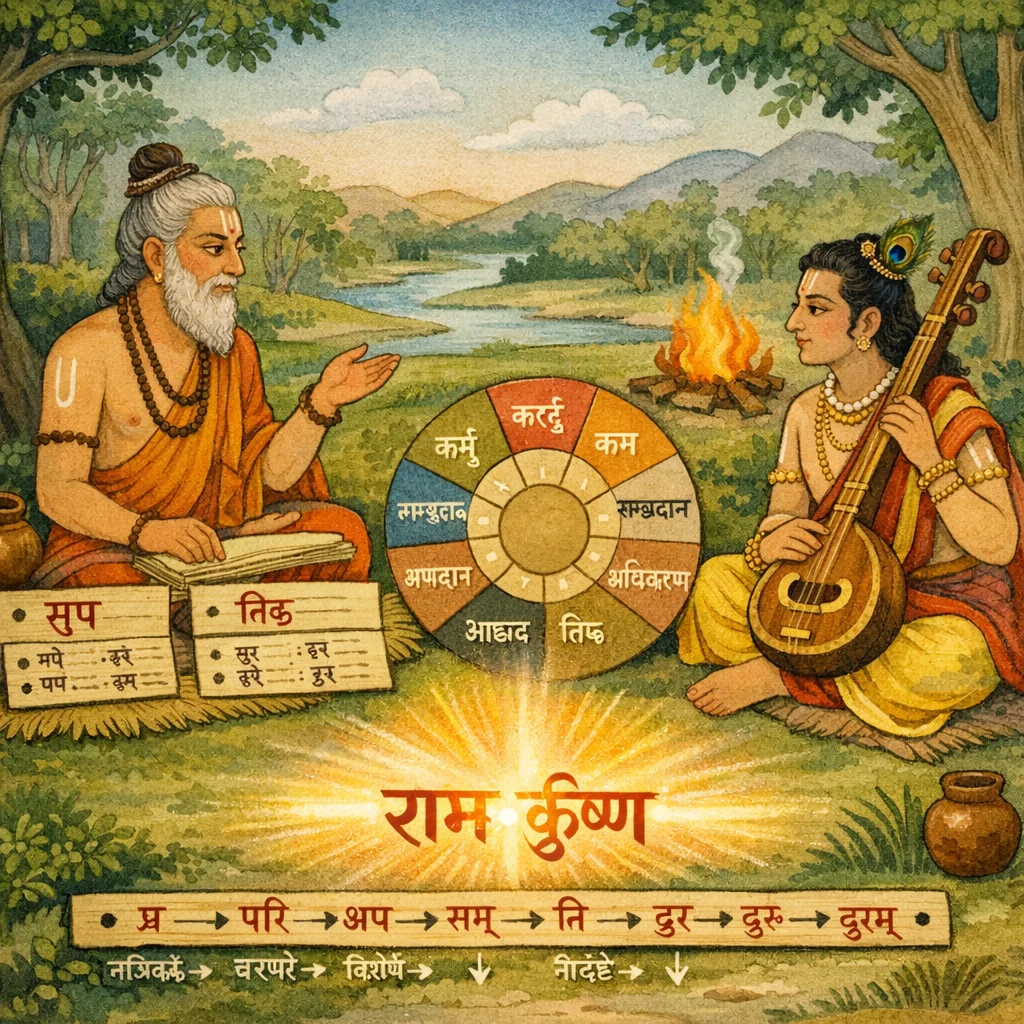
Vyākaraṇa-saṅgraha: Pada–Vibhakti–Kāraka–Lakāra–Samāsa
Sanandana teaches Nārada a compact syllabus of grammar, calling it the Veda’s interpretive “mouth.” He defines pada as a sup/tiṅ-terminated word, explains prātipadika, and correlates the seven vibhaktis with the kārakas (karma, karaṇa, sampradāna, apādāna, sambandha/ṣaṣṭhī, adhikaraṇa), noting key exceptions. He surveys upasarga meanings (especially “upa”) and special dative governance in formulas like namaḥ, svasti, svāhā. The lesson then turns to verbs: persons, parasmaipada/ātmanepada, the ten lakāras and their uses (mā sma + aorist; loṭ/liṅ for benediction; liṭ for remote past; lṛṭ/lṛṅ for future), gaṇas, and derivations (causative, desiderative, intensive, yaṅ-luk), with reflections on agency and transitivity. It concludes with compound types (avyayībhāva, tatpuruṣa, karmadhāraya, bahuvrīhi), taddhita lineage affixes, sample word-lists, and the affirmation that compounded divine names like “Rāma–Kṛṣṇa” signify one bhakti-worship of the one Brahman.
Shlokas
Verse 1
सनंदन उवाच । अथ व्याकरणं वक्ष्ये संक्षेपात्तव नारद । सिद्धरूपप्रबंधेन मुखं वेदस्य सांप्रतम् ॥ १ ॥
Sanandana said: Now, O Nārada, I shall teach you grammar in brief, through a systematic compendium of established forms, for at present it serves as the very ‘mouth’—the gateway—of the Veda.
Verse 2
सुप्तिङंतं पदं विप्र सुपां सप्त विभक्तयः । स्वौजसः प्रथमा प्रोक्ता सा प्रातिपदिकात्मिका ॥ २ ॥
O brāhmaṇa, a ‘word’ (pada) is that which ends in either sup (nominal case-endings) or tiṅ (verbal endings). The sup endings are arranged into seven vibhaktis (case-relations). ‘Su–au–jas’ are declared to be the first case (nominative), grounded in the prātipadika, the nominal base.
Verse 3
संबोधने च लिंगादावुक्ते कर्मणि कर्तरि । अर्थवत्प्रातिपदिकं धातुप्रत्ययवर्जितम् ॥ ३ ॥
A meaningful nominal base (prātipadika) is that which is used in address (vocative), wherein gender and the like are expressed; it is employed with reference to an object (karman) or an agent (kartṛ), and it is free from verbal roots and inflectional suffixes.
Verse 4
अमौसशो द्वितीया स्यात्तत्कर्म क्रियते च यत् । द्वितीया कर्मणि प्रोक्तान्तरांतरेण संयुते ॥ ४ ॥
The accusative (dvitīyā) is used for the object—that for whose sake an action is done. Thus the dvitīyā is declared to denote karma (the object), even when the relation is carried through intervening words or phrases.
Verse 5
टाभ्यांभिसस्तृतीया स्यात्करणे कर्तरीरिता । येन क्रियते तत्करणं सः कर्ता स्यात्करोति यः ॥ ५ ॥
The third case is taught with the endings ṭā, bhyām, and bhis—used for the instrumental sense, and in certain constructions also for the agent. That by which an action is accomplished is called karaṇa (instrument); the one who performs it is called kartā (agent).
Verse 6
ङेभ्यांभ्यसश्चतुर्थो स्यात्संप्रदाने च कारके । यस्मै दित्सा धारयेद्वै रोचते संप्रदानकम् ॥ ६ ॥
The fourth case (dative) is expressed by the endings ṅe, bhyām, and bhyas, and is used for the kāraka called sampradāna (the recipient). One to whom one intends to give, or for whose sake one undertakes an action, is termed sampradāna.
Verse 7
पंचमी स्यान्ङसिभ्यांभ्यो ह्यपादाने च कारके । यतोऽपैति समादत्ते अपदत्ते च यं यतः ॥ ७ ॥
The fifth case (pañcamī) is used with the endings ṅasi, bhyām, and bhyas for the kāraka called apādāna (the point of separation): that from which something departs, that from which something is taken, and that from which something is received.
Verse 8
ङसोसामश्च षष्ठी स्यात्स्वामिसंबंधमुख्यके । ङ्योस्सुपः सप्तमी तु स्यात्सा चाधिकरणे भवेत् ॥ ८ ॥
The case-ending (vibhakti) taught by the affixes Ṅas and Osām is the sixth case (genitive), chiefly expressing the relation of owner and possession. The case-ending indicated by Ṅyos and Sup is the seventh case (locative), and it denotes the locus or supporting basis (adhikaraṇa).
Verse 9
आधारे चापि विप्रेंद्र रक्षार्थानां प्रयोगतः । ईप्सितं चानीप्सितं यत्तदपादानकं स्मृतम् ॥ ९ ॥
O best of Brahmins, in actual usage, even with respect to a support (ādhāra), when something is employed for the sake of protection—whether desired or undesired—that is understood as the ablative relation called apādāna (a point of removal from the source).
Verse 10
पंचमी पर्यणङ्योगे इतरर्तेऽन्यदिङ्मुखे । एतैर्योगे द्वितीया स्यात्कर्मप्रवचनीयकैः ॥ १० ॥
When paryaṇañ is used in the sense of “otherwise/except,” and when it is directed toward another quarter, the fifth case-ending (ablative) is employed; but when these particles function in a karma-pravacanīya construction, the second case-ending (accusative) is used.
Verse 11
लक्षणेत्थंभूतोऽभिरभागे चानुपरिप्रति । अंतरेषु सहार्थे च हीने ह्युपश्च कथ्यते ॥ ११ ॥
The particle-prefix (upasarga) “upa” is taught as conveying the senses of indication (lakṣaṇa), “being such” (itthaṃbhūta), “towards/near” (abhi), “a part or portion” (bhāga), and also “following/around/towards” (anu, pari, prati). Further, it is used in the sense of “between/within” (antara), “together with” (saha), and “deficiency or inferiority” (hīna).
Verse 12
द्वितीया च चतुर्थी स्याञ्चेष्टायां गतिकर्मणि । अप्राणिषु विभक्ती द्वे मन्यकर्मण्यनादरे ॥ १२ ॥
In expressions of exertion, and with verbs denoting motion or action, both the accusative (second case) and the dative (fourth case) may be used. With inanimate objects as well, these two case-endings occur—especially in manyat (“to consider”) constructions and to convey disregard or slighting.
Verse 13
नमःस्वस्तिस्वधास्वाहालंवषड्योग ईरिता । चतुर्थी चैव तादर्थ्ये तुमर्थाद्भाववाचिनः ॥ १३ ॥
The words “namaḥ,” “svasti,” “svadhā,” “svāhā,” “alam,” and the ritual cry “vaṣaṭ” are taught as governing the fourth case (dative). The fourth case is also used to express “for the sake of that,” namely purpose; and the -tum infinitive, arising from a verbal root, denotes bhāva as an action intended to be done.
Verse 14
तृतीया सहयोगे स्यात्कुत्सितेंऽगे विशेषणे । काले भावे सप्तमी स्यादेतैर्योगे च षष्ठ्यपि ॥ १४ ॥
The third case-ending (instrumental) expresses association, being together with. It is also used when speaking of a contemptible limb or part, and when a qualifier (adjective) is applied to such a part. The seventh case-ending (locative) denotes time and state/condition; and in similar constructions the sixth (genitive) may also be used.
Verse 15
स्वामीश्वरोधिपतिभिः साक्षिदायादसूतकैः । निर्धारणे द्वे विभक्ती षष्टी हेतुप्रयोगके ॥ १५ ॥
With words such as “svāmī” (master), “īśvara” (Lord), “adhipati” (overlord), “sākṣī” (witness), “dāyāda” (heir), and “sūtaka” (one under ritual impurity), two case-endings are used in expressions of specification (nirdhāraṇa); but in causal usage the sixth case, the genitive (ṣaṣṭhī), is employed.
Verse 16
स्मृत्यर्थकर्मणि तथा करोतेः प्रतियत्नके । हिंसार्थानां प्रयोगे च कृतिकर्मणि कर्तरि ॥ १६ ॥
Likewise, when an act is performed for the sake of remembrance (smṛty-artha), and when √kṛ “to do” carries the sense of deliberate exertion; and in usages that convey injury; and in actions brought about by an agent’s intentional undertaking—the agent (kartṛ) is understood as the locus and subject of the action.
Verse 17
न कर्तृकर्मणोः षष्टी निष्टादिप्रतिपादिका । एता वै द्विविधा ज्ञेयाः सुबादिषु विभक्तिषु । भूवादिषु तिङतेषु लकारा दश वै स्मृताः ॥ १७ ॥
The sixth case-ending (ṣaṣṭhī, genitive) is not intended to denote the agent and the object; rather, it conveys participial senses such as those expressed by niṣṭā and the like. Thus, among the nominal inflections beginning with su, these case-endings are to be understood as of two kinds. And in the verbal system—among tiṅ-endings based on roots such as bhū—ten lākāras (tense/mood markers) are traditionally remembered.
Verse 18
तिप्त संतीति प्रथमो मध्यमः सिप्थस्थोत्तमः । मिव्वस्मसः परस्मै तु पादानां चा मपनेदम् ॥ १८ ॥
“Tipta” and “saṃtīti” are to be understood as the first and the middle forms; “sipthastha” is the best, the final form. And in parasmaipada (active usage) there is also the elision of the pāda-elements, the ending parts—this is the rule as stated.
Verse 19
त आतेंऽते प्रथमो मध्वः से आथे ध्वे तथोत्तमः । ए वहे मह आदेशा ज्ञेया ह्यन्ये लिङादिषु ॥ १९ ॥
The first set of endings is “ta, āte, ṁ’te”; then come “se, āthe”, with “dhve” as the highest. Likewise, the substitute forms “e, vahe, maha” are to be understood, and also other such forms in matters beginning with liṅga (grammatical gender) and related topics.
Verse 20
नाम्नि प्रयुज्यमाने तु प्रथमः पुरुषो भवेत् । मध्यमो युष्मदि प्रोक्त उत्तमः पुरुषोऽस्मदि ॥ २० ॥
When a name is used (as the subject in speech), it is treated as the first person. The second person is said to be the “yuṣmad” (you) form, and the third, the other person, is the “asmad” (I/we) form.
Verse 21
भूवाद्या धातवः प्रोक्ताः सनाद्यन्तास्तथा ततः । लडीरितो वर्तमाने भूतेऽनद्यतने तथा ॥ २१ ॥
The verbal roots beginning with “bhū” are taught, along with those formed with the san-ādi affixes. Thereafter, the lakāra “laṭ” is prescribed for the present tense, and likewise for the non-remote past.
Verse 22
मास्मयोगे च लङ् वाच्यो लोडाशिषि च धातुतः । विध्यादौ स्यादाशिषि च लिङितो द्विविधो मुने ॥ २२ ॥
O sage, in constructions with “mā sma” (“do not…”), laṅ (the aorist) should be used; and for benedictions (āśiṣ), loṭ (the imperative) is used from the verbal root. Likewise, liṅ (the optative) is employed in injunctions and also in benedictive sense—thus liṅ is of two kinds.
Verse 23
लिडतीते परोक्षे स्यात् श्वस्तने लुङ् भविष्यति । स्यादनद्यतने लृटू च भविष्यति तु धातुतः ॥ २३ ॥
For an action in the remote past, not directly witnessed, the liṭ is used; for an action of tomorrow, the luṅ is employed. For the non-immediate future as well, lṛṭ and lṛṅ are used—according to the verbal root.
Verse 24
भूते लुङ् तिपस्यपौ च क्रियायां लृङ् प्रकीर्तितः । सिद्धोदाहरणं विद्धि संहितादिपुरः सरम् ॥ २४ ॥
For actions in the past, the luṅ (aorist) is taught, together with the endings tip, tas, and jhi. For conditional or to-be-done actions, the lṛṅ is proclaimed. Know this as the established illustration, succinctly gathered from the Saṃhitā and related grammatical teachings.
Verse 25
दंडाग्रं च दधीदं च मधूदकं पित्रर्षभः । होतॄकारस्तथा सेयं लांगलीषा मनीषया ॥ २५ ॥
O best among the Pitṛs, there are also the “tip of the staff” (daṇḍāgra), the “giver of curds” (dadhīda), and “honey-water” (madhūdaka). Likewise, the Hotṛ-formula (hotṝkāra) and this “lāṅgalīṣā” are understood through reflective discernment.
Verse 26
गंगोदकं तवल्कार ऋणार्णं च मुनीश्वर । शीतार्तश्च मुनिश्रेष्ट सेंद्रः सौकार इत्यपि ॥ २६ ॥
O lord among sages, these are mentioned: Gaṅgā-water, bark-garments, and the burden of debt; and also, O best of sages, one afflicted by cold, together with Indra, and even the syllable “sau” as well.
Verse 27
वध्वासनं पित्रर्थो नायको लवणस्तथा । त आद्या विष्णवे ह्यत्र तस्मा अर्घो गुरा अधः ॥ २७ ॥
Here, the bridal seat, the rite meant for the Pitṛs, the leader of the rite, and salt—these are to be offered first to Viṣṇu. Therefore, the arghya-offering is to be placed below, with due weight and reverence.
Verse 28
हरेऽव विष्णोऽवेत्येषादसोमादप्यमी अधाः । शौरी एतौ विष्णु इमौ दुर्गे अमू नो अर्जुनः ॥ २८ ॥
“Hare!” and “O Viṣṇu!”—thus is this protective utterance. Even from the realm of Soma, and even from those below, may the two—Śaurī and Viṣṇu—protect us. In peril and hardship, may these two safeguard us; and may Arjuna, the valiant, be our defender.
Verse 29
आ एवं च प्रकृत्यैते तिष्टंति मुनिसत्तम । षडत्र षण्मातरश्च वाक्छुरो वाग्धस्रिथा ॥ २९ ॥
Thus, O best of sages, these remain established in their own nature. Here there are six—the Six Mothers—together with the powers of speech (vāk) and hearing (śrotra), abiding as supports of articulated sound.
Verse 30
हरिश्शेते विभुश्चिंत्यस्तच्छेषो यञ्चरस्तंथा । प्रश्नस्त्वथ हरिष्षष्ठः कृष्णष्टीकत इत्यपि ॥ ३० ॥
He is called Hari because He reclines; He is the all-pervading Lord, to be contemplated. He is also known as Śeṣa, and as that which moves everywhere. He is further called Praśna; also Hari-ṣaṣṭha; and likewise Kṛṣṇa-ṣṭīkata.
Verse 31
भवान्षष्ठश्च षट् सन्तः षट्ते तल्लेप एव च । चक्रिंश्छिंधि भवाञ्छौरिर्भवाञ्शौरिरित्यपि ॥ ३१ ॥
“You are the sixth; there are six ‘saints’; and for you there is also the ‘sixfold anointing/marking.’ Cut through (the foes) as the discus-bearer; you are Śauri—indeed, you are also called Śauri.”
Verse 32
सम्यङ्ङनंतोंगच्छाया कृष्णं वंदे मुनीश्वर । तेजांसि मंस्यते गङ्गा हरिश्छेत्ता मरश्शिवः ॥ ३२ ॥
O lord of sages, I bow to Kṛṣṇa—the all-pervading Infinite—by whose mere shade one attains the Supreme. The Gaṅgā is revered as His radiance; Hari is the remover of sins; and Śiva is the auspicious bestower of welfare.
Verse 33
राम ँकाम्यः कृप ँपूज्यो हरिः पूज्योऽर्च्य एव हि । रोमो दृष्टोऽबला अत्र सुप्ता इष्टा इमा यतः ॥ ३३ ॥
Rāma is the most desirable object of devotion; out of compassion He is to be worshipped. Indeed, Hari alone is worthy of worship and adoration. Here the hairs are seen to stand on end through bhakti, and these helpless women lie asleep—therefore this is the cherished marvel in this place.
Verse 34
विष्णुर्नभ्यो रविरयं गी फलं प्रातरच्युतः । भक्तैर्वद्योऽप्यंतरात्मा भो भो एष हरिस्तथा । एष शार्ङ्गी सैष रामः संहितैवं प्रकीर्तिता ॥ ३४ ॥
“This is Viṣṇu; from the navel arises the Sun. This is the hymn of praise; this is its fruit; in the morning one should remember Acyuta. Though He is the inner Self, devotees should proclaim, ‘O! O! This indeed is Hari!’ This is the bearer of the Śārṅga bow; this is Rāma. Thus the Saṃhitā is proclaimed.”
Verse 35
रामेणाभिहितं करोमि सततं रामं भजे सादरम् । रामेणापहृतं समस्तदुरितं रामाय तुभ्यं नमः । रामान्मुक्तिमभीप्सिता मम सदा रामस्य दासोऽस्म्यहम् । रामे रंजत् मे मनः सुविशदं हे राम तुभ्यं नमः ॥ ३५ ॥
I ever do what Rāma has enjoined; I worship Rāma with reverence. By Rāma all my sins are removed—O Rāma, to You I bow. From Rāma alone I always seek liberation; I am forever Rāma’s servant (dāsa). My mind delights in Rāma, becoming perfectly clear—O Rāma, to You I bow.
Verse 36
सर्व इत्यादिका गोपाः सखा चैव पतिर्हरिः ॥ ३६ ॥
The gopīs begin their address with “O All (sarva) …”; and to them Hari is at once their friend and their lord (husband).
Verse 37
सुश्रीर्भानुः स्वयंभूश्च कर्ता रौ गौस्तु नौरिति । अनङ्घान्गोधुग्लिट् च द्वे त्रयश्चत्वार एव च ॥ ३७ ॥
“(The terms are:) Suśrī, Bhānu, Svayaṃbhū, Kartā; also Rau; ‘Gauḥ’ and ‘Nauḥ’. Further, (the forms) Anaṅghān and Godhugliṭ; and the numerical groups two, three, and four as well.”
Verse 38
राजा पंथास्तथा दंडी ब्रह्महा पंच चाष्ट च । अष्टौ अयं मुने सम्राट् सविभ्रद्वपुङ्मनः ॥ ३८ ॥
O sage, this Sovereign (Time/Death), whose body and mind inspire awe, is said to have eight forms: the king, the path, the punisher who wields the rod, the slayer of a brāhmaṇa, the five elements, and also the group of eight.
Verse 39
प्रत्यङ् पुमान्महान् धीमान् विद्वान्षट् पिपठीश्च दोः । उशनासाविंमे पुंसि स्यारक्तलविरामकाः ॥ ३९ ॥
The inward-turned Person is great—steady in intelligence and truly learned. In such a man, the “six” (inner disciplines) are said to be well recited, and the “two” (outer organs) restrained; thus the impulses of passion and attachment come to rest.
Verse 40
राधा सर्वा गतिर्गोपी स्री श्रीर्धेनुर्वधूः स्वसा । गौर्नौरुपान् दूद्यौर्गोः क्षुत् ककुप्संवित्तु वा क्वचित् ॥ ४० ॥
Rādhā is the gopī who is the complete refuge and final goal of all. She is Śrī (Lakṣmī) herself—also the cow, the bride, and the sister. She becomes the cow, the boat, the footwear, and even the milk; and at times she appears as hunger, as a direction, or as one endowed with awareness.
Verse 41
रुग्विडुद्भाः स्रियास्तपः कुलं सोमपमक्षि च । ग्रामण्यंबुरवलप्वेवं कर्तृ चातिरि वातिनु ॥ ४१ ॥
He is the source of the Ṛg-veda; the manifest splendour; Śrī (prosperity); tapas (austerity); noble lineage; the Soma-drinker; the all-seeing eye; the leader of communities; the ocean-like one; the protector; the doer; the unsurpassed; and the swift-moving wind.
Verse 42
स्वनहुच्च विमलद्यु वाश्वत्वारीदमेव च । एतद्ब्रह्माहश्च दंडी असृक्किंचित्त्यदादि च ॥ ४२ ॥
“(These are further sacred/technical expressions:) ‘svanahucca’, ‘vimaladyu’, ‘vāśvatvāri’, ‘idam eva’, ‘etad’, ‘brahmāha’, ‘daṇḍī’, ‘asṛk’, ‘kiñcit’, ‘tyad’, and the like.”}]}}
Verse 43
एतद्वे भिद्गवाक्गवाङ् गोअक् गोङ्गोक् गोङ् । तिर्यग्यकृच्छकृच्चैव ददद्भवत्पचत्तुदत् ॥ ४३ ॥
Indeed, this is the phonetic division: “gavāk, gavāṅ; go’ak; goṅgok; goṅ.” Likewise, in the oblique/irregular forms and in the kṛccha-patterns are shown: “dadad, bhavat, pacat, tudat.”
Verse 44
दीव्यद्धनुश्च पिपठीः पयोऽदःसुमुमांसि च । गुणद्रव्य क्रियायोगांस्रिलिंगांश्च कति ब्रुवे ॥ ४४ ॥
“There are words such as dīvyad-dhanuḥ, pipaṭhīḥ, payo’daḥ, and su-mumāṁsi; and also the categories of qualities, substances, actions, relations/compounds, and feminine forms—how many of these should I expound?”
Verse 45
शुक्तः कीलालपाश्चैव शुचिश्च ग्रामणीः सुधीः । पटुः स्वयंभूः कर्ता च माता चैव व पिता च ना ॥ ४५ ॥
He is praised as eloquent, as the very essence of the sweet draught, and as pure; as the leader of all, truly wise, and supremely able. Self-born is He, the doer of all; to us He is both mother and father.
Verse 46
सत्यानाग्यास्तथा पुंसो मतभ्रमरदीर्घपात् । धनाकृसोमौ चागर्हस्तविर्ग्रथास्वर्णन्बहू ॥ ४६ ॥
Likewise, for a man, truthfulness and freedom from deceit are enjoined; and one should avoid delusion of opinion and the long fall into ruin. One should also shun craving for wealth and the wasting away of one’s vigor; and one should not engage in censurable livelihood, tangled conduct, or excessive attachment to gold.
Verse 47
रिमपव्विषाद्वजातानहो तथा सर्वं विश्वोभये चोभौ अन्यांतरेतराणि च ॥ ४७ ॥
Likewise, from joy and despondency arise their effects; and thus the whole universe—both pairs of opposites, and also the mutually interdependent relations between one and another—comes to be experienced.
Verse 48
उत्तरश्चोत्तमो नेमस्त्वसमोऽथ समा इषः । पूर्वोत्तरोत्तराश्चैव दक्षिणश्चोत्तराधरौ ॥ ४८ ॥
Uttara is the highest; Nemas is without equal; and then Iṣa is held to be its match. So too are Pūrvottara and Uttarā; and Dakṣiṇa is paired with Uttarādhara.
Verse 49
अपरश्चतुरोऽप्येतद्यावत्तत्किमसौ द्वयम् । युष्मदस्मञ्च प्रथमश्चरमोल्पस्तथार्धकः ॥ ४९ ॥
Further, there are four forms of “etad” up to “tat”, and the two pronouns “kim” and “asau”. Likewise, “yuṣmad” and “asmad”—their first and last forms—together with the “alpa” (small/indefinite) and “ardhaka” (half/partial) forms are to be understood.
Verse 50
नोरः कतिपयो द्वे च त्रयो शुद्धादयस्तथा । स्वेकाभुविरोधपरि विपर्ययश्चाव्ययास्तथा ॥ ५० ॥
“noraḥ”, “katipayaḥ”, “dve”, “ca”, “trayaḥ”, and words beginning with “śuddha”; likewise “sva”, “eka”, “abhu”, “virodha”, “pari”, and “viparyaya”—all these too are to be understood as indeclinables (avyaya).
Verse 51
तद्धिताश्चाप्यपत्यार्थे पांडवाः श्रैधरस्तथा । गार्ग्यो नाडायनात्रेयौ गांगेयः पैतृष्वस्रीयः ॥ ५१ ॥
Taddhita (secondary derivational) affixes are also used to convey the sense of lineage or offspring; thus arise forms such as Pāṇḍava and Śraidhara, and likewise Gārgya, Nāḍāyana, Ātreya, Gāṅgeya, and Paitṛṣvasrīya.
Verse 52
देवतार्थे चेदमर्थे ह्यैद्रं ब्राह्मो हविर्बली । क्रियायुजोः कर्मकर्त्रोर्धैरियः कौङ्कुमं तथा ॥ ५२ ॥
If the intention is for the deities, the offering is to be understood as belonging to Indra’s sphere; if it is for a Brahmanical sacred purpose, it is a havis-offering and a bali. Likewise, for one who joins the rite with its proper application and for the doer of the act, steadfastness (dhairya) is enjoined—and so too the use of kauṅkuma (saffron/vermillion).
Verse 53
भवाद्यर्थे तु कानीनः क्षत्रियो वैदिकः स्वकः । स्वार्थे चौरस्तु तुल्यार्थे चंद्रवन्मुखमीक्षते ॥ ५३ ॥
In the conventional sense beginning with “bhava,” the term is taken as kānīna; in another usage, as kṣatriya; and in Vedic usage, as svaka. In its primary sense it means caura (a thief), yet in an equivalent figurative sense it is said to “gaze upon a moon-like face.”
Verse 54
ब्राह्मणत्वं ब्राह्मणता भावे ब्राह्मण्यमेव च । गोमान्धनी च धनवानस्त्यर्थे प्रमितौ कियान् ॥ ५४ ॥
“Brahminhood,” “being a Brahmin,” and “Brahmin-ness” are all terms denoting the same state. Likewise, “one possessing cows,” “one possessing grain/wealth,” and “a wealthy man” are used with the same intent; so what difference of measure can there be in the meaning meant?
Verse 55
जातार्थे तुंदिलः श्रद्धालुरौन्नत्त्ये तु दंतुरः । स्रग्वी तपस्वी मेधावी मायाव्यस्त्यर्थ एव च ॥ ५५ ॥
In the sense of one’s birth-condition he is called Tuṇḍila (pot-bellied); in the sense of faith, Śraddhālu (one endowed with śraddhā); and in the sense of loftiness, Dantura. He is also called Sragvī (garlanded), Tapasvī (practising tapas), Medhāvī (wise), and Māyāvī (skilled in stratagem)—these indeed are the intended meanings.
Verse 56
वाचालश्चैव वाचाटो बहुकुत्सितभाषिणि । ईषदपरिसमाप्तौ कल्पव्देशीय एव च ॥ ५६ ॥
One is also called vācāla (talkative), vācāṭa (chattering), a speaker of many contemptible words, one who leaves statements slightly unfinished, and one who speaks as though offering only conjectural directions (kalpadeśīya).
Verse 57
कविकल्पः कविदेश्यः प्रकारवचने तथा । पटुजातीयः कुत्सायां वैद्यपाशः प्रशंसने ॥ ५७ ॥
The expressions “kavikalpa” and “kavideśya” are used in the sense of describing a manner or mode (prakāra). Likewise, “paṭu-jātīya” is employed when conveying censure, while “vaidya-pāśa” is used when conveying praise.
Verse 58
वैद्यरूपो भूतपूर्वे मतो दृष्टचरो मुने । प्राचुर्यादिष्वन्नमयो मृण्मयः स्रीमयस्तथा ॥ ५८ ॥
O sage, in former times he was regarded as one who wandered about in the guise of a physician; and, according to the abundance of a place or condition, he is said to be made of food, made of clay, and likewise made of prosperity.
Verse 59
जातार्थे लज्जितोऽत्यर्थे श्रेयाञ्छ्रेष्टश्च नारद । कृष्णतरः शुक्लतमः किम आख्यानतोऽव्ययान् ॥ ५९ ॥
O Nārada, one may be deeply ashamed of worldly aims, yet still be called “more beneficial” and “most excellent.” What use, then, is there in recounting imperishable matters with mere comparisons such as “darker” or “whiter”?
Verse 60
किंतरां चैवातितरामभिह्युच्चैस्तरामपि । परिमाणे जानुदघ्नं जानुद्वयसमित्यपि ॥ ६० ॥
They are also termed “kintarā”, “atitarā”, and even “abhihyuccais-tarā” (“very lofty”). In measure, they are said to reach up to the knee, and also to be equal to both knees (knee-high or a two-knee measure).
Verse 61
जानुमात्रं च निर्द्धारे बहूनां च द्वयोः क्रमात् । कतमः कतरः संख्येयविशेषावधारणे ॥ ६१ ॥
“Up to the knee” is used when determining a measure. When arranging many items, and also when ordering two, the terms “katama” and “katara” are employed to ascertain a specific one among countable alternatives.
Verse 62
द्वितीयश्च तृतीयश्च चतुर्थः षष्टपंचमौ । एतादशः कतिपयः कतिथः कति नारद ॥ ६२ ॥
“The second, the third, and the fourth; the sixth and the fifth”—thus, in this manner, some are reckoned as “a few”, and some as “a certain number”. How many are there, O Nārada?
Verse 63
विंशश्च विंशतितमस्तथा शततमादयः । द्वेधा द्वैधा द्विधा संख्या प्रकारेऽथ मुनीश्वर ॥ ६३ ॥
“Twenty, the twentieth, and likewise the hundredth and the rest—numbers are expressed in two ways, in double forms, and also as ‘dvidhā’ (‘in twofold manner’), according to usage, O lord of sages.”
Verse 64
क्रियावृत्तौ पंचकृत्वो द्विस्रिर्बहुश इत्यपि । द्वितयं त्रितपं चापि संख्यायां हि द्वयं त्रयम् ॥ ६४ ॥
“In the context of actions (ritual performance and repeated doing), the expressions ‘five times,’ ‘twice or thrice,’ and ‘many times’ are used. Likewise, in numerical counting, the terms ‘a pair’ and ‘a triad’ simply denote ‘two’ and ‘three’.”
Verse 65
कुटीरश्च शमीरश्च शुंडारोऽल्पार्थके मतः । त्रैणः पौष्णस्तुंडिभश्च वृंदारककृषीवलौ ॥ ६५ ॥
“Kuṭīra, Śamīra, and Śuṇḍāra are regarded as terms meaning ‘of little worth’ (insignificant). Likewise, Traiṇa, Pauṣṇa, and Tuṇḍibha are synonymous terms; and so too are Vṛndāraka and Kṛṣīvala.”
Verse 66
मलिनो विकटो गोमी भौरिकीविधमुत्कटम् । अवटीटोवनाटे निबिडं चेक्षुशाकिनम् ॥ ६६ ॥
“Impure, grotesque, and foul-smelling—terrifying in form; dwelling in pits and forests, dense with darkness, and haunting the sugarcane-groves—such are the dreadful beings described.”
Verse 67
निबिरीसमेषुकारी वित्तोविद्याञ्चणस्तथा । विद्याथुंचुर्बहुतिथं पर्वतः शृंगिणस्तथा ॥ ६७ ॥
“Also mentioned are Nibirīsa, Meṣukārī, Vitto-vidyāñcaṇa, Vidyāthuṃcu, Bahutitha, and likewise the mountain called Śṛṃgin.”}]}}}json_schema code: {
Verse 68
स्वामी विषमरूप्यं चोपत्यकाधित्यका तथा । चिल्लश्च चिपिटं चिक्वं वातूलः कुतपस्तथा ॥ ६८ ॥
(He is called) the Lord (Svāmī), the One of unequalled form; also Upatyakā and Ādhityakā; Cilla, Cipiṭa, Cikva; Vātūla; and likewise Kutapa.
Verse 69
वल्लश्व हिमेलुश्च कहोडश्चोपडस्ततः । ऊर्णायुश्च मरूतश्चैकाकी चर्मण्वती तथा ॥ ६९ ॥
Then were mentioned Vallaśva, Himelu, Kahoḍa, and thereafter Upaḍa; also Ūrṇāyu, Marūta, Ekākī, and likewise Carmaṇvatī.
Verse 70
ज्योत्स्ना तमिस्राऽष्टीवच्च कक्षीवद्य्रर्मण्वती । आसंदी वञ्च चक्रीवत्तूष्णीकां जल्पतक्यपि ॥ ७० ॥
Moonlight turns into darkness; even what is firm becomes unstable; what should be a refuge proves constricting. A seat becomes a snare; and even one who sits silent is, in truth, still “speaking” through inner agitation.
Verse 71
कंभश्च कंयुः कंवश्च नारदकेतिः कंतुः कंतकंपौ शंवस्तथैव च । शंतः शंतिः शंयशंतौ शंयोहंयुः शुभंयुवत् ॥ ७१ ॥
“(These are further sacred epithets to be recited:) Kambha, Kaṃyu, Kaṃva, Nārada-keti, Kaṃtu, Kantakaṃpa, and likewise Śaṃva; also Śaṃta, Śaṃti, Śaṃyaśaṃta, Śaṃyohaṃyu, and Śubhaṃyuvat.”
Verse 72
भवति बगभूव भविता भविष्यति भवत्वभवद्भघवेच्चापि ॥ ७२ ॥
“It is; it became; it will become; let it be; it was not—yet even so, all such verbal forms are but expressions addressed to the Blessed One, Bhagavān.”
Verse 73
भूयादभूदभविष्यल्लादावेतानि रूपाणि । अत्ति जघासात्तात्स्यत्यत्त्वाददद्याद्द्विरघसदात्स्यत् ॥ ७३ ॥
“May it become,” “it became,” and “it will become”—these are the verbal forms beginning with the l- (lakāra) endings. Likewise: “he eats” (atti), “he ate” (jaghāsa), “he will eat” (tātsyat), “because of the state of being ‘eating’” (attvāt), “he should eat” (adadyāt), and “he will eat again” (dvir-aghāsadātsyat)—all are illustrative forms.
Verse 74
जुहितो जुहाव जुहवांचकार होता होष्यति जुहोतु । अजुहोज्जुहुयाद्धूयादहौषीदहोष्यद्दीव्यति । दिदेव देविता देविष्यति च अदीव्यद्दीव्येद्दीव्याद्वै ॥ ७४ ॥
“(Forms such as:) ‘juhita’, ‘juhāva’, ‘juhavāṃcakāra’; ‘hotā’, ‘hoṣyati’, ‘juhotu’; ‘ajuhoḥ’, ‘juhuyāt’, ‘dhūyāt’, ‘ahauṣīt’, ‘ahoṣyat’; and ‘dīvyati’, ‘dideva’, ‘devitā’, ‘deviṣyati’, ‘adīvyat’, ‘dīvyet’, ‘dīvyāt’—indeed, these are correct verbal forms.”
Verse 75
अदेवीददेवीष्यत्सुनोति सुषाव सोता सोष्यति वै । सुनोत्वसुनोत्सुनुयात्सूयादशावीदसोष्युत्तुदति च ॥ ७५ ॥
“He has pressed (the Soma); he will press; he presses. He has pressed well. The presser will press indeed. ‘Let him press’; ‘he pressed’; ‘he should press’; ‘he may press’; ‘he has pressed’; ‘he had pressed’; ‘he will have pressed’—and he also impels (another) to press.”
Verse 76
तुतोद तोत्ता तोत्स्यति तुदत्वतुदत्तुदेत्तुद्याद्धि । अतौत्सीदतोत्स्यदिति च रुणद्धि रूरोध रोद्धा रोत्स्यति वै ॥ ७६ ॥
“From the verbal root tud (‘to strike’): one says tutoda (he struck), tottā (the striker), and totsyati (he will strike); likewise: tudat (striking), tudatva (the state/act of striking), tudetta (may he strike), and tudyāt (he should strike), indeed. And from the root rudh (‘to obstruct’): atautsīt (he struck—illustrative aorist), atotsyat (he will strike—illustrative future); and also ruṇaddhi (he obstructs), rūrodha (he obstructed), roddhā (the obstructer), and rotsyati (he will obstruct), indeed.
Verse 77
रुणद्धु अरुणद्रुध्यादरौत्सीदारोत्स्यञ्च । तनोति ततान तनिता तनिष्यति तनोत्वतनोत्तनुयाद्धि ॥ ७७ ॥
“(Conjugations:) ruṇaddhu; aruṇa; (the optative) drudhyāt; (the aorist) arautsīt; and (the future) ārotsya. Likewise: tanoti; (perfect) tatāna; (agent noun) tanitā; (future) taniṣyati; (imperative) tanotu; (aorist) vatanot; and (optative) tanuyāt indeed.”
Verse 78
अतनीञ्चातानीदतनिष्यत्क्रीणाति चिक्राय क्रेता क्रेष्यति क्रीणात्विति च । अक्रीणात्क्रीणात्क्रीणीयात्क्रीयादक्रैषीदक्रेष्यञ्चोरयति चोरयामास चोरयिता चोरयिष्यति चोरयतु ॥ ७८ ॥
“(Examples of verbal forms:) ‘he stretched’, ‘he stretched out’, ‘he will stretch’; likewise: ‘he buys’, ‘he bought’, ‘buyer’, ‘he will buy’, ‘let him buy’. Also: ‘he did not buy’, ‘he bought’, ‘he should buy’, ‘may be bought’, ‘he caused (another) to buy’, ‘to be bought’. Similarly: ‘he steals’, ‘he stole’, ‘thief’, ‘he will steal’, ‘let him steal’.”
Verse 79
अचोरयञ्चोरयेच्चोर्यात् अचूचुरदचोरिष्यदित्येवं दश वै गणाः । प्रयोजके भावयति सनीच्छायां बुभूषति । क्रियासमभिहारे तु पंडितो बोभूयते मुने ॥ ७९ ॥
Thus there are indeed ten conjugational groupings (gaṇas), illustrated by forms such as: “let him cause to steal,” “he may cause to steal,” “he would steal,” “they stole,” and “he will not steal.” In the causative it means “he makes another do”; in the desiderative it means “he wishes to become/do”; and in the intensive it signifies repeated or emphatic performance of an action—O sage.
Verse 80
तथा यङ्लुकि बोभवीति च पठ्यते । पुत्रीयतीत्यात्मनीच्छायां तथाचारेऽपि नारद । अनुदात्तञितो धातोः क्रियाविनिमये तथा ॥ ८० ॥
Likewise, when the yaṅ-affix is elided (yaṅ-luk), the form “bobhavīti” is also read. And “putrīyati” is used in the sense of one’s own desire (to have a son); so too in customary usage, O Nārada. In the same way, for a verbal root marked with an anudātta and the indicatory letter Ñ (anudātta-Ñit), there is interchange of actions (kriyā-vinimaya).
Verse 81
निविशादेस्तथा विप्र विजानीह्यात्मनेपदम् । परस्मैपदमाख्यातं शेषात्कर्तारि शाब्दिकैः ॥ ८१ ॥
Likewise, O brāhmaṇa, know that verbs beginning with “niviś-” (and the like) are to be used in the Ātmanepada. For the remaining verbs, the grammarians declare the Parasmaipada to be used when the sense is active (kartari).
Verse 82
ञित्स्वरितेतश्च उभे यक्च स्याद्भावकर्मणोः । सौकर्यातिशयं चैव यदाद्योतयितुं मुने ॥ ८२ ॥
And the grammatical markers ñit and svarita, as well as both forms of yaK, are used with reference to (either) state/action (bhāva) and object/act (karman), so as to clearly indicate—O sage—an exceptional sense of ease or facility in expression.
Verse 83
विवक्ष्यते न व्यापारो लक्ष्ये कर्तुस्तदापरे । लभंते कर्तृते पश्य पच्यते ह्योदनः स्वयम् ॥ ८३ ॥
When one intends to act, there is in truth no ‘operation’ that belongs to the agent as the goal; people merely impute agency to a doer. Behold—rice is cooked, as it were, by itself.
Verse 84
साधु वासिश्छिनत्त्येवं स्थाली पचति वै मुने । धातोः सकर्मकाद्भावे कर्मण्यपि लप्रत्ययाः ॥ ८४ ॥
“Well said!” Thus, O sage: “the adze cuts” and “the cooking-pot cooks.” Even when a verbal root is transitive (sakarmaka), the kṛt-affix “la” may be applied in the sense of the action (bhāva) and also in the sense of the object (karma).
Verse 85
तस्मै वाकर्मकाद्विप्र भावे कर्तरि कीर्तितः । फलव्यापरयोरेकनिष्टतायामकर्मकः ॥ ८५ ॥
Therefore, O brāhmaṇa, a verb is declared intransitive (akarmaka) when, in expressing a state (bhāva) or an agent (kartṛ), the result (phala) and the activity (vyāpāra) are lodged in one and the same locus.
Verse 86
धातुस्तयोर्द्धर्मिभेदे सकर्मक उदाहृतः । गौणे कर्मणि द्रुह्यादेः प्रधाने नीहृकृष्वहाम् ॥ ८६ ॥
When, between the two (agent and object), there is a difference in their respective roles (dharmī-bheda), the verbal root is taught to be transitive (sakarmaka). Where the object is secondary, roots such as druh (“to harm”) are cited; where the object is primary, roots such as nī (“to lead”), hṛ (“to carry away”), kṛṣ (“to draw/drag”), vah (“to carry”), and hā (“to abandon”) are given as examples.
Verse 87
बुद्धिभक्षार्थयोः शब्दकर्मकाणां निजेच्छया । प्रयोज्य कर्मण्यन्येषां ण्यंतानां लादयो मताः ॥ ८७ ॥
In verbs whose sense is “causing to know” or “causing to eat,” and in those that take an object expressed as a word, the causative (ṇyanta) may be employed at one’s own discretion; and for other verbs too, the la- endings (la-ādi) are understood to apply to such causative forms when used in the sense of making another perform an action.
Verse 88
फलव्यापारयोर्द्धातुराश्रये तु तिङः स्मृताः । फले प्रधानं व्यापारस्तिङ्र्थस्तु विशेषणम् ॥ ८८ ॥
With the root (dhātu) as the support of both result (phala) and action/process (vyāpāra), the verbal endings (tiṅ) are taught. When the result is expressed, the action is primary, while the meaning conveyed by the tiṅ-ending serves as a qualifying modifier.
Verse 89
एधितव्यमेधनीयमिति कृत्ये निदर्शनम् । भावे कर्मणि कृत्याः स्युः कृतः कर्तरि कीर्तिताः ॥ ८९ ॥
“It is to be increased” and “it is fit to be kindled”—these are illustrations of kṛtya-type forms. kṛtya affixes are used when the sense is action-as-such (bhāva) or when the object is foregrounded (karmaṇi), whereas the kṛt past participle “kṛta” is taught for use when the agent is intended (kartari).
Verse 90
कर्ता कारक इत्याद्या भूते भूतादि कीर्तितम् । गम्यादिगम्ये निर्दिष्टं शेषमद्यतने मतम् ॥ ९० ॥
In the past (bhūta), meanings such as “agent” (kartṛ) and “case-relation” (kāraka) are explained under the heading “bhūta” along with its allied forms. Likewise, the set beginning with “gamya” is prescribed for what is to be reached or understood. The remaining forms are held to belong to the present (adyatana).
Verse 91
अधिस्रीत्यव्ययीभावे यथाशक्ति च कीर्तितम् । रामाश्रितस्तत्पुरुषे धान्यार्थो यूपदारु च ॥ ९१ ॥
In the indeclinable compound (avyayībhāva), the usage “adhisrītya” has been stated as far as possible. In a tatpuruṣa compound, examples include “rāmāśrita” (“one who has taken refuge in Rāma”), as well as words conveying the sense of grain (dhānya) and of sacrificial post-wood (yūpa-dāru).
Verse 92
व्याघ्रभी राजपुरुषोऽक्षशौंडो द्विगुरुच्यते । पंचगवं दशग्रामी त्रिफलेति तु रूढितः ॥ ९२ ॥
A “tiger-fearing” man is called a royal officer; a gambler is termed “one with two teachers.” The mixture of five cow-products is known as “pañcagavya”; “daśagrāmī” denotes a measure pertaining to ten villages; and “triphala” is the established conventional name for the three fruits.
Verse 93
नीलोत्पलं महाषष्टी तुल्यार्थे कर्मधारयः । अब्राह्मणो न ञि प्रोक्तः कुंभकारादिकः कृता ॥ ९३ ॥
In compounds such as nīlotpala (“blue lotus”), the relation is taken as the ‘great genitive’ (mahā-ṣaṣṭhī); and when the sense is that of likeness (tulya-artha), it is a karmadhāraya compound. Further, the taddhita affix Ñi is not taught after “a-brāhmaṇa” (non-Brāhmaṇa), whereas forms like kumbhakāra (“potter”) and the like are accepted as established derivatives.
Verse 94
अन्यार्थे तु बहुव्रीहौ ग्रामः प्राप्तोदको द्विज । पंचगू रूपवद्भार्यो मध्याह्नः ससुतादिकः ॥ ९४ ॥
But when a bahuvrīhi compound conveys a meaning other than the literal sense of its members, O twice-born one, it denotes: “a village that has obtained water,” “one who possesses five cows,” “one who has a beautiful wife,” and “midday along with its attendant elements (such as the sun at its zenith).”
Verse 95
समुच्चये गुरुं चेशं भजस्वान्वाचये त्वट ॥ च द्वयोः क्रमात् । भिक्षामानय गां चापि वाक्यमेवानयोर्भवेत् ॥ ९५ ॥
In a combined injunction (samuccaya), one should worship the Guru and the Lord (Īśa); and where there are two alternative injunctions, the order is to be followed. Likewise, in commands such as “Bring alms (bhikṣā)” and “Bring a cow,” the operative force lies in the verbal instruction itself.
Verse 96
इतरेतरयोगे तु रामकृष्णौ समाहृतौ । रामकृष्णं द्विज द्वै द्वै ब्रह्म चैकमुपास्यते ॥ ९६ ॥
But in mutual conjunction (itaretara-yoga), the names “Rāma” and “Kṛṣṇa” are brought together; O twice-born one, by worshipping “Rāma-Kṛṣṇa”—though spoken as two—one worships the single Brahman.
Frequently Asked Questions
Because Vyākaraṇa supplies the operative access-point for Vedic meaning: it determines correct word-forms, case-relations, verb-usage, and derivation, without which mantra, ritual injunctions, and doctrinal statements can be misread or misapplied.
It presents each vibhakti as a marker of a kāraka relation—accusative for karma (object), instrumental for karaṇa (instrument) and sometimes kartṛ (agent), dative for sampradāna (recipient/purpose), ablative for apādāna (separation/source), genitive for sambandha (possession/relation), and locative for adhikaraṇa (locus), including stated exceptions based on particles and pragmatic intent.
Ritual speech and injunctions depend on correct tense/mood: prohibitions (mā sma) align with aorist usage, blessings align with loṭ/liṅ, narrative temporality uses liṭ/luṅ/lṛṭ/lṛṅ distinctions, and these choices affect how commands, permissions, and intended actions are construed in Vrata-kalpa and Mokṣa-dharma contexts.