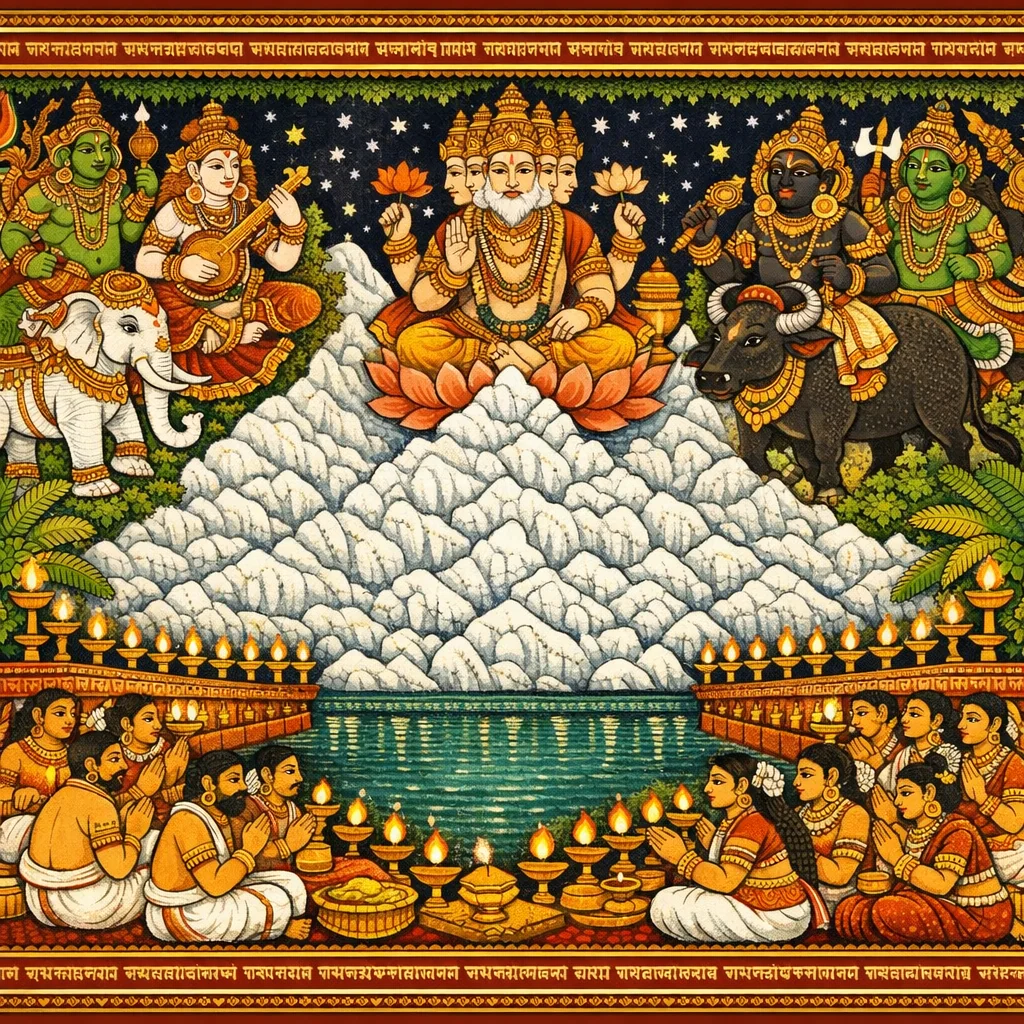
Adhyaya 84: The Rite of Donating the ‘Mountain of Salt’ (Lavaṇācala-dāna)
लवणाचलदानविधिः
Speaker: Īśvara (the Lord)
Īśvara continues the previously set dāna framework and now teaches the supreme Lavaṇācala, the donation of a “Mountain of Salt.” He prescribes three graded amounts in droṇas, allows reduced performance for those of limited means, and gives proportional rules for the transverse span and the mountain-like projecting parts. He directs that the earlier deity-installation be repeated—Brahmā and the others—together with golden Lokapālas, along with sacred tanks, arrangements for Kāma-deva, and an all-night vigil. Finally, he imparts gift-mantras praising salt’s origin (Saubhāgya lake; Viṣṇu’s body), its necessity for taste and health, and promises the donor residence in Umā’s realm for a kalpa and then the highest state.
Key Concepts
Shlokas in Adhyaya 84
Verse 1
*ईश्वर उवाच अथातः सम्प्रवक्ष्यामि लवणाचलमुत्तमम् यत्प्रदानान्नरो लोकान् आप्नोति शिवसंयुतान् //
The Lord said: Now I shall fully expound the supreme Lavaṇācala; by making its donation, a man attains worlds endowed with Śiva—namely, the auspicious state and realms associated with Śiva.
Verse 2
उत्तमः षोडशद्रोणैः कर्तव्यो लवणाचलः मध्यमः स्यात्तदर्धेन चतुर्भिरधमः स्मृतः //
A salt-mound (Lavaṇācala) of the best grade should be made with sixteen droṇas; the middling grade is made with half of that; and the inferior grade is traditionally stated to be made with four (droṇas).
Verse 3
वित्तहीनो यथाशक्त्या द्रोणादूर्ध्वं तु कारयेत् चतुर्थांशेन विष्कम्भपर्वतान्कारयेत्पृथक् //
If one is short of resources, one should build it according to one’s ability, beginning from the standard measure of one droṇa and upward; and the transverse spans and the projecting, “mountain-like” members should be made separately at one-fourth of the main measure.
Verse 4
विधानं पूर्ववत्कुर्याद् ब्रह्मादीनां च सर्वदा तद्वद्धेममयान्सर्वांल् लोकपालान्निवेशयेत् //
One should always carry out the prescribed rite for Brahmā and the other deities exactly as stated earlier; likewise, one should install all the Lokapālas, the guardians of the directions, fashioned in gold.
Verse 5
सरांसि कामदेवादींस् तद्वदत्रापि कारयेत् कुर्याज्जागरणं चापि दानमन्त्रान्निबोधत //
In the same manner, one should have sacred tanks (reservoirs) made here as well, and likewise arrange the installation and worship of Kāma-deva and other deities. One should also keep a ritual night-vigil (jāgaraṇa); now learn the mantras prescribed for giving gifts (dāna).
Verse 6
सौभाग्यसरः सम्भूतो यतो ऽयं लवणो रसः तद्दानकर्तृकत्वेन त्वं मां पाहि नगोत्तम //
From the Lake of Saubhāgya has arisen this salty essence. Therefore, by the power of that gift and as its benefactor, protect me, O best of mountains.
Verse 7
यस्मादन्नरसाः सर्वे नोत्कटा लवणं विना प्रियं च शिवयोर्नित्यं तस्माच्छान्तिं प्रयच्छ मे //
Since all the flavors of food are not fully relishable without salt—and since it is ever dear to Śiva and his consort—therefore, grant me peace (śānti).
Verse 8
विष्णुदेहसमुद्भूतं यस्मादारोग्यवर्धनम् तस्मात्पर्वतरूपेण पाहि संसारसागरात् //
Since this sacred power has arisen from the body of Viṣṇu and therefore increases health and well-being, hence—O Lord—protect me/us from the ocean of saṃsāra, taking the form of a mountain, a firm refuge.
Verse 9
अनेन विधिना यस्तु दद्याल्लवणपर्वतम् उमालोके वसेत्कल्पं ततो याति परां गतिम् //
Whoever, following this prescribed procedure, donates a “mountain of salt,” dwells for a kalpa in Umā’s world; thereafter, he attains the supreme state.
Frequently Asked Questions
It teaches the complete procedure (vidhi) for constructing and donating a Lavaṇācala—an offering shaped as a ‘mountain of salt’—including graded droṇa measurements, proportional design rules, deity and Lokapāla installations, a night vigil, and specific mantras, along with the promised spiritual fruits (Umā-loka for a kalpa and then the supreme state).
Primarily Dharma in the form of dāna-vidhi (ritual-gift law) with strong Vastu/architectonic elements (measures, proportions, constructed form, and installations). Genealogy and creation narratives are not central here, except for brief mythic framing of salt’s origin (Saubhāgya lake; Viṣṇu’s body).