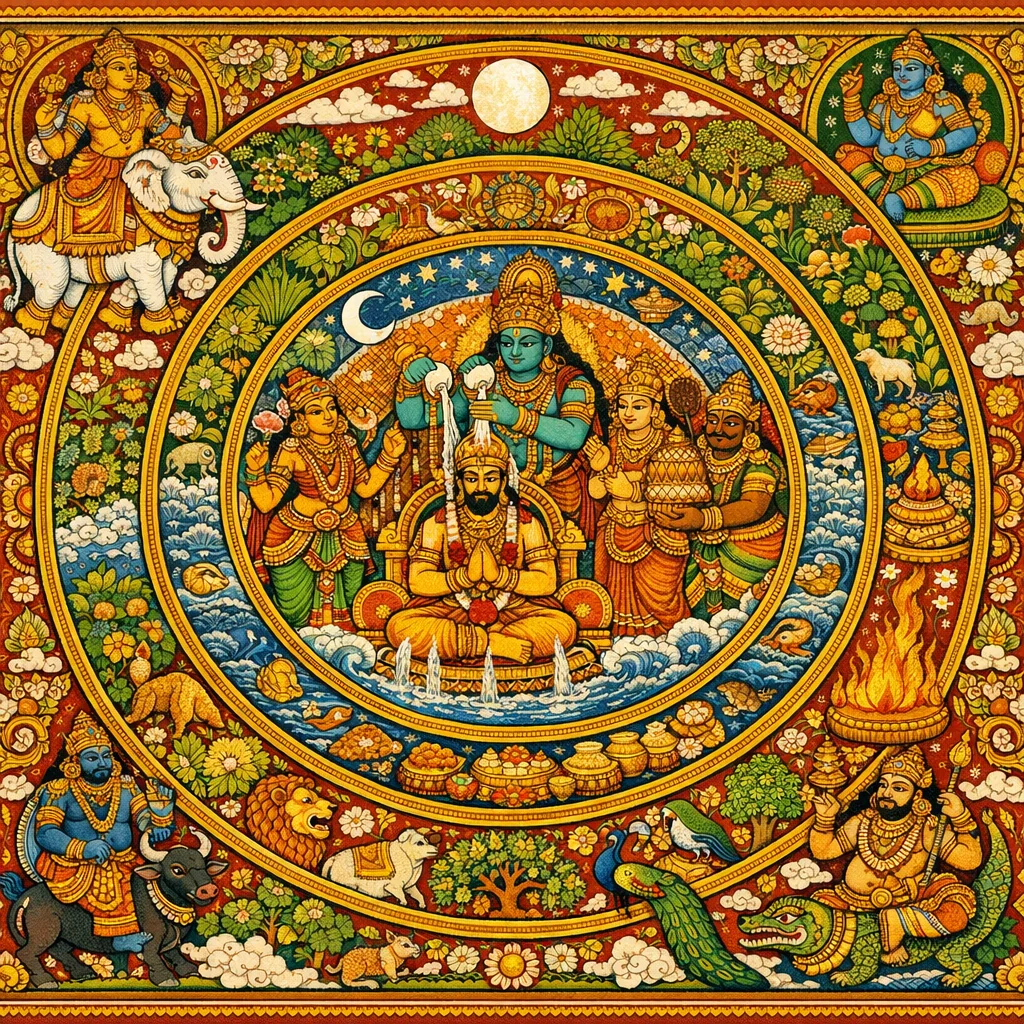
Adhyaya 8: Secondary Creation: Appointment of Cosmic Regents and Consecration of Directional Guardians
प्रतिसर्गे अधिपनियोजनं दिशामधीशाभिषेकश्च
Speaker: Rishis, Sūta
After hearing of primary creation, the sages ask Sūta to explain secondary creation and the rulers who preside over each cosmic cycle. Sūta describes Pṛthu’s universal consecration and his orderly appointment of adhipas: lunar, stellar, elemental, divine, and chthonic powers; then superintendents over mountains, waters, celestial musicians, nāgas, birds, horses, and archetypal chiefs among animals and trees. Brahmā then re-consecrates the rulers of the directions, naming guardians of the east, south, west, and north. The chapter ends by placing Pṛthu’s role across manvantara transitions—after Cākṣuṣa and into Vaivasvata—where he becomes a Prajāpati for all beings, marked by his solar-lineage identity.
Key Concepts
Shlokas in Adhyaya 8
Verse 1
*ऋषय ऊचुः आदिसर्गश्च यः सूत कथितो विस्तरेण तु प्रतिसर्गश्च ये येषाम् अधिपास् तान्वदस्व नः //
The sages said: “O Sūta, you have described the primary creation (ādi-sarga) in detail. Now tell us also of the secondary creation (prati-sarga), and of the presiding rulers of each cycle—who they are.”
Verse 2
*सूत उवाच यदाभिषिक्तः सकलाधिराज्ये पृथुर्धरित्र्यामधिपो बभूव तदौषधीनामधिपं चकार यज्ञव्रतानां तपसां च चन्द्रम् //
Sūta said: When Pṛthu was consecrated to universal sovereignty and became the ruler of the earth, he appointed the Moon as the lord of medicinal herbs, and as the presiding power over sacrifices, sacred vows, and austerities.
Verse 3
नक्षत्रताराद्विजवृक्षगुल्मलतावितानस्य च रुक्मगर्भः अपामधीशं वरुणं धनानां राज्ञां प्रभुं वैश्रवणं च तद्वत् //
Rukmagarbha is likewise proclaimed as the presiding power over the host of stars and constellations, over the twice-born (dvijas), and over trees, shrubs, creepers, and spreading bowers. Varuṇa is the lord of the waters; and in the same manner Vaiśravaṇa (Kubera) is the sovereign over wealth and over kings.
Verse 4
विष्णुं रवीणामधिपं वसूनाम् अग्निं च लोकाधिपतिश्चकार प्रजापतीनामधिपं च दक्षं चकार शक्रं मरुतामधीशम् //
He appointed Viṣṇu as lord over the Ādityas (solar deities) and the Vasus; he made Agni the lord of the worlds; he made Dakṣa the chief of the Prajāpatis; and he appointed Śakra (Indra) as ruler of the Maruts.
Verse 5
दैत्याधिपानामथ दानवानां प्रह्लादमीशं च यमं पितॄणाम् पिशाचरक्षःपशुभूतयक्षवेतालराजं त्व् अथ शूलपाणिम् //
I bow to Prahlāda, the lord of the Daityas and Dānavas; to Yama, ruler of the Pitṛs (the ancestral realm); and to Śūlapāṇi (Śiva), sovereign over piśācas, rākṣasas, beasts, bhūtas, yakṣas, and the king of vetālas.
Verse 6
प्रालेयशैलं च पतिं गिरीणाम् ईशं समुद्रं ससरिन्नदानाम् गन्धर्वविद्याधरकिंनराणाम् ईशं पुनश्चित्ररथं चकार //
He appointed Prāleyaśaila as the lord of mountains; he made the ocean the sovereign of rivers and streams; and again, he established Citraratha as the lord over the Gandharvas, Vidyādharas, and Kinnaras.
Verse 7
नागाधिपं वासुकिमुग्रवीर्यं सर्पाधिपं तक्षकमादिदेश दिशां गजानामधिपं चकार गजेन्द्रमैरावतनामधेयम् //
He appointed the mighty Vāsuki as lord of the Nāgas; he commanded Takṣaka to be the lord of serpents; and he made the elephant named Airāvata the sovereign of the directional elephants, the guardians of the quarters.
Verse 8
सुपर्णमीशं पततामथाश्वराजानमुच्चैःश्रवसं चकार सिंहं मृगाणां वृषभं गवां च प्लक्षं पुनः सर्ववनस्पतीनाम् //
He appointed Suparṇa (Garuḍa) as lord of the birds, and Uccaiḥśravas as king of horses. He made the lion foremost among beasts, the bull foremost among cattle, and the plakṣa tree foremost among all trees.
Verse 9
पितामहः पूर्वमथाभ्यषिञ्चच् चैतान्पुनः सर्वदिशाधिनाथान् पूर्वेण दिक्पालम् अथाभ्यषिञ्चन् नाम्ना सुधर्माणम् अरातिकेतुम् //
Then the Grandfather (Brahmā) consecrated once again these rulers who preside over all the directions; and for the eastern quarter he anointed as guardian of the direction one named Sudharmā, also known as Arātiketu.
Verse 10
ततो ऽधिपं दक्षिणतश्चकार सर्वेश्वरं शङ्खपदाभिधानम् स केतुमन्तं च दिगीशमीशश् चकार पश्चाद् भुवनाण्डगर्भः //
Then the Lord of all made Śaṅkhapada the ruler of the southern quarter. And that same Supreme Lord—who is the very womb of the cosmic egg—appointed Ketumān as lord of the western direction.
Verse 11
हिरण्यरोमाणम् उदग्दिगीशं प्रजापतिर् देवसुतं चकार अद्यापि कुर्वन्ति दिशाम् अधीशाः शत्रून् दहन्तस्तु भुवो ऽभिरक्षाम् //
Prajāpati appointed Hiraṇyaromā as lord of the northern quarter, making him deva-suta, “divine-born.” Even today, the rulers of the directions safeguard the earth—burning down enemies as they protect the world.
Verse 12
चतुर्भिर् एभिः पृथुनामधेयो नृपो ऽभिषिक्तः प्रथमं पृथिव्याम् गते ऽन्तरे चाक्षुषनामधेये वैवस्वताख्ये च पुनः प्रवृत्ते प्रजापतिः सो ऽस्य चराचरस्य बभूव सूर्यान्वयवंशचिह्नः //
Thus, by these four rites, King Pṛthu—bearing that very name—was first consecrated upon the earth. When the Cākṣuṣa Manvantara had passed and the Vaivasvata Manvantara began again, he became a Prajāpati for this world of moving and unmoving beings, a marked emblem of the Solar (Sūrya) lineage.
Frequently Asked Questions
Adhyaya 8 teaches that secondary creation (pratisarga) is expressed as the establishment of cosmic order through appointed presiding rulers (adhipas). By narrating Pṛthu’s consecration and his delegation of authority over deities, elements, beings, and directions, the chapter frames stability in the world as dependent on structured stewardship—an extension of rajadharma into the cosmos.
The chapter primarily addresses Srishti/Creation (pratisarga), Rajadharma (kingship as governance and consecration), and Purāṇic cosmology (adhipas and dikpālas). It also touches genealogy/epochal framing by referencing the Cākṣuṣa and Vaivasvata Manvantaras and Pṛthu’s solar-lineage marker. Vastu Shastra is not directly taught here, but the directional-guardian framework is relevant to later Vastu/Vedic spatial thinking.
Key appointments include: Moon over herbs and over sacrifice-vows-austerities; Rukmagarbha over stars/constellations and vegetation; Varuṇa over waters; Kubera over wealth and kings; Viṣṇu over Ādityas and Vasus; Agni over worlds; Dakṣa over Prajāpatis; Indra over Maruts; Prahlāda over Daityas/Dānavas; Yama over Pitṛs; Śiva (Śūlapāṇi) over piśācas, rākṣasas, bhūtas, yakṣas and vetālas; Citraratha over Gandharvas/Vidyādharas/Kinnaras; Vāsuki over Nāgas; Takṣaka over serpents; Airāvata over directional elephants; Garuḍa over birds; Uccaiḥśravas as king of horses.
Brahmā re-consecrates the rulers of the quarters: for the East, Sudharmā (also called Arātiketu); for the South, Śaṅkhapada; for the West, Ketumān; and for the North, Hiraṇyaromā (described as deva-suta). The text emphasizes that these directional lords continue to protect the earth and burn down enemies.
Pṛthu’s abhiṣeka is presented not merely as political legitimacy but as a cosmic act of organization: he assigns jurisdictions across ritual life, natural domains, and classes of beings. The implication is that righteous sovereignty involves establishing and maintaining ordered stewardship—mirroring the universe’s own administrative hierarchy.
No. Adhyaya 8 does not narrate the Matsya Avatar rescue episode, nor does it provide temple measurements or construction canons. Its focus is pratisarga via the appointment of presiding rulers and the consecration of directional guardians, with a concluding note on manvantara transition and Pṛthu’s Prajāpati status.