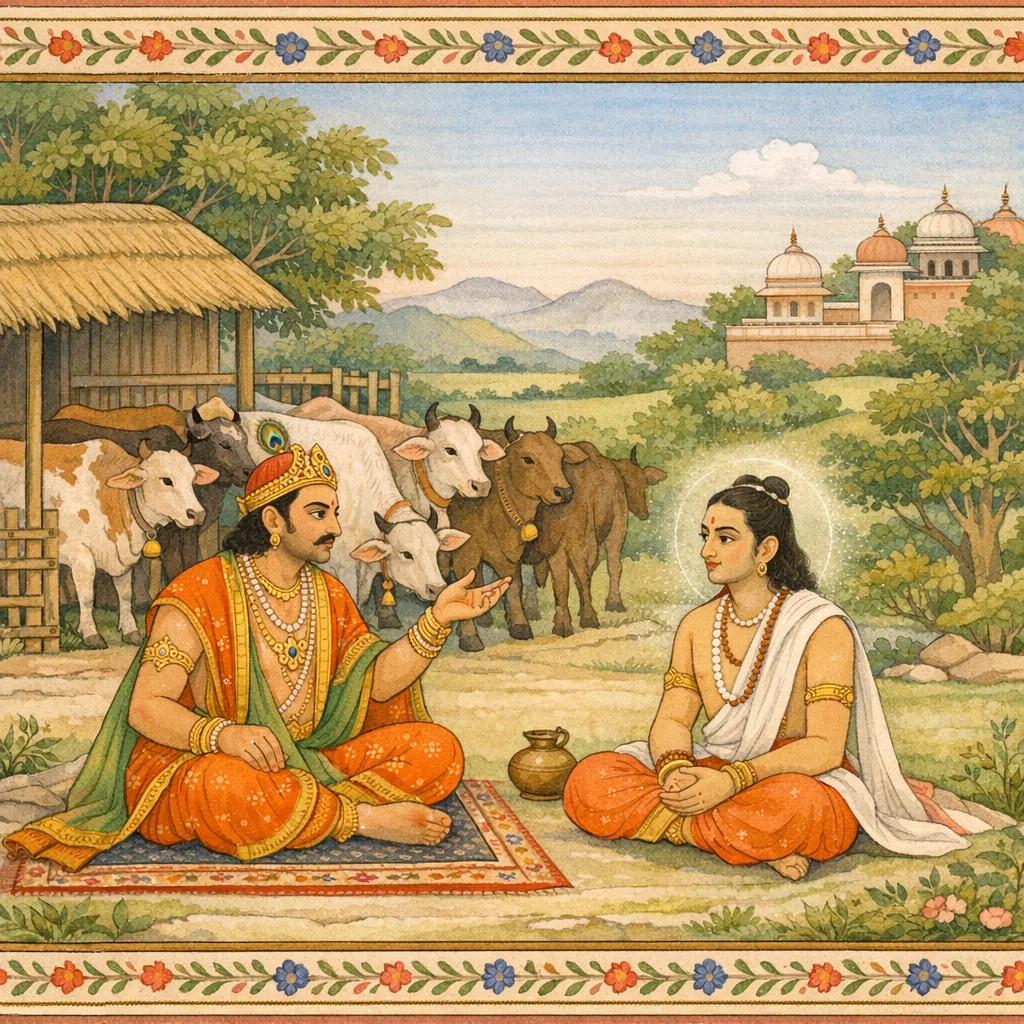
Adhyaya 10
बृहन्नडाप्रवेशः — Bṛhannadā’s Entry into Virāṭa’s Assembly
Upa-parva: Bṛhannadā-praveśa (Arjuna as Bṛhannadā in Virāṭa’s court)
Vaiśaṃpāyana describes a striking figure adorned with feminine ornaments appearing on the ramparts and approaching Virāṭa’s assembly with imposing gait and martial bearing. Virāṭa, surprised, questions attendants about the newcomer’s origin; none can identify him. The figure adjusts ornaments and attire, and Virāṭa tests him with proposals aligned to princely sport and defense, expressing skepticism that such a person is truly a eunuch by nature. Arjuna then speaks, stating his competencies in singing, dancing, and instrumental music, requesting assignment to serve and instruct Uttarā. He identifies himself by the professional name Bṛhannadā and frames his condition as socially detached (without parental ties), suitable for residence in the women’s quarters. Virāṭa grants the request, appointing him to teach dance and arts to his daughter and similarly placed women, while remarking that the newcomer appears fit for wider sovereignty than the offered role. Arjuna remains in the inner quarters as instructor, becoming trusted by the princess and attendants, and his concealed identity is not recognized by those moving within or outside the palace.
Chapter Arc: अज्ञातवास की छाया में पाण्डव विराटनगर में अपने-अपने वेश सँभालते हैं; राजभवन के समीप गोशाला के पास एक दिव्य-तेजस्वी पुरुष (युधिष्ठिर) ठहरता है, और राजा विराट उसे देखकर विस्मित हो उठता है। → विराट उस अपरिचित नरश्रेष्ठ से बार-बार पूछता है—तुम कौन हो, कहाँ से आए हो, क्या करना चाहते हो, कौन-सा शिल्प जानते हो, और यहाँ कैसे रहोगे। पहचान खुल जाने का भय भीतर-भीतर धड़कता है, पर उत्तर ऐसे देने हैं कि सत्य भी न टूटे और रहस्य भी न खुले। → युधिष्ठिर अपने को ‘तन्तिपाल’ (गोरक्षक/गणक) के रूप में प्रस्तुत करता है और अपने अद्भुत ज्ञान का उद्घोष करता है—गवों की संख्या, भूत-भव्य-भविष्य, तथा पशुओं के लक्षणों का सूक्ष्म विवेचन; विराट का विस्मय विश्वास में बदल जाता है। → विराट प्रसन्न होकर उसे अपने आश्रय में रखता है, वेतन-दान और सुरक्षा का वचन देता है तथा गोशाला/पशुधन का भार सौंपता है; युधिष्ठिर अज्ञात रहकर सुखपूर्वक वहीं निवास करने लगता है और अन्य कोई उसकी वास्तविकता नहीं जान पाता। → अज्ञातवास की डोर अभी नाज़ुक है—राजदरबार में यह दिव्य-तेज कब तक छिपा रहेगा, और कौन-सी घटना इस रहस्य को चुनौती देगी?
Shlokas
Verse 1
#::73..8 #::3-..7 () हि २ 7 - सैरन्ध्री किसे कहते हैं, यह स्वयं द्रौपदीने इसके पूर्व तीसरे अध्यायके १८ वें श्लोकमें बताया है। - यहाँ 'गन्धर्वराज” कहनेका गूढ़ अभिप्राय यह है कि वे गन्धर्वतुल्य राजा पाण्डुके पुत्र हैं। दशमो< ध्याय: सहदेवका राजा विराटके साथ वार्तालाप और गौओंकी देखभालके लिये उनकी नियुक्ति वैशम्पायन उवाच सहदेवो<पि गोपानां कृत्वा वेषमनुत्तमम् । भाषां चैषां समास्थाय विराटमुपयादथ,वैशम्पायनजी कहते हैं--जनमेजय! तदनन्तर सहदेव भी ग्वालोंका परम उत्तम वेष बनाकर उन्हींकी भाषामें बोलते हुए राजा विराटके यहाँ गये
Vaiśampāyana said: Then Sahadeva too, having assumed an excellent disguise of the cowherds and adopting their manner of speech, went to King Virāṭa.
Verse 2
गोष्ठमासाद्य तिष्ठन्तं भवनस्य समीपत: । राजाथ दृष्टवा पुरुषान् प्राहिणोज्जातविस्मय:,राजभवनके पास ही गोशाला थी; वहाँ पहुँचकर वे खड़े हो गये। राजा उन्हें दूरसे ही देखकर आश्वर्यमें पड़ गये और उनके पास कुछ लोगोंको भेजा
Having reached the cowshed situated close to the royal residence, they stood there. Then the king, seeing those men from a distance, was struck with astonishment and sent some people to them.
Verse 3
तमायान्तमभिप्रेक्ष्य भ्राजमानं नरर्षभम् | समुपस्थाय वै राजा पप्रच्छ कुरुनन्दनम्,[अपने सेवकोंके बुलानेपर उनके साथ] दिव्य कान्तिसे सुशोभित नरश्रेष्ठ सहदेवको राजसभाकी ओर आते देख राजा विराट स्वयं उठकर उनके पास चले गये और कुरुकुलको आनन्द देनेवाले सहदेवसे पूछने लगे--
Seeing Sahadeva—the best of men—approaching the royal hall, radiant with a divine splendor, King Virāṭa himself rose, went forward to receive him with due respect, and then questioned that delight of the Kuru line.
Verse 4
कस्य वा त्वं कुतो वा त्वं कि वा त्वं तु चिकीर्षसि । न हि मे दृष्टपूर्वस्त्वं तत्त्वं ब्रूहि नरर्षभ,'पुरुषप्रवर! तुम किसके पुत्र हो, कहाँसे आये हो और क्या करना चाहते हो? मैंने आजसे पहले तुम्हें कभी नहीं देखा है; अतः अपना ठीक-ठीक परिचय दो”
“Whose son are you, and from where have you come? What is it that you intend to do? I have never seen you before; therefore, O best of men, tell me the truth—give your identity clearly.”
Verse 5
सम्प्राप्प राजानममित्रतापनं ततोडब्रवीन्मेघभमहौघनि:स्वन: । वैश्यो5स्मि नाम्नाहमरिष्टनेमि- गोसंख्य आसं कुरुपुड्रवानाम्,शत्रुओंको संताप देनेवाले राजा विराटके निकट पहुँचकर सहदेव मेघोंकी घनघोर घटाके समान गम्भीर स्वरमें बोले--“महाराज! मैं वैश्य हूँ। मेरा नाम अरिष्टनेमि है। नृपश्रेष्ठ! मैं कुरुवंशशिरोमणि पाण्डवोंके यहाँ गौओंकी गणना तथा देखभाल करता रहा हूँ। अब आपके यहाँ रहना चाहता हूँ; क्योंकि राजाओंमें सिंहके समान पाण्डव कहाँ हैं? यह मैं नहीं जानता। बिना काम किये जीविका चल नहीं सकती और आपके सिवा दूसरा कोई राजा मुझे पसंद नहीं है”
Having reached King Virāṭa, the scorcher of foes, Sahadeva spoke in a deep voice like the rumbling of dense storm-clouds: “O great king, I am a Vaiśya by station; my name is Ariṣṭanemi. O best of rulers, among the Kuru-Pāṇḍavas I used to count and tend the cattle. Now I wish to live in your service. For I do not know any kings equal to the Pāṇḍavas, lions among rulers. Yet one cannot sustain life without work, and besides you no other king pleases me.”
Verse 6
वस्तुं त्वयीच्छामि विशां वरिष्ठ तान् राजसिंहान् न हि वेझि पार्थान् न शकक््यते जीवितुमप्यकर्मणा न च त्वदन्यो मम रोचते नृप:,शत्रुओंको संताप देनेवाले राजा विराटके निकट पहुँचकर सहदेव मेघोंकी घनघोर घटाके समान गम्भीर स्वरमें बोले--“महाराज! मैं वैश्य हूँ। मेरा नाम अरिष्टनेमि है। नृपश्रेष्ठ! मैं कुरुवंशशिरोमणि पाण्डवोंके यहाँ गौओंकी गणना तथा देखभाल करता रहा हूँ। अब आपके यहाँ रहना चाहता हूँ; क्योंकि राजाओंमें सिंहके समान पाण्डव कहाँ हैं? यह मैं नहीं जानता। बिना काम किये जीविका चल नहीं सकती और आपके सिवा दूसरा कोई राजा मुझे पसंद नहीं है”
“O best of the people, I wish to dwell with you. For I do not know where those lion-like kings—the Pārthas—are. One cannot sustain life without work, and among kings none but you pleases me.”
Verse 7
विराट उवाच त्वं ब्राह्मणो यदि वा क्षत्रियोडसि समुद्रनेमी श्वररूपवानसि । आचक्ष्व मे तत्त्वममित्रकर्शन न वैश्यकर्म त्वयि विद्यते क्षमम्,विराटने कहा--शत्रुतापन! मुझे तो ऐसा लगता है कि तुम ब्राह्मण अथवा क्षत्रिय हो। समुद्रसे घिरी हुई समूची पृथ्वीके सम्राट्की भाँति तुम्हारा भव्य रूप है; अत: मुझे अपना ठीक-ठीक परिचय दो। यह वैश्य कर्म (गोपालन) तुम्हारे योग्य नहीं है
Virāṭa said: “Whether you are a brāhmaṇa or a kṣatriya, you appear like a sovereign whose realm is bounded by the ocean—your form is truly regal. Therefore, O subduer of foes, tell me your real identity. This work of a vaiśya—cattle-tending—does not seem fitting for you.”
Verse 8
कस्यासि राज्ञों विषयादिहागतः कि वापि शिल्पं तव विद्यते कृतम् । कथं त्वमस्मासु निवत्स्यसे सदा वदस्व कि चापि तवेह वेतनम्,तुम किस राजाके राज्यसे यहाँ आये हो? और तुमने किस कलाकी शिक्षा प्राप्त की है? बोलो, हमारे यहाँ कैसे सदा रह सकोगे? और यहाँ तुम्हारा वेतन क्या होगा?
“From whose kingdom have you come here? What craft or skill have you learned? Tell me—how will you be able to stay with us always? And what wages do you seek here?”
Verse 9
सहदेव उवाच पज्चानां पाण्डुपुत्राणां ज्येष्ठो भ्राता युधिष्ठिर: । तस्याष्टशतसाहस्रा गवां वर्गा: शतं शतम्,सहदेव बोले--राजन्! पाँचों पाण्डवोंमें सबसे बड़े भाई युधिष्ठिर हैं। उनके पास एक प्रकारकी गौओंके आठ लाख झुंड थे और प्रत्येक झुंडमें सौ-सौ गायें थीं
Sahadeva said: “O king, among the five sons of Pāṇḍu, the eldest brother is Yudhiṣṭhira. He had eight hundred thousand herds of cattle, and in each herd there were a hundred cows.”
Verse 10
अपरे शतसाहमसा द्विस्तावन्तस्तथा परे । तेषां गोसंख्य आसं वै तन्तिपालेति मां विदु:,इति श्रीमहाभारते विराटपर्वणि पाण्डवप्रवेशपर्वणि सहदेवप्रवेशे दशमो<5ध्याय: ।। २० || इस प्रकार श्रीमहाभारत विराटपर्वके अन्तर्गत पाण्डवप्रवेशपर्वमें सहदेवप्रवेशविषयक दसवाँ अध्याय पूरा हुआ
Sahadeva said: “Some had a hundred cows each; others had twice that number. Thus the count of their cattle was well known, and they recognized me as ‘Tantipāla’—the one in charge of the herd’s tally and oversight.”
Verse 11
भूतं भव्यं भविष्यं च यच्च संख्यागतं गवाम् । न मे>स्त्यविदितं किंचित् समन््ताद् दशयोजनम्
Sahadeva said: “Whether it concerns what has been, what is, or what will be—and whatever can be reckoned about the cattle—there is nothing unknown to me within a radius of ten yojanas in every direction.”
Verse 12
इनके सिवा, दूसरे प्रकारकी गौओंके एक लाख झुंड तथा तीसरे प्रकारकी गौओंके उनसे दुगुने अर्थात् दो लाख झुंड थे। (प्रत्येक झुंडमें सौ-सौ गायें थीं।) पाण्डवोंकी उन गौओंका मैं गणक और निरीक्षक था। वे लोग मुझे “तन्तिपाल' कहा करते थे। चारों ओर दस योजनकी दूरीमें जितनी गौएँ हों; उनकी भूत, वर्तमान और भविष्यमें जितनी संख्या थी, है और होगी, उन सबको मैं जानता हूँ। गौओंके सम्बन्धमें तीनों कालमें होनेवाली कोई ऐसी बात नहीं है, जो मुझे ज्ञात न हो ।। गुणा: सुविदिता ह्वासन् मम तस्य महात्मन: । असकृत् स मया तुष्ट: कुरुराजो युधिष्ठिर:,महात्मा राजा युधिष्ठिरको मेरे ये गुण भलीभाँति विदित थे। वे कुरुगाज युधिष्ठिर सदा मेरे ऊपर संतुष्ट रहते थे। किन-किन उपायोंसे गौओंकी संख्या शीघ्र बढ़ जाती है और उनमें कोई रोग नहीं पैदा होता, यह सब मुझे ज्ञात है। महाराज! ये ही कलाएँ मुझमें विद्यमान हैं। इनके सिवा मैं उन उत्तम लक्षणोंवाले बैलोंको भी जानता हूँ, जिनके मूत्रको सूँघ लेनेमात्रसे वन्ध्या स्त्री भी गर्भधारण एवं संतान उत्पन्न करनेयोग्य हो जाती है
Sahadeva said: “Apart from these, there were a hundred thousand herds of cows of another kind, and twice that—two hundred thousand herds—of a third kind (each herd consisting of a hundred cows). I served as the accountant and inspector of the Pāṇḍavas’ cattle; people used to call me ‘Tantipāla’. Within a radius of ten yojanas, whatever cows there were, I know their numbers in the past, the present, and the future. Concerning cattle, there is nothing across the three times that is unknown to me. These abilities of mine were well known to that great-souled king Yudhiṣṭhira; the Kuru king was repeatedly pleased with me. I also know the methods by which the number of cows increases quickly and disease does not arise among them. O king, these are the skills that dwell in me. Moreover, I know bulls of excellent marks whose very urine—by its smell alone—can make even a barren woman capable of conceiving and bearing children.”
Verse 13
क्षिप्रं च गावो बहुला भवन्ति न तासु रोगो भवतीह कश्चन । तैस्तैरुपायैरविंदितं ममैत- देतानि शिल्पानि मयि स्थितानि,महात्मा राजा युधिष्ठिरको मेरे ये गुण भलीभाँति विदित थे। वे कुरुगाज युधिष्ठिर सदा मेरे ऊपर संतुष्ट रहते थे। किन-किन उपायोंसे गौओंकी संख्या शीघ्र बढ़ जाती है और उनमें कोई रोग नहीं पैदा होता, यह सब मुझे ज्ञात है। महाराज! ये ही कलाएँ मुझमें विद्यमान हैं। इनके सिवा मैं उन उत्तम लक्षणोंवाले बैलोंको भी जानता हूँ, जिनके मूत्रको सूँघ लेनेमात्रसे वन्ध्या स्त्री भी गर्भधारण एवं संतान उत्पन्न करनेयोग्य हो जाती है
Sahadeva said: “By appropriate methods, the cows quickly multiply, and among them no disease arises here at all. By such means—without any fault on my part—these practical skills are established in me.”
Verse 14
ऋषभांश्वापि जानामि राजन् पूजितलक्षणान् | येषां मूत्रमुपाप्राय अपि वन्ध्या प्रसूयते,महात्मा राजा युधिष्ठिरको मेरे ये गुण भलीभाँति विदित थे। वे कुरुगाज युधिष्ठिर सदा मेरे ऊपर संतुष्ट रहते थे। किन-किन उपायोंसे गौओंकी संख्या शीघ्र बढ़ जाती है और उनमें कोई रोग नहीं पैदा होता, यह सब मुझे ज्ञात है। महाराज! ये ही कलाएँ मुझमें विद्यमान हैं। इनके सिवा मैं उन उत्तम लक्षणोंवाले बैलोंको भी जानता हूँ, जिनके मूत्रको सूँघ लेनेमात्रसे वन्ध्या स्त्री भी गर्भधारण एवं संतान उत्पन्न करनेयोग्य हो जाती है
Sahadeva said: “O King, I also know those noble, well-honoured bulls, marked by auspicious signs—such that merely approaching (or smelling) their urine enables even a barren woman to conceive and bring forth a child.”
Verse 15
विराट उवाच शतं सहस्राणि समाहितानि सवर्णवर्णस्य विमिश्रितान् गुणै: | पशून् सपालान् भवते ददाम्यहं त्वदाश्रया मे पशवो भवन्त्विह,विराटने कहा--तन्तिपाल! मेरे यहाँ एक लाख पशु संगृहीत हैं। उनमेंसे कुछ तो एक ही रंगके हैं और कुछ मिश्रित रंगके। वे सब विभिन्न गुणोंसे संयुक्त हैं। मैं उन पशुओं और पशुपालोंको आजसे तुम्हारे हाथमें सौंपता हूँ। मेरे पशु अबसे तुम्हारे ही अधीन रहेंगे
Virāṭa said: “I have gathered a hundred thousand head of cattle—some of a single color, others of mixed colors, each possessing different qualities. I now hand over to you these herds along with their herdsmen. From this day, let my cattle here remain under your protection and authority.”
Verse 16
वैशाम्पायन उवाच तथा स राज्ञोडविदितो विशाम्पते- रुवास तत्रैव सुखं नरोत्तम: । न चैनमन्ये5पि विदु: कथंचन प्रादाच्च तस्मै भरणं यथेप्सितम्,वैशम्पायनजी कहते हैं--इस प्रकार प्रजापालक राजा विराटसे अपरिचित रहकर नरश्रेष्ठ सहदेव वहीं गोशालामें रहने लगे। दूसरे लोग भी उन्हें किसी तरह पहचान न सके। राजाने उनके लिये उनकी इच्छाके अनुसार भरण-पोषणकी व्यवस्था कर दी
Vaiśaṃpāyana said: Thus, remaining unrecognized by King Virāṭa, the best of men (Sahadeva) lived there comfortably. No one else could identify him in any way. The king arranged for his maintenance and support according to his wishes—upholding the duty of a ruler to provide for those under his protection, even without knowing their true identity.
Frequently Asked Questions
The dilemma is how to fulfill a truth-oriented ethical life while maintaining a binding concealment vow: Arjuna must adopt a public persona and occupation that protects the group’s objective without violating court norms or provoking suspicion.
Competence and self-control can be redirected into non-martial domains when circumstance requires; dharma may be preserved through disciplined adaptation of role, speech, and service rather than through overt assertion of status.
No explicit phalaśruti appears in these verses; the chapter’s meta-function is narrative verification of concealment (non-recognition by insiders/outsiders) and institutional placement that enables subsequent Matsya events.