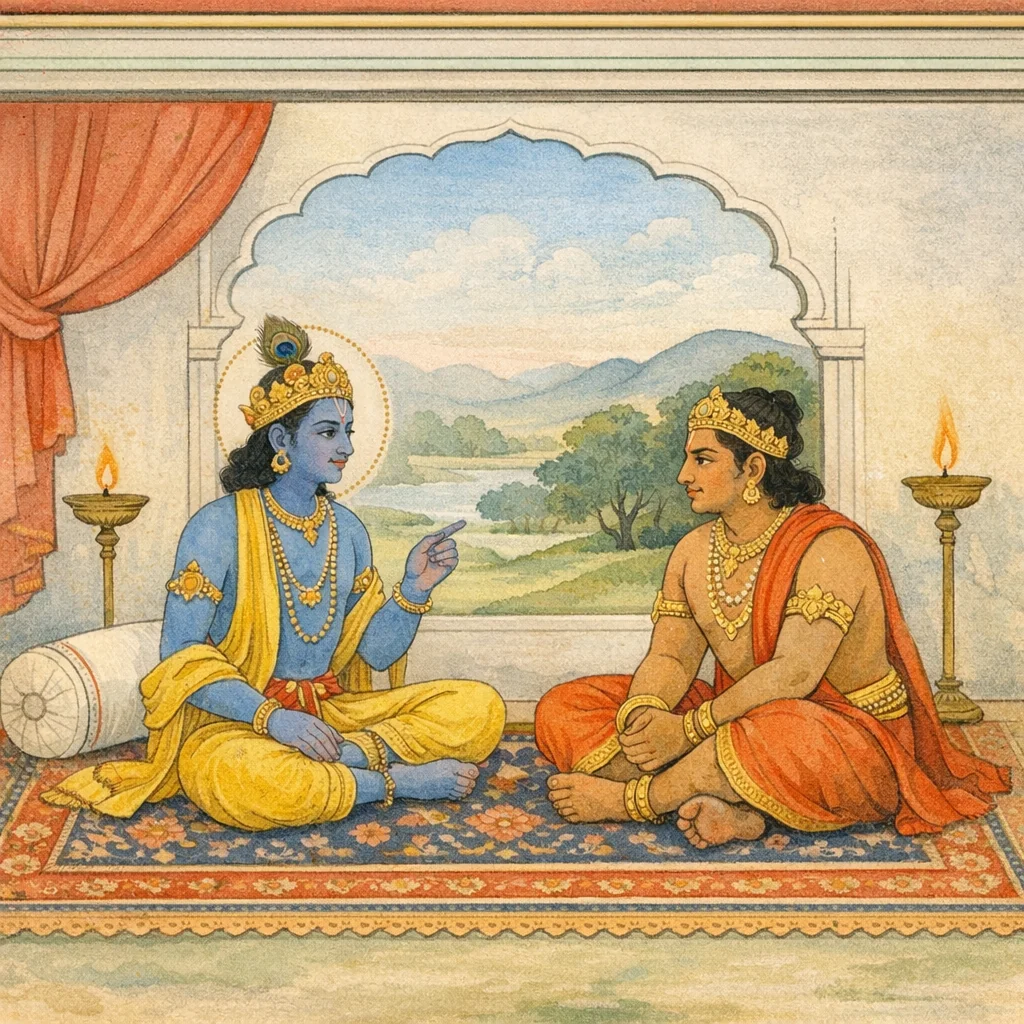
Adhyaya 76
अर्जुनोक्तिः—कृष्णं प्रति पुरुषकार‑कर्म‑विचारः (Arjuna’s Address to Krishna: Agency, Action, and Immediate Counsel)
Upa-parva: Udyoga Parva — Arjuna–Krishna Strategic Counsel (Chapter 76 context)
Arjuna responds to Kṛṣṇa after Yudhiṣṭhira has already articulated what could be said, and he interprets Kṛṣṇa’s stance as skeptical about easy pacification due to Dhṛtarāṣṭra’s compromised position (weakness and attachment) and the entrenched motives driving the Kuru court. He argues that human valor and initiative are not fruitless, asserting that results arise through action rather than inaction. Arjuna cautions against viewing the situation as inherently impossible, and urges Kṛṣṇa to act in a manner that produces security and welfare for all parties. He emphasizes Kṛṣṇa’s unique friendship to both Pāṇḍavas and Kurus, positioning him as a mediator capable of restoring a non-harmful course. Arjuna then foregrounds the accumulated grievances—especially the public humiliation of Draupadī and the coercive seizure of rights through deceitful play—arguing that a kṣatriya cannot withdraw when challenged even at personal risk. The chapter culminates in a practical appeal: Kṛṣṇa should quickly implement what he deems most fitting and beneficial, whether through settlement or decisive enforcement, because further delay only deepens instability.
Chapter Arc: श्रीकृष्ण भीमसेन के भीतर उठे संदेह और आवेग को भाँपकर प्रेमपूर्वक कहते हैं कि उनकी बातों का उद्देश्य आक्षेप या क्रोध नहीं, केवल भीम के मनोभाव को जानना था। → कृष्ण भीम को उसके स्वभावगत पराक्रम और कल्याणकारी संकल्प की याद दिलाते हैं—जैसा कल्याण वह अपने लिए सोचता है, उससे सहस्रगुणा संभावना कृष्ण उसके लिए देखते हैं; साथ ही वे समझाते हैं कि वही पुरुषार्थ कभी सिद्धि का कारण बनता है और वही अनिश्चित कर्म बनकर विनाश का द्वार भी खोल सकता है। → कृष्ण स्पष्ट कर देते हैं कि यदि कौरव संधि-वचन न मानकर युद्ध पर ही अड़े रहे तो घोर कर्म—युद्ध—अपरिहार्य होगा; और उस युद्ध में भीम पर मुख्य भार रहेगा, अर्जुन धुरी संभालेगा, शेष जन पीछे वहन करेंगे। → कृष्ण भीम की ‘कायरतापूर्ण’ शांति-भाषा को रणनीतिक/क्षणिक मानकर उसके तेज को पुनः प्रज्वलित करते हैं, विषाद-ग्लानि से बचने की सीख देते हैं और उसे उसके नियत कर्तव्य—धर्मयुद्ध के लिए तैयार करते हैं। → कौरव यदि संधि अस्वीकार करें तो युद्ध निश्चित—और उस निर्णायक भार को उठाने हेतु भीम-अर्जुन की भूमिका अब तय हो चुकी है।
Shlokas
Verse 1
भस्न्मा रन (2) अिमसन- सप्तसप्ततितमो<्ध्याय: श्रीकृष्णका भीमसेनको आश्वासन देना श्रीभगवानुवाच भावं जिज्ञासमानोऊहं प्रणयादिदमन्रुवम् । नचाक्षेपान्न पाण्डित्यान्न क्रोधान्न विवक्षया
Seeking to understand your true intention, I spoke these words out of affection—neither to reproach you, nor to display learning, nor out of anger, nor with any desire to argue or press a point.
Verse 2
श्रीभगवान् बोले--भीमसेन! मैंने तो तुम्हारा मनोभाव जाननेके लिये ही प्रेमसे ये बातें कही हैं, तुमपर आक्षेप करने, पण्डिताई दिखाने, क्रोध प्रकट करने या व्याख्यान देनेकी इच्छासे कुछ नहीं कहा है ।। वेदाहं तव माहात्म्यमुत ते वेद यद् बलम् । उत ते वेद कर्माणि न त्वां परिभवाम्यहम्,मैं तुम्हारे माहात्म्यको जानता हूँ। तुममें जो बल और पराक्रम है, उससे भी परिचित हूँ और तुमने जो बड़े-बड़े पराक्रम किये हैं, वे भी मुझसे छिपे नहीं हैं; अतः मैं तुम्हारा तिरस्कार नहीं करता
O Bhīmasena! I spoke these words with affection only to understand your state of mind—not to accuse you, display learning, vent anger, or deliver a lecture. I know your greatness; I know the strength and valor that are in you; and your mighty deeds are not hidden from me. Therefore I do not speak to belittle you.
Verse 3
यथा चात्मनि कल्याणं सम्भावयसि पाण्डव । सहस्रगुणमप्येतत् त्वयि सम्भावयाम्यहम्,पाण्डुनन्दन! तुम अपनेमें जैसे कल्याणकारी गुणकी सम्भावना करते हो, उससे भी सहस्रगुने सदगुणोंकी सम्भावना तुममें मैं करता हूँ
O Pāṇḍava, the auspicious qualities you attribute to yourself—I attribute those very virtues to you a thousandfold. O son of Pāṇḍu, in my eyes your goodness and worth surpass even your own modest estimation.
Verse 4
यादृशे च कुले जन्म सर्वराजाभिपूजिते । बन्धुभिश्न सुहृद्धिश्च भीम त्वमसि तादृश:
Born as you are in a lineage honored by all kings, and surrounded by kinsmen and well-wishers, O Bhīma, you are indeed worthy of that very stature.
Verse 5
भीमसेन! समस्त राजाओंद्वारा सम्मानित जैसे प्रतिष्ठित कुलमें तुम्हारा जन्म हुआ है, अपने बन्धुओं और सुहृदोंसहित तुम वैसी ही प्रतिष्ठाके योग्य हो ।। जिज्ञासन्तो हि धर्मस्य संदिग्धस्य वृकोदर । पर्यायं नाध्यवस्यन्ति देवमानुषयोर्जना:,वृकोदर! देवधर्म (प्रारब्ध) और मानुषधर्म (पुरुषार्थ)-का स्वरूप संदिग्ध है। लोग दैव और पुरुषार्थ दोनोंके परिणामको जानना चाहते हैं, परंतु किसी निश्चयतक पहुँच नहीं पाते
Bhīmasena! Born in a renowned line honored by all kings, and surrounded by kinsmen and well-wishers, you are worthy of that same honor. O Vṛkodara, when dharma is uncertain, those who inquire into it cannot reach a settled conclusion about what belongs to divine dispensation (fate, what has already been set in motion) and what belongs to human effort (personal striving). People wish to know the outcome of both fate and effort, yet they do not arrive at a firm decision.
Verse 6
स एव हेतुर्भूत्वा हि पुरुषस्यार्थसिद्धिषु । विनाशेडपि स एवास्य संदिग्धं॑ कर्म पौरुषम्,क्योंकि उपर्युक्त पुरुषार्थ ही कभी पुरुषकी कार्य-सिद्धिमें कारण बनकर कभी विनाशका भी हेतु बन जाता है। इस प्रकार जैसे दैवका फल संदिग्ध है, वैसे ही पुरुषार्थका भी फल संदिग्ध है
That very human effort becomes, at times, the cause of a man’s success in his aims, and at times the cause of his ruin. Thus, as the fruit of fate is uncertain, so too is the fruit of human endeavor uncertain.
Verse 7
अन्यथा परिदृष्टानि कविभिदर्दोषदर्शिशि: । अन्यथा परिवर्तन्ते वेगा इव नभस्वत:,दोषदर्शी दिद्वानोंद्वारा अन्य रूपमें देखे या विचारे हुए कर्म वायुके वेगोंकी भाँति बदलकर किसी दूसरे ही रूपमें परिवर्तित हो जाते हैं
Deeds that discerning poets—keen to detect faults—have observed and judged in one way often turn out otherwise. Like gusts of wind, they shift and transform, taking on a different form than what was first supposed.
Verse 8
सुमन्त्रितं सुनीतं च न्यायतश्नोपपादितम् । कृतं मानुष्यकं कर्म दैवेनापि विरुध्यते,अच्छी तरह विचारपूर्वक निश्चित किये हुए, उत्तम नीतिसे युक्त तथा न्यायपूर्वक सम्पादित किये हुए मानव-सम्बन्धी पुरुषार्थसाध्य कर्म भी कभी दैववश बाधित हो जाते हैं --उनकी सिद्धिमें विघ्न पड़ जाता है
Even a human undertaking—well deliberated, guided by sound policy, and carried out in accordance with justice—can still be thwarted by fate; its accomplishment may meet with obstacles.
Verse 9
दैवमप्यकृतं कर्म पौरुषेण विहन्यते । शीतमुष्णं तथा वर्ष क्षुत्पिपासे च भारत,भारत! दैवकृत कार्य भी समाप्त होनेसे पहले पुरुषार्थद्वारा नष्ट कर दिया जाता है। जैसे शीतका निवारण वस्त्रसे, गरमीका व्यजनसे, वर्षाका छत्रसे और भूख-प्यासका निवारण अन्न और जलसे हो जाता है
O Bhārata, even a work wrought by fate can be struck down by human effort before it is brought to completion—just as cold is warded off by clothing, heat by a fan, rain by a parasol, and hunger and thirst by food and water.
Verse 10
यदन्यद् दिष्टभावस्य पुरुषस्य स्वयंकृतम् | तस्मादनुपरोधश्व विद्यते तत्र लक्षणम्,प्रारब्धके अतिरिक्त जो पुरुषका स्वयं अपना किया हुआ कर्म है, उससे भी फलकी सिद्धि होती है। इस विषयमें यथेष्ट उदाहरण मिलते हैं
Beyond what is allotted by destiny, a man—though shaped by fate—also accomplishes what he has wrought by his own hand; and through that as well, results are attained. In this matter, examples may be found as one wishes.
Verse 11
लोकस्य नान्यतो वृत्ति: पाण्डवान्यत्र कर्मण: । एवंबुद्धि: प्रवर्तेत फलं स्यादुभयान्वये,पाण्डुनन्दन! पुरुषार्थको छोड़कर दूसरे किसी साधनसे--केवल दैवसे मनुष्यका जीवन-निर्वाह नहीं हो सकता। ऐसा विचारकर उसे कर्ममें प्रवृत्त होना चाहिये। फिर प्रारब्ध और पुरुषार्थ दोनोंके सम्बन्धसे फलकी प्राप्ति होगी
Bhīmasena said: “For people, there is no other means of livelihood and progress than action—especially for the Pāṇḍavas. Understanding this, one should set one’s mind to effort and act accordingly. Then the result is attained through the conjunction of both factors: destiny (what is already set in motion) and human endeavor, O son of Pāṇḍu.”
Verse 12
य एवं कृतबुद्धि: स कर्मस्वेव प्रवर्तते । नासिद्धौ व्यथते तस्य न सिद्धौ हर्षमश्लुते,जो अपनी बुद्धिमें ऐसा निश्चय करके कर्मामें ही प्रवृत्त होता है, वह फलकी सिद्धि न होनेपर दुःखी नहीं होता और फलकी प्राप्ति होनेपर भी हर्षका अनुभव नहीं करता
Bhīmasena said: One who has thus made up his mind and engages himself only in action is not distressed when success is not attained, nor does he exult when success is attained. His steadiness lies in doing what must be done, without being shaken by the rise and fall of results.
Verse 13
तत्रेयमनुमात्रा मे भीमसेन विवक्षिता । नैकान्तसिद्धिर्वक्तव्या शत्रुभि: सह संयुगे,भीमसेन! मुझे इस विषयमें अपना यह निश्चय बताना अभीष्ट है कि युद्धमें शत्रुओंके साथ भिड़नेपर अवश्य ही विजय प्राप्त होगी, यह नहीं कहा जा सकता
Here is my measured view, O Bhīmasena, stated plainly: in battle, when one closes with enemies, one cannot declare victory as an absolute certainty. The outcome of war is contingent, and responsible counsel must not promise inevitability where fate, strength, and circumstance may overturn expectations.
Verse 14
नातिप्रहीणरश्मि: स्यात् तथा भावविपर्यये । विषादमच्छेंद् ग्लानिं वाप्येतमर्थ ब्रवीमि ते
“Let your radiance not be excessively diminished, even when circumstances turn contrary. Cast off despondency and also weariness—this is the meaning I declare to you.”
Verse 15
मनोभाव बदल जाय अथबवा प्रारब्धके अनुसार कोई विपरीत घटना घटित हो जाय, तो भी सहसा अपने तेज और उत्साहको सर्वथा नहीं छोड़ना चाहिये। विषाद एवं ग्लानिका अनुभव नहीं करना चाहिये--यह बात भी मैंने तुम्हें आवश्यक समझकर बतायी है ।। श्वोभूते धृतराष्ट्रस्य समीपं प्राप्य पाण्डव । यतिष्ये प्रशमं कर्तु युष्मदर्थमहापयन्,पाण्डुनन्दन! कल सबरेरे मैं राजा धृतराष्ट्रके समीप जाकर तुमलोगोंके स्वार्थकी सिद्धिमें तनिक भी बाधा न पहुँचाते हुए दोनों पक्षोंमें संधि करानेका प्रयत्न करूँगा
Even if one’s state of mind changes, or some adverse event occurs in accordance with destiny, one should not suddenly abandon one’s vigor and enthusiasm. One should not give way to dejection or inner weariness—this too I have told you, judging it necessary. Tomorrow, O Pāṇḍava, having gone into the presence of Dhṛtarāṣṭra, I will strive to bring about a pacification—seeking your welfare, O son of Pāṇḍu. Tomorrow I shall go to King Dhṛtarāṣṭra and attempt to effect a settlement between the two sides, without allowing even the slightest obstruction to the accomplishment of your rightful aims.
Verse 16
शमं चेत् ते करिष्यन्ति ततो5नन्तं यशो मम । भवतां च कृत: कामस्तेषां च श्रेय उत्तमम्,यदि वे संधि स्वीकार कर लेंगे तो मुझे अक्षय यशकी प्राप्ति होगी। तुमलोगोंका मनोरथ भी पूर्ण होगा और कौरवोंका भी परम कल्याण होगा
Bhīmasena said: “If they will make peace, then imperishable fame will be mine. Your wish will be fulfilled, and for them too it will be the highest good.”
Verse 17
ते चेदभिनिवेक्ष्यन्ते नाभ्युपैष्यन्ति मे वच: । कुरवो युद्धमेवात्र घोरं कर्म भविष्यति,यदि वे कौरव युद्धका ही आग्रह दिखायेंगे और मेरे संधिविषयक प्रस्तावको ठुकरा देंगे, तब यहाँ युद्ध ही होगा, जो भयंकर कर्म है
Bhīmasena declares that if the Kauravas harden themselves in obstinate resolve and refuse his words of reconciliation, then in this very place the outcome will be war alone—an act of dreadful consequence.
Verse 18
अस्मिन् युद्धे भीमसेन त्वयि भार: समाहित: । धूरर्जुनेन धार्या स्थाद् वोढव्य इतरो जन:,भीमसेन! इस युद्धमें सारा भार तुम्हारे ऊपर ही रखा जायगा एवं अर्जुन इस भारको धारण करेगा। अन्य लोगोंका भार भी तुम्हीं दोनोंको ढोना है
In this war, O Bhīmasena, the entire burden is being placed upon you. Arjuna must bear the yoke alongside you, and the weight of the other warriors too is to be carried by you both.
Verse 19
अहं हि यन्ता बीभत्सोर्भविता संयुगे सति । धनंजयस्यैष कामो न हि युद्ध न कामये,युद्ध आरम्भ होनेपर मैं अर्जुनका सारथि बनूँगा। यही अर्जुनकी इच्छा है। तुम यह न समझो कि मैं युद्ध होने देना नहीं चाहता
Bhīmasena declares that when battle truly begins, he will serve as the charioteer of Arjuna (Bībhatsu/Dhanañjaya). He emphasizes that this is Arjuna’s own wish, and warns the listener not to mistake his stance for a desire to prevent war at any cost.
Verse 20
तस्मादाशड्कमानोऊ<हं वृकोदर मतिं तव । गदत: क्लीबया वाचा तेजस्ते समदीदिपम्
Therefore, O Vṛkodara, I do not doubt your resolve. Even while you speak in words that sound timid, your inner fire blazes forth—your valor is clearly kindled.
Verse 76
इस प्रकार श्रीमह्या भारत उद्योगपर्वके अन्तर्गत भगवद्यानपर्वमें भीमसेनवाक्यसम्बन्धी छिह्त्तरवाँ अध्याय पूरा हुआ
Thus ends the seventy-sixth chapter of the Bhagavadyāna section within the Udyoga Parva of the revered Mahābhārata, the chapter connected with Bhīmasena’s words. This closing colophon marks the completion of a unit of discourse, situating Bhīma’s speech within the larger ethical and political tensions of the pre-war negotiations.
Verse 77
वृकोदर! इसीलिये जब तुम कायरतापूर्ण वचनोंद्वारा शान्तिका प्रस्ताव करने लगे, तब मुझे तुम्हारे युद्धवेषयक विचारके बदल जानेका संदेह हुआ, जिसके कारण पूर्वोक्त बातें कहकर मैंने तुम्हारे तेजको उद्दीप्त किया ।। इति श्रीमहाभारते उद्योगपर्वणि भगवद्यानपर्वणि कृष्णवाक्ये सप्तसप्ततितमो<ध्याय:
O Vṛkodara, when you began to propose peace through words that sounded cowardly, I suspected that your resolve about war had changed. Therefore, by speaking as I did before, I sought to kindle your ardor and restore your warrior-spirit.
Frequently Asked Questions
Whether continued conciliation remains ethically and strategically viable after repeated injustice, or whether duty requires a decisive course that prevents further harm and restores rightful order.
Outcomes are shaped through disciplined action: one should not dismiss effort as futile, nor declare a situation impossible; wise agency coordinates intent, means, and timing to secure welfare.
No explicit phalaśruti appears in this chapter; its significance is structural—recording the ethical reasoning that bridges negotiation and imminent escalation within the epic’s broader dharma inquiry.