Adhyaya 316
नारद–शुक संवादः (Nārada–Śuka Dialogue): Tyāga, Saṃyama, and Vyakta–Avyakta Viveka
Upa-parva: Mokṣa-dharma (Liberation-ethics discourse) — Nārada–Śuka saṃvāda context
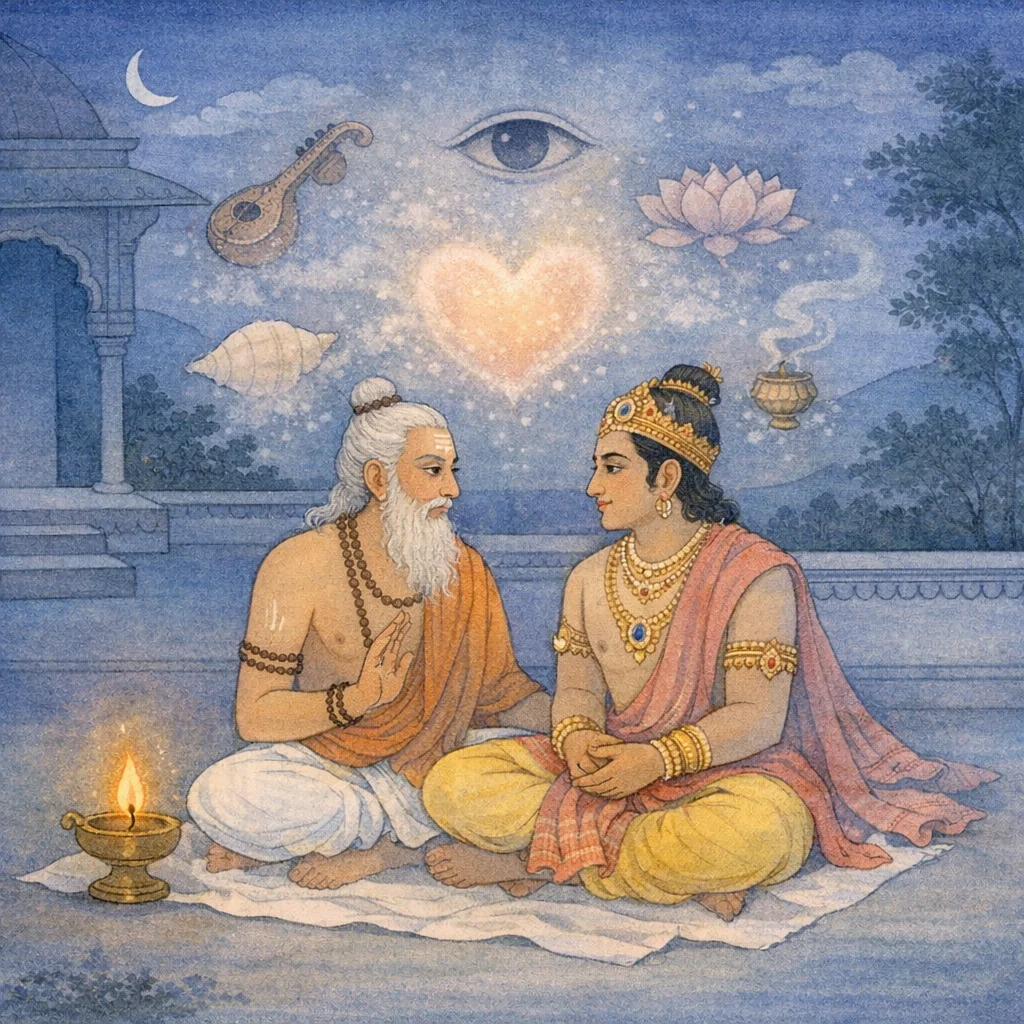
Bhīṣma recounts how Nārada meets Śuka in a secluded interval while Śuka is engaged in svādhyāya. After formal reception, Nārada asks how he may connect Śuka to the highest good; Śuka requests instruction in what is beneficial in this world. Nārada then relays Sanatkumāra’s aphoristic counsel: knowledge is the supreme ‘eye,’ attachment is a signature of suffering, and the seeker should restrain desire and anger, protect austerity from wrath, prosperity from envy, and learning from pride and humiliation. The chapter advances a practical ascetic program—non-injury, friendliness, contentment, non-possessiveness, and solitude—while warning against bondage through family-attachment and acquisitiveness using similes of the silkworm and net-caught fish. It also includes a metaphysical schematic distinguishing vyakta (sense-graspable) from avyakta (beyond the senses, inferred by marks), listing constituents (mahābhūtas, indriyas, guṇas) and portraying liberation as cessation of new bonds through restraint and tapas. The discourse culminates in urging abandonment of grasping, steady discernment, and a release-oriented life that yields fearlessness here and hereafter.
Chapter Arc: जनक के प्रश्नों के उत्तर में याज्ञवल्क्य योग का स्वरूप खोलते हैं—सांख्य-ज्ञान और योग-बल की तुलना करते हुए बताते हैं कि मोक्ष का मार्ग दो नामों से नहीं, एक ही सत्य से प्रकाशित है। → याज्ञवल्क्य उन लोगों की भ्रान्ति पर प्रहार करते हैं जो सांख्य और योग को अलग-अलग देखते हैं; फिर साधना को सूक्ष्म अनुशासन में उतारते हैं—प्राण (रुद्र-प्रधान) की प्रधानता, रात्रि-यामों में वायु-धारण की ‘चोदनाएँ’, और इन्द्रिय-विषयों (शब्द, रूप, स्पर्श, रस, गन्ध) के दोषों को खींचकर भीतर समेटने की प्रक्रिया। → अन्तःकरण-लय का निर्णायक क्षण आता है—मन को अहंकार में, अहंकार को बुद्धि में, बुद्धि को प्रकृति में प्रतिष्ठित कर देना; साधक की समस्त वृत्तियाँ एक-एक करके अपने कारण में विलीन होती जाती हैं, और योग का ‘लक्षण’ स्वयं स्पष्ट हो उठता है। → याज्ञवल्क्य निष्कर्ष देते हैं कि यही योगियों का योग है—इसके अतिरिक्त कोई अलग लक्षण नहीं; जो इसे जान लेते हैं वे ‘कृतकृत्य’ हो जाते हैं, क्योंकि साधन और साध्य का भेद मिटकर एक निश्चयात्मक दर्शन रह जाता है। → जनक के भीतर उठता अगला प्रश्न—जब सांख्य और योग एक ही हैं, तो गृहस्थ-राजा के लिए इस एकत्व का आचरण-रूप क्या हो—संवाद आगे उसी व्यावहारिक कसौटी की ओर बढ़ता है।
Shlokas
Verse 1
ऑपन-माज बछ। अकाल षोडशाधिकत्रिशततमोब् ध्याय: योगका वर्णन और उसके साधनसे परब्रह्म परमात्माकी प्राप्ति याज़्ञवल्क्य उवाच सांख्यज्ञानं मया प्रोक्ते योगज्ञानं निबोध मे । यथाश्रुतं यथादृष्ट॑ तत्त्वेन नृपसत्तम,याज्ञवल्क्यजी कहते हैं--नृपश्रेष्ठ! मैं सांख्यसम्बन्धी ज्ञान तो तुम्हें बतला चुका। अब जैसा मैंने देखा, सुना या समझा है, उसके अनुसार योगशास्त्रका तात्विक ज्ञान मुझसे सुनो
Yājñavalkya said: “I have already taught you the knowledge of Sāṅkhya. Now learn from me the knowledge of Yoga—O best of kings—set forth in its true principles, just as I have heard it, seen it, and understood it.”
Verse 2
नास्ति सांख्यसमं ज्ञानं नास्ति योगसमं बलम् | तावुभावेकचर्यो तावुभावनिधनौ स्मृती,सांख्यके समान कोई ज्ञान नहीं है। योगके समान कोई बल नहीं है। इन दोनोंका लक्ष्य एक है और वे दोनों ही मृत्युका निवारण करनेवाले माने गये हैं
Yājñavalkya said: “No knowledge equals that of Sāṅkhya, and no strength equals that of Yoga. Yet these two proceed along a single course and aim at one goal; both are remembered as leading beyond death.”
Verse 3
पृथक् पृथक् प्रपश्यन्ति ये<प्यबुद्धिरता नरा: । वयं तु राजन् पश्याम एकमेव तु निश्चयात्,राजन! जो मनुष्य अज्ञानपरायण हैं, वे ही इन दोनों शास्त्रोंको सर्वथा भिन्न मानते हैं। हम तो विचार के द्वारा पूर्ण निश्चय करके दोनोंको एक ही समझते हैं
Yājñavalkya said: “Those men who are devoted to ignorance—even if they speak on these matters—perceive the two śāstras as wholly separate. But we, O King, having examined with discernment and reached firm certainty, see them as one and the same.”
Verse 4
यदेव योगा: पश्यन्ति तत् सांख्यैरपि दृश्यते । एकं॑ सांख्यं च योगं च य: पश्यति स तत्त्ववित्,योगी जिस तत्त्वका साक्षात्कार करते हैं, वही सांख्योंद्वारा भी देखा जाता है; अतः जो सांख्य और योगको एक देखता है, वही तत्त्वज्ञानी है
Yājñavalkya said: “The very Reality that the practitioners of Yoga directly behold is also discerned by the followers of Sāṅkhya. Therefore, the one who sees Sāṅkhya and Yoga as one in essence is the true knower of truth—one who understands that differing disciplines can converge upon the same highest insight and should not be set in needless opposition.”
Verse 5
रुद्रप्रधानानपरान् विद्धि योगानरिंदम । तेनैव चाथ देहेन विचरन्ति दिशो दश,शत्रुदमन नरेश! योग-साथनोंमें रुद्र अर्थात् प्राण प्रधान है। इन सबको तुम सर्वश्रेष्ठ समझो। प्राणको अपने वशमें कर लेनेपर योगी इसी शरीरसे दसों दिशाओंमें स्वच्छन्द विचरण कर सकते हैं
Yājñavalkya said: “O subduer of foes, know these yogic disciplines to be foremost, for Rudra—here meaning the vital breath (prāṇa)—is their chief principle. When that very prāṇa is brought under mastery, yogins, even with this same body, are said to move freely in all ten directions. The teaching emphasizes inner governance: sovereignty over oneself becomes the basis of extraordinary freedom.”
Verse 6
यावद्धि प्रलयस्तात सूक्ष्मेणाष्टगुणेन ह । योगेन लोकान् विचरन् सुखं संन्यस्य चानघ,प्रिय निष्पाप भूपाल! जबतक मृत्यु न हो जाय, तबतक ही योगी योगबलसे स्थूल शरीरको यहीं छोड़कर अष्टविध ऐश्वर्यसे युक्त सूक्ष्मशरीरके द्वारा लोक-लोकान्तरोंमें सुखपूर्वक विचरण करता है
Yājñavalkya said: “Dear one, until the time of dissolution (death) arrives, the yogin—having set aside the gross body here—moves happily through various worlds by the power of yoga, in a subtle body endowed with eightfold excellence. The point is that disciplined renunciation and yogic mastery can free one from ordinary bodily limitation, yet this freedom is bounded by the cosmic limit of pralaya; therefore one should pursue yoga with purity and detachment rather than mere wonder at supernatural travel.”
Verse 7
वेदेषु चाष्टगुणिनं योगमाहुर्मनीषिण: । सूक्ष्ममष्टगुणं प्राहुनेंतरं नृपसत्तम,नृपश्रेष्ठ! मनीषी पुरुषोंका कहना है कि वेदमें स्थूल और सूक्ष्म दो प्रकारके योगोंका वर्णन है। उनमें स्थूल योग अणिमा आदि आठ प्रकारकी सिद्धि प्रदान करनेवाला है और सूक्ष्म योग ही (यम, नियम, आसन, प्राणायाम, प्रत्याहार, धारणा, ध्यान और समाधि--इन आठ गुणों (अंगों) से युक्त है; दूसरा नहीं
Yājñavalkya said: “O best of kings, the wise declare that the Vedas speak of yoga in two modes—one ‘eightfold’ in a gross sense and one ‘eightfold’ in a subtle sense. The gross yoga is said to yield the eight extraordinary attainments such as aṇimā and the rest; but the subtle yoga alone is truly eight-limbed—consisting of yama, niyama, āsana, prāṇāyāma, pratyāhāra, dhāraṇā, dhyāna, and samādhi. No other is (properly) called the eightfold yoga.”
Verse 8
द्विगुणं योगकृत्यं तु योगानां प्राहुरुत्तमम् । सगुणं निर्गुणं चैव यथा शास्त्रनिदर्शनम्,योगका मुख्य साधन दो प्रकारका बताया गया है--सगुण और निर्गुण (सबीज और निर्बीज)। ऐसा ही शास्त्रोंका निर्णय है
Yājñavalkya said: “The highest discipline of yoga is declared to be twofold. It is taught, in accordance with the testimony of the scriptures, as (1) saguṇa—practice supported by qualities and a focal support, and (2) nirguṇa—practice beyond qualities, without such support.”
Verse 9
धारणं चैव मनस: प्राणायामश्न् पार्थिव । एकाग्रता च मनस: प्राणायामस्तथैव च,पृथ्वीनाथ! किसी विशेष देशमें चित्तको स्थापित करनेका नाम “धारणा” है। मनकी धारणाके साथ किया जानेवाला प्राणायाम सगुण है और देश-विशेषका आश्रय न लेकर मनको निर्बीज समाधिमें एकाग्र करना निर्गुण प्राणायाम कहलाता है
Yājñavalkya said: “O king, ‘dhāraṇā’ is the fixing of the mind upon a particular locus. When breath-discipline (prāṇāyāma) is practiced together with such mental fixation, it is regarded as the ‘with-attributes’ (saguṇa) form. But when, without taking support of any specific place or object, the mind is gathered into seedless absorption (nirbīja samādhi), that is called the ‘without-attributes’ (nirguṇa) prāṇāyāma.”
Verse 10
प्राणायामो हि सगुणो निर्गुणं धारयेन्मन: । यद्यदृश्यति मुज्चन् वै प्राणान् मैथिलसत्तम । वाताधिकयं भवत्येव तस्मात् तं न समाचरेत्,सगुण प्राणायाम मनको निर्गुण अर्थात् वृत्तिशून्य करके स्थिर करनेमें सहायक होता है। मैथिलशिरोमणे! यदि पूरक आदिके समय नियत देवता आदिका ध्यानद्वारा साक्षात्कार किये बिना ही कोई प्राणवायुका रेचन करता है तो उसके शरीरमें वायुका प्रकोप बढ़ जाता है; अतः ध्यान-रहित प्राणायामको नहीं करना चाहिये
Yājñavalkya said: “Prāṇāyāma, when practiced with attributes (saguṇa)—that is, supported by a definite object of contemplation—helps steady the mind in the attributeless (nirguṇa) state. But, O best of the Maithilas, if one exhales the vital breaths without the inner vision of the appointed deity (or guiding principle) at the time of inhalation and the other phases, then an excess of vāta (wind) surely arises in the body. Therefore, one should not practice prāṇāyāma that is devoid of meditation.”
Verse 11
निशाया: प्रथमे यामे चोदना द्वादश स्मृता: । मध्ये स्वप्नात् परे यामे द्वादशैव तु चोदना:,रातके पहले पहरमें वायुको धारण करनेकी बारह प्रेरणाएँ बतायी गयी हैं। मध्य रात्रिमें रात्रिके बिचले दो पहरोंमें सोना चाहिये तथा पुनः अन्तिम प्रहरमें बारह प्रेरणाओंका ही अभ्यास करना चाहिये:
In the first watch of the night, twelve injunctions (impulses) for sustaining the breath are remembered. In the watch after midnight, beyond the time of sleep, there are likewise twelve injunctions. Thus, in the first part of the night one should practice the twelve disciplines of holding the vāyu; in the middle of the night one should sleep through the two middle watches; and in the final watch one should again practice those same twelve.
Verse 12
तदेवमुपशान्तेन दान्तेनैकान्तशीलिना । आत्मारामेण बुद्धेन योक्तव्यो55त्मा न संशय:,इस प्रकार प्राणायामके द्वारा मनको वशमें करके शान्त और जितेन्द्रिय हो एकान्तवास करनेवाले आत्माराम ज्ञानीको चाहिये कि मनको परमात्मामें लगावे। इसमें संशय नहीं है
Thus, having brought the mind under control through prāṇāyāma, the wise one—calm, self-restrained, devoted to solitude, and delighting in the ātman—should yoke the mind to the Paramātman. Of this there is no doubt.
Verse 13
पज्चानामिन्द्रियाणां तु दोषानाक्षिप्य पठ्चधा । शब्दं रूप॑ तथा स्पर्श रसं गन्धं॑ तथैव च
Yājñavalkya said: Having identified and set forth the faults connected with the five sense-faculties, one should classify them into five—sound, form, touch, taste, and smell.
Verse 14
प्रतिभामपवर्ग च प्रतिसंहृत्य मैथिल । इन्द्रियग्राममखिलं मनस्यभिनिवेश्य ह
Yājñavalkya said: “O Maithila, having withdrawn both discerning insight (pratibhā) and the impulse toward liberation (apavarga), and having gathered the entire host of the senses, he fixes them within the mind.”
Verse 15
मनस्तथैवाहंकारे प्रतिष्ठाप्प नराधिप । अहंकार तथा बुद्धौ बुद्धिं च प्रकृतावपि
Yājñavalkya said: “O king, having established the mind in the ego-sense, and the ego-sense in the intellect, and the intellect again in Prakṛti, one traces the inner faculties back to their subtler ground. This is the contemplative ordering by which a person understands the dependence of mental life on deeper principles and loosens attachment to the shifting movements of thought.”
Verse 16
एवं हि परिसंख्याय ततो ध्यायन्ति केवलम् । विरजस्कमलं नित्यमनन्तं शुद्धमव्रणम्
Thus, after carefully reckoning and discerning (the principles just taught), they then meditate exclusively on that ever-present Reality—like a lotus untouched by dust—endless, perfectly pure, and without any blemish.
Verse 17
तस्थुषं पुरुष नित्यमभेद्यमजरामरम् । शाश्वृतं चाव्ययं चैव ईशान ब्रह्म चाव्ययम्
Yājñavalkya said: “That Supreme Person stands ever-established—indivisible, undecaying, and deathless; eternal and imperishable. He is the Lord (Īśāna), the imperishable Brahman itself.”
Verse 18
मिथिलानरेश! शब्द, स्पर्श, रूप, रस और गन्ध--ये इन्द्रियोंके पाँच दोष हैं। इन दोषोंको दूर करे। फिर लय और विक्षेपको शान्त करके सम्पूर्ण इन्द्रियोंको मनमें स्थिर करे। नरेश्वर! तत्पश्चात् मनको अहंकारमें, अहंकारको बुद्धिमें और बुद्धिको प्रकृतिमें स्थापित करे। इस प्रकार सबका लय करके योगी पुरुष केवल उस परमात्माका ध्यान करते हैं, जो रजोगुणसे रहित, निर्मल, नित्य, अनन्त, शुद्ध, छिद्ररहित, कूटस्थ, अन्तर्यामी, अभेद्य, अजर, अमर, अविकारी, सबका शासन करनेवाला और सनातन ब्रह्म है ।। युक्तस्य तु महाराज लक्षणान्युपधारय । लक्षण तु प्रसादस्य यथा तृप्त: सुखं स्वपेत्,महाराज! अब समाधिमें स्थित हुए योगीके लक्षण सुनो। जैसे तृप्त हुआ मनुष्य सुखसे सोता है, उसी प्रकार योगयुक्त पुरुषके चित्तमें सदा प्रसन्नता बनी रहती है--वह समाधिसे विरत होना नहीं चाहता। यही उसकी प्रसन्नताकी पहचान है
Yājñavalkya said: “O king of Mithilā, sound, touch, form, taste, and smell—these are the five defects that beset the senses. One should remove these defects. Then, having quieted both dissolution into dullness and restless distraction, one should steady all the senses in the mind. O ruler of men, thereafter one should place the mind in the ‘I’-sense, the ‘I’-sense in the intellect, and the intellect in Prakṛti. Having thus merged everything, yogins meditate solely on the Supreme Self—free from rajas, stainless, eternal, infinite, pure, without fissure, unchanging, the inner ruler, unassailable, unaging, deathless, unmodified, the governor of all, the everlasting Brahman. And now, O great king, grasp the marks of one who is truly yoked in yoga. The sign of inner clarity is this: just as a satisfied person sleeps peacefully, so the mind of the yoga-practitioner remains continually serene; he does not wish to fall away from samādhi. This is the hallmark of his settled joy.
Verse 19
निवति तु यथा दीपो ज्वलेत् स्नेहसमन्वित: । निश्चलोर्ध्वशिखस्तद्वद् युक्तमाहुर्मनीषिण:,जैसे तेलसे भरा हुआ दीपक वायुशून्य स्थानमें एकतार जलता रहता है। उसकी शिखा स्थिरभावसे ऊपरकी ओर उठी रहती है, उसी तरह समाधिनिष्ठ योगीको भी मनीषी पुरुष स्थिर बताते हैं
As a lamp filled with oil burns steadily in a windless place—its flame unmoving, rising straight upward—so, say the wise, is the yogin who abides in samādhi: steadfast and unshaken.
Verse 20
पाषाण इव मेघोत्थैर्यथा बिन्दुभिराहत: । नालं चालयितुं शक््यस्तथा युक्तस्य लक्षणम्,जैसे बादलकी बरसायी हुई बूँदोंके आघातसे पर्वत चंचल नहीं होता, उसी तरह अनेक प्रकारके विक्षेप आकर योगीको विचलित नहीं कर सकते। यही योगयुक्त पुरुषकी पहचान है
As a rock, though struck by raindrops born of clouds, cannot be shaken, so too this is the mark of one yoked in yoga: even when many kinds of distractions and disturbances arise, they cannot unsettle the disciplined practitioner. The teaching praises steadiness of mind as an ethical strength—firm amid provocation, pleasure, pain, and the world’s changing conditions.
Verse 21
शड्खदुन्दुभिनिर्धोषैविविधैर्गीतवादितै: । क्रियमाणैर्न कम्पेत युक्तस्यैतन्निदर्शनम्,उसके पास बहुत-से शंख और नगाड़ोंकी ध्वनि हो और तरह-तरहके गाने-बजाने किये जायूँ तो भी उसका ध्यान भंग नहीं हो सकता। यही उसकी सुदृढ़ समाधिकी पहचान है
Even if the roar of many conches and kettledrums resounds, and diverse songs and instrumental performances are carried on, the mind of one truly disciplined in yoga does not tremble or get disturbed. This steadiness amid sensory clamor is the mark of firm samādhi—inner composure grounded in self-mastery.
Verse 22
तैलपात्रं यथा पूर्ण कराभ्यां गृह पूरुष: । सोपानमारुहेद् भीतस्तर्ज्यमानो 5डसिपाणिभि:,जैसे मनको संयममें रखनेवाला सावधान मनुष्य हाथोंमें तेलसे भरा कटोरा लेकर सीढ़ीपर चढ़े और उस समय बहुतसे पुरुष हाथमें तलवार लेकर उसे डराने-धमकाने लगें तो भी वह उनके डरसे एक बूँद भी तेल पात्रसे गिरने नहीं देता, उसी प्रकार योगकी ऊँची स्थितिको प्राप्त हुआ एकाग्रचित्त योगी इन्द्रियोंकी स्थिरता और मनकी अविचल स्थितिके कारण समाधिसे विचलित नहीं होता। योगसिद्ध मुनिके ऐसे ही लक्षण समझने चाहिये
Yājñavalkya said: “Just as a careful man, keeping his mind restrained, climbs a staircase while holding in both hands a bowl filled with oil—so threatened and frightened by many men bearing swords that he does not let even a single drop spill—so too a yogin who has reached the higher state of yoga, being one-pointed in mind, does not waver from samādhi. Through the steadiness of the senses (indriya) and the unshaken condition of the mind, he remains unmoved. Such are the marks by which one should recognize a perfected sage.”
Verse 23
संयतात्मा भयात् तेषां न पात्राद् बिन्दुमुत्सूजेत् तथैवोत्तरमागम्य एकाग्रमनसस्तथा,जैसे मनको संयममें रखनेवाला सावधान मनुष्य हाथोंमें तेलसे भरा कटोरा लेकर सीढ़ीपर चढ़े और उस समय बहुतसे पुरुष हाथमें तलवार लेकर उसे डराने-धमकाने लगें तो भी वह उनके डरसे एक बूँद भी तेल पात्रसे गिरने नहीं देता, उसी प्रकार योगकी ऊँची स्थितिको प्राप्त हुआ एकाग्रचित्त योगी इन्द्रियोंकी स्थिरता और मनकी अविचल स्थितिके कारण समाधिसे विचलित नहीं होता। योगसिद्ध मुनिके ऐसे ही लक्षण समझने चाहिये
Yājñavalkya said: A self-controlled man, even when frightened by them, would not let a single drop fall from the vessel. Just as someone climbs a stairway holding a bowl filled with oil, and even if many men with swords in hand threaten and terrify him, he still does not spill one drop out of fear—so too a yogin who has reached the higher state of yoga, with mind made one-pointed, does not waver from samādhi. Through steadiness of the senses (indriya) and the unshaken condition of the mind, he remains unmoved. Such are the marks by which one should understand a perfected sage in yoga.
Verse 24
स्थिरत्वादिन्द्रियाणां तु निश्चलत्वात् तथैव च | एवं युक्तस्य तु मुनेर्लक्षणान्युपलक्षयेत्,जैसे मनको संयममें रखनेवाला सावधान मनुष्य हाथोंमें तेलसे भरा कटोरा लेकर सीढ़ीपर चढ़े और उस समय बहुतसे पुरुष हाथमें तलवार लेकर उसे डराने-धमकाने लगें तो भी वह उनके डरसे एक बूँद भी तेल पात्रसे गिरने नहीं देता, उसी प्रकार योगकी ऊँची स्थितिको प्राप्त हुआ एकाग्रचित्त योगी इन्द्रियोंकी स्थिरता और मनकी अविचल स्थितिके कारण समाधिसे विचलित नहीं होता। योगसिद्ध मुनिके ऐसे ही लक्षण समझने चाहिये
Because the senses (indriya) have become steady, and likewise because the mind is unmoving, one should recognize the marks of a sage who is thus yoked in yoga. Such a disciplined ascetic, established in higher concentration, does not slip from samādhi even amid disturbances; his inner poise is known by the unwavering stability of his faculties.
Verse 25
स्वयुक्त: पश्यते ब्रह्म यत् तत्परममव्ययम् । महतस्तमसो मध्ये स्थितं ज्वलनसंनिभम्,जो अच्छी तरह समाधिमें स्थित हो जाता है, वह महान् अन्धकारके बीचमें प्रकाशित होनेवाली प्रज्वलित अग्निके समान हृदयदेशमें स्थित अविनाशी (ज्ञानस्वरूप) परब्रह्मका साक्षात्कार करता है
Yājñavalkya said: One who is rightly disciplined and firmly established in meditative absorption beholds Brahman—the supreme, imperishable Reality. It shines within, in the region of the heart, like a blazing fire standing in the midst of vast darkness.
Verse 26
एतेन केवल याति त्यक्त्वा देहमसाक्षिकम् | कालेन महता राजन् श्रुतिरेषा सनातनी,राजन! इस साधथनाके द्वारा मनुष्य दीर्घकालके पश्चात् इस अचेतन देहका परित्याग करके केवल (प्रकृतिके संसर्गसे रहित) परब्रह्म परमात्माको प्राप्त हो जाता है। ऐसी सनातन श्रुति है
O king, by this discipline, after a long time, a man casts off this insentient body and attains only Parabrahman, the supreme Paramātman, untouched by association with Prakṛti. Such is the eternal teaching of Śruti.
Verse 27
एतद्धि योगं योगानां किमन्यद् योगलक्षणम् । विज्ञाय तद्धि मन्यन्ते कृतकृत्या मनीषिण:,यही योगियोंका योग है। इसके सिवा योगका और क्या लक्षण हो सकता है? इसे जानकर मनीषी पुरुष अपने-आपको कृतकृत्य मानते हैं
This indeed is the Yoga of yogins; what other defining mark of Yoga could there be? Having truly understood this, the wise regard themselves as having fulfilled life’s purpose.
Verse 315
इस प्रकार श्रीमह्याभारत शान्तिपर्वके अन्तर्गत मोक्षधर्मपर्वमें याज़वल्क्य और जनकके संवादमें तीन सौ पंद्रहवाँ अध्याय पूरा हुआ
Thus, in the Śrī Mahābhārata, within the Śānti Parva—specifically in the Mokṣa-dharma section—this concludes Chapter 315 of the dialogue between Yājñavalkya and King Janaka.
Verse 316
इति श्रीमहाभारते शान्तिपर्वणि मोक्षधर्मपर्वणि याज्ञवल्क्यजनकसंवादे षोडशाधिकत्रिशततमो<्ध्याय:
Thus ends, in the Śrī Mahābhārata, within the Śānti Parva—specifically the Mokṣa-dharma section—the dialogue between Yājñavalkya and King Janaka: the three-hundred-and-sixteenth chapter.
Frequently Asked Questions
The chapter targets bondage produced by attachment (saṅga) and acquisitiveness (parigraha), presenting them as drivers of delusion, instability of intellect, and repeated suffering across worldly and post-worldly conditions.
Cultivate restraint (especially of kāma and krodha), practice non-injury and friendliness, adopt contentment and non-possessiveness, and pursue self-knowledge with discernment of the manifest and unmanifest to prevent new karmic bonds.
Rather than a formal phalaśruti, the chapter implies results through declarative outcomes: abandoning grasping and forming no new bonds through saṃyama and tapas leads to fearlessness, an ‘aśoka’ state, and near-term attainment of the highest good (paraṃ śreyas).