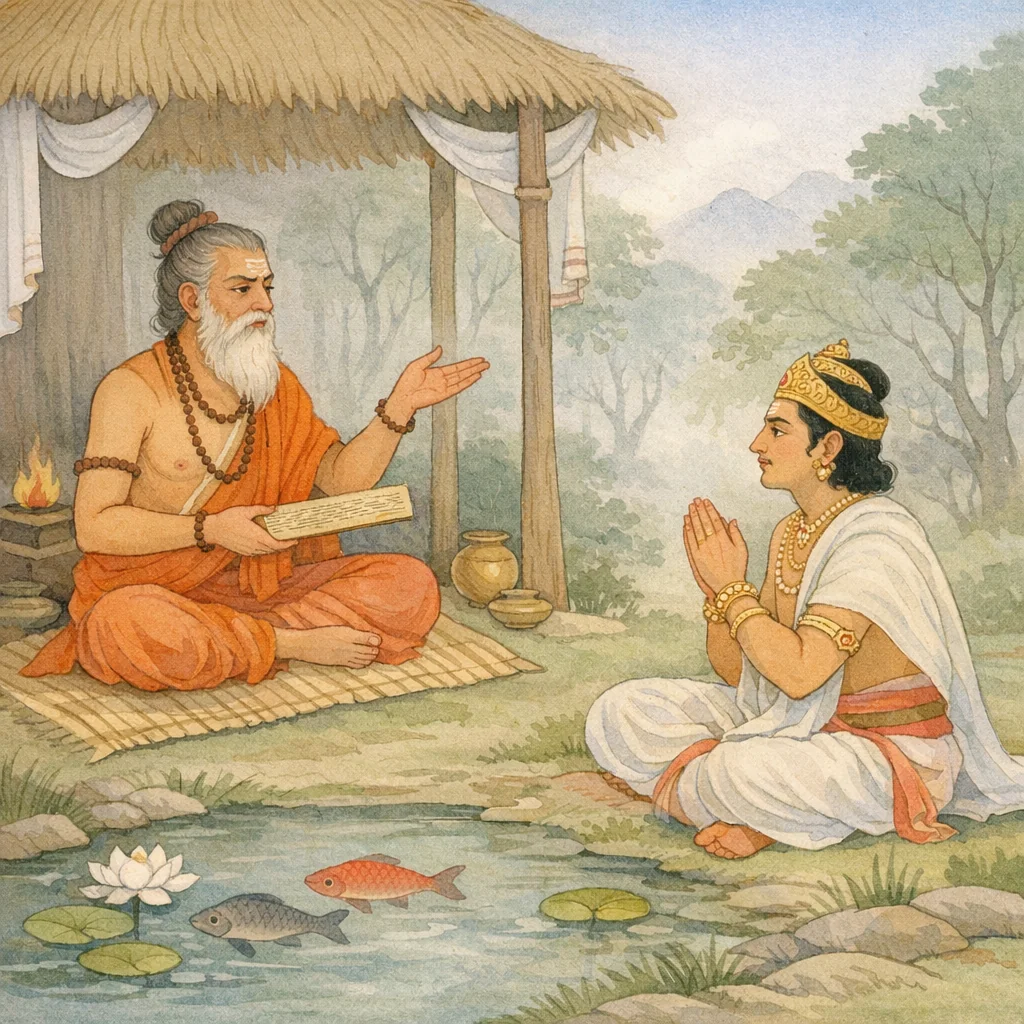
Adhyaya 315
ब्रह्मघोष-प्रवर्तनम्, अनध्याय-नियमः, वायु-मार्ग-वर्णनम् (Restoring Vedic Recitation, the Anadhyaya Rule, and the Taxonomy of Winds)
Upa-parva: Mokṣa-dharma (Instruction on Liberation) — Vyāsa–Nārada–Śuka Dialogue Context
Bhīṣma recounts how Vyāsa’s disciples, pleased with their teacher’s instruction, request permission to descend from the mountain to the human realm and to arrange the Vedas in multiple streams of practice. Vyāsa consents, warning them to remain vigilant because sacred knowledge can be misapplied through error or deceit. After the disciples depart and establish ritual and teaching activity, Vyāsa sits in solitary contemplation. Nārada arrives and remarks that the hermitage lacks brahmaghoṣa (the resonant sound of Vedic recitation), urging Vyāsa to resume study. Nārada delivers a compact aphoristic critique of ‘impurities’ (malas), then instructs Vyāsa to study the Vedas with his son Śuka to dispel darkness attributed to disruptive forces. Vyāsa agrees; he and Śuka begin recitation with correct phonetics. A powerful wind arises; Vyāsa declares an anadhyāya (suspension of study). Śuka, curious, asks about the wind’s origin and operations. Vyāsa responds with a doctrinal exposition: Śuka’s inner clarity, the two post-mortem paths (devayāna and pitṛyāna), seven vāyu-mārgas, and named winds (e.g., pravaha, āvaha, udvaha, saṃvaha, vivaha, parivaha, parāvaha) with their distinct cosmic functions. The chapter concludes by linking severe wind to Viṣṇu’s breath and reaffirming the rule that Vedic recitation is not undertaken amid excessive wind, after which Vyāsa resumes the larger trajectory of instruction.
Chapter Arc: जनक पूछते हैं—जिस जगत में गुणों का जाल सर्वत्र फैला है, वहाँ ‘निर्गुण’ पुरुष को कैसे पहचाना जाए, और प्रकृति-पुरुष का भेद किस दृष्टि से स्पष्ट होता है? → याज्ञवल्क्य गुणों की परिभाषा और उनके संयोगों (द्वन्द्व, संनिपात) से आरम्भ कर बताते हैं कि अव्यक्त प्रकृति स्वभावतः गुणमयी है और गुणों का उल्लंघन नहीं करती; अज्ञानी जीव उन्हीं गुणों का उपभोग करता हुआ उनसे बँधता है। फिर प्रश्न तीखा होता है—यदि गुण सर्वत्र हैं, तो ‘गुणवान’ और ‘निर्गुण’ का भेद किस आधार पर? → निर्णायक विवेक-क्षण में ऋषि कहते हैं—गुणों के संसर्ग से ‘गुणवान’ कहा जाता है, पर तत्त्वदर्शी की दृष्टि में पुरुष नानात्व (बहुत-से) होते हुए भी प्रकृति से असंग है; जो सहवास और निवास को यथातथ्य (जैसा है वैसा) देख लेते हैं, वे लिप्त नहीं होते—जैसे जल में रहते हुए भी मत्स्य जल-स्पर्श से सर्वथा लिप्त नहीं होता। → यथार्थ-दर्शन का फल बताया जाता है: प्रकृति-पुरुष के सहवास को ‘संग’ मानकर जो अन्यथा देखते हैं, उनका दर्शन असम्यक् है और वे बार-बार घोर निरय में गिरते हैं; पर जो केवल ज्ञान का आश्रय लेकर करुणा-युक्त होकर तत्त्व को देखते हैं, वे बन्धन से छूटने की दिशा में स्थिर होते हैं। → याज्ञवल्क्य संकेत करते हैं कि आगे ‘योगों का अनुदर्शन’ (योग-मार्गों का क्रमबद्ध निरूपण) कहा जाएगा—ज्ञान से योग की ओर अगला चरण।
Shlokas
Verse 1
ऑपन-माजल बछ। अकाल ३१-२-दो गुणोंके मेलको द्वद्ध और तीन गुणोंके मेलको संनिपात कहते हैं। पज्चदर्शाधिकत्रिशततमोध्याय: प्रकृति-पुरुषका विवेक और उसका फल याज़्वल्क्य उवाच न शक््यो निर्गुणस्तात गुणीकर्तु विशाम्पते । गुणवांश्षाप्पगुणवान् यथातत्त्वं निबोध मे,याज्ञवल्क्थजी कहते हैं--तात! प्रजापालक नरेश! निर्गुणको सगुण और सगुणको निर्मुण नहीं किया जा सकता। इस विषयमें जो यथार्थ तत्त्व है, वह मुझसे सुनो
Yājñavalkya said: “Dear one—O lord of the people—what is without qualities (nirguṇa) cannot be made qualified (saguṇa), and what is qualified cannot be made quality-less. Hear from me the truth of this matter as it really is.”
Verse 2
गुणैहिं गुणवानेव निर्गुणश्वागुणस्तथा । प्राहुरेवं महात्मानो मुनयस्तत्त्वदर्शिन:,तत्त्वदर्शी महात्मा मुनि कहते हैं, जिसका गुणोंके साथ सम्पर्क है, वह गुणवान् है तथा जो गुणोंके संसर्गसे रहित है, वह निर्गुण कहलाता है
Yājñavalkya said: “The great-souled sages, seers of reality, declare it thus: one who is in association with the guṇas is called ‘guṇavān’, possessed of guṇas; and one who is free from the contact of the guṇas is called ‘nirguṇa’, without attributes.”
Verse 3
गुणस्वभावस्त्वव्यक्तो गुणान् नैवातिवर्तते । उपयुंक्ते च तानेव स चैवाज्ञ: स्वभावत:,अव्यक्त प्रकृति स्वभावसे ही गुणवती है। वह गुणोंका कभी उल्लंघन नहीं कर सकती है। उन्हींको उपयोगमें लाती है और स्वभावसे ही ज्ञानरहित है
Yājñavalkya said: “The Unmanifest (avyakta) has a nature constituted by the guṇas; it never oversteps the guṇas. It employs only those very guṇas in its functioning, and by its own nature it is without knowledge.”
Verse 4
अव्यक्तस्तु न जानीते पुरुषो ज्ञ: स्वभावत: । न मत्त: परमो<स्तीति नित्यमेवाभिमन्यते,प्रकृतिको किसी वस्तुका ज्ञान नहीं होता। इसके विपरीत पुरुष स्वभावसे ही ज्ञानी है। वह सदा इस बातको जानता रहता है कि मुझसे कोई दूसरा उत्कृष्ट पदार्थ नहीं है
Yājñavalkya said: “The Unmanifest (Prakṛti) does not truly know; but the Puruṣa, by his very nature, is the knower. He constantly maintains the conviction, ‘There is none superior to me.’”
Verse 5
अनेन कारणेनैतदव्यक्तं स्यादचेतनम् | नित्यत्वाच्चाक्षरत्वाच्च क्षरत्वान्न तवनन््यथा,इस कारणसे प्रकृतिको अचेतन माना गया है। क्षर अर्थात् विनाशी होनेके कारण वह जडके सिवा और कुछ हो ही नहीं सकती। इधर नित्य तथा अक्षर (अविनाशी) होनेके कारण पुरुष चेतन है
Yājñavalkya said: “For this reason, that Unmanifest (Prakṛti) is understood to be insentient. Being ‘perishable’ (kṣara), it cannot be anything other than inert matter. On the other hand, because the Puruṣa is eternal and imperishable (akṣara), he is conscious.”
Verse 6
यदाज्ञानेन कुर्वीत गुणसर्ग पुन: पुन: । यदा55त्मानं न जानीते तदा5$5त्मापि न मुच्यते,परंतु वह जबतक अज्ञानवश बारंबार गुणोंका संसर्ग करता और अपने असंगस्वरूपको नहीं जानता है, तबतक उसकी मुक्ति नहीं होती है
Yājñavalkya said: “So long as a person, through ignorance, repeatedly falls into association with the guṇas and does not recognize the Self as unattached, liberation does not arise for that very self.”
Verse 7
कर्तृत्वाच्चापि सर्गाणां सर्गधर्मा तथोच्यते । कर्तृत्वाच्चापि योगानां योगधर्मा तथोच्यते,वह अपनेको सृष्टिका कर्ता माननेके कारण सर्गधर्मा कहलाता है और योगका कर्ता माननेसे योगधर्मा कहा जाता है
Yājñavalkya said: “Because he regards himself as the doer of creation, he is spoken of as ‘Sarga-dharma’ (the dharma of creation). And because he regards himself as the doer of yogic disciplines, he is likewise spoken of as ‘Yoga-dharma’ (the dharma of yoga).”
Verse 8
कर्तृत्वात् प्रकृतीनां च तथा प्रकृतिधर्मिता,नाना प्रकृतियोंको अपनेमें स्वीकार कर लेनेसे वह प्रकृति-धर्मवाला हो जाता है
Yājñavalkya said: “Because the constituents of Prakṛti (Nature) act as doers, and because one is shaped by nature’s own law, a person who takes into himself many different dispositions and tendencies becomes governed by Prakṛti’s qualities.”
Verse 9
कर्तृत्वाच्चापि बीजानां बीजधर्मा तथोच्यते । गुणानां प्रसवत्वाच्च प्रलयत्वात् तथैव च,तथा स्थावर पदार्थोंके बीजोंका कर्ता होनेसे उसे बीजधर्मा कहते हैं। साथ ही वह गुणोंकी उत्पत्ति और प्रलयका कर्ता है, इसलिये गुणधर्मा कहलाता है
Yājñavalkya said: “Because it is the agent that brings forth the seeds (the causal principles of beings), it is therefore called ‘Bīja-dharma’ (having the nature of seed). And because it is also the cause of the manifestation of the guṇas and likewise their dissolution, it is called ‘Guṇa-dharma’ (having the nature of the guṇas) as well.”
Verse 10
उपेक्षत्वादनन्यत्वादभिमानाच्च केवलम् | मन्यन्ते यतय: सिद्धा अध्यात्मज्ञा गतज्वरा: । अनित्यं नित्यमव्यक्तं व्यक्तमेतद्धि शुश्रुम,अध्यात्मशास्त्रको जाननेवाले चिन्तारहित सिद्ध यति लोग पुरुषको केवल (प्रकृतिके संगसे रहित) मानते हैं; क्योंकि वह साक्षी और अद्वितीय है, उसे सुख-दुःखका अनुभव तो अभिमानके कारण होता है। वह वास्तवमें तो नित्य और अव्यक्त है, किंतु प्रकृतिके सम्बन्धसे अनित्य और व्यक्त प्रतीत होता है
Yājñavalkya said: “Because the Self stands as a mere witness (remaining indifferent), because it is without a second, and because of the arising of ego-identification, accomplished ascetics—adepts in inner knowledge and free from feverish agitation—speak of the Person as ‘only’ (pure, untouched by Nature). In truth, we have heard in the teachings of the inner science that it is eternal and unmanifest; yet, through association with Nature it appears as impermanent and manifest.”
Verse 11
अव्यक्तेकत्वमित्याहुननात्वं पुरुषे तथा । सर्वभूतदयावन्त: केवलं ज्ञानमास्थिता,सम्पूर्ण प्राणियोंपर दया करनेवाले और केवल ज्ञानका सहारा लेनेवाले कुछ सांख्यके विद्वान् प्रकृतिको एक तथा पुरुषको अनेक मानते हैं
Yājñavalkya said: “Some learned Sāṅkhyas—compassionate toward all beings and relying solely on discriminative knowledge—declare that Prakṛti, the unmanifest source, is one, while the Puruṣas (conscious selves) are many.”
Verse 12
अन्य: स पुरुषो व्यक्त स्त्वध्रुवो ध्रुवसंज्ञक: । यथा मुज्ज इषीकाणां तथैवैतद्धि जायते
Yājñavalkya said: “That other person—the manifest individual self—is in truth impermanent, though it is spoken of as ‘permanent.’ Just as a muñja reed yields its inner pith-fibres (iṣīkā), so indeed does this distinction of self come to be.”
Verse 13
पुरुष प्रकृतिसे भिन्न और नित्य है तथा अव्यक्त (प्रकृति) पुरुषसे भिन्न एवं अनित्य है। जैसे सींकसे मूँज अलग होती है, उसी प्रकार प्रकृति भी पुरुषसे पृथक् है ।। अन्यच्च मशकं विद्यादन्यच्चोदुम्बरं तथा । न चोदुम्बरसंयोगैर्मशकस्तत्र लिप्यते,जैसे गूलर और उसके कीड़े एक साथ होनेपर भी अलग-अलग समझे जाते हैं, गूलरके संयोगसे कीड़े उससे लिप्त नहीं होते तथा जैसे मत्स्य दूसरी वस्तु है और जल दूसरी। पानीके स्पर्शसे कभी कोई मत्स्य लिप्त नहीं होता है
Yājñavalkya said: “The Puruṣa (the conscious Self) is distinct from Prakṛti and is eternal; and the Unmanifest (Prakṛti) too is distinct from the Puruṣa and is non-eternal. Just as the muñja-grass is separable from its stalk, so Prakṛti is separate from the Puruṣa. Know also that a gnat is one thing and an udumbara (cluster-fig) is another; even when they are found together, the gnat is not tainted by the fig through mere association. Likewise, a fish is one thing and water another; by the touch of water the fish is never stained. Thus, mere proximity or contact does not make the Self truly bound or defiled by material nature.”
Verse 14
अन्य एव तथा मत्स्यस्तदन्यदुदक॑ स्मृतम् । न चोदकस्य स्पर्शेन मत्स्यो लिप्यति सर्वश:,जैसे गूलर और उसके कीड़े एक साथ होनेपर भी अलग-अलग समझे जाते हैं, गूलरके संयोगसे कीड़े उससे लिप्त नहीं होते तथा जैसे मत्स्य दूसरी वस्तु है और जल दूसरी। पानीके स्पर्शसे कभी कोई मत्स्य लिप्त नहीं होता है
Yājñavalkya said: “A fish is one thing, and water is understood to be another. Even though they remain in contact, the fish is not tainted in any way by the touch of water.”
Verse 15
अन्यो हाग्निरुखाप्यन्या नित्यमेवमवेहि भो: । न चोपलिप्यते सो5ग्निरुखासंस्पर्शनेन वै,राजन! जैसे अग्नि दूसरी वस्तु है और मिट्टीकी हँड़िया दूसरी वस्तु। इन दोनोंके भेदको नित्य समझो। उस हँड़ियेके स्पर्शसे अग्नि दूषित नहीं होती है
Yājñavalkya said: “Fire is one thing, and the earthen pot is another. Know this distinction to be eternal, O king. The fire is not tainted merely by contact with the pot.”
Verse 16
पुष्करं त्वन्यदेवात्र तथान्यदुदकं स्मृतम् । न चोदकस्य स्पर्शेन लिप्यते तत्र पुष्करम्,जैसे कमल दूसरी वस्तु है और पानी दूसरी, पानीके स्पर्शसे कमल लिप्त नहीं होता है। उसी प्रकार पुरुष भी प्रकृतिसे भिन्न और असंग है
Yājñavalkya said: “Here, the lotus is one thing, and the water is understood to be another. Even when touched by water, the lotus is not stained by it. In the same way, the true person (puruṣa) is distinct from nature (prakṛti) and remains unattached.”
Verse 17
एतेषां सहवासं च निवासं चैव नित्यश: । याथातथ्येन पश्यन्ति न नित्यं प्राकृता जना:
Ordinary people do not always perceive things as they truly are. Even while living in constant association and dwelling together day after day, they fail to see the real nature of those persons and conditions in accordance with reality.
Verse 18
ये त्वन्यथैव पश्यन्ति न सम्यक् तेषु दर्शनम् ते व्यक्त निरयं घोरं प्रविशन्ति पुन: पुन:
But those who persist in seeing things otherwise—whose vision regarding these truths is not rightly aligned—repeatedly enter a dreadful, manifest hell. The verse warns that distorted understanding and willful misperception of dharma and reality lead to recurring suffering and moral downfall.
Verse 19
साधारण मनुष्य इनके सहवास और निवासको कभी ठीक-ठीक समझ नहीं पाते। जो इन दोनोंके स्वरूपको अन्यथा जानते हैं अर्थात् प्रकृति और पुरुषको एक दूसरेसे भिन्न नहीं जानते हैं उनकी दृष्टि ठीक नहीं है। वे अवश्य ही बार-बार घोर नरकमें पड़ते हैं ।। सांख्यदर्शनमेतत् ते परिसंख्यानमुत्तमम् । एवं हि परिसंख्याय सांख्या: केवलतां गता:,इस प्रकार मैंने तुम्हें यह विचारप्रधान उत्तम सांख्य-दर्शन बताया है। सांख्यशास्त्रके विद्वान् इस प्रकार जान करके कैवल्यको प्राप्त हो गये हैं
Yājñavalkya said: Ordinary people cannot correctly discern the true nature of the association and dwelling of these two—Prakṛti and Puruṣa. Those who misconceive their reality, failing to know Prakṛti and Puruṣa as distinct from one another, do not possess right vision; they inevitably fall again and again into dreadful hells. This is the Sāṅkhya teaching I have explained to you—the highest analytical reckoning. By discerning in this way, the knowers of Sāṅkhya attain kaivalya, complete liberation.
Verse 20
ये त्वन्ये तत्त्वकुशलास्तेषामेतन्निदर्शनम् । अतः पर प्रवक्ष्यामि योगानामनुदर्शनम्,दूसरे भी जो तत्त्वविचारकुशल दिद्वान् हैं, उनका भी ऐसा ही मत है। इसके बाद मैं योगियोंके शास्त्रका वर्णन करूँगा
Yājñavalkya said: “Those other sages too, who are skilled in discerning the truth, hold this very view—this is its illustration. Therefore, next I shall set forth the authoritative exposition of the yogic disciplines, as they are to be understood and practiced.”
Verse 314
इस प्रकार श्रीमहाभारत शान्तिपर्वके अन्तर्गत गोक्षधर्मपर्वमें याज़वल्क्य और जनकका संवादविषयक तीन सौ चौदहवाँ अध्याय पूरा हुआ
Thus ends the three hundred and fourteenth chapter in the Gokṣa-dharma section of the Śānti Parva of the Śrī Mahābhārata, which presents the dialogue between Yājñavalkya and King Janaka—bringing their discussion on dharma to its conclusion.
Verse 315
इति श्रीमहाभारते शान्तिपर्वणि मोक्षधर्मपर्वणि याज्ञवल्क्यजनकसंवादे पञ्चदशाधिकत्रिशततमो<ध्याय:
Thus, in the Śrī Mahābhārata, within the Śānti Parva—specifically the Mokṣa-dharma section—ends the dialogue between Yājñavalkya and King Janaka, concluding the three-hundred-and-fifteenth chapter. This colophon marks the close of a teaching episode on liberation-oriented dharma, framed as an instructive exchange between a sage and a royal seeker.
Frequently Asked Questions
Whether to continue Vedic recitation when extreme wind arises; Vyāsa applies the anadhyāya rule, prioritizing ritual correctness and safety over uninterrupted performance.
Cosmic order and inner discipline are interlinked: brahmaghoṣa sustains clarity, while vāyu/prāṇa operates in differentiated modes that structure both natural phenomena and embodied life.
No formal phalaśruti is stated; the implied benefit is preservation of dharma through correct svādhyāya and the cultivation of discriminative understanding (buddhi) regarding prāṇa, restraint, and conditions for practice.